Introduction
Research and discussion about the World Bank often quote the inscription found in the Bank’s main lobby: ‘Our dream is a world free of poverty.’ The institution has claimed its principal mission to be the war on poverty at least since the presidency of Robert McNamara (1968–81). The current president, Robert Zoellick, in his first statement after his appointment, emphasized ‘the agenda of overcoming poverty in all regions’.Footnote 1 Even Alden Clausen, who succeeded McNamara and who is unanimously acknowledged to have reversed the priorities of the Bank’s agenda by discarding poverty-biased policies, putting emphasis instead on macroeconomic adjustment, still stated that ‘a key and central aim of the World Bank is the alleviation of poverty’.Footnote 2 This focus is in noted contrast with what existing literature describes as the ‘long silence’ on the subject of poverty before McNamara. Kapur, Lewis, and Webb state that, ‘The Bank’s Articles of Agreement contain no references to poverty or to related notions … The first twenty-six annual reports of the Bank barely touch on the subject of poverty, and the Bank’s twenty-fifth anniversary history almost ignores the concept.’Footnote 3 Accordingly, descriptions of the activities of the Bank in the 1950s and the early 1960s present that period as the era of economic growth and infrastructural loans. It is only from the late 1960s and especially in the early 1970s – with McNamara’s landmark speech in Nairobi on the plague of absolute poverty – that poverty enters the Bank’s agenda as its first priority. According to these reconstructions, in the 1950s the main tenet was that ‘growth does it all’, and ‘the Bank was swimming with the intellectual current’.Footnote 4
This article has two main aims. The first one is to add depth to the discussions about the early phases in the Bank’s history by showing that, even before McNamara, the Bank produced studies that supported poverty-biased policies. I am not trying to turn the common view upside-down, but I want to give more emphasis to a number of voices in the Bank that are rarely taken into account. The contrast between a pre-McNamara Bank – entirely driven by a trickle-down approach, exclusively focused on infrastructure and power plants – and a post-McNamara Bank – focused on small agricultural projects, poverty-biased policies, redistribution with growth, and basic needs – was highlighted by McNamara and contemporary scholars to mark the change in scale and scope of the Bank’s activities. This was not unlike the Italian fifteenth-century humanists, who depicted the Middle Age as an obscurantist age to mark the renaissance of civilization, culture, and trades in their own age. Shifts in the Bank’s approach and policies are not to be denied, but they should not be caricatured.
Usually, the Bank’s lack of concern for directly pro-poor policies in the 1950s is attributed to difficulties in monitoring the links between social policies and productivity increments, or the Bank’s dependence on the financial community.Footnote 5 Yet the less conservative and more pro-poor policy proposals, which could be observed at the World Bank in the early 1950s, and their sudden demise, are worth interpreting within a broader framework. Such a framework is not directly linked to financial assistance to less developed countries, but to ideological shifts within the United States and their consequences for foreign aid policies.
This brings us to the second aim of the article, which is to propose a re-interpretation of the emergence at the Bank and the subsequent demise of pro-poor policy proposals in the early 1950s as a consequence of the political and ideological post-war landscape both in the United States and internationally. Charles Maier’s analysis of the post-war ‘politics of productivity’ and the demise of the vision of the New Deal is particularly useful, as it shows how New Deal-inspired interventionist policies on social and economic issues quickly lost traction in post-war America. The same shift marked the early years of the World Bank, when social loans appeared and quickly disappeared from the Bank’s agenda. Equally enlightening are Albert Hirschman’s comments on the marginalization of New Dealers in overseas US missions after the Second World War. According to Hirschman, missions in countries that the United States regarded as key for the development of its post-war policies did not admit former New Dealers to top positions. As a consequence, New Dealers in these environments could only have a limited influence in the decision-making process. In countries that were considered of secondary interest, by contrast, New Dealers could reach senior positions and were therefore able to be more influential in the policies of the host country. I argue that the same happened at the World Bank: loan policies with a New Deal flavour were not easily embraced by the Bank’s headquarters but were often recommended and implemented overseas by the Bank’s missions and officers in less developed countries. It is also interesting to point out how the Bank’s management went even further than the United States administration in embracing and promoting the ideology of productivity in its loan policies. While the US government – the first promoter of the politics of productivity – never forgot the consumption side of foreign aid policies, the top management of the Bank was far more orthodox in focusing on productivity alone. I will discuss this more extensively in the last part of this article.
Reassessing the record: poverty and the World Bank in the 1950s
When, in November 1947, the World Bank’s president, John McCloy, announced to the Bank’s board of executive directors that they were ‘going to be driven into a very different field sooner than [he] thought, into the development field’,Footnote 6 he was heralding a completely unexpected transformation, and probably the most radical one in the history of the Bank. The World Bank had been born only three years before, in 1944, at the Bretton Woods conference, with the mission of helping the war-torn European countries to reconstruct their productive capacities. The official name of the Bank was the International Bank for Reconstruction and Development, but people who participated in the preparatory negotiations at the Bretton Woods conference report that the focus was entirely on reconstruction. Of the two architects of the Bretton Woods institutions, the Briton John Maynard Keynes and the American Harry Dexter White, the former was probably the more insistent that the principal mission of the Bank would be the reconstruction of Europe and that assistance to the development of less developed areas should be postponed. In contrast, according to Robert Oliver, ‘White apparently believed that the Bank he originally conceived might finance reconstruction as well as development.’Footnote 7 In fact, the first Bank loans went in 1947 to France, Denmark, Luxembourg, and the Netherlands for reconstruction purposes. However, it soon became clear that the Bank did not have sufficient financial resources to support the reconstruction of Europe. The direct, bilateral intervention of the United States in that reconstruction through the Marshall Plan forced the Bank to reinvent itself in order to survive. The development mission, until then neglected by the Bank, abruptly became its raison d’être.
The new clients of the World Bank – the less developed countries, as they were called in those days – were still in large part colonial territories, or were gaining political independence just at that time. No systematic study of their economies had been pursued, except from a colonialist perspective.Footnote 8 This was so even for several Latin American countries, which had gained independence more than a century earlier, and some of which, such as Argentina, had had flourishing economies. However, by the mid twentieth century, they belonged de facto to the less developed world, and data were sketchy or non-existent. No national accounts systems existed.Footnote 9 The Bank thus organized a series of general survey missions to less developed member countries, to collect data and identify priorities for development programmes.
Between 1949 and 1953, the World Bank organized eleven such missions, namely to Colombia, Cuba, Guatemala, Turkey, Iraq, Jamaica, Surinam, British Guyana, Ceylon (Sri Lanka), Mexico, and Nicaragua.Footnote 10 The missions were officially independent from the Bank, being organized jointly by the Bank and the hosting country upon invitation from the country itself. This gave the missions more freedom in their enquiries, and helped to maintain smooth relations between the Bank and the hosting country. The missions were technically not the ‘official voice’ of the World Bank, as several heads of mission were recruited outside the World Bank. The Bank also hired consultants in specific fields, such as health or public finances. However, this stress on the independence of the missions should be tempered by the awareness that the missions were de facto the Bank’s strategic and operative envoys in the field. It should also be kept in mind that experts sent ‘on mission’ were paid by the Bank. The missions had the mandate not only to collect data and provide a general survey of the economic and social conditions of the countries but also – and most importantly – to design a strategy for development, which would be the cornerstone of the subsequent World Bank loan policies in the hosting country. As the Bank’s fourth annual report stated, the aim of those missions was ‘to provide the basis for a long-term investment program and to indicate what changes, if any, in existing administrative and financial mechanisms and economic and financial policies are necessary to carry it out’.Footnote 11 The identification of the missions with the World Bank was so complete, in public opinion in the hosting countries, that the former head of the World Bank mission to Colombia, who had been chosen from outside the ranks of the Bank and was never a full-time staff member, was described by a Bogotá newspaper as the ‘ex vice presidente del Banco Internacional de Recostrucción y Fomento’.Footnote 12 Of course, describing those missions in general terms presents a certain degree of imprecision, since each of these missions was unique. Nonetheless, it is possible to draw some significant general observations.
All the missions’ reports, as one might expect, focused on examining the economy of the countries visited. What is notable is that the analysis of a country’s economy was integrated into a study of the broader institutional setting and general conditions, rather than keeping a strict focus on the economic conditions of the country. Most of the reports address the organization and efficiency of public administration, the fiscal system, and the banking system. The Turkey mission, for example, focused on public administration ‘in view of the extensive role which the State must necessarily play in carrying out the development program proposed in this Report’.Footnote 13 The mission concluded that insufficient delegation of authority, lack of accountability, waste, and overstaffing seriously compromised the efficiency of the administration, and recommended a series of steps to overcome those shortcomings.Footnote 14 Similarly, the mission to Iraq underscored the need to improve the efficiency of public administration, to augment the ability of the country to absorb foreign capital.Footnote 15 As the Bank’s head of the Loan Department argued in an interview in 1961, several considerations were taken into account when assessing a country’s ability to receive and administer a loan from the Bank: ‘For example … can they administer? Can they absorb foreign aid? Have they got the administrative, the managerial, the technical setup to do the best with whatever money you’re putting in?’Footnote 16
The Colombian mission carried out an extensive analysis of the fiscal and banking systems of that country. It concluded that, even if income tax rates were low compared to North American or European standards, the distribution of the tax burden was nonetheless quite progressive. Importantly, national investments did not seem to have been negatively affected by the fiscal system. Yet, while the tax structure was quite well designed, the tax administration was inadequate, in particular because of a lack of competent staff and trained personnel.Footnote 17 The report therefore suggested some amendments to the tax law that would simplify it and make it more coherent, but most of all it focused on administrative failings and saw the solution to these failings as of ‘vital importance’.Footnote 18 The Mission to Nigeria insisted that the country should establish a national central bank – which at that time did not exist, owing to Nigeria’s status as British colony – to foster the economic development of the country: ‘to postpone the day when functions of currency issue and the management of foreign assets are performed in Nigeria will also postpone the day when trained Nigerians will be able to perform these functions responsibly by themselves’.Footnote 19
The lack of adequate health care and education in the countries visited was among the major shortcomings emphasized by the missions. The Nicaragua mission put poor standards of health and education at the top of the list of the principal causes of backwardness in the country, and proposed short-run basic educational and health programmes to increase productivity in all sectors.Footnote 20 The Nigeria mission, upholding the need to adapt the British educational system more appropriately to Nigeria’s conditions stated: ‘Broadly-based education is an essential in providing the manpower for economic development.’Footnote 21 Likewise, the mission called for higher nutrition, public health, and water supply standards, recommending central government loans to local administrations.Footnote 22 Meanwhile, the Nicaragua mission stated that better education and health were both instrumental in increasing the productivity of the labour force in the country, besides being of value in and of themselves:
Expenditures to improve sanitation, education and public health should, without question, be given first priority in any program designed to increase the long-range growth and development of the Nicaraguan economy.
Without exception, the mission found that in every sector of the economy high disease rates, low standards of nutrition, and low educational and training standards are the major factors inhibiting the growth of productivity. Farm mechanization, improved transportation, and modern industrial machinery will increase total production, but there is a limit to such increase without a basic improvement in the health, the living conditions and the productivity of the country’s limited manpower.
Improvement in these sectors, moreover, involves more than raising gross physical production as measured by national income statistics. It means raising the standard of living directly through better health, greater life expectancy and general physical wellbeing. The program of sanitation, public health and education tackles jointly the problems of increasing the physical productivity of the country and that of improving the living standards of the people. This program is an integral part of the agricultural, industrial and transport investment program.Footnote 23
For different reasons, the housing sector contributed both to the economic growth of a country and to the improvement of the standard of living of the population. Moreover, it was labour intensive and relied principally on domestic capital; thus it was deemed beneficial for the economy of less developed countries. Even in the absence of substantial resources, the Syrian mission recommended that the government implement a programme of low-cost houses in rural settlements and urban centres, and urban slum rehabilitations.Footnote 24
Regarding the increased output of the countries’ economies, the reports recommend different strategies. First, output could be increased by augmenting the available capital, either through net capital formation or through a more complete utilization of existing but inactive capital. Second, output could be augmented by increasing the productivity of the factors of production. Specifically, some reports examined labour productivity and maintained that it could be increased either by transferring labour from less productive to more productive activities, or by improving health, education, and training, or through technological and organizational changes that would reduce labour input per unit of output. As Joseph Spengler noted, these reports also discussed increases in productivity as the result of transfer of labour from less to more productive activities, or of technological and organizational changes. However, much more attention was given to increases in capital and in the productivity of labour through an increase in the health and education of the labour force.Footnote 25 Predictably, all reports highlighted the importance of the agricultural sector and recommended an increase in its productivity. They focused on irrigation issues and the introduction of fertilizers, animal husbandry, more clearly defined property rights, the cadastre (if any), the feasibility of machinery imports, and the role of credit, cooperatives, and local markets. With regard to both agriculture and industry, the reports privileged labour-intensive sectors or projects aimed at large export markets. According to the reports, these sectors or projects required relatively little foreign currency; did not unduly burden the balance of payments; relied on local resources; presented or promised complementarity with other domestic sectors or projects; were appropriately sized for the domestic market; did not require excessive or long-term protection from foreign competitors; improved the domestic distribution of economic activities and population; and, finally, contributed to the improvement of the living standards of the population.Footnote 26
Many reports combined these recommendations, resulting in proposals for integrated and multifaceted plans of intervention, where economic and non-economic issues contributed to a production boost and an improvement of living standards. The Nicaragua report offers an example of this interrelatedness, with a special emphasis on health and education. The Syria report gives a further example of the integrated vision shared by those early general missions:
We have not conceived of a development program simply as a series of public investment projects properly related to each other so that they form a consistent whole. Public investment in irrigation, roads, education, public health and other fields undoubtedly plays an important role in stimulating production and improving conditions of life. There is, however, a wide variety of public expenditures which do not take the form of investment but nevertheless significantly influence the level of economic activity. These range from continuing expenditures on the preservation of public order to current outlays on education and public health and on government services for agriculture. Indeed, few activities of the government are entirely unrelated to development.Footnote 27
The main areas of intervention were infrastructure (mainly irrigation and transportation, sometimes power), and housing, health, and education. The industrial sector was usually the subject of a more cursory treatment. In sum, the reports proposed investments in so-called social overhead capital: that is, capital subject to indivisibilities. Social overhead capital was essential for the economy and for the full private-sector development of a country; yet it did not attract private investments. In the words of Paul Rosenstein-Rodan, investment in social overhead capital is ‘indirectly productive with long gestation periods and delayed yields. Its most important “products” are investment opportunities created in other industries.’Footnote 28 According to Albert Hirschman, social overhead capital ‘is usually defined as comprising those basic services without which primary, secondary, and tertiary productive activities cannot function. In its wider sense, it includes all public services from law and order through education and public health to transportation, communications, power and water supply, as well as such agricultural overhead capital as irrigation and drainage systems.’Footnote 29
The emphasis on overhead capital and the interrelatedness of the many facets of development made it almost natural for the missions to propose the implementation of integrated plans for development. Those programmes were considered by the missions themselves as ‘undeniably ambitious’,Footnote 30 long-term, and addressing several different issues, not just strictly economic ones. To implement the plans, several missions proposed the establishment of a national committee to coordinate the governmental and administrative efforts towards development, turn the report’s recommendations into action, and support the government in their negotiations with international organizations and the World Bank to obtain loans.
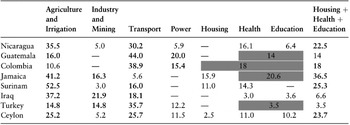
To summarize, the reports prepared by the first World Bank general survey missions were uniformly consistent in their recommendations. They stressed the importance of social overhead capital, in view of both infrastructural indivisibilities and investments in education, health, and nutrition. They considered industrialization important, but gave equal emphasis to the agricultural sector. They also emphasized the importance of international trade, and were basically in favour of trade openness. A very interesting table by Spengler, based on the missions’ reports, summarizes the missions’ proposals for public investments by sector (Table 1). The predominance of investments in social overhead capital and investments in social capital directly affecting the living standards of population were clearly key. As the Nicaragua report stated, ‘The bulk of the investment will be in transportation and agriculture but, because of their urgency, the education and public health sectors have also been assigned a substantial share of the investment expenditures.’Footnote 31
Distribution of public investment by sector in percentage terms, as proposed by the World Bank’s general survey missions of the early 1950s. The totals do not add up to 100 because sectors presenting minor figures have not been included. The three major sectors for each country are given in bold. Merged cells in grey indicate aggregate data.

Source: Elaboration from Spengler, ‘IBRD mission’, p. 591.
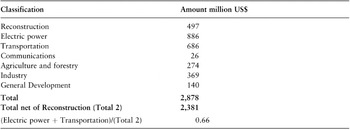
The record of the World Bank’s investments by sector, however, is quite different from the recommendations of the Bank’s general survey missions. In reality, the Bank was extremely selective. Infrastructure – particularly transportation, irrigation, and power – took the lion’s share. Other aspects of social overhead capital such as education and health, in contrast, were completely neglected. Another table illustrates this point well: Table 2 was prepared by the World Bank in 1956, and shows the total loans disbursed by the Bank as of December 1956. Excluding reconstruction loans, two-thirds (66%) of the US$2,381 million disbursed by the Bank to all client countries (both developed and less developed countries) were allocated to electric power and transportation projects. If we narrow the sample to cover just the less developed countries, the share of power and transportation projects rises to 83% for the period 1948–61.Footnote 32
Classification of World Bank loans by purpose as of December 13, 1956. (Note: the reconstruction loans were made in 1947 to France, Denmark, Luxembourg and the Netherlands.)

Source: Robert E. Asher, Walter M. Kotschnig, William Adams Brown, Jr, James Frederick Green, Emil J. Sady, and Associates, The United Nations and promotion of general welfare, Washington, DC: The Brookings Institution, p. 347, reporting data from IBRD, ‘Facts about World Bank lending’, 13 December 1956.
Moreover, the Bank did not adopt any comprehensive programme approach, and increasingly focused on financing specific projects. It is true that the Bank never fully abandoned the rhetoric of planning, but on the operational side it focused on specific projects that were to be closely monitored until completion. The reasons for the Bank’s preference for projects will be discussed below.
The question is why the World Bank’s top management chose to focus only on infrastructure and directly productive investments, completely disregarding the reports that were initially conceived as providing the basis for the Bank’s long-term investment programmes. To answer this question, it is necessary to observe the transformation of the World Bank from its birth through the 1950s, framing it in a broader cultural and ideological change. This principally involved the United States, and, in various degrees, the countries allied to the US after the Second World War.
The World Bank and the politics of productivity in developing countries
The focus of the Bank on infrastructural loans, specifically on projects in power generation and transportation (railways and highways) has usually been explained in the light of the financial constraints imposed on the Bank by Wall Street. Especially in the first years, the only capital that the World Bank could actually count on for loans were the dollars paid in by the United States. By mid 1947, that amounted to US$727 million.Footnote 33 In an international scenario characterized by currency inconvertibility and a structural dollar deficit in the balance of payments of several countries, capital furnished in currencies other than the dollar was useless in reality. Considering that, by August 1947, the Bank had disbursed loans to the tune of US$497 million – the largest one to France in 1947 amounting to US$250 million – the institution soon found itself short of dollars.Footnote 34 The Bank’s decision to raise funds on the US financial market is considered an important reason for its lending conservativeness. John McCloy, the Bank’s president between 1947 and 1949, Eugene Black, the US executive director under John McCloy and then the Bank’s president succeeding McCloy, and Robert Garner, the Bank’s vice-president until 1956, had to work hard to persuade the US financial markets that it was worth investing in the Bank’s bonds. As a matter of fact, as Garner recollected in 1961, initially ‘there wasn’t a Wall Street man who would touch the bonds with a ten-foot pole’.Footnote 35 Yet the Bank needed the trust of the financial community. McCloy put it very clearly in a 1948 interview: ‘The Bank … relies primarily on the private investment community and not upon its member governments for the major part of its loanable resources.’Footnote 36 In this respect, the provenance of the Bank’s top management from Wall Street made things easier.Footnote 37 The Bank’s insistence on the financing of single and well-defined projects rather than comprehensive programmes was also a way to reassure financial circles that the final destination of the Bank’s loans was scrupulously monitored and that its resources were not wasted. According to Garner, ‘The financial community would have been very reluctant to support the Bank unless it had a basis for feeling it was going to operate on sound lines.’Footnote 38
However, ideology played an equally important role. Interesting elements emerge when one takes into consideration the shift between the ideology of the New Deal and the wartime and post-war ideology that subverted New Deal welfarism in the US. The ideological shift that took place within the United States had international repercussions and directly affected international organizations. This framework helps to explain both the presence and the neglect of pro-poor policies within the Bank in the first half of the 1950s.
In a seminal article on the foundations of US international economic policy after the Second World War, Charles S. Maier demonstrated how ‘the construction of the post-World War II Western economy under United States auspices can be related to the political and economic forces generated within American society’.Footnote 39 Maier proposed the ‘politics of productivity’ as an ideological compromise between two opposing traditions of government in the United States. Specifically, he argued that the objective of raising productivity and its main consequence – that is, the standard of living for all social classes – was the way in which America avoided a redde rationem between opposing factions, namely, the conservative business elite and the New Deal generation of civil servants. As Maier put it, ‘the productivist view of America’s postwar mission arose naturally out of the domestic modes of resolving social conflict, or, rather, the difficulty of resolving conflicts cleanly’.Footnote 40 On one side, the New Deal had encountered increasing difficulties in its thrust to reform. In fact, as early as the late 1930s ‘the New Deal thrust to displace economic power from private capital to either corporatist National Recovery Administration (NRA) institutions or to countervailing private forces (i.e., labor unions) was rapidly dissipating’.Footnote 41 In particular, the spending wing of the New Deal was losing ground and room for manoeuvre. On the other side, the business elite, discredited by the 1929 market crash and the ensuing depression, re-entered the corridors of power when it became necessary to unite forces to administer the war effort. The stalemate of New Deal reforms, as Maier said, ‘precluded any consistent social-democratic trend for the American political economy. Coupled with the impressive record of the domestic industrial plant as the “arsenal for democracy”, it made it easier for American leaders to fall back upon the supposedly apolitical politics of productivity.’Footnote 42 In other words, the politics of productivity sanctioned the defeat of the welfarist wing of the New Dealers. For example, the full-employment bill, originally envisaged by the New Deal left as a measure to support government spending for job creation, was eventually emptied of its political content and hugely weakened in its goal to extend federal government power.Footnote 43
The politics of productivity also informed the policies of the World Bank. According to the Bank’s ‘Articles of agreement’, one of its principal purposes was to ‘assist in the reconstruction and development of territories of members by facilitating the investment of capital for productive purposes’, and to ‘supplement private investment by providing … finance for productive purposes’.Footnote 44 Loans should, ‘except in special circumstances, be for the purpose of specific projects’.Footnote 45 In addition, the Bank would give due attention to considerations of economy and efficiency, ‘without regard to political or other non-economic influences or considerations’.Footnote 46 Notwithstanding the apparent clarity of these articles, however, there was much uncertainty about how the Bank should interpret its role once it opened for operations. As Roy Harrod summarized, commenting on the Bretton Woods conference: ‘The biggest question at issue was never fully discussed, namely, whether the Bank should be a sound conservative institution on normal lines, or depart from orthodox caution in the direction of greater venturesomeness.’Footnote 47 In fact, what constituted ‘special circumstances’, which would allow loans other than for specific projects, left much room for interpretation, as did the definition of ‘investment of capital for productive purposes’. What was even more difficult to identify was how economic considerations could be separated from political or other non-economic influences. This was due not only to the impact of the Cold War, the war on communism, and other geostrategic interests of major member countries – particularly the United States and the United Kingdom – on the activities of the Bank, but also to political and social factors that would naturally affect the Bank’s investments in a country. As Robert Garner put it, ‘One has to make certain general assumptions as to whether the country is going to have a reasonable degree of political stability, or whether it’s going to be in constant political turmoil.’Footnote 48
Other research, in contrast to Maier’s perspective on the politics of productivity, has emphasized the central role of consumption in post-war American society and ideology. Scholars of the ‘politics of consumption’ have argued that the expansion of US power internationally rested on the consumer revolution that took place in America during the twentieth century. Warren I. Cohen has noted that, from as early as the 1920s, many Japanese were increasingly eager to absorb culture, habits, and consumption models from the United States. After the Second World War this trend expanded enormously in many parts of East Asia: ‘American mass culture’, Cohen wrote, ‘became the rage everywhere. Wherever choice was possible, blue jeans were worn by the young. Coca-Cola was drunk everywhere (except among the Thai and Hmong, who share my preference for Pepsi.)’Footnote 49 Victoria de Grazia described the American influence worldwide and especially in Europe as a ‘Market Empire’, ‘a great imperium with the outlook of a great emporium’, which reached its apogee after the Second World War and whose impetus derived from the American revolution in mass consumption.Footnote 50 However, she adds that, even in relatively developed Europe, high levels of consumption were postponed in order to increase productivity first. Whereas industrial output in western Europe was 50% higher than in 1938, household consumption had only risen by 3%.Footnote 51 On this topic, Walt W. Rostow noted that, while the United States had experienced high mass consumption in the 1920s and then again in the post-war decade of 1946–56, Europe in the early 1950s was still one step behind.Footnote 52
As for the rest of the world, the main question was not mass consumption but industrialization or, in other words, capital accumulation and productivity increase. The economist and Nobel laureate W. Arthur Lewis summarized this view by stating that
the central problem in the theory of economic development is to understand the process by which a community which was previously saving and investing 4 or 5 percent of its national income or less, converts itself into an economy where voluntary saving is running at about 12 to 15 percent of national income or more. … We cannot explain any ‘industrial’ revolution … until we can explain why saving increased relative to national income.Footnote 53
When domestic savings were not sufficient to attain a satisfactory rate of growth, international aid would have helped to fill the gap. When the economic development of less developed countries was discussed, consumption was not thought of as a driving force. In the few cases when consumption was taken into consideration, it was in negative terms. Mass consumption of consumer goods, and even basic services such as potable water, were thought to have a negative effect on saving rates and capital accumulation, thus harming the industrializing effort. While the Bank’s early general missions had a broad conception of what constituted loans for productive purposes, and explicitly stated that wellbeing and productivity were inextricably linked and self-reinforcing, the Bank’s top management focused instead on a narrower approach to productivity. They pointed out that there was a trade-off between economic growth, on the one hand, and welfare development, on the other. As a senior official argued in 1960, ‘water is the first thing people want, but we have to distinguish between … amenities which raise the standard of living, and … projects which will benefit the economy …. Our emphasis should be on the latter’.Footnote 54
Therefore, when in 1953 the Colombian government requested a Bank loan for the rehabilitation of a very poor area in Barranquilla, a northern coastal city, as the general survey mission had recommended, Robert Garner replied that
The Bank should concentrate its efforts on projects which will yield the greatest and quickest increase in output and productivity. As a rule, projects for municipal improvement do not meet this test. However, by lending for projects which do, we believe we can most effectively assist our member countries to develop new sources of wealth and income which would enable them to provide out of their own resources better municipal services, better housing, better health and education – in fact, all of the fruits of greater economic productivity.
In the case of the Barranquilla project, I am convinced that, although the social benefits might be considerable, the economic results would not be nearly as great as those which could be obtained from … directly productive projects.Footnote 55
In another case, the International Labour Organization proposed to the Bank to join forces in order to establish an international agency to finance construction projects in less developed countries. This activity would have simultaneously created employment and raised the average quality of houses, and thus average living standards, but the Bank refused to participate. The opinion of the Bank’s economists, who held that ‘there are areas where the housing shortage seriously hampers the development of new resources and industries, so that financing of new houses would in those areas be directly productive even within a narrow understanding of that term’,Footnote 56 was not sufficient to broaden the top management’s approach to productivity to include the direct improvement of living standards.
The issue was not that the Bank’s general survey missions did not share the emphasis of the top executive management on productivity and the size of production; in fact, they considered the rise in productivity to be a fundamental cornerstone for the development of less developed countries. But from the missions’ reports it emerges that concerns about productivity were merged with questions as to how to intervene immediately and directly to lighten the burden of extreme poverty. The Colombian report, for example, stated that, to make the basic elements of decent living standards generally available, emphasis on the national product per capita was of fundamental importance. This overshadowed the stress on redistribution, or on whether production should focus on consumer or capital goods.Footnote 57 At the same time, it stressed that ‘only by a generalized attack throughout the whole economy on education, health, housing, food and productivity can the vicious circle of poverty, ignorance, ill health and low productivity be decisively broken’.Footnote 58
The shift from New Deal ideas to the post-war politics of productivity was linked, as we will see, with the path followed by Keynesian ideas, broadly defined, after the Second World War. It was also related to the new international hegemonic role assumed by the United States in post-war reconstruction and development efforts.
How the Keynesian revolution was exported to developing countries
New Deal liberals were usually advocates of state interventionism, welfare reforms, and deficit spending. Those policies were often identified as Keynesian, or proto-Keynesian, even though several studies have demonstrated that New Deal policies cannot be traced back to Keynes, and several among those New Deal economists rejected a comparison of their own policy recommendations with those of Keynes.Footnote 59 Lauchlin Currie was a former Harvard instructor, then the principal assistant to the Federal Reserve Board governor, Marriner Eccles, and subsequently personal economic advisor to Franklin D. Roosevelt, and he was described by Herbert Stein as ‘the intellectual leader’ of the group of ‘spenders’ in Washington. Currie was critical of Keynes’s General theory, and if some of his writings show a Keynesian influence, that came essentially from the Treatise on money. Stein argued that those New Dealers’ ideas ‘were of pre-Keynesian origin and did not respond quickly, if ever, to what was new in the General Theory’.Footnote 60 However, several other commentators and New Dealers have spoken of the members of the New Deal interventionist wing as the US Keynesians. John K. Galbraith, in his famous article on how Keynes came to America, underscored the role of Harvard University in the transfer of Keynesian ideas from Cambridge, UK, to Cambridge, MA, and eventually to Washington, DC, and added:
Marriner Eccles, … head of the Federal Reserve Board, and Lauchlin Currie … had on their own account reached conclusions similar to those of Keynes as to the proper course of fiscal policy. When the General Theory arrived, they took it as a confirmation of the course they had previously been urging.
…
There was a strong feeling in Washington that key economic posts should be held by people who understood the Keynesian system and who would work to establish it. Currie at the White House ran an informal casting office in this regard.Footnote 61
The point here is that, no matter what position we might take in the controversy on the direct links of New Deal policies to Keynes’s theories, those policies acquired, for a number of reasons, a distinct Keynesian flavour, or were perceived as such, at least beginning from Roosevelt’s second term.Footnote 62 Lauchlin Currie, despite his critical view of the General theory, still referred to the New Deal years as a quintessential Keynesian era: ‘we didn’t sleep much, but when we did, the General Theory kept working’.Footnote 63 From this standpoint, Keynesianism can be interpreted, as Walter Salant suggested, as ‘the rejection of the paradigm according to which private market forces can be relied on to maintain or restore high output and employment automatically if the government does not interfere with them’.Footnote 64
Albert Hirschman vividly sketched the enthusiasm that animated the US Keynesian New Dealers when they travelled abroad, first with the US military administrations in Japan and Germany, and then as officers in the administration of the Marshall Plan. According to Hirschman, the fact that they played an advisory, rather than managerial, role explains the seeming paradox that they were more influential in countries where the US presence was less pervasive. As a matter of fact, in Germany the top managerial positions were given to military officers and civilians – businessmen, bankers, lawyers – who had nothing to do with the New Deal or with Keynesianism. In Japan, New Dealers were very influential in the first couple of years after the end of the war, but were soon marginalized when the Cold War intensified. The Keynesians advisors could thus only exert a minor influence. On the contrary, in countries where the United States exerted a less stringent control, the US Keynesians happened to be much closer to the local government, and could influence it more directly.Footnote 65
A similar pattern can also be observed in the internal dynamics at the World Bank. Here one can see a tide of Keynesian proposals, characterized by New Deal interventionism and planning, that came principally from the Bank’s missions in the field and from the economists who worked with those missions. An early commentator described the missions’ reports as a mix of old reminiscences and more modern ideas. Among the former, he listed the cohabitation of neo-mercantilist ideas, old classical doctrines of market freedom and private enterprise competition, and marginalist analysis. However, it was the influence of modern economic theories that dominated the reports, especially
(1) the Keynesian distinction between mature and immature economies, between full and less-than-full employment … and between macroeconomic propensity to consume and to invest; (2) the emphasis on the new welfare economics …; (3) the theory of long-term economic growth …; (4) a certain understanding for those propositions of the socialist ‘competitive solution’ which recommend a fairly comprehensive scope of governmental planning.Footnote 66
However, the Bank’s top management marginalized these ideas. The institution was led by businessmen, bankers, and lawyers. They belonged to Wall Street and would not accept the New Deal and Keynesian policies, not to mention governmental planning, which to their eyes was like embracing socialism. John McCloy, the second Bank president, was a Wall Street lawyer with close ties to the US business establishment. He was also well connected with the US administration, including individuals such as Dean Acheson, Averell Harriman, and George Kennan. It is not by chance that, upon leaving the Bank in 1949, McCloy became the US high commissioner for occupied Germany, one of those positions that certainly did not go to people who sympathized with the New Deal. Perhaps the most outspoken Bank senior manager against the New Deal heterodoxy was its vice-president, Robert Garner. Garner, too, came from a large corporation – he had been vice-president of General Food – and had held Roosevelt, the New Deal, and fiscal activism in very low esteem: ‘[Roosevelt] instituted the New Deal. He took us off the gold standard. He began to run terrific deficits[;] his vicious attacks on bankers and businessmen assured the long continuation of the depression. … Roosevelt was a man completely without principle, had a shallow mind and, I think, did more harm to this country than anyone else in history.’Footnote 67 Inexplicably, he hired Lauchlin Currie, the former special advisor to Franklin D. Roosevelt for economic affairs and one of the most renowned ‘spenders’ in the US administration, to head the first general survey mission of the Bank to a developing member country: Colombia. It is worth remembering that the World Bank’s general survey missions were supposed to set the ground for the Bank’s long-term development strategies, and the Colombia mission – the first Bank general mission – was all the more a pilot for the Bank’s subsequent policies.
The parable of Currie is symptomatic of the course followed by New Dealers and Keynesians after the Second World War: they advised the US foreign administration; they favoured planning and considered both the productive and the welfare side of economic recovery; and they had much more freedom in those countries where the United States exercised less control, whether military or business-related. Currie had been a prominent New Dealer and Keynesian sui generis. Alan Sweezy considered him a forerunner of Keynesian policies in the United States before the publication of the General theory, and William Barber pointed out Currie’s emphasis on ‘the humanitarian and social aims of the New Deal’ on the one hand, and ‘sound economics’ on the other.Footnote 68 When Currie agreed to lead the Bank’s mission to Colombia, he set it up in accordance with the same multifaceted approach. He recruited experts on highways and waterways; railways; industry, fuels, and power; transportation; community facilities; agriculture; finance; foreign exchange; health; and welfare. The mission’s expert for finance, money, and banking was Richard Musgrave, a Harvard graduate who would apply Keynesian analysis to public finance and was recommended to Currie by Alvin Hansen, one of the most fervent apostles of Keynes in the US.Footnote 69
The relations between Currie and the Bank were initially excellent. The mission left for Colombia in early July 1949. When it returned to Washington, DC, in late October of the same year, it had succeeded in collecting data previously unavailable, including series of national income, capital formation, international payments, and money supply. It had also collected basic data on health, housing, sanitation and municipal services, transportation, and the living standard of the population. The report was eventually published and presented to the Colombian government in the summer of 1950. But when the time came for implementation, the relations between the Bank and Currie turned cold. In September 1950, the Colombian government established a Committee for Economic Development, and appointed Currie as its principal advisor. Just one month earlier, on publication of the report, Currie had stated:
It appears essential that the attack on the problem be incorporated in a comprehensive, overall program that provides for simultaneous action on many fronts. Economic, political and social phenomena are so inter-related and interwoven that it is difficult to effect any significant and lasting improvement in one sector of the economy while leaving the other sector unaffected … Poverty, ill health, ignorance, lack of ambition, low productivity are not only concomitants – they actually reinforce and perpetuate one another.Footnote 70
Following this approach, he aimed at implementing the report’s development plan. Furthermore, he organized a new mission with the aim of studying how to improve the efficiency of the public administration. Later, he would recommend plans for the rehabilitation of degraded slums and for the improvement of potable water utilities in some major Colombian cities. The World Bank felt increasingly at variance with Currie’s approach. Notwithstanding the Bank’s initial endorsement of the report, the institution publicly contradicted its approach by granting Colombia, in early 1951, a US$16.5 million loan for infrastructure works only, with no reference to other plans. Furthermore, as reported above, no loans were granted for public facilities, or for the sectors of health, housing, and sanitation. In 1952, when the Committee was replaced by a new body called the National Planning Council, and the Bank was invited to appoint its lead advisor, Currie was excluded.
Meanwhile, Currie was increasingly appreciated by the Colombian government. Following his work as the main economic advisor to the Committee for Economic Development, the government – not the World Bank – appointed him as advisor to the National Planning Council. This created severe tensions in the Council, but Currie was always firmly supported and listened to by the Colombian government. A Colombian weekly magazine opened an article on Currie with the following words: ‘En el quinto piso del Banco de la República, tiene su despacho un hombre de modales suaves, de conversación apacible aunque vigorosa, de canas prematuras que busca persistentemente aunque en forma discreta y pacífica, traer a Colombia el New Deal.’Footnote 71 Over the years, Currie became increasingly influential in Colombia. One Colombian president, Virgilio Barco, reportedly told a World Bank officer: ‘in Colombia there [are] only two kinds of economics, B.C. and A.C., that is, before and after Currie’.Footnote 72
The World Bank's partial divergence from the US foreign aid policies
Somewhat ironically, the World Bank proved too efficient in sidelining pro-poor policies in favour of capital infrastructures. Thus, the Bank soon found itself on more conservative ground than the US administration. The latter started to lend on a large scale for agricultural development, and to improve the living standards of the rural poor, as a way to contain communism in the ‘peripheries’. ‘In country after country’, Kapur, Lewis, and Webb wrote, ‘the [US] policy was to prevent “another China”.’Footnote 73 The politics of productivity, promoted by the US administration in Europe and rigidly embraced by the World Bank’s top management for the Bank’s loan policies worldwide, was broadly interpreted by the US administration to include poverty-biased policies. This would help tackle the rising threat of communism in several underdeveloped regions of the world. With reference to Southeast Asian countries, the US administration stated:
These countries have in general very low standards of living and will need substantial foreign capital over an extended period of time if their peoples are to have any real prospect of escaping their present poverty. A substantial portion of this assistance can be placed on a loan basis through the International Bank [i.e. the World Bank] and the Export–Import Bank. If, however, we are to meet the threat of communism in this area we will need to push development more rapidly than could reasonably be expected to be financed by loans.Footnote 74
Between 34% and 48% of US aid to South Asia in the years 1951–57 was spent on agriculture, health, and education.Footnote 75 The position of the US administration was summarized in a Congressional study: foreign aid would ‘Help raise living standards in the less developed areas and thus make Communist claims less attractive’ and, as a consequence, ‘help lay the foundation for a world of prosperity, political freedom, and international cooperation’.Footnote 76 The Congressional publication questioned the ‘easy and simple assumptions about a straight line between poverty and communism and between economic development and democracy’.Footnote 77 However, it recognized that ‘many scholars have argued that there is little hope for democracy unless industrialization is accompanied by education, modern public administration, and socioeconomic changes to help assure that a large percentage of the people benefit from the growing wealth of the nation’.Footnote 78 In this respect, the position of the US echoed the emphasis that, from as early as 1948, the United Nations had placed on ‘the indivisibility of the social and the economic aspects of promoting better standards of living and the need for coordinating both aspects’.Footnote 79
It should be pointed out that, in the 1950s, especially after the Korean War, military aid increased at a much higher rate than economic and social aid in Europe, Asia, and other underdeveloped regions. However, if we look at economic and social aid alone, the aid policies that the US administration carried out in Europe were undoubtedly different from those that it implemented in less developed areas. The World Bank, in contrast, fully endorsed a productivity approach, even when dealing with less developed member countries. Somewhat paradoxically, at least as far as less developed countries were concerned, the first World Bank general survey missions, with their comprehensive ‘Keynesian’ and ‘New Deal’ approach to the problems of development, happened to be more in tune with the non-Keynesian and anti-New Deal US administration – and with the United Nations – than they were with the instructions from their top management.
Conclusions
The relations between the World Bank’s top management and the early general survey missions of that organization to developing member countries were very revealing. They evolved with exactly the same dynamics as those emphasized by Maier, in his article on ideological shifts within the Marshall Plan, and by Hirschman, in his comments on the spread of Keynesianism out of the United States.
In the years of the New Deal, productivity was considered a necessary element for economic and social recovery and for the improvement of the living conditions of the population at large, but not a sufficient one. As documented above, ‘humanitarian aims’ had a similarly important role in New Deal policies. Correspondingly, the World Bank’s missions demonstrated an inclusive approach to the development efforts of the countries they visited. They highlighted the central role of productivity and stressed its importance in order to improve living standards in poor countries. However, instead of focusing exclusively on productivity, they insisted on the strong links between the productive capacity of a country, the raising of productivity rates, and the quality of life of the population. From the missions’ perspective, to keep a strict focus on the economic aspects of the problem was insufficient.
The Bank’s top management, in contrast, saw a trade-off between efforts to raise productivity and efforts to better the living standards of the poor. As in the broader post-war ideological landscape, productivity became the sufficient vehicle to prosperity. At the Bank, as in post-war American ideology, productivity subsumed every other consideration and promised to solve – alone – the problem of poverty. In connection with this ideological shift, the Bank moved from treating its early general survey missions as pathfinders and pilots of future Bank policies to discarding them because they recommended an excessively inclusive and ‘unsound’ approach, a definition that became a resounding motif.
Another similarity between the Bank’s relations to its survey missions and the US government’s relations with its advisors abroad can be found in the conditions that promoted the efficacy of the Bank’s missions. In fact, those missions seem to have been more effective when they were able to sustain, in some form, an independent life outside the Bank’s umbrella. A systematic inquiry into the aftermaths of the Bank’s early missions, and the vicissitudes of their prominent officials, lies outside the scope of the present article, and would require a major research effort. However, the case of the Colombian mission and its chief, the New Deal economist Lauchlin Currie, offers one important example and suggests a hypothesis worth testing on a larger scale. These dynamics are consistent with Hirschman’s paradox, according to which the more that New Deal and Keynesian ideas were kept at a safe distance from the control of military or business-ruled administrations, the more easily they could be transmitted to host countries.
Examining the history of international organizations through the lens of the political economy of international relations offers interesting insights into the transformations that occur in these institutions. In the case of the World Bank, the post-war ideological shifts that took place in the United States, the most important of the Bank’s shareholders, and that influenced all its allies, gave a well-defined ideological imprint to the Bank itself. After all, the World Bank had been born in Bretton Woods under the auspices of a New Dealer, Harry Dexter White, and John Maynard Keynes himself. The subsequent ideological backlash, which characterized both the United States and its European allies, did not pass without effect on the World Bank.