Introduction
Head and neck squamous cell carcinoma (SCC) is the sixth most prevalent neoplasm worldwide, and 500 000 patients are diagnosed with head and neck SCC annually.Reference Jemal, Siegel, Ward, Murray, Xu and Thun1 Head and neck SCC is treated with surgery, radiotherapy or chemotherapy, or a combination thereof, depending on disease location and stage. Recently, concurrent chemotherapy has been administered as a primary modality in cases of early stage pharyngeal cancer. Meta-analysis data have demonstrated that altered fractionation regimens of radiation and/or the addition of chemotherapy result not only in improved survival, but also in a significant increase in treatment-related toxicities, particularly acute mucositis xerostomia and long-term swallowing dysfunction.Reference Blanchard, Baujat, Holostenco, Bourredjem, Baey and Bourhis2–Reference Machtay, Moughan, Trotti, Garden, Weber and Cooper4 The typical rate of gastrostomy tube dependence in patients treated with chemoradiotherapy has been reported as between 9 per cent and 39 per cent.Reference Dowthwaite, Franklin, Palma, Fung, Yoo and Nichols5
Minimally invasive surgery techniques for head and neck SCC are frequently reported in the head and neck literature, driven by the desire to offer a less morbid alternative to chemoradiation. These techniques have included transoral laser microsurgery and, more recently, transoral robotic surgery. Transoral robotic surgery was first introduced by Weinstein et al.Reference Weinstein, O'Malley and Hockstein6 in 2005, in their case report of supraglottic laryngectomy performed in a canine model.
Transoral robotic surgery with the da Vinci Surgical System has been used to remove laryngeal and pharyngeal cancers, with the objective of improving functional and aesthetic outcomes without worsening survival outcomes.Reference Dowthwaite, Franklin, Palma, Fung, Yoo and Nichols5,Reference Genden, Desai and Sung7,Reference Weinstein, O'Malley, Cohen and Quon8 Transoral robotic surgery allows for a clearer and wider view of the surgical field, and better three-dimensional visualisation of structures. It mimics standard surgical instruments and arm movements, but with tremor filtration. Another advantage of transoral robotic surgery over chemoradiation is the maintenance of swallowing function. Previous studies have reported a low rate of percutaneous endoscopic gastrostomy (PEG) dependence and a high rate of oral intake following transoral robotic surgery. This is important, as swallowing dysfunction is a major problem following head and neck cancer therapy.
Swallowing is a complex process involving multiple oropharyngeal and upper oesophageal sphincter (UOS) muscles controlled by the autonomic nervous system. Thus, damage to these muscles and nerves causes swallowing dysfunction. Transoral surgery maintains the muscle framework of the laryngopharynx owing to oropharyngeal resection without pharyngotomy or mandibulotomy, and avoids radiation damage to normal tissue, thus preserving swallowing function. However, most studies have evaluated post-operative functional outcome using the PEG dependence rate and the Functional Outcome Swallowing Scale. Objective assessment of post-operative function following transoral robotic surgery has rarely been reported, and only one study used videofluoroscopic swallow study.
Videofluoroscopic swallow study is an X-ray-based technique that has been the ‘gold standard’ for analysing swallowing function in patients with dysphagia.Reference Dodds, Stewart and Logemann9,Reference Rubesin10 However, videofluoroscopic swallow study can only evaluate the movement of anatomical structures and the bolus, and cannot evaluate the generated pharyngeal pressure. Furthermore, interpretation of the examination results is subjective, which can result in poor intra-observer reliability.Reference Kelly, Drinnan and Leslie11,Reference Stoeckli, Huisman, Seifert and Martin-Harris12 The objective analysis of pharyngeal pressure is important to reveal the underlying pathophysiology of deglutition.
High-resolution manometry was recently developed to achieve a better understanding of pharyngeal and oesophageal disorders. The foundation of high-resolution manometry was laid in the early 1990s by Clouse and Staiano.Reference Clouse and Staiano13 High-resolution manometry quantifies the pressure generation in pharyngeal structures in real time, and generates a spatiotemporal plot. This method can directly measure pressure patterns along the length of the pharynx, with adequate spatial and temporal resolution.Reference Takasaki, Umeki, Enatsu, Tanaka, Sakihama and Kumagami14 The main target structures are the velopharynx, mesopharynx and UOS. Though this technique is informative and has potentially high clinical value, it has yet to be applied to routine clinical practice as an assessment method for dysphagia.
Therefore, we used high-resolution manometry to evaluate the impact of changes in peri-operative swallowing function on pharyngeal pressure events, to better understand the effects of transoral surgery.
Materials and methods
Patients
Between April 2014 and March 2016, 10 patients with various stages of oropharyngeal cancer underwent transoral surgery at the Tottori University Minimum Invasive Surgical Center. Table 1 shows each patient's characteristics. The Tottori University institutional review board approved this study (registration number 2723). Informed consent was obtained from all patients.
Patient characteristics

Pt. no. = patient number; TNM = tumour–node–metastasis; pre-op = pre-operative; FOSS = Functional Outcome Swallowing Scale; PAS = Penetration Aspiration Scale; post-op = post-operative; M = male; SCC = squamous cell carcinoma; DM = diabetes mellitus; F = female; PAC = papillary adenocarcinoma; ACC = adenoid cystic carcinoma
Pre-operatively, all patients underwent endoscopic examination, contrast-enhanced computed tomography (CT) of their neck and chest, ultrasonography of their neck, a positron emission tomography–CT whole-body scan, videofluoroscopy, and high-resolution manometry.
For this study, we selected patients with the following characteristics: (1) aged 20 years or older; (2) a diagnosis of oropharyngeal SCC, with the tumour (T) stage classified pre-operatively as either carcinoma in situ (Tis), T1 or T2, according to the 2010 Union for International Cancer Control tumour–node–metastasis (TNM) classification;Reference Sobin15 and (3) performance status of 0 or 1. Exclusion criteria were: (1) patients with dysphagia or poor mouth opening; and (2) inadequate exposure of the tumour or affected area, as determined by pre-operative endoscopy.
Transoral surgery
Transoral surgery included transoral robotic surgery and transoral videolaryngoscopic surgery. Transoral robotic surgery was performed according to our previously described procedure.Reference Fujiwara, Fukuhara, Kitano, Fujii, Koyama and Yamasaki16 Only one surgeon approved by the Tottori University Minimum Invasive Surgical Center Committee performed the transoral robotic surgery console procedure. The surgeon and an assistant underwent basic training to obtain certification as a console surgeon for the da Vinci Surgical System, in addition to advanced training using both animal and cadaveric dissection. Transoral videolaryngoscopic surgery was performed according to the procedure reported by Tomifuji et al.Reference Tomifuji, Araki, Yamashita and Shiotani17 Specifically, lateral oropharyngeal cancer was resected according to transoral lateral oropharyngectomy. For cancer of the tongue base and soft palate, partial resection (less than 50 per cent) was performed.
If ultrasonography or CT showed the presence of neck metastasis, neck dissection was performed as a concurrent and staged procedure, depending on the primary tumour site. Except in the case of oropharyngeal cancer (tongue base), the neck dissection was performed before transoral surgery.
Functional evaluation
The collected data included: pre-operative patient characteristics such as tumour location, histology, peri-operative complications, and total duration of hospital stay. Before surgery and two months afterwards, patients underwent high-resolution manometry and videofluoroscopic swallow study. The neck dissection cases were evaluated before transoral surgery and two months afterwards.
High-resolution manometry
A solid-state high-resolution manometer (Starlet; Star Medical, Tokyo, Japan) was used for data collection. The manometric catheter (Unisensor, Portsmouth, New Hampshire, USA) has an outer diameter of 4 mm and 20 circumferential pressure sensors spaced 1 cm apart. These inputs are averaged and recorded as the mean pressure. The system is calibrated to record pressures between −50 mmHg and 300 mmHg. The catheter was calibrated before each use, according to the manufacturer's specifications.
Topical adrenaline and lidocaine were applied to the nasal passages, and xylocaine jelly was applied to the manometric catheter; these were used as topical anaesthetics, and to ease the passage of the catheter through the nasal cavity and pharynx. In order to prevent insertion of the catheter into the airway and to check the sensor position, the insertion was monitored with laryngoendoscopy.
During the experiment, each patient sat comfortably in an examination chair, and looked straight ahead with their chin in a neutral position. They were asked to swallow saliva five times. The data of the five swallows were collected and analysed for each patient.
The following pharyngeal and proximal oesophageal measures were obtained for all patients: velopharyngeal and mesopharyngeal pressures, velo-meso-hypopharynx contractile integral, and upper oesophageal sphincter relaxation pressure (Figure 1).
Measurement of velopharyngeal maximum pressure (‘a’), mesopharyngeal maximum pressure (‘b’), upper oesophageal sphincter relaxation pressure (‘c’) and distal contractile integral (‘a’ and ‘b’) using high-resolution manometry (topography image).

Videofluorography
Videofluoroscopic swallow study was performed by an otolaryngologist with the help of a speech pathologist. Each patient was asked to sit down, to stabilise their otolaryngeal structures. They were then asked to swallow 5 ml of a 40 per cent diluted barium solution twice. Videofluoroscopic swallow study images were obtained and analysed by two otolaryngologists, each with at least 10 years of experience in videofluoroscopic swallow study interpretation.
We used the Penetration Aspiration Scale to evaluate overall swallowing function. The Penetration Aspiration Scale describes the depth of aspiration of the swallowed bolus into the airway. This tool has acceptable reliability. It consists of an eight-point scale ranging from 1 (material does not enter the airway) to 8 (material enters the airway and passes below the vocal folds, and no effort is made to eject it).Reference Rosenbek, Robbins, Roecker, Coyle and Wood18
Statistical analysis
Statistical comparisons between pre- and post-operative data were performed using the Wilcoxon signed-rank test in Prism software (MDF, Tokyo, Japan).
Results
Patients
Between April 2014 and March 2016, a total of 44 patients with oropharyngeal cancer underwent transoral robotic surgery or transoral videolaryngoscopic surgery at our hospital. Thirty-three of the 44 patients were excluded from this study because they could not undergo post-operative swallowing function because of their schedules. Ten of the 44 patients underwent evaluation of peri-operative swallowing function.
The average patient age was 70 years; eight were male and two were female. The tumour site distribution was as follows: five had a tumour in the lateral wall; two in the posterior wall; two in the tongue base; and one in the soft palate (Table 1). Four patients underwent transoral robotic surgery and six patients underwent transoral videolaryngoscopic surgery. Four patients (40 per cent) underwent selective neck dissection (levels II–IV). In all patients, the transoral robotic surgery and transoral videolaryngoscopic surgery procedures could be completed without the need for intra-operative conversion to open surgery. No patients received adjuvant therapy. Pre- and post-operative Penetration Aspiration Scale and Functional Outcome Swallowing Scale scores were not significantly different.
Manometry
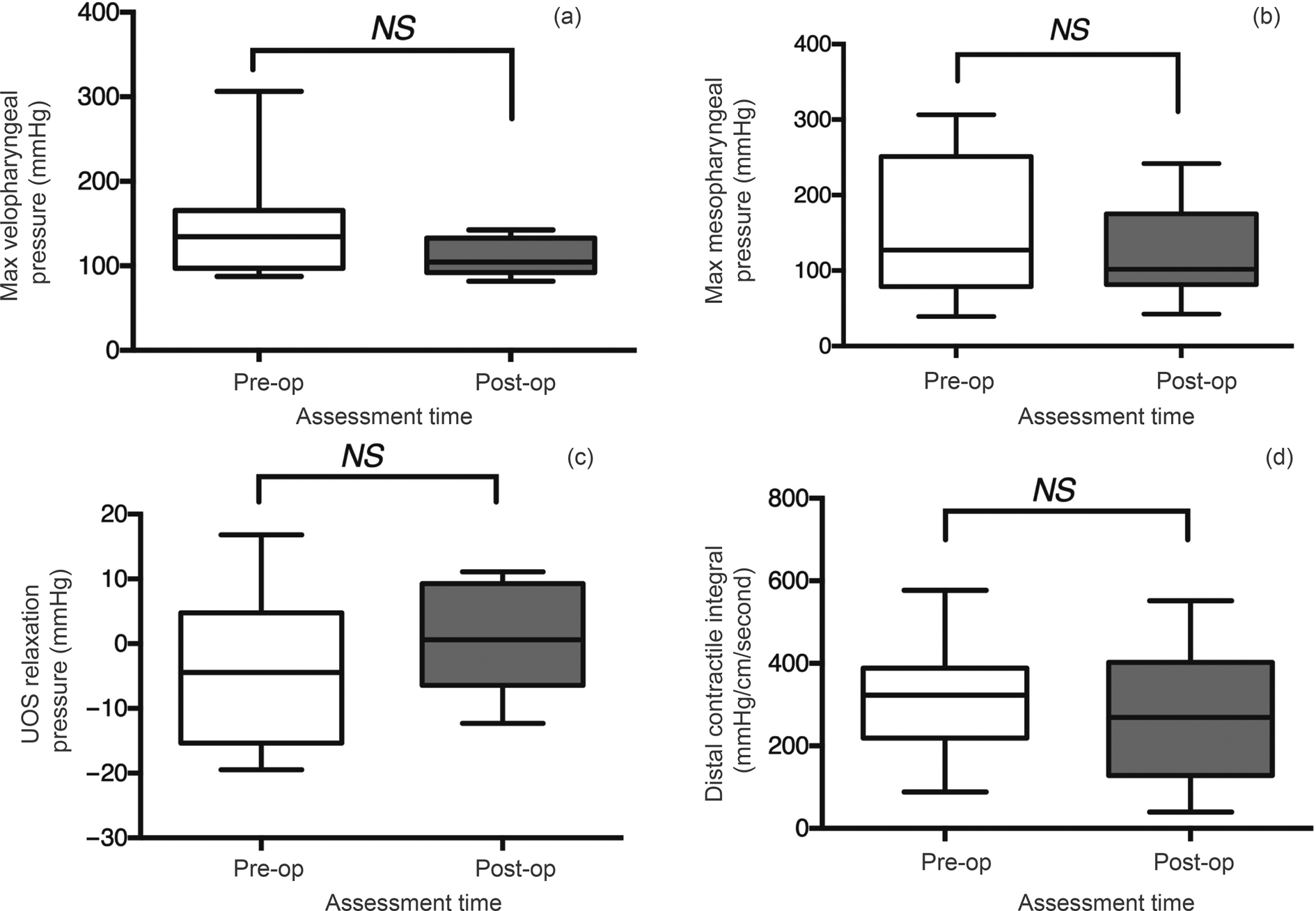
In all study patients, the high-resolution manometry procedures were completed with no complications. High-resolution manometry showed no significant pre- versus post-operative differences in maximum velopharyngeal pressure (pre-operative 145.9 ± 20.5 mmHg vs post-operative 111.1 ± 6.8 mmHg; p = 0.1602) or maximum mesopharyngeal pressure (pre-operative 154.3 ± 29.0 mmHg vs post-operative 126.5 ± 21.7 mmHg; p = 0.065). There were also no significant differences pre- versus post-operatively in upper oesophageal sphincter relaxation pressure (pre-operative −4.1 ± 3.9 mmHg vs post-operative 0.06 ± 2.7 mmHg; p = 0.30) or distal contractile integral (pre-operative 316.3 ± 43.4 mmHg/cm/second vs post-operative 277.8 ± 51.3 mmHg/cm/second; p = 0.375) (Figure 2).
Comparison of pre- and post-operative high-resolution manometry values: (a) maximum velopharyngeal pressure, (b) maximum mesopharyngeal pressure, (c) upper oesophageal sphincter relaxation pressure and (d) distal contractile integral. Max = maximum; NS = not significant; pre-op = pre-operative; post-op = post-operative; UOS = upper oesophageal sphincter

However, pharyngeal velocity was significantly higher post-operatively than pre-operatively (pre-operative 12.7 ± 2.0 cm/second vs post-operative 21.2 ± 2.9 cm/second; p = 0.013) (Figure 3).
Topography image of manometry showing pharyngeal velocity (white arrows) during swallowing (a) pre-operatively (‘pre-op’) and (b) post-operatively (‘post-op’). Pharyngeal velocity was significantly higher (as indicated by the asterisk) post-operatively than pre-operatively (c).

Discussion
Transoral robotic surgery with the da Vinci Surgical System has been used for the removal of pharyngeal and laryngeal cancers, with the objective of improving functional and aesthetic outcomes without worsening survival.Reference Dowthwaite, Franklin, Palma, Fung, Yoo and Nichols5,Reference Genden, Desai and Sung7,Reference Weinstein, O'Malley, Cohen and Quon8 Furthermore, the rate of PEG dependency has been found to be low following transoral videolaryngoscopic surgery.Reference Tomifuji, Araki, Yamashita, Mizokami, Kamide and Suzuki19 On the other hand, Rich et al. conducted a multivariate analysis of prognostic factors for swallowing function in patients with advanced-stage oropharyngeal cancer who underwent transoral laser microsurgery, and found that T4 oropharyngeal cancer (tonsil and tongue base) was associated with poor swallowing function.Reference Rich, Liu and Haughey20
A number of studies have reported functional outcomes such as PEG dependency and Functional Outcome Swallowing Scale scores following transoral robotic surgery performed for oropharyngeal carcinoma. Chronic gastrostomy dependence was found to range from 0 per cent to 7 per cent (mean follow-up duration of 11–32 months), regardless of disease stage.Reference Weinstein, O'Malley, Cohen and Quon8,Reference Genden, Park, Smith and Kotz21–Reference Weinstein, Quon, Newman, Chalian, Malloy and Lin30 Moore et al. reported that the Functional Outcome Swallowing Scale score returned to normal (score of 0) by the four-week assessment point in all patients who had a normal baseline swallowing function.Reference Moore, Olsen and Kasperbauer25
The transoral approach allows surgeons to perform oropharyngeal resection without pharyngotomy or mandibulotomy, to maintain the critical muscular framework of the laryngopharynx necessary to preserve swallowing function, and to avoid tissue damage associated with radiotherapy. Previous studies showed that 9–27 per cent of patients treated with frontline transoral robotic surgery avoided post-operative radiotherapy, and 34–45 per cent avoided chemotherapy.Reference Weinstein, O'Malley, Cohen and Quon8,Reference Genden, Park, Smith and Kotz21,Reference Hurtuk, Agrawal, Old, Teknos and Ozer22,Reference Moore, Olsen and Kasperbauer25,Reference Sinclair, McColloch, Carroll, Rosenthal, Desmond and Magnuson27
However, investigations of swallowing using procedures such as fibre-optic endoscopic evaluation of swallowing and the modified barium swallow study have rarely reported outcomes; thus, the detailed mechanisms for preserving swallowing function by transoral surgery have not been elucidated. No patients in the aforementioned studies were reported to develop aspiration or velopharyngeal reflux following fibre-optic endoscopic evaluation of swallowing.
High-resolution manometry can improve our understanding and ability to evaluate the pharyngo-oesophageal region. However, no studies thus far have used high-resolution manometry to objectively evaluate swallowing function during transoral surgery. This study is the first to demonstrate swallowing function in detail using high-resolution manometry. The results showed little change in pharyngeal pressure and upper oesophageal sphincter (UOS) relaxation pre- and post-operatively. Genden et al. reported that mean Performance Status Scale scores reached a nadir at 2 months after transoral robotic surgery, and rose rapidly to near-normal levels by 12 months.Reference Genden, Park, Smith and Kotz21 Thus, we evaluated post-operative swallowing function at two months after surgery.
Leonhardt et al. reported a statistically significant drop in Performance Status Scale scores from baseline to 6 months; scores improved thereafter and were no longer significantly decreased at 12 months.Reference Leonhardt, Quon, Abrahao, O'Malley and Weinstein24 That study, however, in contrast to the current study, included many patients who received adjuvant therapy, and this difference makes it difficult to compare the results directly. Furthermore, all patients in this study demonstrated wound epithelisation at two months after surgery; thus, this time point was considered to be appropriate for evaluation.
In this study, no significant pre- and post-operative differences were observed in pharyngeal pressure or UOS relaxation pressure, and videofluoroscopic swallow study showed no significant difference in Penetration Aspiration Scale scores.
A previous study reported that fibre-optic endoscopic evaluation of swallowing showed no aspiration in any patients,Reference Moore, Olsen and Kasperbauer25 an outcome similar to that of this study. However, T3 or T4 oropharyngeal cancer was found to differentiate PEG dependency.Reference Moore, Olsen and Kasperbauer25 Generally, however, transoral surgery in the clinical setting is indicated for patients with early stage (Tis–T2) oropharyngeal cancer without pre-operative dysphagia. Our study consisted of such a population; the current and aforementioned studies differed regarding patient characteristics.
• High-resolution manometry showed that transoral surgery preserved pharyngeal constriction
• Pharyngeal velocity was significantly higher post-operatively than pre-operatively
• Transoral surgery might cause scar formation in the pharynx, which could lead to pharyngeal narrowing
Swallowing function is associated not only with pharyngeal pressure, but also with elevation of the larynx, timing of the deglutition reflex, and pharyngeal sensation. Thus, we used not only high-resolution manometry, but also videofluoroscopic swallow study; the latter showed no aspiration, penetration, obvious piriform sinus residue or obvious swallowing reflex delay. It is suggested that transoral surgery performed in patients without pre-operative dysphagia results in little change in pharyngeal muscle structure and preserves swallowing function. However, further studies are needed to evaluate the impact of different tumour subsites and T stages on the swallowing mechanism.
The average age of patients in this study was higher than in other reports on transoral robotic surgery. A previous study showed that the UOS intrabolus pressure during sphincter opening was greater in older patients, possibly indicating decreased compliance of the cricopharyngeal muscle with age. In addition, older patients exhibited more vigorous pharyngeal contractility than younger counterparts for all but effortful swallows, perhaps reflecting a compensatory response to reduced UOS compliance with age. However, given that this was a small study, the impact of age on transoral surgery could not be evaluated.
In this study, pharyngeal velocity was significantly higher post-operatively than pre-operatively. Transoral surgery might cause scar formation in the pharynx, which could lead to pharyngeal narrowing depending on the size of the resection. However, pharyngeal volume was not measured in this study; thus, further evaluation is required.
Conclusion
High-resolution manometry showed that transoral surgery in patients without pre-operative dysphagia preserved pharyngeal constriction and swallowing function. Further studies are required to better clarify the advantages of transoral surgery.
Acknowledgement
This study was supported by the Japan Agency for Medical Research and Development (161k021022h004).
Data availability statement
The datasets used during the current study are available from the corresponding author on reasonable request.
Competing interests
None declared