Staphylococcus aureus is a major pathogen in hospitalized infants and is the second most common cause of late-onset neonatal sepsis.Reference Boghossian, Page and Bell1,Reference Lake, Weiner, Milstone, Saiman, Magill and See2 These infections are associated with mortality, morbidity, and prolonged lengths of stay.Reference Verstraete, Boelens and De Coen3–Reference Song, Perencevich, Campos, Short and Singh5 Staphylococcus aureus commonly exists as a colonizer of the nasal cavity, skin or gastrointestinal tract of humans, being found in ~20%–40% of healthy adults and 5%–55% of infants.Reference Weidenmaier, Goerke and Wolz6–Reference Rodriguez, Correa, Ospina, Atehortua and Jimenez10 Neonates colonized with S. aureus have an increased risk of subsequent infection.Reference Delaney, Wang and Melish11–Reference Popoola and Milstone13 Newborns may acquire S. aureus during their birth or shortly thereafter, from a colonized mother, the hospital setting, or the community surrounding them.Reference Jimenez-Truque, Tedeschi and Saye9,Reference Leshem, Maayan-Metzger and Rahav14–Reference Milstone, Voskertchian and Koontz16
Since hospital-associated methicillin-resistant S. aureus (MRSA) first emerged in 1980s and became prevalent in neonatal intensive care units (NICUs), attention to S. aureus in NICUs has largely focused on MRSA, with relatively little consideration given to methicillin-susceptible S. aureus (MSSA).Reference Jimenez-Truque, Tedeschi and Saye9,Reference Shane, Hansen and Stoll17 Most centers have implemented strategies for S. aureus screening and isolation with or without decolonization, again, focused on MRSA.Reference Dong, Glaser and Speer18–Reference Milstone, Song, Coffin and Elward20 However, MSSA infections are 3 times more common than MRSA infections among infants in NICUs, and both are associated with similar morbidity and mortality.Reference Shane, Hansen and Stoll17,Reference Carey, Duchon, Della-Latta and Saiman21,Reference Ericson, Popoola and Smith22
Molecular epidemiological studies of MRSA in NICUs have shown a few clones to be responsible for spreadReference Madigan, Cunningham and Patel23; in contrast, the molecular epidemiology of MSSA in this setting is less well defined. Traditionally, several methods, such as pulsed-field gel electrophoresis, surface protein A sequence (spa) typing, and multilocus sequence typing (MLST), have been used for molecular typing of S. aureus isolates. Recent studies have shown that molecular analysis using whole-genome sequencing (WGS) enables higher discrimination than conventional methods, allowing better understanding of molecular epidemiology.Reference Madigan, Cunningham and Patel23–Reference Leopold, Goering, Witten, Harmsen and Mellmann25
We noted an increase in the MSSA colonization rate in our NICU beginning in May 2018. In this study, we analyzed the clinical and molecular epidemiology of MSSA in NICU infants at Mayo Clinic Rochester to describe clusters of MSSA colonization that occurred over a 1-year period.
Methods
Setting
This study was carried out in a level-4 NICU at Saint Mary’s Campus, Mayo Clinic Hospital in Rochester, Minnesota. The NICU is a 34-bed unit caring for ~385 infants per year, with an average daily census of 15–33 patients (median, 24). The unit consists of 5 rooms with 4–6 bed spaces in each room, plus 6 additional single-room bed spaces for patients in need of isolation.
Screening
Beginning in April 2016, universal S. aureus screening was in place, using a single swab obtained from the anterior nares, axilla, and groin area of each infant in the NICU every Tuesday on a weekly basis.
Culture and identification
Swabs were plated on trypticase soy agar with 5% sheep blood agar and Columbia nalidixic acid (CNA) with 5% sheep blood agar plates, incubated at 35°C with CO2, and examined for growth at 16–24 hours and, if negative, at 48 hours. Colonies were identified by gram staining and coagulase testing, and/or by matrix-assisted laser desorption ionization–time-of-flight mass spectrometry (MALDI-TOF-MS). Antimicrobial susceptibility testing was performed using agar dilution with results interpreted using Clinical and Laboratory Standards Institute guidelines.26 Isolates were archived at −80°C in 0.9% sterile saline (Baxter, Deerfield, IL). When >1 MSSA isolate was detected from the same infant, only the first isolate was subjected to WGS.
Whole-genome sequencing
DNA was extracted from cultured MSSA isolates using the Zymo Research Quick-DNA Fungal/Bacterial Miniprep kit (Zymo Research, Irvine, CA) according to the manufacturer’s instructions. Paired-end sequencing libraries were prepared using Nextera XT DNA Library Prep kits (Illumina, San Diego, CA) and WGS performed on an Illumina MiSeq (Illumina) using V2 2 × 250-bp chemistry targeting 200× depth of coverage. Raw sequencing reads were processed for adapter and index removal using the MiSeq reporter software in real time.
Genome assembly and core genome multilocus sequencing type (cgMLST) determination
FASTQ files were imported into SeqSphere+ version 6.0.2 software (Ridom, Munster, DE) and handled using an automated assembly and typing pipeline. The pipeline includes FastQC read quality control and Velvet de novo genome assembly. Assembled genomes were mapped against an S. aureus reference genome (NC_002951.2) to define the core genome. A core genome target threshold of ≥95% was applied to all assemblies. Isolate relatedness was based on the total number of core genome allelic differences between each isolate.
Results
cgMLST of MSSA isolates
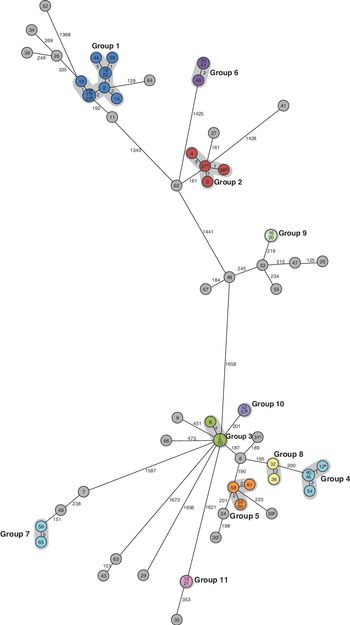
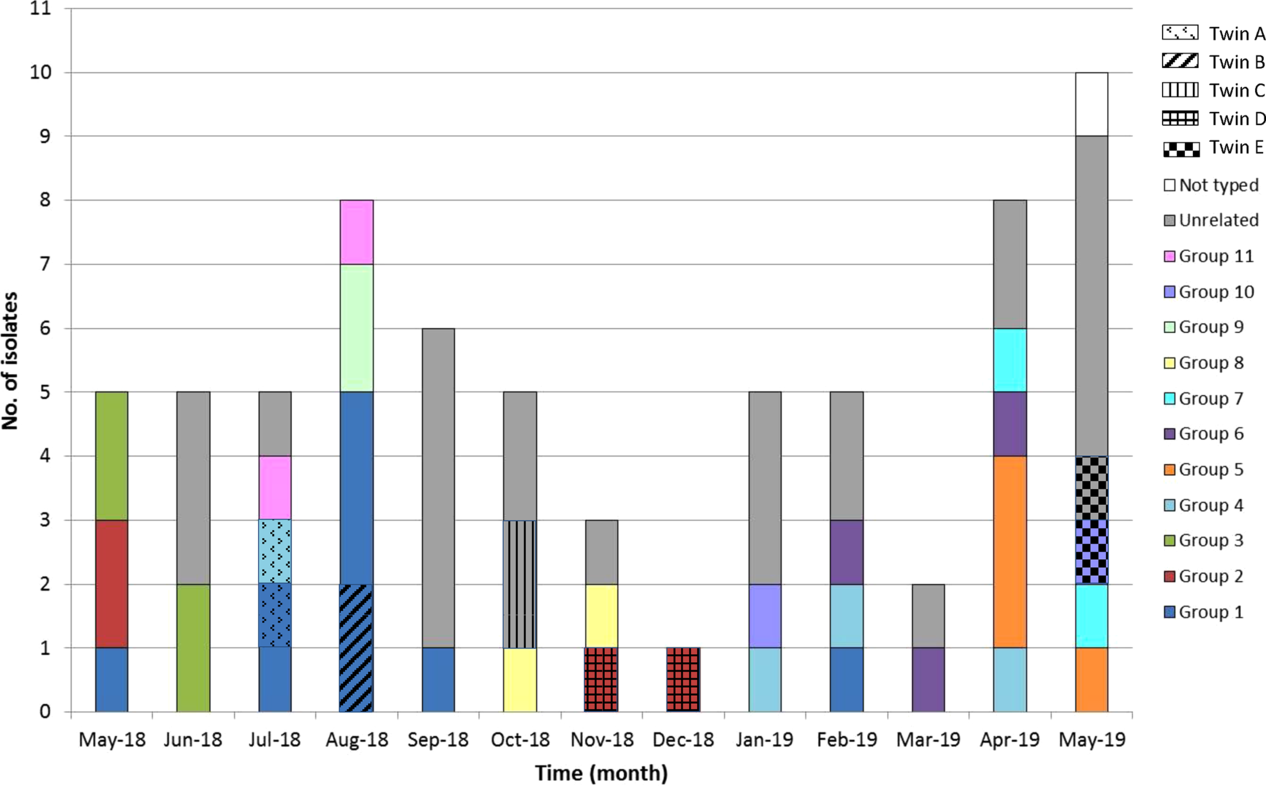
Over the 1-year study period (May 2018 to May 2019), 68 MSSA-colonized infant cases were detected. The median (range) gestational age and birth weight were 28 weeks (range, 22–40) and 985 grams (range, 360–4,280), respectively. The proportions of infants born via vaginal delivery, and infants with central venous catheters were 39.7% and 52.9%, respectively. Of 68 isolates, 67 were subjected to cgMLST analysis. (One isolate could not be retrieved for sequencing.) Of the 67 isolates analyzed, cgMLST analysis identified 11 groups of related isolates based on their having ≤9 allelic differences (Fig. 1, groups 1–11) comprising a total of 39 isolates, with group sizes ranging from 2 to 10 isolates. Furthermore, 28 isolates were unrelated to each other and to any of the groups, differing by >100 allelic differences. Cases of infants colonized with MSSA were scattered throughout the study period; isolates belonging to the same relatedness group were detected over periods of a few weeks to a few months (Fig. 2).
Core genome multilocus sequence type (cgMLST) minimum spanning tree of methicillin-susceptible Staphylococcus aureus isolates from colonized neonatal intensive care unit infants. Numbers in each circle indicate isolate numbers, assigned chronologically by the date of isolation. Numbers next to lines indicate the numbers of allelic differences between isolates, as determined by cgMLST. Superscripted characters indicate pairs of twins (A–E); twin pair A (isolate 12 and 15), twin pair B (isolate 17 and 23), twin pair C (isolate 30 and 31), twin pair D (isolate 37 and 38), and twin pair E (isolate 57 and 59). Line lengths are not proportional to the number of allelic differences and angles between lines are randomly assigned. Background grey shading indicates isolates in the same group.

Monthly distribution of methicillin-susceptible Staphylococcus aureus (MSSA) colonization in neonatal intensive care unit infants from May 29, 2018, to May 28, 2019, by cgMLST group. MSSA colonization was detected throughout the study period, with peaks in August–September 2018 and April–May 2019. Isolates in each cgMLST group were serially detected over several months. Among colonized infants, there were 5 pairs of twins, of which 2 pairs (twin pairs B and D) had related isolates, and 3 pairs (twin pairs A, C, and E) had unrelated isolates. Of the 2 pairs of twins with related isolates, 1 pair (twin pair B) had stayed in the same room and the other in different rooms.
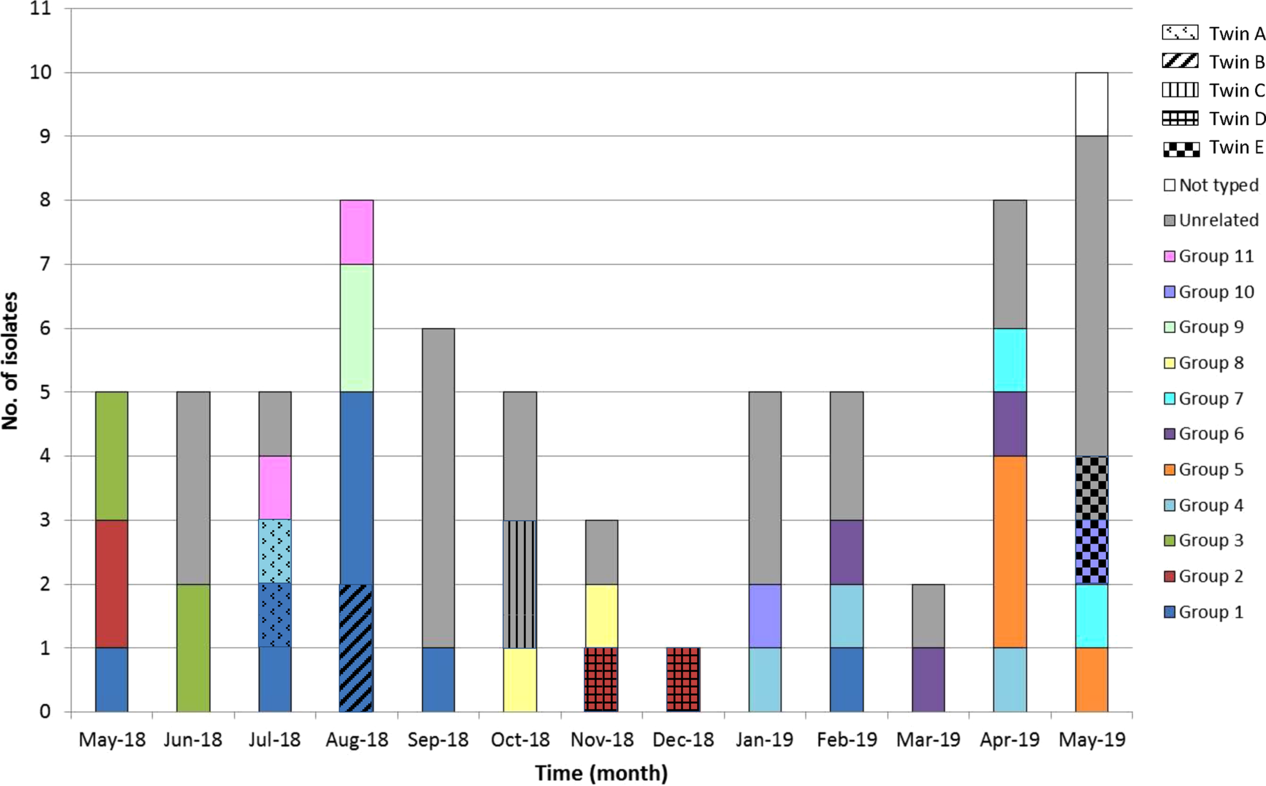
Group 1, the largest group, included 10 isolates; group 1 isolates were detected from infants in 4 multibedded rooms (room 1–4) with overlapping stays from May to September 2018 (Fig. 3). Group 2 consisted of 4 isolates, 2 of which were obtained from twin infants (twin pair D) and were isolated after 2 months of their hospital admission. The other 2 isolates in group 2 were detected from 2 infants whose stays overlapped with each other but not with the twins. Group 3 included 4 isolates from infants who were in room 1 on the same day. Group 4 also consisted of 4 isolates; they were detected from infants housed in 3 rooms (rooms 1–3), and 2 of the affected infants were admitted to room 2 but not at the same time. Group 5 also included 4 isolates; these isolates were found in infants in 2 different rooms (rooms 1 and 3) but at the same time. Group 6 included 3 isolates from infants who had been born at different medical centers and who were housed with temporally overlapping stays in room 1 in the NICU. Groups 7, 8, 10, and 11 were comprised of 2 isolates each and were all found in infants in different rooms but who had temporally overlapping hospital stays (ie, for each related pair). The 2 group 9 isolates were from infants who shared room 4.
Timeline of grouped methicillin-susceptible Staphylococcus aureus isolates from infants in the neonatal intensive care unit according to the rooms in which they stayed, by core genome multilocus sequence type (cgMLST) group. Bars illustrate hospitalization period of colonized infants. Bar colors represent cgMLST groups, with small inverted triangles indicating dates of isolation. Dotted lines designate those infants who were in the indicated location before the study period began.
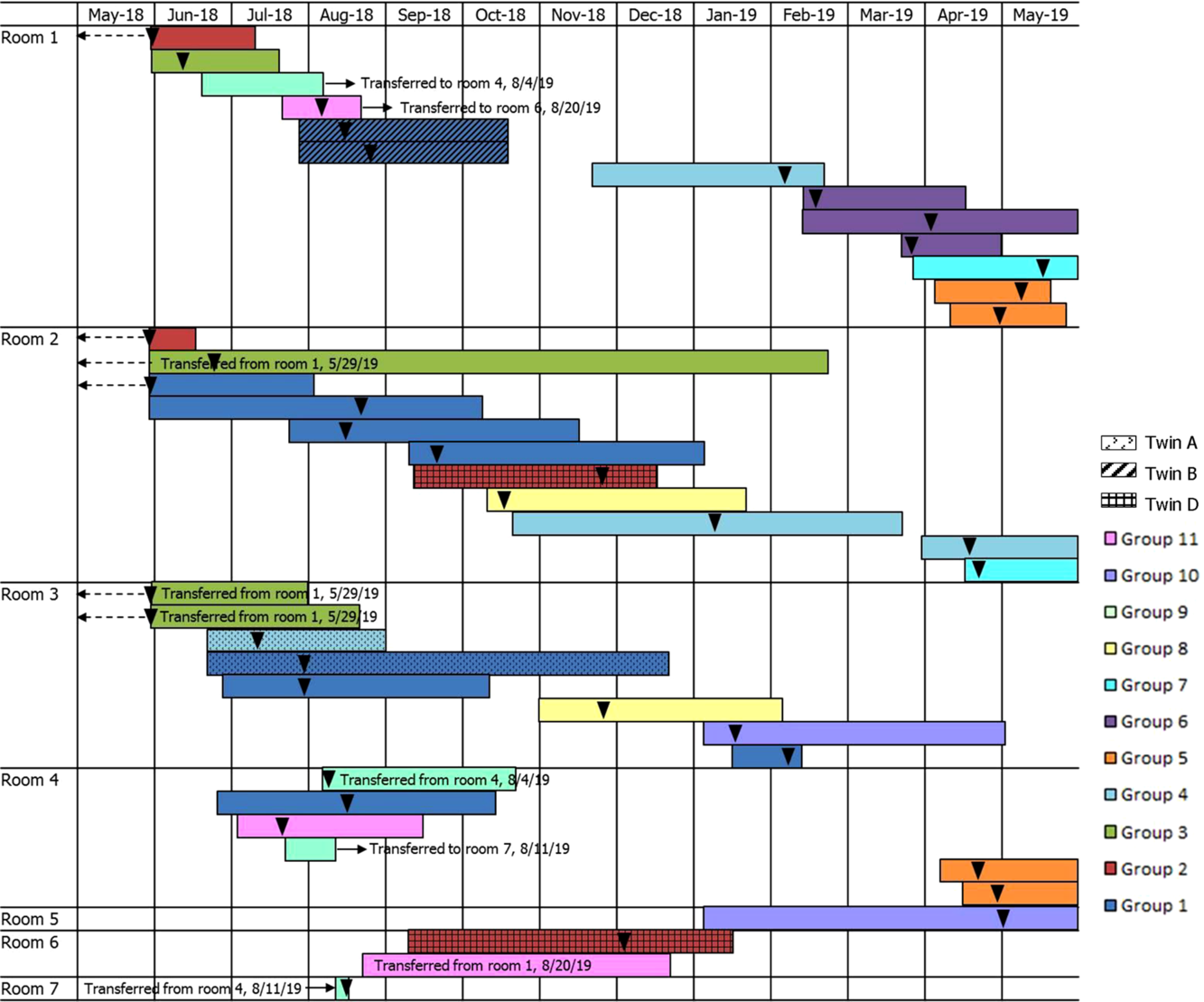
Among the MSSA-harboring infants, there were 5 pairs of twins (A–E), of which 3 (A, C, and E) had unrelated isolates between each twin pair, even though they stayed in the same room throughout their hospital stays (Figs. 1 and 2). Of the 2 pairs of twins with related isolates (B and D), 1 pair (B) had stayed in the same room and the other pair stayed (D) in different rooms (Fig. 3, room 2 and 6).
Clinical information
Among the colonized infants, 3 (4.5%) died during their hospitalization; no deaths were related to MSSA infection. Overall, 13 infants (19.7%) developed MSSA infection: bacteremia (n = 3), wound infection (n = 5), conjunctivitis (n = 4), and cellulitis (n = 1). The 3 bacteremia events involved isolates from different WGS groups. There was no association between isolates from infants with clinical infection and specific WGS groups. Among infants not colonized with MSSA, no bacteremia occurred through their discharge during the study period.
Antimicrobial susceptibility
Antimicrobial susceptibilities for MSSA isolates according to WGS group are shown in Supplemental Table 1 (online). All MSSA isolates in groups 1, 2, 3, 6, 10, and 11 were susceptible to all tested antimicrobials, whereas all isolates in groups 5, 7, and 8 were resistant to clindamycin and all isolates in group 9 were resistant to doxycycline.
Control measures
Several control measures were implemented in an attempt to prevent additional spread of MSSA in the NICU. Infants who were identified as colonized with MSSA were cared for using standard precautions; contact precautions were not used unless there was a separate indication for the use of contact precautions or another isolation precautions category. As a part of standard precautions, staff were encouraged to wear gloves and gowns when they had close direct physical contact with an infant, such as while holding the infant during feeding. MSSA colonized babies were treated with nasal mupirocin twice daily for 5 days and chlorhexidine baths twice, 48 hours apart once they reached 36 weeks of postmenstrual age and were at least 72 hours old. From May 2019 onward, colonized or infected infants were cared for in single rooms or were isolated in cohorts in multibed rooms. Hand hygiene for staff and environmental cleaning were reinforced, including use of audits and adenosine triphosphate testing of high-touch surfaces. Hand hygiene compliance in the NICU during the study period was 40%, 63%, 53%, and 100% in July–September 2018, October–December 2018, January–March 2019, and April–June 2019, respectively. Parents were instructed at the time of their infants’ admission and encouraged throughout their hospitalizations to perform hand hygiene prior to entering the NICU and prior to touching or holding their infants. Staff were advised to clean their mobile devices with disinfectant wipes at the beginning and end of each shift, when visibly soiled, after direct contact with patients or patient environments, and after exiting isolation rooms.
Discussion
The molecular epidemiology of MSSA in this study differed from that in our previous study,Reference Madigan, Cunningham and Patel23 which analyzed MRSA in the same NICU over 3 years using the same WGS methods. The previous MRSA analysis demonstrated that only a few clones were responsible for spread of MRSA and that spread occurred over a long period of time.Reference Madigan, Cunningham and Patel23 In contrast, in this study, 58% of MSSA isolates from NICU infants over the 1-year study period belonged to 11 small groups, with 42% being unique. Although the 2 studies were not conducted during the same periods, this finding suggests that the within-facility clonal diversity of MSSA is higher than that of MRSA. This finding is consistent with a previous molecular surveillance study of MSSA and MRSA colonization in infants, their parents, and medical staff in a NICU.Reference Mongkolrattanothai, Mankin, Cranston and Gray27 Although the molecular characterization methods differed from those used in our study, 15 patterns were identified among 25 MSSA isolates and 3 patterns were identified among 9 MRSA isolates, indicating higher clonal diversity of MSSA than MRSA.Reference Mongkolrattanothai, Mankin, Cranston and Gray27 Another study found heterogeneous MSSA colonization, with 16 shared strains and 22 unique strains among 85 isolates.Reference Ahmed28 MRSA is likely to be acquired from limited sources and spread through shared spaces, equipment, and healthcare personnel, whereas MSSA likely originates from diverse sources. Notably, however, some studies have reported hospital-associated transmission of MSSA with a few predominant clones associated with infection and colonization in NICUs.Reference Achermann, Seidl and Kuster29,Reference Graham, Morel and Zhou30 In our study, some clones showed spatial and temporal relations, suggesting hospital-associated transmission, but no extensive spread of any single strain occurred; differences may depend on intrinsic properties of specific strains alongside local infection prevention and control practices.Reference Achermann, Seidl and Kuster29
Colonization of family members or visitors may lead to subsequent S. aureus acquisition by infants in NICUs. The nasal carriage rate of S. aureus is ~20%–30% in the general population, with the rate being ~15%–20% for parents of infants admitted to NICUs.Reference Mongkolrattanothai, Mankin, Cranston and Gray27,Reference Pinter, Mandel, Hulten, Minkoff and Tosi31,Reference Sakr, Bregeon, Mege, Rolain and Blin32 A recent randomized controlled study of the effect of decolonization of parents colonized with S. aureus (MSSA or MRSA) on transmission to neonates in 2 NICUs illustrates the potential magnitude of parent-to-infant spread.Reference Milstone, Voskertchian and Koontz16 The study found that, by 90 days, nearly 60% of colonized infants were colonized with S. aureus strains concordant with their parent’s baseline strains, although pulsed-field gel electrophoresis (not WGS) was used to determine concordance. In addition, the study found that decolonization of parents reduced the rate of acquisition of a concordant strain by >50%. However, a variety of issues, including generalizability, feasibility, scalability and the impact on family-centered care must be understood better before this intervention is applied routinely.Reference Zachariah and Saiman33
Another mechanism by which infants may acquire S. aureus carriage is perinatal acquisition from colonized mothers. Recent studies have shown colonization with S. aureus in 10%–15% of newborns at or shortly after birth, with maternal colonization increasing infant colonization.Reference Jimenez-Truque, Tedeschi and Saye9,Reference Leshem, Maayan-Metzger and Rahav14,Reference Maayan-Metzger, Strauss and Rubin34 Our study could not confirm whether or not perinatal acquisition affected introduction of the bacteria into the NICU because the carriage state of parents was not examined and screening of infants at the time of admission was not performed during the study period. However, since most MSSA was detected in the second or subsequent screenings performed >1 week after admission, most of the infants might be presumed to have acquired MSSA during their hospitalization.
Our data also show that more than half of isolates were related to other isolates. Isolates belonging to groups 1, 3, 5, and 6 were detected serially in the same room or in different rooms with overlapping stays, suggesting at least some within-hospital transmission. This has been shown in recent MSSA outbreaks in NICUs, in which 2 parallel outbreaks had originated from exogenous sources.Reference Roisin, Gaudin and De Mendonca35 Spread of S. aureus within hospitals can be mediated by medical staff or hospital environments, including medical equipment, as a reservoir or vector.Reference Romano-Bertrand, Filleron and Mesnage19,Reference Eldirdiri, Lee, Jack, Wright, Findlay and Phillips36,Reference Price, Cole and Bexley37 Because no systematic surveillance of the medical staff or the hospital environment was carried out in our study, it was not possible to determine whether they might have mediated bacterial transmission. Interestingly, after infants with group 2 isolates were discharged at July 2018, group 2 isolates were not detected until they reappeared in November 2018. One of the infants with group 4 carriage stayed in a different room and did not have overlapping hospital stays with the other group 4 infants (Fig 3). We were unable to determine whether a reservoir mediating transmission might have existed or whether isolates endemic in the community might have been introduced on >1 occasion.
Although MSSA has received less attention than MRSA in NICUs, MSSA is an important cause of morbidity and mortality.Reference Ericson, Popoola and Smith22,Reference Dolapo, Dhanireddy and Talati38 The incidence of MSSA bacteremia over a year in this study was 3 times higher than that of MRSA bacteremia in our previous MRSA study, a finding consistent with other reports.Reference Popoola and Milstone13,Reference Graham, Morel and Zhou30 Previous studies show a comparable mortality rate between MSSA and MRSA infections in infants admitted to NICUs.Reference Shane, Hansen and Stoll17,Reference Ericson, Popoola and Smith22 Recently, there has been an increasing recognition that hospital infection prevention and control efforts must focus not only on preventing MRSA infections but S. aureus infections overall, including those caused by MSSA.Reference Romano-Bertrand, Filleron and Mesnage19,Reference Ericson, Popoola and Smith22,Reference Carey39 However, additional study is needed to more precisely quantify the association of MSSA acquisition on subsequent infection, morbidity or mortality in infants as well as effects of interventions to prevent S. aureus colonization.
Although the cgMLST results were not compared with those of other typing methods for the MSSA isolates from this study, we previously reported that cgMLST provides high resolution for determining relatedness of both MSSA and MRSA.Reference Madigan, Cunningham and Patel23,Reference Park, Greenwood-Quaintance and Uhl24 In our prior neonatal MRSA study, cgMLST provided more resolution than PFGE, separating, for example, 2 isolates away from 23 that were all included in the same indistinguishable PFGE group.Reference Madigan, Cunningham and Patel23 Similarly, in our S. aureus bacteremia study, several isolates assigned to the same spa type were unrelated to each other by cgMLST.Reference Park, Greenwood-Quaintance and Uhl24 In a neonatal MSSA bacteremia study, cgMLST was able to distinguish outbreak-related isolates from the other isolates of the same sequence type by classical MLST.Reference Slingerland, Vos and Bras40
This study has several limitations. Cultures from the hospital environment and surveillance of healthcare workers were not performed, so we were unable to determine whether MSSA from infants in different rooms or in the same rooms during nonoverlapping periods of hospitalization was acquired through horizontal transmission. In addition, because family members and visitors were not screened, we were unable to determine whether they were the source of the babies’ MSSA. Because MSSA isolates collected from clinical infection sites were not sequenced, we could not definitively show that colonizing isolates caused clinical infections. Finally, since only 1 isolate was sequenced from each infant, colonization with >1 strain of MSSA would not have been detected.
In summary, WGS demonstrated that MSSA isolates colonizing infants in a NICU had a high degree of overall clonal diversity: 42% of isolates were unrelated to each other or any of the isolate group. Nonetheless, most isolates showed relatedness to other isolates, but generally with small numbers of isolates in each group. These results demonstrate that WGS is a useful tool to understand the molecular epidemiology of MSSA in NICUs, although additional study using WGS is needed to understand complex transmission pathways in more detail to better inform infection prevention and control practices.
Supplementary material
To view supplementary material for this article, please visit https://doi.org/10.1017/ice.2020.355
Acknowledgments
We appreciate the physicians, nurses, and other staff in the NICU for their help with this investigation. We also appreciate the staff of the clinical microbiology laboratory for their help with isolate acquisition, storage, processing, and analysis. Finally, we thank the Mayo Clinic Center for Individualized Medicine for assistance with development of the WGS platform.
Financial support
This research was supported by the Mayo Clinic Center for Individualized Medicine.
Conflicts of interest
Dr Patel reports grants from CD Diagnostics, Merck, Hutchison Biofilm Medical Solutions, Accelerate Diagnostics, ContraFect, TenNor Therapeutics Limited and Shionogi. Dr Patel is a consultant to Curetis, Specific Technologies, Next Gen Diagnostics, PathoQuest, Selux Diagnostics, 1928 Diagnostics and Qvella; monies are paid to Mayo Clinic. In addition, Dr Patel has a patent on Bordetella pertussis/parapertussis PCR issued, a patent on a device and method for sonication with royalties paid by Samsung to Mayo Clinic, and a patent on an antibiofilm substance. Dr Patel receives travel reimbursement from ASM and IDSA, an editor’s stipend from IDSA, and honoraria from the NBME, Up-to-Date and the Infectious Diseases Board Review Course. Dr Huskins reports fees for serving as a consultant to ADMA Biologics and Pfizer. All other authors declare no conflicts of interest.