SMALL MARINE ISLANDS: WINDOWS TO POSSIBLE COASTAL FUTURES
In the face of extreme change in coastal systems globally, especially climate-induced threats, frameworks can synthesize data needs to address future issues (Cinner et al. Reference Cinner, Adger, Allison, Barnes, Brown, Cohen and Gelcich2018). This paper offers a framework to help visualize complex relationships in marine waters of small islands (<20 000 km2), including small-island states (SISs) and small islands within larger states (SILSs) (Nurse et al. Reference Nurse, McLean, Agard, Briguglio, Duvat-Magnan, Pelesikoti, Tompkins and Barros2014).
Inhabited small islands are a type of coastal and marine social–ecological system (SES) (Glaser et al. Reference Glaser, Christie, Diele, Dsikowitsky, Ferse, Nordhaus and Schlüter2012a) characterized by the surrounding sea and a high proportion of coastal territory, in many cases encompassing entire islands. Understanding island-specific human–ecosystem links – or small-island SESs – is a crucial component of enabling sustainability of related livelihoods. Small-island populations often have a high primary reliance on coastal marine resources and fishing. In 17 Pacific island countries and territories, 47% of coastal households list fishing as a primary or secondary source of income (SPC 2008, Bell et al. Reference Bell, Kronen, Vunisea, Nash, Keeble, Demmke and Pontifex2009), while agriculture and other land-based resources, particularly freshwater, are also critically important.
Small islands confront global change on a reduced spatial scale, with potentially greater intensity and urgency (Rockström et al. Reference Rockström, Steffen, Noone, Persson, Chapin Iii, Lambin and Lenton2009, Leach et al. Reference Leach, Rockström, Raskin, Scoones, Stirling, Smith and Thompson2012). Often geographically isolated, they highlight the influence of marine dynamics on coastal systems, which provide natural resources but can be socially and economically isolating (Philpot et al. Reference Philpot, Gray and Stead2015). Small islands are particularly vulnerable to freshwater and land scarcity, extreme events and sea-level rise, resulting in vulnerability for access to food, water, land and energy resources (Baldacchino Reference Baldacchino2006, Schwerdtner Mánez et al. Reference Schwerdtner Mánez, Husain, Ferse and Mánez Costa2012, Borges et al. Reference Borges, Phillips, Ng, Medeiros and Calado2014). Many are found in areas prone to natural hazards, such as tropical cyclones and tsunamis (Forbes et al. Reference Forbes, James, Sutherland and Nichols2013). Small islands have limited resources, often with severely limited land and high population density (Solomon & Forbes Reference Solomon and Forbes1999, Nurse et al. Reference Nurse, McLean, Agard, Briguglio, Duvat-Magnan, Pelesikoti, Tompkins and Barros2014). In addition, due to the large expense of transporting primary resources or manufactured goods to markets, economic opportunities may be limited. While increasingly connected to the outside through communication technology and air transport, residents of poorer small islands often depend on the local marine natural resource base with few alternatives: in rural communities of some Pacific island countries and territories, the subsistence fishery accounts for 60–90% of all fish caught (SPC 2008, Bell et al. Reference Bell, Kronen, Vunisea, Nash, Keeble, Demmke and Pontifex2009). For small islands, especially atolls or low-lying islands, the proportion of the island negatively impacted by an extreme event can be very high, with limited opportunity for refuge (Ratter Reference Ratter2008). The impacts are exacerbated by remoteness, increasing the challenge of support in the recovery process (Johnston Reference Johnston2016).
SMALL-ISLAND STATES AND SMALL ISLANDS WITHIN LARGER STATES
In addition to the many extrinsic factors that make small islands highly vulnerable, the smallest and most marginal islands within island states are often additionally threatened by intrinsic governance factors, such as receiving fewer financial resources than larger islands or administrative centres (van Beukering et al. Reference van Beukering, Brander, Tompkins and McKenzie2007, Bunce et al. Reference Bunce, Mee, Rodwell and Gibb2009, Philpot et al. Reference Philpot, Gray and Stead2015); this can be further accentuated in SILSs, where international activities are constrained by the larger state. Decisions are frequently centralized off-island and island-specific priorities are rarely acknowledged as national political or administrative priorities. Indonesia, for example, has over 17 000 small islands, which mostly lack island-specific governance institutions. Some SISs construct an economic base from migrant labour remittances and foreign aid (as in Tuvalu and Niue; Connell & Conway Reference Connell and Conway2000, Bertram Reference Bertram2006, Connell Reference Connell2008), establish offshore banking or insurance (as in the Cayman Islands and Bermuda) or utilize jurisdiction as a resource (e.g., by selling fishing licences in national exclusive economic zones or granting differential tax rates; Connell Reference Connell2013). Such island state strategies require island-level legislative and judicial powers, a crucial missing element for SILSs. Differences in the degree of proactive utilization of strategic niches by island states exist, and there are alternatives to the classic migration, remittances, aid and bureaucracy (MIRAB) strategy for SISs to benefit from their economic and cultural ‘hinterland’ (Stead Reference Stead2005, Baldacchino Reference Baldacchino2006).
Whether in archipelagic states such as Indonesia or the Philippines or in small multi-island states, SILSs often lack the formal rights and institutional capacity to represent the island as a governance unit. Dependent island territories, a special class of SILSs, are currently associated with 12 ‘parent’ nations (including the USA, China, New Zealand, France and the UK), with vastly different political cultures and structures, although usually providing a mechanism for substantial financial and infrastructure support. Depending on the structure and powers of local and regional governance units, SILSs can thus find themselves marginalized in national development (Glaeser & Glaser Reference Glaeser and Glaser2010, Lane et al. Reference Lane, Mercer Clarke, Forbes and Watson2013). In these islands, the absolute and relative strengths of traditional, village, provincial and national levels of governance and the effectiveness of institutions across levels affect whether, and how, tailored solutions can be developed at the island level.
CONSIDERING A FRAMEWORK TO SUPPORT PRIORITIZATION OF TRANSFORMATIVE OPPORTUNITIES FOR COASTAL CHANGE GOVERNANCE
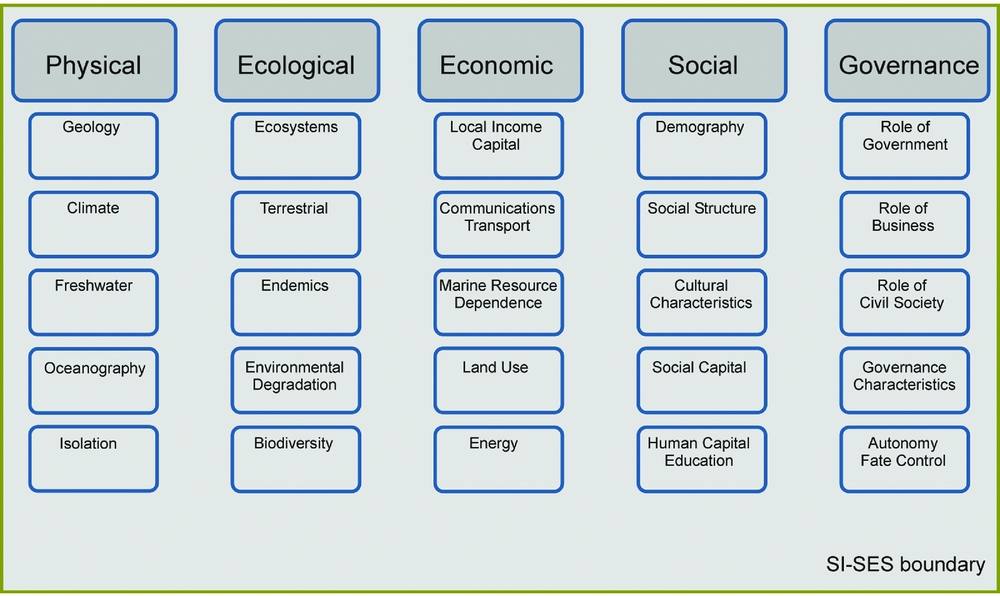
To help envisage governance options on the island level in both SISs and SILSs, this paper helps to build a typological framework to show key vulnerabilities and transformative opportunities for small islands. This small-island archetypal (SIA) framework sets out to integrate and connect information on small-island SESs, categorizing vulnerabilities and opportunities amongst the respective physical, ecological, economic, social and governance components (Fig. 1). As small-island SESs can be considered windows into possible coastal futures, the SIA framework is intended to support island-related decision-making while also providing critical insights for the potential futures of larger coastal systems.
Small-island archetypal framework.

Other authors have recognized the value of a framework or typological approach to the challenges of identifying pathways to positive outcomes in complex or ‘messy’ SESs (Alessa et al. Reference Alessa, Kliskey and Altaweel2009). Ostrom (Reference Ostrom2007, Reference Ostrom2009) proposed a nested framework approach to identify small sets of subsystem variables relevant to particular outcomes. These subsystems can interact in a non-linear fashion, the evolution of this interaction affecting changes in the complex SES may require changes in management policy; and “long-term sustainability depends on rules matching the attributes of the resource system, resource units, and users” (Ostrom Reference Ostrom2009: 421). Others have embraced the concept of adaptive cycles as a conceptual framework for assessing resilience (Holling & Gunderson Reference Holling, Gunderson, Gunderson and Holling2002, Plummer & Armitage Reference Plummer and Armitage2007, Cinner et al. Reference Cinner, Adger, Allison, Barnes, Brown, Cohen and Gelcich2018), but the inherent difficulty remains of applying seemingly simple frameworks in the context of complex SESs (e.g., González et al. Reference González, Montes, Rodríguez and Tapia2008, Bunce et al. Reference Bunce, Mee, Rodwell and Gibb2009, Fath et al. Reference Fath, Dean and Katzmair2015). Nevertheless, as an island-specific contribution to this quest, we believe that the proposed SIA framework – with its balanced options to analyse biogeophysical dynamics – can have utility as a visualization tool for framing comparative discussions on governance approaches and priorities or transformative opportunities within complex small-island SESs.
Physical components
The adaptive capacity of island systems is affected by the physical characteristics of their terrain and climate, in particular their limited space, geological character and relief (Nunn Reference Nunn1994, Forbes et al. Reference Forbes, James, Sutherland and Nichols2013, Hills et al. Reference Hills, Carruthers, Chape and Donohoe2013, Weigelt et al. Reference Weigelt, Jetz and Kreft2013). Many oceanic islands arise from geodynamic processes of mantle convection and plate tectonics. In view of sea-level rise and other climate change trends such as increased storm intensity, land elevation is a critical variable. Together with soil type and island size, elevation determines the relative importance of terrestrial ecosystems in social–ecological interactions (e.g., forested watersheds or agriculture). Oceanic islands can be classified into four physical categories (volcanic, near-atolls and atolls, continental fragments and high-carbonate islands including raised atolls) with distinctive sets of natural hazards and adaptation challenges (Forbes et al. Reference Forbes, James, Sutherland and Nichols2013). On continental shelves, shoal islands (which may have associated reefs) develop by convergence of sediment transport, patch reef growth or the emergence or drowning of relief with changing sea level. High-volcanic and continental fragment islands are particularly susceptible to changes in rainfall intensity, with implications for flooding, landslides and reef degradation. Atolls, lacking any high relief, are particularly limited in freshwater resources and notably vulnerable to rising sea levels and storm overtopping. These differing geophysical conditions generate different sets of coastal forcing (environmental drivers of change and hazards) and are associated with specific vulnerabilities and adaptation needs. The characteristics and dynamics of the surrounding oceans affect species dispersal patterns and resource availability (Knittweis et al. Reference Knittweis, Kraemer, Timm and Kochzius2009) and thus the adaptation needs and capacities of islanders.
Ecological components
Ecological characteristics such as biodiversity and the status of key ecological components and species vary among islands. Island social–ecological dynamics are affected by the size and character of their marine, coastal and terrestrial ecosystems. On smaller shoal or atoll islands, the terrestrial elements may be small or absent and have low biodiversity. Instead, the existence, size and ecological characteristics of a lagoon are critical for atolls and their SESs. Where island terrestrial ecosystems are degraded by deforestation or extreme events (e.g., cyclones), implications arise for freshwater availability, coastal sedimentation rates and the state of marine ecosystems, with repercussions for human well-being. Coral reefs not only serve as major coastal protection structures, but also contribute sediment to atoll islands (Perry et al. Reference Perry, Kench, Smithers, Riegl, Yamano and O'Leary2011, Forbes et al. Reference Forbes, James, Sutherland and Nichols2013). The health and stability of reef systems can be affected by poor land-use practices, pollution or overexploitation of various kinds. In addition, climate change or changes in regional ocean dynamics can raise sea surface temperatures and cause widespread bleaching of corals (Hoegh-Guldberg et al. Reference Hoegh-Guldberg, Mumby, Hooten, Steneck, Greenfield, Gomez and Harvell2007). Ocean acidification and invasive species are further threats to the health of marine and reef ecosystems.
Economic components
Small-island economies often rely on only one or two sectors, such as fisheries, tourism or finance (Philpot et al. Reference Philpot, Gray and Stead2015). While such a lack of economic diversity can increase vulnerability, some SISs have developed adaptation options (Briguglio et al. Reference Briguglio, Cordina, Farrugia and Vella2009) that can be lacking in SILSs, although this is not always the case (e.g., Baldacchino & Milne Reference Baldacchino and Milne2006). Adaptation to economic shock has different implications for different social groups, and inequalities may result.
Communication and transport are crucial for island economies and are typically more costly than in mainland locations (Newell et al. Reference Newell, Nuttall, Prasad and Veitayaki2017). In addition, islands can be physically isolated from essential off-island sources of food and water by a combination of poor transport technology and weather conditions. On the remote islet of Lanyukan off South Sulawesi (Indonesia), inhabitants still run out of food and freshwater when there are continuous medium–heavy seas for more than two weeks.
Small islands tend to be fossil fuel poor but are particularly dependent on energy for communication, transport and other priorities such as freshwater production. Island energy initiatives have become pioneers in context-specific green solutions (Shetye et al. Reference Shetye, Gouveia and Pathak1990), sometimes related to a range of traditional and innovative buffering and adaptation strategies that can inform wider sustainability pathways. The solar-powered desalination implemented through local initiative on Bequia (St Vincent and the Grenadines) is an excellent example (Lane et al. Reference Lane, Mercer Clarke, Forbes and Watson2013).
Island clusters can enable the development of travel and trade links and, more recently, of human migration from islands with fewer economic opportunities to those that are centres of government and commerce (Jones Reference Jones1996, King & Connell Reference King and Connell1999). Migration can cause pressures on land, resources and infrastructure, creating challenges to sustainable development (White et al. Reference White, Falkland, Metutera, Mourongo, Abete-Reema, Overmars and Perez2008). Out-migration may occur for economic, political or environmental reasons (Kelman Reference Kelman2015). On some islands, such as Grenada in the Caribbean or Niue in the South Pacific, the out-migration has caused a drop in total population (Pool Reference Pool1989, Connell Reference Connell2008). Nevertheless, many islands are confronting increased urbanization and intensified land use, thus encountering resource limitation (e.g., for freshwater; Schwerdtner Mánez et al. Reference Schwerdtner Mánez, Husain, Ferse and Mánez Costa2012) or leading to waste quantities surpassing local disposal capacity (Solomon & Forbes Reference Solomon and Forbes1999).
The economic dependence of islanders on local ecosystem services can thus affect adaptation options. Access to subsistence food supply supports local social resilience (Adger et al. Reference Adger, Carpenter, Folke, Hughes and Rockström2005) because it can maintain islanders’ food security under adverse economic conditions (Christensen Reference Christensen2011). Economic dependence on nature could in this way mobilize ecosystem users to engage in environmental governance and management (Ostrom Reference Ostrom2009). The degradation, pollution and overuse of natural resources, however, also expose ecosystem-dependent islanders to food safety and security risks (e.g., Seribu Islands in Jakarta Bay; Baum et al. Reference Baum, Kusumanti, Breckwoldt, Ferse, Glaser and Dwiyitno2016).
Social components
Demographic structures influence adaptive capacity (Huigen et al. Reference Huigen, Overmars and de Groot2006, Cinner et al. Reference Cinner, Adger, Allison, Barnes, Brown, Cohen and Gelcich2018), and, in conjunction with other factors, population size and density can generate pressures on limited resources (Hummel Reference Hummel2008, Kronen et al. Reference Kronen, Vunisea, Magron and McArdle2010, Philpot et al. Reference Philpot, Gray and Stead2015). Population can also be a source of strength in human and social capital (Boserup Reference Boserup1984, Connell Reference Connell2013), particularly in culturally rich and diverse contexts (Berkes Reference Berkes2009). How long a human population has resided on an island influences social structures and islanders’ local ecological knowledge (Chertow et al. Reference Chertow, Fugate, Ashton, Singh, Haberl, Chertow, Mirtl and Schmid2013). Human populations with sea-based cultures have lived on Pacific islands for at least 3000 years (Nunn Reference Nunn2009). Caribbean islands in turn retain hardly any pre-colonial populations today, and some smaller Indonesian islands have only recently been settled by culturally diverse migrants (Glaser et al. Reference Glaser, Krause, Halliday, Glaeser, Glaser, Krause, Ratter and Welp2012b). The strength and characteristics of social hierarchies and networks affect governance and management (Turner et al. Reference Turner, Forster, Fitzsimmons, Gill, Mahon, Peterson and Stead2017). Island social structures range between strongly hierarchical, multi-stranded, patron–client relations in highly asymmetrical power contexts (e.g., in Indonesia; Meereboer Reference Meereboer, Robinson and Paeni1998, Pelras Reference Pelras2000) and polycentric societies with small power differentials between leaders and others (e.g., in Melanesia; Lauer Reference Lauer2016).
Island cultures may be land or sea based, or a mixture of both (Glaeser & Glaser Reference Glaeser and Glaser2010), which affects islanders’ perceptions of and behaviour towards the sea (Philpot et al. Reference Philpot, Gray and Stead2015). Marine-based cultures in the South Pacific, for instance, consider the waters surrounding their islands as part of their home territories (Johannes Reference Johannes2002, Lowe Reference Lowe2006) and perceive their region as ‘an ocean of islands’ (Hau'ofa Reference Hau'ofa1994, McMillen et al. Reference McMillen, Ticktin, Friedlander, Jupiter, Thaman, Campbell and Veitayaki2014) and their countries as ‘large ocean island states’ (Cook Islands’ Prime Minister Henry Puna in 2012). In addition, these populations often possess, or lay claim to, marine territorial rights (e.g., Aswani et al. Reference Aswani, Albert, Sabetian and Furusawa2007).
This links to the concept of the ‘we-group’ (Firth Reference Firth1936), where cultural/affective and economic links with the sea generate social identities characterized by mutual trust and a strong sense of island-specific marine territory (e.g., Abecasis et al. Reference Abecasis, Schmidt, Longnecker and Clifton2013). Social, ethnic and political divisions in some islands undermine this, but numerous small islands possess as-yet underexploited potential for self-organized collective action (Pratt & Govan Reference Pratt and Govan2010). That this may reach well beyond the level of the individual island's marine territory is demonstrated, for example, by the network of island-based locally managed marine areas (LMMAs) in the Pacific (Govan Reference Govan2009) and by emerging regional governance in the Spermonde Archipelago in Indonesia (Glaser et al. Reference Glaser, Baitoningsih, Ferse, Neil and Deswandi2010, Deswandi Reference Deswandi2012).
Levels of trust influence the feasibility and effectiveness of collaborative adaptation and transformation strategies. Where livelihoods depend on the marine environment, island identities may be closely associated with the sea (e.g., Novaczek et al. Reference Novaczek, Mitchell and Veitayaki2005). For example, in Madagascar and many Pacific islands, cultural taboos limit the use of coastal and marine resources with varying potentials for conservation and livelihood security (Cinner Reference Cinner2007, Foale et al. Reference Foale, Cohen, Januchowski-Hartley, Wenger and Macintyre2010). Many islands depend on artisanal fisheries where local ecological knowledge and social bonds affect marine use practices (Ruddle Reference Ruddle, Dyer and McGoodwin1994, Johannes Reference Johannes1981, Reference Johannes2002, Aswani & Lauer Reference Aswani and Lauer2014, Philpot et al. Reference Philpot, Gray and Stead2015).
Human capital in island societies often rests on traditions (Diegues Reference Diegues2008) and grows through training, education and experience (Crook et al. Reference Crook, Todd, Combs, Woehr and Ketchen2011, Thaman Reference Thaman2013). Physical isolation can reduce islanders’ formal education, but may support ecocultures (Pretty Reference Pretty2011) that rely on the deep ecological knowledge arising from long-term dependence on nature. Islanders’ ecological knowledge, both traditional and newly emergent, relates to fisheries, fishing grounds and the wider marine environment (Forster et al. Reference Forster, Turner, Fitzsimmons, Peterson, Mahon and Stead2017). In conjunction with social energy (the self-organization potential) for protecting one's ‘own territory’ (Glaser et al. Reference Glaser, Baitoningsih, Ferse, Neil and Deswandi2010), this can be an asset for ocean management (Johannes Reference Johannes1981, Cordell Reference Cordell1995, Aswani & Hamilton Reference Aswani and Hamilton2004).
Social capital and social energy for locally appropriate adaptation and transformation can be generated by strong people–place connections, supportive values and beliefs, diverse forms of knowledge, skills and learning, dense and active social networks, governance with collaborative institutions and engaged leadership and a positive outlook that includes readiness to accept change (Berkes & Ross Reference Berkes and Ross2013).
Governance components
Understanding what type of governance would be effective at making an impact on human behavioural change is important for sustaining marine resources, especially in small islands where errors in decision-making can have faster and more significant unintended consequences (e.g., increased rule-breaking; Peterson & Stead Reference Peterson and Stead2011). Governance is the framework of formal and informal institutions that includes government, market and civil society influences on the system to be governed (Kooiman et al. Reference Kooiman, Bavinck, Chuenpagdee, Mahon and Pullin2008, Olsen et al. Reference Olsen, Page and Ochoa2009). It affects an island's access to resources, support and funding. Features such as social cohesion, local decision-making rights and social and governance flexibility (Adger et al. Reference Adger, Carpenter, Folke, Hughes and Rockström2005) affect small islands’ adaptive and transformative capacities (Philpot et al. Reference Philpot, Gray and Stead2015).
Governance structures vary with types and relative strengths of commercial sectors, civil society and public interests (Turner et al. Reference Turner, Forster, Fitzsimmons, Gill, Mahon, Peterson and Stead2017). Different forms and combinations of centralized, federal or polycentric government exist, with diverse options for informal governance (e.g., traditional leadership or community-based actions and self-regulation; Okeke-Ogbuafor et al. Reference Okeke-Ogbuafor, Gray and Stead2017). Especially for isolated islands, governance without government is common (i.e., political steering through societal and/or market forces without the exercise of formal political authority; Young Reference Young2013). This can be a strength (e.g., adaptability) or a weakness (e.g., low enforcement vis-à-vis powerful interests). Frameworks can help build effective participatory platforms, which can target governance mechanisms that will direct actions that are more likely to be supported by those impacted. Understanding governance processes for collaborative learning and adaptive management increases the adaptive capacities of islanders (Johnson et al. Reference Johnson, Dana, Jordan, Draeger, Kapuscinski, Schmitt Olabisi and Reich2012), especially when the socioeconomic characteristics are considered with environmental impacts (Stead Reference Stead2005), supporting goals of autonomy and fate control.
SMALL-ISLAND ARCHETYPAL FRAMEWORK CASE STUDY: SPERMONDE ARCHIPELAGO (INDONESIA) – SOCIAL CAPITAL HOLDS POTENTIAL FOR MARINE MANAGEMENT
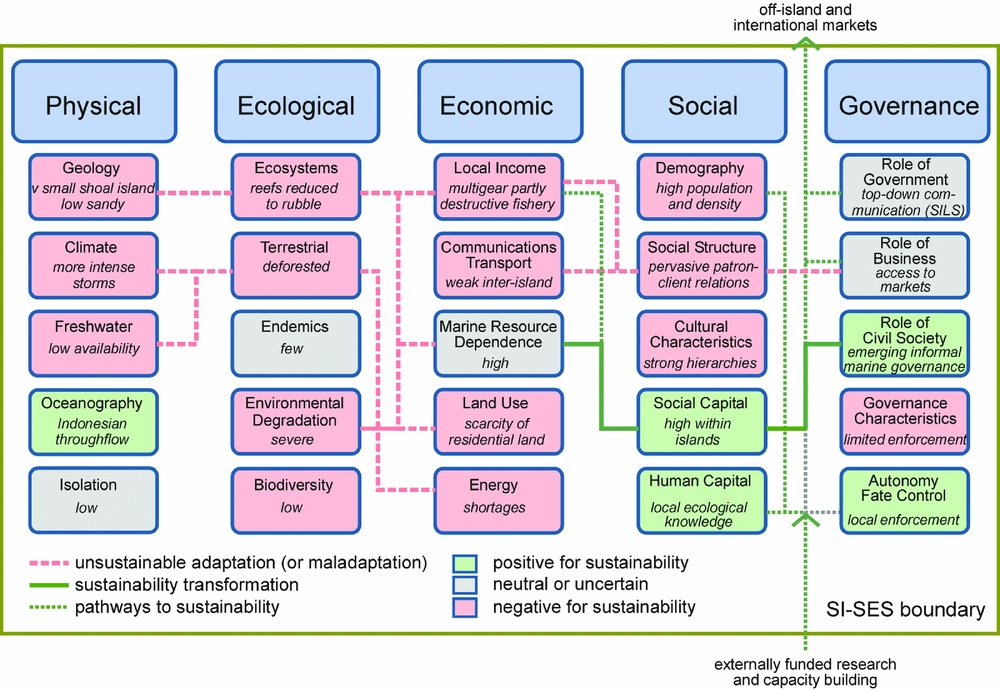
We apply the SIA framework in order to visualize and identify potential areas of vulnerability and resilience in the Spermonde Archipelago (Fig. 2). This case study highlights context-specific features posing sustainability challenges and components that support transformation to more sustainable futures.
Small-island archetypal (SIA) framework to identify adaptation and transformation options for the Spermonde Archipelago, Indonesia. SI-SES = small-island social–ecological system; SILS = small islands within larger state.

Physical factors
The Spermonde Archipelago extends over an area of about 2500 km2 some 20–60 km offshore from South Sulawesi, with about 100 coral cays and numerous barrier and submerged patch reefs (Moll Reference Moll1983, Tomascik et al. Reference Tomascik, Mah, Nontji and Moosa1997). The Indonesian through-flow current (Gordon Reference Gordon2005) affects the genetic structuring of marine species and their connectivity with the wider Indo-Malay Archipelago (Knittweis et al. Reference Knittweis, Kraemer, Timm and Kochzius2009). Two main seasons with different wind patterns (rainy northwest monsoon and dry southeast monsoon) are locally said to have become less predictable, with more intense storms (Ferse et al. Reference Ferse, Glaser, Neil and Schwerdtner Máñez2014).
Ecological factors
Fishing affects fish community structures (Pet-Soede et al. Reference Pet-Soede, Van Densen, Pet and Machiels2001b); high trophic-level species (e.g., sharks and groupers) and some commercial species are becoming rare and corallivorous crown-of-thorns starfish more common. Four ecological zones parallel to the shores of the southern peninsula of Sulawesi differ in eutrophication levels, composition of benthic taxa, availability of commercial species, zooplankton composition and the status of most coral species (e.g., Cornils et al. Reference Cornils, Schulz, Schmitt, Lanuru, Richter and Schnack-Schiel2010, Plass-Johnson et al. Reference Plass-Johnson, Taylor, Husain, Teichberg and Ferse2016). Many reefs have been reduced to rubble by blast fishing and coral bleaching.
Economic factors
Fishing has been intensive since the 14th century (Erdmann Reference Erdmann1995) and remains the main income source for the great majority of islanders. Supported by trader-patrons, local fishers use over 20 fishing techniques, including illegal blast and cyanide fishing, targeting crustaceans, sea cucumbers and many fish species (as live reef fish or ornamentals; Pet-Soede et al. Reference Pet-Soede, Van Densen, Hiddink, Kuyl and Machiels2001a, Ferse et al. Reference Ferse, Knittweis, Krause, Maddusila and Glaser2012). The archipelago has one of the largest live coral fisheries in Indonesia (Raymakers Reference Raymakers2001). Local marine products have entered international markets as local fishermen link with foreign importers via a chain of intermediary patrons and export companies (Ferse et al. Reference Ferse, Knittweis, Krause, Maddusila and Glaser2012). While the spatial distribution of local fishing was explained by its small operational scale a decade ago (Pet-Soede et al. Reference Pet-Soede, Van Densen, Hiddink, Kuyl and Machiels2001a), Spermonde fishermen today seasonally follow fish to distant waters, while Spermonde fishing grounds are targeted by external fishers.
Social factors
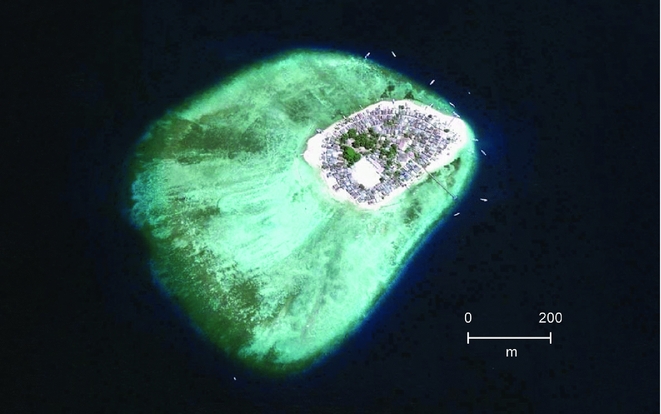
The archipelago has about 45 000 residents across 54 islands. Population density is 750 per hectare and growing (Fig. 3). Islanders are mostly of Makassarese and Buginese ethnic origin or descend from the Bajao/Bajo (also known as Sama). Most fishers are part of a patron–client system. Patrons provide access to markets, fishing gear, licences and loans and prevent law enforcement agencies from prosecuting ‘their’ client fishers when these are caught using illegal fishing gear or catching protected species (Radjawali Reference Radjawali2011). Some island societies are dominated by an individual strong leader, others are divided by conflicts; some show an explicit conservation orientation, while others focus on both regulated and non-regulated natural resource extraction (Glaeser & Glaser Reference Glaeser and Glaser2010, Glaser et al. Reference Glaser, Breckwoldt, Deswandi, Radjawali, Baitoningsih and Ferse2015). Despite a sophisticated formal structure to facilitate local participation in marine management, local knowledge about the government-initiated and community-based marine protected areas is low. Islanders see access to resources and influence in the programme as being open only to a minority (Glaser et al. Reference Glaser, Baitoningsih, Ferse, Neil and Deswandi2010). Adaptation strategies to deal with falling catches (e.g., loans from patrons, diversifying fishing methods and fishing migration within and beyond the archipelago) resolve issues only over the short term, at the individual level (Ferse et al. Reference Ferse, Glaser, Neil and Schwerdtner Máñez2014).
The densely populated small island Pulau Badi, Spermonde Archipelago (4°58′S 119°17′E), 11 January 2014, imagery © 2017 DigitalGlobe, courtesy of Google Earth Pro.

Governance factors
Spermonde spans two administrative units that both extend beyond the archipelago: Makkassar Municipality and Pangkep Regency. Communication across administrative units is rare (Gorris Reference Gorris2015). The official approach to marine management of the archipelago is community based and participatory, aiming to instil conservation practices in the face of illegal and destructive fishing. Provincial and national legislation (e.g., on coastal management, protected areas and fisheries), an internationally funded marine management project and the trans-national regional Coral Conservation Initiative are important governance elements, which are locally perceived as ‘top-down’ (Baitoningsih Reference Baitoningsih2009). There is little enforcement of fishing and conservation regulations. Although residents lack marine governance and management traditions, self-organizing, bottom-up governance of marine territories also occurs. Informal and island-specific rules in use are developing for clearly delimited and sometimes adjoining marine territories (Glaser et al. Reference Glaser, Baitoningsih, Ferse, Neil and Deswandi2010, Deswandi Reference Deswandi2012). These territories are defended by residents of different islands as ‘theirs’. Emergent rules on their use rest on the informal, strong notion of a marine ‘island exclusion zone’ over which island residents have authority (Glaser et al. Reference Glaser, Baitoningsih, Ferse, Neil and Deswandi2010, Deswandi et al. Reference Deswandi, Glaser, Fersen, Hornidge and Antweiler2012). The informal rule is that, as soon as an island is inhabited, residents gain rule-making rights over the surrounding waters. This self-organized construction of local rights explicitly aims to protect islanders’ interests against outsiders extending their reach.
Social–ecological system adaptation and transformation dynamics: potential for action
The strong connections to regional and international markets for marine products promote the perception among Spermonde islanders that the sea will always provide something for them to sell. Driven by markets and patron–client relations, they are targeting a growing number of species, often with illegal techniques such as blast and poison fishing. At the same time, fishing seasons are becoming less predictable, with more frequent storms and more dangerous fishing conditions (Glaser et al. Reference Glaser, Breckwoldt, Deswandi, Radjawali, Baitoningsih and Ferse2015). The growing island populations also cause increased pollution and reduce per capita availability of land (Fig. 3) and, in conjunction with climate change, of freshwater (Schwerdtner Mánez et al. Reference Schwerdtner Mánez, Husain, Ferse and Mánez Costa2012). This can undermine residents’ well-being, reduce resilience and increase vulnerability.
Foci to support transformation towards greater sustainability (Fig. 2) include the following:
• Patron–client relations enforce unsustainable marine resource use, providing great profits to a few. Alternative social security and market access options for fishers need to be explored.
• Local claims on marine territories are strong, but few coastal actors interact across administrative units.
Although not all locally emergent rules in the Spermonde Archipelago are conservation orientated (Glaser et al. Reference Glaser, Baitoningsih, Ferse, Neil and Deswandi2010, Deswandi Reference Deswandi2012), multiple instances of forceful local rule implementation, especially by islanders with productive local fishing grounds, indicate the potential for self-organizing and sustainability-enhancing marine management at a local community scale. Networking between central governance actors across larger areas composed of smaller units of locally self-organized marine governance offers a bottom-up pathway to marine governance at an ecologically relevant spatial scale (Deswandi Reference Deswandi2012). This requires an enabling umbrella framework to focus and link community efforts towards sustainably used marine areas (Ferse et al. Reference Ferse, Máñez Costa, Schwerdtner Máñez, Adhuri and Glaser2010, Glaser et al. Reference Glaser, Breckwoldt, Deswandi, Radjawali, Baitoningsih and Ferse2015).
CONCLUSIONS
The visualization benefits of frameworks include offering a whole-systems approach to synthesizing complex relationships in dynamic coastal systems. Despite different levels and ways of employing concepts such as social and human capital, the case study presented herein points to increased ocean governance options when island communities are effectively identified and engaged (Turner et al. Reference Turner, Forster, Fitzsimmons, Gill, Mahon, Peterson and Stead2017). Our framework builds on this potential for SES self-organization identified by Ostrom (Reference Ostrom2009) and provides a useful focus for understanding governance needs at the small-island level. As technical changes spread in exploiting marine resources, islanders’ sense of marine territoriality appears to be following suit, at least in some places (Glaser et al. Reference Glaser, Baitoningsih, Ferse, Neil and Deswandi2010, Campbell & Hanich Reference Campbell and Hanich2014). Where this is the case, marine protected area networks (Green et al. Reference Green, White, Christie, Kilarski, Meneses, Samonte-Tan and Bunce Karrer2011) can address implementation deficits via the joint efforts of small islands that protect and manage adjacent ocean regions locally perceived as ‘territories’ (Steneck et al. Reference Steneck, Paris, Arnold, Ablan-Lagman, Alcala, Butler and McCook2009, Deswandi Reference Deswandi2012). Within a multi-level and polycentric ocean governance framework (Visbeck et al. Reference Visbeck, Kronfeld-Goharani, Neumann, Rickels, Schmidt and van Doorn2013) in which islanders have decision-making rights and resources, such networks are likely to enhance local community capacities for improved ocean management (Turner et al. Reference Turner, Forster, Fitzsimmons, Gill, Mahon, Peterson and Stead2017).
Further case studies are clearly needed to develop and populate the SIA framework and evaluate its full potential. Extension to a SIS example is a logical next step and has been initiated in Fiji, while another pilot has been undertaken in India. With additional data-rich island case studies from other regions and social, political and economic contexts, a number of small-island SES dynamics are expected to emerge in relation to key coastal sustainability challenges. Systematic and adaptive analysis at the island level, enabled by the SIA framework, can inform island-level analysis and action, but is also expected to support regional to global coastal analysis and decision-making. So far, this framework is an explorative tool tested for its practical application to enhance our general insights and understanding of small-island SESs. It provides a context for the identification of some of the inhibitors and pathways presented herein. The overall resilience of a given island or island group may be assessed by the distribution of matrix colour and the strength of linkages between components. Undoubtedly, this approach will only be effective if developed with and by islanders and co-developed with decision-makers, thus becoming part of a self-directed change process. Transformation of small-island SESs, as windows to a more sustainable future, requires action to counter inhibiting factors. This framework can contribute effectively by visualizing and addressing specific areas of vulnerability and specific social and governance components with potential for transformation.
ACKNOWLEDGEMENTS
We are pleased to acknowledge support from Land-Ocean Interactions in the Coastal Zone (LOICZ). This is a contribution to its successor, Future Earth Coasts, and to the Ocean Governance challenge of the IMBeR (Integrated Marine Biosphere Research) project. The paper is rooted in discussions at three meetings: the LOICZ Open Science Conference in Yantai, China, 2011; the University of Maryland, 2012; and the IMBIZO III conference in Goa, India, 2013. Thanks to Hartwig Kremer, Eric Wolanski, Bernhard Glaeser and Alice Newton for collaboration in these events. We thank three anonymous reviewers for their detailed and constructive comments and Malin Delfs for sorting the literature references.
FINANCIAL SUPPORT
None.
CONFLICT OF INTEREST
None.
ETHICAL STANDARDS
None.