Introduction
Non-suicidal self-injury (NSSI) is alarmingly widespread in community samples of adolescents (Ross & Heath, Reference Ross and Heath2002; Zoroglu et al. Reference Zoroglu, Tuzun, Sar, Tutkun, Savas, Ozturk, Alyanak and Kora2003; Muehlenkamp & Gutierrez, Reference Muehlenkamp and Gutierrez2004, Reference Muehlenkamp and Gutierrez2007). NSSI involves the deliberate, direct destruction or alteration of body tissue with no conscious suicidal intent (Favazza, Reference Favazza1998; Lloyd-Richardson et al. Reference Lloyd-Richardson, Perrine, Dierker and Kelley2007). NSSI is heterogeneous, ranging from minor to severe forms (Lloyd-Richardson et al. Reference Lloyd-Richardson, Perrine, Dierker and Kelley2007; Whitlock et al. Reference Whitlock, Muehlenkamp and Eckenrode2008) and NSSI behaviours can be classified into subgroups based on their potential for causing tissue damage (Skegg, Reference Skegg2005; Whitlock et al. Reference Whitlock, Muehlenkamp and Eckenrode2008). Some find higher prevalence rates in girls than in boys (see, for instance, Ross & Heath, Reference Ross and Heath2002), whereas others find no sex difference (see, for instance, Muehlenkamp & Gutierrez, Reference Muehlenkamp and Gutierrez2004). Sex differences in forms and numbers of NSSI behaviours engaged in exist (Whitlock et al. Reference Whitlock, Muehlenkamp and Eckenrode2008).
According to the emotion regulation hypothesis, adolescents engage in NSSI to regulate their emotions, most often to decrease their negative affective states (Jacobson & Gould, Reference Jacobson and Gould2007). This is supported by findings showing that prior to engaging in NSSI, adolescents experience negative emotions, such as anger, sadness and anxiety, which are reduced during and especially after having self-injured (Ross & Heath, Reference Ross and Heath2003; Laye-Gindhu & Schonert-Reichl, Reference Laye-Gindhu and Schonert-Reichl2005). However, these findings are exclusively based on adolescents' retrospective self-reports (Jacobson & Gould, Reference Jacobson and Gould2007). This confirms the need for exploring the emotion regulation hypothesis in a more objective manner.
In a model of the neural basis of emotion processing, two neural systems underlie neuropsychological processes that are important for emotional behaviour (Phillips et al. Reference Phillips, Drevets, Rauch and Lane2003). The ventral system, including the amygdala, insula, ventral striatum, and ventral regions of the anterior cingulate gyrus and prefrontal cortex, is primarily important for the identification of the emotional significance of a stimulus, the ensuing production of an affective state, and the automatic regulation of emotional responses. The dorsal system includes the hippocampus and dorsal regions of anterior cingulate gyrus and prefrontal cortex. It is important for the performance of executive functions (EFs), which includes effortful regulation of affective states and emotional behaviours. This involves an inhibition or modulation of the processes that are mainly dependent upon the ventral system (Phillips et al. Reference Phillips, Drevets, Rauch and Lane2003). Thus, impaired EFs suggest an ineffective ability to regulate emotions. EFs may be defined as the skills that are essential for purposeful, goal-directed activity (Anderson, Reference Anderson1998). Although the different EFs are interrelated, they are meaningfully diverse abilities (Miyake et al. Reference Miyake, Friedman, Emerson, Witzki, Howerter and Wager2000). Shifting between mental sets or tasks, updating and monitoring of information in working memory (WM), and inhibition of dominant responses are main aspects of EFs (Miyake et al. Reference Miyake, Friedman, Emerson, Witzki, Howerter and Wager2000). Although not completely consistent (Herba et al. Reference Herba, Tranah, Rubia and Yule2006), some find sex differences in EFs in adolescents (Anderson et al. Reference Anderson, Anderson, Northam, Jacobs and Catroppa2001; Fields et al. Reference Fields, Collins, Leraas and Reynolds2009).
Only three studies have previously examined neuropsychological functions in adolescents engaging in self-injuring behaviours. No differences were found between adolescents and adults engaging in NSSI as compared with controls on measures of impulsivity (Janis & Nock, Reference Janis and Nock2009). Likewise, no differences were found between adolescents engaging in self-injurious behaviours and adolescents with none such behaviours on tests of EFs (Ohmann et al. Reference Ohmann, Schuch, Konig, Blaas, Fliri and Popow2008). However, adolescents who currently self-harmed showed impaired decision making compared with adolescents with a previous history of self-injuring, adolescents with depression and healthy controls (Oldershaw et al. Reference Oldershaw, Grima, Jollant, Richards, Simic, Taylor and Schmidt2009).
The primary aim of the present study was to explore the main aspects of EFs – shifting, updating and inhibition – in adolescents engaging in NSSI. Since adolescents engaging in NSSI constitute a heterogeneous group, we examined a high-severity NSSI group, a low-severity NSSI group in addition to a control group along these basic dimensions of EFs. As there may be sex differences in NSSI and EFs, we investigated the possible interactive effect of sex.
Method
Participants
A total of seventeen high schools in urban and nearby areas agreed to participate in the study. All grade 9 students present at the schools at the scheduled times were approached to participate. A total of 327 adolescents were recruited and participated in the screening session. Group sizes of approximately 30 adolescents would enable us to detect group differences (Kyte et al. Reference Kyte, Goodyer and Sahakian2005; Matthews et al. Reference Matthews, Coghill and Rhodes2008). To ensure such group sizes in the test session, we screened until we had 74 adolescents meeting the criteria for inclusion in the NSSI subgroups. The control group, matched as closely as possible for sex, ethnicity and school belonging, was randomly selected from those who had never engaged in any NSSI. This resulted in 116 adolescents being selected to participate in the test session (74 adolescents in the NSSI subgroups and 42 adolescents in the control group). As 13 of these withdrew from further participation, this left 103 adolescents participating in the test session. Based on participants' reported NSSI in the screening questionnaire and in the section on NSSI in the semi-structured diagnostic interview in the test session, participants were classified into three groups: a high-severity NSSI group (n=33), a low-severity NSSI group (n=29) and a control group (n=35). Of participants that had reported that they had never engaged in NSSI on the screening questionnaire, five revealed in the interview that they had engaged in one NSSI behaviour during the past year. They were excluded from all analyses as they failed to meet the criteria for any of the groups. Furthermore, due to extreme scores on several measures, one girl in the control group was excluded from all analyses.
NSSI was defined as the deliberate, direct destruction or alteration of body tissue with no conscious suicidal intent. Acts such as mentally hurting oneself and engaging in risky behaviours were excluded. Inclusion in the NSSI subgroups required that the adolescent had engaged in at least two different NSSI behaviours during the past year. Participants meeting these initial criteria were given a score reflecting the severity of their NSSI. Two NSSI characteristics were used to calculate the NSSI severity score; the form(s) and the total number of different NSSI behaviours engaged in.
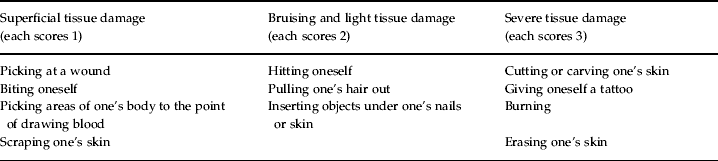
With respect to NSSI forms, NSSI behaviours were classified into three groups based on their potential for causing tissue damage (Skegg, Reference Skegg2005; Whitlock et al. Reference Whitlock, Muehlenkamp and Eckenrode2008). Behaviours with potential for superficial tissue damage were each scored 1, while those with potential for causing bruising or light tissue damage were each scored 2. Last, behaviours with potential for causing severe tissue damage were each scored 3.
To ensure reliability of the classification of NSSI behaviours into the three groups, training of two raters was completed, resulting in 90% agreement on 20% of the data. Table 1 summarizes the classification of NSSI behaviours into the three groups. For each participant meeting the initial criteria for inclusion in the NSSI subgroups, the weighted scores of the NSSI behaviours were summarized to give an NSSI severity score (mean=7.9, s.d.=3.6, median=7.0).
The categorization of NSSI behaviours into three groups

NSSI, Non-suicidal self-injury.
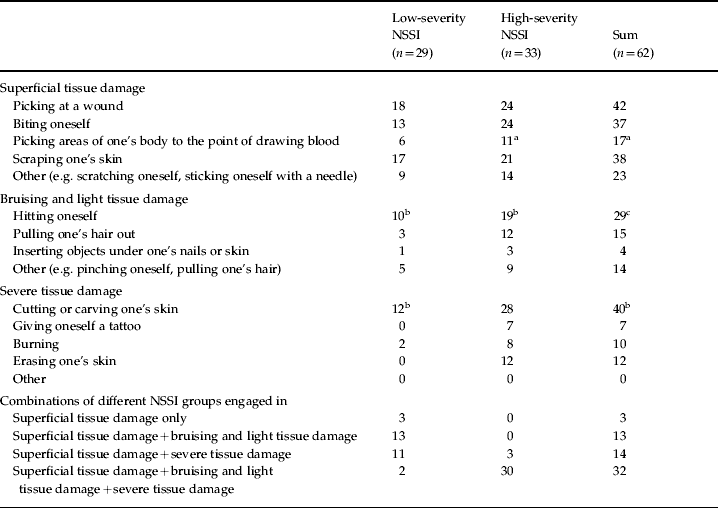
The median was used as the cut-off point separating the participants into the two NSSI subgroups. Of the participants, nine scored this value. Of these, five were classified into the high-severity NSSI group as they had engaged in NSSI behaviours in all three NSSI groups, a similar pattern to the majority (i.e. 25 of 28) of participants in the high-severity NSSI group. The four remaining participants were classified into the low-severity NSSI group as they had engaged in NSSI behaviours in two NSSI groups, either groups 1 and 2 or groups 1 and 3, a similar pattern to the majority (i.e. 20 of 25) of participants in the low-severity NSSI group. Table 2 summarizes the number of participants having engaged in each NSSI behaviour and in each combination of different NSSI groups, separately for each NSSI subgroup.
The number of participants having engaged in each NSSI behaviour and in each combination of different NSSI groups, separately for each NSSI subgroup

NSSI, Non-suicidal self-injury.
a Three scores missing.
b One score missing.
c Two scores missing.
The study was carried out in accordance with the Helsinki Declaration and accepted by the local regional ethics committee.
Measures
Symptom assessment
Functional Assessment of Self-Mutilation (FASM)
The FASM (Lloyd et al. 1997, cited by Lloyd-Richardson et al. Reference Lloyd-Richardson, Perrine, Dierker and Kelley2007) is a self-report questionnaire of the methods, frequency and functions of NSSI. Studies with adolescent samples have yielded support for its psychometric properties (Nock & Prinstein, Reference Nock and Prinstein2005; Lloyd-Richardson et al. Reference Lloyd-Richardson, Perrine, Dierker and Kelley2007).
Kiddie-Sads – Present and Lifetime Version (K-SADS-PL)
The K-SADS-PL (Kaufman et al. Reference Kaufman, Birmaher, Brent, Rao, Flynn, Moreci, Williamson and Ryan1997) is a semi-structured diagnostic interview assessing current and lifetime history of psychopathology in children and adolescents according to DSM-IV criteria (APA, 1994). The following diagnoses were considered particularly relevant and were examined: major depressive disorder (MDD), generalized anxiety, obsessive compulsive disorder, panic disorder, social phobia, post-traumatic stress disorder, anorexia nervosa, bulimia nervosa, attention deficit hyperactivity disorder, alcohol abuse and substance abuse.
Beck Depression Inventory (BDI)
The BDI (Beck et al. Reference Beck, Steer and Garbin1988 b) is a 21-item self-report measure of depressive symptoms. Its psychometric properties for use with adolescents are supported (Larsson & Melin, Reference Larsson and Melin1990; Ambrosini et al. Reference Ambrosini, Metz, Bianchi, Rabinovich and Undie1991).
Beck Anxiety Inventory (BAI)
The BAI (Beck et al. Reference Beck, Epstein, Brown and Steer1988 a) is a 21-item self-report measure of anxiety. It shows acceptable psychometric properties in adolescent samples (Jolly et al. Reference Jolly, Aruffo, Wherry and Livingston1993; Osman et al. Reference Osman, Hoffman, Barrios, Kopper, Breitenstein and Hahn2002).
State-Trait Anger Expression Inventory (STAXI)
The STAXI (Spielberger, Reference Spielberger1988) is a self-report measure of the experience and expression of anger. It has been used with adolescents (Guertin et al. Reference Guertin, Lloyd-Richardson, Spirito, Donaldson and Boergers2001). Its subscales have adequate internal consistency and construct validity (Spielberger, Reference Spielberger1988).
Neuropsychological tests
Wechsler Abbreviated Scale of Intelligence (WASI)
The WASI (Psychological Corporation, 1999) provides a brief estimate of intelligence. It consists of four subtests: vocabulary, block design, similarities, and matrix reasoning. The primary variables of interest were the total intelligence quotient (IQ) score and the IQ sum scores on the verbal and non-verbal tests, respectively.
Cambridge Neuropsychological Test Automated Battery (CANTAB)
Tests were selected from the Cambridge Neuropsychological Test Automated Battery (CANTAB; Cambridge Cognition, 2006): obligatory training tests and EF tests.
The obligatory training tests administered were The Motor Screening test (MOT) and Big/Little Circle (BLC), which are training tests administered in advance of other CANTAB tests.
Each of the three EF tests administered measures each of the main aspects of EFs, i.e. shifting, updating and inhibition (Miyake et al. Reference Miyake, Friedman, Emerson, Witzki, Howerter and Wager2000).
The Intra/Extradimensional (IED) Set Shift measures shifting. The subject must learn which of two presented stimuli is correct, assisted by feedback from the computer. Initially, two stimuli of one dimension (pink shapes) are shown, then each of two dimensions (pink shapes and white lines) are shown. The stimuli and/or rules change after six consecutive correct responses (the criterion of learning at each stage). These shifts are initially intra-dimensional (pink shapes are the relevant dimension), then extra-dimensional (white lines become the relevant dimension). The test terminates if at any stage the subject fails to reach the criterion of learning after 50 trials. The variables of interest were: stages completed, pre-ED errors and EDS errors. These reflect the number of stages completed successfully, the number of errors made prior to the extra-dimensional shift and in the extra-dimensional stage of the task, respectively.
The Spatial Working Memory (SWM) test measures updating and monitoring of spatial information in WM. The screen displays a number of boxes. The subject has to find one token in each box and use them to fill up a column on the side of the screen. Gradually, the number of boxes increases from three to eight. Touching any box where a token has already been found is an error. The subject decides the order in which boxes are visited. The variables of interest were total errors and strategy, reflecting the number of errors made and the use of an efficient strategy for completing the task, respectively.
The Stop Signal Task (SST; Logan et al. Reference Logan, Cowan and Davis1984) measures inhibition of dominant responses. The screen shows a white ring, in which a left- or right-pointing arrow is displayed. First, the subject has to press the left button on a press pad when seeing a left-pointing arrow, and the right button when seeing a right-pointing arrow. In the second part of the task, the subject has to continue pressing the buttons as before, but has to withhold pressing the button if hearing a beep. The variables of interest were direction errors on stop and go trials and stop signal reaction time (SSRT) last half, expressing the number of times the subject pressed the wrong button and the ability to inhibit an initiated response (Eagle et al. Reference Eagle, Baunez, Hutcheson, Lehmann, Shah and Robbins2007), respectively.
Procedure
A researcher met all potential participants in their classrooms, informing them about the study. The adolescents also received written information, including information to their parents. Before participation, all participants and their parents signed an informed consent. The participants were seen in two sessions.
Screening session
The participants from each school completed the FASM in a classroom. On the basis of their responses to the FASM, participants meeting the criteria for inclusion in the NSSI subgroups were identified.
Test session
All participants met at the Department of Psychology at the University in Oslo. They completed the following tests: MOT, BLC, IED, SWM, SST and WASI. They also completed BDI, BAI and STAXI. A clinical psychologist administered the sections covering the selected psychiatric diagnoses in K-SADS-PL. All participants were tested individually and were compensated 25 Euros for their participation.
Statistical analysis
spss for Windows (version 16.0; SPSS Inc., USA) was used to register and analyse data. To assess group differences in depressive and anxious symptoms and anger, one-way between-groups analyses of variance (ANOVA) were completed. Group comparisons in frequencies of each diagnosis were performed using χ2 tests.
Scores on the dependent variables on the three EF tests were converted to Z scores. In doing so, we were able to make mean Z scores, reflecting the mean scores of the variables on each EF test for each participant; one for the IED test variables, one for the SWM test variables and one for the SST variables. When positive scores on the dependent variables on the EF tests had opposite meanings in their interpretation, some of them were reversed accordingly.
In instances of group differences in frequencies of diagnoses, one-way between-groups ANOVA were conducted to explore the main effects of the particular diagnoses on the mean Z score of the variables on each EF test.
To explore main effects of group and sex and their possible interaction on the mean Z score of the variables on each EF test, two-way between-groups ANOVA were performed. Only when these initial analyses yielded significant effects, further two-way ANOVA with scores on each variable on the relevant EF test were completed. Post-hoc comparisons using the least significant difference (LSD) test were applied. When interaction effects between group and sex were found, post-hoc comparisons were applied using a dummy variable with six values representing the six possible combinations of sex and group (2×3).
As a criterion of statistical significance, an α level of p<0.05 was used. Results reaching trend level (defined as p<0.1) on main or interaction effects are included and commented on.
Results
Demographic, psychometric and clinical characteristics
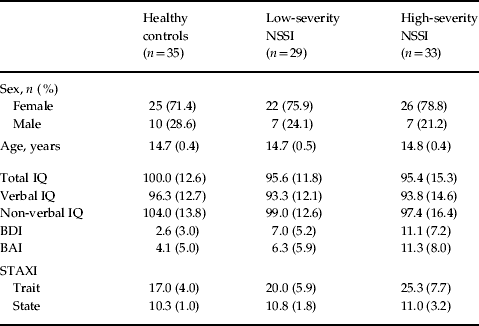
Table 3 summarizes group demographic, psychometric and clinical characteristics. For two girls in the low-severity NSSI group, current MDD and previous generalized anxiety, respectively, were scored as missing as sufficient information was not obtained in the diagnostic interview. There were no significant group differences in age, sex ratios or on any IQ indicators.
Demographic, psychometric and clinical characteristics

NSSI, Non-suicidal self-injury; IQ, intelligence quotient; BDI, Beck Depression Inventory; BAI, Beck Anxiety Inventory; STAXI, State-Trait Anger Expression Inventory.
Values are given as mean (standard deviation) unless otherwise indicated.
There were significant group differences on the BDI score [F(2, 94)=21.16, p=0.00, η2=0.31]; the high-severity NSSI group had a higher score than the low-severity NSSI group (p=0.00) and the control group (p=0.00), respectively. The low-severity NSSI group showed a higher score than the control group (p=0.00).
The score on the BAI showed significant group differences [F(2, 94)=11.20, p=0.00, η2=0.19]; the high-severity NSSI group had a higher score than both the control group (p=0.00) and the low-severity NSSI group (p=0.00).
There were significant group differences on the STAXI trait score [F(2, 94)=16.70, p=0.00, η2=0.26]; the high-severity NSSI group showed a higher score than both the control (p=0.00) and the low-severity NSSI group (p=0.00), respectively. Also, the low-severity NSSI group had a higher score than the control group (p=0.05). No significant group differences were found on the STAXI state score.
There were no significant group differences in frequencies of any diagnoses with the exception of current MDD (control group=0%, low-severity NSSI group=10.7%, high-severity NSSI group=21.2%, χ2=8.19, df=2, p<0.02) and previous MDD (control group=0%, low-severity NSSI group=0%, high-severity NSSI group=15.2%, χ2=10.22, df=2, p<0.01). However, there was a trend towards significant group differences on current social phobia (control group=0%, low-severity NSSI group=3.4%, high-severity NSSI group=12.1%, χ2=5.35, df=2, p<0.07).
No main effects of either current or previous MDD on the mean Z scores of the IED variables, the SWM variables or the SST variables, respectively, were found. Accordingly, they were not included in further analyses.
Performance on EF tasks
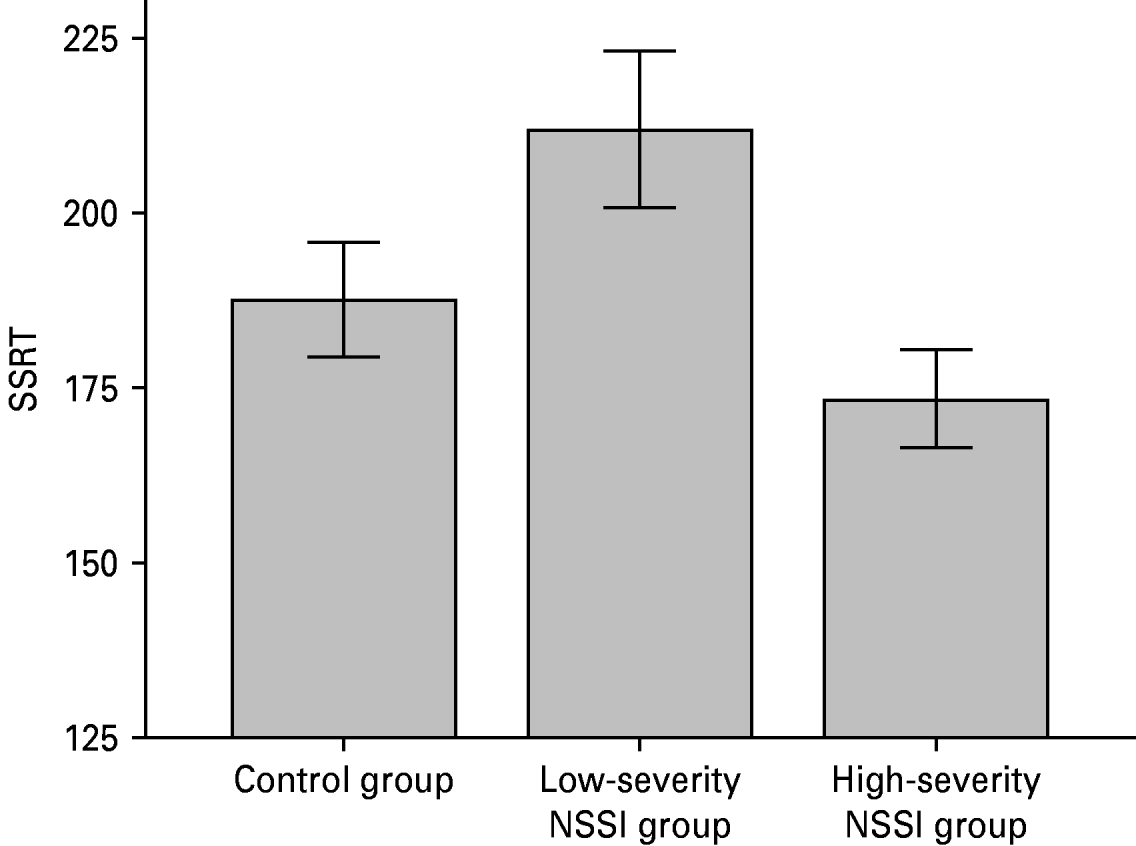
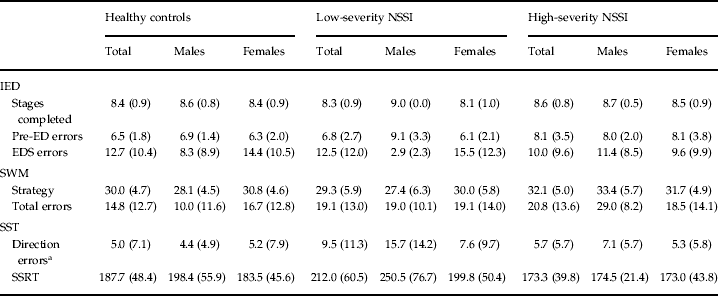
Table 4 summarizes performance on all EF tasks, displayed by each group and separately for males and females in each group. Fig. 1 depicts group differences in scores on the SSRT.
Scores on the Stop Signal Reaction Time (SSRT) for the three groups. Values are means, with standard errors represented by vertical bars. NSSI, Non-suicidal self-injury.

Summary of results on all executive function tasks in each group and separately for males and females in each group

NSSI, Non-suicidal self-injury; IED, Intra-Extradimensional Set Shift; Pre-ED errors, errors made prior to the extra-dimensional shift; EDS errors, errors made in the extra-dimensional stage; SWM, Spatial Working Memory; SST, Stop Signal Task; SSRT, Stop Signal Reaction Time.
Values are given as mean (standard deviation).
a Direction errors on stop and go trials.
IED variables
No significant group or sex differences or any interaction effect between group and sex were found on the mean Z score of the IED variables.
SWM variables
On the mean Z score of the SWM variables, there were significant group differences [F(5, 91)=3.98, p=0.02, η2=0.08]. There were no significant sex difference or interaction effect between group and sex. Post-hoc comparisons revealed no significant group differences.
Significant group differences were found on the SWM total error score [F(5, 91)=4.08, p=0.02, η2=0.08], but no sex difference was found. There was a trend towards a significant interaction effect between group and sex [F(5, 91)=2.75, p=0.07, η2=0.06]. A scatter plot inspection of these results revealed that the significant main effect of group was caused by the interaction effect of sex. Post-hoc comparisons showed that males in the high-severity NSSI group had a higher score than both males (p=0.00) and females in the control group (p=0.03).
On the SWM strategy score, there were significant group differences [F(5, 91)=3.52, p=0.03, η2=0.07]; the high-severity NSSI group had a higher score than the low-severity NSSI group (p=0.04). No significant sex difference or interaction effect between group and sex emerged.
SST variables
On the mean Z score of the SST variables, there were significant group differences [F(5, 91)=6.26, p=0.00, η2=0.12]; the low-severity NSSI group had higher scores than the control group (p=0.02) and the high-severity NSSI group (p=0.01), respectively.
A trend towards a sex difference [F(5, 91)=3.91, p=0.05, η2=0.04] was found, while no interaction effect between group and sex emerged.
On the score on SST direction errors on stop and go trials, there were significant group differences [F(5, 91)=4.61, p=0.01, η2=0.09]; the low-severity NSSI group had a higher score than the control group (p=0.03). There were no sex difference or interaction effect between group and sex.
There were significant group differences on the score on the SSRT variable [F(5, 91)=6.21, p=0.00, η2=0.12]; the low-severity NSSI group had a higher score than the high-severity NSSI group (p=0.00). A trend towards a sex difference emerged [F(5, 91)=3.71, p=0.06, η2=0.04], while no interaction effect between group and sex was found.
Discussion
The main finding in this study was that the high-severity NSSI group had WM deficits, while the low-severity NSSI group had impaired inhibitory control. There were no significant group differences in IQ, strengthening the conclusion that the results reflect impairments in specific aspects of EFs and not group differences in general cognitive abilities. Neither NSSI subgroups had shifting deficits.
The males in the high-severity NSSI group made particularly many errors on the WM task, emphasizing the importance of examining interaction effects of sex. Nevertheless, the females in the high-severity NSSI group also had WM deficits, as shown in their poor use of the efficient strategy in completing the task. Males in the low-severity group had the most impaired inhibitory control; however, the females in the same group showed the same pattern.
Our findings replicate previous findings of associations between NSSI and depressive (Ross & Heath, Reference Ross and Heath2002; Laye-Gindhu & Schonert-Reichl, Reference Laye-Gindhu and Schonert-Reichl2005) and anxious symptoms (Ross & Heath, Reference Ross and Heath2002) and anger control problems (Laye-Gindhu & Schonert-Reichl, Reference Laye-Gindhu and Schonert-Reichl2005). Those meeting criteria for a current or a previous MDD did not perform worse on the EF tests than those who did not meet the criteria. This indicates that impairments in EFs in adolescents engaging in NSSI are not just an expression of an underlying psychological disorder.
The adolescents in the high-severity NSSI group had WM deficits, suggesting that their ability to distract themselves to regulate negative moods is impaired. By loading WM with tasks demanding effortful cognitive processing, mood-congruent processing can be prevented and thereby result in distraction from negative moods (Van Dillen & Koole, Reference Van Dillen and Koole2007). In this way WM is one mechanism through which distraction from negative moods operates (Van Dillen & Koole, Reference Van Dillen and Koole2007) and is thereby related to emotion regulation.
Following a predetermined search sequence is an efficient strategy in completing the WM task (Owen et al. Reference Owen, Downes, Sahakian, Polkey and Robbins1990). The poor use of this strategy among adolescents in the high-severity NSSI group suggests that they struggle in focusing on a specific strategy, reflecting a fundamental deficit in their use of organizational strategies (Owen et al. Reference Owen, Downes, Sahakian, Polkey and Robbins1990). This might complicate their strategically loading of WM with mood-incongruent processing, and thereby impair their ability to distract themselves from negative moods. Previous findings show a positive association between strategy score and number of errors (Owen et al. Reference Owen, Downes, Sahakian, Polkey and Robbins1990). For the males in the high-severity NSSI group, the poor use of the efficient strategy may explain the many errors they made. However, this does not apply for the females, making no more errors than the other groups. This is difficult to explain. Using the efficient strategy may reduce the loading on WM (Owen et al. Reference Owen, Downes, Sahakian, Polkey and Robbins1990). Apparently females in the high-severity NSSI group can complete tasks requiring WM, but due to ineffective organizational strategies, their WM becomes ‘overloaded’. This could impair their ability to distract themselves from negative moods.
Another mechanism through which emotion regulation occurs is suppression, demanding inhibition of prepotent responses (Nash et al. Reference Nash, Henry, McDonald, Martin, Brodaty and Peek-O'Leary2007). Although suppression does not provide relief from negative emotions, it can inhibit emotional behavioural expression (Gross & Levenson, Reference Gross and Levenson1997). In light of the emotion regulation hypothesis, it is surprising that the high-severity NSSI group did not have impaired inhibitory control. In contrast, the impaired inhibitory control found in the low-severity NSSI group might suggest an impaired ability to suppress emotional behavioural expressions of negative emotions.
Our finding of no impaired inhibitory control in the high-severity NSSI group implies that their self-injuring is not engaged in impulsively. Although engaging in similar NSSI behaviours, the high-severity NSSI group may engage in NSSI behaviours in a more deliberate, self-injuring way than the low-severity NSSI group. This is consistent with previous research showing that adolescents engaging in moderate/severe NSSI are likely to contemplate NSSI before engaging in the behaviour (Lloyd-Richardson et al. Reference Lloyd-Richardson, Perrine, Dierker and Kelley2007).
In contrast, the impaired inhibitory control in the low-severity NSSI group suggests an impulsive nature of their self-injuring. As there are individual differences in the degree to which adolescents engage in emotion-based rash action and risky behaviour (Cyders & Smith, Reference Cyders and Smith2008), the adolescents in the low-severity NSSI group might be on the one extreme on this disposition. Accordingly, their self-injuring might primarily reflect benign, clinically insignificant experimenting with these behaviours. This is in contrast to the self-injuring nature of the same behaviours, reflecting pathological, clinically significant NSSI among the adolescents in the high-severity NSSI group.
With one exception (Oldershaw et al. Reference Oldershaw, Grima, Jollant, Richards, Simic, Taylor and Schmidt2009), our main findings are inconsistent with previous findings of no impaired EFs in adolescents engaging in NSSI. There are several possible explanations for the inconsistency. First, previous studies have only had one NSSI group. As adolescents engaging in NSSI represent a heterogeneous group (Lloyd-Richardson et al. Reference Lloyd-Richardson, Perrine, Dierker and Kelley2007; Whitlock et al. Reference Whitlock, Muehlenkamp and Eckenrode2008), we classified them into subgroups, thereby finding distinctive features for each group. Furthermore, the use of different EF tests can explain the inconsistency. The theoretically driven tests used in our study accurately measure each main aspect of EFs (Robbins et al. Reference Robbins, James, Owen, Sahakian, Lawrence, McInnes and Rabbitt1998; Miyake et al. Reference Miyake, Friedman, Emerson, Witzki, Howerter and Wager2000) and can detect specific impairments in adolescent populations (Fagerlund et al. Reference Fagerlund, Pagsberg and Hemmingsen2006; Matthews et al. Reference Matthews, Coghill and Rhodes2008). Last, self-injury has been defined differently across studies, possibly influencing the findings.
The behaviours that qualify for NSSI and those that are of clinical significance are unresolved issues (Lloyd-Richardson et al. Reference Lloyd-Richardson, Perrine, Dierker and Kelley2007). We decided to use as criteria for inclusion in the NSSI subgroups that the adolescents had engaged in at least two different NSSI behaviours during the past year because, first, this would exclude adolescents only endorsing the item ‘picked at a wound’, as it in isolation may reflect non-pathological, non-NSSI (Lloyd-Richardson et al. Reference Lloyd-Richardson, Perrine, Dierker and Kelley2007). Second, previous studies (Ross & Heath, Reference Ross and Heath2002; Laye-Gindhu & Schonert-Reichl, Reference Laye-Gindhu and Schonert-Reichl2005) have included adolescents having only engaged in one NSSI behaviour as self-injurers. Thus, our criteria did not seem too liberal. Third, in a community sample of adolescents, the mean number of different NSSI behaviours performed was 2.35 (Lloyd-Richardson et al. Reference Lloyd-Richardson, Perrine, Dierker and Kelley2007). Our criteria could not be too conservative relative to this finding, i.e. it should capture the average adolescent engaging in NSSI in a community sample.
Furthermore, our procedure for classifying adolescents into the NSSI subgroups was based on a thorough literature review. The NSSI forms and the number of different NSSI behaviours engaged in are particularly important in distinguishing NSSI severity (Jacobson & Gould, Reference Jacobson and Gould2007; Whitlock et al. Reference Whitlock, Muehlenkamp and Eckenrode2008). NSSI frequency was not included in quantifying NSSI severity for two reasons. First, its association with severity is unclear (Jacobson & Gould, Reference Jacobson and Gould2007). Second, frequency of NSSI is difficult to assess retrospectively (Jacobson & Gould, Reference Jacobson and Gould2007). In accordance with this, a substantial number of the adolescents in our study claimed that they did not know or could not remember how many times they had engaged in NSSI. Thus, we found NSSI frequency to be a too unreliable criterion for NSSI severity.
The relatively few males in our sample raises the question of the reliability of our findings. By interpreting our findings as reflecting real group differences, there is a risk of committing a type I error. However, rejecting our findings entails the possibility of committing a type II error. The risks of ignoring our findings of impairments in EFs in adolescents self-injuring seem substantial. However, the reliability of our findings will be strengthened if replicated with samples including more males. Furthermore, it would be interesting to explore individual differences within the NSSI subgroups in future studies.
In addition to impaired EFs, increased emotional reactivity can constitute a vulnerability for emotional dysregulation (Nock et al. Reference Nock, Wedig, Holmberg and Hooley2008). Heightened levels of activity within the ventral system may be associated with increased emotional reactivity, resulting in abnormalities in emotional regulation (Phillips et al. Reference Phillips, Drevets, Rauch and Lane2003). Including a measure of emotional reactivity in future research may inform us whether adolescents engaging in NSSI also have a vulnerability in this respect.
In conclusion, NSSI subgroups have distinct deficits in EFs, supporting the emotion regulation hypothesis.
Acknowledgements
We thank all the adolescents who participated in the study and Ragnhild Bø and Øyvind Bastnes Lie for their valuable assistance in collecting data. The study was supported by grants from the Norwegian Directorate for Children, Youth and Family Affairs (06/34707) to L.T.F. and A.M.
Declaration of Interest
None.