Clergy are not only important religious leaders, but they can have considerable political impact as well, given “the strategic positions they occupy in American religious and public life” (Smidt Reference Smidt2016, 2).Footnote 1 With weekly audiences unmatched by any other American voluntary organization (Cnaan et al. Reference Cnaan, Boddie, McGrew and Kang2006, 124; Smidt Reference Smidt2016, 21–22), ministers have enormous potential as “cue-givers,” especially among their parishioners (Djupe and Gilbert Reference Djupe and Gilbert2002, Reference Djupe and Gilbert2003, Reference Djupe and Gilbert2009; Woolfalk Reference Woolfalk2012, Reference Woolfalk2014), as regular church attenders frequently report receiving political messages from their pastor (Martínez, Smith, and Cooperman Reference Martínez, Smith and Cooperman2016; Brown, Brown, and Jackson Reference Brown, Brown and Jackson2021).
Clergy shepherd congregations, and congregations typically serve as a moral community for those who worship regularly.Footnote 2 This fact that congregations serve as moral communities fundamentally differentiates involvement in congregational life from that of other forms of voluntary associations, with clergy playing a far more significant role in the life of congregational members than do comparable leaders of other voluntary associations. And, although clergy may well provide their congregants guidance on spiritual and moral problems, they may also do so on political matters by mobilizing congregants through agenda-setting or by directly encouraging political action (Guth et al. Reference Guth, Green, Smidt, Kellstedt and Poloma1997; Djupe and Gilbert Reference Djupe and Gilbert2003; Olson Reference Olson, Smidt, Kellstedt and Guth2009). And, if some recent analyses are correct, their efforts may also influence politics by producing political and even religious “counter-reactions” from those opposed to their aims (Campbell, Layman, and Green Reference Campbell, Layman and Green2021).
Like most work on American electoral behavior, the literature on clergy politics has often focused on partisanship. This is largely because party identification reveals “more about (one's) political attitudes and behavior than does any other single piece of information” (Hershey Reference Hershey2013, 109), as partisanship serves to structure political perceptions, forge stances on issues, and shape candidate evaluations (Campbell et al. Reference Campbell, Converse, Miller and Stokes1960; Lewis-Beck et al. Reference Lewis-Beck, Jacoby, Norpoth and Weisberg2011). And, although clergy partisanship may be of interest in any presidential election, the 2016 contest provides an intriguing context for assessing the profession's electoral behavior. Donald Trump's campaign statements, his frequent challenges to the norms of civil discourse, and public doubts about his moral and religious character seemed almost designed to destabilize previous clergy voting patterns, particularly among Republicans. This article therefore examines the electoral choices of American Protestant clergy in 2016, focusing especially on the reaction of Republican clergy to Trump's candidacy.
In addressing this matter, we first review the literature on clergy partisanship and note several trends within American society and the profession that may have altered partisan alignments. Then, after a brief description of the data employed, we examine clergy partisanship in 2016 and report on the presidential candidates favored by clergy in the primaries and in the general election, and then compare their voting patterns with those of denominational laity. Given that psychological and attitudinal factors beyond party identification have also been linked to electoral choice in 2016 (Sides, Tesler, and Vavreck Reference Sides, Tesler and Vavreck2018; Whitehead, Perry, and Baker Reference Whitehead, Perry and Baker2018), we next consider how such factors shaped presidential voting among these religious professionals. And, finally, we use logistic regression to assess the direct influence of party identification, attitudes, and demographic factors on voting.
The Partisanship of Clergy
Clergy partisanship obviously shapes the nature of any political cues conveyed to congregants. And ministers do provide cues: many clergy report taking public stands on political issues regularly, talking about political candidates, and urging their congregants to vote (Guth et al. Reference Guth, Green, Smidt, Kellstedt and Poloma1997; Brewer, Kersh, and Petersen Reference Brewer, Kersh and Petersen2003; Djupe and Gilbert Reference Djupe and Gilbert2003). Although cue-giving is certainly not limited to the pulpit, participant observations reveal that clergy do indeed address political issues from that venue (Brewer, Kersh, and Petersen Reference Brewer, Kersh and Petersen2003; Woolfalk Reference Woolfalk2013). Finally, although most sermons lack direct political statements, an extensive analysis of over 21,000 sermons from more than 2,100 American clergy has shown that: (1) many sermons include implicit political content, (2) some clergy do include explicit messages, and (3) overt political messages are more common from mainline Protestant clergy than from evangelical ministers (Woolfalk Reference Woolfalk2013, 24–26).Footnote 3
Of course, the question remains: Do such cues influence those receiving them? Efforts made to assess the effects of clergy cues among congregants (e.g., Bjarnason and Welch Reference Bjarnason and Welch2004; Smith Reference Smith2008; Djupe and Gilbert Reference Djupe and Gilbert2009) have yielded somewhat conflicting findings. However, experimental studies have revealed that “clergy political speech can in many cases move congregant attitudes” (Knoll and Bolin Reference Knoll and Bolin2019, 8), but that “not all cues are equally effective at activating religious thinking in politics” (Woolfalk Reference Woolfalk2013, 56). In fact, implicit cues tend to be more effective: “only implicit cues have a multidimensional influence on political behavior and a reinforcing effect on political attitudes and moral issue evaluations” (Woolfalk Reference Woolfalk2013, 58–59). And, of course, clergy may convey a different sort of “cue” by means of their own public political engagement.
Although many factors shape clergy cue-giving, a familiar theme is that “clergy are motivated to avoid conflict in their congregations” (Knoll and Bolin Reference Knoll and Bolin2019, 5). Not surprisingly, then, when political messages are delivered by clergy from the pulpit, they are often brief and implicit rather than lengthy and explicit (Djupe and Gilbert Reference Djupe and Gilbert2002; Brewer, Kersh, and Petersen Reference Brewer, Kersh and Petersen2003; Smidt and Schaap Reference Smidt and Schaap2009)—the very kind of cues most likely to have an impact. And, the partisanship of clergy shapes the nature of the political cues clergy offer to parishioners, as clergy are more likely to engage in cue-giving activities based on their partisan identifications than on their theological orientations (Smidt Reference Smidt2016, 183).
Previous Findings: Clergy Partisanship
A half century ago, religious historian Marty (Reference Marty1970) outlined the existence of a “two-party system” in American Protestantism—comprised of theological conservatives and theological liberals. Although rooted in religious controversies, this divide soon extended into political life, as Johnson's (Reference Johnson1966, Reference Johnson1967) study of Oregon clergy found that theological liberalism was associated with both ideological liberalism and Democratic identity.
Nearly two decades later, a national multi-denominational survey of Protestant pastors confirmed that Marty's theological division was shaping the world of partisan politics among clergy, with theological conservatives coalescing in the GOP and more liberal clergy in the Democratic Party (Guth et al. Reference Guth, Green, Smidt, Kellstedt and Poloma1997). Theological conservatives were located primarily in evangelical Protestant denominations, while theological liberals were even more concentrated in mainline Protestant churches. Thus, by the late 1980s, evangelical clergy had become overwhelmingly conservative and Republican, whereas mainline clergy were more liberal and Democratic, although their ranks also included significant conservative and Republican minorities.
While these basic patterns persisted over the next two decades, there were several important modifications (Smidt Reference Smidt2016, 187–188).Footnote 4 First, in the late 1980s, many clergy still shunned strong party ties by preferring “an independent or, more often, an independent-leaning classification” (Guth et al. Reference Guth, Green, Smidt, Kellstedt and Poloma1997, 118). Two decades later, however, clergy from the same seven Protestant denominations included far fewer independents—dropping from nearly half in 1989 to a little more than a third in 2009. Second, overall party identification had shifted in a Republican direction: in 1989, Republicans outnumbered Democrats about 3 to 2, but by 2009 the ratio was closer to 4 to 2. And, finally, clergy were increasingly prone to claim “strong” partisan identifications, increasing from 30 to 42% over the same period. For the most part, their electoral choices reflected these partisan patterns (Smidt Reference Smidt2016, 188, 194).
Potential Factors Altering Previous Findings
Clearly, the party identifications and electoral choices of clergy are not static, as individual-level and aggregate-level shifts in partisanship can result from a number of sources. First, changes in the profession's social composition may alter partisan patterns. For example, most of the “new breed” liberal, activist clergy ordained in the 1960s (Cox Reference Cox1967; Garrett Reference Garrett1973) were still ministering in the late 1980s, but by 2016 they had been replaced by new generations of clergy. And since the late 1980s, more women and second-career pastors have entered the profession (Smidt Reference Smidt2016, 44–50). At the same time, those reaching maturity in the Reagan era and joining the ranks of clergy in the 1990s tended to be more orthodox and conservative in many Protestant denominations, at least in comparison with the 1960s “new breed.”
In addition to changes in the profession, the meaning of party identification itself can shift over time. Political parties are transformed in various ways: the public policies that they advance may change; the types of candidates they nominate for public office may be altered; and, the parties' social constituencies can shift, as groups reconsider their loyalties. Given such possible changes, public perceptions of party membership can be reconfigured. Thus, what it means to be a Democrat or a Republican may mutate, as citizens engage in a historical, collective process of meaning-making related to party membership (Kreiss Reference Kreiss2017, 447).
Moreover, the foundations of partisan identification can change. Party identification can rest on two different footings—either instrumental or expressive (Huddy and Bankert Reference Huddy and Bankert2017). Instrumentally, party identification derives from a cognitive assessment of a citizen's political and ideological stances compared to those of the major parties. Partisanship is thus a function of a continuing assessment of party performance, ideological orientations, and policy proximity. On the other hand, an “expressive” interpretation sees party identifications forged from some enduring political identity, strengthened by a linkage to emotional ties of affiliation with salient social groups (e.g., those based on gender, religion, ethnicity or race). This expressive understanding of partisan identification has seen growing scholarly acceptance, as it can “better account for the stability of partisan attachments, their relative immunity to short-term economic and political fluctuations, the powerful influence of partisanship on vote choice independently of issues preferences, and the power of partisan elites to influence rank-and-file partisan opinion” (Huddy and Bankert Reference Huddy and Bankert2017, 3). Accordingly, partisan identifications may be tied more to the social groups with which Americans identify than to their issue positions or ideological orientations.
This expressive interpretation is related to the much-noted rise of political polarization in the electorate, due in part to “negative partisanship” (Abramowitz and Webster Reference Abramowitz and Webster2016) or, alternatively, “affective polarization” (Iyengar, Sood, and Lelkes Reference Iyengar, Sood and Lelkes2012; Iyengar et al. Reference Iyengar, Lelkes, Levendusky, Malhotra and Westwood2019). Both concepts recognize that party identifiers have increasingly come to dislike and distrust their partisan opponents. From the perspective of social identity theory, animosity toward the opposing party (known as “affective polarization”) is “a natural offshoot” of partisan identity (Iyengar et al. Reference Iyengar, Lelkes, Levendusky, Malhotra and Westwood2019, 130). “Natural” or not, negative affect toward the opposing party has grown markedly (Abramowitz and Webster Reference Abramowitz and Webster2016), attributed variously to the decline of cross-cutting identities (Mason Reference Mason2015), a high-choice media environment with a proliferation of partisan news outlets (Lelkes, Sood, and Iyengar Reference Lelkes, Sood and Iyengar2017), and longer campaigns with more negative advertising (Iyengar, Sood, and Lelkes Reference Iyengar, Sood and Lelkes2012). Indeed, affective polarization now influences attitudes and behaviors even outside politics, such as dating and marriage decisions (Iyengar et al. Reference Iyengar, Lelkes, Levendusky, Malhotra and Westwood2019: 136–139), even though issue polarization has not increased to the same extent (Mason Reference Mason2015).
Thus, there are good reasons to examine Protestant clergy's response to the 2016 presidential election. First, as the classic “Michigan model” of voting behavior stressed, an especially attractive (or unattractive) candidate can sometimes override a voter's long-term partisanship (Campbell et al. Reference Campbell, Converse, Miller and Stokes1960). That would certainly seem to be a possibility, given Trump's unconventional candidacy. Not only did he run an unusual campaign in terms of staffing, funding, and spending (Golshan Reference Golshan2016), but, more importantly, he violated many long-standing norms of American political discourse (Kreiss Reference Kreiss2017, 443–444; Panke and Petersohn Reference Panke and Petersohn2017).
Trump also lacked “expressive” appeal to core GOP religious constituencies. He hardly appeared to be a deeply religious person, even though it has long been advantageous for politicians to be perceived as religious (Smidt et al. Reference Smidt, denDulk, Froehle, Penning, Monsma and Koopman2010, 80–83). Married to his third wife, Trump was reluctant to talk about his religious faith: when asked to cite his favorite Bible verse, he declined to do so. He was not active in the Presbyterian church he claimed to attend, and he seemed oblivious to religious language (Taylor Reference Taylor2016). Nor did he have any evident connections to evangelical Protestants and other conservative white Christians. His sexual behavior violated all the norms held by the GOP's religious constituencies, with his failure to adhere to such norms being publicly highlighted by the Access Hollywood recording that surfaced toward the end of the campaign. All this led many religious leaders, including prominent evangelicals, to oppose his candidacy. Accordingly, our first hypothesis is:
H1: Although some Republican clergy supported Donald Trump during the nomination process, most Republican clergy backed other candidates to be the nominee of the Republican Party.
Nevertheless, given the strength of partisan polarization within the electorate, it is likely that a majority of Republican clergy would, once Trump became the nominee of their party, choose to support him as opposed to Clinton in the general election. Consequently, our second hypothesis is:
H2: A substantial majority of Republican clergy supported Trump in the 2016 general election.
Still, Trump's candidacy presented a strong challenge to the partisan structure of the Protestant clergy, especially on the Republican side. Indeed, strong Republican partisanship itself might seem to diminish Trump's appeal to an increasingly partisan GOP clergy, as he openly belittled party rivals during the primaries, and when nominated, mocked both John McCain and Mitt Romney, the previous Republican standard bearers. Nor did a long political record in the GOP provide a basis for partisan support of Trump, as his own partisan history was all over the map. And, unlike Trump, few candidates have won a major party nomination for president having no previous service in public office or the military. This leads then to our third hypothesis:
H3: Despite an apparent level of greater political polarization in 2016 than in 2008, a smaller percentage of Republican clergy cast their ballots for Trump in 2016 than for McCain in 2008.
However, evangelicals have had a long-standing and deep antipathy to Hillary Clinton (Fea Reference Fea2018, 75–76; Margolis Reference Margolis2020), and Trump's overwhelming support among white evangelical voters in 2016 cannot be understood apart from her candidacy. Given this antipathy, evangelical Republican clergy should have supported the 2016 GOP nominee more strongly than mainline Republican clergy. So our fourth hypothesis is:
H4: Despite sharing the same partisan identifications, a larger percentage of Republican clergy from evangelical Protestant denominations voted for Donald Trump than did Republican clergy in mainline Protestant denominations.
In addition, clergy tend to be better educated than their congregants (most denominations require both college and seminary training), and, given their professional concerns, they are more likely than laity to take seriously the moral and ethical consequences of some policies advanced by Trump—or the ethical lapses of the candidate himself. Thus, although partisan identifications shaped the voting decisions of clergy and laity, we expect that both Republican and Democratic clergy will be less likely to vote for Trump than the Republican and Democratic laity within their denomination. Thus, our fifth hypothesis is:
H5: Within each denomination, a smaller percentage of Republican clergy cast their ballots for Donald Trump than did Republican laity, as did a smaller percentage of Democratic clergy in relationship to Democratic laity.
Moreover, Trump emphasized “culture wars” issues only after securing the GOP nomination, and he often deviated from Republican orthodoxy, especially on immigration, foreign trade, the environment, and international alliances, postures which he combined into a vocal rejection of “globalism.” He emphasized threats to “the American way of life,” buttressed by strong nativist assertions about Barack Obama's citizenship, the need for a wall between the U.S. and Mexico, the dangers of immigrants, and constant attacks on Muslims. Although not stressed by previous Republican nominees, these populist themes proved quite attractive to evangelical Protestants and other conservative Christians (Guth Reference Guth2019). Hence, we hypothesize that:
H6: Protestant clergy who perceived threats to “the American way of life” would, regardless of their partisan identification, be more likely to vote for Trump than those who were less likely to perceive such threats.
Data
To address these expectations, we use a survey of more than 2,500 clergy across ten Protestant denominations, conducted after the 2016 election.Footnote 5 Although the survey did not include every major Protestant denomination, the theological, social and political range of (predominantly white) American Protestantism is well represented. First, the study includes the two largest evangelical churches, the Southern Baptist Convention (SBC) and the Assemblies of God (AOG), as well as the largest mainline denomination, the United Methodist Church (UMC). Three other prominent and influential mainline bodies are also included: the Presbyterian Church in the USA (PCUSA), the Evangelical Lutheran Church in America (ELCA), and the Christian Church (Disciples of Christ). Also surveyed were four historically “ethnic” bodies: the Lutheran Church—Missouri Synod (LCMS), the Christian Reformed Church (CRC), the Reformed Church in America (RCA), and the Mennonite Church USA (MCUSA). The first two are confessional bodies increasingly aligned with the evangelical tradition, the RCA is a mainline church with some conservative elements, and the MCUSA is a historic “peace” church in the Anabaptist tradition, now rent by theological and political controversy (for profiles of these denominations, see Smidt Reference Smidt2004).
Because printed denominational directories of clergy are no longer publicly available, the addresses of congregations in each denomination were randomly selected by and purchased from a commercial firm. Questionnaires were then mailed to pastors of the selected congregations at the address provided.Footnote 6 Sample sizes and response rates are presented in the Methodological Appendix.
In order to examine the partisan identifications and presidential voting behavior of denominational laity, we draw upon the Cooperative Congressional Election Study of 2016 (now known as the Cooperative Election Study). This data file has over 64,500 respondents, enabling an examination of laity affiliated with the larger Protestant denominational bodies.
The Partisanship of American Protestant Clergy in the 2016 Presidential Election
The partisan identifications of clergy provide an important starting point for analyzing the partisanship of clergy in the 2016 presidential election, as partisan identifications serve to channel their initial partisan loyalties and direction of political involvement. And the partisanship of denominational laity provides one context for that engagement.
The Partisan Identifications of Clergy
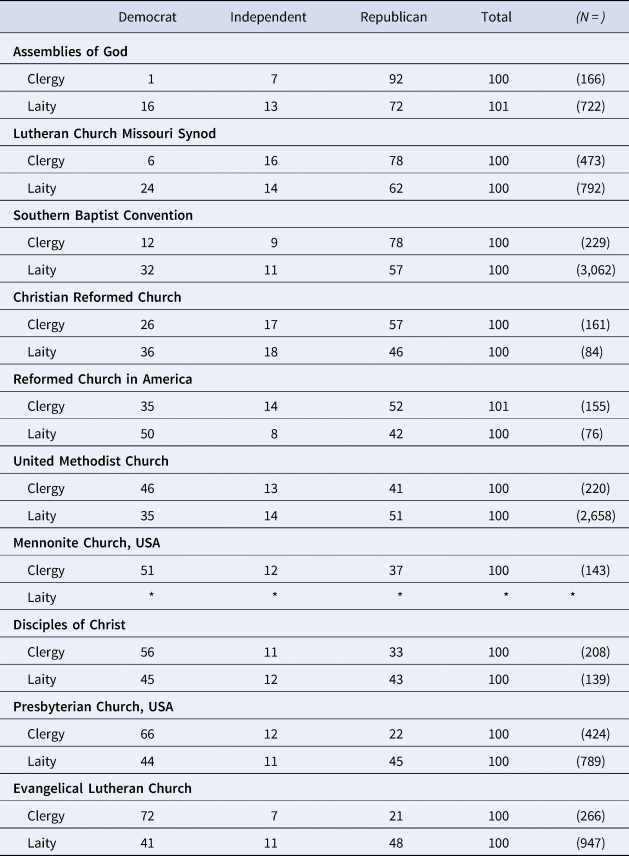
What then was the partisan configuration of Protestant clergy in 2016? Using National Council of Churches (NCC) membership as the criterion for the mainline Protestant category (evangelical denominations are those outside the NCC),Footnote 7 the data in Table 1 show that evangelical clergy are largely Republican, while mainline ministers are predominantly Democratic.Footnote 8 However, the partisan identifications of mainline clergy are less uniform than their evangelical counterparts, a pattern quite similar to that discovered several decades ago (Guth et al. Reference Guth, Green, Smidt, Kellstedt and Poloma1997). Evangelical clergy range from the monolithic 92% Republican in the Assemblies of God to over three-quarters in the LCMS and SBC, down to a more modest 57% in the Christian Reformed Church. On the other hand, mainline ministers identify as Democratic by large majorities in the ELCA and PCUSA, well over half in the Disciples of Christ), or by plurality in the UMC. Only the small RCA and Mennonite Church deviate much from the general pattern, with the former having more Republicans than other mainline bodies, and the latter, more Democrats than might be expected, given the Mennonites' historic evangelical theology. Nevertheless, the data reveal a continuing partisan divide between evangelical and mainline clergy, one that is perhaps even wider today than in the late 1980s.
Partisan identification by denomination: Clergy and laity, 2016 (in percent)

Clergy Source: The Cooperative Clergy Study Project of 2017.
Laity Source: 2016 Cooperative Congressional Election Study.
Note: Independents who lean toward a party are included in that party's figures.
* Number of respondents too small for inclusion.
When we consider laity partisanship, we find evangelical laity are also highly Republican, while mainline laity are more divided—but there are clear clergy/lay differences everywhere. As Table 1 shows, the “clergy/laity gap” ranges from 15 to 30%. This is true for both evangelical denominations, where the clergy are more Republican, and for most mainline churches, where the clergy are more Democratic, especially in the PCUSA and ELCA.Footnote 9
Do the differing partisan inclinations of clergy and laity hold any political significance? When ministers engage in political cue-giving or in electoral campaign-activity, are they “preaching to the choir” or “converting sinners”? If they seek to avoid conflict, clerical political activity might occur primarily when pastor and congregants share political perspectives and, as a result, stress mobilization rather than engage in cue-giving. On the other hand, if differences are relatively modest, brief and implicit ministerial cues may dominate. But when differences are more substantial, clergy may well be cautious about political cue-giving and forego electoral activities, fearing congregational reactions.
To test the impact of clergy/laity “matchups” we asked ministers whether their social and economic views were more liberal, the same, or more conservative than their congregations. About two-fifths (41%) reported they were “about the same,” while a slightly smaller number (37%) thought they were “more conservative,” and only 22% felt they were “more liberal.” If conflict avoidance is clergy's main concern, most political activity should come from pastors in close agreement with their flock, but that is not the case. On both a seven-item issue pronouncement within the church index and a ten-item political campaigning index (see Appendix), those agreeing with their congregations were least active, while those more liberal and (especially) those more conservative were more engaged.Footnote 10 Multivariate analysis (data not shown) suggests that strength of partisanship is the prime factor driving electoral activism, with a modest boost from being “more conservative” than one's church, older, and better-educated. The results for issue pronouncement within the church differed, with denomination, gender, and education dominating: as Southern Baptist and Assemblies pastors do more cue-giving, as do women ministers and those with more years of education. Being more conservative than one's congregation and strength of Democratic partisanship bolster such activity a little. Although such data do not reveal that clergy are necessarily transmitting cues regarding their preferred candidate to their congregants, it can be inferred that they are doing so either through the nature of the particular cues they offer, the kinds of voter guides made available to congregants, or the public displays of campaign activity in which they engage. But, regardless of whether they are providing issue or electoral “cues,” many clergy are being heard by folks with political perspectives differing from theirs.Footnote 11
Initial Favorites and Primary Choices by Pastors
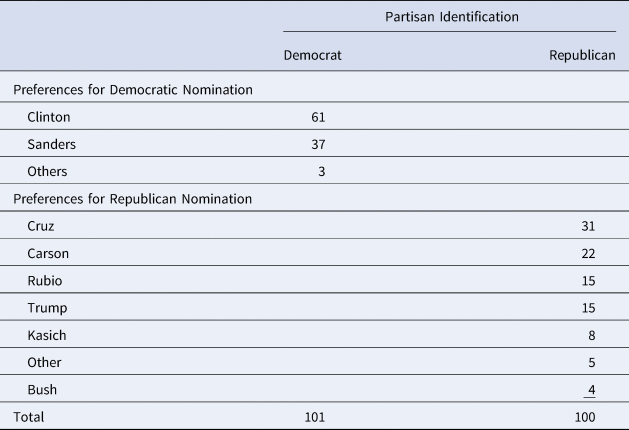
How did Protestant clergy respond to their choices in the 2016 election? The partisan divisions among clergy naturally channeled them into different presidential primaries, and like other citizens, clergy started the 2016 campaign with personal favorites. Table 2 presents the Democratic and Republican pastors' respective initial preferences, with partisan “leaners” classified with the appropriate party. The initial GOP field was large, but among Republicans, Texas Senator Ted Cruz was the leading candidate (favored by 31%), followed by surgeon Ben Carson (22%) and Florida Senator Marco Rubio (17%). Donald Trump was the initial choice of just 15% of Republicans, with John Kasich (8%) and Jeb Bush (4%) drawing even less support. Further analysis shows that Carson, Rubio and Trump had almost identical levels of support from evangelical and mainline Republicans, but Cruz was much more attractive to the former (36%) than the latter (12%), while Kasich appealed more to Republican clergy in mainline denominations than to Republican clergy in evangelical denominations (22–4%).
Initial clergy preferences for party nominee (in percent)

Source: The Cooperative Clergy Study Project of 2017.
Note: Clergy indicating that they were Independent but “leaning toward” a party are included with “strong” and “weak” identifiers.
Democratic clergy had a simpler choice, with only Hillary Clinton and Bernie Sanders demonstrating any real appeal. Clinton was seen by many as the heir-apparent to President Obama and, not surprisingly, was far more often preferred by Democrats. Yet, regardless of early preferences, the eventual real choices in the primary season were much more limited, as most GOP aspirants dropped out before or soon after the first contests. Table 3 reports the primary votes of Protestant clergy in each party, controlling for religious tradition.
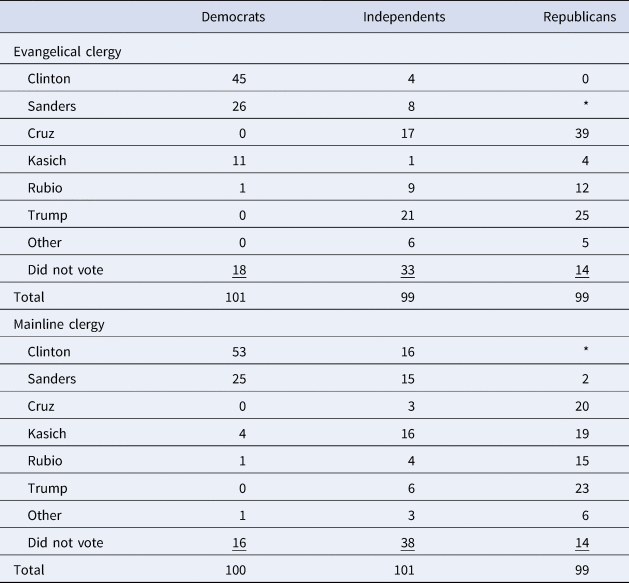
The 2016 presidential primary vote of Protestant clergy by partisan identification controlling for religious tradition (in percent)

Source: The Cooperative Clergy Study Project of 2017.
Several important patterns appear. First, the primary vote of Democrats varied by religious tradition. A majority in mainline denominations cast ballots for Clinton, with only a quarter choosing Sanders. Among evangelical Democrats, however, Clinton failed to garner majority support, while Sanders—somewhat surprisingly—did just as well as among mainline Democratic clergy. This suggests that the long-standing evangelical antipathy toward Hillary Clinton was evident even among Democratic clergy. Furthermore, evangelical Democrats were, in comparison to their mainline counterparts, somewhat more dissatisfied with their choices: they were more than twice as likely to vote for a Republican presidential candidate (12–5%, respectively) and slightly more likely to abstain from voting (18–16%, respectively). Republican voting patterns also differed by tradition. Whereas mainline Republicans split almost evenly among Kasich, Cruz, and Trump, evangelical Republicans clearly favored Cruz. In any case, Trump was hardly the preferred candidate of GOP clergy, as only about one-quarter of ministers in both evangelical and mainline denominations voted for him. Thus, Hypothesis #1 is confirmed.
What factors influenced ministers' primary choices? To explain the patterns in Table 3, we investigated the forces that divided voters on their “real” choices: Clinton versus Sanders and Cruz versus Trump (data not shown). Of course, we might expect to find relatively few distinguishing factors in a party primary, where candidates' ideological range is often limited. And, in fact, only a few variables differentiated Clinton and Sanders supporters. Neither theological orientation nor ideological self-identification separated their proponents, and on two dozen issues, their backers split significantly on only a couple: Clinton's were a little more hawkish on military issues and more favorable toward NAFTA, while Sanders' were slightly less supportive of gun control. As in the mass public, “strong” Democrats leaned toward Clinton, Sanders did better among “weak” partisans and independent “leaners.” Only a few other traits mattered: women clergy, older ministers, and pastors of large churches and African-American congregations leaned toward Clinton.
The densely populated early GOP field soon narrowed to a contest between Ted Cruz and Donald Trump. Cruz's career exuded strong social conservatism, while Trump's partisan and ideological trajectory had been erratic. Cruz was a proud Southern Baptist and built his campaign machinery on evangelical clergy and pro-life groups, while Trump's nominal PCUSA ties seemed unlikely to attract much “home team” support from Presbyterian clergy. Although he had gradually built up a small corps of “court evangelicals” in anticipation of a presidential run (Fea Reference Fea2018), Trump seldom campaigned in religious venues and did not organize extensive faith-based ventures during the primaries (Rozell and Wilcox Reference Rozell and Wilcox2017). Not surprisingly, then, Cruz and Trump supporters were somewhat distinct politically. Although their voters did not differ in theological orthodoxy, Cruz did better among strong political conservatives. And, their backers differed significantly on issues: the best predictors of a Trump primary vote among clergy were opposition to immigration, aggressive stances on military issues, and strong anti-Muslim attitudes, along with slightly more liberal positions on abortion and social welfare.
The General Election
As noted earlier, the 2016 presidential election occurred in a context of growing political polarization. Not surprisingly, party identification powerfully shaped the vote of the mass public, as nearly all Democratic identifiers (88%) voted for Clinton and nearly all Republican identifiers (89%) voted for Trump.Footnote 12 Accordingly, although the 2016 presidential election was unusual in many respects, party loyalty was as important as ever in shaping the outcome.
One way to assess the effects of the Trump campaign is to compare clergy voting in 2016 with the votes of Protestant clergy from the same ten denominations in the 2008 contest. Our expectations are that, with the growth in affective polarization in American politics, Republican clergy supported Trump in the 2016 presidential election by a substantial margin, but that, with Trump as the GOP standard bearer, there was greater party defection among Republican clergy in 2016 than in 2008.
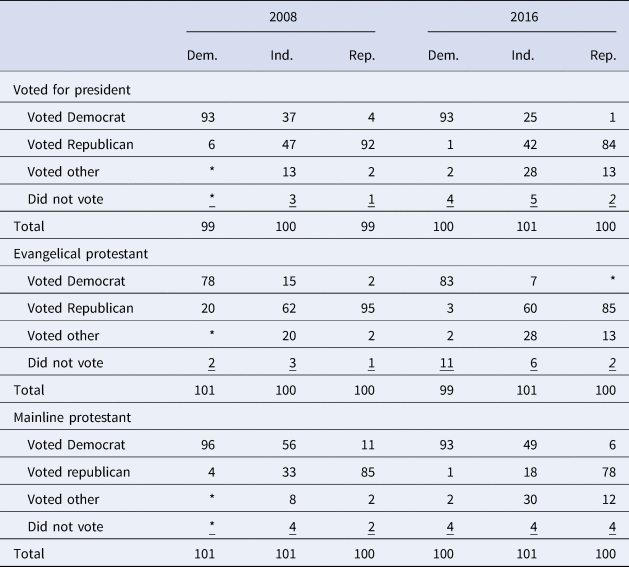
The effects of Trump's campaign among Republican clergy are evident in Table 4. Nearly all Democratic ministers (93%) reported voting for Obama in 2008, and again for Clinton (93%) in 2016; in contrast, although nearly all Republican clergy (92%) voted for McCain in 2008, only 84% reported having voted for Trump in 2016, thereby confirming both Hypotheses #2 and #3. Clearly, then, some Republican clergy were conflicted in 2016, with a fair amount of partisan defection despite the current context of high partisan polarization.
Vote for president by Protestant clergy: 2008 and 2016 (in percent)

Source: The Cooperative Clergy Study Project of 2017.
*Less than 1%.
Nevertheless, Republican clergy with misgivings about Trump could not bring themselves to vote for Clinton. In fact, in 2008 Obama received more Republican ballots (4%) than Clinton received in 2016 (1%). Instead, many Republicans (13%) in 2016 elected to vote for a third-party candidate (or not vote at all). Moreover, several important differences emerged in the voting patterns of evangelical and mainline clergy, both in 2016 and across the two elections. First, among Democrats, mainline clergy gave Clinton a greater percentage of their vote (93%) than did evangelical clergy (83%). This was due, in large part, to the fact that a far larger percentage of evangelical than mainline Democrats did not vote in 2016.
Likewise, important differences appear among independents. Evangelical independents were no more attracted to Trump in 2016 than they had been to McCain in 2008 (60% versus 62%), but that figure in 2016 still ran far ahead of the comparable figure for mainline independents (18%). Evangelical independents, conversely, were far less likely than their mainline counterparts to cast ballots for Clinton (7% versus 49%), once again revealing the antipathy many evangelicals held toward Hillary Clinton. Finally, evangelical and mainline Republicans also diverged somewhat. More than four-fifths of evangelical Republicans voted for Trump (85%), compared to a little more than three-quarters of mainline Republicans (78%), thereby confirming Hypothesis #4. Republican clergy from the two religious traditions did cast third-party ballots at similar levels (12 or 13%), but very few evangelical Republicans voted for Clinton (less than 1%), while nearly 6% of mainline Republicans did.
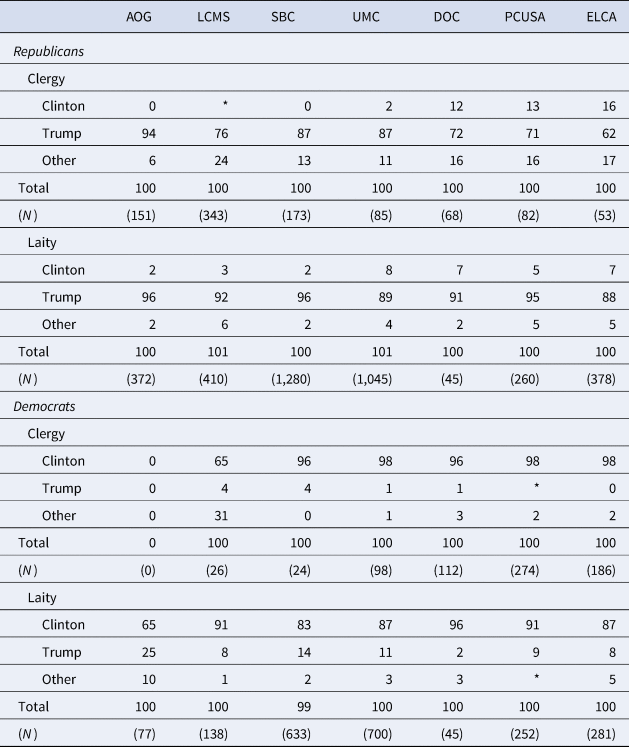
To what extent, then, did clergy differ in their voting patterns from laity within their denominations, even after controlling for their partisan identifications? We used the 2016 Cooperative Congressional Election Study (CCES) to assess the voting behavior of laity in seven of the denominations in our study (three denominations were dropped given their small N in the survey). Table 5 compares the voting behavior of Democratic and Republican laity with their clerical counterparts in those seven denominations.
Presidential vote in 2016 by denomination controlling for partisan identification: A comparison of clergy and laity (in percent)

Clergy Source: The Cooperative Clergy Study Project of 2017.
Laity Source: 2016 Cooperative Congressional Election Study.
*Less than 1%.
Several patterns stand out. First, Republican clergy were less likely to support Trump than were Republican laity in every denomination. Indeed, substantial differences between Republican clergy and laity appeared in mainline churches (around 20%, with the UMC being an exception), while smaller, though important, differences were present between Republican clergy and laity in the evangelical denominations (around 10%, with the monolithic AOG being the exception). Thus, despite sharing partisan identifications and denominational affiliation, Republican clergy were far less likely to support Trump than were Republican laity.
Democratic laity were also more likely to vote for Trump than Democratic clergy in all seven denominations. Democratic clergy, regardless of denomination, rarely cast a ballot for Trump (the maximum was 4% in both the SBC and LCMS), while Democratic laity were somewhat more likely to do so, ranging from a low of 2% in the Disciples to 25% among the AOG laity. Thus, Hypothesis #5 is also confirmed.
Factors Influencing Clergy Choices: Political Issues
Given the central role of party identification in shaping voter choices, did other factors reinforce or produce deviation from the “normal” partisan vote? One obvious candidate might be the issue preferences of clergy. Studies of American elections have long shown that issues play an important role in shaping electoral choice (Campbell et al. Reference Campbell, Converse, Miller and Stokes1960; Nie, Verba, and Petrocik Reference Nie, Verba and Petrocik1976; Lewis-Beck et al. Reference Lewis-Beck, Jacoby, Norpoth and Weisberg2011). And presidential candidates invariably articulate issue positions to attract voters.
Social Conservatism and Environmentalism. Most scholarly research on the 2016 election has emphasized the role of cultural, rather than economic, factors in shaping voting decisions (Grossman Reference Grossman2018; Mutz Reference Mutz2018). Although the classic New Deal coalitions were based largely on economic issues, scholars have discerned other issue dimensions that cut across the old economic alignments, most notably “social” or “value” questions, such as abortion, gay rights, and the role of women in society. Some also argue that, in an era of relative affluence, other “post-materialist” values such as environmentalism can animate politics (Inglehart Reference Inglehart1977, Reference Inglehart1990). During the campaign, Trump clearly aligned himself with a more traditional “moral” view of politics to attract social conservatives and expressed extreme skepticism about environmental concerns, while Clinton positioned herself as a staunch social liberal and the “environmental candidate.”
Perceived Threats. In addition to social conservatism and environmental skepticism, Trump highlighted threats to “the American way of life.” Certainly, his theme of “Make American Great Again” suggested that the character, luster, and standing of the country had already been eroded. His rallies featured rants about threats to this “way of life,” such as liberal attacks on religious freedom and the Christian status of the nation (Justice and Berglund Reference Justice and Berglund2016), illegal immigration and Islamic terrorism (Wooley Reference Wooley2016), and a globalism that undermined “America First” economic and political interests (Diamond Reference Diamond2016). Numerous scholarly analyses have confirmed a relationship between such threat perceptions and voting for Trump at the mass level, whether expressed in the form of “Christian nationalism” (Fea Reference Fea2018; Whitehead, Perry, and Baker Reference Whitehead, Perry and Baker2018), Islamophobia (Elkins Reference Elkins2017; Sides, Tesler, and Vavreck Reference Sides, Tesler and Vavreck2018), or anti-globalism (Mutz Reference Mutz2018).
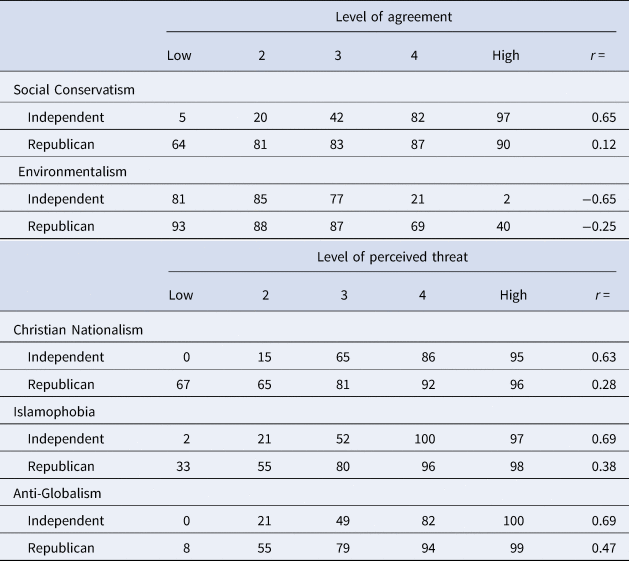
To assess whether these political issues also shaped clergy voting, we constructed measures of social conservativism, environmentalism, Christian nationalism, Islamophobia, and anti-globalism (see Appendix for construction). Table 6 examines the relationship between voting for Trump and these issue variables while controlling for party identification. (Because few Democratic clergy voted for Trump, analysis is limited to independents and Republicans.) The results confirm that all five measures are related to the Trump vote, even when controlling for party identification. Not surprisingly, the correlations are stronger among independents than with Republicans, as GOP partisans were already inclined to vote for Trump. Still, for both independents and Republicans, the Trump vote increases monotonically with greater social conservativism and decreases with stronger environmentalism.
Trump vote among clergy by issue positions and threats, controlling for partisan identification (in percent)

Source: The Cooperative Clergy Study Project of 2017.
Note: Only 7 out of 893 Democratic clergy reported voting for Trump in 2016, and, as a result, they are not presented in the analysis.
Similarly, all three measures of threat perception are strongly related to voting for Trump, even controlling for partisanship. Once again, the relationship is strongest among independents, but for both groups Trump support increases as threat perceptions grow. Indeed, among Republicans, the three “threat” measures are more strongly correlated with the Trump vote than either social conservatism or environmentalism. Clearly, decisions to vote for Trump were strongly influenced by perceived threats to America, especially among Independents, but even among Republicans.
Multivariate Analysis (Binary Logistic Regression)
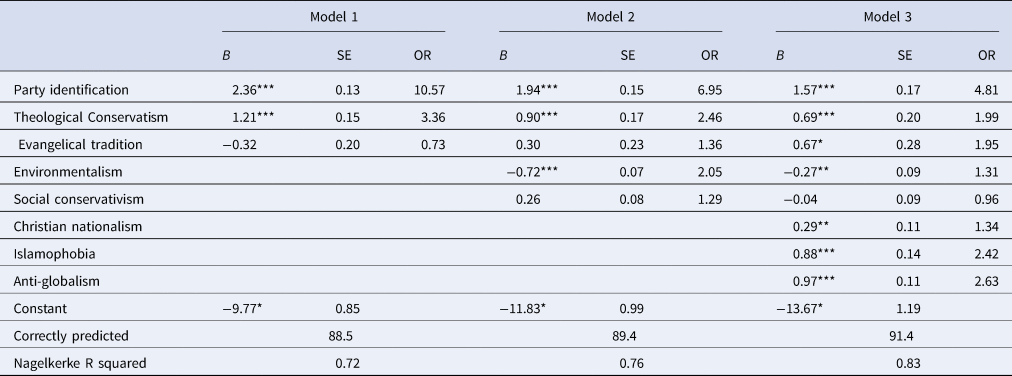
To incorporate all these variables in a full analysis of the Trump vote among clergy, we ran logistic regressions, including religious and political variables while controlling for gender, age, seminary education level, and community size.Footnote 13 The dependent variable was coded as “1” if the respondent voted for Trump and coded “0” for all other votes. The results appear in Table 7.
Binary logistic regression models predicting clergy vote for Trump (2016 voters only)

Source: The Cooperative Clergy Study Project of 2017.
Note: Gender, age, level of seminary education, and community size serve as control variables.
*p < 0.05;**p < 0.01;***p < 0.001.
The first model includes party identification, theological conservatism (see Appendix for calculation) and religious tradition (evangelical or mainline). Not surprisingly, party identification was strongly and significantly associated with voting for Trump, while theological conservatism also contributed significantly. But religious tradition had no significant predictive power once theological perspective was in the equation. Among the control variables (data not shown) neither gender nor level of seminary education were significant. Age and community size were significant, however: the Trump vote increased with age and decreased with larger community size. Overall, model 1 correctly predicts 88.5% of the votes (well beyond the cut value of 0.50), with a Nagelkerke R squared value of 0.72.
Model 2 adds environmentalism and social conservatism to the regression. Along with partisanship, both were significantly related to the vote, with the probability of a Trump ballot declining as environmentalism increased and increasing with greater social conservatism. In addition, theological conservatism retained statistical significance (as did the pastor's age and the size of the community in which he/she ministered). The addition of these two issue variables produces slightly more correct predictions, rising from 88.5 to 89.4%, with the Nagelkerke R squared increasing from 0.72 to 0.76.
Finally, model 3 adds the threat variables. Not surprisingly, partisan identification retains the strongest effect, but Christian nationalism, anti-globalism and Islamophobia also significantly enhance the probability of voting for Trump, with anti-globalism having the largest effect. Social conservatism drops out as a significant predictor, though environmentalism remains statistically significant at the 0.01 level. Theological conservatism also remains statistically significant at the 0.001 level, even after all the issue and threat variables are included. Moreover, after the three threat variables are added, neither the pastor's seminary education nor size of the community was significant, though age and gender remained significant at the 0.01 level, with older ministers and men being more Republican (data not shown). And, in this final model, being in the evangelical tradition becomes statistically significant, if only at the 0.05 level. The addition of the three threat variables boosts the correctly predicted Trump votes from 89.4 to 91.4%, with the Nagelkerke R squared moving from 0.76 to 0.83, an impressive performance.
Conclusions
Several conclusions can be drawn from this study. First, the partisan divisions apparent among Protestant clergy in the late 1980s persist today, enhanced by increasingly “strong” partisanship on both sides. Even with the passing of the “new breed” liberal activists of the 1960s and the social changes shaping more recent generations of clergy, evangelical ministers remain overwhelmingly conservative and Republican, while most mainline clergy hold more liberal and Democratic political inclinations. Not surprisingly, perhaps, the extent of their engagement with the electoral process is driven primarily by the growing strength of that partisanship rather than by the nature of their congregational context.
Second, Donald Trump was not the preferred choice of Republican Protestant clergy, either evangelical or mainline, during early stages of the 2016 nomination process. Indeed, even with the winnowing of the GOP field, no more than one-quarter of Republican clergy in either tradition cast a primary ballot for him.
Third, over the course of the general election campaign, Republican clergy did largely rally behind their party's nominee, ultimately voting for Trump, while Democratic clergy overwhelmingly backed Clinton. Nevertheless, despite the high level of political polarization in which most clergy stuck with their party's candidate, a sizable segment of Republicans resisted partisan pressures and rejected Trump—either by casting ballots for another candidate or by failing to vote at all.
Fourth, despite sharing the same partisan identification and denominational affiliation, Republican clergy were less likely than Republican laity within the same denomination to cast their ballots for Trump. The same was true with regard to Democratic clergy and Democratic laity within the same denomination: such clergy were less likely than their laity to cast a ballot for Trump. Just what contributed to this greater reluctance on the part of clergy than laity to cast a ballot for Trump remains to be discerned by future analyses comparing clergy and laity voting decisions. But, whatever factors may prove to contribute to such differences will likely reveal potential factors that can serve to limit some of the effects of “identity politics.”
Fifth, the propensity of both independents and Republicans to vote for Trump varied according to their perception of “threats.” Those who saw both the Christian heritage of the U.S. and Christians themselves endangered and who perceived threats from Islam and globalism were more likely to cast GOP ballots. Attitudes on social conservatism and environmentalism also had an impact, but a smaller one—perhaps because these older issues were already “baked in” to party identifications.
Still, the relationship between perceptions of threat and vote choice is not too surprising. Political actors can not only choose to articulate what it means to be part of a group, but they can also choose to exaggerate or even invent perceived threats to the group. And, in so doing, they make group identities and attitudes more salient and relevant to electoral decisions. Although much recent literature has emphasized how such strategies produced support for Trump among less-educated voters, this study shows the efficacy of this approach even among a well-educated group of religious leaders, who may in turn have chosen to reinforce the candidate's own electoral themes within their own congregations or acted upon them in their own political engagement.
Methodological Appendix
Profile of sample

Descriptive statistics (2016 election voters only)

Political campaigning and issue pronouncement,
Political campaigning is an additive index of actions a minister took in 2016: (1) publicly endorsed a candidate, (2) campaigned for a party or candidate, (3) displayed a campaign button, sticker or yard sign, (4) attended a political rally, (5) tried to persuade someone to vote for a candidate, (6) prayed publicly for a candidate, (7) endorsed a candidate while preaching, (8) joined a political organization, (9) gave money to a candidate or party, and (10) actively supported a presidential candidate. Scores range from 0 to 10, with a mean of 2.40, a standard deviation of 2.21, and an alpha of 0.76.
Issue pronouncement in church is an additive index of actions a minister took in 2016: (1) pulpit stand on a political issue, (2) touched on a controversial issue while preaching, (3) preached a whole sermon on an issue, (4) prayed publicly about an issue, (5) took a public stand (not preaching) on an issue; (6) had voter guides available in the church, (7) offered educational sessions on public issues. Scores ranged from 0 to 7, with a mean of 3.94, a standard deviation of 1.82, and an alpha of 0.66.
Social conservatism is a principal component score of three Likert-type items asking whether: (1) “We need a constitutional amendment prohibiting all abortions unless necessary to save the mother's life or in cases of rape and incest,” (2) “Homosexuals should have all the same rights and privileges as other Americans,” and (3) “We still need more legislation to protect women's rights.” All items loaded on a single component with an Eigenvalue of 2.08, explaining 69% of the variance, with a theta reliability of 0.78.
Environmentalism is a principal component score of two Likert-type items, whether: (1) “Global warming is a serious threat to the future of the planet,” and (2) “More environmental protection is needed even if it raises prices or costs jobs.” Both items loaded on a single component with an Eigenvalue of 1.86, explaining 93% of the variance, with a theta reliability of 0.92.
Christian nationalism is a principal component score of three Likert items on whether: (1) “The U.S, was founded as a Christian nation.” (2) “Discrimination against Christians in this country has become a serious problem in recent years,” and (3) “Religious freedom in the U.S. is threatened by groups opposing religion.” All items loaded on a single component with an Eigenvalue of 2.33, explaining 78% of the variance, with a theta reliability of 0.86.
Islamophobia is a principal component score of three Likert-type items asking whether: (1) “The values of Islam are at odds with American values and way of life,” (2) “Islam encourages violence more than other major religions,” and (3) “A temporary ban on Muslims entering the country is essential in order to counter potential terrorist acts.” All items loaded on a single component with an Eigenvalue of 2.47, explaining 83% of the variance, with a theta reliability of 0.89.
Anti-globalism is a principal component score of five Likert-Type items on whether (1) “American foreign policy should concentrate more on working with our allies than on acting alone,” (2) “Trade laws like NAFTA have not benefited our country, costing too many Americans their jobs,” (3) “Given the threat of terrorism, the U.S. must be able to take preemptive military action against other countries,” (4) “The growing racial and ethnic diversity is in the U.S. is strengthening American society,” and (5) the number of immigrants that should be increased or decreased. All items loaded on a single component with an Eigenvalue of 2.83, explaining 57% of the variance, with a theta reliability of 0.81.
(For purposes of illustration in Table 6, all these scores were divided into five equal categories.)
Theological conservatism is a principal component score based on agreement with the following six statements: (1) Jesus was born of a virgin, (2) Jesus physically rose from the dead, (3) Jesus will return bodily to earth one day, (4) The devil actually exists, (5) There is no other way to salvation but through belief in Jesus Christ, and (6) The Bible is the inerrant Word of God, both in matters of faith and in historic, geographical, and other secular matters. All items loaded on a single component with an Eigenvalue of 4.59, explaining 76% of the variance, with a theta reliability of 0.94.
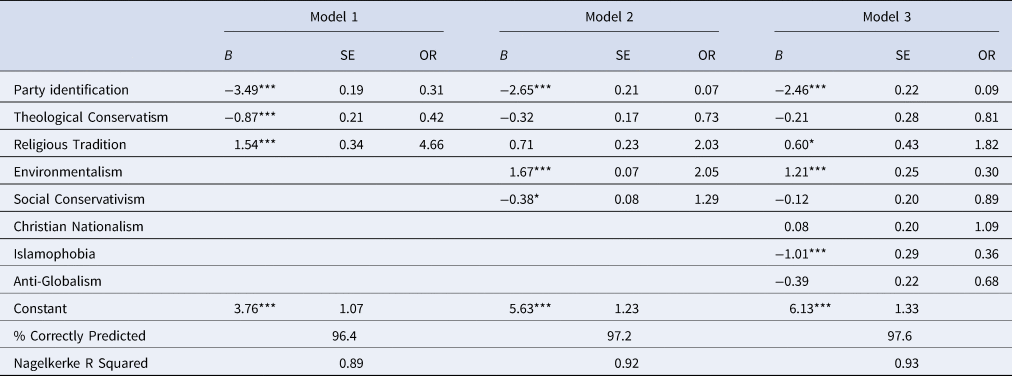
Binary logistic regression models predicting voting for Clinton (2016 election voters only)

James L. Guth is William R. Kenan Professor of Politics and International Affairs at Furman University. He is the co-author of several books and many scholarly articles on the role of religion in American and European politics. His current research focuses on the religious contribution to populist politics in the United States and Europe.
Corwin E. Smidt is a Senior Research Fellow with the Paul B. Henry Institute for the Study of Christianity and Politics and Professor of Political Science emeritus at Calvin University. He is a founding member of the Religion and Politics section of the American Political Science Association, having served on its executive committee on different occasions, and is author and co-author of a number of books and journal articles related to religion and American politics.