After four years of rising tensions over China's construction of military bases in the South China Sea, in July 2016 the Permanent Court of Arbitration issued a landmark decision layered with meaning, academic as well as diplomatic. “China's claims to historic rights, or other sovereign rights or jurisdiction,” wrote the panel of five judges, “with respect to the maritime areas … encompassed by the relevant part of the ‘nine-dash line’ are contrary to the Convention [on the Law of the Sea] and without lawful effect.” Writing with unambiguous clarity, the court ruled that China's dredging of these artificial islands for military bases gave it no right whatsoever to the surrounding seas and rebuked Beijing for infringing on waters that the Philippines should rightly control. China's claims to most of the South China Sea within that nine-dash line, which Beijing first published on maps at the height of the Cold War in 1953 and has pursued ever since, “were extinguished,” the court said, by the UN Convention (Gao and Jia Reference Gao and Jia2013, 103–4; New York Times 2016; Permanent Court of Arbitration 2016, 68–77, 116–17).
After China's Foreign Ministry insisted the decision was “invalid and has no binding force,” the New York Times advised China's president Xi Jinping against “provocative actions that could … lead to a military confrontation with its neighbors or the United States” (New York Times 2016). In the months of diplomatic maneuvering preceding this decision, the Philippines had reversed its expulsion of the U.S. military at the close of the Cold War in 1991 and recently granted Washington five bases facing the South China Sea (Whaley Reference Whaley2016).
Suddenly, a small sea that long seemed of secondary or even tertiary geopolitical import had become the epicenter of international tensions. Suddenly, military conflicts seemingly resolved by the end of the Cold War decades before had reappeared with exceptional force. If we now treat this seemingly peripheral locale on its own terms, the South China Sea emerges as an arena for geopolitical conflicts reaching back a century or more. Similarly, this revival of military tensions that once made the Cold War seem so distinct, so clearly circumscribed, now force us to reconsider this period within a longer timeframe of geopolitical conflict. What would this region and period look like, we might now ask, if we treat the South China Sea as central, not peripheral, and the Cold War not as bounded by a specific ideological conflict but as the midpoint in a century-long clash of empires? In addressing such diffuse, even difficult questions, these recent events have done us the additional service of identifying military bases, often overlooked by scholars, as both means and metric for major shifts in geopolitical power.
The fixed chronological boundaries that demarcate the Cold War are the first barrier to be contested before we can insert this forty-year period and its tensions in a wider historical context. For much of the past century, Asia suffered a succession of devastating wars that seem to define the history of this world region that is home to half of humanity. Indeed, simple chronology shows an almost unbroken chain of military conflict—from the Philippine-American War (1898–1902) and World War I (1914–18), through the Manchurian Incident (1931–32), the Sino-Japanese War (1937–41), World War II (1941–45), the Chinese Civil War (1946–49), the Korean War (1950–53), and the Vietnam War (1961–75), all the way to the longest of them all, the Cold War (1948–90).
Given their extraordinary violence and immediate impact, historians, myself included, have tended to treat each of these conflicts on its own terms, tracing its origins, chronicling its course, and assessing its legacy. But this relentless succession of Asian wars over the span of a century offers a disconcerting hint that there might be some deeper driver underlying and perhaps uniting these seemingly separate conflicts. Perhaps World War II and the Cold War were not, despite the massive destruction and millions dead, the epochal events we have long thought them to be.
Historians are trained to seek out elusive elements of continuity, to distrust arbitrary chronological divides, and to constantly reexamine and revise. In this spirit, we must ask: what is so extraordinary about September 2, 1945 (when World War II ended) or March 5, 1946 (when Winston Churchill heralded the Cold War)? If these two days, separated by just six months, did not open temporal voids, somehow bisecting time's seamless web into distinct periods, then we should set aside these chronological boundaries and begin recalibrating the Cold War's history accordingly.
Complicating this chronology further, many of the major events coincident with the Cold War's advent in Asia—notably, the Vietnamese and Chinese revolutions—have multiple meanings, comingling the nationalism heightened by World War II; the communism synonymous with the Cold War; and a discordant element, the decolonization that marked the end of European empires. Indeed, this comingled, even contradictory mix of war and revolution, nationalism and communism mark the first years of the Cold War era across a vast swath of Asia—from India to Burma, Malaya, Indonesia, the Philippines, and all the way to Vietnam, China, and Korea. If we add Japan, which suffered the loss of one of history's largest empires, then virtually the whole of Asia felt the impact of this imperial transition.
Once spared from mistaking chronology for causality, we are freed to search for that deeper driver in the dynamics of Asia's recent history. Looking beyond the battles and diplomacy, the dominant historical development for much of the twentieth century was, arguably, decolonization, the consequent shift in geopolitical balance, and the ensuing clash of empires. From this perspective, both World War II and the Cold War were mere epiphenomena, violent cataclysms sparked by this deeper historical force, much as volcanic eruptions along the Pacific's ring of fire are caused by tectonic subduction far beneath the earth's surface. Such analysis cannot, of course, erase the Cold War as a major period in Asia's history, but instead allows us a fuller appreciation of these decades as a time of transition from Europe's imperial dominion over Asia to a new era with Asian powers as central players in the contestation for global hegemony.
This perspective also allows us to reconsider the major historiographical frames that have shaped our understanding of Asia's modern history. For decades, historians of Southeast Asia, myself included, have debated whether the Japanese occupation during World War II was somehow transformative, moving the region from colonial subjugation, through revolution, to postwar independence. While my mentor Harry Benda argued, as eyewitness to the Japanese invasion of Java, that the war's impact was uniform throughout the region, and I, a generation later, proposed instead a spectrum of more diverse influence, both of us accepted the war as the determinative frame for historical analysis (Benda Reference Benda1956; Reference Benda1958, chap. 1; Reference Benda1962; Reference Benda and Goodman1967; Ikehata Reference Setsuho and Jose1999; McCoy Reference McCoy and McCoy1980). Yet as those postwar anti-colonial struggles that ended with Saigon's fall in 1975 fade further into the past, both of us now seem myopic in our singular focus on the war's role in shaping the region's history. Time thus creates distance that compels historians to recast the past.
Simply put, Southeast Asia's nationalist struggles, despite all their searing death and destruction, were but manifestations a global transformation driven by historical forces larger than the particulars of Japanese occupation policy. Admittedly, the war's end allowed Vietnam's declaration of independence on September 2, 1945, launching an anti-colonial struggle that won a new nation by 1954. But Algeria achieved independence from the same imperial power just eight years later, a blink of history's eye, even though France had maintained unbroken colonial control throughout the war. If we move beyond a regional comparison with Indonesia, focused on the simultaneity of their independence at war's end, to a comparison with Algeria based on a decade of shared anti-colonial struggle, then decolonization soon eclipses world war as the more consequential causality for political transformation.
Similarly, decolonization is the reason the Philippines always remained the awkward exception to Benda's grand transformation thesis (Steinberg Reference Steinberg and Silverstein1966; Reference Steinberg1967, chap. 2–3, 6–7, 9). The archipelago secured U.S. congressional authorization for its independence before the war in 1935, not at its end in 1945. And when that independence came, it was soon circumscribed by massive U.S. military bases that remained throughout the forty years of the Cold War. Instead of forcing the Philippines into a tempo of transformation that marches it lockstep with the rest of Southeast Asia from colonization via Japanese occupation to independence, we should pay attention to the singular marker that ruptures these regional rhythms: U.S. military bases.
Thinking About Military Bases
Despite their centrality to the region's history for over five centuries, scholars of Asia have generally disregarded foreign military enclaves as inherently exogenous, alien to the indigenous culture that is their academic focus and forte. Those few who study military bases generally focus on the tawdry social margins of bars and brothels, not their broader geopolitical import (Enloe Reference Enloe2014, 125–73; Sturdevant and Stoltzfus Reference Sturdevant and Stoltzfus1992). By contrast, specialists in imperial, international, and military history study bases, admittedly in a cursory manner, as indicators of hegemonic power. While historians can readily chart the course of colonial empires by mapping changes in territory, the more amorphous “informal empire” and its corollary “hegemony” lack comparable metrics. Absent alternatives, military bases might represent the clearest marker for tracing these more diffuse systems of global and regional dominion, particularly since the postwar eclipse of formal European empires (Johnson Reference Johnson2007, chap. 4).
If military bases are indeed the bellwether bastions of empire, both expansion and eclipse, then they might well prove more meaningful indicators of geopolitical change than the biggest of battles or bloodiest of wars. From the sixteenth to the twenty-first century, fortified enclaves have served as nodes for each hegemon's most advanced military technology, strategically sited astride the corridors of air, land, and sea, ready to unleash mass destruction and thus deter any challenge to its authority. For five centuries, geopolitical hegemony has thus involved the use of military bases as Archimedean levers to move the globe—from the fifty fortified Portuguese feitorias that dotted its tropical latitudes in the sixteenth century to the thousand U.S. military bases that dominate it in the early twenty-first century.
Throughout Asia's long twentieth century, military enclaves in the circum South China Sea have been flashpoints for geopolitical change. Whether the U.S. victory at Manila Bay in 1898, Singapore's fall in 1942, American withdrawal from Subic Bay in 1992, or China's Spratly Island bases in 2015, military bases are iconic markers for both geopolitical dominion and imperial transition.
Yet the persistent importance of military bases despite rapid, relentless technological change is perplexing. Bases are both vital and vulnerable—that is, they are surprisingly vulnerable to capture in times of conflict, yet vital to the aspirations of any hegemonic power. For effective “warlike preparation,” as strategist Alfred Thayer Mahan argued in his renowned study of sea power in 1890, “the maintenance of suitable naval stations …, when combined with decided preponderance at sea, make a scattered and extensive empire, like that of England, secure.” With their bases in “all parts of the world,” the British fleets “kept open the communication between them, and relied upon them for shelter.” No doubt “an unexpected attack may cause disaster in some one quarter,” but, said Mahan, Britain's “actual superiority of naval power prevents such disaster from being general or irremediable.” By contrast, with “no foreign establishments, either colonial or military, the ships of war of the United States,” Mahan said pointedly, “will be like land birds, unable to fly far from their own shores. To provide resting-places for them … would be one of the first duties of a government proposing to itself the development of the power of the nation at sea” (Mahan [1890] Reference Mahan1957, 71–72). So important were bases for the nation's defense that, as he argued in a widely read essay in 1890, “it should be an inviolable resolution of our national policy that no European state should henceforth acquire a coaling position within three thousand miles of San Francisco”—a distance that encompassed the Hawaiian islands that America would soon acquire (Mahan Reference Mahan1890). In sum, the combination of a large fleet and a network of overseas bases were, in Mahan's view, the two essential components for both a strong navy and a capacity for global power.
But such observation is not explanation. We must dig deeper to find the driver for the continuing geopolitical significance of military bases. Moving beyond Mahan, we might venture that, in the long years between wars, bases allow empires to project their power—asserting dominion over other nations, expanding a defensive perimeter, or advancing territorial claims. Historian Paul Kennedy has argued that Britain's “naval mastery” made it “extremely difficult for other, lesser states to undertake maritime operations or trade without at least its tacit consent” (Kennedy Reference Kennedy1983, 9).
Yet modern bases do much more. Naval bastions and their patrols can weave a web of dominion across an open sea, transforming the unbounded ocean into de facto territorial waters and thereby allowing preferential access to valuable fisheries, minerals, or strategic waterways. Military bases, both air and sea, also serve to extend the penumbra of hegemony over the client states of informal empire. Even in an age of cyberwarfare, bases thus remain essential to geopolitical gambits, as China has demonstrated so forcefully in the South China Sea.
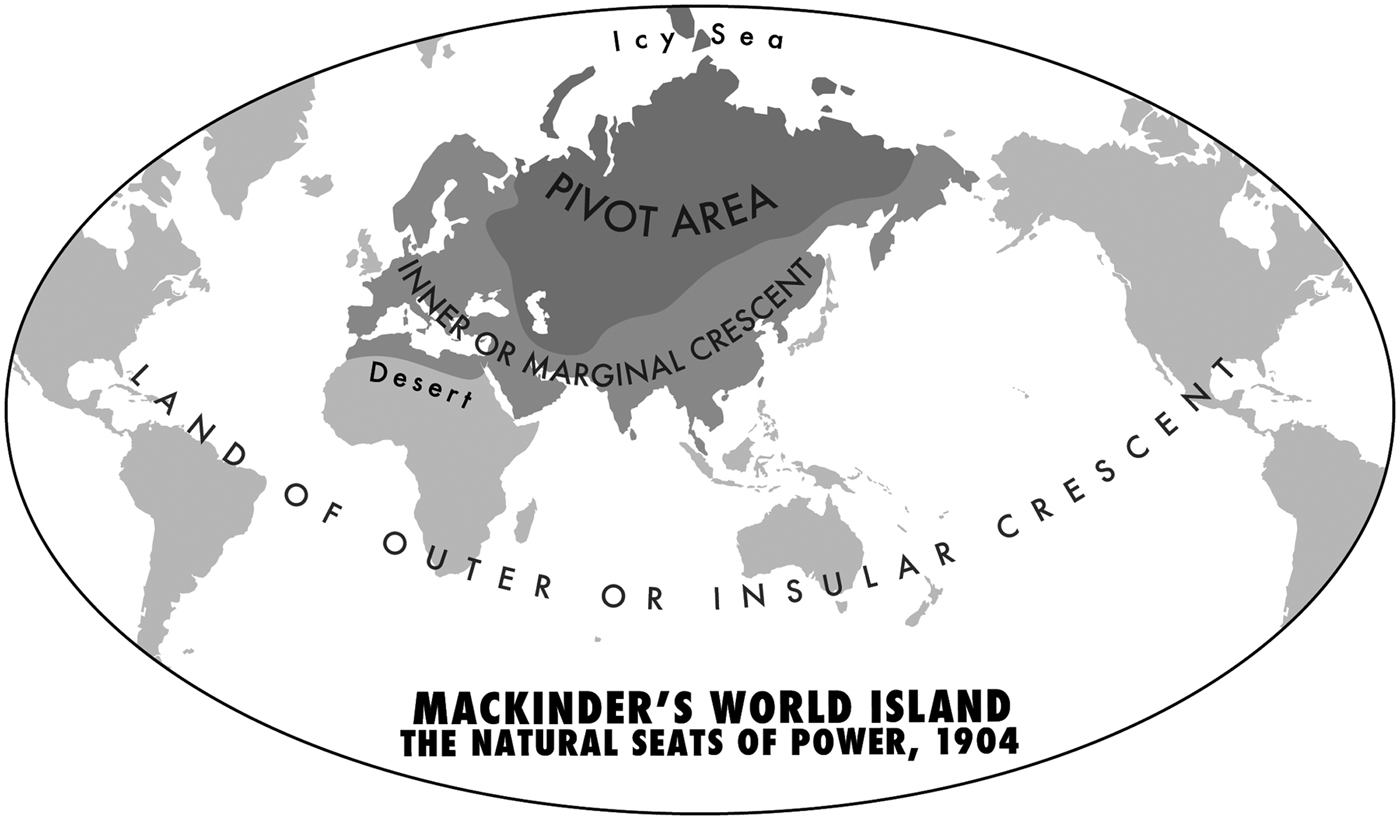
If the sire of modern geopolitics, Sir Halford Mackinder, was correct in his seminal geopolitical treatise that “Euro-Asia” constitutes, along with Africa, a single “world island,” then control of this vast land mass presents a paramount strategic challenge for any would-be global hegemon. The “discovery of the Cape road to the Indies” in the sixteenth century, Mackinder explained, “endowed Christendom with the widest possible mobility of power … wrapping her influence round the Euro-Asiatic land-power which had hitherto threatened her very existence.” Writing in 1904 while the single track of the Trans-Siberian Railway, the world's longest, was crawling across the continent for 5,700 miles from Moscow toward Vladivostok, Mackinder argued that “trans-continental railways are now transmuting the conditions of land power.” In coming decades as rails covered all of Asia, he predicted that: “The spaces within the Russian Empire and Mongolia are so vast, and their potentialities in … fuel and metals so incalculably great that a vast economic world, more or less apart, will there develop inaccessible to oceanic commerce.” In the fullness of time, the “pivot state” of Russia might, in alliance with another land power like Germany, expand “over the marginal lands of Euro-Asia,” allowing “the use of vast continental resources for fleet-building, and the empire of the world would be in sight” (Mackinder [1904] Reference Mackinder2004).
Whether or not that prediction ever proves accurate, Mackinder had divined the underlying geopolitical conflict between the Eurasian land states (Germany then Russia) and the encircling maritime powers (Britain, Japan, and America) that would direct Asia's destiny for decades to come (see figure 1). After a half-century of violent contestation for control of what Mackinder had called “Euro-Asia,” another British scholar, imperial historian John Darwin, argued in his magisterial survey After Tamerlane that the United States had achieved its “colossal Imperium … on an unprecedented scale” in the wake of World War II by becoming the first power in history to control the strategic axial points “at both ends of Eurasia”—Western Europe and, at the other antipode, Japan, the Philippines, and strategic sea lanes through the South China Sea (Darwin Reference Darwin2008, 469–71).
The natural seats of power. Map created by the University of Wisconsin–Madison Cartography Laboratory.

For the past two centuries, global hegemony has thus been marked by one maritime nation after another using military bases for, in Mackinder's words, “wrapping her influence round the Euro-Asiatic land-power.” On the eve of World War I, the British navy of 300 warships ruled the seas from a global network of thirty fortified bastions—controlling maritime chokepoints from Gibraltar through the Suez Canal to the Straits of Malacca and completing this circum-continental control through naval alliances with Japan and the United States (Jane Reference Jane1900, 68–70; Reynolds Reference Reynolds1998, 104–20).
When Washington began building a Pax Americana during the Cold War, first and foundational for the containment of Soviet and Chinese land power within the world island was the U.S. Navy. In the postwar architecture of U.S. geopolitical power, the two axial points at the antipodes of Eurasia were joined by an arc of steel comprising overlapping layers of mutual defense treaties from NATO to SEATO, a string of strategic air bases, and naval patrols from the Sixth Fleet at Naples to the Seventh Fleet at Subic Bay, Philippines (Darwin Reference Darwin2008, 469).
By the time the Cold War had settled across Asia in the mid-1950s, the United States had a global network of military bases in thirty-six countries aimed, in large part, at containing the Sino-Soviet bloc behind an “Iron Curtain” that bisected the Eurasian landmass (Darwin Reference Darwin2008, 470–71). When the Cold War ended in 1990, the U.S. semi-circlement of communist China and Russia required 700 overseas bases, an air force of 1,763 jet fighters, a vast nuclear arsenal with more than 1,000 ballistic missiles, and a navy of 600 ships, including fifteen nuclear carrier battle groups—all linked by the world's only global system of communications satellites.Footnote 1
Among the many U.S. bases ringing the Eurasian landmass, those on its Pacific littoral were of particular strategic import before, during, and after the Cold War. There at the cusp of Asia and the Pacific, an underlying, unforgiving geopolitical logic has, to a surprising extent, shaped the fate of empires. During the decades following its capture of Manila Bay in 1898, the United States defied that logic disastrously by holding a single string of trans-Pacific bases; but, in the aftermath of World War II, complemented it successfully with offshore bastions from Japan to the Philippines, secured by dominion over the entire Pacific basin. As the fulcrum between the defense of one continent and control of another, the Philippines has remained a constant focus in Washington's century-long effort to expand and then extend its global power.
Philippine Bases
Military bases in the Philippines are thus an apt metric to measure key changes in Washington's geopolitical strategy. From the age of empire, through World War II, and into the Cold War and its aftermath, Washington clung to these enclaves in the Western Pacific, fighting two wars and negotiating numerous treaties—thereby suggesting a geopolitical significance far more fundamental than the vagaries of the Cold War. From this perspective, the containment of China and the Soviet Union was but a means to a greater end: global dominion.
Throughout their long history, these Philippine bases also served as a frontier of fantasy that rendered otherwise sober American strategists susceptible to illusions of technological mastery. From Mahan's premature plans for America as a Pacific hegemon through two chimerical visions of victory on the eve of World War II—MacArthur's citizens' army and Stimson's air armada—these dreams of dominion frequently foundered on geopolitical reality, sparking cycles of individual inspiration and bureaucratic reexamination. Even at the Cold War's peak, moreover, the massive U.S. bases in the Philippines never became active centers for combat operations, instead providing secondary support for the Vietnam War of the 1960s and the Indian Ocean expansion of the 1980s.
Nonetheless, the impact of these small U.S. enclaves upon the Philippines has been profound. Throughout the century-long chronicle that follows, it will become apparent that Washington's relations with its closest, most constant Asian ally, the Philippines, have been shaped not by any exercise in tutelary democracy or ephemeral economic interest, but instead by a constant quest for geopolitical dominion. Despite a recurring rhetoric of bilateral amity, Washington has always acted as a great power, optimizing its strategic access to the bases while oblivious to the complications they created for the security of the host nation. To hold its strategic enclaves at Clark Field and Subic Bay during the Cold War, the United States intervened constantly in the country's internal affairs, infringing upon Philippine sovereignty and provoking nationalist hostility.
Yet the word “enclave,” with its connotation of isolation from social surrounds, is a misnomer. Military bases require the tolerance, active or tacit, of collaborating local elites, and thereby ramify widely into the host society, shaping its politics, identity, and international alignments. By setting conditions for the use of these foreign military bases, leaders of smaller nations also gain some leverage to influence great power rivalries. Thus, for Filipino leaders from Manuel Quezon in the 1930s through Corazon Aquino in the 1990s and her son Benigno Aquino III more recently, the presence of U.S. forces on Philippine soil was the ultimate political issue of their day, determining the country's position in international politics, defining the meaning of Filipino nationalism, and inviting foreign influence into domestic politics. While the Cold War certainly did not create the bases, it did compound their strategic importance—distorting the course of Philippine politics, complicating the country's diplomatic position, and creating lasting resentments that still influence relations between the two nations.
An Island Bastion
As America started its ascent to global power and expanded its navy in the late nineteenth century, the Pacific represented a major strategic challenge. Influenced in part by Captain Mahan's advocacy of overseas bases and markets, the Navy ordered Admiral George Dewey's squadron to seize Manila Bay during the Spanish-American War of 1898, which he did with a crushing, celebrated victory over the Spanish fleet (Thomson, Stanley, and Perry Reference Thomson, Stanley and Perry1981, 103–4, 111, 136). With grand aspirations but little grasp of the region's geopolitics, Washington had blundered into the Western Pacific, creating a strategic conundrum that would bedevil its defense policy for the next forty years.
Appointed president of the Naval War Board in 1900, Admiral Dewey recommended dispatch of a major battle fleet to the Pacific, supported by construction of a fortified base in the Philippines. Although President Theodore Roosevelt blocked transfer of capital ships from the Caribbean, he recommended a million-dollar appropriation for construction of a major naval base at Subic Bay, a deep-water harbor just north of Manila Bay on the South China Sea. Appointed chair of the new Joint Army-Navy Board in 1903, Dewey affirmed the Subic site and designated it homeport for the Asiatic Squadron, a small Pacific battle fleet that would sortie out of this bastion to fight delaying actions until the main flotilla could arrive from the Atlantic (Berry Reference Berry1981, 21–25; Braisted Reference Braisted1954). At the dawn of the twentieth century, Washington thus established military bases in the Philippines as anchors for an expanded defensive perimeter that arched from Guantanamo Bay, through the future Panama Canal, to Pearl Harbor, Guam, and Manila Bay.
Within four years, however, the Navy's plans for its Philippine bastion had collapsed. Dewey's choice of Subic Bay, distant from Manila and exposed to a landward attack, made the Army responsible for its defense and opened a bitter intra-service dispute. In 1904, the commander of the Army's Philippine Department, General Leonard Wood, began pressing President Roosevelt to transfer the navy base inside Manila Bay, where his limited forces had a better chance of mounting a credible defense. Within this protracted intra-service dispute lay the germ of a realization that limited U.S. strategic capabilities had rendered the Philippine base indefensible (Berry Reference Berry1981, 24–27; Braisted Reference Braisted1954; Morton Reference Morton1957).
The Russo-Japanese War finally forced Washington to abandon its plans for a major naval presence in the Western Pacific. In its victories over Russia's Pacific fleet at Port Arthur and its Baltic fleet in the Tsushima Straits, the Japanese Navy established two new strategic dicta: first, a fortified base was no defense for an inferior fleet against superior attackers; and, most important, a two-ocean navy could lose to an inferior fleet in its home waters. In 1906, Roosevelt ordered the last U.S. Navy battleship out of the Pacific and, a year later, he authorized appropriations for construction of a new Pacific bastion at Pearl Harbor, Hawaii, not Subic Bay, Philippines. In a letter to his Secretary of War William Howard Taft, Roosevelt clarified the strategic implications of his decision, saying, “the Philippines form our heel of Achilles”—a determination that soon led to his advocacy of immediate independence for the Islands (Berry Reference Berry1981, 27–28; Thomson et al. Reference Thomson, Stanley and Perry1981, 140–43).
Just as Captain Mahan had popularized Pacific expansion in 1890, so Homer Lea, an influential amateur strategist, now made the case for retreat. In his widely read book The Valor of Ignorance, published in 1909, Lea predicted that the battle-hardened Japanese army, now unchecked by any fortified U.S. naval base, could capture Manila “in less than three weeks.” Referring to the Japanese seizure of Russia's Yellow Sea bastion in 1904, Lea argued that “Port Arthur has again demonstrated the vulnerability of permanent fortifications and the old fallacy of their making…. These stone castles of nations are but the dream castles of their vanity.” Significantly, the detailed map of the Philippines facing these words marked the probable path for a Japanese attack on Manila—the precise routes the Japanese would, in fact, follow when they invaded the Islands thirty-two years later (Lea Reference Lea1909, 250–53).
Drawing similar strategic lessons from the Russo-Japanese War, senior U.S. military planners shared Lea's assumptions about the inevitability of a Japanese attack on the Philippines. For over fifteen years, from 1907 to 1923, the U.S. military, operating under an early version of “War Plan Orange,” planned to hold fortifications around Manila Bay against invaders with Army troops for an indefinite period until the Atlantic battle fleet could arrive to relieve the garrison. Such planning carried within it a sober strategic assessment that allowed for a partial or total U.S. naval defeat in the Philippine waters (Morton Reference Morton1959, 221–25).
At the end of World War I, the Versailles settlement conceded much of Micronesia to Japan, suddenly rendering the U.S. defense of the Philippines a strategic impossibility. With the Japanese sited astride the Central Pacific sea-lanes from Pearl Harbor to Manila Bay, small U.S. Army detachments were now expected to defend the Philippines against superior Japanese forces almost indefinitely. In 1922, the Washington Conference on naval disarmament compounded this problem by conceding Japan strategic advantage in the Western Pacific and barring any further fortification of U.S. bases in the entire Pacific. Surprisingly, by banning new Pacific base construction, the treaty increased the importance of existing Philippine installations and brought the U.S. Navy back to Manila Bay. A year after the Washington Conference, the Joint Board approved a Pacific Fleet of twelve modern battleships and resolved that the Philippines “provided the best bases for military and naval forces operating … in the Far East.” Under this plan, U.S. forces in Philippines would fight a defensive war against Japanese invaders while the main battle fleet sailed from Pearl Harbor to relieve the garrison (Morton Reference Morton1959, 227–31). Louis Morton, the leading military historian of this period, has called this strategy, War Plan Orange, “more a statement of hopes than a realistic appraisal” (231).
Writing in 1924, Germany's leading scholar of geopolitics, Karl Haushofer, observed that military bases still made America a formidable Pacific power. The United States, he said, “stands across the Pacific with an armored foot on the Americas and East Asia” thanks to “the famous American Quadrilateral” that “provides natural protection … in the magnificent air barrier from the Aleutian Islands via Hawaii and Midway.” With lightning-quick cruisers at its bases, the U.S. position in the Pacific gained what Haushofer called “an awesome defensive momentum in the counter-attack, out of the … proximity of its bases in contrast to an attacking power which approaches from beyond the expanse and far from its base ‘with empty bunker and full keels’” (Haushofer Reference Haushofer2002, 184–85, 294). The U.S. position in the Western Pacific might be vulnerable to Japanese attack, a topic Haushofer ignored, but its Central Pacific bastions represented a formidable capacity for an eventual counter-attack.
As Japan showed its strength by conquering Manchuria and invading China, the U.S. military again realized the vulnerability of its forward position in the Philippines. Between 1932 and 1938, General S. D. Embick led a campaign for a fundamental revision of U.S. strategic planning for the Pacific. While still commanding the Corregidor garrison at the mouth of Manila Bay in 1932, General Embick called the current plan for a relief fleet “literally an act of madness.” He urged the Joint Army-Navy Board to adopt the Alaska-Hawaii-Panama triangle as the “strategic peacetime frontier in the Pacific.” As chief of the War Plans Division in Washington during 1937–38, Embick became the architect of an Army-Navy compromise that adopted his Hawaii-Alaska line while leaving a very small, very vulnerable garrison in the Philippines (Morton Reference Morton1959, 236–47).
During the same period, Washington manipulated the persistent Filipino agitation for independence to translate these strategic decisions into colonial policy. Responding to pressure from American dairy and sugar lobbies seeking to end competition from Philippine products, the U.S. Congress passed the Hares-Hawes-Cutting Bill (HHC) in late 1932 with a ten-year transition to full independence. Although the Joint Army-Navy Board had recommended withdrawal from the Philippine bases at independence, the bill required the retention of all existing U.S. military installations. In a contradictory gesture, Section 11 of the bill also directed the U.S. president to negotiate neutralization of the Islands. Apparently agreeing with Raymond Buell of the Foreign Policy Association, who quipped that “you cannot neutralize a fort,” President Hoover vetoed the legislation in January 1933. Although a Democratic Congress passed the bill over his veto, opposition in the Philippine Assembly, whose approval was required under the law, blocked enactment. After the Assembly formally rejected the HHC Act, its Senate president, the mercurial Manuel Quezon, lobbied the incoming U.S. president, Franklin Roosevelt, to introduce new legislation. On Roosevelt's recommendation, Congress passed the Tydings-McDuffie Bill, returning all U.S. Army bases to the Philippines after independence and leaving the future of its Navy installations to later negotiations (Berry Reference Berry1981, 50–60).
Like many Philippine politicians of his own and later generations, Quezon's assertive advocacy of national sovereignty cohabited with a contradictory desire to live under the protection of powerful U.S. bases. Writing to journalist Roy Howard in the midst of the HHC debates, Quezon argued that: “It is our ordained fate to have to depend upon some big nation, not necessarily as a colony but as a sort of planet.” But he would not be satellite to a weak American battlestar. “If America is to retain these naval and military stations without adequate fortifications and garrisons, and a superior Navy, it would only serve as an invitation to war with Japan” (Friend Reference Friend1965, 123).
Under the Commonwealth government created by the Tydings-McDuffie Act, the Philippine defense situation became even more precarious. Always a potential threat, Japan withdrew from the Washington treaty system in 1934–36 and was soon involved in a major war with China. Although the United States began building sixty-nine capital ships under the Vinson-Trammel Act of 1934, few of these were destined for the Pacific (Iriye Reference Iriye1987, 23–24, 27, 63). As the threat of war grew stronger, Filipino officials realized that U.S. forces in their islands were large enough to invite a Japanese attack but not strong enough to defeat it.
The Advent of World War II
After Washington jettisoned this strategic liability in 1935 by launching the Philippines on a ten-year transition to independence, another technological fantasy, air power, brought the U.S. military back to the Islands on the eve of World War II. The start of U.S. decolonization in the 1930s coincided with Japan's sudden reach for an expanded empire, producing geopolitical realignments reflected in a changing array of bases. In 1941, Japan deployed air squadrons at Saigon, while the United States shifted B-17 strategic bombers to the Philippines in what proved a premature bid for primacy via airpower. Convinced that the B-17 superseded Japan's naval dominion over the Western Pacific, Secretary of War Henry Stimson sent squadrons of scarce Flying Fortresses to Manila with the mission of destroying any invasion fleet on the high seas. Simultaneously, General Douglas MacArthur, then military advisor to the Philippine Commonwealth, sustained the tremulous Filipino political elite with his own dream of defeating a mechanized Japanese invasion with a mass infantry of Filipino conscripts. The U.S. presence would make the Philippines one of the most heavily contested battlegrounds during World War II—the site of the biggest land battle in Southeast Asia at the war's start and of history's largest naval engagement at its close.
Following inauguration of the Commonwealth in 1935, its president, Manuel Quezon, was deeply troubled by the country's weak defenses and hired General MacArthur, recently retired as U.S. Army chief of staff, to devise a solution to this strategic dilemma. With MacArthur's absolute assurance that the Islands could be defended, Quezon allocated 22 percent of the Commonwealth's budget to fulfill the general's plan for a citizens’ army of 400,000 men. Assisted by Colonel Dwight Eisenhower and a staff of U.S. advisors, MacArthur's military mission supervised the creation of a nationwide reserve program as the foundation for a regular Philippine Army. After only a few years of his program, MacArthur assured the Filipino public that “it would take a half million men, ten billion dollars, tremendous casualties and three years' time to successfully invade the Philippines” (Friend Reference Friend1965, 160–65). Like earlier and later imperial fantasies, MacArthur's vision of defeating the Japanese Imperial Army on the beaches with reserve regiments of Filipino peasants had an air of unreality.
From the outset, Washington blocked MacArthur's defense plans. Concerned that the creation of a large, well-armed Filipino force would diminish their colonial control, senior American officials imposed a de facto arms embargo on Manila that left the Islands defenseless. The bureaucratic battle began in January 1936 when the War Department's General Embick notified the State Department's Far Eastern Division that MacArthur had telegrammed the Chief of Staff “soliciting sale by the War Department to the Philippine Government 4,500 Browning guns and 400,000 rifles” (NARA 1936c).
Angered that both he and U.S. commanders in the Islands were “not consulted and were virtually ignored,” the U.S. High Commissioner in Manila, Frank Murphy, sent Washington a forty-one-page memo in May arguing that the arms sales, if allowed, would inaugurate “a significant change in conditions and Philippine-American relations.” Murphy warned that arming the Philippine Commonwealth could threaten the “security of United States military and civil authority” and “might present a serious practical obstacle to [U.S.] intervention, might amount to practical nullification of the right.” For these reasons, Murphy recommended that “the amount of arms furnished to the Commonwealth government should be carefully restricted, in order that the effective authority of the United States Government should not be subject to any uncertainty or doubt” (NARA 1936a).
Murphy's memo set off alarm bells in Washington and led to an eventual embargo on arms shipments to the Philippine government. Agreeing that the situation was one of “extraordinary gravity,” Assistant Secretary of State Francis Sayre advised his secretary in July that 75,000 rifles were already en route to Manila, enough to supply a Philippine Army that could overwhelm the U.S. garrison of “10,500 men, of which only about 4,000, I believe, are Americans.” In addition to MacArthur's personal approach to the War Department, Sayre reported that the “Filipinos are negotiating with private arms manufacturers and … have told the Connecticut firm … that if the firm does not take favorable action they may turn to Japanese or other firms” (NARA 1936d). In September, Secretary of State Cordell Hull wrote the War Department insisting that the “rapidity of accumulation of armament” be stopped until its implications for America's “underlying Far Eastern policies” could be studied (NARA 1936b).
Although the arms trickled through to Manila over the next five years, the de facto U.S. embargo remained in place until the Japanese invaded the Islands in December 1941. Not only did the War Department deny the Philippines arms to defend itself, but it refused to allocate its own forces for the task. In 1939, MacArthur appealed for more American troops, but Army Chief of Staff George Marshall refused since the U.S. Army's force of 190,000 men was inadequate for the nation's defense (Berry Reference Berry1981, 77–78).
Washington's indecision over its Pacific defenses discouraged President Quezon and forced him to reconsider his commitment to MacArthur's defense program. In 1939, Quezon visited Japan and returned to tell his cabinet that “developments in the European war have convinced me of the futility of spending money to carry on our program of defending the Philippines.” Quezon asked President Roosevelt to begin negotiations for neutralization of the Philippines and planned to cut back mobilization measures (Friend Reference Friend1965, 192–93).
Defense appropriations slipped from 22 percent of the Commonwealth's budget to only 14 percent in 1939. After three years of active training, MacArthur's citizens' army was still in poor shape. Instead of increasing as planned, the number of trainees completing their five months' service had declined from 36,600 in 1937 to 29,500 two years later. Similarly, the number of registrants under the compulsory conscription system dropped from 155,100 in 1936 to only 90,700 four years later. Reflecting the low level of government support, the regular Philippine Army had only 3,697 enlisted men in 1940 (James Reference James1970, 526–27).
The Flying Fortress
At this low ebb, a vision of airpower inspired Washington to reverse its policy on Philippine defense. The B-17 “Flying Fortress” bomber had entered service in 1939 and, two years later, Royal Air Force combat tests in Europe showed that it was the world's first effective long-range, daylight bomber. Reading reports of its performance in mid-1941, Secretary of War Henry Stimson decided that its range and armor made it a wonder weapon capable of defeating the geography that had given the Japanese navy dominion over the Western Pacific. As governor-general in 1928–29, Stimson had formed an emotional attachment to the Philippines and felt strongly that it should remain an American dependency. In his correspondence, he rejoiced at the discovery of a weapon that would place the Philippines inside America's defensive perimeter.
Stimson's awareness of the B-17's potential came in early 1941, when subordinates began filing reports about its performance. In March, his assistant secretary of war for air, Robert A. Lovett, gave Stimson a history lesson:
At irregular intervals in history some new development has altered the art of warfare and changed the fate of peoples and the world. Today that development is the large airplane, particularly the fast bomber. It has annihilated distance. To the artilleryman, “range” means distances up to, say, 20 miles. To the Air Corps, range means distances up to 4,000 miles today, and more tomorrow. (NARA 1941)
With its thousand-mile range, heavy payload, precise Norden bomb-sight, and heavy armor for operations beyond fighter cover, the Flying Fortress could, Stimson felt, range across the Pacific's vast distances to destroy any Japanese invasion fleet before it reached the Philippines. Over the opposition of the British and American commanders who wanted the scarce bombers for their own defenses, in August 1941 Stimson convinced President Roosevelt to send a massive fleet of 165 Flying Fortresses to the Philippines, the bulk of the 220 scheduled for production for the last half of 1941 (Sherry Reference Sherry1987, 103–8). By the time of the Japanese attack in December, the U.S. Army had seventy-four heavy and medium bombers in the Philippines, thirty-five of them B-17s (Berry Reference Berry1981, 80–81).
As the first bombers landed at Manila, Stimson recorded his private thoughts in his diary of September 12. In a marginal note to guide his postwar biographer, McGeorge Bundy, Stimson, with unintended irony, titled this entry “My vision of effect of Flying Fort on P.I. [Philippine Islands].” In this passage, Stimson observed:
[T]hese planes are vital at the present moment … in the Philippines, where it has just come home to us that the creation of the 5-engine bomber … has completely changed the strategy of the Pacific and lets American power get back into the Islands in a way that it has not been able to do for twenty years.… Now, this morning, nine of our bombers that we have sent round through the South Seas arrived in Manila, thus demonstrating our power by air to carry our force over the Japanese obstruction and again be in a position to exert that power in the South Western Pacific. Just at this timely moment when our State Department is trying to hold back the Japanese from going down into Indo China and Siam. (Yale University Archives 1941a, 62)
Stimson's “vision” of air power is even more evident in his letter of October 21, 1941, to President Roosevelt about the bomber program. Not only could the bombers defend the Philippines, they could make America master of the entire Pacific and thereby shatter the Axis alliance:
A strategic opportunity of the utmost importance has suddenly arisen in the southwestern Pacific. Our whole strategic possibilities of the past twenty years have been revolutionized by the events in the world in the past six months.… We are rushing planes and other preparations to the Philippines from a base in the United States which … bids fair to stop Japan's march to the south and secure the safety of Singapore, with all the revolutionary consequences of such action.…
Simultaneously with this southwestern Pacific opportunity, another such chance is opening in the northwestern Pacific. Vladivostok is one of three gateways to Russia…. Its operation would … permit … a circular sweep of these bombers which would greatly increase their safety by permitting those [bombers] in the south, after passing over Japan and stopping at Vladivostok to proceed to safety in the north…. The power of such a completed north and south operation can hardly be over-estimated. The control over the Western Pacific which it would open could hardly fail to have immense powers of warning to Japan…. It might well remove Japan from the Axis powers. (Yale University Archives 1941b, 149–50)
Given the Roosevelt administration's Europe-first policy, the dispatch of those bombers to Manila was a bold decision. But given the actual strategic balance in the Pacific, Stimson's inspiration was a flight of imperial fantasy. Others in Washington shared his fanciful hopes. Speaking at an off-the-record press briefing on November 15, Army Chief of Staff George Marshall said that, in the event of war, Philippine-based “Flying Fortresses will be dispatched immediately to set the paper cities of Japan on fire” (Sherry Reference Sherry1987, 108–9).
As more sober minds might have seen, Japanese fighters, flying from bases nearby on Taiwan, soon destroyed most of the B-17s on the ground in the Philippines during the first days of war. Reflecting on this defeat and the impending Japanese capture of Manila on New Year's Eve 1941, Stimson, articulating a sense of powerlessness, complained that “now we have to sit helpless while our thirty years' successful experiment in laying the foundations of free government in the Philippine nation goes down in fragments under the military autocracy of Japan” (Yale University Archives 1941c, 160).
Under MacArthur's command in the Philippines, Stimson's air strategy may not have had a fair test. Obsessed by his own vision of victory on the beaches with an army of Filipino conscripts, MacArthur had neglected both his air and naval forces. Seeking vindication of this controversial strategy, MacArthur petitioned Marshall in February 1941 to discard War Plan Orange and extend his defenses beyond Manila Bay to the entire archipelago. Ignoring repeated orders to concentrate troops around the bay, MacArthur unilaterally extended his defenses across the archipelago in October, a decision Washington approved a month later (James Reference James1970, 594–95).
In December 1941, when Japanese forces from Taiwan landed on Luzon at Lingayen Gulf, just as Homer Lea had predicted, MacArthur's main force, now without air cover, had to retreat to the Bataan Peninsula at the mouth of Manila Bay, just as the original War Plan Orange had prescribed. After Japanese carriers crippled the main U.S. base at Pearl Harbor on December 7, Japanese bombers from Saigon sank the British capital ships Prince of Wales and Repulse in the South China Sea on December 10, and the Japanese Army captured the British bastion at Singapore in February 1942, U.S. forces in the Philippines were utterly isolated. With supplies and troops dispersed across the archipelago, MacArthur's forces on Bataan could only hold out for four months, far less than even pessimistic War Department planners had expected.
As veteran colonials, Stimson and MacArthur each entertained their own vision of victory that had collided in the Philippines with disastrous consequences. Under conventional military planning, strategies of coastal and air defense could readily be coordinated. Unfortunately, the Stimson and MacArthur plans were not mere strategies, but were instead hegemonic visions of imperial mastery not readily subordinated or reconciled.
Planning for Postwar Power
Within two years, however, massive wartime bombing transformed Stimson's air power fantasy into a strategic reality. Even while U.S. forces were island hopping toward Tokyo in the middle of World War II, the Pentagon began planning to push its postwar strategic perimeter to the edge of Asia. As bomber ranges increased from 1,100 miles for the B-17 to 3,250 for the B-29, War Department planners grasped the importance of extending America's defensive perimeter into the Western Pacific by securing an impregnable ring of Philippine bases.
The war itself was providing an ongoing lesson in the strategic significance of the South China Sea and the importance of proximate bases. In 1943–44, U.S. Navy submarines penetrated Japan's indefensible imperial frontier arching across the Pacific, fighting a war of attrition that cut the strategic lifeline between Japanese industry in Northeast Asia and its critical war materials in Southeast Asia. During the war, the U.S. Navy's fleet of some 120 submarines in the Pacific sank 1,164 of Japan's merchant ships, crippling its industries in the home islands. With the 20 to 30 subs based in Freemantle focused on the South China Sea, the U.S. Navy sank 107 Japanese tankers carrying critical oil supplies from Indonesia and reduced this capacity during 1944 alone from 700,000 to 200,000 tons—effectively splitting its empire apart and collapsing it from within well before formal surrender. This small submarine fleet, with less than 2 percent of the Navy's manpower, had exploited the geopolitical flaw in Japan's Pacific strategy with devastating effect (Andersen Reference Andersen2010; Blair Reference Blair1975, 17–18, 359–60, 474–75, 486–93, 551–54, 609–12, 816–19; Joint Army-Navy Assessment Committee 1947, table II, table V, appendix).
Even as U.S. forces were island-hopping toward Tokyo, General Thomas Handy of the War Department's Operations Division advised Stimson, in November 1943, that “present studies concerning U.S. post-war military requirements … envisage the establishment of a chain of outlying bases as a defense ring around the Western Hemisphere.” After reviewing “the improved performance of advanced type heavy bombardment aircraft,” the Operations Division had concluded that “the United States cannot be adequately defended unless bases … are obtained for operation of our aircraft far beyond the … borders … to be defended.” To secure this “outer defensive ring” and “insure against a major surprise attack on our shores,” President Quezon should be pressed for base concessions “so general and so sweeping in nature that as to permit exact locations to be determined by U.S. military and naval authorities upon conclusion of the war” (NARA 1943a).
That same month, the Joint Chiefs of Staff drew up postwar plans for two strategic bomber wings, the “Luzon Bomber Striking Force” and the “Mindanao Bomber Striking Force,” which would be defended by twenty-six air, land, and sea bases that ringed the entire Philippine archipelago in circles of steel. Reflecting the constancy of U.S. reach for Pacific hegemony, the Joint Chiefs of Staff decided that wartime bases established for the liberation of the Philippines should be sited to serve postwar strategic planning:
In the course of present operations involving recapture of the Philippine Islands …, large sums of money and extensive time and effort will be spent on providing bases in the Philippines. We consider that it is of the utmost importance, if it can be accomplished without any detriment to our war effort, to put this money, time, and effort into locations and facilities, which will be of subsequent value to the welfare of the United States. (NARA 1943c, appendix A, 4–5)
For these bases to be effective after Philippine independence, which was scheduled for 1946, Pentagon planners recommended future negotiations secure the “unrestricted operation of military aircraft … over Philippine territory” and the right of “U.S. vessels to enter and depart from Philippine territorial waters at will” (NARA 1943c, appendix A, 6). Projected independence notwithstanding, this massive complex of bases ringing the entire archipelago would reduce the future Philippine Republic to a militarized semi-colony.
The Tydings-McDuffie Act of 1934, guaranteeing Philippine independence after the war, effectively banned any new U.S. bases, so the War Department now had to convince President Quezon to accept an abrogation of this clause. Under Section 10, the Act stated that, at independence in 1945, “the United States shall … surrender all right of possession … over the territory and people of the Philippines, including all military and other reservations … (except such naval reservations and fueling stations as are reserved under section 5).” Further, the U.S. president should negotiate the status of those naval bases within two years of independence (U.S. Congress 1934). In effect, the law limited the United States to the few bases it occupied in 1934, and made no provision for granting any new military concessions. Although strongly identified with the Act's anti-bases provision, Quezon was in a vulnerable position. Living in Washington, D.C., as head of the Philippine government-in-exile, he faced the end of his constitutional term as president and desperately required a U.S. Congressional extension to keep his vice-president and rival Sergio Osmeña from succeeding him in November 1943.
Consequently, Quezon conceded, in May 1943, that the “importance of air power had not been fully recognized” when the Philippines negotiated the removal of U.S. military installations from its soil. He now offered to allow U.S. bases “not only for the protection of the Philippines but also for the maintenance of peace throughout the Orient.” Analyzing Quezon's memorandum, the State Department concluded that it proposed “a concept that the Philippines can and should continue to be for military purposes a dependency of the United States.” At a meeting on October 4 in his suite at Washington's Shoreham Hotel with Secretary Stimson and Roosevelt's personal emissary, Judge Samuel Rosenman, Quezon agreed to grant the United States unconditional base concessions in return for an extension of his presidential term. In effect, Quezon was offering to make the Philippines what Rosenman called “a sort of headquarters or central station for a military-political policing of the Far East” (Franklin D. Roosevelt Library 1943). After later meetings refined details of the agreement, Congress extended Quezon's presidential term in November 1943 and, with his full approval, passed a resolution in mid-1944 authorizing negotiations for postwar Philippine bases (Friend Reference Friend1965, 235–37; Shalom Reference Shalom1981, 59–60).
Following Quezon's death in 1944, his successor, Vice President Sergio Osmeña, had even stronger reasons for formalizing his predecessor's agreement with Stimson. During the battles of liberation, Manila was devastated, rivaling Dresden or Tokyo for war damage. Arriving at Washington in May 1945 to lobby for war rehabilitation funds, Osmeña signed a “Preliminary Statement of General Principles” conceding the United States unrestricted use of twenty-four army and fourteen navy bases—the very circles of steel the Pentagon had hoped would ring its future air bastions on Luzon and Mindanao. For the Philippines, it was a bad bargain, restoring the worst features of the prewar defense dilemma. Although conceding a massive military complex that would be a prime target in a global war, the Philippines was not protected by a mutual defense treaty that would require the United States to defend the Republic if the bases were attacked (Berry Reference Berry1981, 127–34).
After preparing the Army's list of bases, Secretary Stimson noted with satisfaction in his diary of May 11, 1945, that the base negotiations were “creating a status between the Philippines and the United States which is very different from actual independence. I think I was not so far off myself when as Governor I tried to get a dominion status for the Philippines instead of independence” (Yale University Archives 1945a, 119).
Indeed, in his April 1945 address before the U.S. delegation to the United Nations' conference in San Francisco, Stimson had defended the new Philippine bases in terms that made them seem, in his diary entry that evening, a recovery of both national and personal power:
I went on and pointed out the errors which we had made in not keeping a path open across the Pacific to enable us to guard the Philippines and our interests in the Far East. I told them Mr. Wilson had been warned against giving the Mandated Islands to Japan but nevertheless allowed it to be done. I pointed out that as Governor in 1928 it had been my unhappy position to go over the plans for the defense of Corregidor and to realize that the brave men on that island were deliberately being left there to a glorious but hopeless defense of the island. I then pointed out we had not only not reserved any bases but we had under the Four Power Treaty agreed not to further fortify the Philippines…. We thus shackled ourselves and placed our reliance upon treaties which the Japanese promptly broke, and I earnestly begged them never again to repeat that error. I then told them how in 1941 … I stood in Washington helpless to reinforce and defend the Philippines and had to simply watch their glorious but hopeless defense….
I think my talk was very effective. Old General Embick, who is the Army adviser of the delegation, had come to me beforehand and begged me to speak out and when I did so the entire delegation followed every word apparently with entire sympathy. (Yale University Archives 1945b, 46–47)
The Problem of Sovereignty
Just the Pentagon's vision of the Philippines as a bastion led Washington to impose terms of lasting dependence on the infant Republic during World War II, so Washington would maneuver, right after the war, to retain its Philippines bases in a bid to contain the communist powers on the Eurasian land mass. Throughout the Cold War, Philippine bases would become key anchors in a successful U.S. strategy for controlling those axial points at the antipodes of the vast Eurasian continent.
Postwar negotiations for a formal base treaty were slowed by deep divisions over terms between Washington and Manila. Determined to preserve their prerogatives, the U.S. Army and Navy pressed for minimum restrictions. In February 1946, the Joint War Plans Committee under the Joint Chiefs recommended that “bases in the Philippines should considered not merely as outposts, but as springboards from which United States armed forces may be projected” (NARA 1946b, 22).
Specifically, the Pentagon felt there should be no Philippine controls over its use of these bases and the U.S. military should retain criminal jurisdiction over its personnel, a form of extraterritoriality that aroused opposition even in the Pentagon. At a meeting of the Joint Staff Planners on February 27, the Pentagon's chief planner, General George Lincoln, expressed concern that in pressing for these bases “we might be making demands of the Philippine Commonwealth to a degree that would seriously infringe upon the full sovereignty which it is intended to give the Philippine people.” Responding to these concerns, the Joint Planners passed along their base recommendations “for review by representative of the Department of State.” (NARA 1946a).
The State Department's Far Eastern director, John Carter Vincent, also warned that extraterritoriality would arouse deep resentments in the Philippines. Despite such keen prescience, the more senior military won this bureaucratic battle and the draft treaty required a virtual abrogation of Philippine sovereignty over twenty-three base areas. Sensing opposition in his Congress, newly elected President Manuel Roxas, although staunchly pro-American, pressed for revisions to the draft agreement in September 1946 (Berry Reference Berry1981, 139–43).
That November, Army Chief of Staff Dwight Eisenhower argued, with insight born of his prewar posting in the Islands, that the bases would compromise future bilateral relations. Writing to the Secretary of State, the Secretary of War advised that: “General Eisenhower has recognized that the military and strategic importance of the Philippines weighs less in the U.S. national interest than the future good relations of the two nations and that the long-term continuance of any Army forces in the Philippines must be contingent on the expressed desire of the Philippine government.” Since he had spent four years in Manila organizing the Philippine Army before the war, Eisenhower's views were respected. Concurring with Eisenhower's recommendation, the Secretary of War asked advice on “whether we may plan upon the complete withdrawal of Army forces, or whether the Philippine government will welcome a token force” (Bonner Reference Bonner1987, 32; NARA 1943b). Within weeks, President Truman agreed to withdraw all Army troops and the War Department ordered an immediate halt to all base construction in the Philippines (Berry Reference Berry1989, 30–31).
Fearing the loss of U.S. military protection, President Roxas soon reversed his position and approved the Military Bases Agreement, thereby binding the country to its original and objectionable clauses. Under the Military Assistance and the Military Bases agreements, Washington won a ninety-nine-year lease on twenty-three installations with unrestricted use for offensive operations. Two of these, Clark Field and Subic Bay, soon became among the largest overseas U.S. bases anywhere in the world. Signed in March 1947 and ratified unanimously by the Philippine Senate, the Bases Agreement was part of a complex of treaties that restored the ties of economic and military dependency, including a national plebiscite in March 1947 that saw 79 percent of voters, still sentimental over shared sacrifices during World War II, approving a constitutional amendment granting Americans economic parity with Filipinos. Once these economic provisions were approved, the United States accelerated the transfer of $620 million in war reconstruction payments (Berry Reference Berry1989, 32–37).
Despite the political strain of these adjustments inside the Philippines, the immediate American reaction to ratification of the Bases Agreement was a momentary diffidence. With large bases in Guam, Okinawa, and Japan adjacent to a likely northeast Asian war zone, the Pentagon had no immediate use for the Philippines bases. Between January and June 1948, the number of American airmen at Clark Air Base dropped from 4,000 to only 2,000. Such obvious disinterest provoked mounting concern among Filipino political leaders (Berry Reference Berry1989, 69–71).
But just as the Pentagon's plans for a Philippine airpower bastion seemed to fade, the advent of the Cold War in Asia, between 1948 and 1954, invested the main U.S. bases at Subic Bay and Clark Field with renewed strategic significance as anchors for a littoral defense facing the Asian mainland. In an assessment of global defense for the State Department in August 1948, famed Cold War strategist George Kennan included the Philippines on a short list of must-keep strategic territories—the North Atlantic nations, the Mediterranean, the Middle East, and Japan—that the United States “cannot permit … to fall into hands hostile to us.” The “maintenance of political regimes in those areas … favorable to the continued power … of our nation” was, Kennan said, “an irreducible minimum of national security” (Gaddis Reference Gaddis2005, 29). Two years later, when the Cold War finally came to Asia, the sum of these postwar negotiations made the Philippines, along with Japan, the main U.S. bastions along the Pacific littoral, emblematic of American power in Asia.
The Cold War in Asia
The U.S. push for Philippine bases, manifest in that formal agreement of 1947, was part of what Bruce Cumings (Reference Cumings2009, 393) has called “an entirely new phenomenon … in American history, namely, the permanent stationing of soldiers in a myriad of foreign bases across the face of the planet…: an archipelago of empire.” Under the National Security Act of 1947 and related legislation, Washington forged its basic instruments for the exercise of global power—the Defense Department, the U.S. Air Force, the National Security Council (NSC), and the Central Intelligence Agency (CIA). That legislation also established the U.S. Pacific Command at Pearl Harbor as “the core of the nation's global power,” covering 52 percent of the earth's surface with forces numbering, at the Cold War's close, 362,000 troops and 220 ships (Cumings Reference Cumings2009, 420–21; Reilly Reference Reilly, McCoy, Fradera and Jacobson2012). For the next sixty years, the succession of steely admirals designated Commander in Chief, Pacific Fleet, the likes of Harry Felt and John S. McCain, Jr., would become Washington's most powerful plenipotentiary, a veritable viceroy for the Pacific and field marshal for all of Asia.
Yet there was more to that “core” of U.S. global power than mere real estate or manpower. As Mackinder and Haushofer struggled and failed to articulate through their long scholarly careers, there was and is an unchanging, unrelenting geopolitical dynamic in the interplay of land and sea, of continents and islands, that shapes the fate of empires at this cusp between Asia and the Pacific. From heady victory at Manila Bay in 1898, through decades of strategic blunders that ended so ignominiously at Bataan, to its crushing defeat of the Japanese Navy, Washington had come, by default if nothing else, to a viable geopolitical position astride the Asian littoral, allowing it both a defensive perimeter by control of the Pacific and an axial position for hegemony over the Eurasian landmass. Through underlying geopolitical dynamics, that littoral would prove a fulcrum for both domestic defense and global dominion. With its chain of bases stretching for 2,000 miles from Misawa in northern Japan to Subic Bay, Philippines, the Pacific Command could deter or deflect any attack on America and simultaneously foray on to the Asian mainland to contain the communist powers. When Washington ventured beyond its offshore position for covert or conventional combat during the Cold War, the result was usually defeat or draw, whether in North China, Korea, Burma, Nepal, Laos, Cambodia, or South Vietnam. Yet the same covert interventions along the littoral itself were usually successful, both in Indonesia and the Philippines. And when Washington neglected this littoral position in the afterglow of its Cold War victory, those same unrelenting geopolitical pressures would soon bring it back again.
From this geopolitical perspective, the Cold War in Asia was shaped by Washington's sustained effort to protect its axial position at this eastern antipode of Eurasia and, simultaneously, advance its ambit of control onto the Asian mainland. In service of this first aim, Washington secured its position along the Pacific littoral with a chain of major military installations—including air bases at Yokota, Misawa, and Kadena in Japan as well as the sprawling Yokosuka naval base near Tokyo and the smaller Sasebo port; permanent garrisons in South Korea; an anti-communist bastion on Taiwan; massive enclaves at Clark Field and Subic Bay, Philippines; and access to ports at Sydney and Brisbane under the ANZUS alliance.
In pursuit of the second aim, Washington used its position on the Pacific rim for major wars on the Asian mainland, first in South Korea (1950–53) and then in South Vietnam (1963–75). Simultaneously, the United States conducted a succession of covert operations to shore up its geopolitical position along an Iron Curtain that stretched across Asia. Under President Eisenhower, an expanded NSC served as his central command for fighting the Cold War, meeting weekly to plan foreign policy for a fast-changing world; while the CIA became his strike force for securing the support of the hundred new nations emerging from colonial rule, conducting 170 major covert operations in forty-eight nations worldwide during his eight-year term. In Asia, Eisenhower and his immediate successors relied on CIA covert action to check communism—manipulating the political balance inside allied states (Japan, South Korea, Philippines, Thailand, Laos, and South Vietnam); intervening covertly inside Cambodia and Indonesia to move them away from neutralism; forming the Armée Clandestine of Hmong militia in Laos to harass Hanoi; and probing China's long southern frontier with Tibetan guerrillas in Nepal and Nationalist Chinese militia in Burma (Conboy and Morrison Reference Conboy and Morrison1999, 1–49; Kiernan Reference Kiernan2004, 105; McCoy Reference McCoy2003, 162–78, 289–316; McGranahan Reference McGranahan2010, 93–96, 104–7, 131–40, 149–53, 164–83; Prouty Reference Prouty1972; Weiner Reference Weiner2008, 48–54, 87).
Under Eisenhower's Overseas Internal Security Program, the CIA also served as lead agency in strengthening the coercive capacities of Washington's Third World allies, creating secret police units for a dozen states such as Thailand; and, in 1958 alone, training 504,000 officers in twenty-five nations, including four in Southeast Asia. In the quarter-century after World War II, U.S. military advisers trained over 300,000 soldiers in seventy countries, thereby acquiring access to this influential elite within emerging nations worldwide. When civilian leaders became defiant, Washington could, through CIA covert operations, assist the ascent of compliant military leaders to power through a string of coups—Iran in 1953, Thailand and Pakistan in 1958, Laos in 1960, South Vietnam in 1963, and Indonesia in 1966. The sum of these interventions was a distinct “reverse wave” in the global trend towards democracy from 1958 to 1975 as military coups seized power in more than three dozen nations, including six in Southeast Asia, that represented a full quarter of the world's sovereign states (Charmley Reference Charmley1995, 97; Fineman Reference Fineman1997, 132–35, 182–83; Huntington Reference Huntington1991, 16–21; Kagan Reference Kagan2012, 23–24; Rosenau Reference Rosenau2005, 18–26; Wiener Reference Weiner2008, 29–30, 39–40, 44–54, 61–70, 84–87, 92–105, 157, 133–40, 142, 187–89, 321–23, 717).
As decolonization and the Cold War coincided during the early 1950s, the Eisenhower administration was forced to develop a new form of hegemony, replacing Europe's fading empires of local allies, the so-called subordinate elites, with a global network of similarly cooperative national leaders (Robinson Reference Robinson, Owen and Sutcliffe1972). Concerned about the “surging nationalism of many Asian countries” and aware that “Asian unification must be made through Asians,” the Defense Department suggested that its ally President Ramon Magsaysay of the Philippines had “the logical potential” to advance a form of nationalism that complemented U.S. policy (U.S. Army Heritage and Education Center 1955).
From its inception, the U.S. system of subordinate elites did not create mere surrogates or clients, but allies who worked, albeit from a weaker position, to maximize their nation's interests. As Ronald Robinson (Reference Robinson, Owen and Sutcliffe1972, 138–39) once argued so persuasively for the British Empire, the U.S. discovered that even the most pliant of its subordinate elites could soon become assertive. Within a decade, Washington had to concede President Park Chung Hee billions of dollars in exchange for deployment of 50,000 Korean troops to Vietnam and South Vietnam's Ngo Dinh Diem was challenging American directives. Simultaneously, Filipino leaders began to chafe against the unequal terms of the U.S military bases, requiring Washington to play upon every possible string in the alliance—formal diplomacy, military aid, economic incentives, counterinsurgency, and covert manipulation (Baldwin Reference Baldwin1975; Reilly Reference Reilly, McCoy, Fradera and Jacobson2012).
A Cold War Bastion
After Mao Zedong's victory in 1949 brought the Cold War to Asia, Washington rediscovered the significance of its Philippine bases and tried to placate Filipino security concerns. Faced with tight budgets and inadequate forces for global containment, Washington at first offered rhetoric rather than any real commitment of its military forces. During his famous National Press Club speech of January 1950, Secretary of State Dean Acheson announced that the U.S. defensive perimeter ran along the Asian littoral from Japan to the Philippines, proclaiming: “An attack on the Philippines could not and would not be tolerated by the United States” (Berry Reference Berry1989, 72–74). But such assurances would no longer satisfy Filipino security concerns as communist victories in China and Vietnam heightened Cold War tensions across Asia.
During a state visit to Washington in February 1950, just weeks after Acheson's statement, Philippine president Elpidio Quirino sought the assurance of a mutual defense treaty as an end to the recurring defense dilemma that came with the U.S. bases. Within months, the Korean War forced the Joint Chiefs of Staff to adopt a wider view of its Asian-Pacific defense posture and thereby reassess the importance of its neglected Philippine installations, concluding: “The Philippines are an essential part of the Asian offshore island chain of bases on which the strategic position of the United States depends.” In April 1951, however, Senator Claro Recto demanded that the United States give an “iron clad guarantee” of commitment to the country's defense or the Philippines should declare its neutrality. Many Filipino legislators dismissed him as a radical, and the CIA station chief prepared poison for a possible assassination. But his nationalist logic—either defend the bases or get out—approximated Quezon's prewar position and soon won Recto a wide following, particularly while the Korean War provided the instructive spectacle of the near eclipse of another U.S. client state. As the chorus of criticism rose within the Philippine Congress, Washington finally concluded, in August 1951, a Mutual Defense Treaty with the Philippines. Signed simultaneously with the ANZUS alliance and the U.S.-Japan Security treaty, this series of littoral alliances gave diplomatic legitimacy to the Joint Chiefs' strategy of defending the “off shore island chain” (Berry Reference Berry1989, 75–83; Bonner Reference Bonner1987, 41–42).
Starting in 1952, the U.S. Navy spent $170 million to build a massive base at Subic Bay as homeport for the Seventh Fleet and a bastion for containing communism. Within a base area of 262 square miles, the size of Singapore, Navy Seabees moved mountains and filled swamps to build a massive wharf for aircraft carriers, runways for a busy naval air station, storage for 110 million gallons of petroleum supplies, and a sprawling ship repair facility with three dry docks that employed 15,000 Filipino workers. They also cut bombproof caverns deep into local mountains for storage of nuclear warheads for a first strike against China and the Soviet Union. As home to the Thirteenth Air Force, nearby Clark Field had capacity for 200 fighters and a bombing range bigger than the District of Columbia. Washington reciprocated by providing Manila with $704 million in military equipment and training between 1946 and 1971 (Anderson Reference Anderson1991, 76–89; Bengzon and Rodrigo Reference Bengzon and Rodrigo1997, 16–18, 41–42; Cullather Reference Cullather1994, 79–80; MilitaryBases.com, n.d.; Salonga Reference Salonga2001, 445; Shalom Reference Shalom1981, 63–66, 109–10). When this work was done, Clark and Subic were the largest overseas U.S. military installations, anchors for a U.S. defensive perimeter running along the Pacific rim from Japan to Australia.
To hold these bases against growing nationalist opposition, the United States continued to play a quasi-colonial role in the politics of an independent Philippines. After a team of CIA operatives worked successfully with the Philippine military to break a revolt by some 20,000 Huk communist guerrillas in the early 1950s, its agents supported Defense Secretary Ramon Magsaysay's successful 1953 presidential campaign with cash and campaign propaganda—even planning a military coup should he fail at the ballot box. For the next twenty years, the CIA's Manila station remained a constant player in Philippine politics, maneuvering relentlessly to advance politicians sympathetic to American interests, above all the bases (McCoy Reference McCoy1999, 108–9; Smith Reference Smith1976, 101–14, 249–321).
Yet this mix of informal intrigue and formal U.S. commitments, even when backed by credible force, could no longer assuage postwar nationalists. Aggravated by repeated killings of Filipino civilians at Clark and Subic during the 1950s, disputes about criminal jurisdiction over U.S. military personnel forced the issue of sovereignty. As the leader of a colonized people, Quezon may have been content with the indignities of satellite status. But ten years after independence, the solons of an emerging republic were no longer satisfied with anything less than full sovereignty. The American willingness to concede criminal jurisdiction to its NATO and Japan allies in 1953 made the Philippine Bases Agreement seem a humiliating colonial document. In July 1956, therefore, the Philippine Congress passed a joint resolution for revisions to the agreement, demanding: (1) the Philippine flag fly over the U.S. bases; (2) Philippine courts should have criminal jurisdiction; (3) a joint Philippine-American command be established; (4) the Philippine Congress must approve use of the bases for war; and (5) the term of lease be reduced from ninety-nine to twenty-five years. By December, bilateral talks between Senator Emmanuel Pelaez and Undersecretary of the Army Karl Bendetsen collapsed over a basic disagreement between the U.S. military's need for minimum restrictions and the Filipino demand for maximum controls. In further base negotiations three years later, the United States agreed to prior consultation before offensive use and a reduced lease of twenty-five years. During a state visit to the Philippines in 1960, President Eisenhower, a living embodiment of the country's original defense dilemma, offered a maximum statement of U.S. commitment, saying: “Any attack against U.S. forces stationed in the Philippines would be considered as an attack against the United States and would be instantly repelled.” The finalization of those principles with the reduced twenty-five-year lease, under the Ramos-Rusk agreement of 1966, set in motion a quarter-century of fitful base negotiations around these irreconcilable positions of minimum restrictions versus maximum controls (Berry Reference Berry1989, 80–102, 126).
Throughout the Cold War, Washington's willful insensitivity to Philippine claims of sovereignty aroused mounting opposition to the U.S. bases by student demonstrations that filled Manila's streets in the late 1960s. After declaring martial law in 1972, Ferdinand Marcos used the base issue to win tacit support for his authoritarian regime from three successive U.S. administrations. Simultaneously, he pressed so hard for increased payments that, at a low ebb in their use after the Vietnam War, senior U.S. diplomats recommended walking away. In 1977, George Kennan, the senior strategist who had urged retention of the bases back in 1948, now advised “immediate, complete, resolute and wordless withdrawal” (Bonner Reference Bonner1987, 205–11). Ambassador Francis T. Underhill, former political counselor in Manila, cabled the State Department an insightful analysis that echoed General Eisenhower's earlier warning. “Our relations with the Philippines can never be normal while our bases remain. For the Filipinos they create contradictions and strains which twist and warp every aspect of their attitudes toward us,” he wrote. “The bases are also regarded as an affront to Philippine national pride, and a symbol of imperfect independence and continuing dependency…. The base relationship also helps to perpetuate in the Philippines a neurotic, manipulative, psychically crippling form of dependency” (213).
Washington continued to ignore such advice while the Cold War made these bases its paramount interest in the Philippines. Although the Carter administration entertained the idea of relocating U.S. military facilities to the Marianas, its representatives broke the impasse, after three years of negotiations, by agreeing to annual U.S. compensation of $500 million (Berry Reference Berry1989, 163–217, 236–37). During the 1980s, moreover, the Reagan administration expanded the U.S. Navy to 600 ships and extended its cruising responsibilities into the Indian Ocean. This new mission revived Subic's importance, making it an important second-echelon base for Navy vessels patrolling a long arc beyond Singapore to Diego Garcia.
To secure its lien on the bases, the United States bound the Philippines to its strategy with generous economic and military aid. In the most limited sense, the bases themselves accounted for about 4 percent of the Philippines' Gross National Product (GNP), and their removal threatened to slow the growth of an already weak economy. Although never stated in any treaty, there was, from 1946 to 1974, in an informal barter of base concessions for access to the U.S. sugar market, a key source of foreign exchange during the first thirty years of Philippines independence. Although preferential access to the U.S. sugar market ended in 1974, the United States still had leverage as a patron for Philippine international finance negotiations. While the Marcos regime abused this aid and left the country with some $30 billion in foreign debt, American support remained important, even after Marcos's ouster in 1986, in winning creditors' tolerance for a manageable repayment program. Nonetheless, nationalists included a clause in the 1987 constitution mandating the Philippines’ “freedom from nuclear weapons in its territory”—a direct slap at the nuclear-armed U.S. fleet at Subic Bay. After fifteen months of intense negotiations, in October 1988 the two nations concluded the Manglapus-Shultz Agreement, setting annual compensation at $481 million and allowing the United States to maintain its policy of secrecy about nuclear weapons aboard ships visiting the Philippines (Sciolino Reference Sciolino1988).
The end of the Cold War seemed, at least momentarily, to change this fraught relationship. In November 1990, the U.S. Embassy announced withdrawal of the Third Tactical Fighter Wing from Clark Field, home of the U.S. 13th Air Force. For the first time since World War II, the United States would, in the words of an Embassy statement, “have no fighter aircraft permanently based in the Philippines.” The disposition of the U.S. Navy base at Subic Bay would, the Embassy added, be the subject of future bilateral negotiations (New York Times 1990).
Despite the reduced military presence, Asia's sustained growth of the 1990s drew 40,000 ships and two-thirds of the world's liquefied natural gas supplies through the South China Sea, lending a new form of strategic significance to nearby U.S. bases in the Philippines (Ji 2000). The sea also had proven oil reserves of seven billion barrels and estimates, according to optimistic Chinese sources, of 130 billion barrels—second only to Saudi Arabia (Kaplan Reference Kaplan2016). More immediately, the South China Sea, with its shallow continental shelf and circumferential breeding grounds of riverine deltas, ranked fourth among the world's nineteen major fishing grounds, producing as much as one-fifth of the world's catch in 2010 and providing protein for two billion people in the twelve surrounding nations (McManus, Shao, and Lin Reference McManus, Shao and Lin2010, 273; Sumaila and Cheung Reference Sumaila and Cheung2015, 1–3).
Nonetheless, after the humiliations of hosting two sprawling U.S. bases for over forty years, Filipino nationalists now seized upon the Cold War's end to urge an American withdrawal. In a front-page editorial titled “The Longest Process of Decolonization,” Manila Chronicle editor Amando Doronilla, dean of Manila's journalists, argued that “our national dignity and self-esteem” demanded that the Philippines “remove the bases as the last vestige of its colonial relationship with the US” (Doronilla Reference Doronilla1990).
Amidst negotiations over renewal of the bases, Mount Pinatubo unleashed a massive eruption in mid-1991—covering much of Clark Field in volcanic ash, forcing the United States to abandon this bastion, and focusing the ongoing base negotiations on Subic Bay. The U.S. representative Richard Armitage, described by the Philippine side as “narrow, arrogant, and insensitive,” used “a combination of strong-arm tactics and back-channel maneuvers” to win “every possible advantage for the United States,” producing a “lopsided” draft agreement. Feeling Washington had sent an “enforcer” who thought “we were a weak and craven people whose honor was for sale,” the lead Filipino negotiator, Alfredo Bengzon, a U.S.-trained physician with a certain affection for America, resigned in quiet protest. After these reversals, President Corazon Aquino struggled to win support for a treaty that extended the U.S. tenure at Subic for another seventeen years. To ensure ratification, the president led a “people power” march of 150,000 supporters through a tropical downpour to the front doors of the Philippine Senate (Bengzon and Rodrigo Reference Bengzon and Rodrigo1997, 240–51, 304–8).
Inside the Senate, however, the draft treaty sparked several days of impassioned debate. “It was never the thinking in the U.S. that foreign bases are for the defense of their host countries,” said Senator Juan Ponce Enrile. “They are for the defense of the U.S. and for the projection of its power.” His ally Senator Ernesto Maceda added that the United States had been clear that bases could not support the Philippines in a dispute over the Spratly Islands, which was the “only imminent external security problem we foresee” (Salonga Reference Salonga2001, 446–73). Senator Teofisto Guingona, Jr. reviewed the past half-century of relations with the United States, starting with the million Filipinos who died during World War II and ending with the long years of frustration over fair compensation for the bases. He then damned the treaty as unequal since “even the defense of our country in case of attack is subject to their own constitutional processes and congressional action.” In rebuttal, Senator Edgardo Angara reminded his colleagues that “a huge volume of international trade traverses sealanes adjacent to the Philippines.… As a superpower, the U.S. is in the best position to keep those routes accessible for free use of everyone.” After these searchingly honest speeches, the Senate voted by a narrow 12–11 margin to reject the treaty, sparking “spontaneous applause from the overcrowded gallery” and cheers from the crowd of 30,000 citizens gathered outside (Bengzon and Rodrigo Reference Bengzon and Rodrigo1997, 1–5, 267–70; Salonga Reference Salonga1995, 233–43, 279).
With an acute sense of the changing geopolitics that came with the Cold War's end, the Filipino elite could no longer sustain the dangerous ambiguity of U.S. bases that invited military conflict with China over the South China Sea, but would not defend Philippine claims in the event of such conflict. As U.S. Marines lowered the flag at Subic Bay and the Navy tugs towed the floating dry docks over the horizon towards Pearl Harbor, the Philippine military assumed, for the first time in its history, full responsibility for the country's defense. Three years later in 1994, China occupied some shoals in the Spratly Islands called Mischief Reef, challenging the Philippine claim to a maritime zone with vast undersea oil and gas reserves. With the external threat now clear, President Fidel Ramos, a career officer and former chief of staff, won passage of the Armed Forces Modernization Act of 1995 and a military appropriation of P30 billion, both aimed at restoring a “sense of military professionalism” absent for decades (Manila Times 1998; Miranda Reference Miranda and Kalaw-Tirol1995, 72–76, 83–86; Philippine Daily Enquirer 1996a, 1996b, 1998; Reuters 1992; Today 1998a, 1998b; United Press International 1992).
But the Asian financial crisis of 1997 would ultimately block any major appropriations before Ramos's term ended in mid-1998, denying Manila the jets and ships needed to defend its territorial claims in the South China Sea. Instead, in 1998 the Philippine military grounded a rusting U.S.-surplus ship on Ayungin Shoal as a base for a squad of barefoot soldiers who were forced to fish for their rations. By 2005, the last of the F-5 jet fighters the United States had provided during the Cold War ran out of spare parts, leaving Manila with just a few rusting Coast Guard cutters to face a swelling Chinese armada (Bradsher Reference Bradsher2014; Himmelman Reference Himmelman2013; Philippine Daily Inquirer 2015; Whaley Reference Whaley2016).
Simultaneously, the Philippine fleet of 1.4 million small-scale fishing boats was harvesting 2.6 million tons of fish from the South China Sea, competing with China's militarized commercial fleet of 92,000 vessels, the leading edge in its de facto seizure of the South China Sea. With the world's highest annual fish consumption at 70 pounds per capita, China caught 3.2 million tons in 2009 and aimed to increase that total substantially under its 2011 five-year plan—forcing ships out of its depleted home grounds and into disputed waters near Malaysia and the Philippines (Denyer Reference Denyer2016b; Funge-Smith, Briggs, and Miao Reference Funge-Smith, Briggs and Miao2012, 11, 26; Stratfor 2016, 4–6; United Nations 2012, 3–5). In mid-2012, China responded to Philippine naval inspection of its fishing boats at Scarborough Shoal by occupying the reef and denying Filipino fishermen access (Bradsher Reference Bradsher2014; Del Callar Reference Del Callar2012). Unable to defend the Philippine claim to a vast maritime domain, equivalent to about a third of its sovereign territory, the administration of Benigno Aquino III filed its suit against China before the Permanent Court of Arbitration in 2013 and began renewing the strategic alliance with America.
The Future of the Past
Only a decade after the U.S. Navy had quit Subic Bay in 1992, American troops were back for fourteen years of joint counter-terror operations under Operation Enduring Freedom/Philippines—a continuity indicating the constancy of the U.S. bid for control over this axial antipode. Starting in January 2002, the U.S. Defense Department sent 1,200 troops to the southern Philippines, the start of operations that would keep U.S. Special Operations forces in Mindanao for a mix of counter-terror and rural reconstruction. In November 2002, the two nations, building on a Visiting Forces Agreement signed in 1999, concluded a Mutual Logistics Support Agreement that allowed the U.S. military to preposition heavy equipment on Philippine bases (Bowden Reference Bowden2007; Cruz de Castro Reference Cruz de Castro2003, 980–85; Montesano Reference Montesano2003, 161–64).
Gradually, it became apparent that these short-term tactical operations reflected a broad strategic transition in U.S. defense policy from major bases to a more disparate global array. To cover the whole globe after the Cold War, the Pentagon shifted to an agile stance with just a few main operating bases linked to dispersed “lily pads,” small forward operating sites with prepositioned weapons for sudden strikes against rogue actors anywhere on five continents. By 2004, Washington had assigned 300,000 service personnel to 130 countries where they staffed 725 military bases, more than double the 300 foreign installations at the Cold War's peak in 1954. Even in this new global array, Philippine access was still an important asset for a U.S. Asia-Pacific strategy focused on a “hedged” containment of China's growing military. In effect, the Philippines remained the sole location with the requisite mix of geography and goodwill to allow semi-permanent U.S. bases for ready force projection on the South China Sea (Chicago Daily Tribune 1954; Docena Reference Docena2007, 7, 22–23, 45–51, 71, 91–106; Johnson Reference Johnson2004a; Reference Johnson2004b, 151–85; Kagan Reference Kagan1997; Rachman Reference Rachman1996, 129–39; Shambaugh Reference Shambaugh1996, 182–88; Trohan Reference Trohan1955; Yuan Reference Yuan2003).
Throughout the War on Terror, Washington's continuing quest for global hegemony was evident in a new nexus of dispersed air bases. By 2011, the U.S. Air Force and the CIA had ringed the Eurasian landmass with sixty smaller bases—from Sicily to the southern Philippines—for an armada of drones, including the workhorse Reaper, armed with Hellfire missiles for lethal strikes within a range of 1,150 miles, and the newer Global Hawk equipped with surveillance cameras for flights of 8,700 miles at altitudes of 50,000 feet (Northrop Grumman 2008; Rogoway Reference Rogoway2014; Schmitt Reference Schmitt2003; Turse Reference Turse2011, Reference Turse2012).
Along with its quest for dominance over new military domains of cyberspace and space, Washington was determined to maintain its control over air and sea, that “command of the commons,” which, says Barry Posen, has allowed the United States “more useful military potential for a hegemonic foreign policy than any other offshore power has ever had.” While Britain's global power projection “ended at the maximum range of the Royal Navy's shipboard guns,” the U.S. command of space could see “across the surface of the world's land masses,” its airpower “can reach targets deep inland,” and its infantry can advance with “a great reserve of responsive, accurate, air-delivered firepower” (Posen Reference Posen2003, 8–9).
Amidst its move to a flexible global posture of “lily pads” and drone strikes, Washington began rebuilding its heavy-metal chain of military bases and strategic forces along the Asian littoral, all aimed at checking China's rise. After President Obama announced a “pivot to Asia” in a 2011 address to the Australian Parliament, a full battalion of U.S. Marines was deployed, in March 2014, at Darwin on the Timor Sea, well positioned to access the strategic Lombok and Sunda straits. Five months later, the two powers signed a U.S.-Australia Force Posture agreement allowing both prepositioning of equipment and basing of U.S. warships at Darwin (Australia Centre on China in the World 2015).
With the nearest bases at Guam, Sasebo, and Darwin still three to five days steaming distance from the South China Sea, the Philippines were, once again, critical for the U.S. position in the Pacific. In April 2014, the U.S. ambassador signed the Enhanced Defense Cooperation Agreement with the Philippines, allowing the stationing of U.S. forces and the prepositioning of heavy equipment. To implement that agreement, Manila granted the U.S. permanent facilities inside five Philippine bases, including two on the shores of the South China Sea (see figure 2; Australian 2014; Bacon Reference Bacon2015; Hernandez and Whaley Reference Hernandez and Whaley2016; Republic of the Philippines 2014; Santos Reference Santos2012; Whaley Reference Whaley2016). A year later in July 2015, the Philippines opened its own military installations at Subic Bay, just 145 miles from the contested Scarborough Shoal, as a base for two frigates and a new squadron of Korean-built FA-50 jet fighters, allowing increased access by the U.S. Navy (Guardian 2015; Jennings Reference Jennings2015).
U.S. Navy positions in the Pacific, 2016. Map created by the University of Wisconsin–Madison Cartography Laboratory.

Further north, in December 2015 Seoul finally completed a naval facility on Jeju Island after nine years of fitful construction, delayed by heavy popular protests, giving the U.S. Navy access to a strategic base astride the East China Sea (Choson ilbo 2015; Kyunghyang ilbo 2016a, 2016b; Salmon Reference Salmon2011; Seoul shinmun 2012). In combination with its eight major established air and naval bases at Okinawa and Japan, Washington had, by 2016, effectively rebuilt its chain of military enclaves all along the Asian littoral (Scappatura Reference Scappatura2014). To operate these installations, the Pentagon planned to “forward base 60 percent of our naval assets in the Pacific by 2020” along with a similar preponderance of Air Force fighters and bombers, as well as its “space and cyber capabilities” (Greenert Reference Greenert2014, 1–5, 20; Hagel Reference Hagel2012). In sum, building upon long-standing bilateral ties, the United States seemed determined, under President Obama, to hold that axial lever for control of the vast Eurasian land mass.
China's Strategy
After years of abjuring any aspirations to power, Beijing's actions in 2014–16 revealed a deft two-part strategy for challenging U.S. hegemony: first, a transcontinental engineering project of sufficient scale to realize Halford Mackinder's original 1904 vision of harnessing the Eurasian heartland as an engine to drive the ascent of a new world power; and, second, construction of naval bases to sever the circle of steel that Washington had long arrayed around the continent's perimeter.
In less than ten years, China invested a trillion dollars in an infrastructure that can economically integrate the Eurasian land mass. Between 2007 and 2014, China crisscrossed its countryside with 9,000 miles of new high-speed rail, more than the rest of the world combined (Olivier et al. Reference Olivier, Bullock, Jing, Sondhri and Zhou2015; Xinhuanet 2010, 2015). Simultaneously, Beijing began collaborating with surrounding states to integrate its national rail network into a transcontinental grid, starting in 2008 with the “Eurasian Land Bridge” (Bradsher Reference Bradsher2013; DB Schenker 2012). In this same dynamic decade, Beijing has constructed a comprehensive network of transcontinental gas and oil pipelines to import fuels from Central Asia, Southeast Asia, and Russia for its own population centers—in central, southern, and northeastern China (Meyer Reference Meyer2015; Nurshayeva and Zhumatov Reference Nurshayeva and Zhumatov2009; Stratfor 2013). The result can potentially realize Mackinder's vision of an integrated Eurasian infrastructure and the consequent rise of a new “empire of the world.”
The recurring import of military bases as markers of geopolitical change was manifested by parallel developments in the Arabian and South China seas. Spurning speculation that Beijing might turn its economic strength into global power, senior officials such as Zheng Bijian, writing in a 2005 issue of Foreign Affairs, insisted China would not “follow the path of the great powers vying for global domination during the Cold War.” Instead, Beijing would “transcend ideological differences to strive for peace, development, and cooperation with all countries of the world” (Zheng Bijian Reference Bijian2005).
Throughout 2015, however, Beijing's construction of potential naval bases revealed a deft strategy for neutralizing the military forces Washington had long arrayed around the continent's perimeter. In April, President Xi Jinping signed an agreement with Pakistan to spend $46 billion on a China-Pakistan Economic Corridor. Highways, rails, and pipelines will stretch nearly 2,000 miles from Kashgar in Xinjiang, China's westernmost province, to a joint port facility on the Arabian Sea at Gwadar, Pakistan, opened back in 2007. China has invested more than $200 billion in building this strategic port, just 370 miles from the Persian Gulf, creating a potential base for future Chinese naval deployments in the energy-rich Arabian Sea (BBC News 2015; Page Reference Page2011; Rahmat Reference Rahmat2015; Shahid Reference Shahid2007).
In April 2014, Beijing escalated its claim to exclusive control over the South China Sea (see figure 3), expanding Longpo Naval Base on Hainan Island for the region's only nuclear submarine facility, accelerating its dredging for artificial atolls that could become military airfields in the disputed Spratly Islands, and formally warning off U.S. Navy overflights (Kristensen Reference Kristensen2014; Sciutto Reference Sciutto2015; Wee Reference Wee2015; Wingfield-Hayes Reference Wingfield-Hayes2014). Starting in 2014, China's dredges were churning the seabed to build permanent bases on seven shoals. While Pentagon officials issued stern warnings about freedom of the seas and sent its ships on a succession of patrols near these artificial islands, China's armada of dredges accelerated their operations. Finally, on Fiery Cross Reef in January 2016, China landed its first aircraft on a new 3,000-meter airstrip, prompting a formal protest from Vietnam (Asia Maritime Transparency Initiative, n.d.; Cooper Reference Cooper2015; Forsythe and Perlez Reference Forsythe and Perlez2016; Himmelman Reference Himmelman2013; Ho 2016; New York Times 2015; Perlez Reference Perlez2015; Watkins Reference Watkins2015).
Military situation in South China Sea, 2016. Map created by the University of Wisconsin–Madison Cartography Laboratory.

A month later in February 2016, China moved toward militarizing these atolls by basing batteries of HQ-9 anti-aircraft missiles on Woody Island in the Paracels—and did so just a day after Obama's summit with Southeast Asian leaders had issued a call for freedom of navigation in the South China Sea (Landler and Forsythe Reference Landler and Forsythe2016; Tomlinson and Frilling Reference Tomlinson and Frilling2016). By installing a nominally defensive weapon rather than jet fighters, China made an assertive, even aggressive claim to control of this airspace with a minimum of diplomatic disruption. A month later in March, however, U.S. intelligence chief James Clapper told Congress that China had installed powerful military radar on the southernmost atoll, Cuarteron Reef, allowing China's DF-21D carrier-killer missile batteries on the mainland to strike U.S. ships in the South China Sea. Washington responded by sending the carrier group headed by the U.S.S. Stennis on a patrol across the South China Sea while Chinese naval vessels cruised nearby in a “wary standoff” (Forsythe and Perlez Reference Forsythe and Perlez2016).
Simultaneously, the Pentagon, mindful of China's regional military superiority, warned that, by 2030, Beijing will have built so many carriers that one will always be close to these “contested waters,” making the South China Sea “virtually a Chinese lake” (Denyer Reference Denyer2016a). For the great powers, old and new, military bases can reveal geopolitical realities their rhetoric conceals (see figure 4).
Strength of air and naval forces, East and Southeast Asia, 2015. Graphic created by the University of Wisconsin–Madison Cartography Laboratory.

In a clash of rival geopolitical strategies, Beijing's integration of the world island with infrastructure faces Washington's continuing bid to control Eurasia from is axial position on the Pacific littoral. By building the installations for military bases in the Arabian and South China seas, Beijing is forging a future capacity to surgically and strategically impair U.S. military containment. If, by contrast, the new U.S. bases along the Pacific littoral are not mere castles of vanity, another of those imperial fantasies, then they might actually serve as circles of steel, containing China as they once did during the Cold War and thereby extending U.S. global hegemony deeper into the twenty-first century.
Conclusion
This century of conflict in the circum South China Sea reveals, above all, the continuing significance of military bases as fulcra for the local application of global power. For the past 125 years in the Asia-Pacific region, these small enclaves have played a major role in imperial contestation despite a relentless escalation in the speed and range of strategic weaponry. From the coal-fired warship, through the dreadnought-class battleship and the advent of airpower, nuclear weapons, and current space cum cyberspace conflict, bases have remained an essential component of effective military deployment. Whether steel-hulled cruisers or stratospheric drones, weapons without bases remain what Captain Mahan aptly called, back in 1890, “land birds, unable to fly far from their own shores” (Mahan [1890] Reference Mahan1957, 71).
While bases are clearly significant in actual combat, they are even more important for peaceable imperial expansion, extending that penumbra of hegemony over client states or demarcating the unbounded sea as quasi-sovereign territory. Although long overlooked and under-theorized in scholarly analysis, military bases are visible markers for the ebb and flow of empires as well as significant factors in the internal politics of their host societies.
Bases are then apt metrics to measure each stage in America's ascent to global power. Ambitious for imperial influence, Washington seized a string of naval bastions from San Juan to Subic Bay circa 1898, but quickly pulled back to Hawaii when Japan's naval power, demonstrated so forcefully in the Tsushima Straits, exposed U.S. bases in the Philippines to attack. When Japanese fortified islands in the Central Pacific rendered residual U.S. forces in the Philippines vulnerable during the 1930s, Washington attempted a complete withdrawal on the eve of World War II, only to return in its aftermath when the strategic bomber made expanded defenses imperative for the U.S. position in the Pacific.
During the Cold War, the U.S. Navy built a massive military base at Subic Bay as a bastion on this axial antipode for controlling the Eurasian land mass and containing its communist powers. Though Washington's heavy-handed diplomacy cost it access soon after the fall of the Berlin wall, the Philippines, lying astride the South China Sea, has again become a bellwether in the ongoing geopolitical contestation between China and the United States for control of these strategic sea-lanes and global hegemony more generally.
Not only are bases significant in these geopolitical terms, but they also reveal analytical metrics that allow us to recast the past, assaying historical continuity and discontinuity. On the surface level of discontinuity, U.S. control of Asia's axial littoral and the rival Sino-Soviet alliance during the Cold War split the continent into militarized blocs for forty years of a tense, often violent confrontation marked by two major wars and countless covert operations. From this perspective, the imperial age, World War II, the Cold War, and the post–Cold War era are distinct periods, the sum of particular historical attributes that make each one best understood as bounded and unique.
Seeking continuity underlying successive epochs in Asia's modern history does not erase the Cold War as a major historical period but instead allows us to appreciate its import, seeing not only the drama of events in their immediate unfolding but also their significance in history's longer arc. Again, with military bases as our metric, we can trace two sources of historical continuity, the indigenous and the imperial.
The extraordinary persistence of the U.S. quest for Philippine bases testifies to an underlying continuity that seems to subvert any discrete periodization. Although Washington's sometimes fanciful motivation for a Philippine presence has ranged from projecting naval power to containing communism, or now checking China, an underlying geopolitical logic has pressed the United States to secure access to Philippine bases, via war or diplomacy, at five distinct points in its pursuit of global power over the past 120 years—1898, 1934, 1947, 1991, and 2016. Just as Washington's misperception of that determinative geopolitical dynamic at the cusp of Asia and the Pacific condemned it to decades of insecurity before World War II, so its later mastery during the Cold War, via that chain of island bases from Misawa to Clark, Yokosuka to Subic, assured America both domestic security and global dominion. In its continuing quest for global hegemony after the Cold War, Washington has rediscovered the strategic salience of that insular littoral and applied its military technologies, old and new, for control of that axial fulcrum at the edge of Eurasia.
Beneath the Cold War's sharp ideological clash, moreover, long-gestation changes within Asian societies were slowly blurring, even erasing that bipolar division and deepening a century-long capitalist transformation that has given Asia the world's most dynamic economies. Behind the Cold War's shield of U.S. military bases with their air and naval armadas, noncommunist Asia emerged from an often-violent decolonization for sustained economic expansion. As Asia shifted from exploited imperial periphery to engine of global growth, Japan's GNP grew by 1,409 percent from 1950 to 1985 (compared to West Germany's 557 percent); Indonesia's economy expanded by 7 percent per annum from 1966 to 1990; and Thailand enjoyed similar growth from 1960 to 1990 that transformed it from an agricultural to an industrializing nation (Elias and Noone Reference Elias and Noone2011; Harrison Reference Harrison2008, 55; Hewison Reference Hewison1999, 22–24). After a century of crippling civil conflict, amplified by periodic imperial interventions, China, on the other side of the Iron Curtain, joined this capitalist trend at the close of the Cold War with annual economic growth averaging an extraordinary 10 percent (Zheng Liu Reference Liu2015). Whatever the merits of this transformation might or might not be, this change dissolved the Cold War's once-deep ideological cum social divisions and capitalized China's current geopolitical gambit.
If we recognize decolonization as a significant source of continuity in Asia's history, then the Cold War gains new import as a forty-year transition from imperial subjugation to economic dynamism. If we also accept geopolitical contestation as an additional source of continuity, then the Cold War seems another chapter, albeit an important one, in an incessant imperial struggle for control of Eurasia, that all-important world island, and a possible global hegemony. By using military bases as a lens to discern geopolitical forces beneath the immediacy of seemingly epochal conflicts, we can thus grasp not only the longer-term consequences of major events but also something of their deeper historical causality.