


A. An “Old” Trans-Atlantic Maxim in Three Stories and Three Paradoxes
I. Background: Three Converging Stories
Shortly after World War II, an economics professor in the Midwestern United States by the name of Curt Gruneberg discussed “Our Real Difficulties in Understanding Tax Problems” and portrayed the “legal profession of today” as one afflicted by a “psychological handicap” encapsulated in a Latin proverb:
Each profession develops in its members a special state of mind connected with special preferences and dislikes. One dislike on the part of the legal profession is clearly indicated in the old Roman saying: judex non calculat (a jurist does not calculate) … Today, this saying is as true as it was two thousand years ago. Whoever has seen the eagerness of a judge to get rid of difficult calculations … knows that the old dislike on the part of the legal profession in the Roman Empire has been transmitted to the legal profession of today.Footnote 1
Fast forward sixty-six years. Further south in the United States, Judge Brian K. Tester of the bankruptcy court for the District of Puerto Rico hears the case In re Sandra Sanchez Ramos, for which he needs to determine whether projected tax refunds “fall within the disposable income category”.Footnote 2 The judge explains that “this court judex non calculat—does not calculate, and thus engages in the weighing of the following three factors….”Footnote 3
Only a few years later, across the Atlantic, a young law graduate by the name of Philipp Amthor becomes one of Germany’s youngest congressmen. He joins parliament at age twenty-four, freshly graduated from law school with no intermittent job experience. In a plenary session of Germany’s federal parliament—Bundestag—in October 2020 he defends an election law draft that had been criticized by seven invited experts, by declaring: “There is an old beautiful maxim, which is called: Iudex non calculat. And it means: A judgment derives not from the number of arguments provided, but from their quality. And quality is on our side, dear colleagues.”Footnote 4
Here are three different stories, seven decades apart, from three professional domains—academia, judiciary, and politics—across two countries with different legal systems. What unites these stories is their shared reference to, and reverence for, an “old beautiful maxim” (Amthor)Footnote 5 as “transmitted to the legal profession of today” (Gruneberg). Such a beautiful illustration of how shared legal traditions unite lawyers across time, profession, and jurisdiction. Or is it?
II. Motivation: Three Unresolved Paradoxes
The assumption of convergent legal (hi)stories across the Atlantic quickly crumbles when subjected to further scrutiny. Even with respect to our three introductory stories, at least three paradoxes stand out:
First, while Gruneberg repeatedly highlighted the non calculat maxim in U.S. scholarly literature even before 1950,Footnote 6 most anglophone scholars will tell you that they never even heard of it. In fact, this Article will show that Gruneberg was the only English-speaking academic to use it in over thirty years, and that it did not gain wider currency until after the year 2000. Why should reference to a Roman saying be distributed so unevenly across the recent past?
Second, while Amthor repeatedly invoked the non calculat maxim in quick successionFootnote 7—and was not nearly the first German politician to do so—Judge Tester’s decision is unique in the history of published U.S. adjudication. Although scholars note that the Latinization of legal jargon is particularly pronounced in English legalese—from ab initio to stare decisis Footnote 8—no other anglophone judge seems to ever have mentioned the maxim publicly.Footnote 9 How could that be if it was, indeed, part of a shared trans-Atlantic legal heritage?
Lastly, note that Gruneberg and Amthor explain the maxim’s meaning very differently, and with opposite intentions: While the former uses it to criticize judges for their “eagerness to get rid of difficult calculations”, the latter uses it to praise judges for their focus on the “quality, not the number of arguments”—which seems to be in line with Judge Tester’s usage as well. Those are vastly different readings of the same words. Which interpretation sticks closer to the phrase’s original meaning?
III. Outline and Contribution
To resolve the three paradoxes, this Article empirically explores the intellectual history of the non calculat maxim across the professional domains represented by the protagonists of our three stories.
In Section B, I will first analyze the anglophone journal literature pioneered by Gruneberg. I conclude that the meaning of the maxim is unclear—there are three competing interpretations—but what is clear is that every usage of the maxim is related to Germany or its German-speaking neighbors.
In Section C, I then explore the maxim’s usage in Germany, especially in Amthor’s political arena. I find that the maxim is used as offensive or defensive banter predominantly by conservative congressmen with a law degree, some of whom hold yet another, fourth, interpretation of the maxim.
In Section D, I then turn to legal education as the common denominator between our three studies and conduct a survey of German law students. I find that most of them are familiar with the maxim, although they report different meanings yet again, and generally contradict, as a normative matter, the concomitant number aversion in law.
Lastly, in Section E, I set out to locate the historical origin of the maxim and continue the story of our protagonist, Judge Tester. I find that the maxim’s origin seems to be lost in the fog of the pre-1850s and suspect that it may just have been an apocryphal bit of law school humor all along.
Taken together, these findings reveal that the non calculat maxim originated not in ancient Rome at all, but in Germany, where it made a career in legal education and national politics, and got exported by German authors into English-speaking scholarly journals, until even a United States federal court dignified it, quite whimsically, in a published judgment.
Our investigation of this Latin maxim therefore serves less as a study in legal semiotics than in the intellectual history of Law: Just like U.S. lawyers unfailingly use the letter “K” to abbreviate the word contract without knowing or questioning why,Footnote 10 German lawyers routinely use the non calculat maxim without acknowledging its parochial, possibly satirical, origin. As a quasi-anthropological account of legal habituation, this “Case Study on the Origins, Persistence and Propagation of Legal Conventions”Footnote 11 invites us to question the substantial underpinnings of mindless lawyerly rituals.
B. The Meaning and Use of Non Calculat in English Scholarship
In Germany, non calculat is so popular that it even features in a novel, in one character’s incomprehensible diatribe about liability in animal husbandry.Footnote 12 In academic scholarship, German lawyers have, over the past forty years (1983–2024), referred or alluded to the non calculat maxim in well over sixty scholarly articles, just by their titles alone.Footnote 13 Some German law professors squarely contend that the maxim is “familiar to any even semi-learned lawyer”,Footnote 14 or even “familiar to any jurist since antiquity”.Footnote 15 Compare this perception with English-speaking scholarship: It contains barely half as many references in journal article full texts as German scholarship in article titles: Even a thorough full-text search for non calculat Footnote 16 across eight databases yields—after deduplication and cleaning—just thirty-three articles in anglophone journals that have mentioned the maxim.Footnote 17
In order to comprehensively study the maxim’s usage in English-language scholarship, I explore in Section I. what authors actually mean by it, in Section II. when and where it gets used, and in Section III. what rhetorical purpose it might serve. I document each occurrence (with its verbatim quote) in the Appendix, and their metadata in a public Zenodo dataset.Footnote 18 In the remaining text I cite each source by its [publication year in square brackets] as recorded in the Appendix at the end of the Article.
I. How do Authors Define and Translate Non Calculat?
Being a Latin phrase, what do authors mean when they use it in English-language scholarship? Consider first their literal translations, if they provide one at all: Some translate the maxim as “judge/s do/es not calculate”—[1949], [2001], [2006]—which one author attributes to Wikipedia [2013b]. Others vary this slightly into “a jurist does not calculate” [1947], “lawyers do not calculate” [2018a] or “a judge never calculates” [2024a]. Two authors even settle on the (unintentionally?) comical translation “the judge does not count” or “judges do not count” [1998, 2004b]. Note that all translations are in present tense indicative, hence favoring a descriptive understanding—“does not”—rather than a normative one—“should not”. Just two authors favor clearly normative constructions as “the judge does not (like to) do math” [2002] and “lawyers … fail to properly ‘do’ mathematics” [2023].
More interesting and elaborate than literal translations is the semantic meaning attributed to these words. There are at least three, which one author in our corpus [2013b] lifts straight from Wikipedia:
It originates from the Roman legal concept that obvious calculation errors in a court decision are not harmful to the decision itself and can be corrected at any time.
Figuratively it also describes the concept that a judge does not ‘add up’ the number of arguments but instead bases their decision on the strength of those arguments.
Jokingly, it is often used to mean ‘judges (or jurists) are unable to do the math’, often by jurists themselvesFootnote 19
Two of these meanings were already present in our introductory stories: While German congressman Amthor referred to the second interpretation to praise judges’ reasoning skills, U.S. economics professor Gruneberg referred to the third to criticize judges’ “eagerness … to get rid of difficult calculations”.Footnote 20 What about judges themselves? Our remaining protagonist, Judge Tester, when asked to explain his usage of the maxim, sounded similar notes as Amthor: “The use of ‘judex non calculat’ in that opinion was to express the idea that 10 legal arguments versus one on the other side would still require analysis to determine the more persuasive. The judge should not just decide that the numerous prevails over the few.”Footnote 21
Surprisingly, however, this judge-friendly interpretation is not what we find in our corpus. None of the journal authors embrace this reading. Of the twenty-two articles explaining the maxim in any detail, every single explanation hews closely to the third interpretation. Albeit rarely in jocular tone, but in rather serious words of (dis-)approval.
Most assert that iudex non calculat expresses some “aversion of judges and counsels to any ‘mathematics’” [1992, 2018a], because “lawyers have traditionally been reluctant to cope with” mathematical structures [2010], and “mathematical formulae are not drawn up for lawyers” [1984]. More specifically, some authors assert “that lawyers to a certain extent are reluctant to use” probability calculus [2006], or tend to reject “probabilistic reasoning in judicial decisions” [2024b]. Whatever the precise extent of this “dislike on the part of the legal profession” [1947], it gets credited for number-aversion across areas of the law that roughly fall into two domains:
In the economic domain, Gruneberg blamed such number aversion for “our real difficulties in understanding tax problems” [1947], others found it “to discourage law students and lawyers from learning accounting” [1984],Footnote 22 from working with “trade contingency measures … which is traditionally not particularly favored by jurists” [2009], or “determining the market value of a property” which “hardly is merely a matter of legal interpretation” [2024a].
In the technological domain, the aversion was said to explain why “financial contracts are written in natural language” [2018a], why “judges and jurors struggle with the proper understanding of scientific methods” [2018b], why lawyers fail at “recognising and resolving technico-social problems” in general [1979], or more specifically their “serious lack of understanding of the statistical issues” involved in algorithmic data mining [2023].
This negatively connoted “scarifying aspect, to law students, of mathematics” [2004a] competes with a much more celebratory perspective: A number of recent authors commend non calculat as a “traditional ideal on the European Continent” (and in England) where “solicitors were often quite proud to be bad bookkeepers, which went with their identification with the ideal of learned gentlemen” [2004b]. Consequently, “[l]awyers hailed themselves that ‘number crunching’ was not their business” [2015a] or that “[a]ssessing the future development of economic variables is … hardly the court’s task” [2017]. In this perspective, non calculat might be considered a legacy of the “legalist tradition which … personifies Justice under the traits of a blindfolded goddess, omniscient, unbiased and insensitive to the identities of the parties and to the context in which decisions are taken” [2015b]. According to this view, non calculat becomes
more than a description of past judicial practice; it is a customary norm that reflects the scope of judicial resources and ability. Courts are not administrative agencies; they lack the bureaucracy needed for maintaining consistent oversight; and their procedural safeguards are better suited to deliberating about occasional and highly focused issues than to maintaining a permanent watch on the activities of another governmental branch [2013a]
Regardless of whether one subscribes to the first understanding, which might be labelled critical and descriptive—“lawyers are bad at numbers”—or the second one, which might be labelled praiseful and normative—“lawyers should not care for numbers”—the fact remains that of three potential meanings of the non calculat maxim, just one has been adopted by scholars writing in international journals.
II. When and by Whom was Non Calculat Used in Journals?
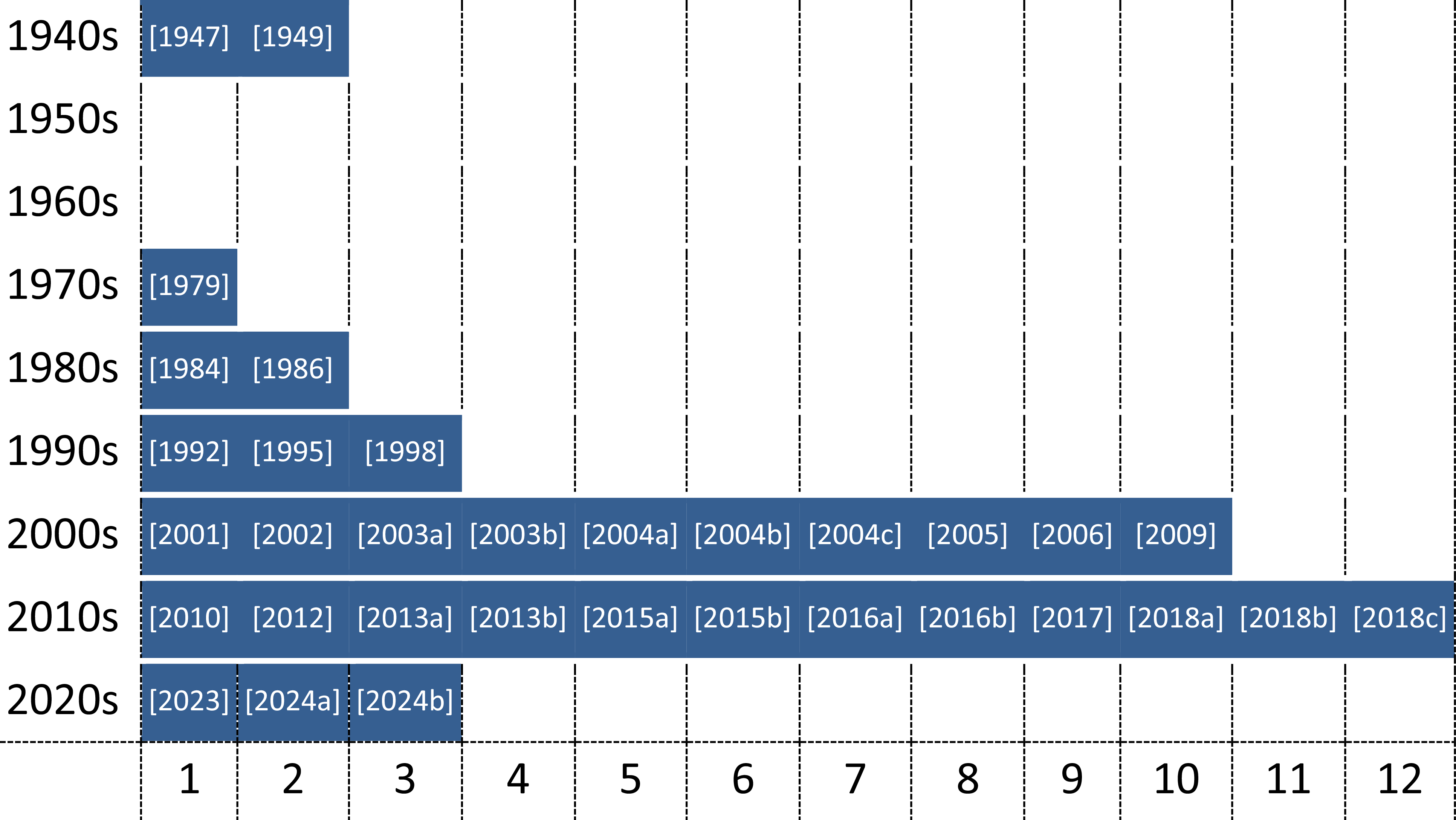
Having reviewed the commonly assumed meaning of the maxim, we next turn to its usage across time and location. Considering the diachronic distribution of references, we find that the maxim was used just twice in the three decades after the second World War, with most other references accruing in the recent three decades, as shown in Figure 1:
Absolute number of English-language law journal articles substantively mentioning non calculat across decades since 1947.

Of these usages of non calculat, only two occurred within the article title—[2001], [2015b]—in contrast to over sixty German article titles mentioning the phrase.Footnote 23 In one instance, the titular reference was singular: Nowhere else did the article mention the maxim [2001].Footnote 24 Other formats in which the maxim appeared include a speech [1995], a workshop comment [2003], a discussion transcript [2013b], a special issue introduction [2024b], and five book reviews, including two of the earliest corpus entries: [1949], [1984], [2005], [2009], and [2016b].
Considering the recent date of most references, and the relative dearth of older sources, it may seem surprising to see a Latin maxim grow in popularity from virtual obscurity at just the time when command of Latin was still common academic currency. A simple explanation might come from a 1997 study on “the Use of Latin in the Modern Legal World” that demonstrated empirically how, in the U.S., “Latin in court opinions has experienced a revival over the past forty years.”Footnote 25 There is a better explanation though.
Looking at the publishing venues of the thirty-three articles in our corpus, we find that almost half of them were either published in declaredly “European” journals—[2010], [2013b], [2015a], [2015b], [2017], [2023], [2024b]—or the Columbia Journal of European Law [2002], the Common Market Law Review [1986, 2009], or in a “German” [2004c], “Austrian” [2005], “Hungarian” [1998], “Geneva” [1995] or “Scandinavian” [2006] journal.
Considering the country of affiliation reported for the authors of these articles, seven out of seventeen, or 41.2 %, turn out to have been from Germany.Footnote 26 In addition, three more articles referred to specifically “German” issues of law in their titles—two of them written by a German author [2012] [2016a], one by an Austrian [2024a]. Of the remaining fifteen articles in the corpus, one third had at least one German author, one third had at least one author from the United States, and one article had both [2013a].Footnote 27
This means that of altogether thirty-seven distinct authors in our corpus, at least fifteen, or 40.5 %, were affiliated in Germany—including repeat offender Klaus Meßerschmidt [2012] [2016a]—and only five, or 13.5 %, were affiliated in the United States—including the other repeat offender Curt Gruneberg [1947] [1949]. Of the five U.S. authors, three co-authored their text with a German [2013a], French [2004b], or Swiss [2018a] colleague, and another merely cited “German academics” who he had overheard [2004a].
This authorship pattern suggests a likely cause for the rising popularity of non calculat in English legal literature: The growing globalization of legal academia and an increasing presence of European (co-)authors in international law journals might have ushered the maxim across the Atlantic. Yet, why would the oldest references to non calculat [1947] [1949] come from an economics professor in Kansas? This is a fascinating story,Footnote 28 and its protagonist entirely forgotten, so I shall briefly dig into it.
Gruneberg, who in the U.S. was variously called Grueneburg or Gruenburg, Footnote 29 was actually born Curt Grüneberg—with an umlaut—in Berlin on Christmas Day 1895 to a “Mosaic” (Jewish) merchant and his wife.Footnote 30 Both parents were said to be “distinguished” individuals, with his father apparently coming “from a musical family”, and his mother part “of the Kantozovich [Kantorovich?] family, widely known in intellectual life”.Footnote 31 According to Gruneberg’s handwritten CV, he studied in Freiburg until World War I broke out, then intermittently served in the war and finished his studies in Berlin.Footnote 32 For unclear reasons, he then obtained a doctorate cum laude in administrative law from the University of Erlangen in 1921,Footnote 33 before working for an unnamed “publishing company” from which the Nazis “discharged” him in 1933.Footnote 34 We may assume that the publisher was Berlin’s Allgemeine Fleischerzeitung, Butchers’ General Gazette, which is still published today, because Grüneberg produced a 248-page legal self-help book there in 1932.Footnote 35 Six years later, he emigrated, via Jerusalem, Trieste, and Toronto, to the United States, where his subsequent career was summarized by two obituaries:Footnote 36 He worked as a tax consultant or accountant in New York, obtained a master’s degree in accountancy from Columbia University in 1942, was drafted by the military in April of the same year and applied (as a “stateless” person) for U.S. citizenship in December. He was naturalized in 1949 after being appointed an assistant professor of economics at Kansas City University (K.C.U.) two years prior. His university career was short-lived: He died from a heart attack just after midnight on January 14, 1950 at Menorah Hospital in Kansas City. He left no spouse or children. His main legacy may just be the first recorded usage of non calculat by a U.S. citizen—and the only one for over half a century.
This all shows that there simply is no tradition of the non calculat maxim in the Anglo-American world. Wherever the maxim appears in English scholarly writing, a German lawyer lurks just around the corner.
III. Which Rhetorical Purpose does Non Calculat Serve?
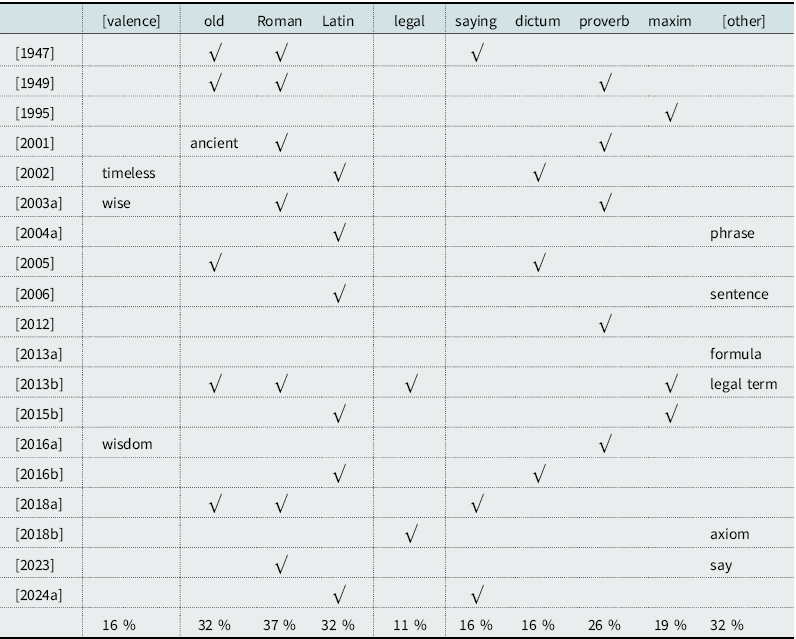
If the maxim is not, as we might have assumed, part of a shared tradition, then why do authors even use it vis-à-vis an uninitiated audience? In order to explore its pragmatics, we analyze the co-occurrences of non calculat: How was it framed rhetorically, and which, if any, attributes usually accompanied the phrase? Table 1 provides a detailed breakdown of all 19 non calculat frames encountered in our corpus.
Co-occurrences and attributive framing of non calculat.

Long description
A table showing co-occurrences and attributive framing of non calculat. The table has 19 rows and 11 columns. The columns are labeled as valence, old, Roman, Latin, legal, saying, dictum, proverb, maxim, and other. The rows are labeled with years and other descriptors. Each row contains checkmarks indicating the presence of certain attributes. The table provides a detailed breakdown of all 19 non calculat frames encountered in the corpus.
This breakdown allows several inferences to be drawn about the pragmatics of non calculat in scholarly literature:
-
1. None of the 19 epithets occurs twice. This low degree of formulaicity suggests that individual authors may be genuinely convinced of the attributes they assign to the phrase, rather than merely copying and pasting boilerplate characterizations.
-
2. All but five epithets—[1995], [2012], [2013a], [2016a], [2018b]—include age-related framing: “old”, “ancient”, “Latin”, “Roman”. Even the earliest reference [1947] called non calculat an “old Roman saying” to conjure images of the “Roman Empire” and its world “two thousand years ago”.Footnote 37 This suggests that most authors try to derive epistemological authority from the maxim’s supposed historicity.
-
3. None of eight nominal attributes get used in more than 26 % of cases. While some articles simply refer to non calculat as “the maxim” [1995], others are more prolix, calling it an “old maxim from Roman law” and “legal term” [2013b]. This suggests that the epistemological status of the “maxim” is either unclear or differs across contexts.
-
4. Less than one out of every five epithets, or 16 %, attributes valence; each of these cases connotes the maxim positively as a “timeless” [2002] “wise” [2003a] “wisdom” [2016a] rather than negatively as, say, a “dogma”.Footnote 38 This positive valence starkly contrasts with the mostly critical explanation observed earlier. Most authors, however, seem to abstain from judging the maxim’s veracity or authority.
Just as authors hesitate to attribute valence, they seem to be equally as reluctant to cite external references. Many use the maxim in mere passing, treating it matter-of-factly as though it required no introduction or explanation at all.Footnote 39 Considering the strict scrutinies of law review bluebooking, it is quite remarkable that even of four articles published in student law reviews—[1949], [1984], [2004a], [2013a]—just one (!) even attempted to cite a source for the maxim: In a paper for the Connecticut Journal of International Law, Markus Heintzen and Stephen Utz assert that “[t]he formula judex non calculat is found in the Digests of Roman Law (Dig. 49, 8, I § 1) as early as the second century B.C.E.” [2013a]. While reassuringly precise, the reference is equally as misleading: Neither the Roman Digest cited,Footnote 40 nor other Latin classics, even use the phrase non calculat at all.Footnote 41
Yet, the assumed historicity suggests that authors employ non calculat to generate an aura of erudition and to invoke the epistemological authority inherent in the maxim’s purportedly ancient pedigree.
C. The Pragmatics of Non Calculat in German Politics
If English-language scholarship takes no note of non calculat except where European scholars contribute to it, and if many European scholars idealize number-aversion as a political virtue, then how do politicians themselves treat this supposed virtue? Empirically, the comparative pattern is similar to the one in scholarly journals: A full-text search across all types of U.S. Congress documents since 1949, while returning almost two million documents, returns not a single reference to the non calculat maxim.Footnote 42 In contrast, over the same time span, the maxim was invoked some twenty times across eighteen debates of the German Parliament, Bundestag, and once even in the travaux préparatoires for a draft law.
Each of these recorded uses—with verbatim quotes, the URL of each session protocol, and demographic data for the respective congressmen—have been made available in a public Zenodo dataset.Footnote 43 A closer look at these data in Section C.I will reveal who used the maxim in parliament, in Section C.II when it was most popular, and in Section C.III what these lawmakers intended.
I. Who Invoked the Non Calculat Maxim?
Fifteen distinct congressmen—no womenFootnote 44—have used the maxim in debates,Footnote 45 three of whom used it repeatedly.Footnote 46 Unsurprisingly, just two were engineers,Footnote 47 all others law school graduates. Even the earliest recorded use of non calculat in 1950 was meant to “remind my lawyer colleagues in this House that jurists in general are not sympathetic towards number-juggling”.Footnote 48 This matter-of-fact usage suggests that the speaker’s “lawyer colleagues” were assumed to be well familiar with the maxim even then.
Interestingly, this speaker—being the first post-war congressman to use non calculat in debate—was an unapologetic Nazi. He had joined the party in 1933, and continued to praise the “revolutionary NSDAP line” even four years after Germany had lost the war.Footnote 49 While there is no obvious relationship between political leanings and Latin maxims, it appears that of all congressmen who used non calculat over the years, all but twoFootnote 50 belonged to right-leaning conservative parties such as Free Democrats (FDP), Christian Democrats (CDU), or the far-right fringe (DRP/AfD). There seems to be an inverse correlation between conservative beliefs and the willingness to have lawyers calculateFootnote 51—but we will test this hypothesis later, in Section D.IV.
II. When Did the Non Calculat Maxim Get Used?
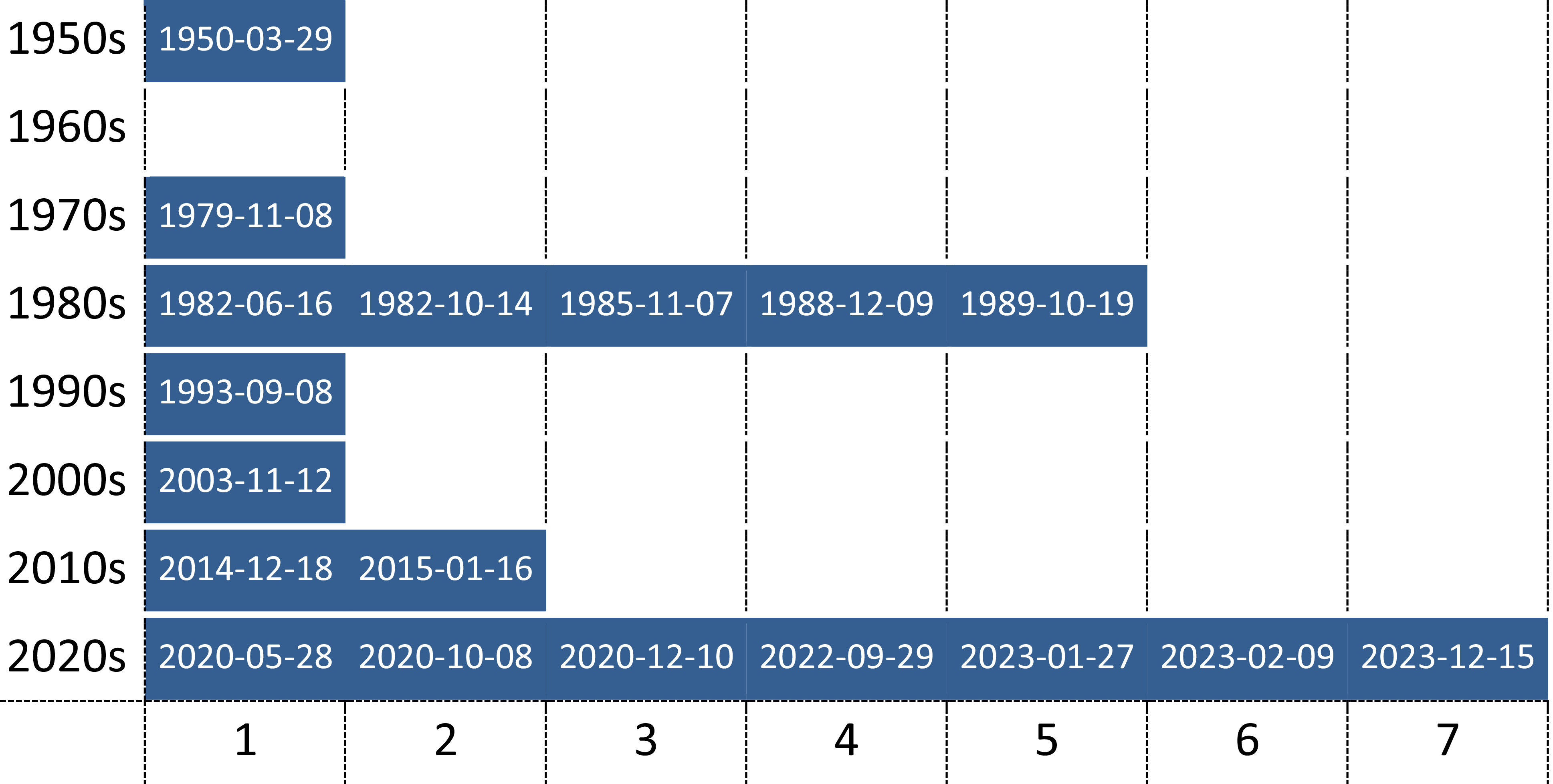
Analysing the maxim’s appearances over time (see Figure 2 below), we find a similar pattern as in English-speaking journals: Following a dearth in early years—with only two references in the three post-war decades—the maxim’s prominence surges in the very recent past: Seven of all eighteen debates that included the maxim, or 39 %, occurred in just the first third of this decade alone.
Unlike the rising popularity in English-language scholarship, there is no intuitive reason why the maxim should attain peak prominence in 2020–23.
III. Why did Politicians use Non Calculat?
Of the three competing interpretations of non calculat,Footnote 52 the first never appeared in parliamentary debates, and just three debates referred to the second reading that judges should weigh, not add arguments.Footnote 53 As in scholarly journals, almost all instances of non calculat referred to its third, jocular, usage; either offensively to criticize opponents—for example, “I am surprised you would be capable of adding this correctly”Footnote 54—or defensively to apologize for numerical slips—“You know: judex non calculat.”Footnote 55
In addition to oral banter, non calculat also appeared in legislative documents once, namely in the official 1996 rationale for reforming Germany’s arbitration laws. As part of this reform, legislators had to explain why arbitration courts—unlike state civil courts—should decide not just on the merits of the case, but also on the costs of their proceeding: “Civil courts do decide on the costs, yet without quantifying them. However, the maxim ‘judex non calculat’ derives in civil courts from the cost assessment procedure administered by legal officers.”Footnote 56
This quote provides evidence for a fourth reading of non calculat, namely that judges are relieved from quantifying court costs due to administrative assistance. It was not the first time that this interpretation appeared: Just a few years prior, a pioneer of German legal informatics had argued in a textbook on “applied computer science” that “the two thousand year old Roman-law tradition of ‘Iudex non calculat’” implied that judges “let subordinates do the calculations” and “automatically deny themselves closer engagement with the calculator [devices]”.Footnote 57 This interpretation may also be what Curt Gruneberg had had in mind,Footnote 58 and more recently, ill-conceived interpretations of non calculat were described as a manifest reason why “the issue of calculation has traditionally attracted relatively little attention in legal writing and practice”.Footnote 59
D. Thinking Like a Lawyer: Non Calculat in Legal Education
We have already seen how some legal scholars from Germany celebrate non calculat as a proud commitment to their “legalist tradition”—barring them from quantifying justiceFootnote 60—as best summarized by one German attorney:
[I]n the legal context, I am generally wary of mathematical axioms. Maybe the sentence ‘iudex non calculat’ is well put …. Certainly O.W. Holmes was correct – even for our legal system – to assert that ‘The life of law has not been logic; it has been experience’…. We need no numerical dogmatics, but pragmatism and normative evaluation. Any lawyer who proceeds otherwise risks being derided as a scholastic, as a rule automaton, a technician of the law, and a case plumber. The natural-sciency logic of terms … only covers up … the actual problems of attributing responsibility.Footnote 61
Rarely do German lawyers ramble so polemically, and rarer still do they appeal to legal authorities from the U.S. Given that politicians with law school training—even those with little else in terms of life experienceFootnote 62—also employ non calculat as an instinctive rhetorical device, maybe there is indeed what Curt Gruneberg called a “special state of mind” of the “legal profession”.Footnote 63 Might its root cause lie in the common denominator of these professional domains—their protagonists’ law school experience? To explore this question, I conducted a survey among German law students.Footnote 64 Below I briefly summarize the method and survey uptake, before analysing the responses in detail in Sections I. through IV.
There are currently forty-four law schools at German universities. No platform allows to contact their students collectively, so I e-mailed the student body representatives at each of forty-two law schools:Footnote 65 I asked them to relay my survey “on the language of law” to all students at their school, and I reminded them twice at ten day intervals. As a result, slightly less than half of the student bodies responded: All of fifteen agreed to disseminate the survey, five refused—some on account of being unable to contact their members, others due to an overwhelming number of similar requests. There is reason to suspect, however, that only five student representatives actually did distribute the survey as agreed: While my survey respondents reported affiliations with twenty-one different law schools—or half of the total—most of these schools (sixteen or 76.2 %) were mentioned but once. Instead, responses clustered heavily in five law schoolsFootnote 66 and cannot, therefore, faithfully represent all German law students. Some variation in geography and reputation did transpire nonetheless: Of the five schools, one was located in each of the North, South, West, East, and capital region of Germany; at the time of my survey they ranked—in a satisfaction survey among German law students—sixth, twentieth, twenty-first, thirty-seventh, and thirty-ninth respectively,Footnote 67 out of forty-four.
The survey was designed to run for one full month during off-class season on a platform for social science research in Germany, SoSciSurvey (www.soscisurvey.de). 235 law students completed the questionnaire. Respondents passed through three consecutive survey pages. On the first, they were asked to respond to four socio-demographic questions, which I will analyse in Section D.IV below. On the second survey page, they were asked to actively recall statements pertaining to “law and numbers”, which I will utilize in Section D.I. On the third page, they were then asked to think about non calculat specifically, and to answer four additional questions about this maxim, which will be the subject of sections D.II and D.III.
Throughout these following sections, individual responses get cited by their ID (for example, “#200”) from the dataset, which has been archived—along with questionnaire and codebook—in the online repository Zenodo.Footnote 68
I. How Many Students Actively Recall Non Calculat?
The survey had been introduced in general terms as “regarding the language of law”, and before it first mentioned non calculat, respondents were asked to list any “legal principles, maxims or proverbs”—juristische Prinzipien, Grundsätze oder Sprichwörter—which they could think of in relation to “law and numbers”—Recht und Zahlen.
This request alone caused major survey attrition: Fifty participants aborted the survey, thirteen more continued without responding to this question. Many may have just lost interest at the mention of “numbers”, as even two who continued protested that “I study law and not maths.” (#119) or “I have not studied law to do calculations.” (#230) Eight others frankly admitted that they could not think of any such “principle, maxim, or proverb”.
Limiting the subsequent analysis to 185 respondents who did continue the survey, the median respondent provided two maxims—or 2.25 on average—and only five respondents exhausted the preset maximum of ten responses. Of those who provided any response at all, eighty-five—or 49.4 %—included a variation of iudex/judex/iurex/iuris/ius non calcula(t) or, in three cases, a German paraphrase—“Juristen rechnen nicht” or “Der Richter rechnet nicht”. In all but five of these eighty-five instances, this was the very first mention. This implies that non calculat is the very first thing that comes to a law student’s mind in almost every second case of thinking about law and numbers. No other principle, maxim or proverb was nearly as prominent.Footnote 69
Looking at the duration of law school exposure, additional experience did seem to boost recall: The sixty-nine enrolled students who mentioned non calculat had studied 5.6 semesters on average, whereas the eighty-eight who did not had studied 4.6 semesters; just one provided no study duration. Among law graduates, sixteen out of twenty-seven, or 59.3 %, mentioned the maxim. When later prompted to think specifically about non calculat and where they encountered it, sixty-eight of 127 respondents, or 53.5 %, reported knowing it “from classes at university”. Almost as many (sixty-six) recalled it from “private conversation among personal acquaintances” —which likely includes fellow law students, seeing as the fifty-two respondents who knew the maxim from private conversations had studied 6.1 semesters on average, while seventy-six others had studied just 4.9 semesters.
II. What does Non Calculat Mean to Law Students?
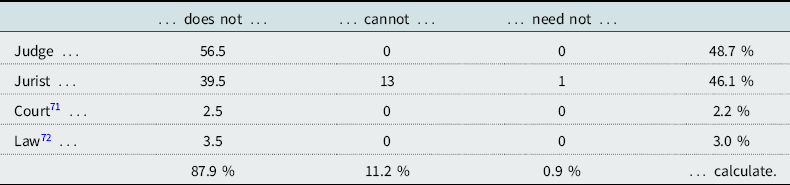
When asked what they suppose the maxim “means”—bedeutet—eight respondents provided a circumlocution, 109 a literal translation, and seven combined both. Of the 116 translations, Table 2 breaks down their variation:
Proposed meanings of iudex non calculat by 116 German law students.

Table 2. Long description
A table showing the breakdown of translations of a maxim by 116 German law students. The table has four rows and four columns. The columns are labeled ‘... does not ...’, ‘... cannot ...’, ‘... need not ...’, and ‘calculate.’ The rows are labeled ‘Judge’, ‘Jurist’, ‘Court’, and ‘Law’. The values in the table are as follows: Row 1: Judge, 56.5, 0, 0, 48.7 percent. Row 2: Jurist, 39.5, 13, 1, 46.1 percent. Row 3: Court, 2.5, 0, 0, 2.2 percent. Row 4: Law, 3.5, 0, 0, 3.0 percent. The table also includes totals at the bottom: 87.9 percent, 11.2 percent, 0.9 percent.
The table shows that while nearly everyoneFootnote 70 translated calculat to “calculate”—rechnen or, in one instance, kalkulieren—their subject and predicate phrases differed. Each table cell reports the absolute number of cases—out of 116—combining the given subject and predicate. In eight instances, respondents held two competing interpretations; each was counted with a fraction of 0.5. The table is noticeably sparse: Most respondents construed the maxim as referring to judges—48.7 %—or jurists—46.1 %—and despite some variation in modality, no respondent construed the maxim as saying that one “should not” or “must not” calculate. In that sense, the maxim’s interpretations were surprisingly uniform.
Moving from translations to circumlocutions, the dominant themes among the fourteen identified responses were “quality, not quantity” or judges weighing rather than adding arguments—#3, #11, #52, #122, #213, #225—and “law is not formulaic”, not capable of scientific precision—#88, #94, #177/#218: keine Zählwissenschaft. Two respondents reported a “quotidian” (#50) or “false” (#225) interpretation of jurists’ inability to calculate, others read the maxim to say that judges decide only on the merits, not on the extent (#147), that courts can correct miscalculations post-hoc (#183), that judges apply the law regardless of parties’ material interests (#124), and that judges should not offset punishments against each other (#223).
Here we thus re-encounter each of our four previously established interpretations,Footnote 73 as well as two new ones (in #124 and #223). In these “new” cases, neither of the two respondents meaningfully answered the question about the origin of their familiarity with non calculat.
III. How Much did Students Agree with Non Calculat?
In addition to their understanding of the maxim, students were also surveyed about their agreement with it. At least one respondent had reported during the active recall phase that he “frequently uses” the maxim “in everyday life when someone wants to know something about numbers from me”—#205—which implies its defensive function in line with this respondent’s self-construal of his task as a legal professional.
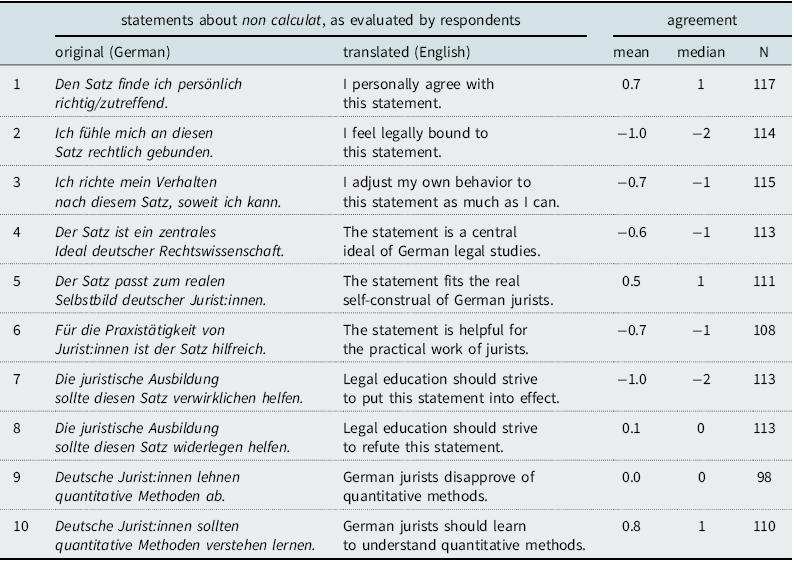
At the conclusion of the survey, all respondents were asked how strongly they agree—on a scale of fiveFootnote 74—with each of ten statements about their previously stated understanding of non calculat. Two of these statements—at rows seven and eight—directly contradicted each other, as an attention check to ensure respondents did not fill the survey blindly. Six respondents who did indeed simultaneously agree with both of these statements—#35, #38, #86, #93, #151, #231—were excluded from the following analysis.
This left 117 respondents previously familiar with non calculat and with some conception of what it meant to them. Their responses were pooled due to the substantially similar understandings reported earlier.Footnote 75 Each respondent replied to at least four of the ten statements,Footnote 76 summarized as follows:
As this tabulation shows, on the micro-level of subjective attitudes, students personally support the descriptive assertion that “jurists do not calculate”—the median respondent “agrees somewhat” with statement 1—but refuse the normative implications of feeling legally bound—they “disagree completely” with statement 2—or of adjusting their behavior de facto—as they “disagree somewhat” with statement 3.
Turning next to the macro-level of their assumptions about German lawyers in general, students neither consider non calculat a “central ideal” of legal studies—the median respondent “disagrees somewhat” with statement 4—nor do they find it practically helpful—they “disagree somewhat” with statement 6. Yet they do agree, again, with the more descriptive assertion that non calculat “fits the real self-construal” of German jurists—they “agree somewhat” with statement 5—while they seem somewhat less convinced of the general disapproval of German jurists vis-à-vis quantitative methods—they remain “neutral/indifferent” with respect to statement 9.
Considering finally their policy stance, students do not want legal education to promote non calculat—they “disagree completely” with statement 7—but neither are they in favor of its eradication—remaining “neutral/indifferent” about statement 8. They merely affirm the importance of learning to understand quantitative methods—as they “agree somewhat” with statement 10. This aligns with their earlier disapproval of practically any normative reading of non calculat in statements 2–4 and 6.
Thus emerges a mixed picture: German law students are not, generally, in favor of number aversion, but they do appreciate its widespread prevalence. They perceive it as part of German jurists’ actual image of themselves, but not as an ideal worth supporting. They personally agree that non calculat is true, while perceiving no obligation for it to be so. They want jurists to learn about quantitative methods and they perceive refusal as unhelpful for legal practice. In short: Iudex non calculat—sed debet. (“… but they should.”)
IV. Which Political Loyalties does Non Calculat Serve?
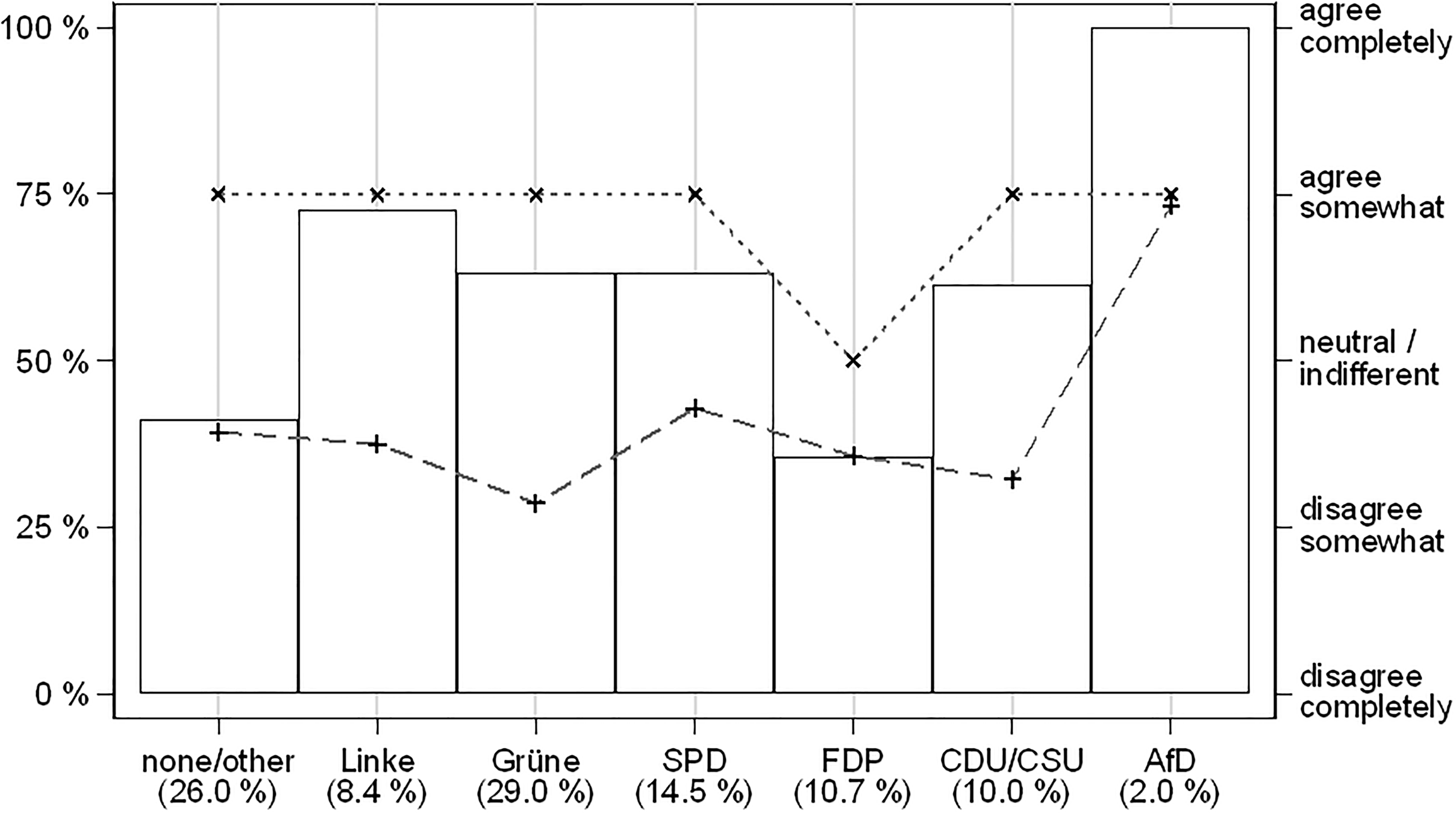
Although students on average did not normatively support non calculat, there might still be attitudinal differences along party lines. After all, 90 % of references to non calculat in German parliament had come from politicians speaking on behalf of liberal-conservative or right-wing parties (see Section C.I above). In order to test whether political conservatism might correlate with the urge to dissociate law and computation, I included in my survey a sociodemographic question asking respondents about their political leanings.Footnote 78 Surprisingly, there was no discernible pattern among the 131 respondents whose party leaning could be correlated with their attitudes towards non calculat, as illustrated by the following correlation graph:
The previous graph plots respondents’ position on the political spectrum on the horizontal axis against three non calculat measures on one of the two vertical axes: As a bar plot against the left-hand vertical axis, their proclivity to actively recall non calculat in % of respondents; as line plots against the right-hand vertical axis, either their median agreement (marked as ×) with the last statement in table 3—“German jurists should learn to understand quantitative methods.”—or the median value of a composite index (marked as +) which averages each respondent’s agreement with the first seven statements from table 3. Both lines appear almost flat, showing close to no correlation between non calculat attitude and political leaning.
Ten evaluative statements about non calculat, with mean and median strength of agreement on descriptive Likert items converted to [−2,+2] among N German law students.

Table 3. Long description
The table presents ten evaluative statements about non calculat, with columns for the original German statements, translated English statements, and agreement metrics including mean, median, and the number of respondents (N). The table has ten rows, each corresponding to a different statement. Each row includes the original German statement, its English translation, the mean agreement, the median agreement, and the number of respondents. The statements cover various aspects of agreement, legal binding, behavior adjustment, central ideals, self-construal, practicality, and the role of legal education. The agreement metrics range from -1.0 to 0.8 for the mean and -2 to 1 for the median, with the number of respondents varying between 98 and 117.
The only exception to this finding is a sharp increase in the right-most part of the graph. This needs to interpreted with caution though, due to the heavily skewed distribution of political leanings in our sample. While more than a quarter of respondents—thirty-four of 131—did not report leaning towards any of the six mainstream German parties, more than half of respondents, sixty-eight or 51.9 %, sympathized with one of the three parties in the left-green coalition government at the time of my survey—thirty-eight Green, nineteen SPD, and eleven Left, respectively. Only twenty-seven respondents, or 21 %, leaned towards the liberal-conservative parties—FDP, CDU/CSU—and just two towards the extreme right—AfD. Given subsamples this small, any increase on the right-hand side of the graph may be due to sampling bias.
E. Whence Non Calculat: Unthinking Adherence or Quixotical Humor?
While law students do not reproduce the politicized pattern of non calculat usage which we observed in politicians, their responses confirm that number aversion is considered an integral part of German lawyers’ identity, even at the earliest career stage of those attending law school.Footnote 79 Might law school even condition students “into unthinking adherence to conventions that we cannot even explain ourselves”?Footnote 80 Consider what legal anthropologist Elizabeth Mertz once called “Thinking Like a Lawyer”, namely “the acquisition of lawyerly ‘thinking’ as an initiation into” a legal “tradition”.Footnote 81 Even as non calculat has failed to become a shared trans-Atlantic tradition, might it still be considered a genuinely defining German legal tradition?
In order to explore this question, I studied how different actors in the legal system perceive its historical authority —from law students in Section E.I, to judges in Section E.II, and legal historians in Section E.III. Yet, any attempt to historically trace the first instance of the maxim has failed: Its origin story may just be lost in the fog of the pre-1850s, as Section E.IV concludes.
I. Law Students’ Collective Dating: 986 Years
When asked in my survey (Section D.) how long ago German law students supposed that non calculat first appeared in writing, their 144 responses ranged from zero to 3,000 years. Excluding respondents who had never previously heard of non calculat, and therefore had to guesstimate based on the Latin phrasing, the remaining 124 estimates produced a combined average of 986 years, median 550 years, which would correspond to a medieval origin. Only twenty-nine respondents—23.4 %—assumed an age of 2,000 or more years, which would correspond to an origin in antiquity, such as classical Roman law.
II. Judicial Skepticism: No More Than a “Pseudo-Adage”?
Judges are even more skeptical of non calculat’s antique origin. While German judges have thus far refrained from even mentioning the maxim, the published case record of European courts, CJEU and ECtHR,Footnote 82 is more explicit: Even the earliest user of non calculat—French advocate general (AG) Henri Mayras—saw it as no more than a “pseudo-adage attributed to mediaeval jurists”.Footnote 83 Of the three subsequent cases, two had a specifically German pedigree,Footnote 84 leaving just one instance with no apparent relation to Germany where non calculat got used without questioning its historical veracity.Footnote 85
In the U.S., Judge Tester, as the only judge who referred to non calculat, did not exactly choose it for its antique pedigree either. His reference was quite a bit more quixotical, as the judge himself clarified upon request:
[W]hile I was in law school, I had a colleague who was an English major and in each of his essay answers to exams, he would use a word that he was certain the professor would have to look up … Also, a fellow federal judge of mine quoted Shakespeare in all of his opinions. I shared these stories with my law clerks at the time, and we decided to draft the opinion to include 5 Latin phrases that we thought would be appropriate and interesting.Footnote 86
Indeed, Tester’s decision also referred to quantum meruit—“as much as she deserves”—de die in diem—“from day to day”—and to “the well-established Latin maxim” vigilantibus non dormientibus aequitas subvenit—“equity aids the vigilant, not the sleeping”—as well as generalia specialibus non derogant—“the general does not detract from the specific”. Like these other phrases, the judge had chosen non calculat less to ground his judicial philosophy than to craft an “interesting” judicial in-joke.Footnote 87 For what it is worth, at least his was no case of “unthinking adherence” to law school drills.
III. Scholarly Dispute: “No Earlier Than the Middle Ages”?
Like a quarter of German law students in my survey, well over a third of the scholarly literature also dates non calculat to “Roman” times.Footnote 88 However, just one English-language article, co-authored by a German lawyer [2013a], ever cited a historical source—albeit one we could not confirm.Footnote 89 Tracing this error further back, we find that the author had quoted from own prior work in German,Footnote 90 which in turn referred to a collection of “Latin Legal Rules and Proverbs” by German legal historian Detlef Liebs saying:
Judex non calculat. The judge does not calculate. Calculation is not the judge’s task; simple calculations in a decision do not partake of the finality of judgment. A mistake in this process can be corrected anytime. See Dig. 49, 8, 1 § 2 (Macer) …Footnote 91
German legal scholars frequently defer to such collections, which is why Liebs’ interpretation has become almost uncontested as “the analysis generally given time and again.”Footnote 92 All similar encyclopedias either repeat Liebs’ explanation and accept him as the authoritative source,Footnote 93 or they cite no source at all.Footnote 94 Only recently have other legal historians begun to acknowledge that non calculat “cannot be classical Roman law, because ‘to calculate’ in the words of classical jurists was ‘computare’, not ‘calculare’. Calculare only started appearing at the end of the fourth century A.D.”Footnote 95
One expert from Austria, while finding the maxim to be “in line with the general spirit of the antique sources”, estimated its first literal appearance as “no earlier than the Middle Ages”.Footnote 96 A German colleague dates the appearance of non calculat even later: “I opine that we can be absolutely certain that the paroemia cannot originate from the Middle Ages.”Footnote 97
With so little agreement on the maxim’s original meaning and historical source, I eventually decided to engage the wisdom of crowds: I initiated a “Research Competition in History of Language and Law” and called upon legal historians all over the world to provide any example or evidence of “primary sources (written or printed, published or not) containing the exact phrase ‘(i/j)udex non calculat’ prior to 1850.” The competition was announced on LinkedIn in April 2024, reposted on LinkedIn and Twitter (X) by the Centre for Legal History at Edinburgh, shared through the Legal History Blog,Footnote 98 the Dutch legal history blog Rechtsgeschiedenis,Footnote 99 and the blog of the European Society for Comparative Legal History.Footnote 100 I also contacted two eminent soon-to-be-retired scholars of Roman law in Germany, who agreed to disseminate the call for submissions through their professional networks.
The competition ran from April through June 2024. Three book prices had been offered as a reward. None was claimed: Of the half dozen responses received from various universities, including Ann Arbor, Berlin, Poznań, and Salamanca, none presented any previously unknown source.Footnote 101 This implies that the sources cited in the following section are indeed our collective current state of knowledge about the historical origin of non calculat.
IV. What We Know: First Recorded in 1851, but Certainly Older?
Given its immense prominence in legal writing, the unclear source of the non calculat maxim is vexing. What we can learn from the Google Books corpus is that the maxim was already used prior to 1900 to support a variety of causes—be it defending the liberal agenda against welfarist judicial intervention,Footnote 102 or allocating accountability for book-keeping matters.Footnote 103
Even earlier, a variant of the maxim—lex non calculat—appeared in a debate in the parliament of then-Kingdom Hanover on March 24, 1860, to argue why actuaries rather than judges should be entrusted with book revisionsFootnote 104—a forerunner of the fourth interpretation of non calculat identified earlier.Footnote 105
Its true origin must precede this by a lot, however. Even high-ranking judges in the 19th century could not recall anymore “where this strange sentence came from”.Footnote 106 The oldest known appearance to date is a thirty-four page medical essay by a prominent Prussian obstetrician about the length of umbilical cords (1851), which opens with the words: “Iudex non calculat; — and may we say the same of physicians.”Footnote 107 No explanation of the maxim at all, just assumed familiarity even among the journal’s non-lawyer readership. We should conclude, therefore, that the maxim became part of the German learned discourse quite some time before that.
How long before? “Nobody knows”, says one legal historian from Germany who had investigated the question,Footnote 108 and he closed his cold case with words that even at the end of our extended exploration, we cannot help but reiterate: “Let research proceed. We shall remain curious.”Footnote 109
F. Conclusion: On Mindless Rituals in Law
Even though the origin of non calculat remains unclear, our study is still instructive regarding the intellectual history of legal rituals and the sociology of legal habituation. There may be a trans-Atlantic convergence after all—if not in legal Latin, then at least in the mind-numbing effects of law school.
For as far as anyone can tell at the moment, the non calculat maxim is an apocryphal, highly ritualized phrase that virtually every lawyer in one jurisdiction, Germany, encounters in law school, internalizes into their professional identity, and invokes mindlessly without any serious thought, despite the phrase’s pronounced ambiguity and its users’ inability to explain its origins or actual meaning. Lawyers in most other jurisdictions have never even heard of it in the first place.
This exact description has been given before: The non calculat maxim shares all of these properties with another apocryphal and equally vexing recent tradition on the other side of the Atlantic: Lawyers in the United States unanimously abbreviate the word “contract” to the letter K, and none of them can conclusively explain this practice or identify its origin. This convention also originated in U.S. law school education and turned into “legal language so sticky that it remains in use long after anyone has forgotten its raison d’être”.Footnote 110 Exactly the same may now be said for non calculat. This peculiar parallel may indeed, at long last, unite lawyers across time, profession, and jurisdiction: Sometimes we simply don’t know the “arcane underpinnings of the rules we all follow.”Footnote 111
Absolute number of plenary sessions of Germany’s federal parliament, Bundestag, containing references to non calculat across decades since 1950.

Correlation of familiarity/agreement with non calculat and political leaningFootnote 77

Acknowledgements
The author thanks the convenors and participants of the workshop “Just Computation: Social and Historical perspectives on Calculation in the Law” (8/9 September 2023) at Harvard Kennedy School, which inspired and improved this study, as well as Gregor Albers, Andreas Fleckner, Andreas Kessler, and Martin Schermaier for insightful discussions, two anonymous reviewers for helpful suggestions, and Simon Weyhofen for research assistance.
Competing Interests
The author declares none.
Funding Statement
No specific funding has been obtained for this Article.
Appendix
Corpus of Thirty-three Scholarly Articles Mentioning Non Calculat
The corpus analyzed supra (Section B.) resulted from a full-text search for “non calculat” in each of HeinOnline’s Law Journal Library, Westlaw’s Secondary Sources, LexisNexis Secondary Materials, Kluwer Online, ProQuest Social Science Premium Collection, JSTOR, Google Scholar, and the Internet Archive in June 2023. Jule Halbach, Pariroo Rattan and Simon Weyhofen helped provide access to some of these databases. In order to illustrate corpus construction and cleansing, the detailed process was as follows:
-
– HeinOnline returned 44 results. 11 were not in English (7 German, 1 each Italian, Polish, Bosnian, and Croatian), 11 included “non calculat” exclusively to cite literature with these title words.Footnote 112 The remaining 22 articles formed a baseline corpus.
-
– JSTOR returned 52 results. 11 were indexed as “English”, 4 of these duplicated HeinOnline results, 4 contained merely front or back matter, one used “non calculat” exclusively to cite [2015]. The remaining two [1995, 2003] were added to the corpus.
-
– The Internet Archive returned 58 results. 37 were not in English,Footnote 113 4 used non calculat exclusively to cite literature with these title words,Footnote 114 another 6 were false positives caused by line breaks or flawed OCR (“non calculat-ive”, “non calculat-ed”, “non calculat-ing”, “non calculat[or]”). Of the remaining 11 results, just one was a journal article [1947].
-
– Google Scholar (queried through Harzing’s Publish or Perish) returned 463 results, but did not allow to filter by language or document type. Because book publications were not within the purview of the present study,Footnote 115 the list of results was sifted manually. 100 of the 463 results were found to be in English, but only four contained journal articles not seen in another database [1979, 2018a, 2018b, 2018c].
-
– ProQuest returned 11 results, with just one relevant article to add [2003a]. Other databases yielded even fewer results (Westlaw 11, Nexis 9, Kluwer 6)—all of them duplicates.
The corpus was last updated in September 2025 using the same four databases from which most of the corpus derived (HeinOnline, JSTOR, Internet Archive, and Google Scholar). Three newer articles were identified, boosting the corpus size up to 33 articles. A tabulated list of these articles is archived on Zenodo.Footnote 116 One article from a conference proceedings volume—although equivalent to journal publications in some disciplines—was omitted from the corpus because it merely summarized a journal article already contained in the corpus.Footnote 117 The following list cites all journal usages of non calculat in verbatim context, sorted ascendingly by date of publication.
[1947] The Journal of Accountancy (p. 35, 40) – Curt Gruneberg
Each profession develops in its members a special state of mind connected with special preferences and dislikes. One dislike on the part of the legal profession is clearly indicated in the old Roman saying: judex non calculat (a jurist does not calculate). This saying was valid not only for Rome but for the Roman Empire; that means for almost the whole world as it was known at that time. Today, this saying is as true as it was two thousand years ago. Whoever has seen the eagerness of a judge to get rid of difficult calculations and to transfer this part of the case to an accountant, knows that the old dislike on the part of the legal profession in the Roman Empire has been transmitted to the legal profession of today.
[1949] University of Kansas City Law Review (p. 96, id.) – Curt Gruneberg
“Iudex non calculat” (a judge does not calculate) says an old Roman proverb, thereby indicating the general dislike of Roman jurists against determining amounts by way of mathematical processes. This dislike, as we all know, was not restricted to jurists many centuries ago.
[1979] Computer Networks (p. 187, 188–89) – Wilhelm Steinmüller
lawyers have no preparation for the legal assessment of information processes. […] Even less are they familiar with the exercise of recognising and resolving technico-social problems: judex non calculat.
[1984] Southwestern Law Journal (p. 1217, id.) – Werner F. Ebke
Despite the long tradition of courses on “Law and Accounting” in a great number of law schools, accounting is today more than ever an almost exclusive domain of business schools rather than law schools. The overemphasis by some texts on the mechanical aspects of bookkeeping, the view that mathematical formulae are not drawn up for lawyers (“iudex non calculat”), the highly technical language of accountants, as well as the complex and too often complicated structure of financial statements, have tended to discourage law students and lawyers from learning accounting.
[1986] Common Market Law Review (p. 641, 650–51) – René Barents
The words “indirect protection” in the second paragraph of Article 95 do not necessarily imply a quantitative determination of the protective effect of the internal tax on the imported products. […] as the definitive judgment in Case 170/78 demonstrates, the Court may relay on a number of indications […] In the proceedings three criteria were put forward: the relationship between the tax and the volume, the alcohol content and the price of these beverages. The application of the first criterion showed a difference of about 400%, the second of at least a 100% and the third a difference of 58-77%, in some cases even 268%. For the Court together these criteria were sufficient to establish the existence of a protective effect of the tax on wine in relation to the tax on beer. The value of this approach is not only that justice can be done on the basis of “iudex non calculat”, but also that the burden of proof is considerably lightened as it is no longer necessary for the plaintiff to indicate the correct fiscal relationship between domestic and imported products.
[1992] American Journal of Jurisprudence (p. 171, 183–84) – Hannu T. Klami
When a theoretician of the law tries to develop models for legal reasoning, models presupposing numerical assessments of probative force, utility and hierarchy involve complicated calculations. […] I know exactly the aversion of judges and counsels to any “mathematics”: iudex non calculat. […] Iudex non calculat. He will, nevertheless, reason, much in the same vein as two thousand years ago when one spoke about rheton apo dianoias, verba and voluntas—When will they ever learn—When will they ever learn?
[1995] Geneva Papers on Risk and Insurance (p. 74, id.) – Reimer Schmidt
The critical examination by means of economic analysis of the practical results of judicial decisions and the application of law should be taken very seriously but cannot of course be assumed to lead to the conclusion that “economic law” is the general yardstick for legal principles. However, I would join with Hein Kötz in warning not to forget the maxim “iudex non calculate” and to juxtapose the watchword “iudex calcula!”.
[1998] Acta Juridica Hungarica (p. 225, id.) – Alexander Blankenagel
one will even find publications on tax law and projects on taxation systems, but there is practically nothing on the constitutional pattern of budget law and the financing system of the state. So maybe it is true that the judge does not count—iudex non calculat—but as far as the legal scholars are concerned, they do not even talk about money.
[2001] Journal of Environmental Law (p. 235, article title) – Levente Borzsák
Punishing Member States or Influencing Their Behaviour or Iudex (non) calculat?
[n. †: Ancient Roman proverb, stating that judges do not calculate.]
[2002] Columbia Journal of European Law (p. 53, 68) – Markus G. Puder
The number juggling performed during the Nice Summit connotes the timeless Latin dictum about lawyers and mathematics – iudex non calculat, which may be freely translated as “the judge does not (like to) do math.”
[2003a] Journal of Family History (p. 31, 47) – Wolfram Müller-Freienfels
in connection with their shift from acting as a servant of justice to serving as a welfare functionary, judges have been turned into arithmeticians who are helpless without their pocket calculators (in direct contrast to the wise Roman proverb iudex non calculat).
[2003b] Journal of Institutional and Theoretical Econ. (p. 65, 69) – Urs Schweizer
if the buyer feels cheated after having observed the signal, he may take the case to court. […] Never try to update your beliefs. Judges will be happy to hear this message. Yet, they may have arrived at similar conclusions, possibly for other reasons, long ago. First, judex non calculat. Second, all human beings, not just judges, have difficulty grasping Bayes’s updating rule on intuitive grounds, and hence they are prone to make mistakes. So better keep hands off whenever possible.
[2004a] Chicago-Kent Law Review (p. 403, 418) – Thomas S. Ulen
There are two obvious reasons and two not-so-obvious reasons for the paucity of empirical work in the law. The first of the obvious reasons is that to do empirical work requires a facility with statistical techniques—such as hypothesis testing, regression analysis, and ANOVA—in which the typical law professor has had no formal training. [n. 40: The scarifying aspect, to law students, of mathematics is hard to exaggerate. Indeed, it is so well known among German academics that there is a Latin phrase to cover it—iudex non calculat.]
[2004b] Law & Social Inquiry (p. 615, 618) – Yves Dezalay & Bryant G. Garth
Professional investment in credibility serves both the lawyers and their clients. […] The importance of this credibility is reflected in professional hierarchies. At the top are the high priests invested with the purity of the law—the legal academy, lawyer statespersons, high court judges, queen’s counsel, and others, depending on the time and the place. Below them are the law merchants dealing essentially with the family businesses. And then there are the “pariahs” doing the dirty work at the periphery of the legal world. These are the so-called men of affairs, accountants, or various clerks dealing historically with debt collection, insolvency, and later tax. The traditional ideal on the European Continent was in fact that Judex non calculat—judges do not count. In England, similarly, David Sugarman has shown that solicitors were often quite proud to be bad bookkeepers, which went with their identification with the ideal of learned gentlemen.
[2004c] German Law Journal (p. 957, 964) – Gralf-Peter Calliess
On 11 September 2002 the Commission presented a proposal for a revision of the consumer credit directive (87/102/EEC) of 1986. [… The proposal] amounts to 89 pages with 38 Articles and three Annexes containing a vast amount of mathematical formulas with examples for calculation (for: iudex non calculat).
[2005] Austrian Review of Int’l and European Law (p. 357, 359) – Sigmar Stadlmeier
Priemayer has presented an interesting study on the approach of EC competition law to alliances of undertakings, with lots of economic insight into legal categories, and has again proved the old dictum iudex non calculat inapplicable to competition law.
[2006] Scandinavian Studies in Law (p. 339, 353 n. 31) – Tobias Mahler & Jon Bing
Probability calculations are not necessarily irrelevant to lawyers, but it may be the case that lawyers to a certain extent are reluctant to use them. This may be illustrated by the Latin sentence judex non calculat (“the judge does not calculate”). However, note that there are examples of the importance of probabilities in a judicial context, cf. […]
[2009] Common Market Law Review (p. 1776, id.) – Christoph Herrmann
the law of trade contingency measures requires at least a superficial understanding of economic concepts such as rent seeking behaviour, demand elasticity etc. and business concepts such as fixed and variable costs, cross-elasticity and the like. Last but not least, dealing with trade contingency measures brings with it a task which is traditionally not particularly favoured by jurists: iudex non calculat! However, dumping margins and most of the other legal concepts relevant for the application of trade contingency measures require doing the maths.
[2010] European Journal of Risk Regulation (p. 371, 373) – Thomas Burri
Perhaps the unwillingness of lawyers to grapple with the implications of chaos theory goes back to the technical, mathematical structure of chaos theory – a structure lawyers have traditionally been reluctant to cope with: iudex non calculat.
[2012] Legisprudence (p. 347, 377–78) – Klaus Meßerschmidt
Critics of judicial activism assert that courts ‘lack the adaptability and capacity to carry out a successful social policy role’. Adjudication, they claim, is ‘a particular poor means for framing issues and devising effective policies’. The lack of accountability and steering capacity of the Court may, in the end, lead to serious problems which remind one of the proverbs fiat iustitia, pereat mundus and judex non calculat.
[2013a] Connecticut Journal of Int’l Law (p. 71, 106) – Markus Heintzen & Stephen Utz
Judex non calculat [n. 52: The formula judex non calculat is found in the Digests of Roman Law (Dig. 49, 8, I § 1) as early as the second century B.C.E. On the understanding of the time, calculation was not a task for the court but was for the parties before it to settle. Further, the inclusion of purely calculative details in a judgment was beyond the judicial power, because details of this kind were open to judicial correction at any time.] is more than a description of past judicial practice; it is a customary norm that reflects the scope of judicial resources and ability. Courts are not administrative agencies; they lack the bureaucracy needed for maintaining consistent oversight; and their procedural safeguards are better suited to deliberating about occasional and highly focused issues than to maintaining a permanent watch on the activities of another governmental branch.
[2013b] European Competition Law Annual (p. 516, id.) – José Luis Da Cruz Vilaça
Finally, let me touch once again on the question of economists. I had an Italian colleague who in a hearing once quoted an old maxim from Roman law: Iudex non calculat. [n. 48: According a Wikipedia, Iudex non calculat is ‘a legal term that loosely translates as “The judge does not calculate”. It originates from the Roman legal concept that obvious calculation errors in a court decision are not harmful to the decision itself and can be corrected at any time. Figuratively it also describes the concept that a judge does not “add up” the number of arguments but instead bases their decision on the strength of those arguments. Jokingly, it is often used to mean “judges (or jurists) are unable to do the math”, often by jurists themselves,’] We have a wide range of legal backgrounds in both Courts, which is really a very good thing for the efficiency and richness of our case law. However, I agree that it’s good for judges deciding competition cases to have a good background in economics.
[2015a] European Business Law Review (p. 95, 99) – Bernhard Großfeld
Lawyers hailed themselves that ‘number crunching’ was not their business: ‘Judex non calculat’. This changed with Enron in the United States and with Parmalat in Italy, both events of the ‘roaring nineties’. They became a rich issue of worldwide discussions dealing with corporate governance and the role of lawyers in this context. Fannie Mae is another fact of the picture.
[2015b] European Journal of Risk Regulation (p. 597, 598) – Alexandre Biard
[…] in an interview given in October 2012 to the Newspaper Le Monde, the President of the German Constitutional Court was asked whether a lawsuit filed by 37,000 individuals weighed more than a lawsuit filed by a single plaintiff. His reply was blatantly negative: ‘we do not count but we ask ourselves whether the claim is meritless or not’. His response demonstrated the predominance of the legalist tradition which, in the western tradition at least, personifies Justice under the traits of a blindfolded goddess, omniscient, unbiased and insensitive to the identities of the parties and to the context in which decisions are taken. As the Latin maxim says: iudex non calculat. From the viewpoint of judges wishing to protect their social prestige and impartiality, no other response could have been expected.
[2016a] Theory and Practice of Legislation (p. 209, 232) – Klaus Meßerschmidt
While the Court renounced on calculating basic social benefits to the needy independently, it imposed strict standards of rational decision-making on the legislator including a survey of facts. This approach allowed the Court to strike down on the Hartz IV law, although the proverbial wisdom ‘judex non calculat’ seems untouched by the judiciary. The Court declared that the provisions on standard benefits for adults and children were unconstitutional, primarily because they were not entirely based on a statistical investigation by the legislature.
[2016b] ASA Bulletin (p. 810, 811) – n.a.
[describing the contents of a book:] To overcome the Latin dictum “judex non calculat” hints are given to calculate the appropriate indemnity.
[2017] European Journal of Law and Economics (p. 517, 531) – Juergen G. Backhaus
Assessing the future development of economic variables is difficult, and it is hardly the court’s task to assume this onerous burden. Iudex non calculat; and the judge need not even calculate.
[2018a] Journal of Risk Finance (p. 76, 77) – Willi Brammertz & Allan I. Mendelowitz
“Judex non calculat” is an old roman saying, which can be roughly translated as “Lawyers do not calculate”[n. 3: For a complete discussion of this topic, see (Brammertz et al., 2009).]. This aversion to mathematics may be one reason financial contracts are written in natural language.
[2018b] Frontiers in Psychology (#2073, p. 5) – Alex Biedermann & Kyriakos Kotsoglou
Forensic scientists take the legal axiom ‘iudex non calculat’ quite literally and deplore that traditional fact-finders (judges and jurors) struggle with the proper understanding of scientific methods, and science in general.
[2018c] Rationality & Society (p. 220, 238) – Christoph Engel & Werner Gueth
Iudex non calculat This skeptical assessment may be overstated for simple arithmetic operations. But calculus is certainly beyond most professional lawyers, and out of the question for a jury.
[2023] European Law Journal (p. 223, 225) – Douwe Korff
The above views show a serious lack of understanding of the statistical issues, even in relation to false-true positives and negatives, and the base-rate fallacy. This is not surprising, because lawyers have long failed to properly “do” mathematics (iudex non calculat, as the Romans used to say). But in the digital age, mathematical and statistical ignorance is no longer acceptable.
[2024a] Land Use Policy (no. 106975, p. 2) – Benjamin Davy
It is not possible to determine the market value of a property merely by applying law as an attorney or court would do. In fact, the Latin saying “iudex non calculat” (literally: a judge never calculates) already indicates that land valuation hardly is merely a matter of legal interpretation.
[2024b] European Journal of Legal History (p. 1) – Filippo Contarini & Florian Reverchon
The People v. Collins ruling thus marks a rejection of probabilistic reasoning in judicial decisions: judex non calculat. This rejection, however, may appear paradoxical. The science of probability, developed in the mid-17th century, precisely aims to produce objective knowledge of contingent events. Why should the judge […] forgo such a powerful epistemological tool?

 Open access

