Introduction
Terrigenous material makes up a considerable proportion of total sediment accumulation in the Southern Ocean, grain size and heavy mineral composition provide important signals of the sediment origin (Ehrmann & Polozek Reference Ehrmann and Polozek1999, Diekmann Reference Diekmann2007, Ergin et al. Reference Ergin, Keskin, Doğan, Kadioğlu and Karakaş2007, Hauptvogel & Passchier Reference Hauptvogel and Passchier2012). Grain size is sensitive to environmental changes and has long been used to identify types of depositional environments (Gao & Collins Reference Gao and Collins2001). Spatial changes in grain size composition are the result of a variety of processes such as abrasion, selective transport and mixing of sediments. Heavy minerals are a function of complex interactions between source area and sedimentation (Ergin et al. Reference Ergin, Keskin, Doğan, Kadioğlu and Karakaş2007), and their assemblages provide valuable clues about provenance. Therefore, combining analysis of grain size and heavy mineral composition will help to explain sediment provenance and transport processes, especially in polar regions where chemical weathering is very weak. A detailed study of the provenance of surface sediments in specific areas will not only help to understand modern sedimentary environments and processes, but also provide a geological basis for interpreting palaeoenvironmental records.
The Antarctic cryosphere, especially the East Antarctic Ice Sheet (EAIS), plays an important role in the global climate system (White et al. Reference White, Bennike, Berg, Harley, Fink, Kiernan, McConnell and Wagner2009, Berg et al. Reference Berg, Wagner, Cremer, Leng and Melles2010, Crespin et al. Reference Crespin, Yam, Crosta, Massé, Schmidt, Campagne and Shemesh2014, Mackintosh et al. Reference MacKintosh, Verleyen, O’Brien, White, Jones, McKay, Dunbar, Gore, Fink, Post, Miura, Leventer, Goodwin, Hodgson, Lilly, Crosta, Golledge, Wagner, Berg, van Ommen, Zwartz, Roberts, Vyverman and Masse2014). The Prydz Bay area is the depocenter for sediment supplied by the Lambert Glacier/Amery Ice Shelf, which drains approximately 10% of total Antarctic ice volume (Forsberg et al. Reference Forsberg, Florindo, Grützner, Venuti and Solheim2008). Detailed knowledge of the records preserved in marine sediment is important for revealing information about past climates in East Antarctica and also for predicting future climate. Comprehensive studies of sedimentary patterns and processes in the modern environment are central to interpretation of palaeorecords. However, research in this area is limited.
In the recent past, considerable progress has been made in modern sedimentary processes in Prydz Bay. Diekmann (Reference Diekmann2007) suggested that most detrital materials in the southern part of the Southern Ocean have a direct glaciogenic input from Antarctica. Harris et al. (Reference Harris, Taylor, Pushina, Leitchenkov, O’Brien and Smirnov1998) identified four main factors influencing sedimentation: the movement of the Amery Ice Shelf and adjacent ice sheets, ocean current circulation patterns, sea ice distribution and water depth. Also, sea surface temperature was thought to be important for the survival of ice (icebergs), and thus for transport and deposition of ice-rafted debris (IRD) (Diekmann & Kuhn Reference Diekmann and Kuhn1999, Diekmann Reference Diekmann2007). However, studies on modern processes and related mineralogical signatures are still rare (Borchers et al. Reference Borchers, Voigt, Kuhn and Diekmann2011). Borchers et al. (Reference Borchers, Voigt, Kuhn and Diekmann2011) provided a set of mineralogical data (clay minerals and heavy minerals) in this area; however, a more detailed sediment provenance of the sand in these sediments is lacking and is of vital importance to the understanding of the glacial dynamics. Based on the above-mentioned work, we have undertaken a detailed study of grain size and heavy minerals in surface sediments on the Prydz Bay continental shelf aiming to reveal the sediment features, sources and related sedimentary processes and conditions in the region.
Regional setting
Prydz Bay, bounded by Princess Elizabeth Land on the east and Mac. Robertson Land on the west, is downstream of the Lambert Glacier/Amery Ice Shelf system, draining c. 20% of the EAIS (Fricker et al. Reference Fricker, Warner and Allison2000, Forsberg et al. Reference Forsberg, Florindo, Grützner, Venuti and Solheim2008). Its morphology is shaped by former advances of the Lambert Glacier and other smaller glaciers (O’Brien & Harris Reference O’Brien and Harris1996). Seaward of the Amery Ice Shelf, Prydz Bay shows bathymetry typical of glaciated margins with deep water, in which the deepest is Lambert Deep and the broadest is Amery Basin (Forsberg et al. Reference Forsberg, Florindo, Grützner, Venuti and Solheim2008). Amery Basin occupies the centre of the bay below 500 m and shoals gently to the outer shelf banks at c. 100–200 m deep, Four Ladies Bank to the east and Fram Bank to the west. The northern side of Amery Basin features a trough c. 500–600 m deep that crosses the shelf to the shelf edge. To the south-east of Amery Basin, with depths reaching c. 1200 m, the Svenner Channel parallels the Ingrid Christensen Coast.
Geology
Prydz Bay is part of the Pan-African Prydz Belt, which is recognized as a result of tectonic processes initiating in the Archean (Wilson et al. Reference Wilson, Grunow and Hanson1997, Boger et al. Reference Boger, Wilson and Fanning2001, Liu et al. Reference Liu, Jahn, Zhao, Li, Li and Liu2006) and comprises three Archaean cratonic blocks, a Grenvillian granulite terrane and a Pan-African high-grade belt (Liu et al. Reference Liu, Jahn, Zhao, Li, Li and Liu2006). The Archaean blocks, exposed in the southern Prince Charles Mountains, Vestfold Hills and Rauer Islands, comprise primarily of orthogneiss; while the Grenvillian granulite is mainly exposed in the northern Prince Charles Mountains and consists of metamorphic complex including felsic orthogneiss, gneiss, mafic granulite and charnockite (Li Reference Li2006). The Pan-African high-grade belt mainly distributes along the Prydz Bay coastline and consists of mafic-felsic composite orthogneisses and migmatitic paragneisses (Fitzsimons & Harley Reference Fitzsimons and Harley1991, Dirks & Wilson Reference Dirks and Wilson1995, Liu et al. Reference Liu, Jahn, Zhao, Li, Li and Liu2006).
Circulation and glaciation
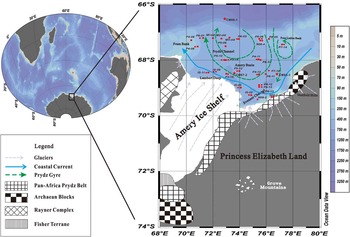
Circulation in Prydz Bay is characterized by a clockwise gyre in front of the Amery Ice Shelf (Fig. 1) (Smith et al. Reference Smith, Dong, Kerry and Wright1984, Passchier et al. Reference Passchier, O’Brien, Damuth, Januszczak, Handwerger and Whitehead2003), which covers almost the entire bay. At a depth of 50–500 m, water flows into the bay in mid and east longitude of the continental shelf and to the south-eastern corner of the bay. Then it separates into two branches; one branch flows westward along the coast with a width of c. 50 km and out of the bay at Cape Darnley, while the second branch flows eastward and forms an anti-clockwise gyre at Four Ladies Bank. To the north, the Antarctic Slope Current, driven by prevailing winds and input of dense waters from coastal areas, flows along the slope at c. 66°S and the Antarctic Divergence is due north. To the south, a cold surface water, originating in the vicinity of the West Ice Shelf and driven by East Wind Drift, flows westward along the coast and exits the bay at Cape Darnley (Passchier et al. Reference Passchier, O’Brien, Damuth, Januszczak, Handwerger and Whitehead2003). The near-bottom (10 m above the bed) current velocity was measured by Hodgkinson et al. (Reference Hodgkinson, Colman, Kerry and Robb1988, Reference Hodgkinson, Colman, Robb and William1991a, Reference Hodgkinson, Colman, Robb and Williams1991b) with a maximum velocity of 37 cm s-1 (mean: 14 cm s-1) on the continental slope (CM86-1, water depth: 566 m) and 5 cm s-1 on the continental shelf (CM87-2, depth: 565 m) (Harris & O’Brien Reference Harris and O’Brien1998) (Fig. 1).
Topographical and oceanographic features of Prydz Bay and surrounding areas, East Antarctica. The blue and green dashed arrows represent flow patterns in the bay. The red stars identify locations where near-bottom current velocity data are available from Hodgkinson et al. (Reference Hodgkinson, Colman, Kerry and Robb1988, Reference Hodgkinson, Colman, Robb and William1991a, Reference Hodgkinson, Colman, Robb and Williams1991b). The red dots represent heavy mineral analysis sites and the red squares represent grain size analysis sites.

The bay is covered by sea ice for most of the year. The lifespan of the sea ice differs across the bay with longer residence time in the west. Icebergs are also observed on the eastern side of the bay, and are believed to have originated from the West Ice Shelf and brought southward by the coastal current under the influence of cyclonic winds (Smith et al. Reference Smith, Dong, Kerry and Wright1984). The distribution of icebergs and floating ice masses in the bay differs in different sections, with more icebergs and floating ice near the outlet glaciers.
The most important source of terrestrial ice in the bay is derived from the Lambert Glacier/Amery Ice Shelf system, which is a composite system made up of several major confluent ice streams including the Lambert, Fisher and Mellor glaciers in the southern Prince Charles Mountains. Other sources of glaciers entering the bay primarily come from the Ingrid Christensen Coast, including the Sørsdale Glacier which flows south of the Vestfold Hills and the glaciers that contribute to the Publication Ice Shelf. While only a few small glaciers flow into the bay from Mac. Robertson Land (Passchier et al. Reference Passchier, O’Brien, Damuth, Januszczak, Handwerger and Whitehead2003).
Sampling and analysis methods
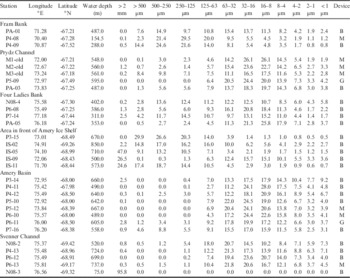
The uppermost surface sediments (0–5 cm) were sampled on the continental shelf of Prydz Bay by the 24th and 29th Chinese Antarctic expeditions in 2007 and 2012, respectively (Fig. 1). Sampling information is given in Table I.
Overview of sample sites, devices and grain size composition of surface sediments in Prydz Bay, East Antarctica.

B=box corer, M=multicorer, G=gravity corer.
Both sieve analysis and a laser particle sizer (Mastersizer 2000) were used for grain size measurement. First, H2O2 was used to remove organic material, and HCl (0.25 moll-1) to remove CaCO3. Samples were then placed in a water bath at 85°C for 4 hours and Na2CO3 (1 moll-1) was added to remove biogenic silica (opal). Samples were washed using de-ionized water and dried. The coarser fraction was retained on a mesh (>2 mm, gravel), weighed and its abundance calculated in percent weight. The finer fractions (<2 mm) were immersed in de-ionized water, scattered by sodium metaphosphate and analysed with a laser particle sizer. Percent weight of gravel, sand, silt and clay were recalculated and normalized to 100%. Q-type factor analysis was applied to the grain size percentage using SPSS version 19.0. This statistical method is used to determine the groupings of fractions with similar sets of grain size associations.
For the heavy mineral analysis, several grams of the dried fine-sand fraction (63–125 μm) were taken for the separation of heavy and light fractions by the gravitational settling method using Bromoform (a specific gravity of 2.89). The heavy fraction, repeatedly washed by acetone and distilled water, was air-dried and weighed. Heavy mineral grain mounts were analysed under a polarizing microscope. Mineral grains were identified based on their optical properties. More than 300 grains were counted on each slide to determine the broad distribution of species in a sample. All tests were conducted in the key laboratory of Marine Sedimentology and Environmental Geology, State Oceanic Administration, China.
Results
Grain size analysis
The results of the grain size analysis of surface sediments from Prydz Bay are summarized in Table I. In general, gravel was common in surface sediments in the bay, indicating a typical glacial-marine sedimentation environment. In the eastern region of the bay, including Four Ladies Bank, Svenner Channel, Amery Basin and Prydz Channel, sediments generally contained more silt and clay, and less sand and gravel. The sum of silt and clay amounted to 70.3% (on average) on Four Ladies Bank, 83.7% in Prydz Channel, 84.8% in Svenner Channel (except for N03) and 88.5% in Amery Basin. The gravel content was mostly <5%, with an exception of 95.8% at N03 in Svenner Channel. In front of the Amery Ice Shelf, sediments contained 0–47% gravel, 8–90.8% sand, 7.6–53.3% silt and 1.8–12.4% clay, which could be classified into sandy gravel, gravelly sand, sand and muddy sand. On Fram Bank, sediments were dominated by sand and silt, with 0–0.5% gravel and 3.3–8.5% clay.
Heavy mineral analysis
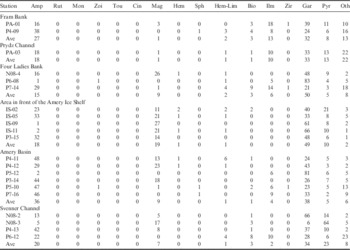
Table II shows the heavy mineral composition of the sediments from the study area. The concentration of heavy minerals in the 2- to 4-phi (0.125–0.063 mm) sand fraction ranged from 5% to 18% by weight, with an average of 9.6%. The highest total heavy mineral concentrations (11–18%) were confined to the area off the Amery Ice Shelf (IS-05), Amery Basin (P5-10, P4-12) and Svenner Channel (P4-13, N08-2). The total heavy mineral concentration decreased south-eastward from 18% (P5-10) to 11% (P4-13) in Amery Basin.
Heavy mineral composition of the sand fraction in surface sediments from the Prydz Bay continental shelf (%).

Amp=Amphibole, Rut=Rutile, Mon=Monazite, Zoi=Zoisite, Tou=Tourmaline, Cin=Cinnabar, Mag=Magnetite, Hem=Hematite, Sph=Sphene, Hem-Lim=Hematite-Limonite, Bio=Biotite, Ilm=Ilmenite, Zir=Zircon, Gar=Garnet, Pyr=Pyroxene, Oth=Others.
In descending order, the major heavy minerals were: garnet (mean: 41%, range: 6–83%), amphibole (mean: 24%, range: 1–48%), pyroxene (mean: 11%, range: 2–64%), magnetite (mean: 9%), ilmenite (mean: 5%), epidote (mean: 3%), tremolite-actinolite (mean: 2%), biotite (mean: 2%), and hematite-limonite (mean: 1%).
Amphibole and garnet could be observed in most of the stations in the bay (Table II); however, other minerals were confined to local areas. Tourmaline and cinnabar were only found in sediments at Fram Bank, and zoisite was only found at Four Ladies Bank and Amery Basin. Hematite-limonite and biotite have similar distribution trends, with highest average content in sediments at Four Ladies Bank and lowest in the area off the Amery Ice Shelf. Magnetite and ilmenite dominated different parts of the study area; the former was relatively rich in front of the Amery Ice Shelf and in Svenner Channel, whereas the latter was relatively rich at Fram Bank, Prydz Channel and Four Ladies Bank. Apatite, zircon, sphene, zoisite, siderite and tourmaline occurred as accessory heavy minerals each with a mean abundance of <1%.
Discussion
A lack of information on the bedrock of the hinterland around Prydz Bay makes it hard to deduce sediment provenance using heavy mineral analysis alone. However, sediment provenance and related transport processes can be discerned if the information of grain size, heavy minerals, marine circulation and icebergs are analysed together.
Grain size and the factors influencing sedimentation
A considerable proportion of sediment in the Southern Ocean is terrigenous, and the detrital portion of sediment on continental shelves derive from glaciogenic inputs (Diekmann Reference Diekmann2007). The surface sediments are relatively rich in coarser clastic material on the continental shelf of Prydz Bay and show typical characteristics of glaciomarine sediments. According to Hodgkinson et al. (Reference Hodgkinson, Colman, Kerry and Robb1988, Reference Hodgkinson, Colman, Robb and William1991a, Reference Hodgkinson, Colman, Robb and Williams1991b), the fastest near-bottom current velocity above the sea bed in the study area (sites in Fig. 1) is c. 5 cm s-1 (mean speed). According to Dou’s equation (Reference Dou1999), the incipient velocity of sand (63 μm) at a depth of 600 m is 85 cm s-1; thus, currents with the observed speeds in Prydz Bay cannot carry sediments with grain sizes of ≥63 μm, while the coarser fraction (sand and gravel) may be a primary feature of the IRD. Most of the study area is covered by sea ice and floating ice in winter, with icebergs scattered in the bay (O’Brien & Leitchenkov Reference O’Brien and Leitchenkov1997, Passchier et al. Reference Passchier, O’Brien, Damuth, Januszczak, Handwerger and Whitehead2003). Recent observations have shown that sea ice density and lifespan are much higher in the western areas, especially in the north-west (i.e. Prydz Channel and Fram Bank), which generally agrees with the grain size distribution of surface sediments. When icebergs calve from the ice shelves and outlet glaciers, they drift northward off the Amery Ice Shelf, and then gradually melt and release debris into the sea.
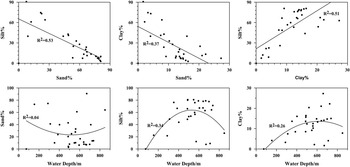
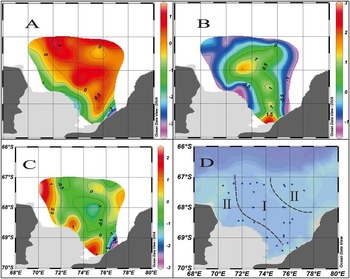
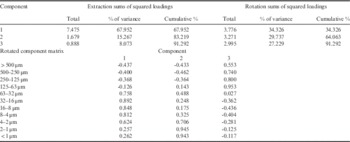
We used Q-type factor analysis to describe the distribution of different grain size fractions. Three factors were extracted with eigenvalues of >0.6 (with an accumulative percentage variance of 91.29%). After the varimax orthogonal rotation, the rotated component matrix was obtained (Table III). The percentage of principal factor 1 was 67.95%. The silt fraction (4–63 μm) had higher positive loadings, the clay fraction (<4 μm) had moderately positive loadings and the sand fraction (>63 μm) had negative loadings, indicating reverse correlations between sand, silt and clay content. The r 2 of the two fit-lines were 0.53 and 0.37, respectively (Fig. 2a–c). The r 2 value and positive correlation between the silt and clay fractions indicate that they possibly have similar influences from marine hydrodynamics. Figure 2d–f shows that the silt content increases with water depth in areas shallower than 600 m, but decreases with water depth in areas deeper than 600 m. The r 2 values for the relationships between water depth and sand, silt and clay were 0.04, 0.34 and 0.26, respectively (Fig. 2d–f). The 600 m contour is a threshold for iceberg reworking in Prydz Bay because the sea floor is widely ploughed by iceberg keels in areas shallower than 600 m (O’Brien & Leitchenkov Reference O’Brien and Leitchenkov1997). This indicates that the fine-grained sediments are relatively rich in the deep areas beyond iceberg ploughing. Among them, the silt fraction can serve as a flow speed indicator because it is inclined to enrich on the eastern side of Prydz Bay with strong near-bottom currents (Fig. 3a).
Relationships between different sediment fractions. a.–c. Correlations between grain size components. d.–f. Correlations between different sediment fractions and water depth.

Distribution of the loadings of the three factors influencing sedimentation at the different stations in Prydz Bay. a. Factor 1 has high positive scores mainly distributed on the eastern side of the bay; while on the western side, the factor 1 scores are high negative values. b. High negative values for factor 2 are mainly observed at Fram Bank, in the area in front of the Amery Ice Shelf and at Four Ladies Bank, and high positive scores are seen in Prydz Channel, Amery Basin and Svenner Channel. c. An opposite distribution is seen for factor 3 with high positive scores at Fram Bank, the area in front of the Amery Ice Shelf and at Four Ladies Bank, and low negative scores in Prydz Channel, Amery Basin and Svenner Channel. d. The study area was divided into two sections according to the distribution of loadings for factors 1, 2 and 3. Section I includes Prydz Channel, Amery Basin and Svenner Channel, and section II includes Four Ladies Bank, Fram Bank and the area in front of the Amery Ice Shelf.

Results of Q-type factor analysis.

Table III shows that factor 2 had a similar influence on sedimentation to factor 1, but that it had high positive loadings on clay (<4 μm). Clay, silt and very fine sand were major components of sediments in the east of Prydz Bay including Four Ladies Bank, Amery Basin, Prydz Channel and Svenner Channel, but clay was relatively rich in the central area of the bay (Fig. 3b). Although clay particles can be transported over long distances by air, the dust from South America, Australia and South Africa can be disregarded on continental margins around East Antarctica especially in the modern warm climate (Diekmann Reference Diekmann2007, Li et al. Reference Li, Ginoux and Ramaswamy2008). Without any rivers flowing into the bay, the clay enrichment in the centre of Prydz Bay indicates it is distal sediment in a weak environment. The near-bottom current velocity observed would be favourable to deposition of clay and fine silt in Amery Basin; meanwhile, the special circulation structure of the Prydz Gyre in which flow speed is inclined to decrease inwards is favourable for clay enrichment in the centre of Amery Basin.
The loadings of factor 3 on different sediment fractions are illustrated in Table III. Particles with grain sizes <32 μm had negative loadings, while other fractions had positive loadings. The average absolute values of loadings in descending order were: sand and coarse silt (32–63 μm), very fine to medium silt (4–32 μm) and clay. This suggests that factor 3 had most influence on sand and had no particular impact on coarse silt and clay. When comparing observations of sea ice density in the area (observation during China’s Antarctica expeditions), stations with higher scores (Fig. 3c) were primarily distributed in areas with higher sea ice density throughout the year (i.e. Fram Bank, periphery of the Amery Ice Shelf and Four Ladies Bank) where more icebergs were also observed. Sand (>63 μm) is often distributed as IRD, and thus the stations with high loadings coincided with locations at which icebergs concentrate. Therefore, factor 3 represents the impact of icebergs/floating ice masses, which directly influence the sedimentation process of sand.
The distribution of the scores for the three factors influencing sedimentation at different stations is illustrated in Fig. 3. It shows that the high positive scores of factor 1 are mainly distributed on the eastern side of the bay, while its high negative values are distributed on the western side. High negative values for factor 2 are mainly observed at Fram Bank, in the area in front of the Amery Ice Shelf and at Four Ladies Bank, and high positive scores are seen in Prydz Channel, Amery Basin and Svenner Channel. An opposite distribution is seen for factor 3, with high positive scores at Fram Bank, the area in front of the Amery Ice Shelf and at Four Ladies Bank, and negative scores in Prydz Channel, Amery Basin and Svenner Channel. Accordingly, the study area can be divided into two sections: section I includes Prydz Channel, Amery Basin and Svenner Channel, and section II includes Four Ladies Bank, Fram Bank and the area in front of the Amery Ice Shelf (Fig. 3).
In section I, the average clay content in the sediment increased as follows: Prydz Channel, Svenner Channel and Amery Basin. Currents strongly influence the distribution of clay and silt. When the flow velocity is large, the silt fraction is retained and the clay fraction is carried away; when the flow velocity decreases, the clay fraction is easier to deposit. Thus, the above order suggests a descending order of the current velocities in the different provinces. Due to the existence of the Prydz Gyre, flow speed slows in areas of deep bathymetry especially in the centre of the gyre; therefore, the clay content is consequently higher in Prydz Channel, Svenner Channel and Amery Basin. This is consistent with the average water depth of the sampling stations.
The sand fraction cannot be easily transported by currents but it is instead carried by icebergs/floating ice masses in the polar sea. The average near-bottom current velocity is <14 cm s-1 in section I (Hodgkinson et al. Reference Hodgkinson, Colman, Kerry and Robb1988, Reference Hodgkinson, Colman, Robb and William1991a, Reference Hodgkinson, Colman, Robb and Williams1991b). Thus clay and fine silt are inclined to settle, which will lead to a higher proportion of fine particles in sediment. Meanwhile, the deeper bathymetry in these areas has protected the sea floor from iceberg plough and from deposition of IRD. This is consistent with observations by Harris & O’Brien (Reference Harris and O’Brien1998). They observed fewer plough marks on the sea floor in these areas, especially in Svenner Channel where sediment was not disturbed. An exception is at N08-3, where the dredged sediment is almost gravel; this is probably influenced by coastal ice and coastal erosion because the site is near the shoreline and has a shallow depth.
Sediments in Amery Basin mainly consisted of silt. However, the average clay content was the highest in the study area. Because the Amery Basin is situated at the centre of the Prydz Gyre, the flow speed in water column is relatively low, but also inclined to gradually decrease inwards, which is exclusively favourable for deposition of the clay fraction. Furthermore, the gravel content indicates a small influence from icebergs in this area, although side-scan sonography observations show few iceberg plough marks (Harris & O’Brien Reference Harris and O’Brien1998). Because the Prydz Gyre almost covers the entire bay it probably entraps a few icebergs. In addition, the downslope wind may contribute to the northward movement of icebergs. Parts of icebergs have entered Amery Basin and left a few traces (IRD) in sediments.
Compared with the sediment composition in Amery Basin, sediments in Prydz Channel generally contained more sand. This can be explained by the passage of icebergs/floating ice masses. Plough marks were observed by Harris et al. (Reference Harris, Taylor, Pushina, Leitchenkov, O’Brien and Smirnov1998) in northern part of the channel, indicating an influence of iceberg keels, but their influence is limited, and this is consistent with sediment composition here. Relatively shallower bathymetry and higher current velocity (Hodgkinson et al. Reference Hodgkinson, Colman, Kerry and Robb1988, Reference Hodgkinson, Colman, Robb and William1991a, Reference Hodgkinson, Colman, Robb and Williams1991b) shortens the residence time of icebergs/floating ice masses, thus less gravel is deposited and more clay transported away, and sediment composition here contains more sand as the ‘old’ sand fraction exposed by iceberg scouring.
In section II, sediments contained more gravel and sand. Our results in section I demonstrate that clay content is influenced mainly by current speed, which is largely controlled by topography/water depth. However, this is not in the case in section II. More clay and fine silt deposit in the area in front of the Amery Ice Shelf, where the average near-bottom current velocity is <13 cm s-1. However, sediments here contained much more gravel and this may be due to the influence of the Amery Ice Shelf. The interactions between the ice shelf, tides and currents erode the ice shelf itself by forming cavities, and causing debris to melt out and deposit in situ. Therefore, sediment here contains much more gravel on average than other areas. The westward surface coastal current may also be a contributing factor. Icebergs drift westward along with the coastal current and detritus will melt out and deposit in situ. However, sediments at IS-09 contained more silt compared with sediments at other stations in front of the Amery Ice Shelf. This may be due to the polynya, where the formation of sea ice leads to the formation of dense, cold waters that sink and flow, depositing fine particles.
At Fram Bank, sand constituted more than half of the sediment, and silt made up just over 30%. The average clay content was the lowest in the bay. This is consistent with the water depth/topography, indicating the high current velocity in the area and agreeing with the observations of Hodgkinson et al. (Reference Hodgkinson, Colman, Kerry and Robb1988, Reference Hodgkinson, Colman, Robb and William1991a, Reference Hodgkinson, Colman, Robb and Williams1991b). They observed a near-bottom current velocity of c. 14 cm s-1 on upper Prydz Channel Fan and up to a maximum of 2 m s-1 in the north-western region of the study area at c. 63°E, thus an intermediate current velocity can be expected at Fram Bank which is appropriate for sedimentation of coarse silt, clay and fine silt transported by currents, consistent with observations by Harris & O’Brien (Reference Harris and O’Brien1998). Compared with the sediment compositions of the other provinces in the bay, the lowest gravel content and highest sand content at Fram Bank may be due to the combined effects of coastal currents and iceberg scouring. The high current speeds observed would shorten iceberg residence time, but iceberg scouring has a greater influence on extending residence time. Icebergs probably plough the sea floor and rework the coarse bottom sediments without much melting, leaving more sand and less gravel in these sediments.
Compared to Fram Bank, a similar environment probably exists at Four Ladies Bank (Harris & O’Brien Reference Harris and O’Brien1998). Thus, the high average sand content in sediments at Four Ladies Bank is probably due to the influence of icebergs and strong bottom currents. At station PA-05, no gravel was found, and sediment composition showed the highest content of silt, and an intermediate content of clay that was probably due to the high coastal current velocity. Similar features were observed in the sediments at N08-4. However, sediments in P7-14 had the highest gravel content at Four Ladies Bank. The shallow water depth at this site allowed for a much higher current velocity, and its winnowing effects on sediments transport the fine fraction away. Icebergs may have also ploughed the sea floor and the residence time of icebergs may be extended, allowing more debris to melt out and deposit in situ. Sediments at P6-08 showed similar features, except for a lower gravel content due to the deeper water depth which weakened the disturbance of iceberg scouring. Increased water depth decreases iceberg residence time, consequently icebergs leave less debris behind.
In general, current and topography/water depth are the dominant factors controlling sedimentation in section I. Antarctic Coastal Current and topography/water depth dominate sedimentation processes in Svenner Channel, while the Prydz Bay Gyre is more important in Amery Basin and Prydz Channel. Icebergs/floating ice masses, the Amery Ice Shelf and current play the major roles in controlling sedimentation at Four Ladies Bank, Fram Bank and the area in front of the Amery Ice Shelf.
Heavy minerals and their provenance implications
Heavy minerals are widely used to determine the provenance of coarse materials because of their resistance to destruction (Wu et al. Reference Wu, Lin, Shen and Feng2005). However, similar bedrock around Prydz Bay makes the heavy mineral assemblage similar in each area, and much of the exposed bedrock has not experienced outlet glacier scour since the Last Glacial Maximum (Hodgson et al. Reference Hodgson, Nood, Vyverman, Bryant, Gore, Appleby, Gilmour, Verleyen, Sabbe, Jones, Ellis–Evans and Wood2001, Lilly et al. Reference Lilly, Fink, Fabel and Lambeck2010). These factors make it difficult to use heavy minerals for provenance, but slight differences in specific heavy minerals can still be relevant.
Buoys attached to icebergs suggest a westward flow along the coastal areas (Smith et al. Reference Smith, Dong, Kerry and Wright1984, Allison Reference Allison1989). The grain size analysis described above suggests that icebergs/floating ice masses are the primary factor controlling the sand fraction of sedimentation in the bay, with an average relevance of 0.7615. Due to the permanent ice sheet cover in East Antarctica, little is known about the bedrock; only scattered information of rocks and minerals is known. This limited data was used to outline sediment provenance using typical heavy minerals that can be obtained at most of the stations in Prydz Bay in relatively high amounts. In addition, several specific heavy minerals were used to explain sources within the context of physical oceanography.
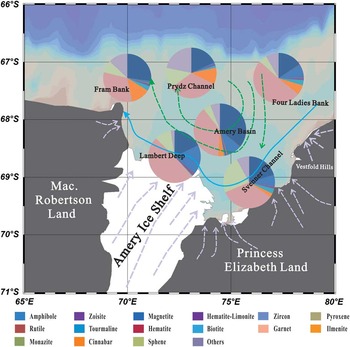
Amphibole was the dominant heavy mineral in the bay. Its content decreased from east to west along the coast, except at Fram Bank where it was higher. This descending trend is consistent with iceberg movement in the bay. As sand is carried by icebergs we inferred that the amphibole probably originated in Princess Elizabeth Land where icebergs calve from the West Ice Shelf. In particular, the Vestfold Hills consist primarily of orthogneiss outcrops that have a relatively high amphibole content. The amphibole content in surface sediments in the Svenner Channel is higher than it is in the area in front of the Amery Ice Shelf, even though the bedrock of its hinterland, Landing Bluff and Larsemann Hills, is primarily moyite, which bears no amphibole (Li Reference Li2006). Thus, its source is probably the icebergs flowing from the north-east. As for the area in front of the Amery Ice Shelf, bedrock in the Prince Charles Mountains, through which the Lambert/Amery Ice System flows, primarily consists of granulite-facies gneisses in the northern part, and amphibolite-facies and greenschist-facies gneisses in the southern part. The relatively high content of amphibole in front of the Amery Ice Shelf may result partly from these areas and partly from icebergs originating in Princess Elizabeth Land. Lastly, the amphibole content at Fram Bank was higher than the sum of its content at Four Ladies Bank and the area in front of the Amery Ice Shelf. This results from inputs of amphibole from the Mac. Robertson Land, where bedrock mainly consists of gneiss intruded by charnockite plutons (Fig. 4) due to the small glaciers on the western coast of the bay that carry debris into the area. Other typical heavy minerals, i.e. ilmenite, had similar features to that of amphibole in the bay. This confirms the hypothesis that sand content in the western areas (i.e. Fram Bank) partly derive from Mac. Robertson Land, and sediment in the eastern areas derive from the Lambert Graben and Princess Elizabeth Land.
Map of heavy mineral provenance in the Prydz Bay region. Geology of the Lambert Glacier drainage basin after Tingey (Reference Tingey1991), Borchers et al. (Reference Borchers, Voigt, Kuhn and Diekmann2011) and Li (Reference Li2006).

Typical heavy minerals can also help identify sediment source. These are only seen at limited stations in different areas of the bay. For example, rutile, monazite and zoisite are only found in sediments at Four Ladies Bank and Amery Basin. Considering the knowledge on iceberg movement, these heavy minerals were inferred to derive from the high-grade metamorphic gneisses (Li Reference Li2006) in the Vestfold Hills in Princess Elizabeth Land. These heavy minerals found in the Amery Basin may be due to the influence of the Prydz Bay Gyre and the westward coastal current. The Prydz Bay Gyre captures icebergs that flow westward with coastal currents (Vaz & Lennon Reference Vaz and Lennon1996) in front of the Amery Ice Shelf and carries them to the basin where debris is deposited. This is also consistent with higher amounts of amphibole in Amery Basin. In addition, tourmaline and cinnabar only exist in sediments at Fram Bank, and probably derived from the intruded charnockite plutons in the Mawson Escarpment (Tingey Reference Tingey1991). However, tourmaline and cinnabar were not found in Amery Basin or Prydz Channel, which may suggest that the low concentration of these heavy minerals was a result of weathering or that detrital material from Mac. Robertson Land does not contribute to sedimentation in these areas (Fig. 4).
As for magnetite, its content in front of the Amery Ice Shelf was much higher than the sum of the magnetite contents at Fram Bank, Four Ladies Bank and Svenner Channel. This is probably due to the contribution of the northern Prince Charles Mountains, where bedrock is primarily felsic metamorphic rocks with charnockite intrusions and contains magnetite as an accessory mineral (Zhao et al. Reference Zhao, Ellis, Kilpatrick and McCulloch1997). Differences in the concentrations of other heavy minerals in the area, such as hematite, sphene, zircon, hematite-limonite, biotite and ilmenite, indicate that their transport was consistent with the drift of icebergs and floating ice masses in the bay. Mineral content decreased from the source to the deposition locations. The magnetite content in the Amery Basin, Prydz Channel and Four Ladies Bank indicate that it primarily derives from movements of the Amery Ice Shelf and that these sediments derive from the Prince Charles Mountains.
In general, icebergs are calved from ice shelves and outlet glaciers, and then carried by western coastal currents out of the bay at Cape Darnley (Fig. 4). Some of the icebergs were captured in front of the Amery Ice Shelf by the Prydz Bay Gyre, which circulates clockwise and centres in the Prydz Channel. The sand fraction in the sediments at Four Ladies Bank primarily derives from Princess Elizabeth Land, while sand in the Svenner Channel and in front of the Amery Ice Shelf primarily comes from Princess Elizabeth Land and the Prince Charles Mountains. Sediments in Amery Basin and Prydz Channel are the result of converging effects of debris derived from the hinterland around the bay. The contribution of different sediment provenances cannot be deduced in this case, but we do know that less debris is carried by glaciers and transported to Fram Bank due to a lack of outlet glaciers in Mac. Robertson Land.
Conclusions
Common gravel and poorly sorted surface sediments indicate the Prydz Bay is a typical glaciomarine environment mainly influenced by ice shelf, iceberg, sea ice, topography and marine circulation.
Based on grain size and Q-type factor analysis, the study area could be divided into two sections: section I included Prydz Channel, Amery Basin and Svenner Channel, and section II included Four Ladies Bank, Fram Bank and the area in front of the Amery Ice Shelf. In section I, currents and topography were the main factors influencing sedimentation. Coastal currents dominate the sedimentation in Svenner Channel, while the Prydz Bay Gyre was the main factor influencing sedimentation in Prydz Channel and Amery Basin. In section II, icebergs/floating ice masses, the Amery Ice Shelf and currents were the dominant influences on sedimentary processes.
The concentration of typical heavy minerals in the sediments of the bay revealed the provenance of hinterland around the bay. Heavy minerals indicate that surface sediments at Four Ladies Bank primarily derive from the Princess Elizabeth Land. Sediments in the area in front of the Amery Ice Shelf, Svenner Channel, Amery Basin and Prydz Channel have a mixed sediment source derived from the eastern side of the bay. The contribution from Mac. Robertson Land to sediments on Fram Bank was limited due to the lack of outlet glaciers along the coast.
Grain size and heavy minerals are useful proxies for interpreting glacial dynamic and ocean–ice interactions on continental margins around Antarctica. Our results may help to understand sediment provenance and modern glaciomarine environments in Prydz Bay. However, further study on the modern sedimentary processes and past ice–ocean–atmosphere interactions in this region are necessary.
Acknowledgements
This work was supported by the Chinese Polar Environment Comprehensive Investigation & Assessment Programs (Grant nos. CHINARE2015-01-02, CHINARE2015-04-01), and the National Natural Science Foundation of China (Grant no. 40176136). We want to extend thanks to a number of crew who devoted their time and effort for marine geological sampling in the 24th and 29th Chinese National Antarctic Research Expeditions, and thanks to the Chinese Repository of Polar Sediments for providing samples. Thanks also go to Prof Xianwei Meng for in-depth comments and suggestions. We would also like to thank the reviewers for their comments on the manuscript.