Substantial amounts of scientific information on invasive species are available to environmental managers. Unfortunately, managers rarely rely on the scientific literature for developing weed control programs, largely because there is a mismatch between the type of research conducted by invasion biologists (essentially fundamental) and the needs of practitioners (essentially applied), a clear example of the so-called “knowing–doing gap” (Lavoie and Brisson Reference Lavoie and Brisson2015; Matzek et al. Reference Matzek, Covino, Funk and Sauders2014, Reference Matzek, Pujalet and Cresci2015). Reliable information on the cost of control campaigns is especially lacking, which complicates the task of managers who must evaluate the costs and benefits of different control methods and the feasibility of large-scale operations conducted with limited resources (Braun et al. Reference Braun, Schindler and Essl2016; Delbart et al. Reference Delbart, Mahy, Weickmans, Henriet, Crémer, Pieret, Vanderhoeven and Monty2012).
Management Implications
Controlling a well-established population of purple jewelweed (Impatiens glandulifera) on riverbanks is probably unrealistic on a regional scale, but a local, systematic (from upstream to downstream), hand-pulling control is technically practicable along a river system. To locally extirpate purple jewelweed, two hand-pulling operations per summer repeated over 2 yr are effective, so long as the controlled area is double-checked during each operation for missed plants, especially flowering individuals. The riparian vegetation may spontaneously recover following an early summer hand-pulling campaign, particularly if grass species with rhizomatous root systems are present. However, controlling purple jewelweed is expensive: a 1-km stretch of a brook (two riverbanks 5- to 6-m wide), requires 1,500 to 1,600 work hours, a minimum investment of Can$24,000 (US$18,000). Targeting small populations before they spread into available habitats would be more economical. On the other hand, dredging a 1-km section of a brook to remove an accumulation of sediments may represent costs of about Can$30,000 (US$23,000). Considering purple jewelweed may accelerate riverbank erosion, what initially appears to be a costly control campaign could in fact represent a wise investment to prevent recurrent problems.
Purple jewelweed (Balsaminaceae: Impatiens glandulifera; hereafter PUJE) is one of the invasive species for which a significant amount of information is available on the biology and ecology of the plant, but little information is available on the control methods and their associated costs. The native range of this annual vascular plant is located in the western part of the Himalayas (India, Pakistan), where it can grow up to an altitude of 4,000 m (Clements et al. Reference Clements, Feenstra, Jones and Staniforth2008). An individual may reach a height of 2.5 m at midsummer. Although its root system is shallow, the large stem base and the adventitious roots help solidly anchor the plant in the soil (Ennos et al. Reference Ennos, Crook and Grimshaw1993). A single plant may produce 800 to 2,500 seeds contained in capsules that split explosively at maturity, dispersing the seeds up to 5 to 6 m. (Beerling and Perrins Reference Beerling and Perrins1993; Chapman and Gray Reference Chapman and Gray2012; Clements et al. Reference Clements, Feenstra, Jones and Staniforth2008). Beerling and Perrins (Reference Beerling and Perrins1993) argued that PUJE seeds can, under certain circumstances, remain viable in the soil for at least 18 mo, but Perglová et al. (Reference Perglová, Pergl, Skálová, Moravcová, Jarošík and Pyšek2009) concluded, on the basis of laboratory and garden experiments, that a seedbank is unlikely for this species. Seeds can be dispersed by water, especially during floods (Čuda et al. Reference Čuda, Rumlerová, Brůna, Skálová and Pyšek2017; Love et al. Reference Love, Maggs, Murray and Provan2013; Pyšek and Prach Reference Pyšek and Prach1995), but the range of distances achieved by water dispersal along streams and rivers is unknown.
PUJE was introduced in Europe in 1839 and in northeastern North America in 1883 (Perrins et al. Reference Perrins, Fitter and Williamson1993; Tabak and von Wettberg Reference Tabak and von Wettberg2008). It has spread rapidly along rivers and drainage ditches, where it can form dense stands (Dawson and Holland Reference Dawson and Holland1999; Kostrakiewicz-Gierałt and Zając Reference Kostrakiewicz-Gierałt and Zając2014; Perrins et al. Reference Perrins, Fitter and Williamson1993; Pyšek and Prach Reference Pyšek and Prach1995). The effects of PUJE on the biodiversity of riparian habitats is nevertheless controversial. Several studies have shown that the invader has a low impact on plant species richness and composition (Diekmann et al. Reference Diekmann, Effertz, Baranowski and Dupré2016; Hejda and Pyšek Reference Hejda and Pyšek2006; Hejda et al. Reference Hejda, Pyšek and Jarošík2009) and that the invaded habitats even support a higher richness and abundance of gastropods (Ruckli et al. Reference Ruckli, Rusterholz and Baur2013). Others showed that PUJE may change the composition of snail and microarthropod assemblages (Horáčková et al. Reference Horáčková, Juřičková, Šizling, Jarošík and Pyšek2014; Rusterholz et al. Reference Rusterholz, Salamon, Ruckli and Baur2014) or reduce the abundance of foliage- and ground-dwelling invertebrates (Tanner et al. Reference Tanner, Varia, Eschen, Wood, Murphy and Gange2013). Some ecologists found evidence that PUJE outcompetes native plants for pollinators and disrupts pollen transfer networks (Chittka and Schürkens Reference Chittka and Schürkens2001; Lopezaraiza-Mikel et al. Reference Lopezaraiza-Mikel, Hayes, Whalley and Memmott2007; Thijs et al. Reference Thijs, Brys, Verboven and Hermy2012), but others concluded that there was no impact on pollination (Bartomeus et al. Reference Bartomeus, Vilà and Steffan-Dewenter2010; Emer et al. Reference Emer, Vaughan, Hiscock and Memmott2015; Vilà et al. Reference Vilà, Bartomeus, Dietzsch, Petanidou, Steffan-Dewenter, Stout and Tscheulin2009). A serious concern is soil erosion, a consequence of the replacement of perennials by PUJE, which leaves riverbanks devoid of vegetation cover after plant death and decomposition in late fall. Soil losses may reach, in heavily invaded riparian sites, 2,300,000 kg (Greenwood and Kuhn Reference Greenwood and Kuhn2014). Greenwood and Kuhn (Reference Greenwood and Kuhn2015) estimated that the increasing dominance of PUJE in riverbanks could compromise their ability to provide certain ecosystem services, such as filtering nutrient-rich sediments, moderating stream flow, and providing natural flood protection.
The scientific literature on the management and control of PUJE is sparse. Models predicted that removing upstream populations first, in an effort to locally reduce the ability of the species to colonize downstream parts of river systems, could be effective. However, from a regional point of view, a 99% control efficiency over a 25-yr period would be almost as ineffective as no management at all with regard to controlling the species (Wadsworth et al. Reference Wadsworth, Collingham, Willis, Huntley and Hulme2000). At the Thayatal-Podyjí National Park (Austria–Czech Republic), repeated mowing and hand-pulling operations allowed a major (87%) reduction of the area covered by PUJE populations within a decade (Schiffleithner and Essl Reference Schiffleithner and Essl2016). To our knowledge, the only experiment comparing the respective efficacy of PUJE control techniques (Cockel et al. Reference Cockel, Gurnell and Gurnell2014) showed that hand pulling was much more effective than mowing for reducing the PUJE cover over a 2-yr period. In summary, the control of a well-established population of PUJE is probably unrealistic from a regional point of view, but the local, systematic (from upstream to downstream), hand pulling of PUJE is apparently technically practicable along a river system. However, the question remains: Is such an operation cost-effective?
We tested the feasibility of a PUJE control (hand-pulling) campaign conducted along a small brook strongly invaded by the species. We evaluated the amount of time required to control the plant, i.e., to reduce the number of individuals to the lowest possible level, as close as possible to complete extirpation, according to density and biomass. We paid particular attention to the disposal of pulled plants, which must be considered in the total cost, and to the rapid recovery of riparian vegetation following hand pulling, a critical point for the prevention of soil erosion and the opportunistic establishment of other invasive species that could negate the benefits of PUJE removal (Cockel et al. Reference Cockel, Gurnell and Gurnell2014; Hulme and Bremner Reference Hulme and Bremner2006). We accurately calculated the cost of a control campaign. We hypothesized that PUJE removal time would be directly proportional to stem density and biomass, and that a hand-pulling campaign beginning in early summer would allow a spontaneous (unassisted) and complete recovery of the riparian vegetation. However, we also predicted that a PUJE control campaign would be extremely expensive where the species is already well established.
Materials and Methods
Study Area
The PUJE population selected for this study was located along the Sainte-Geneviève Brook (hereafter SGBk), at Saint-Isidore, near Québec City, in Québec, Canada (46.98°N, 71.15°W). SGBk is the main tributary of the Fourchette Brook, which flows into the Etchemin River that ends its course in the St Lawrence River at the town of Lévis, across the river from Québec City. The mean annual temperature in the study area is 5 C, the mean temperature of the coldest month (January) is −12 C, and that of the warmest month (July) is 19 C. The mean annual precipitation totals 1,178 mm, 23% of which falls as snow (Government of Canada 2017).
SGBk is 11-km long. The brook, 2- to 3-m wide, is bordered by agricultural lands (corn, soybean) over 80% of its course. Riverbanks have an average inclination of 36°. They are essentially clayey or loamy, with some rocky sections, and are covered by a herbaceous riparian strip about 5- to 6-m wide in cultivated areas. Province of Québec legislation requires the preservation of a vegetated riparian strip at least 3-m wide on both sides of a stream in agricultural areas (Loi sur la qualité de l’environnement, chapitre Q-2, r. 35). At the study site, the riverbank vegetation is largely dominated by PUJE and two other perennial exotic invasive species, reed canarygrass (Phalaris arundinacea L.) and smooth brome (Bromus inermis Leyss.), with almost no shrubs nor trees.
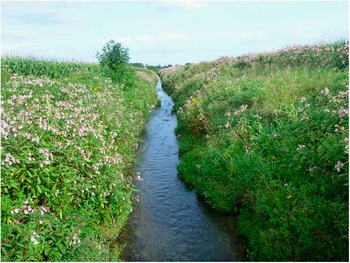
About 2001 (exact introduction year unknown), some PUJE individuals were planted a few meters from SGBk, in a residential garden located 7.4 km from the source of the brook. PUJE has since spread along SGBk: in 2016 the riverbanks were heavily infested (up to 177 individuals m−2) downstream from the introduction point (Figure 1). Several thousands of individuals were also detected along the course of the Fourchette Brook, from its junction with SGBk to the Etchemin River (C Lavoie, unpublished data).
Purple jewelweed (Impatiens glandulifera) population at Sainte-Geneviève Brook (Québec, Canada). Photograph taken August 16, 2016 (M. Leblanc).

Data Sampling
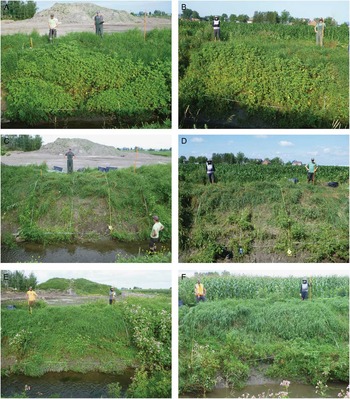
We selected a 1-km-long stretch of SGBk, 535 m downstream from the introduction point of the species, at the beginning of a cultivated zone where conditions were uniform with regard to width and composition of the vegetated riparian strip and adjacent land use. A hand-pulling station was systematically located every 50 m along the stretch, on each riverbank, for a total 42 stations; three of these were subsequently rejected because they were too heavily disturbed by recent agricultural activities (vegetation in large part removed). Before hand pulling began, a 24-m2 area was delimited at each station, 4-m wide by 6-m long (32 stations), or 3-m wide by 8-m long where the riparian strip was narrower (7 stations). The following data were taken: (1) the width of the riparian strip; (2) the width and (3) the water level of the brook; and (4) the slope of the riverbank. The vegetation cover inside the 24-m2 area was sampled just before the first and the second hand pulling using a point intercept method (Meunier and Lavoie Reference Meunier and Lavoie2012). Lines were drawn 1-m apart across each station. The presence of four plant categories touching a 3-cm-wide rod (held perpendicular to ground) was recorded at every meter along each line: (1) PUJE; (2) grass species; (3) forb species others than PUJE; and (4) woody species. The presence of the other invasive species (reed canarygrass and smooth brome) was also noted. This method provided frequency data (indicator of plant cover) from 35 or 36 sampling points per station. Photographs were taken just before and after the first hand pulling and before the second hand pulling (Figure 2). The total experimental area in 2016 was 936 m2.
Overview of two sampling stations on the riverbanks of Sainte-Geneviève Brook (Québec, Canada) just before (A: July 5, 2016, 177 stems m−2; B: July 14, 2016, 83 stems m−2) the first hand pulling of purple jewelweed (Impatiens glandulifera), just after (C, D) the first hand pulling, and just before (E: August 16, 2016, 3 stems m−2; F: August 18, 2016, 3 stems m−2) the second hand pulling. (Photographs: M Leblanc.).

As previously mentioned, two hand-pulling operations were conducted in summer 2016, the first from June 30 to July 14, when most PUJE individuals reached a height of about 60 cm and were thus easy to detect and hand pull, and the second from August 15 to 18, to detect individuals that were not eliminated during the first hand pulling and document the recovery of the vegetation of the riparian strip. Hand pulling was conducted by two or three wildlife technicians (student trainees). Pulled plants were dumped in 140-L trays that were emptied as needed on a tarp. During the first hand pulling, technicians made a single attempt to remove an individual with its root system; if the stem broke without roots, the base of the stem was left on site. This procedure was used to evaluate whether a quicker and cheaper hand-pulling operation would be as effective as a meticulous (all roots removed) but more time-consuming protocol. However, during the second hand pulling, all stems were removed with their root systems, even if the stems initially broke off. After the end of each hand pulling, the area was double-checked for missed stems. Extracted plants were tallied by presence or absence of root system and flowers. Fresh biomass was determined with a portable scale. For this experiment, fresh biomass was more relevant than dry biomass, given that technicians were handling fresh tissue. Pulled plants were packed into black garbage bags to prevent rerooting, and left on site to die by solarization. Time required for hand pulling and bagging was noted.
Data Analyses
The relationship between PUJE stem density or biomass and hand-pulling time was analyzed with linear regressions. Wilcoxon matched-pairs signed-rank tests were used to detect significant differences between the vegetation cover before the first and the second hand pulling, considering data were not normally distributed (Scherrer Reference Scherrer1984). Stata software (StataCorp 2013) was used for calculations.
Operation costs were estimated for a 1-km stretch of a brook and over a 2-yr period. For Year 1, we calculated the total time (two hand-pulling operations) required to extract and pack PUJE stems for the area treated in 2016 (936 m2). We then extrapolated this time to the total riparian strip area of SGBk over 1 km, estimated using the mean value of the width of the strips measured at the 39 hand-pulling stations.
On the basis of previous experiments (Cockel et al. Reference Cockel, Gurnell and Gurnell2014; Schiffleithner and Essl Reference Schiffleithner and Essl2016) and the results of this study, we concluded that a single summer of hand pulling would not be sufficient for an effective control of PUJE. Some small stems, hidden in the vegetation, will inevitably be missed by technicians in Year 1. Although most are unlikely to reach maturity by the end of the summer, the few that do will produce seeds. Our experimental design did not allow a second year of hand pulling in 2017, because the stations were reseeded by the thousands of bordering PUJE individuals; in a real control procedure, all individuals would be systematically eliminated upstream to downstream to prevent reseeding. So we estimated that it would be necessary to conduct a second summer of control (Year 2), with one hand pulling at the beginning of the summer and an additional one at midsummer. We estimated that the effort of each hand pulling at Year 2 would be equivalent to the time required to conduct the second hand pulling of 2016 (Year 1). In fact, technicians will probably spend more time searching for residual PUJE stems than actually hand pulling in Year 2.
The cost of the labor force was calculated using the mean hourly wage (including social benefits) of a wildlife technician hired in Québec, which was Can$33.39 in 2015, i.e., about US$26 (Institut de la statistique du Québec 2016), or the hourly wage (with benefits) paid to the students who were hired for this study (Can$15.16, US$12), which would represent the minimum wage that can reasonably be paid under these circumstances.
Results and Discussion
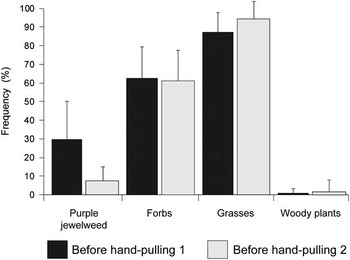
The density and biomass of PUJE stems before the first hand pulling was highly variable across the 39 stations investigated along SGBk (Table 1), from 1 to 177 stems m−2 (mean: 45 stems m−2) and from a value close to zero to 3.55 kg m−2 (mean: 0.95 kg m−2). Stem density (mean value) was higher at SGBk than in the native range of the species (India: 18 to 30 stems m−2; Tanner et al. Reference Tanner, Jin, Shaw, Murphy and Gange2014) but very close to values recorded in Europe (Beerling and Perrins Reference Beerling and Perrins1993; Greenwood and Kuhn Reference Greenwood and Kuhn2014). The mean frequency of PUJE (indicator of plant cover) was 30% before the first hand pulling (Figure 3), varying from 3% to 77% among stations, which was roughly the same as recorded in various riparian habitats of the Czech Republic and Germany (Bartomeus et al. Reference Bartomeus, Vilà and Steffan-Dewenter2010; Hejda and Pyšek Reference Hejda and Pyšek2006). Higher covers (60% to 100%) have nevertheless been observed in Europe (Cockel et al. Reference Cockel, Gurnell and Gurnell2014; Emer et al. Reference Emer, Vaughan, Hiscock and Memmott2015; Hejda et al. Reference Hejda, Pyšek and Jarošík2009; Hulme and Bremner Reference Hulme and Bremner2006). Although invaded by PUJE, the SGBk riverbanks maintained a high cover of grass species (mean frequency: 87%), of which nearly half (43%) was smooth brome.
Frequency data (indicator of plant cover; mean±SD) of four plant categories in sampling stations on the riverbanks of Sainte-Geneviève Brook (Québec, Canada), just before the first hand pulling of purple jewelweed (Impatiens glandulifera) conducted from June 30 to July 14, 2016, and just before the second hand pulling conducted from August 15 to 18, 2016.

Working time required in summer 2016 to hand pull and bag purple jewelweed from 39 sampling stations covering a total area of 936 m2 on the riverbanks of Sainte-Geneviève Brook (Québec, Canada).

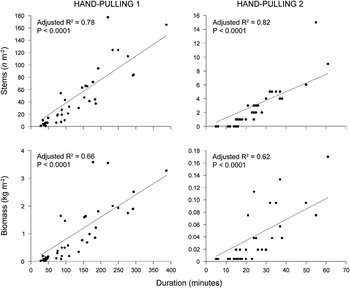
Hand-pulling and bagging time was directly and significantly related to stem density and biomass, but the relationship was stronger for density (Figure 4). Evaluating stem density prior to the first hand pulling with the following equation can thus provide a good estimation of the time required for managing the operation:
 $$t=\left( {1.7d{\plus}54} \right)/24$$
where t is the total amount of time (in minutes) required for extirpating PUJE over an area of 1 m2, and d is the PUJE stem density per square meter.
Duration of purple jewelweed (Impatiens glandulifera) hand-pulling operations, including bagging (1: from June 30 to July 14, 2016; 2: from August 15 to 18, 2016), according to stem density and fresh biomass, conducted in 39 sampling stations (area: 24 m2) on the riverbanks of Sainte-Geneviève Brook (Québec, Canada).

Only 10% of the stems were pulled without their root system during the first hand pulling, a good performance but not enough to negate the need for a second hand pulling during the same summer. Density and biomass were strongly reduced by the first hand pulling to a mean of 2 stems m−2 and to a value close to zero for biomass (Table 1), but it should be noted that a certain number of stems would also have been naturally thinned through competition for light and space, especially in the stations with the highest density (Beerling and Perrins Reference Beerling and Perrins1993). About 14% of the stems pulled at mid-August were flowering and could have produced a new generation of seeds if not removed. However, it is likely this proportion would have been lower if all stems detected during the first hand pulling had been removed with their root systems (Clements et al. Reference Clements, Feenstra, Jones and Staniforth2008).
The first hand pulling significantly (P<0.0001) reduced the cover (frequency) of PUJE from 30% to 7% (mean values; Figure 3) and had a significant effect on the forb (reduction; P=0.0211) and grass (increase; P=0.0068) cover, although changes were small. In fact, the plant cover disturbed by the first hand pulling largely recovered during the following 30 d (Figure 2), because of the vegetative spread (rhizomes) of grass species, particularly reed canarygrass and smooth brome. Reed canarygrass and smooth brome are highly invasive species (Lavoie et al. Reference Lavoie, Dufresne and Delisle2005; Otfinowski et al. Reference Otfinowski, Kenkel and Catling2007; Stannard and Crowder Reference Stannard and Crowder2003), and this probably explains the rapid recovery of the riparian vegetation, although other experiments also showed that riparian vegetation may rapidly recover within 1 mo of PUJE removal, because most riverbank species have a seedbank or vegetative dispersal means (Hulme and Bremner Reference Hulme and Bremner2006).
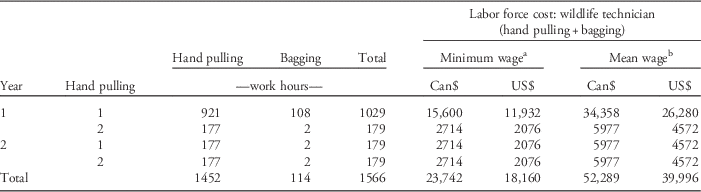
All stations considered, the first hand pulling took six times longer than the second (Table 1). A total of 101 work hours was required to remove PUJE stems from 936 m2; 9% of this time was used for bagging. For a 1-km stretch of a brook (two riverbanks), under SGBk conditions (mean bank width: 5.6 m), this represents 1,208 h for the first year (Table 2). But since a second year would probably be necessary to extirpate the plant, the total amount of time required to control PUJE over this distance totals 1,566 h. This represents 1,398 work hours ha−1. By comparison, 270 work hours ha−1 over a 10-yr period were necessary to reduce PUJE extent and density by 77% at the Thayatal-Podyjí National Park (Schiffleithner and Essl Reference Schiffleithner and Essl2016). The context and methods were different, and the PUJE cover was much lower (1% to 3%) in the park than at SGBk (F Essl, personal communication), which is a precaution against comparing worker efficiency, but both cases provide insight on the magnitude of effort required to control PUJE stands.
Estimation of the cost of a control campaign of purple jewelweed along 1 km of riverbanks (1,1 ha) and over 2 yr in Québec (Canada).

a Can$15.16 (US$12), social benefits included: wage paid to student technician trainees in 2016.
b Can$33.39 (US$26), social benefits included (according to Institut de la statistique du Québec 2016).
In the Québec context, controlling (hand pulling and bagging) PUJE from SGBk over a 1-km distance would represent a minimum investment of Can$23,742 (about US$18,000), but could reach Can$52,289 (about US$40,000) if experienced (higher wages) wildlife technicians were employed (Table 2). This is probably a minimum estimation, since we cannot exclude the possibility that more than 2 yr may be necessary to extirpate the plant. Bagging was efficient—stems rapidly decomposed in the bags—but to what extent this procedure was really essential to prevent rerooting remains unclear. However, not bagging would only reduce costs by 7%. We contacted 25 nongovernmental organizations in Québec who are in charge of the management and environmental protection of watersheds and the control of riparian invaders, and none (with one exception) would be able to allocate such a sum for controlling PUJE without municipal or state (provincial) support, which is rarely provided in Québec for controlling invasive species.
Controlling a well-established (about 15-yr-old) PUJE population is very expensive, and as highlighted by Meier et al. (Reference Meier, Dullinger, Zimmermann, Baumgartner, Gattringer and Hülber Karl2014), targeting small stands before they spread into available habitats would be more economical. Other control options (burning, herbicides, tilling) are strictly prohibited in Québec in riparian habitats (Loi sur la qualité de l’environnement, chapitre Q-2, r. 35; Loi sur les pesticides, chapitre P-9.3, r. 1) and cannot be considered to reduce labor costs. On the other hand, the same stretch of SGBk we used in our experiments had to be dredged in 2015 to remove an accumulation of sediments impeding drainage and causing flooding in the Saint-Isidore village. This cost Can$30,000 (about US$23,000) per kilometer. Without additional supporting data, we cannot prove this was the result of accelerated riverbank erosion due to an extensive PUJE infestation, but what initially appears to be a costly control campaign could in fact represent a wise investment to prevent recurrent problems.
Acknowledgments
This research was financially supported by the Natural Sciences and Engineering Research Council of Canada. We are grateful to the Conseil de bassin de la rivière Etchemin for having provided field work assistance (Clovis Arguin and Jacob Carrier), to Elisabeth Groeneveld and Nicolas Trottier for additional help on this project, to Steeven Lagrange (Steegrain, Inc.) and Christian Larochelle (Laroporc, Inc.) for access to the study site, and to two anonymous reviewers for comments on an earlier draft.