In 2007, the Chinese media and blogosphere were abuzz with the story of Chongqing's “nail house” (dingzi hu 钉子户). Its occupant, Wu Ping 吴苹, refused to give up rights of return on her property when she was offered what she considered insufficient compensation from developers who wanted to build a luxury apartment complex. Wu and her husband held out for three years until their house, perched on a lone column of land surrounded by the excavation site, was finally demolished in April 2007. Wu's “nail-like” tenacity transformed her into a folk hero for many, displacing tired, officially sanctioned models like Lei Feng 雷锋, whose similarly hardware-evocative “spirit of the screw” (luosiding jingshen 螺丝钉精神) – in which people were urged to follow Lei's example of being anonymous, rust-free screws in the great revolutionary machine – seemed hopelessly out-of-date. The media coverage suggested a new, unofficial “model citizen”: ordinary individuals like Wu Ping who were willing to hold the state accountable in protecting the private property of its citizens.
While the drama of the Chongqing nail house captured the attention of the Chinese public and the world, a quieter but far more systematic and potentially wider-ranging development has also been unfolding: the increasing pluralization of the policy-making process in authoritarian China. That is, otherwise marginalized officials, non-governmental organizations and activists of all stripes have managed to wriggle their way into the policy-making process and even help shape policy outcomes. They have succeeded in part because they have understood and accepted the general rules of the game of policy making under the rubric of “fragmented authoritarianism.”Footnote 1
The “fragmented authoritarianism” framework, first proposed in 1988, has remained the most durable heuristic through which to study Chinese politics. It asserts that policy made at the centre becomes increasingly malleable to the parochial organizational and political goals of various vertical agencies and spatial regions charged with enforcing that policy. Outcomes are shaped by the incorporation of interests of the implementation agencies into the policy itself. Fragmented authoritarianism thus explains the policy arena as being governed by incremental change via bureaucratic bargaining.
This article suggests that previously-excluded members of the policy-making process in China – officials only peripherally connected to the policy in question, the media, non-governmental organizations and individual activists – have successfully entered the political process precisely by adopting strategies necessary to work within the structural and procedural constraints of the fragmented authoritarianism framework. The point of entry is through the agency slack that results from the inability of institutions to adapt sufficiently to rapid socioeconomic change, the aggressive lobbying of pressure groups or the changing expectations of the citizenry. These spaces are fertile ground for policy change; that is, if the right set of elements is in place.
Policy Entrepreneurs
The most important of these elements are “policy entrepreneurs.” John Kingdon defines policy entrepreneurs as “advocates for proposals or for the prominence of an idea” and describes their defining characteristic as “their willingness to invest their resources – time, energy, reputation, and sometimes money – in the hope of a future return … [including] in the form of policies of which they approve.”Footnote 2 A fragmented political system allows policy entrepreneurs a key resource necessary to compete in such a way within the policy process: the existence of the “spaces” necessary for them to operate without being snuffed out by the coercive apparatus of the state. Territorial, jurisdictional and other political cleavages provide comparatively fertile ground for various contending interested parties to push their agendas and to arrive at compromises that better reflect their own parochial or institutional goals, which is exactly the method employed by policy entrepreneurs in China. In other words, the political dynamics captured in the fragmented authoritarianism framework provide policy entrepreneurs with a road map, a playbook by which they can pursue their policy goals. They adopt the strategies that traditional actors in China have used for decades to pursue their agendas and institutional mandates.
There are three new types of policy entrepreneurs in China that figure prominently in the analysis to follow. The first are officials within Chinese government agencies opposed to a given policy, often because of official organizational mandates. These officials are able to voice their opposition in part because their policy portfolios give them a degree of political cover (for example, officials in seismological bureaus can articulate the negative geological effects of a hydropower station proposal without fear of reprisal). Conversely, by refraining from pursuing their organizational mandates, these units run the risk of being seen as weak or even irrelevant, a potentially deadly label in the current era of administrative downsizing and bureaucratic fat-cutting.Footnote 3
A second category of policy entrepreneurs, journalists and editors, is emerging in a gradually evolving and expanding liberal media environment. Although it is important to avoid overstating the growing parameters of acceptable discourse in China, newspapers, magazines and television broadcasts have provided a platform for journalists to pursue stories that match their own growing progressive interests and agendas. This in turn has been reinforced by the Chinese media being increasingly required to generate their own budgetary revenue. As a result, they must rely on advertising, which depends upon circulation and readership.Footnote 4 Towards this end, there has been a dramatic increase in the proportion of tabloid journalism that, in addition to racy sex stories, cover government injustice, civil protest and the like.
One particularly important node of the media's power is the close relationship the media shares with the third type of policy entrepreneur, individuals within Chinese non-governmental organizations (NGOs). The successes of NGOs in Chinese politics can be partially explained by the fact that a large percentage of their officers and staff members were trained as journalists or editors, giving them especially close access to the media. NGOs are a critical set of actors that define the contours of policy entrepreneurship in China. There are somewhere between 300,000 and a million NGOs in China today. Michael Büsgen argues that NGOs in China are different from those which helped bring about regime change in the Soviet Union and Eastern Europe because the former must work within the Leninist party state and avoid even the appearance of threatening the structural status quo.Footnote 5 The almost seamless interface between the two groups allows Chinese NGOs to play a more significant role in the political process than might otherwise be the case.
Issue Frames
Policy entrepreneurs interpret events using often-existing ideas in new ways with the goal of recruiting potential supporters. This is done through “articulation” and “amplification.” By articulating how an issue is described, entrepreneurs link together and assemble events in order to establish a natural and persuasive narrative, offering a fresh, alternative perspective on the issue in question.Footnote 6 They pick symbols that can be packaged in such a way as to offer a different point of view by which to understand and appreciate events, objects and situations.Footnote 7 In addition to articulating the issue, policy entrepreneurs amplify it by identifying its core components and boiling them down into a portable narrative, which they can shop around to potential supporters. These narratives often depend upon deliberate references to historical antecedents, metaphors, analogies and images.Footnote 8
The concept of framing is important because it suggests a number of dimensions not captured in the current literature on policy making in China. First, it shows a degree of authority within the Chinese media in their ability to report critically on issues that would have been unthinkable a decade or more ago. It also underscores media sophistication in providing stories that are couched in terms that undermine Beijing's ability to maintain its monopoly on spin. Third, it reveals the role of NGO leaders in spearheading this media assault. Fourth, it also demonstrates the intimate contact between the media, government leaders in Beijing, government officials in the localities and activists throughout the system. Moreover, this has affected the policy-making process, not simply the implementation of policy already agreed upon in Beijing.
Finally, it provides the foot-in-the-door necessary to “expand the sphere of political conflict,” in Schattschneider's classic phrase,Footnote 9 by transforming hitherto irrelevant actors not traditionally associated with the policy (but who are now relevant because of the oppositional issue frame cast by the initial policy entrepreneurs) into allies. In the Dujiangyan 都江堰/Yangliuhu 杨柳湖 controversy summarized below, it was only after the issue frame of “economically developing the west” (xibu da kaifa 西部大开发) was supplanted by “protect China's cultural heritage” (in this case a 2,000-year-old irrigation project predating the Qin dynasty) that the Cultural Relics Bureau, and by extension, the Ministry of Culture, could legitimately enter the bureaucratic tug-of-war.
In China, “state framing,”Footnote 10 which I do not distinguish conceptually from official propaganda, has met with mixed success in the reform era. The age of infallibility of Mao Zedong Thought died out before Mao himself did,Footnote 11 and the reform era has been marked by a degree of scepticism about official ideological exhortations. As a result, there is variation in the success of “official” state framing. Some types of framing appear to be quite strong – such as the shift of falun gong 法轮功 from a “sporting club” to a somewhat suspicious homegrown spiritual society to its current conception as a poisonous cultFootnote 12 – and are backed up by the state's coercive apparatus. Similarly, one is likely to find very little deviation from the government “line” on contentious issues like Taiwan and Tibet. Others, such as the official welcoming of capitalists into the Chinese Communist Party under the larger rubric of “The Three Represents” (sange daibiao 三个代表) have drawn scorn from both citizens and, privately, many officials.
But what is central here is the unofficial framing that has taken place in China and how it has shaped the policy processes in the past few years. There has been some scholarship on the role of framing in Chinese politics, but it tended to focus on the mass protests of 1989,Footnote 13 a set of events that is largely unique and unlikely to be replicated while the current regime remains in power. As such, it is not particularly helpful in allowing us to draw wider generalizations. By contrast, I am looking at how framing by policy entrepreneurs has begun to shape the political debate on all sides of contentious and substantively important issue areas in China today.
Differences from the Democratization and Contentious Politics Literature
Others have argued that the Chinese state may be just as fragmented as it was in the 1980s – perhaps even more so – but not as authoritarian as it was a decade ago. However, even though scholars begin from this premise, they tend to ignore the more prosaic dimension of the policy process, focusing instead on scenarios of regime change, state–society relations and electoral mechanisms.
Recent literature on democratization in China tends to focus on one of two dynamic processes: elite-driven change and grassroots efforts. Bruce Gilley ventures that democratization is likely to be elite-initiated in the form of a rational response to a “multiple metastatic dysfunction.” But Gilley assumes that elite-level democratization at the national level would necessarily lead to replication of such events at local levels throughout China. Much of the top-down variant of democratization is flawed because democratization imposed on local governments from on high in Beijing is not really democracy at all.Footnote 14
The literature on the mechanisms of democracy in China, particularly those works focusing on township and village elections, does not explicitly provide any guidance to how its conclusions can translate into meaningful policy outcomes. It concentrates on process, and insofar as it looks at outcomes, the focus is on the role of elections in strengthening the Chinese Communist Party. This leaves us with two bookends, each of which fails to capture an important dynamic: the pluralization of the Chinese political process.Footnote 15 Other strands of recent scholarship focus on the fact that while state capacity has eroded to the extent that organized protest is increasingly becoming a political reality in China, the state's coercive power remains strong enough to resist the demands of many of these protests, rendering the latter more symbolic than substantive.
The State Security Bureau has released figures, now widely cited, of 58,000 protests in 2003, 74,000 in 2004 and 87,000 in 2005.Footnote 16 There has been some scholarly debate over the significance of these data. Some argue that the numbers are relatively trivial when considered relative to China's overall population, or that only a few protests are large-scale organized demonstrations as we might imagine them in the West, leaving the majority quite small and therefore insignificant.Footnote 17 Others contend that protesters are hindered by the fragmentation of the workforce, the poor prospects for workers disenfranchised by reform, the strong deterrent measures facing potential protest leaders, and the patterns of strategically dismantling state-owned enterprises to minimize social instability (or, rather, to isolate into smaller groups those laid-off workers who would be most likely to lead a protest).Footnote 18
Another group of scholars has focused on the process of the protests themselves and how protesters can come away with something, even if they lose. In their work on “rightful resistance,” O'Brien and Li argue:
Rightful resistance is a form of popular contention that operates near the boundary of authorized channels, employs the rhetoric and commitments of the powerful to curb the exercise of power, hinges on locating and exploiting divisions within the state, and relies on mobilizing support from the wider public. In particular, rightful resistance entails the innovative use of laws, policies, and other officially promoted values to defy disloyal political and economic elites.Footnote 19
In the cases presented here, opponents to state policy are not simply content with resisting policies that affect them directly; they seek to change the substance of broader policies. Their principal targets are not merely those local officials whose corruption and other malfeasance run counter to legal and other norms. Rather, policy entrepreneurs’ focus is on entering in and working within the policy process to achieve their principal policy-related goals.
Before going further, it is worth asking what is making China become less authoritarian. First, the institutions that arose during the pre-reform era have adapted to the issues facing China today only imperfectly. The problems these bureaucracies face are arguably more fast-moving and complex than had been the case under Mao. The 1998 government downsizing, as well as the proliferation of leadership small groups (lingdao xiaozu 领导小组) and the erosion of the outer membranes of traditional xitong 系统, all attest to this. The state has responded by delegating responsibilities to economic, social and other types of actors (whether NGOs, shiye danwei 事业单位, or other non-state or quasi-state hybrids) under the rubric of “small state large society” (xiao zhengfu da shehui 小政府大社会).Footnote 20 Second, there seems to be a gradual recognition by state actors that as information becomes more accessible in China as a whole, experts who are versed or literate in such information are useful, and the state actors (who do not possess the same skills) therefore seek out such expertise. Finally, there is a reinforcing effect whereby success breeds more success: once policy entrepreneurs are allowed to participate and their efforts contribute to an outcome they deem successful without drawing prohibitive sanctions, they set a precedent and are (cautiously) emboldened. Even the partial success of the Nu River 怒江 controversy described below almost certainly influenced the process and the initial outcome of the most recent debate over the damming of Tiger Leaping Gorge (Hutiaoxia 虎跳峡). Certainly other recent work on protests in China suggests a parallel with the notion of official state institutions or actors that are nevertheless critical allies of the opposition. As Perry and Selden write: “While local officials frequently crack down on popular resistance, in numerous cases their leadership is instrumental in shaping, legitimating and articulating the demands of social movements, and in some cases in networking with state officials on behalf of local interests.”Footnote 21
Policy Entrepreneurship and Issue Framing in Hydropower PoliticsFootnote 22
The Nu River remains one of two undammed rivers in China. It is located in a remote stretch of western Yunnan province that hugs the contours of its border with Myanmar. The stunning beauty of the surrounding Three Parallel Rivers (San jiang bingliu 三江并流) region led to its designation on 3 July 2003 as a UNESCO World Heritage site. However, during the negotiations, the Yunnan provincial government had pushed for a clause that states that the “World Heritage” designation only comes into effect at an altitude of 2,000 metres.Footnote 23 This curiosity was explained by the nearly simultaneous announcement that a gargantuan hydropower project involving 13 major hydropower stations would be built along the Nu River as well as along other parts of the Three Parallel Rivers area.
Almost as soon as it was announced, opposition began to mount. In the spring of 2003, there was a meeting in the provincial capital Kunming to discuss the Nu River Project (NRP) which was attended by experts from Beijing and Yunnan. Local experts all supported the project, while their national-level counterparts from Qinghua University and the Chinese Academy of the Social Sciences expressed doubts or opposed the project outright. The views of the experts that supported the NRP were carried in the local newspapers; the views of the opponents were not. There was no firm conclusion at the close of the meeting.
At the same time, a television programme, Newsprobe (Xinwen diaocha 新闻调查), broadcast an exposé that included interviews with Yunnan watershed activist Yu Xiaogang 于晓刚 and local officials in Nujiang prefecture. The interviewers asked the local officials some very basic questions about the NRP. The officials betrayed an almost complete ignorance beyond the most general aspects of the project, underscoring the lack of information that was extended to local officials and somewhat undermining the credibility of their unqualified support for the project. Before this, prefecture-level people's congresses and political consultative conference meetings had placed the NRP on the conference agenda. After the Newsprobe broadcast the project was dropped from the schedule.Footnote 24
Beijing-based environmental activist Wang Yongchen 汪永晨 learned about the NRP on 16 August 2003. The person who notified Wang asked if she could provide a list of dam experts and other scholars familiar with the Nu River who might be able to pass on information-cum-ammunition to the State Environmental Protection Administration (SEPA) for a forthcoming meeting between SEPA and the National Development and Reform Commission. Wang provided the contact information for Yunnan University professor He Daming 何大明.
In the first week of September, He presented his opposition to the NRP at the “Nu River Valley Hydropower Development and Ecological Environmental Protection Issue Expert Forum” organized by SEPA in Beijing and attended by more than 70 experts. He was the first scholar and the only local expert who opposed the Nu River development. Although He was a single, isolated voice, his opinion quickly caught on and snowballed dramatically, even though the content was characterized as an “internal” discussion.Footnote 25
On 25 October, the NGO Green Earth Volunteers organized a petition in which 62 people from science, culture and arts, journalism, and folk environmental protection fields signed their opposition to the NRP at the “Second Meeting of the China Environment and Culture Promotion Society.” This petition was publicized through the media, and elicited widespread public reaction opposing the NRP.
The first local activist to take on a leadership role was Yu Xiaogang through his own NGO, Green Watershed. On 1 October he began his own survey of the Nu River valley. Yu's goal was to obtain an unbiased understanding of the situation and to advise the Yunnan provincial government as a disinterested NGO. But he also had an agenda. Yu had spent much time and energy monitoring the effects of the Manwan 漫湾 Dam along the Lancang River 澜沧江 and anticipated many of the same problems encountered there – an adverse impact on resettled people, landslides and other negative environmental effects – to be present along the NRP. Yu had hoped to meet SEPA officials who had come to survey the Nu River at the same time, but they abruptly revised their itinerary and returned to Kunming.
In November, the venue of the debate shifted to Beijing, specifically in the form of the “Third Meeting of China and the United States Environment Forum.” There were a number of NGOs in attendance. Wang Yongchen's group, Green Earth Volunteers, and some others successfully pushed for a discussion of the Nu River, despite unsuccessful appeals to UNESCO's Beijing office to take action. Debate was heated. The significance of the meeting was that it led to a diffusion of opposition to the NRP throughout China's NGO network.
At around the same time, the “World Rivers and People Opposed to Dams” meeting was held in Thailand. Among the participants were Wang Yongchen, representatives of the NGO Friends of Nature, activist and China Youth Daily editor Zhang Kejia 张可佳, and Yu Xiaogang. At this meeting, NGOs from over 60 countries signed a document in the name of the meeting calling for protection of the Nu River and sent it to UNESCO. UNESCO replied by stating that it was paying close attention to the NRP. Over 80 NGOs in Thailand also sent a letter to China's Ambassador in Thailand on the Nu River issue. Meanwhile, the NRP debate was percolating up to the national level.
The National Environmental Impact Assessment Law came into force on 1 December 2003. Significantly, it did not have a “grandfather” clause. In August 2003, barely a month after the Three Rivers region was declared a World Heritage site and just at the time that Wang Yongchen found out about the NRP, the National Development and Reform Commission convened a meeting to examine the “Nu River Middle and Lower Reaches Hydraulic Planning Report.” It was approved in two days. Bolstered by this momentum, the Huadian Group 中国华电集团公司, the state-run company responsible for the NRP, rushed to get its proposal approved by the State Council before the Environmental Impact Assessment Law came into effect, thus freeing them of the constraints of the law. The proposal itself contained no provisions on the impact of the NRP on the environment.
The bare-bones proposal, combined with the speed at which Huadian sought to push it through the State Council approval process, raised the suspicions of some, especially at SEPA. Mou Guangfeng 牟广丰, the vice-director of the Environmental Impact Assessment Office and director of SEPA's Supervision Department, in particular, was troubled by this. Mou, described by Southern Weekend (Nanfang zhoumou 南方周末) as “a lone voice in the wilderness,” sought the assistance of Wang Yongchen.Footnote 26 According to the report, Wang recalled later that she encouraged the SEPA official, who was feeling isolated and powerless by saying: “SEPA must stand firm and never give up.”
Mou suggested mobilizing experts on the Nu River to help mount a campaign. Through a massive effort by groups such as Green Earth Volunteers and the Yunnan-based Green Watershed, scholars, experts, citizens, and sections of the media rallied to the Nu River cause. For example, Shen Xiaohui 沈孝辉, a senior researcher at the State Forestry Bureau, succeeded in submitting a petition letter to the National People's Congress and the Chinese People's Political Consultative Conference with the help of Liang Congjie 粱从诫, a CPPCC member and founder of the Beijing-based Friends of Nature group.Footnote 27
Mou's opposition – on top of a broad base of support from the media, NGOs and (privately) some local officials – was able to halt Huadian's momentum, and delayed the process indefinitely, certainly beyond the critical date of 1 December.Footnote 28 It also helped motivate others to signal their disapproval of the project, and these concerns made it all the way up to the desk of Premier Wen Jiabao 温家宝.
On 18 February 2004, Wen stated that “such a large hydropower station project that draws high social attention, and has environmental controversy, should be cautiously studied, and scientifically decided.”Footnote 29 This effectively suspended the NRP. On 9 April 2004, Wen's decision was carried by The New York Times.Footnote 30 Over the course of the next three years, the Nu River issue would be hotly debated at all levels of government and in multiple policy circles. Although at the time of writing the outcome remains uncertain, there are clear indications that whatever policy is eventually adopted in the Nu River case, the policy entrepreneurship analysed above will have played a major role.
The Nu River Case in a Broader Context: Variation in Policy Outcomes
In order to put the Nu River case into proper context, it is useful to discuss two other instances in which the outcomes were markedly different, even though they took place at roughly the same time and in the same general area of China's south-west. In August 2003, the Sichuan provincial government cancelled the Yangliuhu hydropower project as a result of opposition from a group of policy entrepreneurs. The opposition was able to transform successfully the government's claim that a dam at the site of the 2,000-year-old Dujiangyan Irrigation Project would help bring electricity and much-needed economic development to the interior. This issue frame was supplanted by the notion that the project would destroy one of China's most important cultural heritage icons. Local officials were able to mobilize activists within the media, including such official state-run publications as China Youth Daily, to publicize the issue newly framed in terms of China's lost cultural heritage. The story grew as almost 200 media outlets descended on Dujiangyan, and the widespread public outcry was instrumental in halting the project.Footnote 31
The third case, Pubugou 瀑布沟, stands in sharp contrast to the other two. Unhappiness with the proposed Pubugou hydropower dam project in Hanyuan county 汉源县 – particularly with the terms of financial compensation to the resettlers – began in 2001 but erupted in protest four years later when between 50,000 and 100,000 local residents occupied the dam site. Ultimately the outcome was only to delay the beginning of the construction of the dam by a year, and the protests were followed by an almost complete news blackout and police crackdown. Opponents were unable to provide an alternative issue frame to that of developing the western part of China, while the government was able to inject its own revised issue frame of the need to maintain social stability. Any remaining opposition was quickly silenced.Footnote 32
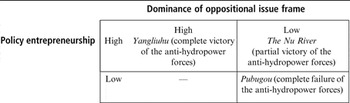
The outcome of these three cases is summarized in Table 1. Variation across the two upper cells depends on the dominance of the issue frame in question. In the case of Yangliuhu (the upper-left cell) the oppositional issue frame achieved an almost insurmountable dominance. That is, opposition framed in terms of cultural heritage issues was extremely effective in grabbing the attention of a large audience, transcending other circumstances that might otherwise mitigate the frame's effect.
Outcomes of Three Hydropower Cases

In the Nu River case (the upper-right cell) policy entrepreneurship was extremely high, but on both sides of the issue. Thus, the oppositional frame of environmental protection never achieved the degree of salience that the cultural heritage frame evoked at Dujiangyan did. As a result, an otherwise “objective” scientific debate over the effects of economic development on the environment quickly became politicized. In such an environment, oppositional issue frames competed with one another rather than privileging any particular side.
The bottom-right cell illustrates the outcome when neither policy entrepreneurship nor oppositional issue frame dominance was present. Although Hanyuan residents were originally approached by journalists and their issues taken on by some local officials, their claims to be relocated became toxic once they erupted into open protest. Opposition framed around compensation seemed to have forced local government agencies to dig in their heels.Footnote 33
The fact that these events took place at roughly the same time, in the same region and focused on the same policy areas makes possible a structured comparison across the three cases. Arguably there is a high degree of internal validity. However, such a research design is poorly suited to support larger, more generalizable claims. That is, we can only speculate about the degree to which these cases are illustrative of the policy process in areas outside that of hydropower. The next section addresses this shortcoming.
Extending the Argument to Other Policy Areas
In order to achieve greater leverage with a limited amount of data, I employ the use of a critical or “crucial” case.Footnote 34 That is, if it can be demonstrated that the phenomenon described above can be found in a policy area where there is a decreased likelihood that it will arise, we can make some tentative generalizations about the argument with a bit more confidence. One arena where policy entrepreneurs might be expected to have little, if any, effect is international trade. International trade is, by definition, foreign policy, and as such it should be relatively immune to tinkering and undue influence by any single individual, particularly if that individual falls outside the formal government apparatus.
In contrast to hydropower, which can be said to encompass important symbolic and substantive arguments on all sides (that is, hydropower itself is an important issue, but so are those embraced by the opposition: cultural heritage, biodiversity, human ecology), the case below is one where policy entrepreneurs representing a tiny industry (cigarette lighters) that was not in any way favoured by the authorities in Beijing were able to leverage the entire trade policy agenda in favour of the arcane issue of child safety regulations. As a further difference, the policy entrepreneur in the case, Huang Fajing 黄发静, was motivated by economic self-interest and not by a larger activist movement.
These two distinct policy areas – hydropower and international trade – suggest that it is the political context in China and not the attributes of a certain policy area that make policy entrepreneur-led change possible. They also suggest a greater likelihood of the transportability of these changing processes to other, unrelated policy areas.
International Trade and Child Safety Regulations
Factories in Wenzhou municipality began producing lighters in the late 1980s. In 1991, Huang Fajing established the Rifeng Corporation 温州市日丰打火机有限公司. Far from cornering the market, Huang faced an environment of intense competition. In 1993, Wenzhou boasted 2,000 lighter manufacturers (assembling from parts made by local companies) and lighter component factories. These companies were largely family operations run from people's homes. The family patriarch was usually the boss, and the employees included brothers, sisters and cousins. The average size of these operations was between four and five people (the shift from cottage industries to factories began in earnest in 1994, when technical expertise also began to take off). Because of the inevitable problems of quality control that arose from such an environment of unbridled competition, the Wenzhou government established an office to inspect and evaluate each factory, and if the factory and its products were not up to standard they were denied a licence. This brought the number of lighter and lighter-part factories down to around 300.
At the end of 1992, the Wenzhou Lighter Industry Association (WLIA) was established. This body was able to rein in the collective action problem so that quality grew and Wenzhou could begin developing its own designs for lighters. In addition, the WLIA began a programme to protect industry from unfair competition, under which each association member is compelled to sign an affidavit to accept association rulings when applying for product design rights (de facto patents). The designs are evaluated and published in local newspapers for comment. If nobody opposes the new design within five days, the “patent” is granted. As a result, there is an IPR/patent mechanism completely within the industry association. If there is a case of infringement, the association handles it.Footnote 35 The WLIA was one of the first associations to do this, but it is now increasingly a common feature of industry associations.
However, in 1994, international developments stretched the WLIA's abilities to protect its members to breaking point. The United States was instituting a standard that required lighters valued at US$2 or less to adopt child-resistant properties. This took the Wenzhou lighter industry, which was still in its infancy, completely by surprise. As a result of the passage of this law, export volume in Wenzhou dropped 70 per cent in one month. Huang resolved that he would not be caught off guard by such exogenous shocks again.Footnote 36
His vigilance was tested in 2001. Huang was advised by the president of the European Lighter Importers Association, Klaus Troeber, that the European Union (EU) was planning to establish a child safety standard. Although this came as a shock to the Chinese manufacturers, these developments had already been going on within the EU for several years. In 1998, four years after the adoption of the regulations in the United States, the European Commission issued a mandate to the European Standardization Organization to develop a European standard for lighters covering child-resistance (CR) requirements, which were to take into account the US standards. The Chinese saw no meaningful difference in the language between the two sets of regulations except that the proposed EU standards had substituted a €2 threshold instead of the $2 threshold in the US regulations.
The proposed standards were part of the EU–China negotiations over China's World Trade Organization (WTO) accession package.Footnote 37 But when Huang sought assistance from Chinese officials he was rebuffed. Appealing to the Economics and Trade Commission and the Quality Examination Supervision and Quarantine Bureau at the (Wenzhou) municipal and national levels, the response was the same: lighters were simply not a strategically important part of China's economic trajectory.
Faced with this situation, Huang took matters into his own hands by putting together a conference on the topic of child safety regulations. He personally invited 17 lighter factory owners plus local and national media. By paying for the event himself, he was able to go beyond official government talking points. The meeting was entitled the “Wenzhou Study Meeting of Common Interests to Resist the Proposed EU CR law” (Wenzhou yanjiu tongren dizhi Oumeng CR fa'an yantaohui 温州研究同仁抵制欧盟 CR 法案研讨会). The title was a clever device that evoked two long-running political, mutually-reinforcing themes. First, the phrase “dizhi” invokes the boycotting of Japanese goods (dizhi Rihuo 抵制日货). By injecting this phrase, Huang was better able to animate this issue in the eyes of his audience. In addition, and perhaps less directly, he was able to evoke the national meta-narrative of China's “century of humiliation” (bainian guochi 百年国耻),Footnote 38 inspired by an outside power yet again trying to prevent China from benefiting from, and thus being able to take its rightful place within, the global free trading system. Huang reframed the issue from a dry technical dispute to another, contemporary chapter of the long history of China being disadvantaged by the West. At the time, “WTO fever” was running high in China and any story on the WTO seemed to find a media outlet. This story in particular – that is, “the EU is violating its own WTO rules” – was irresistible to the media, which made up a large part of the conference participants and dutifully reported on the issue.
In the months that followed, Huang Fajing wrote a number of reports for various Chinese media sources which were widely distributed. Some even reached internal government news sources, the neibu cankao ziliao 内部参考资料. Indeed, when asked about this issue during the annual Bo'an Forum, then Premier Zhu Rongji stated that he was already aware of it.Footnote 39
At the same time, the serendipity of shared interests was being forged. The Fair Trade Bureau (Jinchukou gongping maoyi ju 进出口公平贸易局) (FTB) of the Ministry of Commerce was established in November 2001, immediately after China's accession to the WTO. The charge of the FTB is to remedy trade barriers, including specifically responding to and initiating anti-dumping procedures. There is a “trade barriers division,” maoyi bilei diaocha chu 贸易壁垒调查处 – although “trade” has since been dropped from the title to expand its scope to include investment – which handles foreign trade barriers, as distinct from “foreign allegations of Chinese trade barriers.” The latter are handled by various government bureaus, depending on the nature of the actual allegations, with most handled somewhere else within the Ministry of Commerce.
The CR lighter case reached the FTB in January 2002, before the bureau had been fully established. Indeed, between November 2001 and January 2002, the FTB's primary focus was the administrative issues necessary to set up the office, centred on informing others that it actually existed.
In addition to Huang's guerilla-like efforts, the CR issue was also percolating up through another channel: vice-premier and former trade negotiator Wu Yi 吴仪 was on a fact-finding trip that took her to several cities in Zhejiang province. While in Wenzhou, she met members of the local lighter association who informed her about their situation. Immediately thereafter, several top-ranking officials of the FTB went to Wenzhou. Since the FTB was fishing around for a case to begin its work, it embraced the CR issue and began collecting detailed information about the case.Footnote 40
Things on the European side were moving apace. The voluntary standard (EN 13869) was adopted in 2002,Footnote 41 but this was regarded as suboptimal by many in the EU. This provided an opportunity for the Chinese side to try to influence the decision to move it closer to Beijing's ideal point. In the spring of 2002, another delegation led by the deputy director-general of the FTB (and including Huang Fajing) went to Europe to discuss the issue with the EU authorities.Footnote 42
On 21 March 2003, an official body was established, which eventually became known as the Zhongguo zhengfu lianhe daibiaotuan (中国政府联合代表团), including four people from government (from the FTB) and three from industry, including Huang Fajing. The group embarked on a tour of six EU countries. These efforts were reported in the European media, including the local Chinese media in Europe. In China the impact was even greater. “Almost everybody in China” was aware of what was going on, according to Huang, who added, “if the people know, so does the government.”Footnote 43
In 2004, 2005 and 2006, Beijing sent an ever-growing set of delegations to the EU, visiting an increasing number of countries. These delegations included representatives from the FTB, Wenzhou and Ningbo lighter businesses, European importers of Chinese lighters, representatives from the Wenzhou government, and, of course, Huang Fajing. Over time, the two sides became increasingly sympathetic to the concerns of the other side. Bringing the situation full circle, in late 2006 the Ministry of Commerce sponsored a panel discussion in Wenzhou on lighter child safety standards, with Huang as one of the organizers.Footnote 44
The European Commission was still trying to ameliorate what it saw as an imperfect situation,Footnote 45 ultimately proposing that EU member states adopt a specific Commission Decision under Article 13 of the General Product Safety Directive to ban non-CR and novelty lighters.Footnote 46 Although the language of the standard includes the €2 threshold, the Decision contains technical parameters to distinguish between lighters in or outside its scope, as EU member states felt that lighter safety should not be linked to the cost of a product. In essence, the €2 standard was rendered toothless. This was seen as a significant victory for the Chinese side because they saw that their concerns had been incorporated into the Decision.Footnote 47
Huang Fajing's role as a policy entrepreneur was absolutely critical to this process. He began as an “interested party” and co-ordinated these activities to get key Chinese officials to go to Europe to discuss these issues, particularly from the Ministry of Commerce's Fair Trade Bureau. He has interacted with the EU Health and Consumer Protection Directorate, the EU CEM, EU member health directorates, and EU manufacturers and producers. Huang himself was honoured as one of China Central Television's “Men of the Year” in 2003,Footnote 48 and in late 2007 a feature film was released in China documenting his travails, entitled Brilliance in Europe (Dianliang Ouzhou 点亮欧洲).Footnote 49 Finally, this has also emboldened other Wenzhou-based industries, particularly eyeglass and leather shoe manufacturers, to get involved in EU anti-dumping cases.
Conclusion
As the above cases suggest, an increasing number of non-traditional – and increasingly non-state – policy entrepreneurs have been able to enter and significantly shape the policy process in China. Political fragmentation provides fissures in which one of the most important aspects of power – information – is jealously guarded. Such an environment decreases the amount of information available, thus increasing its value. Previously unavailable information has a much greater impact than it might in a situation in which it was freely available all along. The leaking of information by local agencies to journalists, combined with journalists' own instincts (and increasingly, mandate) for information-gathering, takes on a significant degree of political importance.
Second, as Lieberthal asserts, is “the encouragement given to many organs to become increasingly self-supporting through bureaucratic entrepreneurship,” a dynamic that has also “strengthened the tendency of bureaucratic units to work vigorously to promote and protect their own interests in the policy-making process.”Footnote 50 The behaviour of the Fair Trade Bureau in the lighter case and the State Environmental Protection Administration are particularly illuminating examples of this.
Although we should be modest in what we expect as far as political liberalization is concerned, an absolutely critical component of politics – the barriers to entry into the political process – arguably separates liberal political regimes from illiberal ones, and these barriers have been demonstrably lowered in China as these cases suggest. One may object to this conceptualization of policy entrepreneurs as overly strategic, but all that the characterization really means is that these individuals have learned how to prevail – or at least compete – in the rough-and-tumble world of Chinese politics without losing their normative and often strongly held personal policy goals.
In a sense, this means that the pluralization of the policy process in China provides both less and more influence on policy than would certain forms of democratization. On the one hand, meaningful elections, the mechanism on which many definitions of democracy depend, do not exist in China (village and township elections notwithstanding). On the other hand, the role of the opponents in these policy debates is as direct and firmly embedded within the political process as is the case in many democratic regimes. Of course, one must be careful in taking this implication too far; rather, the more appropriate claim here is that while the fragmented authoritarianism framework continues to define the major contours of the policy-making process in China, the playing field is becoming increasingly crowded.