An active shooter is an “individual, or individuals who kill or attempt to kill people in a populated area. 1,2 ” Active shooter events have become increasingly more common in the past 10-20 y. Between 2000 and 2019, the Federal Bureau of Investigation (FBI) has identified 305 separate active shooter incidents. 3,4 One hundred sixty of those events took place between 2000 and 2013, while the following 5 y saw a total of 145. That is an increase in the number of incidents from an average of 12 between 2000 and 2013 to 29 between 2014 and 2019. Health-care facilities are listed as 1 of the primary locations where the public is most at risk. 3 The FBI reports a total of 12 shootings at health-care facilities from 2000 to 2018. 3 Emergency departments (Eds) remain particularly vulnerable with their high volumes of patients and trauma volumes. 5,Reference Palestis6 In fact, EDs are the most common location of hospital-related shootings, with a third of all hospital-related shootings occurring in the ED. 3,Reference Kelen, Catlett and Kubit7
Active shooter events are often ambush attacks, meaning the perpetrator surreptitiously enters a facility with a concealed weapon and positions themselves in a manner to exact the greatest harm. While most health-care facilities are equipped with security, traditionally the threat of an active shooter has not been an area of training for those outside of the security role. Given the surprise element, health-care workers are often faced with the initial response despite lack of formalized training for the response or surveillance of these events. Additionally, the evasive and fleeing response actions during an active shooter response may seem unnatural or foreign to health-care providers taught to preserve and care for patients. Reference Gerold8 Despite the increase in active shooter events and the unnatural response actions they prompt, an appropriate corresponding increase in active shooter training for health-care providers has not occurred. Some hospitals have begun to implement basic “Code Silver” trainings for their staff, but these trainings many times lack site-specific guidance, ED-specific guidance, and many times lack active participation or demonstration.
Some hospitals and health-care systems have begun to use computer-based training models for active shooter training to reach a large portion of their staff. These training methods often lack active participation, hospital-specific or departmental-specific response protocols, and the native workplace environment of the learner. Other methods for training include large full-scale events in the ED or on campus (in situ), which can be expensive and disruptive to the flow of the ED operations. Reference Mannenbach, Fahje and Sunga9–Reference Wexler and Flamm11 These types of events can also create an element of psychological stress to the patients and visitors. Reference Mannenbach, Fahje and Sunga9 Both types of training involve a 1-time occurrence and varying degrees of participation. This can make the retention of active shooter response actions, departmental response actions, and personal comfort levels with response very difficult.
Additionally, many types of training have the goal of completion of the training or exposure to a simulated active shooter event Reference Mannenbach, Fahje and Sunga9,Reference Kotora, Clancy and Manzon10 and not the actual targeting of provider comfort levels with handling such an event or response. Only recently have studies begun to try to measure comfort levels. Reference Jones, Kue and Mitchell12,Reference Sanchez, Young and Baker13
Given the increase in frequency and the overall challenge in preparing for such events, we devised a quality improvement project with a unique training methodology to better prepare our ED providers. Our methods aimed to address the above limitations in typical trainings by a 3-phase approach: an interactive lecture with a scenario-based discussion, guided walkthrough of the ED detailing safe zones and exits with demonstration of response behaviors, and lastly, a simulation-based practical conducted in a temporally spaced second phase of training. Objectives included preparing ED providers for an active shooter situation, getting providers comfortable with considering common active shooter scenarios and the subsequent capabilities of their department for safety and departmental response, and finally allowing the practice of response behaviors. By temporally spacing the training into 2 phases, we also aimed to increase and prove retention.
Methods
The content for the multimodal active shooter response training included our site’s departmental response and was adapted from the US Department of Justice, FBI, and US Department of Homeland Security’s “Run, Hide, Fight” curriculum. The “Run, Hide, Fight” curriculum advocates for getting away from the shooter or shooters as the top priority, followed by finding a place to conceal or barricade oneself, and fighting the perpetrator(s) as a last resort. 1,2 These instances can be common encounters that can lead to violence at any time, and our goal was to recreate this setting with our scenarios.
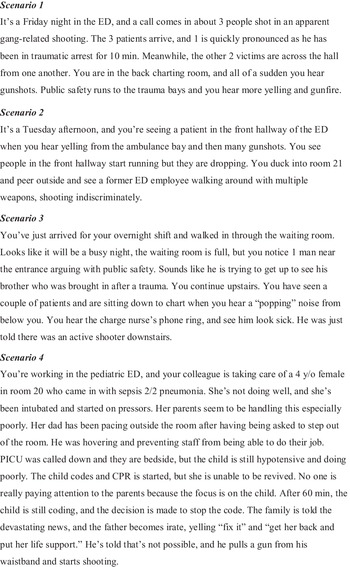
Training was divided into 2 phases: a lecture/walkthrough phase and a simulation phase, with data collection primarily occurring through survey-based collection. The training was conducted in 2 sessions in early and mid-2019. In the first phase, participants went through an interactive lecture on “Run, Hide, Fight” response actions and the departmental response plans. This was coupled with a scenario-based discussion of common ED encounters that could degrade into active shooter events (Figure 1). After the discussion, participants were taken to the ED and shown secure areas, exit points, and how to barricade in a treatment room using objects in the room. Participants then demonstrated these behaviors. This lecture and walkthrough portion lasted 90 min.
Lecture scenarios for discussion.

The second portion of education was active shooter simulation-based training, which took place again in 2 sessions in mid to late 2019. This second phase of training took place 4-5 mo after the lecture/walkthrough for each group. This portion was approved by hospital administration and conducted in concert with hospital public safety. Additionally, for psychological safety, all participants were informed they were participating in an active shooter simulation which would simulate gunfire, loud noises, and a perpetrator. All participants were given the option to not participate in this portion. Participants also participated in a 15-min pre-brief before simulation.
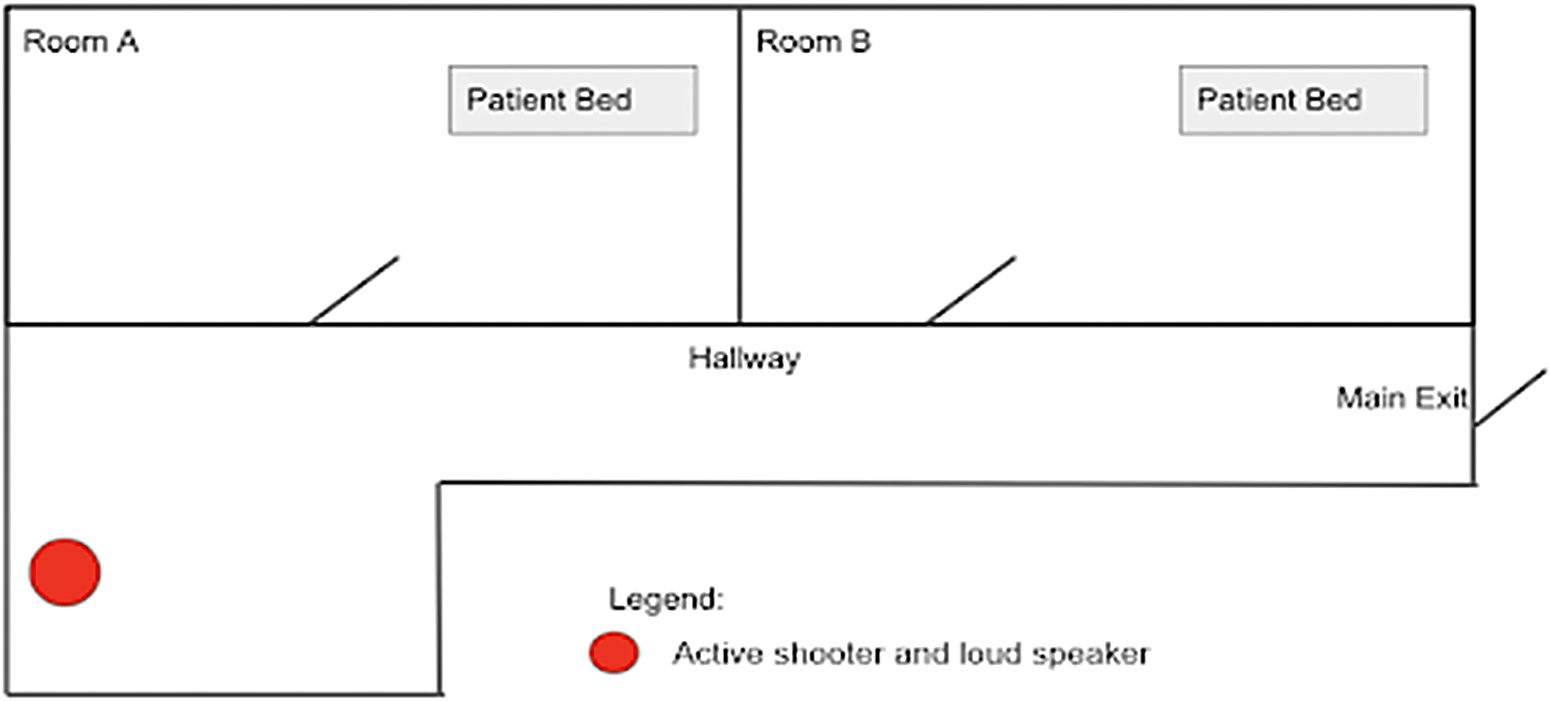
During the active shooter simulation, participants were given the opportunity to react and use the principles of “Run, Hide, Fight” while being immersed in simulated ED patient care scenarios. All simulation rooms were set-up to mirror layout and supplies in an actual ED room. Each room had a simulation confederate acting as a nurse or family member. Participants were randomly selected in pairs to 1 of 2 simulation rooms (Figure 2). To enhance realism, both rooms included patient scenarios. The scenario in room A required securing a patient airway with intubation, and the scenario in room B involved a difficult patient and family member. Both scenarios were designed to engage and distract participants to the potential active shooter component. The active shooter portion of the simulation commenced after the participants had several minutes to stabilize their patient situation. The active shooter was portrayed by a confederate wielding a realistic pistol prop. Gunfire was simulated with a speaker positioned next to the active shooter.
Active shooter simulation layout.

Simulation room A was closer to the active shooter, while B was down the hallway and closer to the main exit. Simulation room A was more ideally suited for barricade/hide/fight strategy versus room B, which was more amenable to a run strategy. When the scenario started, the doors to room A and B were open. The simulation lasted approximately 10 min, which provided the participants enough time to either flee or barricade in place. Simulation confederates observed barricading and fleeing behaviors, departmental response behaviors, and safety behaviors. Immediately following the simulation, the participants participated in a 15-min debrief.
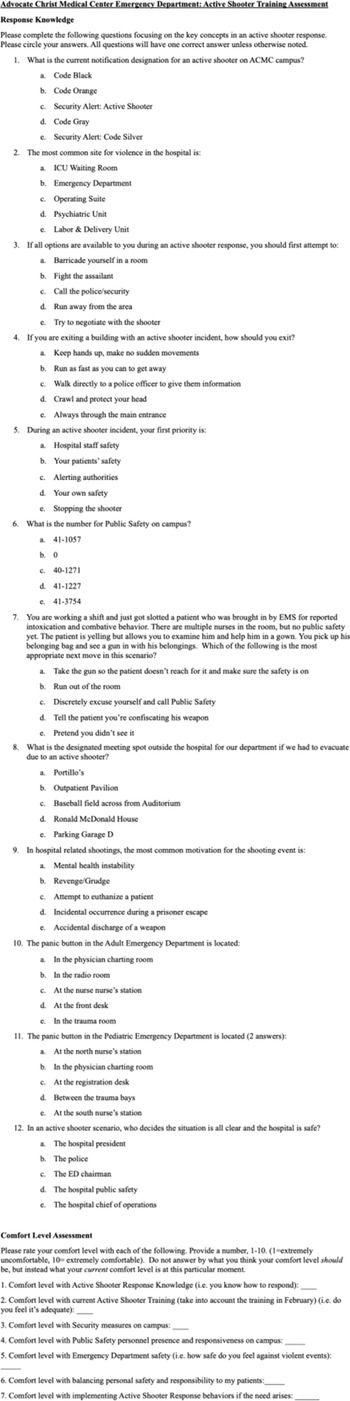
Data on response knowledge and comfort levels were captured in a 19-item survey, repeated at 4 points during the training. Specifically, participant knowledge on active shooter response tactics and departmental response steps were tested, as well as comfort levels for active shooter response overall, departmental and hospital safety measures, and potential implementation of active shooter response behaviors (Figure 3). Additionally, descriptive data were captured during the simulation regarding fleeing and barricading behaviors as well as adherence to departmental response steps.
Data collection survey.

These surveys were conducted at 4 points throughout the training: pre-lecture/walkthrough, post-lecture/walkthrough, pre-simulation, and post-simulation. The surveys were conducted immediately before and after the training phases with a 4- to 5-mo gap between the post-lecture/walkthrough survey and the pre-simulation survey. Surveys were completed anonymously with each participant given a unique participant number that was recorded on the surveys. Participant numbers were blinded to the research team. Descriptive data collected during the phase 2 simulation were collected by the hospital simulation lab staff and then reported to the study organizers as a collective without any identifying information for the participants.
Participants were recruited on a voluntary basis and included the ED attending physicians, resident physicians, nurses, and techs. Attending physicians were the only group to have received training on general “Run, Hide, Fight” principles before the project. This was a required computer-based training module that occurred 1 y before the study project.
Data analysis from the surveys was conducted including standard mean, median, and standard deviations for both knowledge-based questions and comfort level questions. Paired t-test analysis was conducted between pre- and post-surveys within each phase and between both phases. Additional descriptive analysis was conducted from feedback from simulation confederates. This project was reviewed by departmental research leadership and deemed quality improvement research and institutional review board exempt.
Scenario 1
It’s a Friday night in the ED, and a call comes in about 3 people shot in an apparent gang-related shooting. The 3 patients arrive, and 1 is quickly pronounced as he has been in traumatic arrest for 10 min. Meanwhile, the other 2 victims are across the hall from one another. You are in the back charting room, and all of a sudden you hear gunshots. Public safety runs to the trauma bays and you hear more yelling and gunfire.
Scenario 2
It’s a Tuesday afternoon, and you’re seeing a patient in the front hallway of the ED when you hear yelling from the ambulance bay and then many gunshots. You see people in the front hallway start running but they are dropping. You duck into room 21 and peer outside and see a former ED employee walking around with multiple weapons, shooting indiscriminately.
Scenario 3
You’ve just arrived for your overnight shift and walked in through the waiting room. Looks like it will be a busy night, the waiting room is full, but you notice 1 man near the entrance arguing with public safety. Sounds like he is trying to get up to see his brother who was brought in after a trauma. You continue upstairs. You have seen a couple of patients and are sitting down to chart when you hear a “popping” noise from below you. You hear the charge nurse’s phone ring, and see him look sick. He was just told there was an active shooter downstairs.
Scenario 4
You’re working in the pediatric ED, and your colleague is taking care of a 4 y/o female in room 20 who came in with sepsis 2/2 pneumonia. She’s not doing well, and she’s been intubated and started on pressors. Her parents seem to be handling this especially poorly. Her dad has been pacing outside the room after having being asked to step out of the room. He was hovering and preventing staff from being able to do their job. PICU was called down and they are bedside, but the child is still hypotensive and doing poorly. The child codes and CPR is started, but she is unable to be revived. No one is really paying attention to the parents because the focus is on the child. After 60 min, the child is still coding, and the decision is made to stop the code. The family is told the devastating news, and the father becomes irate, yelling “fix it” and “get her back and put her life support.” He’s told that’s not possible, and he pulls a gun from his waistband and starts shooting.
Results
A total of 66 ED providers participated in the study project between February 6, 2019, and October 24, 2019. Varying degrees of survey completion occurred, and a total of 33 participants completed the required 4 survey set to have complete matched data.
Active Shooter Response Knowledge
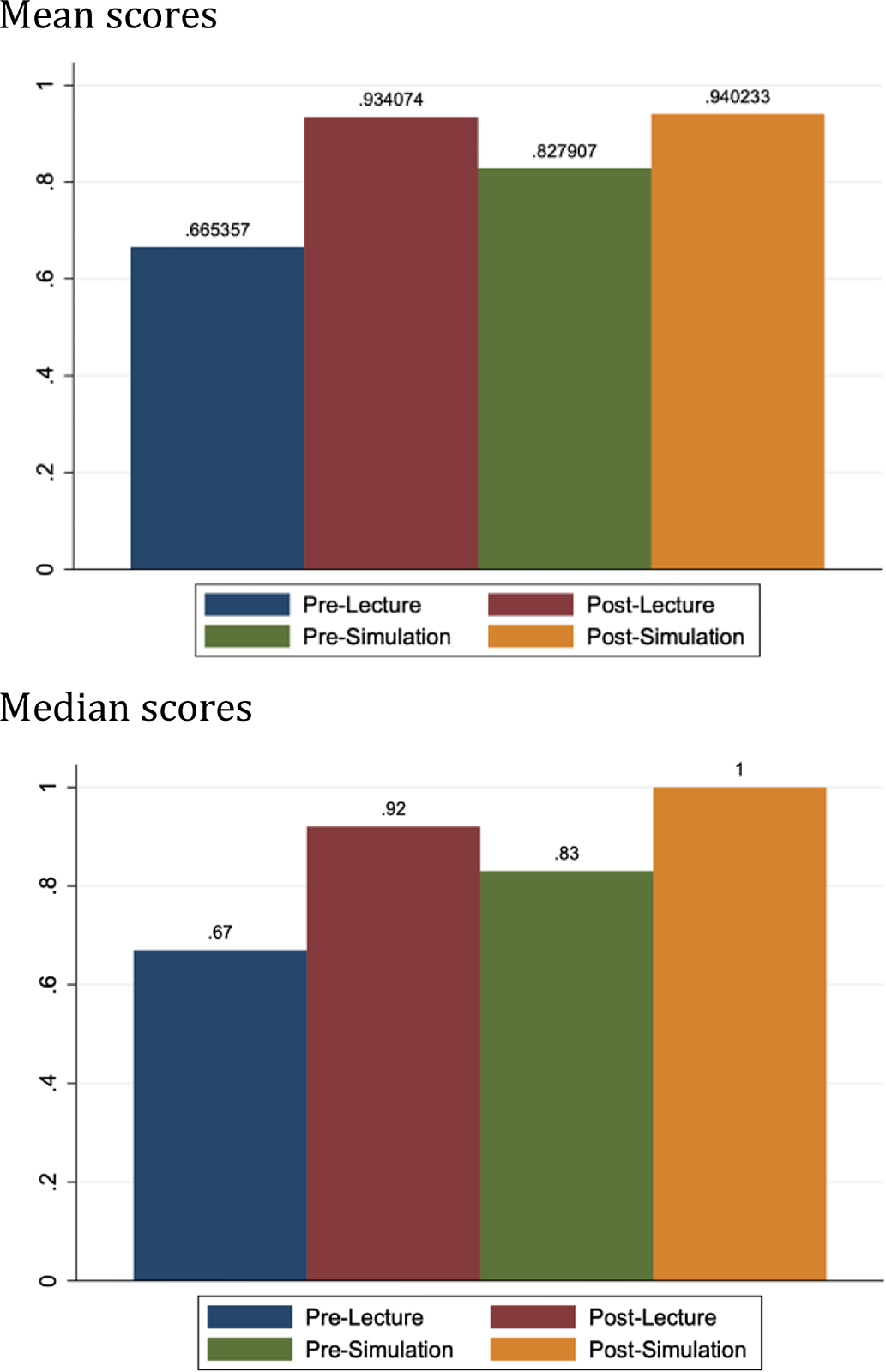
The primary outcome was active shooter response knowledge following the lecture/walkthrough phase and then the subsequent simulation phase. The mean and median scores for the pre- and post-lecture/walkthrough (phase 1) and pre- and post-simulation (phase 2) surveys are reported in Tables 1 and 2 and Figure 4. Paired t-test was used to determine statistical significance between each phase’s pre- and post-survey. The mean score pre-lecture/walkthrough (M = 67; SD = 13) improved on post-lecture/walkthrough (M = 93, SD = 7), P ≤ 0.01. Similarly, the mean score pre-simulation (M = 83, SD = 14) improved on post-simulation (M = 94; SD = 7), P ≤ 0.01.
Mean active shooter response knowledge scores

Median active shooter response knowledge scores

Mean and median active shooter knowledge scores graph.

After 4-5 mo, phase 2 was completed. Retention from phase 1 to phase 2 was assessed by administering the survey before simulation (phase 2) and comparing those results with post-lecture/walkthrough values (phase 1). Participant mean pre-simulation score was M = 83, SD = 14, which was an average reduction in score by 10% from the post lecture/walkthrough score of M = 93, SD 7. This was still a notably higher score than pre-lecture/walkthrough demonstrating some retention. The post-simulation score, M = 94, SD = 7, (P ≤ 0.01) also saw a statistically significant increase in score from pre-simulation. Additionally, the mean and median post-simulation scores were higher than the mean post lecture/walkthrough scores.
Staff Comfort Levels With Active Shooter Response
The secondary outcome was to assess comfort levels of the providers with knowing and being familiar with the general active shooter response behaviors, knowing and being familiar with the departmental response and safety protocols, and comfort with deploying and performing active shooter response behaviors. Comfort levels were assessed using a 7-item section on each of the 4 surveys throughout the phases. Responses were reported using a 1-10 Likert scale. Paired t-test was used to determine statistical significance between pre- and post-surveys of each phase.
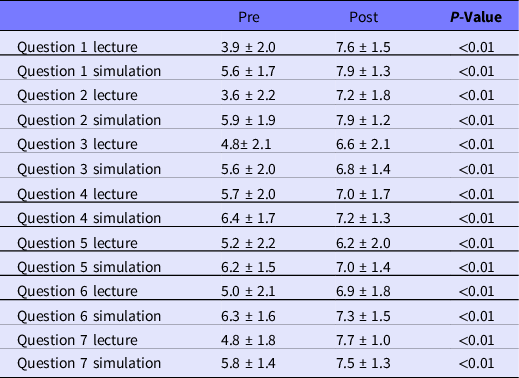
The overall comfort levels on each question increased following both lecture/walkthrough (phase1) and simulation (phase 2), for all questions (Table 3). For reference, Figure 3 lists the specific comfort level questions used.
Mean active shooter response comfort levels

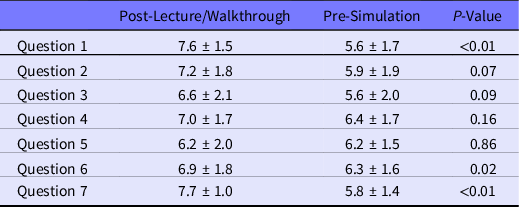
Similarly, to the active shooter knowledge questions, there was a reduction in comfort levels on all questions from post lecture/walkthrough (phase 1) to pre simulation (phase 2). However, this reduction was not back to baseline values, suggesting some retention and subsequent retained comfort. Additionally, there was a significant retention of comfort displayed for questions 1 and 7, which represent comfort for active shooter response knowledge and comfort level with implementing active shooter response behaviors (Table 4).
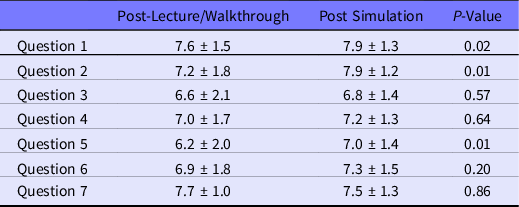
Comparison of post-lecture/walkthrough and post-simulation comfort levels

Comfort levels were higher post simulation comparatively to post lecture/walkthrough, but this increase was not found to be significant (Table 5).
Comparison of post-lecture/walkthrough and pre-simulation comfort levels

Descriptive Observations on Response Behaviors
In addition to the measurable outcomes listed above, the study project design allowed us to collect direct observation data on response behaviors. Specifically, during our phase 2 simulation, we were provided the opportunity to directly observe both active shooter response behaviors of “Run, Hide and Fight” as well as departmental-specific response steps by participants.
In simulation room A, which included a scenario of a critically ill patient with need for intubation, and a direct view of the active shooter, all groups appropriately chose to hide/barricade in place. Barricading behaviors observed were quick and extensive using code carts, chairs, garbage cans, and bedside tray stands. Once barricades were in place, less than half of the groups strategized for potential weapons or next steps should the active shooter breach the door. All groups had 1 person continue to care for the patient (ventilation by means of bag valve mask or connecting the patient to the ventilator) while the others completed the barricading activities. Interestingly, senior attending physicians tended to care for the patient and encourage others to hide.
All groups remained quiet and still throughout the continued simulated shooting. All groups waited for a police “all-clear” and practiced the extra step of verifying an officer’s identity before opening the door. Other response behaviors that were observed less than 50% of the time included shutting lights off, silencing phones and patient monitors, and calling 9-1-1 or public safety.
In simulation room B, which included a patient having a medical emergency, complicated by a difficult patient and family member, most groups also chose to barricade in place. This simulation room did not immediately have direct visualization of the shooter for approximately 45 s, so there was a window to run. Most groups reported that, because they could not exactly locate the direction of the gunshots, they elected to hide/barricade. Again, the barricades were deployed very quickly and effectively and included patient beds, code carts, chairs, and garbage cans. Health-care providers enlisted the aid of the “patient and family member” played by simulation confederates to help with the barricades. Similar to pairs that went through simulation A, the simulation B pairs also had a less than 50% occurrence of shutting the lights off, silencing phones and monitors, and calling 9-1-1 or public safety. All groups waited for a police “all-clear” and practiced the extra step of verifying an officer’s identity before opening the door.
Pairs that did decide to run out of simulation room B, and subsequently out of the sim lab, all did so with hands raised and with hands empty at a controlled pace. Once they were told they were in a safe place, all pairs verbalized calling 9-1-1 for help. Interestingly, all the pairs that ran set up in a flank formation with the patients in between the workers.
Discussion
As active shooter events and the subsequent threat to health-care facilities increase, there is a clear and evident need for increased response training for health-care providers. This is especially true for the ED, the most common site for health-care–related shootings.
Current common methods for active shooter response training include computer-based training, in-situ drills, and full-scale hospital drills, all which have limitations including lack of active participation or demonstration, lack of practice for specific departmental response protocols, cost, and retention. With these limitations in mind, we designed a training to increase both provider knowledge and comfort on active shooter response principles and departmental-specific response protocols. Our training emphasized active participation in potential active shooter scenario-based discussions as well as 2 opportunities to demonstrate response behaviors through a department walkthrough and then a high-fidelity simulation. It also emphasized the active learning for both our ED safety features and steps in our response plan. Through exposure to active shooter response principles at several points, we also strove to increase retention.
Through both phases of our study, we were able to show an increase in both provider knowledge and comfort level for active shooter response. There was a clear loss of some knowledge and comfort between phases, but ultimately the highest scores for both knowledge and comfort were reached post-simulation, showing a cumulative positive effect to being exposed to active learning in both phases. Additionally, participants retained significant comfort between the 2 phases for the 2 particular areas of active shooter response knowledge and comfort for implementing response, emphasizing that the training was impactful in these areas.
Success of the training was also demonstrated in the observed “Run, Hide, and Fight” behaviors and departmental response actions that occurred during the phase 2 simulation. Providers exhibited quick decision-making and commitment to action, excellent barricading behavior using native ED objects and equipment. The participants that opted to “run” did so in a controlled manner and in a safe way. All participants prioritized their safety but also made reasonable accommodations for their patients. In many ways, the phase 2 simulation should have been more challenging for participants as their fundamental training on active shooter response behaviors from phase 1 was 4-5 mo prior with no practice in between. However, participants reacted with quick, efficient decisions and showed significant retention of the behaviors they had first learned about months before, which speaks to the quality and success of the phase 1 training.
Many training programs leave key departmental steps out, and focus only on the generic “Run, Hide, Fight” behaviors. Our training took that to the next level with integration of our department-specific protocols. Participants spoke to the strength of the focus of departmental safety and response information during the initial walkthrough, which included pointing out safe places, closest exits based on various locations in the ED, ED equipment that can be used for barricading, the numbers for public safety, the safe meet-up areas after exiting the building, and use of plain language alerts, etc. They emphasized that the structure of short lecture, scenario-based discussion, and walkthrough really helped solidify the basic concepts.
Our goal was to get the participants to take that information and have them digest it over several months and start thinking about how they would potentially respond as they worked in the department. For many, this was the first time they had considered an active shooter event in the hospital. Allowing that pause for building awareness likely contributed to the success in the phase 2 simulation. The simulation then reinforced those behaviors and quick decision-making and strengthened that core knowledge.
Another benefit to our training design was that ED operations were never interrupted or disrupted during the exercise. We used the department to educate on safe spaces, exits, and other response behaviors, but then performed the actual simulation in the sim lab with rooms designed as ED rooms.
Last, the study also forced active discussion and feedback from staff on how to potentially make the department safer or more prepared. Such suggestions included making the phone number for public safety very easy to remember, having information on active shooter scenarios on hospital badges, and making the EDs safer for the staff and patients such as with lockable doors, improved visitor screening protocols and areas, and safer infrastructure in the intake area.
Limitations of our training included decreased return of complete survey sets, the amount of work involved in set-up and scheduling, and the training being voluntary for all ED staff. The training was completed for 66 participants with only 33 completing all 4 surveys to their entirety. Some of that loss was due to personnel not completing the phase 2 of the study. This inherently is a large challenge for any training with multiple parts or phases. Additionally, the training was not required, so staff participated on a voluntary basis, again contributing to the ultimate diminished return in surveys. Last, our study team consisted of 3 main physician educators and designers with help from our hospital’s simulation team and simulation lab. This might not be feasible for certain hospitals and resources. However, our team was still small comparatively to large full scale or in-situ drill planning teams, making it feasible for many hospitals. The training design lends itself well to being reproducible. Hospitals could choose to do a series of phase 1 training sessions at a time convenient to them. For example, phase 1 training of lecture, scenario-based discussion, and walkthrough could be performed at new hire orientation, resident physician orientation, or during a skills week, and then at a time later that same year, have designated days for the phase 2 simulation. Key to training success is to make it a requirement for ED personnel.
Conclusion
Active shooter situations and hospital-related shootings are an ever-increasing occurrence, with EDs being particularly vulnerable. Our study shows that a 2-phased training including a multimodal approach of lecture, scenario-based discussion, department walkthrough, and a follow-up small-scale simulated active shooter exercise can be very effective in increasing active shooter response knowledge and comfort as well as promoting the retention of that knowledge and comfort.