Sink drains are known to be reservoirs of antibiotic-resistant organisms. However, the most efficient and affordable method of disinfecting sink drains remains unknown. We tested 2 disinfectants against a no-treatment control to measure their effect on colony-forming units on days 1 and 7 after application.
Outbreaks of carbapenemase-producing Enterobacteriaceae (CPE) in healthcare facilities are of significant concern because of the high morbidity and mortality associated with these infections. Increasingly, sink drains are being recognized as an important reservoir and source of transmission of these organisms.Reference Mathers, Vegesana and German Mesner 1 – Reference Leitner, Zarfel and Luxner 3 In 2016, our hospital experienced an outbreak of Klebsiella pneumoniae carbapenemase (KPC)–producing Enterobacterobacteriaceae. During this outbreak, we implemented a bundle of interventions that included culture and PCR-based surveillance of sink drains within the impacted intensive care units (ICUs) to identify potential reservoirs and removal of the pipes. A control ICU also underwent surveillance swabbing of the sink drains; this control unit had not had any patients hospitalized with KPC-producing organisms.Reference Buchan, Graham and Lindmair-Snell 4 A high proportion of sink drains within this control unit were KPC positive, especially sinks located in close proximity to toilets.Reference Buchan, Graham and Lindmair-Snell 4 Based on these findings, we aimed to identify a practical approach for routine disinfection of sink drains within our hospital. In this study, we compared the efficacies of 2 different disinfectants (ie, sodium hypochlorite (bleach) versus a commercially available hydrogen-peroxide–based agent) in reducing the total number of gram-negative colony-forming units (CFU) in sink drains.
Methods
This study was performed in a 26-bed medical intensive care unit (MICU) within a 565-bed academic affiliated hospital in Milwaukee, Wisconsin. Each room has a patient bed, a toilet, and 2 sinks (1 next to the entry door and 1 next to the toilet), all without physical barriers in between. The surfaces in each room (including sink bowls but not drains) are cleaned on a daily basis with a hydrogen peroxide/peracetic acid solution (Oxycide, Ecolab, St Paul, MN).
Interventions
We compared 2 disinfectants in this study: (1) a hydrogen-peroxide–based disinfectant (Peroxide Multi Surface Cleaner and Disinfectant, Ecolab, St Paul, MN) diluted at 6 ounces per gallon of water according to label instructions and applied through a pump-up foaming applicator (F1.5LBK-DP3.75, FOAM-iT, Grand Rapids, MI) and (2) a 1:10 dilution of a 6% sodium hypochlorite disinfectant (Clorox, Oakland, CA).
Patient rooms in the medical intensive care unit were assigned to 1 of 3 groups: hydrogen peroxide foam (rooms 1–8), bleach (rooms 19–26), or control (rooms 11–18). On day 0, disinfectant agents were applied to the assigned sink drains. For the purposes of this study, only sinks in close proximity to toilets were used. To sink drains assigned to the hydrogen peroxide foam group, this disinfectant was directly applied to the inside of each drain until resistance was met at the seal around the foam applicator and the drain. The foam was allowed to stay in the drain for a minimum of 3 minutes according to the manufacturer’s instructions. Rooms assigned to the bleach group received 32 ounces of the 1:10 bleach solution. The solution was prepared within 30 minutes of use. Control sinks did not receive any special disinfection. Daily cleaning for all tested sinks remained unaltered.
Specimen collection
Specimens from each sink were collected using ESwabs (Copan, Brescia, Italy) the morning prior to sink-drain disinfection (day 0), on the day after disinfection (day 1), and on day 7 after initial disinfection. Swabs were inserted into the sink drain, and 2 circular motions were performed to obtain a specimen from the inner walls of the drain pipe. Laboratory testing was initiated within 4 hours of collection. Group assignments were blinded to which team member collected swab specimens (L.S.M.P.) and to laboratory testing personnel (B.W.B. and M.L.F.) until all culture data were finalized.
Culture methods
Serial 10-fold dilutions of each specimen were made in normal saline and plated to MacConkey agar to select broadly for gram-negative bacteria. Cultures were incubated 18–24 hours at 35°C, and all resulting colonies were counted to determine bacterial burden. Results were not stratified by bacterial family, genus, or species.
Statistical analysis
Colony-forming units (CFU) were transformed using the natural logarithm of 1+CFU. Multivariate multiple linear regression was used to compare mean log(1+CFU) changes from baseline (day 0) between the hydrogen-peroxide–based disinfectant, bleach, and control groups on days 1 and 7. This model controlled for the effect of baseline CFU levels and for correlation of changes between days 0 and 1 and between days 0 and 7. Analysis of variance was used to compare the baseline CFU counts between the study groups. All analyses were performed using R version 3.5.0 software (R Foundation for Statistical Computing, Vienna, Austria).
Results
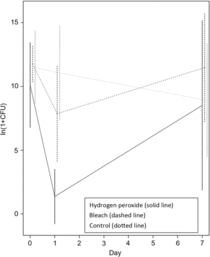
Bacterial CFU counts found in each sink at baseline, day 1 and day 7 are presented in Fig. 1. Baseline CFU counts in all 3 treatment groups were statistically equivalent (P > .05 for pairwise comparison between groups). On day 1, a statistically significant reduction in bacterial CFU was observed in the group treated with hydrogen peroxide compared to sinks treated with the bleach group (P = .0077) and the control group (P < .0001). This difference was not observed in sinks treated with bleach compared with the control group (P = .12). On day 7, bacterial CFU counts had reverted to pretreatment levels (ie, day 0), and no statistically significant difference in CFU count was detected among any of the 3 treatment groups (P > .05). The repeated effect of sinks was accounted for by the use of linear mixed models. The mean CFU counts and 95% confidence intervals for each treatment group are presented in Fig. 2.
Colony-forming units in sinks after treatment with different disinfectants. S: sink; number after S represents room number where sink was located. CFU/mL, colony-forming units per milliliter. Day 0: swabs obtained prior to sink treatment. Day 1: swabs obtained the day after sink treatment. Day 7: swabs obtained 7 days after sink treatment. The 3 treatments were (1) hydrogen-peroxide–based disinfectant (Peroxide Multi-Surface Cleaner and Disinfectant, Ecolab, St Paul, MN); (2) bleach: 1:10 dilution of a 6% sodium hypochlorite disinfectant (Clorox, Oakland, CA); and (3) control: no disinfectants were poured. Day 0: bleach versus hydrogen peroxide (P = .31); control versus hydrogen peroxide (P = .39). Day 1: bleach versus hydrogen peroxide (P = .0036); control versus hydrogen peroxide (P < .0001). Day 7: bleach versus hydrogen peroxide (P = .36); control versus hydrogen peroxide (P = .90).

Natural logarithm and 95% confidence interval of colony-forming units by treatment group. Note. ln, natural logarithm; CFU, colony-forming units. Vertical lines represent the 95% confidence interval for the means. Day 0: bleach versus hydrogen peroxide (P = .31); control versus hydrogen peroxide (P = 0.39). Day 1: bleach versus hydrogen peroxide (P = .0036); control versus hydrogen peroxide (P < .0001). Day 7: bleach versus hydrogen peroxide (P = .36); control versus hydrogen peroxide (P = .90).

Discussion
We compared the efficacy of 2 different commercially available disinfectants to reduce gram-negative colony counts in sink drains. The current study was focused on sinks in close proximity to toilets within patient rooms based on our earlier published findings that these sinks were significantly more likely to contain CPE via culture and molecular detection methods than sinks located near the room entryway. We found that a hydrogen-peroxide–based foaming disinfectant was more effective at decreasing bacterial counts after 24 hours than bleach or no-treatment controls. However, the effect of the hydrogen-peroxide–based disinfectant completely disappeared after 7 days of initial application. The greater initial efficacy of the hydrogen-peroxide–based disinfectant might be due in part to the ability of the foam to remain within the drain for several minutes. Contrary to this, the bleach immediately receded within the sink pipes. Hospital environmental services (EVS) staff who applied the disinfectants reported no fumes or odor during the use of hydrogen-peroxide–based disinfectant and minimal fumes or odor were noted during the application of bleach. EVS staff reported that the application of the hydrogen-peroxide–based disinfectant took longer than bleach and that the bleach was subjectively easier to use.
During the study period, all rooms were occupied by patients; however, we did not monitor individual sink usage. It is possible that a greater reduction in bacterial burden would be observed in frequently used sinks due to physical flushing of the drains. Aggregate data obtained from all sinks in each group still demonstrated significant differences in initial CFU reduction and CFU counts on 7 day.
Sink drains have been reported to serve as reservoir of resistant organisms.Reference Kotay, Chai, Guilford, Barry and Mathers 5 The optimal method for initial and sustained disinfection of sink drains remains unclear. Recently, Mathers et alReference Kotsanas, Wijesooriya and Korman 2 demonstrated a decrease in acquisition of carbapenemase producing organisms after the use of a bundle of interventions which included a thermal p-trap disinfecting technology. However, these devices are quite expensive, and they require special installation and regular maintenance. Our results suggest the use of a foaming hydrogen-peroxide–based disinfectant on a regular basis provides a potential solution to effectively decrease bacterial growth in sink drains. However, our findings also demonstrate that disinfection of sink drains at intervals shorter than 7 days is required to maintain a reduced CFU count. Further studies are needed to examine the bacterial growth kinetics between days 1 and 7 for each agent to establish the optimal interval for disinfection. Notably, we did not specifically look for KPC-producing organisms in this particular study, nor did we stratify growth by organism family, genus, or species. Therefore, we cannot exclude the possibility that some species may be more resistant to killing by the peroxide-based disinfectant evaluated. Additionally, we do not know how systematic disinfection of drains might be impacting bacterial biofilm or its long-term composition and persistence within the sink drains. Further studies should be performed to address these questions.
Author ORCIDs
L. Silvia Munoz-Price, 0000-0001-8654-5746
Acknowledgments
Financial support
No financial support was provided relevant to this article.
Conflicts of interest
L.S.M.P. has received grant funds from Cepheid. B.B. has been a consultant for Luminex, has served as speaker for Biofire, and has received grant funding from Cepheid, Alere/TechLab, and GenePOC. All other authors report no other conflict of interest related to this article.