Introduction
The consequences of learning two languages in early childhood have been a matter of both continued interest and concern for parents, educators and policy makers. The pioneering work of Peal and Lambert (Reference Peal and Lambert1962) challenged the belief that bilingualism was detrimental to cognitive development. Subsequently, Bialystok (Reference Bialystok1982) has initiated a new line of research showing that learning two (or more) languages in childhood may in fact provide a significant cognitive advantage that extends beyond the language system (e.g., Bialystok, Reference Bialystok1988, Reference Bialystok1999, Reference Bialystok2005; Carlson & Meltzoff, Reference Carlson and Meltzoff2008; Martin-Rhee & Bialystok, Reference Martin-Rhee and Bialystok2008; Prior & MacWhinney, Reference Prior and MacWhinney2010). Specifically, bilinguals demonstrate better performance in tasks that tap executive function such as the ability to inhibit irrelevant information, switch between rules and update information in working memory (Miyake, Friedman, Emerson, Witzki, Howerter & Wager, Reference Miyake, Friedman, Emerson, Witzki, Howerter and Wager2000).
Experimental evidence has consistently shown that a bilingual's two languages are active in parallel in both the visual (e.g., Dijkstra, Van Jaarsvel & Brinke, Reference Dijkstra, Van Jaarsveld and Brinke1998; Filippi, Karaminis & Thomas, 2013; Van Hell & Dijkstra, Reference Van Hell and Dijkstra2002; Von Studnitz & Green, Reference Von Studnitz and Green2002) and auditory (e.g., Marian & Spivey, Reference Marian and Spivey2003; Blumenfeld & Marian, Reference Blumenfeld and Marian2011) domains. To avoid using their languages inappropriately, bilingual speakers have to select the target language and control the interference from the non-target one. This process may be contingent upon inhibitory mechanisms (Green, Reference Green1986, Reference Green1998; Hoshino & Thierry, Reference Hoshino and Thierry2011; Linck, Kroll & Sunderman, Reference Linck, Kroll and Sunderman2009; Macizio, Bajo & Cruz Martin, Reference Macizo, Bajo and Cruz Martín2010; Philipp & Koch, Reference Philipp and Koch2009), or otherwise operate via restriction of competition to words within the target language (e.g., Costa & Caramazza, Reference Costa and Caramazza1999; Finkbeiner, Gollan & Caramazza, Reference Finkbeiner, Gollan and Caramazza2006).
Although bilingualism does have some negative consequences for vocabulary size (e.g., Bialystok, Luk, Peets & Yang, Reference Bialystok, Luk, Peets and Yang2010; Bialystok & Luk, Reference Bialystok and Luk2012) and lexical retrieval (e.g., Gollan, Montoya, Fennema-Notestinc and Morris, Reference Gollan, Montoya, Fennema-Notestine and Morris2005; Roberts, Garcia, Desrochers & Hernandez, Reference Roberts, Garcia, Desrochers and Hemandez2002), there is now substantial evidence that the lifelong use of two languages enhances attentional processing (see Bialystok, Craik, Green & Gollan, Reference Bialystok, Craik, Green and Gollan2009, for a fuller review) and may even protect the brain from age-associated cognitive decline (Bak, Nissan, Allerhand & Deary, Reference Bak, Vega-Mendoza and Sorace2014; Craik, Bialystok & Freedman, Reference Craik, Bialystok and Freedman2010). Remarkably, the positive effects of being raised in a bilingual environment are observed even before children begin to talk, suggesting that comprehension processes alone may be sufficient to trigger such advantages (Kovács & Mehler, Reference Kovács and Mehler2009).
The majority of studies examining bilingual executive function have been conducted using visual paradigms such as the Simon Task (e.g., Bialystok, Craik, Klein & Viswanathan, Reference Bialystok, Craik, Klein and Viswanathan2004) or the Attention Network Task (ANT; Costa, Hernández & Sebastián-Gallés, Reference Costa, Hernández and Sebastián-Gallés2008). This is rather surprising given that, historically, research on attentional processes and control of interference focused primarily on auditory paradigms (see Driver, Reference Driver2001, for a historical review). We are typically surrounded by verbal and non-verbal environmental noise that can have a potentially negative impact on our concentration and learning (e.g., Forster & Lavie, Reference Forster and Lavie2008). Therefore, it is important to investigate whether the bilingual advantage in controlling interference extends to auditory attention, as recently claimed in a study using nonlinguistic auditory interference in early childhood, late childhood and early adulthood bilinguals (Bak, Vega-Mendoza & Sorace, Reference Bak, Nissan, Allerhand and Deary2014).
Mayo, Florentine and Buus (Reference Mayo, Florentine and Buus1997) and Shi (Reference Shi2010) have also investigated bilingual sentence comprehension in the presence of background noise in adults. These studies used the Speech Perception in Noise paradigm (SPIN; Bilger, Nuetzel, Rabinowitz & Rzeczkowski, Reference Bilger, Nuetzel, Rabinowitz and Rzeczkowski1984; Kalikow, Stevens & Elliot, Reference Kalikow, Stevens and Elliott1977), in which participants were asked to complete an orally presented sentence with the appropriate word (e.g., The doctor prescribed the DRUG). Comprehension of sentences was degraded by co-presentation of environmental sounds (e.g., multi-babbler speech or reverberation). The results of both studies indicated that bilingual adults completed sentences with significantly lower accuracy than English monolinguals. These findings were consistent with previous research showing a bilingual disadvantage in comprehending monosyllabic words in noise (Rogers, Lister, Febo, Besing & Abrams Reference Rogers, Lister, Febo, Besing and Abrams2006; Tabri, Chacra & Pring, Reference Tabri, Chacra and Pring2011). However, Soveri Laine, Hämäläinen and Hugdahl (Reference Soveri, Laine, Hämäläinen and Hugdah2011) demonstrated a bilingual advantage when the distracting information could be suppressed. Using a forced-attention dichotic listening task, they presented pairs of syllables simultaneously, one in the left and one in the right ear. Finnish–Swedish bilingual adults outperformed Finnish monolingual peers in the number of target syllables reported.
Could bilinguals show the same advantage when processing speech that is not limited to a single syllable? This question was addressed in a study that used a speech comprehension task with thematic role assignment in the presence of verbal interference, adapted from cross-linguistic (Bates, McNew, MacWhinney, Devescovi & Smith, Reference Bates, McNew, MacWhinney, Devescovi and Smith1982) and developmental (Leech, Aydelott, Symons, Carnevale & Dick, Reference Leech, Aydelott, Symons, Carnevale and Dick2007) research. Interference was manipulated by presentation of non-target Italian and English sentences uttered simultaneously over the target sentence. For example, participants were to identify the agent of the target sentence the cat is biting the dog, while hearing another person talking in the background either in Italian or in English. At the beginning of the task, participants were instructed to focus on a target voice (specified by the gender of the speaker, e.g., a male's voice) and ignore the interference (specified by the non-target gender of the speaker, e.g., a female's voice). Both voices were simultaneously presented in each ear. Proficient Italian/English bilingual adults were reliably more accurate than their Italian monolingual peers in identifying the agent of the sentence (Filippi, Leech, Thomas, Green & Dick, Reference Filippi, Leech, Thomas, Green and Dick2012), regardless of the linguistic nature of the interference. In comparison to their bilingual counterparts, Italian monolinguals’ performance was negatively affected by native language interference. However, the bilingual advantage was only observed when comprehending non-canonical sentences, such as passive ‘Object-Verb-Subject’ grammatical constructions (e.g., the cat is bitten by the dog), which were more difficult and thus more demanding in terms of cognitive load. Additional analyses of individual differences also revealed that the level of proficiency in the second language, rather than age of acquisition, was the most reliable predictor of good performance.
The results of this study helped to address an apparent discrepancy in the literature. Although Mayo et al. (Reference Mayo, Florentine and Buus1997) and Shi (Reference Shi2010) did not examine sentence comprehension when the distracting interference could be suppressed, the paradigm used by Filippi et al. (Reference Filippi, Leech, Thomas, Green and Dick2012) exposed participants to a continuous identifiable signal (i.e., the speaker's voice in the target sentence) that allowed them to suppress the competing voice, which was always of the opposite gender. In circumstances under which it was possible to screen out the distracting signal, bilinguals were better able to control the interference than monolinguals, especially when responding to non-canonical sentences, which require a high demand on comprehension skills.
The results of the Filippi et al. (Reference Filippi, Leech, Thomas, Green and Dick2012) study generated two questions: (1) Are the findings due to an advanced skill observed in bilingual adults with high proficiency? (2) Can this attentional advantage be found only in late (post-adolescence) second language acquisition, or might it be a characteristic of the developmental pathway of bilingualism, and therefore also observable in children raised in a bilingual environment since birth? The latter scenario may have educational implications as it is now well established that measures of executive function correlate with academic achievements (see de Haan, Reference de Haan, Mareschal, Butterworth and Tolmie2013, for a more comprehensive review). Inhibitory control and switching are central components of higher-level executive functions such as problem solving, planning and reasoning (Diamond, Reference Diamond2001). The ability to inhibit and control auditory interference is therefore particularly important within the context of an educational environment.
The present study aims to build on previous findings by investigating whether there is a bilingual advantage in controlling interference early in life. Here, we focus on bilingual children between the ages of 7 and 10 years old who were exposed to two languages from their earliest years of life. We tested a heterogeneous group of bilingual children who were brought up hearing a variety of languages, although for all of them English was the language used at school. The heterogeneity of the group increases the ecological validity of the study, decreasing the likelihood that the results were confounded by characteristics of a specific language or culture. All participants were tested in English (children were required to listen and respond to target sentences in English) and linguistic interference was delivered in either English (familiar language) or Greek – a language not known by any of the participants. Bilingual and monolingual children were carefully matched by age and socio-economic status, measured in terms of parental education level.
Based on previous developmental results in which children demonstrated a disadvantage in comprehension of non-canonical sentences degraded by verbal interference (Leech et al., Reference Leech, Aydelott, Symons, Carnevale and Dick2007), we anticipated that differences in the control of interference would be present in the most challenging set of conditions. We expected interference to be most disruptive when target sentences were more difficult (e.g., had a non-canonical structure) and therefore associated with a heavier cognitive load. We predicted that the bilingual advantage in inhibiting verbal interference already observed in adults (Filippi et al., Reference Filippi, Leech, Thomas, Green and Dick2012) would start early in the cognitive development of bilingual children, and therefore be present in our sample of children aged 7 to 10 years.
Methods
The study was approved by the university ethics committee. All children's parents gave written informed consent.
Participants
Forty children were distributed equally across two groups: 20 monolingual English speakers in the UK (mean age = 8.8 years, SD = 1.2, range = 7.1–10.7, 11 boys), and 20 bilingual children in the UK (mean age = 8.8 years, SD = 1.0, range = 7.0–10.4, 11 boys) who spoke English plus one other language: Italian (9), Spanish (2), Dutch (2), Armenian (1), Bengali (1), Polish (1), Czech (1), Russian (1) and Portuguese (1). A parent questionnaire confirmed that all children were exposed to English either from birth or starting in the first three years of life. All children were being educated in English, and used both languages equally on a daily basis, with English predominantly spoken at school and the second language spoken within the family and the extended family. The parents’ level of education for both monolingual and bilingual children was at university degree or higher.
Tasks and Procedure
Children were tested individually in a quiet room. The test sessions were carried out either at school or in the children's home environment. Each child was greeted and asked if s/he agreed to play computer games and answer questions about pictures and numbers. All children gave their verbal consent.
Each session started with a short test to establish if the children could successfully perform an auditory-motor task (Leech et al., Reference Leech, Aydelott, Symons, Carnevale and Dick2007). This baseline measure consisted of 32 ‘ping’ sounds, each 0.3 seconds long, which were adapted from the Mac OS 10.3 alert sounds. The children pressed either the left or right button on a response keypad corresponding to the ear in which they heard a sound. They were asked to press the button as fast as they could with the thumbs of each hand.
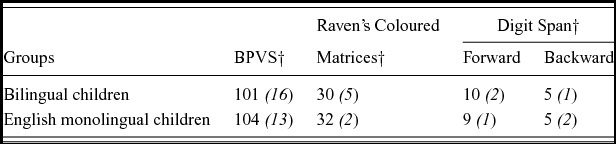
Measures of receptive vocabulary (The British Picture Vocabulary Scale; BPVS-II, Dunn, Dunn, Whetton & Burley, Reference Dunn, Dunn, Whetton and Burley1997), working memory (Digit Span forward and backward – Wechsler, Reference Wechsler2008), and non-verbal reasoning (Raven's Coloured Progressive Matrices – Raven, Court & Raven, Reference Raven, Court and Raven1986) were assessed as background measures, and are reported in Table 1.
Mean raw scores and standard deviations for background measures by language group.

† Performance for Bilingual and Monolingual children was equivalent across tests: Raven's Coloured Matrices (F(1,38) = 2.56, p = .12), Digit Span forward (F(1,38) = 1.15, p = .29) and backward (F(1,38) = 1.14, p = .30), BPVS-II (F(1,38) = .55, p = .50). All scores are within the normal range for this stage of development.
The experimental task was a sentence interpretation task (described below). The full test battery took approximately 50 minutes to complete. At the end of the session, the children were given a certificate as a reward for their participation.
The Sentence Interpretation Task
We designed a variant of a sentence interpretation task that has been used previously by Filippi et al. (Reference Filippi, Leech, Thomas, Green and Dick2012). In this task, participants must identify the “bad animal” (the agent) in a series of sentences. These sentences were of varying syntactic complexity and presented in auditory format either with or without auditory linguistic interference.
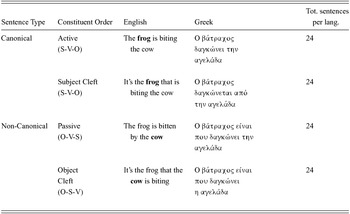
The target language was always English. However, language interference could be in either the same language as the target (English), or in a different unknown language (Greek). An equal number of trials without interference acted as a control condition. This resulted in three conditions: (i) target sentence in English with interference in English, (ii) target sentence in English with interference in Greek, (iii) target sentence in English with no interference. Within each condition, the syntactic structure of the target English sentences was either canonical (Subject-Verb-Object: S-V-O) or non-canonical (Object-Verb-Subject: O-V-S or Object-Subject-Verb: O-S-V). Canonical sentences were taken to be easier and therefore imposing a lower cognitive load than non-canonical sentences (Roland, Dick & Elman, Reference Roland, Dick and Elman2007).
The children were told that they would see two drawings of animals presented simultaneously on the left and right sides of a computer screen and that during this time they would also hear a sentence featuring the two animals, with one of them doing a “bad action” to the other. They were required to identify this animal by making the corresponding left or right key press. Children were also told that sometimes they would hear two people speaking simultaneously, one male voice and one female voice. They were instructed to focus on the voice with the gender indicated on the computer screen at the beginning of the task and ignore the other voice. An illustration of the experimental setup is displayed in Figure 1.
An example of the experimental setting. Two animals are presented on the computer screen. The child is hearing a sentence featuring the two animals (e.g., The Cow is Biting the Horse). S/he needs to identify the animal “doing the bad action” and press either the right or left button on the keypad. In this example, the right answer is “Cow”, right button.

All children were instructed in English and completed 8 practice trial sentences for each experimental condition. For a given sentence, the position of the agent animal (left or right) was counterbalanced across participants. Two pseudo-random condition orders were created, and the children were randomly and equally assigned to each of the two condition orders. Each trial was presented immediately following the children's response, and the children were allowed a maximum of 3 seconds to respond to each trial. If there was no response within 3 seconds, the next trial was presented automatically.
Each trial combined visual and auditory linguistic stimuli. The visual stimuli were drawings of familiar animals taken from several picture databases (Abbate & LaChappelle, Reference Abbate and LaChapelle1984b; Snodgrass & Vanderwart, Reference Snodgrass and Vanderwart1980). Single pictures were digitized black-and-white line drawings (7.0 cm by 5.0 cm) displayed in pairs in accordance with the auditory stimuli (the sentences featuring the animals). Each drawing was embedded in a solid grey rectangle surrounded by a white background, as illustrated in Figure 1. The auditory linguistic stimuli were 192 sentences, 96 in English and 96 translation equivalents in Greek, spoken with natural prosody. The easy canonical sentences (S-V-O) were (1) active and (2) subject-cleft syntactic structures. The difficult non-canonical sentences (O-V-S or O-S-V) were (3) object cleft and (4) passive syntactic structures. Table 2 shows examples of these sentence types.
Example of sentence types (the agent is in bold – but was not stressed in the oral presentation).

Target and non-target sentences were created from a pool of animal nouns and action verbs using the following criteria: (1) Each animal appeared twice as subject, and twice as object; (2) Each verb appeared twice; (3) No noun appeared with a verb more than once as a subject and no noun appeared with a verb more than once as an object; (4) No two nouns were combined together twice; (5) The names of the animals were not cognates; (6) The verbs chosen were all high frequency verbs, transitive, and with mildly negative meaning; (7) Attended (i.e., target) and competing (i.e., interfering) sentences were always spoken by speakers of different genders. Attended and competing sentences were paired pseudo-randomly so that the same animals and syntactic structure would never be presented simultaneously in target and non-target sentences.
Sentences were recorded by native speakers (1 male and 1 female in each case) of British English or Greek onto digital audio tape (DAT) in an Industrial Acoustics 403-A audiometric chamber with a TASCAM DA-P1 DAT recorder and a Sennheiser ME65/K6 supercardioid microphone and pre-amp at gain levels between 6 and 12 db. The recorded stimuli were then digitized via digital-to-digital sampling onto a Macintosh G4 computer via a Digidesign MBox using ProTools LE software at a sampling rate of 44.125 kHz with a 16-bit quantization. The waveform of each sentence and animal name was then edited, converted into a 16-bit 44.125 kHz mono sound file in Audacity 1.2.5 for Mac, and saved in .wav format. Each target and competing speech sentence was normalized to a root mean squared amplitude of 70 dB using Praat software (Boersma & Weenink, Reference Boersma and Weenink2010), such that the average signal-to-noise ratio over the whole sentence was zero (0) dB.
The experiment was run using Matlab 7.7.0 (Mathworks Inc. Sherbon MA, USA) on a MacBook 13” laptop computer with the auditory stimuli presented through Sennheiser EH-150 headphones. Accuracy was recorded in Matlab from a USB Logitech Precision game-pad in which only two buttons were enabled, one on the right and one on the left.
Results
We first report the results of the auditory check and background measures. We then report the results of the sentence interpretation task focusing on the key contrast between bilingual and monolingual children. Last, we examine the role of age in the control of interference between the two linguistic groups.
Background measures
Comparisons between bilinguals and monolinguals revealed no statistically significant differences. This indicated that both groups had equivalent English vocabulary, non-verbal reasoning, and working memory skills (see Table 1).
Comprehension of sentences in the presence of interference
In order to identify differences in control of interference between monolinguals and bilinguals in relation to sentence type, we first performed two mixed factor omnibus (2×2×3) ANOVAs with a between-subjects factor of group (bilinguals/monolinguals) and within-subjects factors of sentence type (canonical/non-canonical) and language interference (no interference/English/Greek).
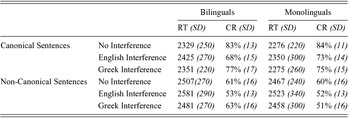
In the first ANOVA we analysed response accuracy and in the second we analysed reaction time. The means and standard deviations for both groups are reported in Table 3.
Monolingual and bilingual children's reaction times (RT) in milliseconds and percent correct responses (CR) in the Sentence Interpretation Task.

Accuracy
The ANOVA revealed a significant main effect of sentence type (F(1,38) = 88.1, p < 0.001, η 2 = 0.70) indicating better performance overall on canonical compared to non-canonical sentences. A significant main effect of language interference was also observed (F(2,76) = 27.9, p < 0.001, η 2 = 0.42), indicating overall better performance in the no interference condition. This main effect was qualified by the interaction between interference and group (F(1,38) = 5.18, p = 0.008, η 2 = 0.12), suggesting that linguistic interference had a differential effect on the bilingual and the monolingual children's sentence comprehension. In line with our prediction, the interference effects were strongest when comprehending non-canonical sentences. More detailed analyses are reported in the paragraph below (about Sentence complexity effects).
No other main effect of group or interaction between sentence and group emerged (p > .1), indicating similar levels of overall performance for monolinguals and bilinguals.
Reaction Time
There was a main effect of sentence (F(1,38) = 83.9, p < 0.001, η 2 = 0.69) and a main effect of interference (F(2,76) = 5.46, p = 0.006, η 2 = 0.13), indicating overall faster comprehension with canonical sentences and when stimuli were presented in the control condition without interference. However, there was no significant main effect of group or interaction. Therefore, our subsequent analyses focus upon accuracy data.
Sentence complexity effects
Because we predicted that interference effects would be stronger for non-canonical sentences that have a high cognitive load, these sentences were analyzed using a 2×3 ANOVA with group (bilinguals vs. monolinguals) as the between-subject factor, and interference (English, Greek and no interference) as the within-subject factor. There was a significant interaction between group and interference (F(1,38) = 3.92, p = 0.024, η 2 = 0.1). Bilingual children outperformed monolingual peers in the comprehension of non-canonical sentences but only when interference was in the unknown language, Greek (t(38) = 2.21, p = .017). In order to explore this interaction in more detail, we performed a series of post hoc tests, which are reported in the following sub-section.
Within-group analyses of non-canonical sentences
A series of paired-samples t-tests indicated that bilingual children were more accurate in comprehending non-canonical sentences when interference was in Greek, t(19) = 3.967, p = .001, compared to when interference was in English. Remarkably, their performance under Greek interference was similar to that of no interference, t(19) = .720, p = .480. Therefore, bilingual children were not significantly affected by the presence of this type of linguistic noise. By contrast, monolingual children's accuracy in comprehending non-canonical sentences dropped in the presence of interference compared to no interference, irrespective of the language of interference [English: t(19) = 2.273, p = .035; Greek: t(19) = 2.298, p = .033]. Monolinguals’ performance in the two interference conditions (English vs. Greek) was not significantly different, t(19) = .278, p = .784.
The role of age in controlling interference during comprehension of complex syntactic structures
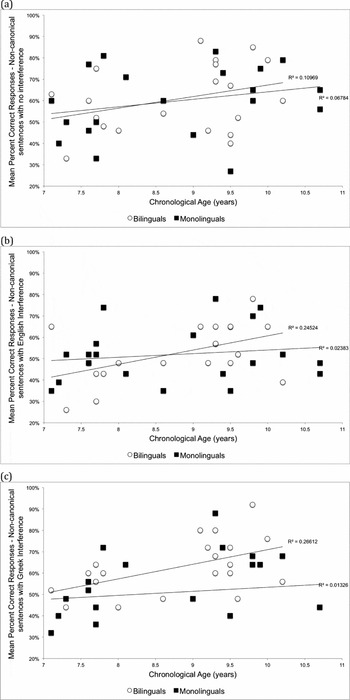
To explore the role of age in controlling interference, the children's individual accuracy scores in the sentence interpretation task were regressed against their chronological age. All trajectories were checked for outliers with Cook's distance (Cook, Reference Cook1977) to determine whether a particular data point disproportionately affected regression estimates. No data points approached or exceeded a Cook's distance of 1, indicating that the models were not unduly influenced by outliers. The regression analyses revealed that, for the bilingual children, age significantly contributed to predicting comprehension in the presence of both types of interference (English: F(1,19) = 5.728, p = .028, adjusted R square = .199, Beta = .49; Greek: F(1,19) = 6.527, p = .020, adjusted R square = .225, Beta = .52). This was not the case for the monolingual children: age was not a significant contributor to predicting comprehension of non-canonical sentences either in the presence of English interference (F(1,19) = .449, p = .511, adjusted R square = .030, Beta = .16), or in the presence of Greek interference (F(1,19) = .242, p = .629, adjusted R square = .042, Beta = .11). For both groups, age was not a reliable predictor of comprehension without interference [monolinguals: (F(1,19) = 1.290, p = .271, adjusted R square = .015); bilinguals: F(1,19) = 2.226, p = .153, adjusted R square = .061]. These data are illustrated in Figure 2 (a, b and c), which indicate that the ability to control interference improves across 7 to 11 years of age in the bilingual children, but not in the monolingual children.
Bilingual and monolingual children's individual performance in the comprehension of non-canonical sentences correlated with chronological age in years: A) no interference (control); B) English interference; C) Greek interference.

The role of English proficiency in controlling interference during comprehension of complex syntactic structures
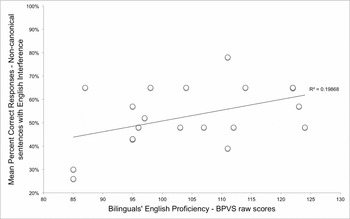
We took receptive English vocabulary (assessed by the BPVS-II's raw scores) as a proxy for relative proficiency and examined the extent to which it predicted performance for the comprehension of non-canonical sentences in the presence of interference.
For the bilingual children, regression analyses revealed a marginal effect towards more proficient knowledge of English predicting better sentence comprehension in the presence of English interference (F(1,19) = 4.300, p = .053, adjusted R square = .193, Beta = .44), but not Greek (F(1,19) = 2.061, p = .168, adjusted R square = .103, Beta = .32). These data are illustrated in Figure 3. For the monolingual children, English proficiency was not a reliable predictor of best performance, regardless of the linguistic interference [English: F(1,19) = 1.479, p = .240, adjusted R square = .076, Beta = .28; Greek: F(1,19) = .841, p = .371, adjusted R square = .045, Beta = .21].
Bilingual children's individual performance in the comprehension of non-canonical sentences in the presence of English interference correlated with a measure of English vocabulary knowledge (BPVS-II raw scores).

These data may indicate a close relationship within our bilingual sample between proficiency in their dominant language (English) and the ability to control interference when the task is more cognitively demanding. Therefore, better English language proficiency in bilingual children may enable them to more effectively screen out irrelevant information under the condition of interference when the cognitive demands of a task are high (e.g., comprehension of English non-canonical sentences with English interference).
Discussion
In this study we investigated the existence of a developmental bilingual advantage in inhibiting irrelevant auditory linguistic information when comprehending natural speech. For this purpose, we extended our previous work with adults to children from 7 to 10 years of age. Performance on a speech comprehension task was compared across bilingual and monolingual children matched on age, general cognitive performance, linguistic performance in English and socio-economic status. Both linguistic groups were tested with a listening paradigm adapted from our previous study (Filippi et al., Reference Filippi, Leech, Thomas, Green and Dick2012). Children were required to identify the agent of English canonical and non-canonical sentences in the presence or absence of English and Greek interfering sentences.
We found that bilingual children were reliably more accurate than monolingual peers in responding to non-canonical English sentences when interference was in Greek, a language that was unknown to all participants. Performance of the two groups was comparable in the presence of English language interference. However, resistance to both types of verbal interference (English and Greek) increased with age in the bilingual but not monolingual group. Therefore, the ability to control verbal interference seems to improve over development in bilingual speakers, but not in monolinguals.
A statistical marginally significant effect suggests that better English proficiency may be a predictor of a bilingual advantage in moderating the effects of native – or more dominant – language interference. Experience in language control may, then, be crucial to any bilingual advantage in filtering out interference during the comprehension of cognitively demanding tasks, such as the comprehension of English non-canonical sentences in the presence of English interference.
Comparison with earlier research with adults
In our previous study (Filippi et al., Reference Filippi, Leech, Thomas, Green and Dick2012) with high-proficiency Italian–English bilingual adults who acquired their second language after adolescence, the familiarity of the interference stimuli was unimportant to efficient target sentence comprehension. The fact that the advantage in control of interference was only observed with unfamiliar language in the present study may be explained by the poorer overall command of English among our participants (in comparison to adults). As reported in the literature, children reach adult levels of proficiency in the comprehension of complex sentence structures (e.g., passives) at about age 12 (Leech et al., Reference Leech, Aydelott, Symons, Carnevale and Dick2007). It follows, therefore, that English interference may introduce an additional component of complexity in childhood due to the fact that the language is actively being acquired and routinely employed (e.g., at school, playing with friends, watching TV). Consistent with this claim, we observed a positive correlation between the age of our participants and performance on the sentence comprehension task, with the bilingual children overtaking the monolingual children by the age of 9. From our results, it seems that the bilingual advantage only clearly emerges once proficiency has been attained. If this interpretation is correct, it follows that the proficiency rather than age of acquisition is the fundamental factor in the conferring of the cognitive advantage associated with the control of linguistic interference.
Contrary to early studies of speech comprehension in noise (Mayo et al., Reference Mayo, Florentine and Buus1997; Shi, Reference Shi2010), our data provide evidence that, when bilinguals can discriminate the target sound, the beneficial effect of bilingualism is extended to auditory attention and improves through development.
Future research
Our findings provide the basis for a larger scale investigation of differences in cognitive development between bilingual and monolingual children and adults. From an early developmental perspective, it is important to identify whether there is any point during cognitive development at which bilinguals or monolinguals are placed at an educational disadvantage. From an ageing perspective, evidence for the protective effect of bilingualism from cognitive decline raises the possibilities for promoting second language learning.
This research addresses an important field of enquiry within developmental psychology, educational psychology and cognitive neuroscience. Educators, parents, and medical professionals can benefit from learning more about the ways in which cognitive abilities can be enhanced during early development and protect against age related deterioration. As the advantage in controlling interference is already observed early in life, we may predict that the areas of the brain involved in auditory processing and control of linguistic interference develop differently in monolingual and bilingual speakers. A recent EEG study comparing bilingual and monolingual adults suggests that performance differences may be due in part to experience-dependent enhancements in the subcortical response to speech sounds in the presence of interference (i.e., multitalker babble – Krizman, Marian, Shook, Skoe & Kraus, Reference Krizman, Marian, Shook, Skoe and Kraus2012). The use of neuroimaging techniques may help reveal the loci of verbal control and possible structural differences between the monolingual and the bilingual brain (Abutalebi & Green, Reference Abutalebi and Green2008). Recent neuroimaging studies implicate the left caudate and posterior paravermis of the right cerebellum in the control of interference during speech comprehension (Crinion, Turner, Grogan, Hanakawa, Noppeney, Devlin, Aso, Urayama, Fukuyama, Stockton, Usui, Green & Price, Reference Crinion, Turner, Grogan, Hanakawa, Noppeney, Devlin and Price2006; Filippi, Richardson, Dick, Leech, Green, Thomas & Price, Reference Filippi, Richardson, Dick, Leech, Green, Thomas and Price2011). However, this line of research is currently limited to control of interferences in adulthood. Therefore, a convergence of neuroimaging and behavioral investigations should aim to build a developmental trajectory of control processes and focus on whether there are differences in specific brain and cerebellar areas due to early bilingual experience. These areas may be relatively preserved from the effect of ageing in bilingual speakers (Filippi & Karmiloff-Smith, Reference Filippi and Karmiloff-Smith2012).
Summary
In conclusion, bilingual children show an advantage over monolinguals in focusing on complex tasks, in this case the comprehension of non-canonical sentences, and in inhibiting irrelevant information provided by simultaneous background verbal noise, likely due to more years of experience using two languages and managing competition from the non-target language while processing the target language (Green, Reference Green1986, Reference Green1998). This advantage seems to strengthen over the course of development. Our findings fill a gap in developmental research on control of linguistic interference in the auditory modality and shed new light on the positive effects of learning a second language early in life.