INTRODUCTION
The macrocyclic lactone (ML) endectocides have transformed the therapy of parasitic infections in animals and humans. Ivermectin (IVM), an avermectin discovered in the mid 1970s, was the first commercially available ML. It has been massively used to control parasitic nematodes as well as arthropod ectoparasites such as fleas, ticks, lice, mites and flies (Campbell, Reference Campbell1985; Woodruff and Burg, Reference Woodruff, Burg, Parnham and Bruinvels1986) in livestock and companion animals. Since its discovery, a number of other ML avermectins (abamectin, doramectin, eprinomectin, selamectin) and milbemycins (milbemycin oxime, moxidectin) have been commercialized for use in animals and crop pests. However, to date IVM is the only ML parasiticide in human clinical use, although moxidectin (MOX) is currently being evaluated for use in humans for onchocerciasis (Cotreau et al. Reference Cotreau, Warren, Ryan, Fleckenstein, Vanapalli, Brown, Rock, Chen and Schwertschlag2003).
The remarkable potency of ML anthelmintics (activity commonly at ⩽1 nm equivalent against many target species), coupled with their great flexibility in formulation, multiple routes of administration and extraordinary persistence, opened up therapeutic options for previously untreated or poorly treated parasitic diseases and provided new management strategies for parasite control. Against trichostrongylid nematodes of livestock, the MLs (in the absence of resistance) are remarkably effective at removing virtually all adults, developing larvae and hypobiotic larvae, and show useful residual activity (the period being dependent upon the half-life of the ML and its formulation) against incoming infective larvae. Somewhat similar activity is seen against nematode parasites of horses, although activity against tissue stages of some may be incomplete. Against canine heartworm, caused by the filarial nematode Dirofilaria immitis, IVM, MOX, milbemycin oxime and selamectin stop the development of the L3/L4 parasitic larval stages in the definitive host and prevent adult worm establishment, sometimes at exquisitely low dose rates (Blair and Campbell, Reference Blair and Campbell1980; Prichard, Reference Prichard2005). Prolonged administration of some of the ML heartworm preventatives kills microfilariae, young developing larvae, older larvae, ‘immature’ young adults, and/or mature adults (McCall, Reference McCall2005).
IVM is used in humans to control onchocerciasis, against which it proved to have dramatic effects in rapidly lowering Onchocerca volvulus microfilarial counts in the skin and inhibiting adult worm production of microfilariae (mf) for many months (Boatin et al. Reference Boatin, Hougard, Alley, Akpoboua, Yameogo, Dembele, Seketeli and Dadzie1998). As a result of this ‘microfilaricidal effect’, the skin microfilarial loads decrease by 95–99% within one month after treatment. The drug also blocks the production of new mf by the adult female worms, which only resume mf release 3–6 months after treatment. This ‘embryostatic effect’ of IVM explains why the mf loads in skin remain at very low levels for up to one year. These two effects reduce mf-induced blindness and skin pathology, and transmission of the parasite via infection of the black-fly vector. In addition to these two critically important actions, IVM also produces a small ‘macrofilaricidal effect’ when administered repeatedly (Duke et al. Reference Duke, Zea-Flores, Castro, Cupp and Munoz1990; Gardon et al. Reference Gardon, Boussinesq, Kamgno, Gardon-Wendel, Demanga-Ngangue and Duke2002). IVM and MOX may also affect the developing larval stages of Onchocerca ochengi (Tchakoute et al. Reference Tchakoute, Bronsvoort, Tanya, Renz and Trees1999), a filarial parasite of cattle which is closely related to O. volvulus; these drugs thus could have some prophylactic effect against O. volvulus establishment.
The success of IVM against onchocerciasis in humans and heartworm in pet animals led to investigations of its use against other filarial parasites, such as Wuchereria bancrofti, Brugia malayi and Brugia timori. Combinations of IVM and albendazole (ABZ) have been adopted for mass treatment of lymphatic filariasis in the Global Program to Eliminate Lymphatic Filariasis, which was initiated by the WHO in 1997. The efficacy of the IVM and ABZ combination therapy for bancroftian filariasis was first reported in 1997 (Addis et al. Reference Addiss, Beach, Streit, Lutwick, LeConte, Lafontant, Hightower and Lammie1997).
The MLs remain the most widely used anthelmintics in veterinary medicine. However, widespread ML resistances have developed in some nematode parasites of sheep, goats and cattle (Loveridge et al. Reference Loveridge, McArthur, McKenna and Mariadass2003; Mejia et al. Reference Mejía, Fernández Igartúa, Schmidt and Cabaret2003; Kaplan, Reference Kaplan2004; Wolstenholme et al. Reference Wolstenholme, Fairweather, Prichard, von Samson-Himmelstjerna and Sangster2004; Geary, Reference Geary2005) and there have been reports of IVM and MOX resistances in the horse parasite Parascaris equorum (Boersema, Eysker and Nas, Reference Boersema, Eysker and Nas2002; Hearn and Peregrine, Reference Hearn and Peregrine2003). More recently, MOX and IVM resistance development in Cyathostomum has been seen (Trawford, Burden and Hodgkinson, Reference Trawford, Burden and Hodgkinson2005; Molento, M. B., personal communication). In some species of nematodes parasitic in small ruminants, IVM resistance has developed quite rapidly (Coles, Rhodes and Wolstenholme, Reference Coles, Rhodes and Wolstenholme2005; Shoop, Reference Shoop1993). Resistance to avermectins has been reported in some ectoparasites and arthropod pests of crops (Clark et al. Reference Clark, Scott, Campos and Bloomquist1995; Humeres and Morse, Reference Humeres and Morse2005) and recently IVM resistance in human Sarcoptes scabiei has been reported (Currie et al. Reference Currie, Harumal, McKinnon and Walton2004). There is accumulating evidence that IVM resistance is developing in O. volvulus, for which annual or semi-annual IVM treatment has been the main control measure for up to 19 years. IVM resistance in O. volvulus appears to be manifested as a partial loss of the inhibition of reproduction in the adult parasites and possibly reduction in the incomplete macrofilaricidal effects of IVM, although the microfilaricidal effects of IVM still appear to remain high (Ali et al. Reference Ali, Mukhtar, Baraka, Homeida, Kheir and Mackenzie2002; Awadzi et al. Reference Awadzi, Boakye, Edwards, Opoku, Attah, Osei-Atweneboana, Lazdins-Helds, Ardrey, Addy, Quartey, Ahmed, Boatin and Soumbey-Alley2004a, Reference Awadzi, Attah, Addy, Opoku, Quartey, Lazdins-Helds, Ahmed, Boatin, Boakye and Edwardsb; Osei-Atweneboana et al. Reference Osei-Atweneboana, Eng, Boakye, Gyapong and Prichardin press). Further evidence for IVM selection on O. volvulus comes from extensive genetic studies (Ardelli et al. Reference Ardelli, Guerriero and Prichard2005, Reference Ardelli, Guerriero and Prichard2006a, Reference Ardelli, Guerriero and Prichardb; Ardelli and Prichard, Reference Ardelli and Prichard2004; Eng and Prichard, Reference Eng and Prichard2005; Eng et al. Reference Eng, Blackhall, Osei-Atweneboana, Bourguinat, Galazzo, Beech, Unnasch, Awadzi, Lubega and Prichard2006) which have shown IVM selection on ABC transporter and β-tubulin genes. IVM is being widely used for lymphatic filariasis control in Africa (Ottesen, Reference Ottesen2006). Resistance to IVM has not so far been reported in W. bancrofti although the possibility of it developing has been considered in mathematical simulations (Schwab et al. Reference Schwab, Churcher, Schwab, Basáñez and Prichard2007).
HOW DO THE MACROCYCLIC LACTONE ANTHELMINTICS WORK?
The original work on the mechanism of action of the avermectins demonstrated their ability to open γ-aminobutyric acid (GABA)-gated chloride channels (Campbell, Reference Campbell1985). The drug has potent activity at GABA receptors in both invertebrates and mammals, and GABA was known to be an important inhibitory neurotransmitter in the nematode somatic neuromuscular system. More recent work suggests that GABA receptors may play a role in some of the effects of IVM (Feng et al. Reference Feng, Hayashi, Beech and Prichard2002). However, glutamate-gated Cl− channels (GluCls), a previously unrecognized class of ligand-gated channels which are absent from vertebrates but have key roles in both arthropods and nematodes, were discovered and found to be more sensitive physiological targets of MLs, than GABA receptors in free-living and parasitic nematodes (Cully et al. Reference Cully, Vassilatis, Liu, Paress, Van der Ploeg, Schaeffer and Arena1994; Dent et al. Reference Dent, Smith, Vassilatis and Avery2000; Njue et al. Reference Njue, Hayashi, Kinne, Feng and Prichard2004; Yates, Portillo and Wolstenholme, Reference Yates, Portillo and Wolstenholme2003). Experiments performed with the free-living nematode Caenorhabditis elegans emphasize the primary importance of GluCls, mediating pharyngeal pumping, in the mechanism of action of IVM in this nematode. However, more research is needed to determine the relative importance of GluCls and GABA receptors, and possibly other receptors, in different parasitic nematodes and different life cycle stages of parasitic nematodes. MLs cause a variety of effects in nematodes, from inhibition of pharyngeal pumping, paralysis and activation of body muscle (these contrary paralytic/activation effects are concentration and time-dependent; Ardelli, B. F. and Prichard, R. K., personal communication) and inhibition of reproduction (Schulz-Key, Reference Schulz-Key1990). In free-living C. elegans, maintained on a carpet of bacteria, the effects of MLs on pharyngeal pumping and feeding are extremely sensitive and may represent the most important effects which produce death of this nematode. However, in some parasitic nematodes, for example those living in the gastrointestinal tract, the body paralysis may be more damaging to the worm and lead to its expulsion (Sheriff et al. Reference Sheriff, Kotze, Sangster and Hennessy2005), while in adult filarial nematodes, inhibition of reproduction may be the most important effect. We know very little about how MLs inhibit reproduction in nematodes and whether this effect is mediated by opening of LGICs or other effects of these highly lipophilic drugs. MLs are potent microfilaricides/filarial larvicides in vivo. However, oral feeding is not thought to be important in filarial nematodes (Strote, Bonow and Attah, Reference Strote, Bonow and Attah1996), so paralysis of the pharyngeal muscle is unlikely to be important in filariae. In addition, IVM does not paralyse microfilariae in vitro unless concentrations are very high (Bennett, Williams and Dave, Reference Bennett, Williams and Dave1988), so the question arises as to how MLs kill microfilariae/filarial larvae and whether GluCl/GABA receptors are involved or other receptors. These authors raised the possibility that IVM acts on microfilariae in vivo by increasing their sensitivity to the host immune system. It is not obvious how a ligand-gated ion channel (LGIC) agonist effect would impair the anti-host immunity defenses of microfilariae/filarial larvae and so the possibility that MLs exert effects on other parasite non-LGIC receptors at nm concentrations should be considered. It is likely that there is still much to discover about the true mechanisms by which MLs act against parasitic nematodes and especially against filarial parasites.
ASPECTS OF MACROCYCLIC LACTONE PHARMACOKINETICS AND TOXICOLOGY
In livestock and humans, IVM has a half-life of about 18–28 hr (Prichard et al. Reference Prichard, Steel, Lacey and Hennessy1985; Baraka et al. Reference Baraka, Mahmoud, Marschke, Geary, Homeida and Williams1996). The avermectins (IVM, abamectin, doramectin, eprinomectin, selamectin), but to a lesser extent MOX, are excellent substrates for P-glycoprotein transport in mammals (Pouliot et al. Reference Pouliot, L'Heureux, Liu, Prichard and Georges1997; Lespine et al. Reference Lespine, Martin, Dupuy, Roulet, Pineau, Orlowski and Alvinerie2007) and it is likely that liver/biliary P-glycoprotein plays a key role in determining faecal excretion of MLs and their half-lives in mammalian hosts (Molento et al. Reference Molento, Lifschitz, Sallovitz, Lanusse and Prichard2004). Furthermore, it is well established that P-glycoprotein in the blood-brain barrier is critically important in preventing IVM reaching toxic concentrations in the CNS and activating CNS GABA receptors (Schinkel et al. Reference Schinkel, Smit, van Tellingen, Beijnen, Wagenaar, van Deemter, Mol, van der Valk, Robanus-Maandag and te Riele1994; Mealey et al. Reference Mealey, Bentjen, Gay and Cantor2001; Roulet et al. Reference Roulet, Puel, Gesta, Lepage, Drag, Soll, Alvinerie and Pineau2003). The ability of ABC transporter membrane proteins to regulate avermectin concentrations in the host has important implications for the consideration of the mechanisms of resistance to the different MLs in parasites.
MECHANISMS OF MACROCYCLIC LACTONE RESISTANCE: ABC TRANSPORTERS, β-TUBULIN AND RESISTANCE MARKER DEVELOPMENT
Drug resistance mechanisms typically involve (1) the up-regulation of cellular efflux mechanisms, (2) an increase in drug metabolism, (3) an alteration in drug receptor sites which reduce drug binding or the functional consequences of the drug binding, or (4) a decrease in abundance of the drug receptors through reduced expression or another route for down-regulation. The first two mechanisms effectively decrease drug concentration at receptor sites and the latter two mechanisms affect the receptor response as a consequence of drug binding. Selection on ABC transporter genes has been demonstrated in ML-resistant parasites and other parasites subjected to repeated exposure to MLs. This evidence will be discussed below. MLs are not extensively metabolized and there is no evidence that a significant increase drug metabolism is involved in ML resistances. Even though deletion of GluCl genes in C. elegans results in loss of susceptibility to IVM, evidence that selection of specific alleles in GluCl or GABA receptors is responsible for IVM resistance is limited in parasitic nematodes (see McCavera, Walsh and Wolstenholme in this special issue). In addition to selection on some ABC transporter genes and GluCl or GABA receptors in ML resistance, there is evidence that IVM and MOX also selects on β-tubulin, as outlined below.
Genetic changes in ABC transporters
The first full length P-glycoprotein (Pgp A) cloned from a parasitic helminth was in H. contortus (Xu et al. Reference Xu, Molento, Blackhall, Ribeiro, Beech and Prichard1998), and these workers found evidence for higher level expression of Pgp A in IVM-selected H. contortus compared with a parental unselected strain. They also showed that the mdr-reversing agent verapamil increased the efficacy of IVM and MOX against a MOX selected strain of H. contortus. Further work showed that selection by IVM and MOX led to a change in genetic polymorphism in Pgp A (Blackhall et al. Reference Blackhall, Liu, Xu, Prichard and Beech1998). Another H. contortus P-glycoprotein, hcpgp-1, was also shown, by genetic hybridization, to be associated with resistance in the IVM-selected strain CAVRS (Le Jambre, Lenane and Wardrop, Reference Le Jambre, Lenane and Wardrop1999). Southern blots of H. contortus drug-resistant isolates revealed a pattern consistent with the involvement of P-glycoproteins in resistance to IVM (Sangster et al. Reference Sangster, Bannan, Weiss, Nulf, Klein and Geary1999). Molento and Prichard (Reference Molento and Prichard1999) found that the mdr-reversing agents verapamil and CL 347099 increased the efficacy of IVM and MOX against IVM- and MOX-selected strains of H. contortus in the jird.
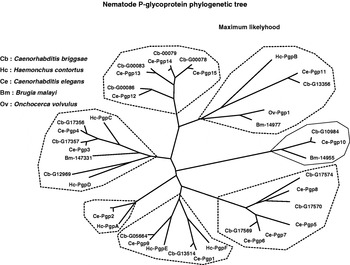
Nematodes have many more P-glycoprotein genes than are commonly found in mammals, with C. elegans having 15. Because nematodes do not have a central nervous system protected by a blood-brain barrier, one can speculate that different P-glycoproteins have evolved in nematodes to protect different neurons in their bodies from toxins, whereas as in mammals expression of one or a small number of P-glycoproteins in the blood-brain barrier protects all of the neurons of the central nervous system from toxins. A phylogenetic tree for nematode P-glycoproteins is shown in Fig. 1. Roulet and Prichard (Reference Roulet and Prichard2006) have reported that IVM and MOX select for constitutive overexpression of at least three (Pgp A, C and E) of six P-glycoproteins whose expression levels were examined in field IVM-resistant and laboratory IVM- or MOX-selected isolates of H. contortus. They further showed that IVM exposure in vivo induced overexpression of five (Pgp A, B, C, D and E) of six P-glycoproteins examined in IVM-resistant H. contortus, 24 hr after infected sheep were treated. In contrast, MOX exposure in vivo induced overexpression in only two (Pgp C and E) of six P-glycoproteins in IVM-resistant H. contortus examined under the same circumstances. Thus, differences in responses to the avermectins compared with moxidectin seen with mammalian P-glycoprotein (Molento et al. Reference Molento, Lifschitz, Sallovitz, Lanusse and Prichard2004; Lespine et al. Reference Lespine, Martin, Dupuy, Roulet, Pineau, Orlowski and Alvinerie2007) may also occur in nematodes. However, to date only H. contortus (Roulet and Prichard, Reference Roulet and Prichard2006) and C. elegans (Ardelli, B. F. and Prichard, R. K. personal communication) have been examined for responses to IVM and MOX.
Nematode P-glycoprotein phylogenetic tree.

Genetic variation in O. volvulus ABC transporter homologues in several human populations in Africa was examined to determine if an association exists between alleles of these genes and IVM treatment. A reduction in genetic polymorphism was shown in two ABC transporter genes, designated OvMDR-1 and OvABC-1, in O. volvulus from IVM-treated patients. A number of single-nucleotide polymorphisms (SNPs) were identified in the alleles of these genes. However, the majority of these SNPs resulted in synonymous or silent mutations, even though several were located in coding regions (Ardelli and Prichard, Reference Ardelli and Prichard2004). For another gene, designated OvABC-3, a more extensive study was performed on O. volvulus from patients in several countries in both East and West Africa, including some who were included in the non-responder study of Awadzi et al. (Reference Awadzi, Attah, Addy, Opoku, Quartey, Lazdins-Helds, Ahmed, Boatin, Boakye and Edwards2004a). As in previous, studies allelic variation in this gene in non-treated populations showed this locus to be highly polymorphic. However, variability was reduced in IVM treated populations. Parasite material collected from the non-responder study showed five polymorphs of OvABC-3, of which one, polymorph C, was in higher frequency in sub-optimal responders. However, it should be noted that only a small number of worms were collected from the study and a particular worm from a sub-optimal responder may not necessarily be responsible for the higher than expected 365 day microfilarial counts.
A significant difference in the polymorphism of the O. volvulus P-glycoprotein gene (OvPGP-1) has been reported between worms collected from untreated people and worms from people in communities that had been repeatedly treated with IVM in Ghana (Eng and Prichard, Reference Eng and Prichard2005). Furthermore, while OvPGP-1 was in Hardy-Weinberg equilibrium in worms from untreated people, it was not in Hardy-Weinberg equilibrium in worms from treated people, indicating that selection on this gene was occurring. The diversity of 28 loci spanning the entire OvPGP-1 gene was examined in four O. volvulus populations from the Volta Region of Ghana (Ardelli et al. Reference Ardelli, Guerriero and Prichard2005, Reference Ardelli, Guerriero and Prichard2006a). These populations received a range of IVM treatments from none to between four and ten treatments. Samples collected from the same villages in 2002 showed a dramatic loss of polymorphism, even in non-treated samples, compared with samples collected in 1999. Taken together, these results suggest that the use of IVM for onchocerciasis control in Ghana is exerting selection pressure on this gene and as a result is reducing genetic diversity. Differences in the frequency of several loci in the OvPGP-1 gene were observed between O. volvulus obtained from IVM-naïve people and people who had been repeatedly treated with IVM.
Twelve genetic markers, spanning the entire O. volvulus half ABC-transporter (OvPLP-1) (Huang and Prichard, Reference Huang and Prichard1999), were examined in the same field population as in previous studies (see Ardelli et al. Reference Ardelli, Guerriero and Prichard2005, Reference Ardelli, Guerriero and Prichard2006a). Although many of the regions remained polymorphic after treatment, there was a loss of several alleles in many regions of the gene (Ardelli et al. Reference Ardelli, Guerriero and Prichard2006b). The results of this study support a region of the OvPLP-1 gene, the loop between TM4 and TM5, as a potentially useful marker site for monitoring IVM selection in O. volvulus.
Linkage disequilibrium (LD – the non random association of loci) is a pattern of association between two SNPs, or two loci, and is affected by many factors, such as recombination, population subdivision, selection, inbreeding and fluxes in population size. Population bottlenecks increase LD, but in the absence of other mitigating factors, such as those mentioned above, this effect does not last very long (Wall, Andolfatto and Reference Wall, Andolfatto and Przeworski2002). Also, strong selection for a particular allele (e.g. as a result of drug treatment) limits genetic diversity around a locus, resulting in a short-term increase in LD around the selected gene. Work from our laboratory (Ardelli et al. Reference Ardelli, Guerriero and Prichard2006a, Reference Ardelli, Guerriero and Prichardb) attempted to use LD to determine genomic ‘hotspots’ that might be involved in IVM resistance in O. volvulus by studying patterns of LD in two ABC transporters (OvPGP-1 and OvPLP-1). A study of drug resistance in Plasmodium falciparum used LD to identify genes involved in chloroquine and quinine resistance in DNA regions encoding 49 putative transporters. SNPs in 11 of the putative transporter genes showed significant associations with decreased sensitivity to chloroquine and/or quinine, and significant LD within and between these genes was also detected. Based on these results, the authors suggested interactions among the transporter genes (Mu et al. Reference Mu, Ferdig, Feng, Joy, Duan, Furuya, Subramanian, Aravind, Cooper, Wootton, Xiong and Su2003). In the studies of Ardelli et al. (Reference Ardelli, Guerriero and Prichard2006a, Reference Ardelli, Guerriero and Prichardb), pairwise LD between loci was determined using D′ (where D′ is a measure of the significance of the LD between two loci). In both studies, the number of regions in LD decreased with treatment and non-treated populations always showed more LD than treated populations. A number of loci were always in complete LD, despite variation in the number of treatments and the year in which the parasites were collected. Selection, which was observed in the two transporter genes, is expected to increase LD. However, within reasonable recombination rates (∼0·4 generations), the duration of the increase in LD is short (Przeworski, Reference Przeworski2002). These data make a strong case that IVM is affecting the genetic diversity of O. volvulus. Most of the significant reduction in genetic diversity was localized to the 4th and 5th transmembrane domains of the O. volvulus half-transporter and there was minimal LD in this area. This region may be useful as a tool to monitor the effect of IVM on O. volvulus populations.
To provide more information on the effects of IVM on O. volvulus populations at two O. volvulus ABC transporter gene loci, OvPGP-1 and OvPLP-1, an analysis of genomic diversity within treated and non-treated populations was undertaken, covering ∼20 kB of DNA, using the unbiased estimates of genetic diversity and mean unbiased gene diversity (Ardelli et al. Reference Ardelli, Guerriero and Prichard2005, Reference Ardelli, Guerriero and Prichard2006a, Reference Ardelli, Guerriero and Prichard2006b). The most dramatic difference in gene diversity was observed in OvPGP-1, as there was a significant loss of diversity with treatment and with time; the strongest effects were observed after 4–6 treatments. OvPLP-1 also showed a dramatic loss of gene diversity coupled with a reduction in genetic polymorphism. Recent work has determined SNPs in the OvPLP-1 genomic sequence, including an amino acid coding change, which may be useful as genetic markers for IVM selection in O. volvulus (Bourguinat, C. and Prichard, R. K., unpublished).
The selection for and induction of higher levels of P-glycoprotein expression in ML selected/resistant nematodes is of interest in trying to understand the possible mechanisms of resistance to the avermectin and milbemycin MLs. However, regulation of expression is typically dependent on motifs upstream of the protein coding sequence and/or in introns. We know very little about the regulatory sequences for ABC transporters in nematodes; much work needs to be done before useful marker sequences, associated with overexpression of some ABC transporters can be identified for ML resistances. Furthermore, differences are apparent between expression patterns of ABC transporters resulting from MOX exposure compared with exposure to IVM. These results suggest that selection on ABC transporters may need to be investigated individually with different ML anthelmintics. However, an interesting coding SNP has been identified in the half-transporter OvPLP in O. volvulus which may prove useful as a marker for IVM selection in this parasite (Bourguinat, C. and Prichard, R. K., unpublished).
Genetic changes in β-tubulin
Using RFLP and SSCP analyses, Eng and Prichard (Reference Eng and Prichard2005) found evidence of significant selection on the β-tubulin isotype I gene in O. volvulus collected in Ghana following several years of widespread IVM use. Sequence differences between two alleles of β-tubulin were reported. IVM selected for increased abundance of an allele (allele B) that was uncommon in O. volvulus populations that had not been under IVM pressure. This allele is distinguished from the wild-type allele A by having three amino acid changes in the coding region (Met117Ala; Val120Ile; Val124Leu), which correspond to changes on the same surface of three adjacent coils in the H3 helix of β-tubulin. In addition, allele B shows a 24 bp of deletion in the intron adjacent to the coding region for the H3 helix. Eng et al. (Reference Eng, Blackhall, Osei-Atweneboana, Bourguinat, Galazzo, Beech, Unnasch, Awadzi, Lubega and Prichard2006) describe an assay which rapidly allows individual O. volvulus macrofilariae or microfilariae to be genotyped in terms of β-tubulin alleles. They also extended the information on β-tubulin allele frequencies, using this amplicon length assay, by showing that allele B was extremely rare (it was not found in the samples analyzed) in adult O. volvulus populations collected prior to the introduction of IVM in a large part of West Africa and Uganda. However, Bourguinat et al. (Reference Bourguinat, Pion, Kamgno, Gardon, Gardon-Wendel, Duke, Prichard and Boussinesq2006) found β-tubulin allele B in O. volvulus obtained in Cameroon before the introduction of IVM for onchocerciasis control in that country, although it was relatively rare in these IVM naïve parasites. Interestingly, these workers found an association between β-tubulin allele homozygosity or (A/B) heterozygosity and fertility in female O. volvulus. In samples taken in 1998 in Ghana, allele B was quite common in O. volvulus macrofilariae obtained from people who had been repeatedly treated with IVM and, although uncommon, could also be found in O. volvulus from people who were IVM naïve (Eng et al. Reference Eng, Blackhall, Osei-Atweneboana, Bourguinat, Galazzo, Beech, Unnasch, Awadzi, Lubega and Prichard2006). It should be noted, however, that by 1998, IVM use was widespread in endemic areas of Ghana. It is of interest that a higher frequency of allele B (as heterozygotes) was found in a small sample of microfilariae obtained from people in Jagbenbeng, Ghana, in 2002, who responded poorly to IVM (greater than 10 microfilariae per skin snip, 90 days after treatment), compared with microfilariae from people who responded as expected, following six annual IVM treatments. O. volvulus samples from the same patients in Cameroon before any use of IVM were compared to samples obtained following either 4 or 13 rounds of treatment with IVM over 3 years (Bourguinat, C., Pion, S. D. S., Kamgno, J., Gardon, J., Duke, B. O. L., Boussinesq, M. and Prichard, R. K. personal communication). Significant selection for β-tubulin allele A/allele B heterozygotes and against homozygous allele A was observed. This selection was greater in patients subjected to a high frequency treatment regime (quarterly) than with annual treatment.
Eng et al. (Reference Eng, Blackhall, Osei-Atweneboana, Bourguinat, Galazzo, Beech, Unnasch, Awadzi, Lubega and Prichard2006) also reported evidence for IVM selection on the β-tubulin isotype 1 gene in H. contortus. This was seen in SSCP analysis of the genomic position 2692 bp-2883 bp of the H. contortus β-tubulin gene GRU-1, which corresponds to the sequence between amino acid 195 and 235 of the translated protein sequence. Selection was also observed in SNP analysis on codon 200 of the β-tubulin isotype 1 gene in an IVM- selected strain, compared with its parental unselected strain of H. contortus. The changes seen at codon 200 with IVM selection in H. contortus do not mean that this amino acid change is directly involved in IVM resistance in this parasite, but may be linked to other changes in β-tubulin. What specific changes in β-tubulin, if any, are directly involved in IVM resistance in H. contortus requires further elucidation, including functional assays. However, it is interesting that Freeman et al. (Reference Freeman, Nghiem, Li, Ashton, Guerrero, Shoop and Schad2003) found a marked derangement in the amphid neurons of H. contortus in an IVM-resistant strain, compared with an IVM-susceptible strain, including a shortening of the dendritic processes in the IVM-resistant worms. A careful examination of the cross-sections in this study suggests that the microtubules in the amphid neurons may be altered in the IVM resistant nematodes. This may provide further evidence for an involvement of mutations in tubulin in IVM resistance. Whether β-tubulin is genetically linked to another locus involved in a mechanism of resistance to IVM or may directly be involved in IVM resistance needs to be determined. While microtubules are involved in signal transfer from nerve cells in the neuromuscular system of animals, it is not established how alterations in β-tubulin might affect signal transfer from IVM receptors in nerve cells to muscles in nematodes to affect responses to IVM, and this will require further investigation.
Benzimidazole resistance is recessive in trichostrongylid nematodes and the TAC200 codon in β-tubulin isotype 1 has been shown to produce a benzimidazole resistance phenotype in homozygotes (Kwa et al. Reference Kwa, Kooyman, Boersema and Roos1993; Prichard, Reference Prichard2001). In the report of Eng et al. (Reference Eng, Blackhall, Osei-Atweneboana, Bourguinat, Galazzo, Beech, Unnasch, Awadzi, Lubega and Prichard2006), IVM did not select for homozygous TAC200 (tyrosine), but appeared to be selecting for β-tubulin TTC200/TAC200 heterozygotes, which are not predicted to show a benzimidazole resistance phenotype. However, 1/4 of the progeny of TTC200/TAC200 heterozygote matings should be homozygotes and should show benzimidazole resistance. The genetic changes observed in β-tubulin in H. contortus selected by IVM, including the selection for TAC200, may be linked with other amino acid changes in β-tubulin or alleles of other genes which associate with β-tubulin during meiosis. Considerable work needs to be done to establish which amino acid changes in β-tubulin, if any, may be functionally important for IVM resistance. Benzimidazole resistance associated with homozygous TAC200 may not itself result in IVM resistance, if TAC200 is not functionally involved in IVM resistance, but rather may be linked to another genetic change involved in IVM resistance. Benzimidazole resistant nematodes have not been observed to be IVM resistant a priori. However, IVM selection for TAC200 may predispose nematodes to benzimidazole resistance and this requires further investigation because it could have long term implications for the outcome of benzimidazole/ML combination treatment against livestock parasites and for the control of lymphatic filariae in Africa.
IVM and MOX appear to be selecting on β-tubulin isotype 1 in H. contortus and O. volvulus and useful SNP markers may exist in O. volvulus for this selection. However, more needs to be done to identify whether a useful SNP marker for IVM resistance can be found in β-tubulin in H. contortus and β-tubulin data on other ML-resistant nematodes is still lacking. The Phe200Tyr SNP selection observed in IVM-resistant H. contortus will not be useful, on its own, for detection of ML resistances as it is also associated with benzimidazole resistance (see Samson-Himmelstjerna et al. in this special issue). However, this association of both benzimidazoles and MLs with the Phe200Tyr SNP may render analysis of this SNP alone, for the detection of benzimidazole resistance, unreliable in field situations where both benzimidazoles and ML anthelmintics have been used to control parasites.
CONCLUSIONS
There is substantial and accumulating evidence that MLs select for changes in sequence and/or expression levels of some ABC transporters, such as P-glycoproteins. However, nematodes have a much greater diversity of ABC transporter genes than do mammals (e.g., there appear to be 15–16 P-glycoprotein genes in H. contortus compared with only 2 in humans). Furthermore, different MLs may select for different effects on ABC transporter genes. These complexities are compounded by the fact that elements that regulate gene expression are typically found 5′ of the coding region and/or in introns; both of these regions are typically highly variable in nematodes, suggesting that it will be difficult to develop reliable banks of SNP markers for ML resistance based on ABC transporter genes. However, possible markers have been identified for IVM selection in O. volvulus based on the half-transporter OvPLP.
IVM appears to be selecting on β-tubulin isotype 1 in at least some isolates of H. contortus and O. volvulus and a simple genetic test has been described for this selection in O. volvulus. However, much additional work needs to be undertaken to see if selection on β-tubulin by IVM and other MLs occurs in other resistant/selected populations of these parasites and in other nematode parasites. In addition, the possibility that the codon 200 SNP seen in IVM (and MOX) selected H. contortus might be linked to another genetic change needs to be investigated in order to find a reliable marker which can distinguish ML from benzimidazole selection. The mechanisms of ML resistance may be complex, making it more difficult to arrive at a reliable panel of resistance markers. Nevertheless, investigations into the mechanisms of resistance should increase our knowledge of both the biology of the parasites and of the pharmacodynamics of the ML anthelmintics. Such investigations should eventually lead us to markers for ML resistance and also possibly to new targets for parasite control.