Introduction
Infection is a leading cause of morbidity and mortality among patients on hemodialysis.Reference Patel, Yi and Booth1 Yet, there are little data on infection prevention knowledge and attitudes among patients on hemodialysis. Patients on hemodialysis are at a particularly high risk for bloodstream infections, especially those caused by Staphylococcus aureus.Reference Jaber2–Reference Rha, See and Dunham4 The 2022 update of the Society of Healthcare Epidemiology of America, Infectious Diseases Society of America, and Association for Professionals in Infection Control and Epidemiology Practice Recommendations of Strategies to Prevent Methicillin-resistant S. aureus (MRSA) Transmission and Infection in Acute-care Hospitals recommended considering intranasal decolonization to prevent MRSA infections among hemodialysis patients and stated that we need further study to determine the best method for decolonizing patients.Reference Popovich, Aureden and Ham5 Prior studies have demonstrated that intranasal mupirocin decolonization can prevent bloodstream infections among patients on hemodialysis.Reference Tacconelli, Carmeli, Aizer, Ferreira, Foreman and D’Agata6–Reference Nair, Perencevich, Blevins, Goto, Nelson and Schweizer8 However, mupirocin has not become standard of care in hemodialysis units due to concerns about the emergence of mupirocin-resistant S. aureus and difficulty implementing mupirocin decolonization in hemodialysis centers.Reference Alfano, Pittiglio and Ferri9
Intranasal povidone-iodine (PVI) may be a potential alternative to mupirocin among hemodialysis patients. Studies of patients undergoing surgical procedures have found that intranasal PVI decreased S. aureus nasal carriage, prevented surgical site infections, and was acceptable to patients.Reference Schweizer, Herwaldt and Boyken10–Reference Phillips, Rosenberg and Shopsin13 Intranasal PVI is safe and causes few adverse effects, even during long-term use.Reference Frank, Capriotti, Brown and Tessema14,Reference Mullings, Panchmatia and Samoy15 Despite PVI’s benefits among surgical patients, PVI use before each dialysis session has not been evaluated among patients on hemodialysis.
As part of the Povidone-iodine to stop Access related INfections and Transmission of Staphylococcus aureus (PAINTS) clinical trial, we surveyed patients on hemodialysis to assess whether they were aware of their infection risk, were willing to take an active role in infection prevention, and would find long-term intranasal PVI use acceptable.Reference Racila, O’Shea and Nair16
Methods
We performed patient surveys as part of a larger stepped-wedge cluster randomized trial at 16 outpatient hemodialysis centers affiliated with 5 academic medical centers. The aim of the larger trial was to evaluate whether intranasal PVI decolonization prevents S. aureus bloodstream infections among patients on hemodialysis and to assess the implementation of this intervention. Results of the effectiveness of PVI will be reported separately. Patients over 18 years of age who underwent hemodialysis in a participating center, who did not have a documented or verbalized iodine allergy or sensitivity, a cognitive impairment affecting their ability to consent, or an active bacterial infection were invited to participate in the clinical trial. Patients who agreed to participate were instructed to apply PVI to their nares immediately before each hemodialysis session (i.e., 3 times per week) until the study end point (from 4 months up to 32 months, depending on the cluster intervention start date). Between September 2020 and May 2023, members of the study team invited patients who were able to consent and who understood English to complete the surveys. Informed consent for the surveys was separate from consent to use PVI. Participants could complete the surveys independently or with the help of a researcher who read the surveys aloud survey questions. Participants decided which questions they wanted to answer. The response rate was estimated by dividing the number of patients who completed the pre-intervention survey by the number of patients receiving hemodialysis at that site in month the site became eligible to participate in the PAINTS intervention. This response rate did not include participants who chose to participate in the survey later.
We created a 9-question pre-intervention survey and a 13-question intervention survey (Appendix 1). The pre-intervention survey was offered to all patients, regardless of interest in the PVI intervention. The intervention surveys were given to participants who were actively using PVI or interested in learning more about using PVI approximately one-month and 6-months after the beginning of the intervention. The surveys assessed participants’ perceived risk of infection and rated their willingness to take an active role in infection prevention. Each survey included two questions modified from the Patient Activation Measure (PAM) to assess participants’ perceptions of their activation at each time point. Patient activation, as quantified by the PAM tool, is a patient’s involvement in their healthcare and their knowledge, skill, and confidence in managing their chronic disease.Reference Hibbard, Mahoney, Stockard and Tusler17 Survey participants answered a Likert scale ranging from strong disagreement to strong agreement with the following statements: “One of the most important things I can do for my health is to take an active role in my health care” and “I am the main person who takes care of my health.” The Likert scales were then dichotomized to agree or disagree. We hypothesized that participants’ perceived activation would increase from the pre-intervention period to the intervention period because participants would be actively involved in an infection prevention intervention. The intervention survey also included questions about the participants’ experiences with PVI during the intervention; however, regular PVI use was not a requirement for participation in the surveys. A patient resource group reviewed the survey questions and edited them for clarity and readability.
We surveyed participants up to three times. We used chi-squared tests to compare responses to specific questions over time. Patients who completed the pre-intervention survey but were not interested in participating in the PVI intervention and those who participated in the intervention but were no longer receiving hemodialysis at a survey time point did not complete the intervention surveys. By design, two study sites did not implement the intervention for 6 months at the conclusion of the study and thus patients from those sites did not complete both intervention surveys. Consequently, the number of surveyed participants varied by time point.
The University of Iowa Institutional Review Board (IRB) served as the IRB of record for three academic medical centers (University of Iowa, Washington University, University of Pennsylvania). The Emory University IRB and the University of Illinois Chicago IRB approved the study for their own sites.
Results
Across the 16 hemodialysis centers, 469 participants completed at least one survey, of whom 261 completed at least two surveys, and 136 completed all three surveys. The response rate of all patients receiving hemodialysis across all centers was approximately 25%, based on participants’ completion of the pre-intervention survey in the month the site became eligible to participate in the PAINTS intervention.
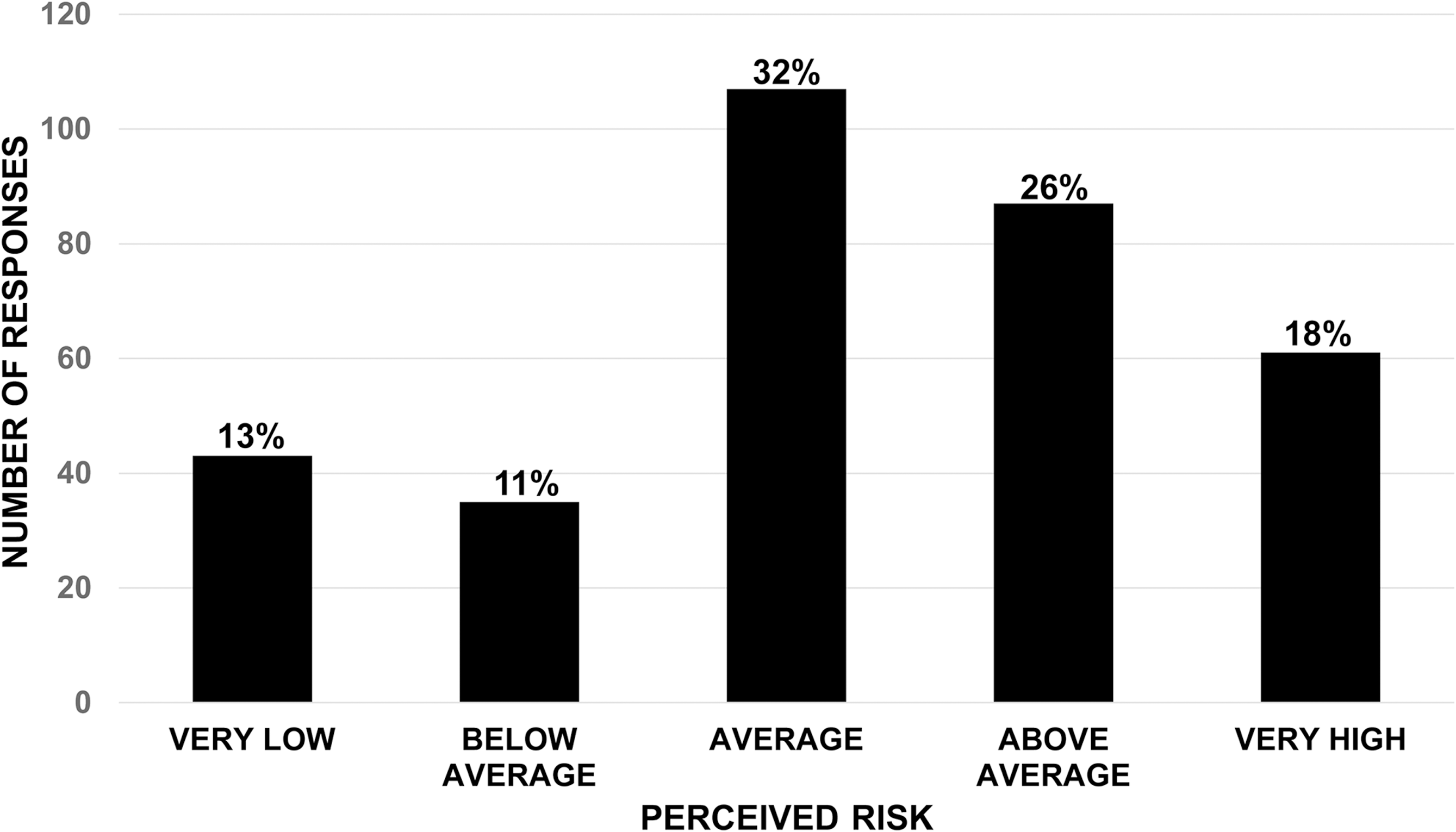
Overall, 55% of participants who completed the pre-intervention survey thought that their risk of infection was average or below average compared with an average person in the United States (Figure 1). Of the 237 participants who responded to the 1-month intervention survey, 45% (106 people) reported they had used PVI. The other 55% of participants were interested in using PVI but had not started using it yet. Of the 106 who had used PVI in the 1-month survey, 84 (79%) reported using it in the last 3 hemodialysis sessions. This decreased slightly to 76 (75%) participants who reported using PVI in the last 3 hemodialysis sessions among the 102 who participated in the 6-month intervention survey. Therefore, among the 469 participants who agreed to complete a survey, only 84 (18%) reported on the 1-month intervention survey that they consistently used PVI, and only 76 (16%) reported on the 6-month intervention survey that they consistently used PVI.
Patient Perceived Risk of Infection Assessed in Pre-Intervention Survey.

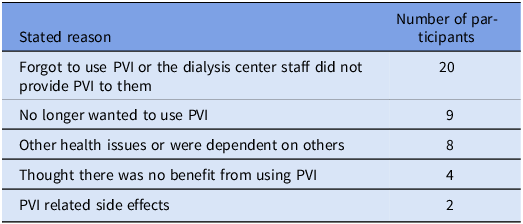
Of the participants who tried PVI and responded to the survey, ten (9.4%) reported side effects: nasal dripping (n = 3), burning/stinging sensation (n = 2), unpleasant smell (n = 1), headaches (n = 1), yellow tears (n = 1), nasal congestion (n = 1), and minor nose bleeding (n = 1). In the 1-month intervention survey, 90 (85%) of participants reported that PVI felt neutral or pleasant to use and 16 (15%) of participants found it unpleasant. Among the 100 participants who reported still using PVI at 6 months and answered the question, 87 (87%) said it felt neutral or pleasant and 13 (13%) said it felt unpleasant. Participants who had used PVI at some point during the study but not in the last three dialysis sessions before an intervention survey, reported a variety of reasons for not using PVI (Table 1).
Patient reported reasons for not using povidone-iodine (PVI) in the Past 3 hemodialysis sessions

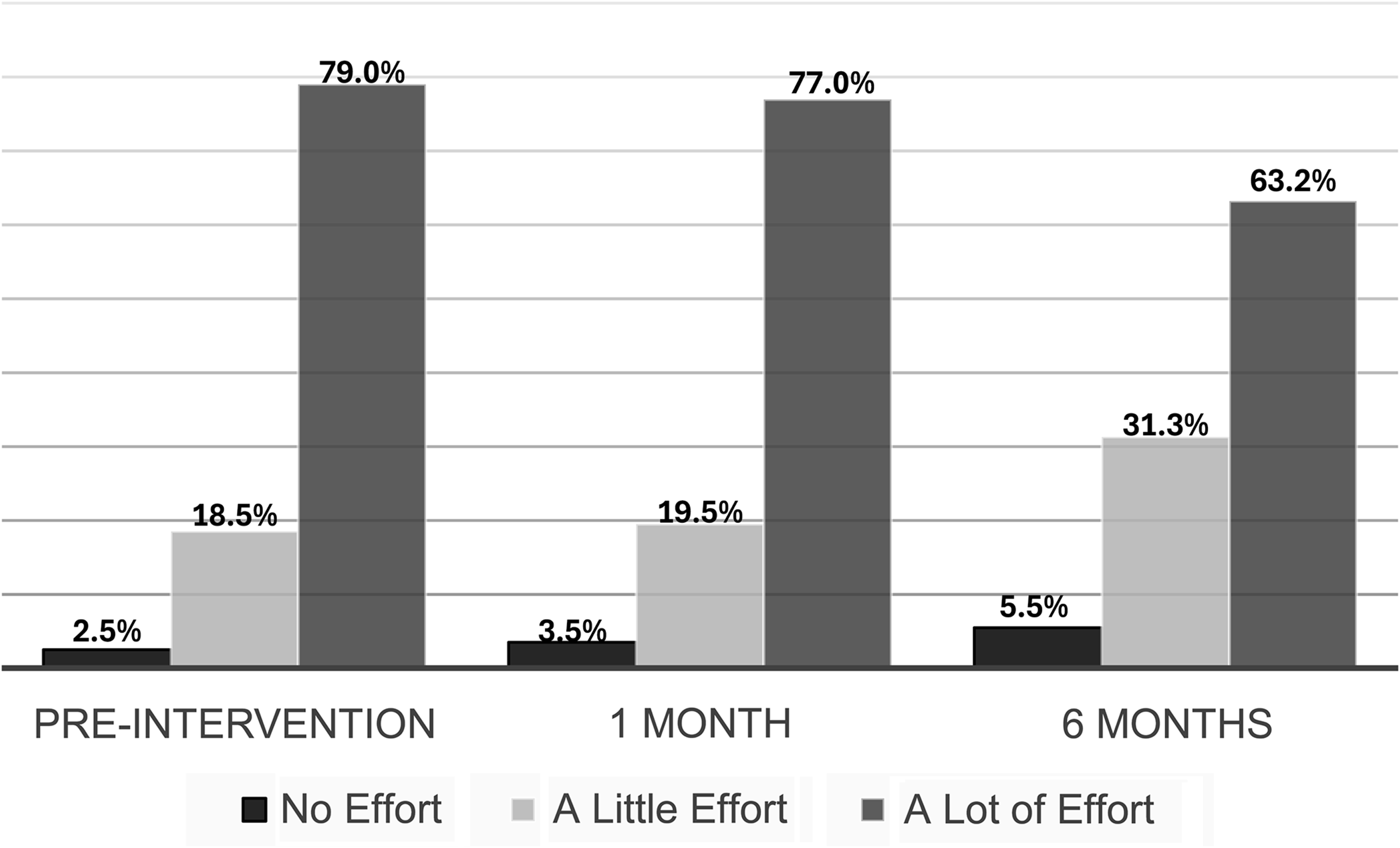
Ninety-nine percent of participants who responded to the pre-intervention survey, the 1-month intervention survey, and the 6-month intervention survey agreed with the patient activation statement, “One of the most important things I can do for my health is to take an active role in my health care.” Similarly, over all time points, most participants (88% in the pre-intervention survey, 89% at 1 month, and 87% at 6 months) agreed with the patient activation statement “I am the main person who takes care of my health.” Pre-intervention, 79% of participants reported that they were willing to expend “a lot of effort” to prevent an infection. This proportion was similar (77%) in the 1-month intervention survey but decreased to 63% in the 6-month intervention survey (p < 0.01). The proportion of participants responding that they were willing to expend “no effort” to prevent infections increased from 2.5% in the pre-intervention survey to 5.5% for the 6-month intervention survey (Figure 2).
Patient Willingness to Expend Effort to Prevent an Infection Reported in Each Survey.

Discussion
Among 469 patients across 16 hemodialysis centers, we found that a minority of eligible participants tried the PVI intervention, and many of those who tried it were not consistently using it. Participants’ most frequent reason for not using PVI was that they forgot to use it or that staff did not offer it to them. Consistent with two prior studies of short term use among surgical patients,Reference Schweizer, Herwaldt and Boyken10,Reference Maslow, Hutzler, Cuff, Rosenberg, Phillips and Bosco11 and other studies of longer term use for rhinosinusitis,Reference Frank, Capriotti, Brown and Tessema14,Reference Mullings, Panchmatia and Samoy15 most participants in our study who used intranasal PVI found it neutral or pleasant to use. Despite participants’ reported satisfaction with PVI, adherence to the PVI protocol was low, which could be due to several factors including competing priorities for both patients and staff, especially during the COVID-19 pandemic, and patients’ misconception that their risk of infection is low.Reference Dukes, Hockett Sherlock and Racila18
Hemodialysis patients are at high risk for multiple types of infections due to coexisting illnesses, presence of central venous catheters that can become infected, and frequent interaction with the healthcare system.Reference Dalrymple, Mu and Nguyen19–Reference Patel, Kallen and Arduino21 In fact, data from the Centers for Disease Control and Prevention document that the rate of S. aureus bloodstream infections is 100-times higher among adults on hemodialysis compared with adults not on hemodialysis (4,248 vs. 42 S. aureus bloodstream infections per 100,000 person-years).Reference Rha, See and Dunham4,22 Yet, in our survey, over half of our study participants reported they considered themselves at average or lower risk of infections than an average person in the US. This result highlights the need to improve patient education regarding their risk of hemodialysis-associated infection, the patient’s role in preventing infections, and thereby preventing the serious adverse outcomes of these infections. Further education might also help motivate patients to participate in infection prevention efforts.Reference See, Shugart, Lamb, Kallen, Patel and Sinkowitz-Cochran23
Hemodialysis patients tend to have multiple co-existing conditions such as diabetes and heart failure.24 Moreover, rates of depression, chronic pain, and difficulties with social support are also high among patients on hemodialysis.Reference Weisbord25 Given their already complicated treatment regimens and their underestimation of their infection risk, patients may have placed a low priority on adding and adhering to another routine task, leading to low participation and adherence rates. Other investigators have noted low compliance rates for hemodialysis-related treatments and behavior modifications.Reference Patel, Yi and Booth1 Thus, we likely need multifactorial strategies, such as health coaching and peer mentoring, to engage patients on hemodialysis in active infection prevention efforts.Reference Hussein, Bennett, Abra, Watson and Schiller26 We may also need to integrate infection prevention interventions into staff workflows at hemodialysis centers to ensure that patients consistently receive interventions such as PVI.Reference Dukes, Hockett Sherlock and Racila18 Previously reported interviews with hemodialysis staff during this study found that ensuring access to PVI supplies, and deliberate, repeated messaging about PVI to staff and patients facilitated use of PVI.Reference Dukes, Hockett Sherlock and Racila18
Prior studies have shown that patients on in-center hemodialysis report a low degree of activation.Reference Hussein, Bennett, Abra, Watson and Schiller26,Reference Van Bulck, Claes and Dierickx27 In each survey, we assessed perceived activation and we asked about their willingness to exert effort to prevent infections. We hypothesized that involving patients in an infection prevention intervention would increase their perceived activation and willingness to take an active role in preventing infections. Contrary to our hypothesis, significantly fewer participants reported that they were willing to expend “a lot of effort” to prevent an infection at the later time points, which also corresponded with decreased use of intranasal PVI. Yet, the majority of patients still agreed with the perceived activation statements at each time point. The inconsistency in the responses to the activation and willingness questions suggests that patients on hemodialysis believe they are actively involved in their healthcare, but they may be unable or are unwilling to participate in a long-term infection prevention intervention.
Our study had some limitations. A minority of eligible patients participated in the intervention and completed the study surveys. Our surveys did not ask patients why they did not want to use PVI. Thus, we could not identify all motivational barriers to patients’ using PVI or other infection prevention measures. Anecdotally, patients often expressed apprehension about having their noses swabbed with PVI given past experiences with nasopharyngeal COVID-19 test swabs, which patients felt were uncomfortable. In addition, all hemodialysis facilities had masking requirements due to the COVID-19 pandemic, which made it difficult for participants to use intranasal PVI during dialysis sessions. Staffing issues, which were exacerbated during the COVID-19 pandemic, also hampered some sites from fully participating.Reference Dukes, Hockett Sherlock and Racila18
Hemodialysis center staff commonly cite a lack of dedicated time as a barrier to implementing infection prevention interventions such as PVI.Reference Dukes, Hockett Sherlock and Racila18,Reference Fitzgerald, Tyner, Drake, Beach, Rupp and Schwedhelm28 Fragmentation of care for patients on hemodialysis leads to nephrologists and dialysis staff becoming responsible for much of the general health maintenance for these complex patients, allowing little time for infection prevention.Reference Sloan, Zhong and Mohottige29 This is also exacerbated by the shrinking nephrology workforce.Reference Sloan, Zhong and Mohottige29
In summary, most participants found intranasal PVI to be acceptable and few participants reported side effects. Participants substantially underestimated their infection risk. Complex health conditions, complex treatment requirements, competing priorities, and social support needs may adversely affect patients’ interest in and ability to actively participate in infection prevention activities. Given the barriers that patients encounter, future studies should evaluate multifactorial strategies for educating patients on hemodialysis about their high risk of infection, helping patients maintain long-term engagement in infection prevention measures, providing personalized support for patients with health challenges, and optimally incorporating intranasal nasal decolonization and other infection prevention interventions into hemodialysis workflows. These multifactorial strategies could be informed by principles of adult learning, implementation science, and human factors engineering.
Supplementary material
The supplementary material for this article can be found at https://doi.org/10.1017/ice.2025.10386.
Financial support
This work was funded by the Agency for Healthcare Research and Quality (AHRQ) [PI: Schweizer]. 3M donated the povidone-iodine product.
Competing interests
The authors do not report any other conflicts of interest.