Introduction
Anxiety is a common source of perinatal psychiatric morbidity and may be particularly prevalent in the postpartum period (Stuart et al. Reference Stuart, Couser, Schilder, O'Hara and Gorman1998; Paul et al. Reference Paul, Downs, Schaefer, Beiler and Weisman2013). In addition to increased general anxiety, specific anxiety disorders also appear to be very common in the postpartum (Wenzel et al. Reference Wenzel, Haugen, Jackson and Brendle2005) and they are also frequently co-morbid with depression (Heron et al. Reference Heron, O'Connor, Evans, Golding and Glover2004; Miller et al. Reference Miller, Pallant and Negri2006). However, anxiety disorders can be overshadowed by the presence of depression and can therefore remain undiagnosed (Matthey et al. Reference Matthey, Barnet, Howie and Kavanagh2003; Austin et al. Reference Austin, Hadzi-Pavlovic, Priest, Reilly, Wilhelm, Saint and Parker2010) or can be misdiagnosed as depression or psychosis (Challacombe & Wroe, Reference Challacombe and Wroe2013). The relatively raised prevalence and diagnostic overshadowing are important as there are well-defined and supported treatments for specific anxiety disorders which may as a result not be accessible or promoted in the perinatal period. Untreated anxiety can have negative and long-term consequences for mother and child (Glasheen et al. Reference Glasheen, Richardson and Fabio2010; O'Donnell et al. Reference O'Donnell, Glover, Barker and O'Connor2014).
Obsessive–compulsive disorder (OCD) is a well-defined anxiety disorder that has been increasingly identified as being triggered or exacerbated in the perinatal period (Neziroglu et al. Reference Neziroglu, Anemone and Yaryura-Tobias1992; Williams & Koran, Reference Williams and Koran1997; Maina et al. Reference Maina, Albert, Bogetto, Vaschetto and Ravizza1999). Accruing evidence suggests that this is a particularly common problem in the postpartum, with estimates of prevalence ranging from 0.7 to 11.1% with a median of 2.7% (Wenzel et al. Reference Wenzel, Haugen, Jackson and Brendle2005; Kitamura et al. Reference Kitamura, Yoshida, Okano, Kinoshita, Hayashi, Toyoda, Ito, Kudo, Tada, Kanazawa, Sakumoto, Satoh, Furukawa and Nakano2006; Navarro et al. Reference Navarro, Garcia-Esteve, Ascaso, Aguado, Gelabert and Martin-Santos2008; Zambaldi et al. Reference Zambaldi, Cantilino, Montenegro, Paes, De Albuquerque and Sougey2009; Miller et al. Reference Miller, Chu, Gollan and Gossett2013). This compares with 1.2% in the general population (Torres et al. Reference Torres, Prince, Bebbington, Bhugra, Brugha, Farrell, Jenkins, Lewis, Meltzer and Singleton2006). Although OCD and depression are distinct disorders, they can be co-morbid or features of each can co-occur and interact in the perinatal period (Miller et al. Reference Miller, Hoxha, Wisner and Gossett2015; Challacombe et al. Reference Challacombe, Salkovskis, Woolgar, Wilkinson, Read and Acheson2016), as at other times (Torres et al. Reference Torres, Prince, Bebbington, Bhugra, Brugha, Farrell, Jenkins, Lewis, Meltzer and Singleton2006).
There is abundant evidence that OCD can be a very debilitating disorder. It is known to significantly affect quality of life for the individual and those around them (Bobes et al. Reference Bobes, González, Bascarán, Arango, Sáiz and Bousoño2001; Olatunji et al. Reference Olatunji, Cisler and Tolin2007; Albert et al. Reference Albert, Maina, Bogetto, Chiarle and Mataix-Cols2010; Subramaniam et al. Reference Subramaniam, Abdin, Vaingankar and Chong2012). Families often become involved in compulsive rituals and avoidance or significantly adapt family life to the demands of the disorder (Stewart et al. Reference Stewart, Beresin, Haddad, Stack, Fama and Jenike2008). Quality of life appears to be affected by OCD during pregnancy (Gezginc et al. Reference Gezginç, Uguz, Karatayli, Zeytinci, Aşkin, Güler, Sahin, Murat Emül, Ozbulut and Geçici2008). In the postpartum, sensitive mother–infant interactions and parenting are compromised, which may be driven by associated depressive symptoms (Challacombe et al. Reference Challacombe, Salkovskis, Woolgar, Wilkinson, Read and Acheson2016). However, it remains unclear whether successful treatment can ameliorate this impact or if, as in the case of depression, more targeted treatments are required (Milgrom et al. Reference Milgrom, Ericksen, Mccarthy and Gemmil2006; Gunlicks & Weissman, Reference Gunlicks and Weissman2008). There is no specific evidence on attachment in perinatal OCD and conflicting evidence that attachment is affected by maternal anxiety disorders (Manassis et al. Reference Manassis, Bradley, Goldberg, Hood and Swinson1994; Warren et al. Reference Warren, Gunnar, Kagan, Anders, Simmens, Rones, Wease, Aron, Dahl and Sroufe2003).
Cognitive–behaviour therapy (CBT) has become one of the main lines of treatment for OCD. It has been shown to be effective in a number of studies (Nakatani et al. Reference Nakatani, Nakagawa, Nakoa, Yoshizato, Nabeyama, Kudo, Isomura, Kato, Yoshioka and Kawamoto2005; Olatunji et al. Reference Olatunji, Davis, Powers and Smits2013; Simpson et al. Reference Simpson, Foa, Liebowitz, Huppert, Cahill, Maher, McLean, Bender, Marcus, Williams, Weaver, Vermes, Van Meter, Rodriguez, Powers, Pinto, Imms, Hahn and Campeas2013, Öst et al. Reference Öst, Havnun, Hansen and Kvale2015), with a recent meta-analysis estimating post-treatment effect sizes of 1.39 (Hedges’ g) and at follow-up of 0.4 (Hedges’ g) (Olatunji et al. Reference Olatunji, Davis, Powers and Smits2013) and 1.31 in a second meta-analysis (Öst et al. Reference Öst, Havnun, Hansen and Kvale2015). Mean refusal and dropout rates for CBT for OCD are 15% (Öst et al. Reference Öst, Havnun, Hansen and Kvale2015). There is little evidence beyond case studies and series as to its application in perinatal populations, which may affect case management (Marchesi et al. Reference Marchesi, Ossola, Amerio, Daniel, Tonna and De Panfilis2016). Case literature indicates that CBT is a potentially useful and acceptable treatment for perinatal OCD, for women who may also prefer not to take medication whilst pregnant or breastfeeding (Christian & Storch, Reference Christian and Storch2009; Challacombe & Salkovskis, Reference Challacombe and Salkovskis2011). Modifications such as delivering the treatment intensively (i.e. over a shorter time-frame) may be particularly useful in enhancing access to treatment for women with young children. In the UK comparable results were found between weekly and intensively delivered treatment (Oldfield et al. Reference Oldfield, Salkovskis and Taylor2011). This implies that recovery could be facilitated within a shorter time, thereby minimizing any impact on parenting and the mother–infant relationship.
One study (Challacombe & Salkovskis, Reference Challacombe and Salkovskis2011) reported on a consecutive series of six women treated with intensively delivered CBT (iCBT; comprising 12 h over 2 weeks), delivered in the participants’ homes where possible (in 4/6 cases). All women showed some improvement with an average reduction on the Yale–Brown Obsessive–Compulsive Scale (YBOCS) of 19 points after 2 weeks which was maintained at 1–3 months follow-up. The intensive and predominantly home-based CBT was rated by mothers as highly acceptable and helpful for parenting, although objective parenting data were not collected.
The primary questions addressed in the current study were whether iCBT was effective compared with treatment as usual (TAU) and, second, whether any improvement in symptoms was associated with differences in parenting variables including mother–infant interactions, attachment and related measures such as parenting self-efficacy.
Method
The study was approved by the Lewisham Research Ethics Committee (08/H0810/18).
Participants
A total of 34 mothers with OCD with a baby of less than 6 months old were recruited from a range of sources as a sample of convenience. The study was advertised via UK-based OCD service user networks and parenting websites as well as within local clinical services. Exclusion criteria were: OCD not the primary diagnosis, psychosis, alcohol or substance abuse, twins, refusal to be videotaped. We excluded six mothers from the study after an initial telephone screening interview [twins (n = 1); refusal to be taped, could not attend for treatment (n = 5)]. A healthy control (HC) group of 37 mothers was recruited from community antenatal clinics, fully described in Challacombe et al. (Reference Challacombe, Salkovskis, Woolgar, Wilkinson, Read and Acheson2016), who were assessed using the same procedures.
Measures
Structured Clinical Interview for DSM-IV (SCID-IV, First et al. Reference First, Spitzer, Gibbon and Williams1995)
This semi-structured interview is used to establish DSM-IV diagnoses (American Psychiatric Association, 2000). The SCID has been shown to have acceptable reliability (Segal et al. Reference Segal and Hersen1994). Most major categories have κ’s of 0.6 or above (Williams et al. Reference Williams, Gibbon, First, Spitzer, Davies, Borus, Howes, Kane, Pope, Rounsaville and Wittchen1992).
YBOCS (Goodman et al. Reference Goodman, Price, Rasmussen, Mazure, Fleischmann, Hill, Heninger and Charney1989)
The YBOCS is a clinician-administered interview to establish OCD symptom severity over the preceding week. Convergent validity of the measure with other clinician-rated measures such as the Clinical Global Impression Scale are reasonable (r = 0.74). Inter-rater reliability correlations have been reported as r = 0.86–0.97 for individual items and r = 0.98 for total scores (Goodman et al. Reference Goodman, Price, Rasmussen, Mazure, Fleischmann, Hill, Heninger and Charney1989; Woody et al. Reference Woody, Steketee and Chambless1995).
Obsessive Compulsive Inventory-Revised (OCI; Foa et al. Reference Foa, Kozak, Salkovskis, Coles and Amir1998)
This is a 42-item self-report inventory concerning symptoms of OCD composed of seven subscales (washing, checking, doubting, ordering, obsessing, hoarding and mental neutralizing). The internal consistency for the full scale is high (0.86–0.95), whilst it is satisfactory for the subscales (>0.7, apart from neutralizing). The OCI has good test–retest reliability for total scores, and satisfactory reliability for subscale scores. The OCI also shows good discriminative validity and is reliable to measure change in symptoms over time (Abramowitz et al. 2005). The distress scale only was used for this study.
Depression, Anxiety and Stress Scale (DASS; Lovibond & Lovibond, Reference Lovibond and Lovibond1995)
The DASS is a 42-item self-report questionnaire designed to measure states of depression, anxiety and tension/stress. It has been widely used in perinatal populations. Internal consistency for each scale was: depression, 0.91; anxiety, 0.84, stress, 0.9; the three factors have been found to be distinct (Lovibond & Lovibond, Reference Lovibond and Lovibond1995).
Perceived Social Support Scale (Marshall & Barnett, Reference Marshall and Barnett1993)
This is an 11-item self-report measure assessing the sharing of concerns, intimacy, opportunity for nurturance, reassurance of worth and assistance or guidance. Items are scored from 1 (‘none of the time’) to 6 (‘all of the time’) according to the respondent's experiences over the past month, and a total score is then calculated. Cronbach's α was reported as 0.91. Test–retest correlation over 4 months is 0.68. It was found to correlate with depression (r = −0.38, p < 0.001), anxiety (r = −0.23, p < 0.001) and physical health as measured by physical symptoms (r = −0.20, p < 0.001).
Golombok–Rust Inventory of Marital Satisfaction (GRIMS; Rust et al. Reference Rust, Bennun, Crowe and Golombok1986)
The GRIMS is a 28-item self-report questionnaire assessing the quality of a respondent's intimate relationship (i.e. a marriage or similar partnership). Items are scored on a four-point Likert scale ranging from ‘strongly agree’ (0) to ‘strongly disagree’ (3). Items are summed to obtain a total score, from which a satisfaction banding is then derived. Alphas of 0.86 in community and 0.89 in clinical groups have been reported and mean differences have distinguished groups seeking treatment for relationship and sexual difficulties (Rust et al. Reference Rust, Bennun, Crowe and Golombok1990).
Maternal Self-Efficacy Scale (Pedersen et al. Reference Pedersen, Bryan, Huffman and Del Carmen1989)
This scale contains 16 items rated on seven-point scales that pertain to mothers’ perceptions of their competence on basic skills required in caring for an infant, with higher scores reflecting greater feelings of efficacy. The scale has shown robust test–retest reliability and moderate to high internal consistency (Pedersen et al. Reference Pedersen, Bryan, Huffman and Del Carmen1989). Internal reliability (Cronbach's α) of the scale was 0.91 antenatally and 0.78 at both 1 and 3 months postpartum (Porter & Hsu, Reference Porter and Hsu2003).
Bates Infant Temperament Questionnaire (ITQ; Bates et al. Reference Bates, Freeland and Lounsbury1979)
This parent-report measure consists of 24 items, each requiring the mother to rate her baby on a 1–7 scale for each characteristic described. Four factors emerge from the questionnaire: ‘infant difficultness’, ‘unadaptability’ (how much the infant dislikes new experience, somewhat akin to behavioural inhibition), ‘dullness’ (how much or little the infant responds positively to stimuli) and ‘unpredictable’ (how much the infant is able to get into a routine). Internal consistency for subscales ranges from α’s of 0.39 for the dull subscale to 0.79 for infant difficultness. Test–retest reliability for subscales ranges from 0.47 for the unpredictable subscale to 0.70 for infant difficultness. Moderate correlations have been reported between independent observation of fussiness (0.22) and soothability (0.18) and ITQ infant difficultness (Bates et al. Reference Bates, Freeland and Lounsbury1979).
Data analytic strategy
The clinician-rated YBOCS was the primary outcome measure in terms of differences in maternal symptoms. The secondary measure of maternal improvement was the self-report OCI. The Self-Efficacy Scale, GRIMS and DASS scales were tertiary measures. The Ainsworth sensitivity scale (M Ainsworth, unpublished scale) was the primary outcome measure for mother–infant interactions, with the Strange Situation Procedure (Ainsworth et al. Reference Ainsworth, Blehar, Waters and Wall1978) as a further primary measure of the relationship. Secondary measures were the Ainsworth cooperation–intrusiveness scale, maternal warmth, vocalizations and overconscientious behaviours (M Ainsworth, unpublished scales).
Analyses were ‘intention to treat’ and outcome data were available for all participants. Analyses of variance (ANOVAs), t tests and Fisher's exact test were used as appropriate. Where repeated measures were reported, an allowance was made for serial dependency when the ε coefficient was found to be significant. In such instances, the Greenhouse–Geisser probabilities and degrees of freedom are reported. For missing questionnaire items, if the subscale consisted of at least eight items, up to two missing items were permitted for data imputation based on participants’ mean scores. Of the data, <1% was missing for each questionnaire across all participants. Data analysis was carried out using IBM SPSS version 21 (USA).
Participant characteristics
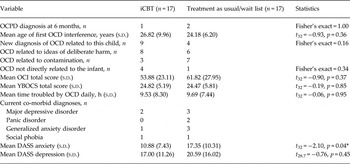
The three groups did not significantly differ in terms of mean age (iCBT 32.4 v. TAU 32.7 v. HC 34.6 years); ethnicity (iCBT 82% v. TAU 88% v. HC 84% white); education (iCBT 65% v. TAU 70% v. HC 95% to degree level or above); with a partner (iCBT 100% v. HC 100% v. TAU 98%); parity (iCBT 65% v. TAU 59% v. HC 51% first-time parents); and child gender (iCBT 53% v. TAU 47% v. HC 51% male) (all p > 0.8). Baseline clinical characteristics of the two OCD groups are presented in Table 1. All five mothers reporting current major depressive disorder had a history of depression prior to this pregnancy; three had experienced previous postnatal depression (1/2 in iCBT group and 2/3 in TAU group). All mothers considered OCD to be their primary problem.
Baseline maternal clinical characteristics of the two OCD groups

OCD, Obsessive–compulsive disorder; iCBT, intensive cognitive–behaviour therapy; OCPD, obsessive–compulsive personality disorder; s.d., standard deviation; OCI, Obsessive Compulsive Inventory; YBOCS, Yale–Brown Obsessive–Compulsive Scale; DASS, Depression, Anxiety and Stress Scale.
* p < 0.05.
The TAU group was significantly higher in dimensionally measured anxiety on the DASS scale. Otherwise, the two clinical groups were well matched. In the HC group the mean DASS anxiety scale was 1.24 (s.d. = 1.79) and depression was 1.78 (s.d. = 2.8). In addition, in the HC group one woman had a specific phobia and one person had generalized anxiety disorder.
Procedure
At the initial contact the study rationale and procedure were explained. If these were acceptable the diagnosis of DSM-IV OCD was then confirmed using the SCID and other exclusion criteria were disconfirmed. Baseline assessments took place in the participants’ homes when their babies were 6 months old (± 2 weeks). This comprised a clinical interview including demographics, symptoms and parenting variables. Dyads were videotaped in three ‘everyday’ interactions. These were: (i) a solid feed; (ii) a nappy change; and (iii) play (firstly without any toys and then with toys provided by the researcher). Up to 8 min of tape were rated in each situation. At 12 months, dyads were filmed in a feed, nappy change and then freeplay followed by a set sequence of toys (shape sorter, stacking rings, soft horse puppet, hammerballs) with 3 min of play recorded for each.
Ratings of maternal sensitivity and cooperativeness/intrusiveness were made on a 1–9 scale using Ainsworth's definitions and descriptions (M Ainsworth, unpublished scales). Maternal warmth during interactions was rated using a 1–9 scale. Maternal vocalizations to the infant were time-sampled every 15 s. A novel code of ‘overconscientiousness’ was devised to capture observable rituals or excessive behaviours designed to prevent harm, e.g. excessive use of wipes. This was rated globally as present/absent. Interactions were coded by a graduate psychologist (E.L.W.) trained in the coding system and blind to the mother's clinical status. A second rater (F.L.C.) coded 10 randomly selected tapes of mothers. Intraclass correlations were: 0.93 for sensitivity; 0.71 for cooperation; 0.81 for warmth. Percentage agreement for vocalizations was 94% and for over-conscientiousness was 90%.
Questionnaires were completed prior to the assessment. Mothers were given £30 for each completed assessment as a token of thanks for their time. A further similar home-based assessment took place when the baby was 12 months old. After this, mothers were then invited to come to the research centre to complete the Strange Situation Procedure (Ainsworth et al. Reference Ainsworth, Blehar, Waters and Wall1978), which consists of eight episodes, including two brief separations from and reunions with the mother. Attachment group classification was assigned using the traditional ABC criteria, based primarily on the infant's reactions to the mother's return (Ainsworth et al. Reference Ainsworth, Blehar, Waters and Wall1978), with the tape then rated in its entirety for disorganized (D) behaviour which potentially yields a further insecure category. The first author (F.L.C.) has been trained to reliability in administration and coding of this measure.
A random sequence of the two treatment categories was generated in blocks of six (www.randomization.com). A person unconnected with the study sealed cards with each category in numbered individual envelopes. The researchers and participants were blind to group allocation until the envelope was opened at the end of the baseline assessment. The outcome/12-month assessment was conducted by a researcher who was blind to group allocation and was not in any way involved in the therapy (J.R., R.A.). Video coding of interactions was conducted by a further researcher blind to group (E.L.W.). Following the outcome assessment, mothers in the TAU group were offered iCBT.
Time-intensive CBT (iCBT)
Participants received 12 h of face-to-face individual iCBT, typically delivered in four sessions of 3 h, with the sessions taking place over a 2-week period. Up to three follow-up sessions of 1 h were offered at monthly intervals, with participants taking these up as they preferred.
iCBT was predominantly delivered by the first author (F.L.C.) who is a qualified clinician, who received ongoing supervision in CBT for OCD for the duration of the study. During the course of the research, three of the 31 cases seen for iCBT were treated by two other qualified CBT and experienced therapists specializing in OCD and familiar with the design and protocol of the study. Two of these were in the iCBT group and one was in the TAU group and seen as a crossover case after the outcome assessment. One mother in the iCBT group did not complete treatment but did complete assessments and was included in all analyses.
TAU
Between 6 and 12 months postpartum in the TAU group, 6/16 (37.5%) women received some CBT, five of whom described it as ‘helpful’ or ‘partly helpful’. A further three had received other psychological input (a mindfulness group for one mother and general counselling for two mothers). Eight mothers in the CBT group and 10 in the TAU group were on psychotropic medication of various types between 6 and 12 months postpartum. Two TAU mothers received no specific treatment during this period.
Medication use
Medication use was not an exclusion criterion. Seven of 17 (41%) mothers in the iCBT group were on medication [serotonin–norepinephrine reuptake inhibitors (SNRI) (2); selective serotonin re-uptake inhibitors (SSRI) (4); SSRI + antipsychotic augmentation (1)] compared with 11/17 (64%) in the TAU group [SSRI (10); SSRI + antipsychotic augmentation (1)]. All medications were at stable dose for 2 months prior to, and throughout the 6 months’ study period.
Ethical standards
All procedures contributing to this work comply with the ethical standards of the relevant national and institutional committees on human experimentation and with the Helsinki Declaration of 1975, as revised in 2008.
Results
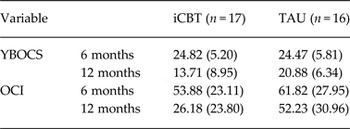
Maternal symptomatology (Table 2)
In order to test the effect of treatment on YBOCS scores, a mixed-model ANOVA with time as the repeated factor and group as the between-group factor was conducted.
OCI and YBOCS scores at 6 and 12 months in iCBT and TAU groups

Data are given as mean (standard deviation).
OCI, Obsessive Compulsive Inventory; YBOCS, Yale–Brown Obsessive–Compulsive Scale; iCBT, intensive cognitive–behaviour therapy; TAU, treatment as usual.
A significant main effect was found for time (F 1,31 = 58.4, p < 0.001), but not group (F 1,31 = 2.37, p = 0.13). Results indicated a significant group × time interaction (F 1,31 = 16.2, p < 0.0001). The mean YBOCS reduction in the CBT group was 48.4% (s.d. = 25.2) and in the TAU group was 12.8% (s.d. = 22.6), which represented a significant difference (t 31 = 4.27, p < 0.0001). This represents a between-subjects effect size of Cohen's d = 1.32 (adjusted according to Cohen, Reference Cohen1988) using 12-month YBOCS total scores and pooled pre-treatment standard deviations. According to the criteria of Tolin et al. (Reference Tolin, Abramowitz and Diefenbach2005), a 30% change on the YBOCS is considered clinically meaningful. This occurred in 12/17 of the CBT group and 3/16 of the TAU group, which represented a significant difference (Fisher's exact test, p = 0.005). The mean percentage OCI improvement in the CBT group was 54.45% (s.d. = 35.62) and in the TAU group was 14.77% (s.d. = 23.37) which was significant (t 32 = 3.84, p = 0.001). This represents an effect size of Cohen's d = 1.90 using end OCI total scores and pooled pre-treatment standard deviations.
Change in general anxiety using the anxiety subscale of the DASS was analysed using repeated-measures ANOVA and there was a main effect of time (F 1,32 = 19.4, p < 0.0001) and group (F 1,32 = 8.53, p = 0.006), reflecting the initial difference in scores, but no significant time × group interaction (F 1,32 = 0.53, p = 0.47). Similar results were found for changes in the DASS depression subscale with a main effect for time (F 1,32 = 23.54, p < 0.0001) but not of group (F 1,32 = 2.15, p = 0.15) and no interaction (F 1,32 = 1.54, p = 0.22). Therefore treatment did not have a statistically significant effect on the change in general anxiety and depression scores.
Change in the Self-Efficacy Scale was examined using repeated-measures ANOVA but no main effect was found for time (F 1,32 = 1.38, p = 0.25) or group (F 1,32 = 0.67, p = 0.42) and there was no interaction (F 1,32 = 0.48, p = 0.49). Similarly there was no main effect of time on the GRIMS marital satisfaction measure (F 1,32 = 1.03, p = 0.32), no main effect of group (F 1,32 = 0.16, p = 0.69) and no time × group interaction (F 1,32 = 1.64, p = 0.21).
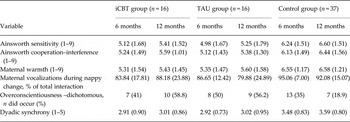
Mother–infant interactions (Table 3)
Video data were available for 16 mothers in each clinical group and all 37 HC mothers.
Interaction ratings at 6 and 12 months in the three groups across the three tasks

Data are given as mean (standard deviation) unless otherwise indicated.
iCBT, Intensive cognitive–behaviour therapy; TAU, treatment as usual.
In order to examine the impact of treatment on interactions, an omnibus ANOVA (2 × 2 × 3 mixed model) was used to examine differences in Ainsworth scale scores (sensitivity and cooperation–interference) over time, between the two clinical groups and over different parenting tasks. There was a third-order interaction between time, scale and task (F 2,60 = 5.541, p = 0.006) indicating that the tasks at different infant ages elicited different levels of sensitivity and cooperation/intrusiveness. There were no other third-order interactions and there was not a fourth-order interaction, indicating that treatment group membership had no effect at either time point on sensitivity or cooperation/interference in any task. A similar pattern was found for maternal warmth.
Overconscientious behaviour was identified at very similar rates at 12 months in the clinical groups: 10/17 of mothers in the CBT group and 8/16 in the TAU group (Fisher's exact = 0.732). However, this was twice as common as in the HC group (7/37).
One-way ANOVAs carried out as simple main effects were significant for comparisons of 12-month sensitivity (F 2,69 = 5.694, p = 0.005), cooperation (F 2,69 = 4.221, p = 0.019), warmth (F 2,69 = 5.379, p = 0.007) and overconscientiousness ratings (χ2 = 0.001). Post-hoc testing revealed that HCs differed from both OCD groups at 12 months, and the OCD groups did not differ in each case.
Vocalizations during nappy change differed between the HC and TAU groups at 6 and 12 months (p < 0.05). The clinical groups did not differ at 12 months (F 2,69 = 2.16, p = 0.123) in terms of maternal vocalizations during nappy change.
There were no between-group differences in the ITQ at 6 or 12 months.
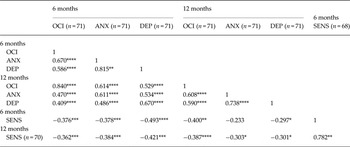
Both 6-month and 12-month interaction data indicated differences between mothers with and without OCD in terms of sensitivity and psychopathology. The correlation matrix (Table 4) indicates relationships between the continuous variables at 12 months.
Correlation matrix for sensitivity and maternal mood variables at 6 and 12 months

OCI, Obsessive Compulsive Inventory total score; DASS, Depression, Anxiety and Stress Scale; ANX, DASS anxiety; DEP, DASS depression; SENS, sensitivity.
Pearson correlations: * p < 0.05, ** p < 0.01, *** p < 0.005, **** p < 0.0001.
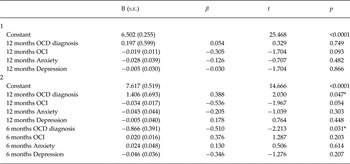
In light of the strong effects for sensitivity and for mood reported in Table 4, a hierarchical regression analysis was performed to examine the contribution of anxiety, depression and obsessional distress and diagnostic status to sensitivity scores at 12 months for the whole sample. Three variables were entered into the model: DASS anxiety, DASS depression and OCI total scores in two blocks. Twelve-month scores were entered as block 1 and 6-month scores were entered as block 2. Twelve-month sensitivity score was the dependent variable (Table 5).
Regression table for maternal sensitivity at 12 months

s.e., Standard error; OCD, obsessive–compulsive disorder; OCI, Obsessive Compulsive Inventory.
* p < 0.05.
This analysis indicated that only the 12-month OCD diagnosis was significant over and above the other variables in the first block. Both regression models were significant, indicating an effect of ‘maternal distress’ on sensitivity (12 months: F 4,66 = 2.753, p = 0.035, and 6 plus 12 months: F 8,66 = 2.870, p = 0.009). The 12-month variables accounted for 9% of the variance (adjusted R 2), rising to 17.6% (adjusted R 2) with the addition of the 6-month scores which was significant (R 2 change = 0.127, F 4,62 = 2.702, p = 0.038).
The finding suggests that having a diagnosis of postpartum OCD, even if it is not current, is an important predictor of current sensitivity in interactions.
Attachment
The groups did not differ in terms of the distribution of attachment categories, with 23/32 (71.8%) classified as secure in the HC group, against 10/14 (71.4%) in each of the iCBT and TAU groups. Three of 32 (9.4%) were avoidant in the HC group v. 3/14 (21.4%) in both clinical groups. Four out of 32 (12.5%) were anxious-resistant in the HC group against 1/14 (7%) in the iCBT group and 0/14 in the TAU group. Two (6.3%) were disorganized in the HC group against 0 in the iCBT group and one in the TAU group.
Discussion
This study indicates that intensive CBT is an effective treatment for postpartum OCD, with a controlled effect size on the primary measure, the YBOCS (1.32) similar to that of a recent meta-analysis of CBT for OCD against wait-list controls (1.31; Öst et al. Reference Öst, Havnun, Hansen and Kvale2015). The low dropout rate suggests that iCBT was particularly acceptable to mothers who may show a preference for psychological treatments over medication (Pearlstein et al. Reference Pearlstein, Zlotnick, Battle, Stuart, O'hara, Price, Grause and Howard2006; Arch, Reference Arch2014). However, iCBT did not fully ameliorate depressive and general anxiety symptoms which changed to some degree in both treated and untreated groups. Marital satisfaction and self-efficacy remained unchanged and remained lower than in the HC group. Furthermore, treatment status was not associated with changes in mother–infant interactions, consistent with findings in postpartum depression (Milgrom et al. Reference Milgrom, Ericksen, Mccarthy and Gemmil2006; Gunlicks & Weissman, Reference Gunlicks and Weissman2008). Analysis of this sample at 6 months indicated that depression was associated with less sensitive interactions (Challacombe et al. Reference Challacombe, Salkovskis, Woolgar, Wilkinson, Read and Acheson2016). At 12 months depression was no longer an independent predictor of sensitivity and diagnosis of OCD at 6 and 12 months became significant. The regression was significant and a composite factor of maternal distress may have led to less sensitive interactions. This mirrors the findings of Tietz et al. (Reference Tietz, Zietlow and Reck2014) that maternal depression and avoidance affected bonding rather than anxiety disorders per se. Additional treatment targeted on residual symptoms of depression and anxiety, marital relationships and/or targeted on mother–infant interactions may therefore be warranted. In tandem with this finding, ‘overconscientious’ interactions were more prominent at 12 months in the clinical groups, suggesting that the developing infant may be presenting different challenges for mothers with OCD. Longer-term longitudinal research is required to examine this possibility.
Attachment was unaffected by postpartum OCD in this sample, as was the case with a previous study of mothers with panic disorder which also found differences in sensitivity (Warren et al. Reference Warren, Gunnar, Kagan, Anders, Simmens, Rones, Wease, Aron, Dahl and Sroufe2003). The current study differed from the findings of Manassis et al. (Reference Manassis, Bradley, Goldberg, Hood and Swinson1994) whose sample included three women with OCD, but primarily consisted of women with panic disorder. The children in that study had a wide age range (18–59 months), necessitating the use of two parallel coding systems which may have affected reliability. Alternatively, the difference could be due to potentially longer exposure to aspects of maternal anxiety that limited family functioning and had a greater effect as the infant developed. Previous research has found that sensitivity only explains some of the variance in predicting attachment categories (De Wolff and van Ijzendoorn, Reference De Wolff and van Ijzendoorn1997). Therefore, although maternal sensitivity was compromised, either it may not be the primary mechanism for developing secure attachment, or it may not have been compromised enough to make a difference. Alternatively, or in addition, there may be a buffering effect from other aspects of the mother–infant relationship. If OCD is a problem (for many, if not all sufferers) of inflated responsibility and over-care, it is consistent with this that whilst aspects of the symptoms may interfere with the ability to be sensitive, the underlying affective bond remains intact. That is, whilst mothers with OCD may be afraid of their own symptoms or hyper-alert to signs of threat to their infant, their experience of the infant themselves is not threatening or disconcerting (Hesse & Main, Reference Hesse and Main2006). Sensitivity in this sample was ‘inconsistent’ rather than ‘insensitive’; at the times when mothers are sensitively attuned, the infants are likely to be comforted and reassured.
Limitations of the study were a small and largely self-identified sample. It would not have been ethical to preclude mothers in the comparison group from receiving treatment which included some sessions of CBT. However, the effect size for iCBT in comparison with TAU was large. About half of the sample was on medication which may have affected outcomes. Mothers in this study were on a wide range of medications, some reluctantly due to concerns about the impact on breast milk. The role of concurrent medication use should also be investigated in order to determine the most effective management of postpartum OCD for mothers and infants.
Just over one-third of mothers in this study had OCD with onset related to this pregnancy, and these mothers with less longstanding problems may have benefitted more from treatment. Similarly, concurrent or historical postnatal depression may have affected key outcomes. Future research with larger samples could examine the challenges presented by particular subtypes of OCD for parenting and allow better examination of predictors of treatment response as well as longer-term follow up. In terms of feasibility, it was clear that intensive treatment of this kind was particularly acceptable, and has the advantage of being rapidly deliverable. This may be especially important as there is evidence of both onset and worsening of OCD during the perinatal period, leading to concerns about the mothers’ ability to cope. Comparison of iCBT with regular (non-intensive) CBT for OCD should now be carried out.
Acknowledgements
This study was funded by a Peggy Pollak Research Fellowship to F.L.C. from the Psychiatry Research Trust, Institute of Psychiatry, Psychology & Neuroscience. Thank you to the Psychiatry Research Trust for funding this project. Thanks go to Dr Victoria Bream, Dr Abi Wroe, colleagues at the Centre for Anxiety Disorders and Trauma, colleagues at the Institute of Psychiatry, Psychology & Neuroscience, OCD charities OCD-UK, OCD Action, Anxiety UK and Maternal OCD. We express enormous gratitude to all the participants.
Declaration of Interest
None.