Background and Introduction
There is widespread concern within Australia about the marked discrepancies in the health, development, wellbeing and educational outcomes of AboriginalFootnote 1 children compared with their non-Aboriginal counterparts (Australian Institute of Health and Welfare, 2012; Australian Research Alliance for Children and Youth, 2013). Of particular concern is the significant over-representation of Aboriginal children in substantiated reports of abuse and neglect (Australian Institute of Family Studies, 2015), and the high levels of developmental vulnerability evident at school commencement (Australian Government, 2013). These inequities stand as evidence of the intergenerational impact of past policies that disrupted cultural and family connection for many Aboriginal people (Burns, Burns, Menzies, & Grace, Reference Burns, Burns, Menzies, Grace, Bowes, Grace and Hodge2012; De Maio et al., Reference De Maio, Zubrick, Silburn, Lawrence, Mitrou, Dalby and Cox2005) and restricted their education (Burridge & Chodkiewicz, Reference Burridge, Chodkiewicz, Burridge, Whalan and Vaughan2012). They also reflect the ongoing experience of exclusion, cultural insensitivity and disrespect for Aboriginal ways of knowing that has often characterised the engagement of Aboriginal people with mainstream child and family services (Harrison & Greenfield, Reference Harrison and Greenfield2011; Menzies & Gilbert, Reference Menzies, Gilbert, Bennet, Green, Gilbert and Bessarab2013).
The early childhood years represent an important window of opportunity to set children on a life course that will prepare them well for the years that follow (Cunha & Heckman, Reference Cunha and Heckman2010; Shonkoff & Phillips, Reference Shonkoff and Phillips2000). A strong body of research evidence points to quality early childhood education as an effective form of early intervention for children who experience disadvantage (Lynch, Reference Lynch2005; Sylva, Melhuish, Sammons, Siraj-Blatchford, & Taggart, Reference Sylva, Melhuish, Sammons, Siraj-Blatchford and Taggart2010). There have been a number of initiatives across Australia that have demonstrated the value of early childhood education settings for Australian Aboriginal children. For example, the Schools as Community Centres programme in NSW was found to potentially benefit Aboriginal children in their learning, social development and engagement with school transition programmes (Department of Education and Communities, 2012); and the Foundations for Success programme in Queensland supported early childhood educators in the implementation of the Early Years Framework with Aboriginal children and families (Perry, Reference Perry2011).
Zubrick and colleagues (Reference Zubrick2006) argued that engaging Aboriginal parents and care givers as educators in the early years of their child's life is essential to a positive relationship between home and school settings, and to the educational achievement of the child. One of the challenges early childhood education settings face is engaging Aboriginal families (Trudgett & Grace, Reference Trudgett and Grace2011). Over recent years, we have seen a significant increase in the enrolment of Aboriginal children in early education services, particularly in rural and remote areas when these services are available; nevertheless, Aboriginal participation remains lower overall than for non-Aboriginal Australians (Hewitt & Walter, Reference Hewitt and Walter2014).
Home visiting and playgroup programmes form an important part of the landscape of services available to support positive early childhood outcomes for Aboriginal families where they are available locally and have successfully engaged the Aboriginal community in a safe and culturally appropriate way. These services, which are shaped to the needs of individual families or small groups of families, potentially reach those reluctant to engage with more formal programmes and support the development of parenting skills, and knowledge of community services. An important component of both home visiting and playgroup services is their focus on supporting parents to positively scaffold their child's early learning and development. Beyond the immediate value they bring to families and children, they may serve as ‘soft entry points’ or a bridge to formal education and other family support services (ARTD Consultants, 2008; Johnston & Sullivan, Reference Johnston and Sullivan2004).
One example of a home visiting programme is HIPPY (Home Interaction Program for Parents and Youngsters), which is delivered in the 2 years before formal schooling. HIPPY has demonstrated effectiveness in supporting improved child outcomes relating to social development, early learning and positive school transition (Liddel, Barnett, Roost, & McEachran, Reference Liddell, Barnett, Roost and McEachran2011). An example of a playgroup programme designed for Aboriginal families is the Families as First Teachers (FaFT) programme, which is delivered in the Northern Territory, primarily in remote sites (Abraham & Piers-Blundell, Reference Abraham and Piers-Blundell2012), based on the Abecedarian early childhood education approach, which includes parenting information and support (Ramey, Sparling, & Ramey, Reference Ramey, Sparling and Ramey2012; Sparling, Reference Sparling2011). The Best Start Playgroup programme from Mungullah in Western Australia is another example of a playgroup model. Best Start used short DVDs to share parenting information, based on what was identified by those attending the playgroup as important to them (Lee & Thompson, Reference Lee and Thompson2007).
This paper describes the development and evaluation of a structured, early parenting education programme for Aboriginal families as a collaborative project between Barnardos Australia, a non-government organisation that works to support the most disadvantaged families, and researchers from Macquarie University. This programme was implemented in a remote community in New South Wales with very limited children's services, and no early childhood education and care services for children in the birth to three age range. It was delivered as part of a supported playgroup for Aboriginal families already in operation and available as part of a continuum of services provided to local families.
New highly structured resources were developed based on the Parents as Teachers (PAT) home visiting programme, an evidence-based early intervention and prevention programme designed for parents of children aged from birth to 3 years and built on child development theory (Wagner, Iida, & Spiker, Reference Wagner, Iida and Spiker2001; Wagner, Spiker, & Linn, Reference Wagner, Spiker and Linn2002). The PAT evidence base is comprised of large studies, including randomised-controlled trials, primarily conducted in the United States (McCabe & Cochran, Reference McCabe and Cochran2008; Pfannenstiel & Zigler, Reference Pfannenstiel and Zigler2007). An Australian evaluation of the PAT programme within the mainstream service system also demonstrated positive outcomes for children and families (Watson & Chester, Reference Watson and Chesters2012). The appropriateness of PAT for the Australian Aboriginal community has not been explored in research previously, including the extent to which programme adaptation is required to ensure responsiveness to local need and cultural context (Bowes & Grace, 2014). Many of the Barnardos staff members had previously been trained in the PAT foundation curriculum, and had found the PAT approach to be impactful in their practice, and easily adapted to suit the needs of families and local context. The strength of the existing PAT evidence-base, combined with positive practice experiences and easily adapted PAT resources, provided a strong foundation on which to develop a programme specifically for Aboriginal families who had been identified as vulnerable.
The project was guided by two key aims: (1) to utilise materials and resources from the PAT programme, adapted to be culturally appropriate, as the basis for a structured parenting education programme to be delivered in an existing supported playgroup for Aboriginal families of children aged birth to 3 years in a rural/remote area; and (2) to assess the acceptability of, and satisfaction with, the programme from the perspectives of the families who attended the programme and of the early childhood educator and local facilitators who delivered it. Programme development and emergent findings from the evaluation are described below.
Development of Parenting Programme Modules and Resources
Planning for this project included consultation with Barnardos staff and Aboriginal community members from the trial site. The support of the local Aboriginal Advisory group was essential for community acceptance of the new programme and for ensuring that the programme was implemented in a culturally appropriate way. The programme needed to be tailored to meet the needs of Aboriginal families from disadvantaged backgrounds, mostly with low literacy levels and who were not familiar with nor accessing any other early childhood education services.
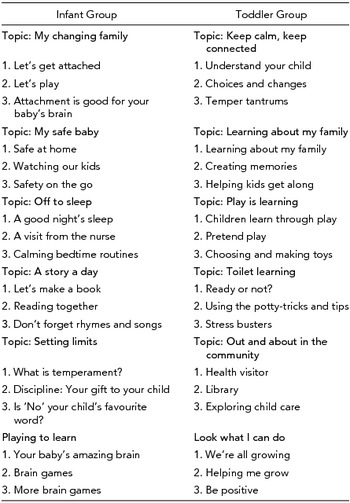
Decisions were made about the topics that would best support family functioning and child development for families of infants (birth to 18 months) and families of toddlers (18 months to three years) based on PAT materials for parents and parent educators, discussions with Barnardos staff, and discussions with Aboriginal community members. Through this consultation process, six topics for each age group were identified as being topics of common concern for parents. Three sessions were developed for each topic. The topics and their sessions are listed in Table 1 above.
PAT-based parenting topics and sessions for an Aboriginal playgroup.

The parenting sessions were run by an early childhood educator, and two Aboriginal trainees who were local women undertaking a Certificate III in Children's Services. All three facilitators were trained in the PAT foundation curriculum, but requested clear and ready to use programme modules for the group parenting programme. Programme module running sheets were accompanied by easy to read, short background reading materials for the facilitators to help increase their confidence and knowledge of each topic. In addition, on-site training was provided by the Macquarie University team, including an Aboriginal trainer with extensive experience in the professional learning of Aboriginal and non-Aboriginal early childhood educators, to prepare facilitators to run the parenting programme. The training group participated in hands-on and role-playing activities as well as in-depth discussions to reinforce their understanding of the concepts in each topic, how to choose appropriate materials and activities, how to set up eye-catching displays for the parents and how they could support the collection of the satisfaction survey parents would be asked to complete after each session for the duration of the trial. All of the participants in the training provided very positive feedback on both the programme materials and on the value of the training provided.
A pre-programme engagement and familiarisation process, to which families were invited to attend supported playgroup sessions once a week, ran for two school terms prior to the commencement of the PAT-based parenting programme. Families were provided transport to the playgroup if this was necessary. ‘Bring a friend’ incentives such as gifts of self-care items and meat vouchers were offered to parents and this in turn helped spread the word about the group. At the end of the school year, all PAT families were given family swimming passes for the local pool.
The PAT-based structured parenting programme was then offered for 3 days per week, a level of intensity thought to be appropriate to supporting positive parenting change. One of the three sessions took a very structured form, involving presentation of the topic, engaging parents in discussion and introducing key parenting messages. Videos, posters, books and other resources were used as appropriate. All of the sessions included child–parent activities that reinforced the focus topic of the week and could be easily replicated at home, further group discussions, play activities and a healthy morning tea. Two sessions per week were held at the Barnardos office where parents could also access other support if needed. One session each week was held at the local preschool with a view to familiarising parents with the preschool and potentially increasing their interest and comfort with enrolling their child once they had turned 3 years of age. Many of the families were also engaged with a family support case management service that targets families with children at risk of entering the child protection system. Attending the parenting group sessions provided these families with an opportunity to talk with their family support worker and/or access facilities such as the telephone to contact Centrelink income support and make medical appointments, or use the photocopy machine, etc. Thus, the parenting and playgroup sessions formed part of a continuum of support for these families.
Parent handouts using graphics or photos and easy to understand language were also developed to remind parents of the key points for each topic and offer suggestions for things they could do with their child at home. The local Aboriginal advisory committee and Barnardos staff supported the research team in reducing the number of handouts and simplifying them, so that they contained one photo and one message and were presented in a way that was fresh, culturally affirming and visually engaging for families with young children. The photos were all of local supported playgroup families (with their permission), engaged in activities with their children that supported their development. The photos were taken by Barnardos staff during the playgroup sessions that preceded the pilot parenting programme. In this way, the parent handouts were very personal to the group, and reinforced the positive things they were already doing with their children. Parent information and handouts were revised multiple times to ensure that complex child development information, such as information about brain development, was communicated in a way that could be easily understood by parents with low levels of literacy. After discussion with the CEO of the local Aboriginal Lands Council, it was decided that use of Aboriginal language on the parent handouts would not be advisable. The local Aboriginal community was made up of people from a variety of language backgrounds and there was not universal knowledge of language in families. A Facebook page for the group was also set up to support the sharing of information and the development of friendships.
Methods
Participants
Parents
The structured parenting programme attracted 25 Aboriginal families, comprising 38 children. For 16 families, the mother attended the session with her child or children. In one family, both the mother and father attended. For nine families, children were sometimes brought to the group by carers or by other mothers or grandmothers. The mean age of the parents was 26 years with a range from 19 to 45 years.
Children attending the sessions were mainly in the targeted age group of birth to 3 years; however, 12 children over this age attended sessions with their younger siblings on days when they were not at preschool or school. The mean age of the 26 children in the birth to 3 years age group was 17.7 months with a range of 1 month to 36 months. There were 18 girls and 8 boys who attended in the targeted age group. Many families had an irregular pattern of attendance. The average number of children in each session was 11 and the average number of parents/carers was 7.
Staff
Four members of the Barnardos team participated in telephone interviews with a member of the research team: the early childhood educator who ran the parenting education sessions; two Aboriginal trainees who helped facilitate the group and the on-site Barnardos manager who took part in the training and acted as a joint facilitator in some of the parenting sessions.
Measures
The evaluation employed a survey design, in which families completed an evaluation form including closed- and open-ended questions at the end of every session they attended. Parents also participated in a feedback session. A qualitative approach was taken to gather staff perspectives of programme impact and implementation.
Family survey
The evaluation form contained seven statements to which parents were asked to respond on a 3-point scale where 0 indicated Disagree or No, 1 indicated ‘Sort of’’ and 2 indicated Agree or Yes. The local Aboriginal advisory group had suggested that we use images to increase the ease of form completion for parents with low literacy levels, and so we included a graphic of thumb down for response 0, thumb sideways for response 1 and thumb up for response 2. The seven statements all related to whether or not participant parents felt they had benefitted from the playgroup session that day, and the extent to which it supported their connections with other parents. At the end of the form, there were two open-ended questions: ‘The thing I liked best about today was . . .’ and ‘I would like to know more about . . .’.
The parent feedback session was guided by four questions: What do you think about this programme? Has it benefitted your family? What is working well? What could we do better?
Staff interviews
Staff observations of parent response to the sessions and their own experiences in implementing the structured parenting education sessions were sought in telephone interviews conducted by a member of the research team. The main parenting programme facilitator also provided extensive notes on how each session had been modified on the day, according to the needs of the participants.
Procedures
Families
At the end of each of the first ten parenting sessions in the trial, participating parents completed the evaluation forms.
Staff
Telephone interviews took place at the end of the 10-week trial period.
Ethics
Ethics approval for this study was secured through the Macquarie University Human Ethics Committee. All of the parents in the group provided informed consent. Results of the evaluation were presented verbally to the participating families and to the Aboriginal advisory group. A formal research report was provided to Barnardos, and made available in the local area for all interested in reading it.
Analysis
A descriptive analysis of survey findings was conducted. This was appropriate due to small participant numbers. Qualitative responses from parents to open-ended survey questions and from the parent feedback session were also coded descriptively. The parents gave quite short and direct responses to the questions being asked, and did not include the depth of explanation that would be required for a thematic analysis. An inductive thematic analysis (Braun & Clarke, Reference Braun and Clarke2006) was, however, conducted for the qualitative data gathered in staff interviews.
Results
Family Reflections on the Value of the PAT-Based Parenting Programme
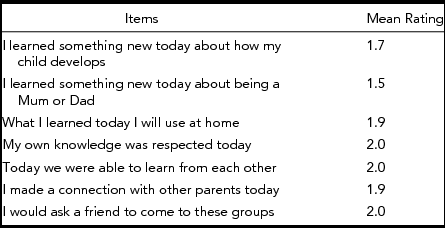
Seventy-one percent of parents completed an evaluation form after eight of the sessions. As can be seen in Table 2, most statements attracted a Yes or thumbs up rating, leading to mean ratings of 1.5 or higher out of 2 (where 0 = No or Disagree, 1 = sometimes and 2 = Yes or Agree).
Mean parent ratings of items on the evaluation form.

In response to the open-ended question asking what participants enjoyed most about the session that day, responses were very specific to the activities they engaged with (e.g., ‘I enjoyed doing crafts with the children’), suggesting that parents most valued the hands-on learning sessions. Responses also suggested that parents appreciated the general parenting messages from the session (e.g., ‘I learnt that all kids are different and it doesn't matter as long as they are healthy’), and enjoyed the guided opportunity to watch their children learning through play and interacting with other children (e.g., ‘I liked watching my son have fun and talk to the other kids’). As the sessions went on, parent responses focussed less on watching their child, and more on learning how they and their child could enjoy activities together (e.g., ‘I didn't think it would be so good to do art work with my daughter’).
Responses to the question about what parents would like to know more about generally focussed on a desire to extend their knowledge of child development (e.g., ‘I want to know more about how to help my child with their speech’), or of strategies to support better behaviour or health (e.g., ‘How do I get my kids to try new foods?’).
There were five key issues that were raised in the group feedback session:
-
1. The programme was well liked and perceived as valuable by the participating families (e.g., ‘I know more about my baby's brain’).
-
2. The families felt very comfortable with the parenting programme facilitators who ran the group, and did not like the idea of bringing in unfamiliar guest speakers (e.g., the early childhood nurse) to talk to them about particular topics, as had been originally planned. They felt that having ‘outsiders’ come into the group would compromise the safety and comfort they felt there: ‘We don't need outsiders telling us what to do’.
-
3. The families requested that, instead of having visitors to the parenting sessions, more community information could be put on the group's Facebook page, e.g., what days you can visit the Early Childhood Nurse and what family events are happening in town.
-
4. They reported that they tried the activities and practised the things they learned when they were at home (e.g., ‘We made a book about healthy food’).
-
5. They did not want the sessions to stop during the school holidays. The families requested that play sessions continue throughout the school holidays.
Staff Reflections on the Value of the PAT-Based Parenting Programme
There were seven key themes that were identified in the telephone interviews with staff members. Six of these related directly to families and included family attendance, family engagement in activities, the development of friendships and other changes in parents over the course of the parenting sessions. One of the themes related to the opportunities the programme facilitated in terms of increasing collaborative relationships between the continuum of Barnardos and other local services, and another to broader community effects. The final theme related to the capacity building that had occurred for the Aboriginal trainee facilitators as a result of their involvement in implementation of this programme.
Attendance
Staff reported that a core of five families attended the thrice-weekly playgroup sessions consistently. Other families attended consistently one or two days per week, or on an ad hoc basis. An average of 10 families attended each session (range of 8 to 18 families in any one session). The number of participating families grew to 25 over the course of the programme. One mother brought three new families to the playgroup and another brought in two. All families present at a session were invited to participate in the study and complete an evaluation form. The two Aboriginal trainee facilitators, contemporaries of many of the mothers, promoted the programme to new families ‘down the street’ and this also led to new families joining the parenting sessions over time.
Engagement in activities
Staff reported that for the first few sessions, parents seemed reluctant to engage in activities with their children. They tended to stand back and either watch staff members working with the children, or talk to other parents whilst their children played. Some mothers in the early sessions resisted the facilitator's attempts to have them move to where they could observe their child playing. For example, one mother refused to move to a chair next to the sand-pit where her child was playing, saying that she disliked the feel of the sand. After the first two or three sessions, this changed to more parent observation of their children at play and finally, towards the end of the sessions, to hands-on engagement in parent–child activities, a key component of the parenting sessions.
Staff also reported that for the first two sessions, when the child development information was being discussed, parents were ‘talking it up, laughing it up’ whilst the facilitator spoke. The facilitator talked to them about the group and the need to refocus on the children and keep the group strong. The group agreed on a set of guidelines that included no talking on the phone, being positive, eating healthy food and using the hats and water bottles that Barnardos had purchased for the children. From the next session onward, parents were attentive. In the facilitator's words, ‘they realise this is serious, good information and are listening more’. The parents responded well to discussion starters in which the facilitator respected them as experts, such as ‘When babies come home from hospital, what sort of things are they able to do?’
Development of friendships
The trainees pointed out that many of the parents already knew one another from school. The early childhood qualified facilitator saw the strong friendship links as a strength of the group. Quite a few parents brought friends’ children to the sessions or looked after them during the sessions. Some mothers told the facilitator that this was the only thing that they came to ‘so it is really important for them [the children] to socialise’. The programme manager said that the parents were all using the programme's Facebook page and were making friendships through Facebook. Participants were invited to attend the Bush Mobile Christmas party and some of the parents went together to this event. The facilitator also reported that during the structured PAT-based parenting sessions children were forming friendships beyond their sibling groups. She reported they were bonding as a group, far more than they had previously.
Other changes in parents over the course of the parenting sessions
The facilitator and the manager reported that parents were not bringing cordial or soft drink for their children anymore, but filled the water bottles provided with water for their children instead (an early session included information on the importance of good nutrition for the growth of children's brains). Another change reported by the facilitator was a new interest in early childhood education. One mother told her ‘I wasn't going to send my child to preschool but now I think she'd enjoy it’. According to the facilitator, parents seemed to be calmer with their children at the end of the programme than they had been at the beginning. She had also observed that their way of talking to their children had changed. In the later sessions, she heard very little bad language or swearing. The facilitator had noticed a significantly improving relationship between one mother and her child in particular. Where this mother had previously not gone to her child when he was hurt, she now did so. The programme manager also noticed a growing confidence in the parents when they arrived at the parenting sessions. Whereas before some parents did not want to walk in the front door of Barnardos, they now walked in and greeted her as they passed her office.
Collaboration with the continuum of Barnardos and other local services
The programme manager discussed the importance of a partnership between the parenting education programme and the Bush Mobile, which meant that the programme staff could borrow rather than buy many toys, books and other resources for use with the children. An additional benefit was that the sessions had proved convenient for parents and the Barnardos caseworker, who would often meet together either before or after parenting sessions. For some families, the presence of the caseworker was instrumental in the early establishment of trust in the parenting programme. The facilitator mentioned that the sessions had also brought in new families to not only the group but to other Barnardos services.
Community effects
Before the programme commenced, there was an intention to bring community elders to observe and assist with playgroup sessions as a way to include community input and extend the reach of the information provided. The local trainees invited several community elders but, due to illness, they were unable to attend. Nevertheless, the Aboriginal trainees reported that they were talking about the programme in the community and that community members felt more comfortable receiving parenting information from them because they knew them. Staff members were excited to see that the parents were talking about the sessions and the things they had learned on the associated Facebook page.
Capacity building for the Aboriginal trainees
The two trainees reported how much they had learned through the PAT training, the parenting group training and from their experiences working with the parenting group. They were pleased that their role in the programme was ‘doing the whole lot’, rather than just having a specialised or helping role. They set up before each session, welcomed parents and children, looked after the children during morning tea, took photos for parents to put in their scrapbooks, and spoke to parents during all activities. Both reported that they planned to seek qualifications and subsequent employment working with children. The skills, competence and confidence of the trainees was evident in the arrangement Barnardos made for them to run play sessions on their own for families over the school holiday period that followed the 10-week pilot programme.
Discussion
Findings reported above indicate that the PAT-based parenting programme was perceived as being of benefit to the participating families, a group generally thought to be difficult to engage in early education and parenting services (Trudgett & Grace, Reference Trudgett and Grace2011). Families experienced the programme as respectful of them, and felt that their knowledge of child development and parenting skills were increased. Programme staff also reported that the programme had benefitted the participating families. They noticed changes in parent behaviour that they viewed as significant, such as parents engaging with and playing with their children when before they had been more distant, and a rapidly growing interest in the child development information being presented. The extension of the programme, at the insistence of parents, beyond the end of the trial to PAT-based play sessions run across the summer holidays, is a further indication that families valued the group and the parent–child activities that were part of the programme. It is interesting to note that, after the research pilot, the programme manager reported that all of the participating parents enrolled their child in the local preschool (where a group session had been held once a week) when they turned 3 years old, supporting the value of the group as a ‘soft entry point’ as discussed earlier (ARTD Consultants, 2008).
The workers also felt that they benefitted from their involvement in programme implementation. The early childhood educator who led the programme, and in particular the Aboriginal trainee workers who also facilitated the programme, reported personal and professional benefits associated with the child development and group session training provided by Macquarie University.
The success of the programme is underpinned by an evidence-based home visiting programme, PAT, adapted for a group setting and the local cultural context. The topics were chosen to be relevant to families of children in the birth to 3-year age range, and the hands-on nature of the learning was well received by the participating parents. Leadership of the group by a qualified and experienced early childhood educator supported by Aboriginal trainees who were members of the local community was very important to helping families view the playgroup as culturally safe and relevant to them. The workers delivered the programme in a creative and flexible way that was highly responsive to the needs of the families in the group. This programme was able to achieve the elements essential to the successful implementation of a programme for Aboriginal families, summarised by Bowes and Grace (Reference Bowes and Grace2013) as requiring ‘safe people’ (people known and trusted with appropriate skills), ‘safe place’ (conducted in a physical space that is comfortable to participants) and ‘safe programme’ (carefully reviewed in consultation with the local community to ensure cultural appropriateness). The impact of the programme would have been enhanced by the regular presence of community elders. This level of community involvement is something we hope to achieve in the future.
The programme evaluation was limited, and findings should be viewed as preliminary. The evaluation did not rigorously assess child and family outcomes, or systematically explore relationships between variables. This evaluation also did not produce in-depth qualitative or case study data. It marks the first phase of a research programme that will continue. This trial has led to further refinement of programme materials and, importantly, has demonstrated that the programme was well received by families and by programme staff. Future research will explore the process of roll-out of the programme to other Aboriginal communities, and the extent of further adaptation required to ensure that the programme is always meaningful within the local context. Future research will also explore family and child outcomes, specifically examining the effectiveness of programmes like this in supporting sustained changes to parenting and home environments, and leading to increased engagement with early childhood education and other child and family services along with decreased involvement with child protection services.
Conclusion
Rural and remote areas of Australia often experience significant disadvantage in the form of reduced access to services. A parenting programme conducted as part of a structured playgroup programme, such as the one described in this paper, potentially provides an important mechanism through which families can access quality information about parenting and child development, connect with families with children of the same age, and overcome barriers to participation in other early childhood and family support programmes. Existing evidence-based programmes, such as PAT, are important in guiding core programme elements and theoretical frames, so long as they allow for the flexibility to be adapted in line with local needs and culture.
Acknowledgements
Our thanks is extended to Barnardos Australia and to Mundipharma, a corporate partner of Barnardos, who provided funding to support this project. We also thank Althea Travis and Elizabeth Starr for their excellent work in the development of the session materials, and the Barnardos staff who brought great knowledge and enthusiasm to the trialling of the programme.