INTRODUCTION
Studies on parasitic isopods of marine fishes are still scarce due to the diversity of fish fauna in the coastal waters of Brazil. Many crustacean isopods are ectoparasites of fish and their infestation may affect the development, health and appearance of economically important fish species rendering their marketing difficult (Thatcher, Reference Thatcher, Salgado-Maldonado, Aldrett and Vidal-Martinez2000; Lima et al., Reference Lima, Chellappa and Thatcher2005; Thatcher et al., Reference Thatcher, Araújo, Lima and Chellappa2007; Costa & Chellappa, Reference Costa and Chellappa2010; Costa et al., Reference Costa, Oliveira and Chellappa2010). The isopod parasites can be easily identified due to their large segmented bodies. They are usually found in the gill chambers and buccal cavity or could be attached to the body surface of the fish. The juvenile forms of isopod parasites can penetrate deeply into the body of the fish and reside underneath the scales. These parasites could damage the tongue and gill filaments of the host and when they penetrate deeply cause destruction of the cells (Pavanelli et al., Reference Pavanelli, Eiras and Takemoto2002).
The redtail parrot-fish, Sparisoma frondosum (Agassiz, 1831) (Osteichthyes: Scaridae) is characterized by possessing beak-like jaws, formed by the fusion of teeth that are used to scrape algae from coral and other substrates (Streelman et al., Reference Streelman, Alfaro, Westneat, Bellwood and Karl2002) and has a wide geographical distribution in the tropical waters of the Atlantic, Indian and Pacific Oceans, although most of the records focus on the Indo-Pacific region (Choat & Bellwood, Reference Choat, Bellwood, Eschmeyer and Paxton1998; Streelman et al., Reference Streelman, Alfaro, Westneat, Bellwood and Karl2002; Nelson, Reference Nelson2006). Members of the family Scaridae exhibit protogynic hermaphroditism since they function first as females and become males when necessary (Winn & Bardach, Reference Winn and Bardach1960; Robertson, Reference Robertson1972; Choat & Robertson, Reference Choat, Robertson and Reinboth1975; De Girolamo et al., Reference De Girolamo, Scaggiante and Rasotto1999; Hawkins & Roberts, Reference Hawkins and Roberts2003; Bonaldo et al., Reference Bonaldo, Krajewski, Sazima and Sazima2006). In the genus Sparisoma (subfamily Sparisomatinae), most females do not change their sex but some become males before sexual maturation (Robertson & Warner, Reference Robertson and Warner1978). This study investigated the metazoan parasitism in S. frondosum in the coastal waters of Rio Grande do Norte, Brazil.
MATERIALS AND METHODS
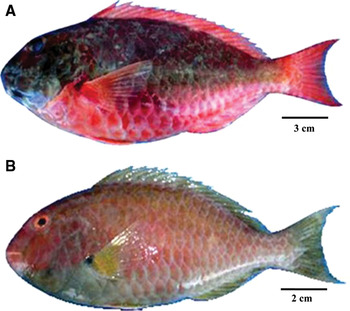
During the period August 2008 to July 2009, female and male samples of S. frondosum (Figure 1) were captured with the help of local fishermen using traps and motor boats, from the coastal waters of Rio Grande do Norte, located in north-eastern Brazil (05°47′42″S and 35°12′32″W). In order to avoid artefacts of sampling all fish samples were screened for the presence of parasites immediately after their capture (since the isopods are capable of abandoning their original host and crawl onto another live fish). All fish samples were weighed to the nearest gram and measured to the nearest centimeter (the total body size measured as the length from tip of snout to the end of the caudal peduncle). The taxonomic identification of fish was confirmed by morphometric and meristic characterization (Menezes & Figueiredo, Reference Menezes and Figueiredo1985; Moura et al., Reference Moura, De Figueiredo and Sazima2001).
The study sample red tail parrot-fish, Sparisoma frondosum (A) female and (B) male.

The body surface, buccal cavity (the mouth and tongue) and branchial chamber (between the operculum and the gills) of all fish were examined and the parasites were removed from the hosts, counted and preserved directly in 70% ethyl alcohol in a labelled tube (Eiras et al., Reference Eiras, Takemoto and Pavanelli2006). Parasites were examined using a stereoscopic microscope (Model Taimin TE 1L coupled with a Kodo Digital video camera). The taxonomic identification of parasites was performed using identification keys (Thatcher, Reference Thatcher, Salgado-Maldonado, Aldrett and Vidal-Martinez2000). Ecological indices of the parasites were calculated based on Bush et al. (Reference Bush, Lafferty, Lotz and Shostak1997).
The gonads of host fish were examined to determine the sex and maturity stages (Vazzoler, Reference Vazzoler1996). To determine the difference in the ratio between males and females and to verify if the difference was statistically significant, the Chi-square (χ2) test was applied at 5% level of significance using the software Statistica 7.0. Rainfall data for the study period were obtained from the Department of Meteorology and Water Management of Rio Grande do Norte (EMPARN), to correlate with the ecological indices of parasitism.
RESULTS
The rainfall data during the study period ranged from 16.0 mm (December 2008) to 372.3 mm (May 2009), with an average of 187.7 mm (± 137.0), based on this, August to December was characterized as the dry season and January to June as the rainy season. A total of 104 samples of S. frondosum were captured during the study period. The sex-ratio between males and females was 1M:6.75F which was statistically significant (χ2 = 25.92). The total length of females ranged from 16.8 to 33.6 cm (23.87 ± 2.29) and that of males from 23.9 to 30.8 cm (26.5 ± SD 0.70). The total weight of females ranged from 88.5 to 557.0 g (294.1 ± 97.52) and of males from 205.5 to 635 g (415 ± 144.5).
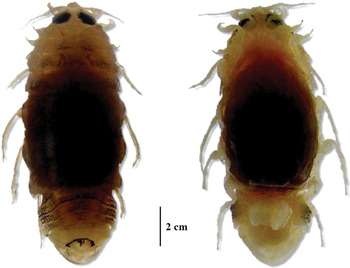
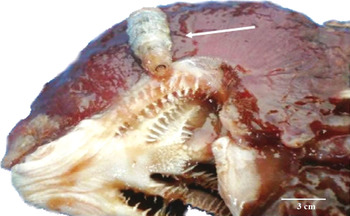
About 34.61% of S. frondosum captured were parasitized by the ectoparasitic isopod Rocinela signata Schioedte & Meinert, 1879 (Figure 2). This parasite showed 100% specificity for the gill chamber of the hosts as a site of attachment (Figure 3).
Ectoparasitic isopod Rocinela signata (female): the dorsal view on left and ventral view on right showing the marsupium or brood pouch. Scale bar = 2 cm.

Rocinela signata in the gill arches of Sparisoma frondosum (the arrow indicates the parasite). Scale bar = 3 cm.

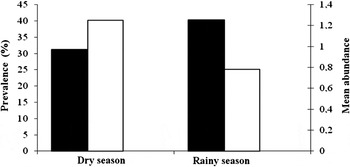
Rocinela signata showed a parasitic prevalence (P) of 37.5%, a mean intensity (MI) of 2.58 parasites per infested fish and a mean abundance (MA) of 0.97 parasites per fish sampled. The prevalence of R. signata was higher during the rainy season (P = 40.39%) than in the dry season (P = 31.19%), however, this difference was not statistically significant at 5% level of significance (χ2 = 0.42). The MA was higher during the dry season though this difference was not statistically significant at 5% level of significance (t =1.049; P = 0.371) (Figure 4).
Ecological parasitic indices of Sparisoma frondosum in the dry and rainy season (□ prevalence; ■ mean abundance).

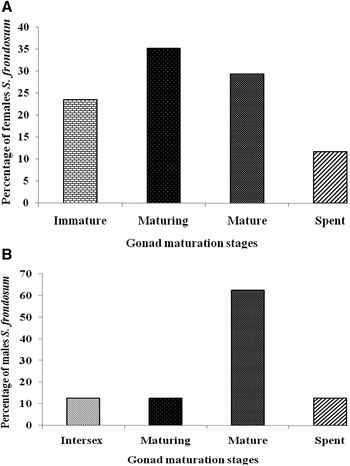
The gonad maturation stages of parasitized samples of females and males of S. frondosum are shown in Figure 5A and Figure 5B respectively.
Gonadal maturation stages of Sparisoma frondosum parasitized by Rocinela signata: (A) females and (B) males during August 2008 to June 2009.

DISCUSSION
This paper reports on the occurrence of the isopod parasite R. signata on redtail parrotfish, S. frondosum in the coastal waters of Natal, Rio Grande do Norte, Brazil. This crustacean isopod parasite is specifically abundant in the gill chambers of commercially important fish hosts.
This study registers a parasitic prevalence of 37.5% of R. signata; on the other hand, an earlier study by Lima et al. (Reference Lima, Chellappa and Thatcher2005) reported a parasitic prevalence of 31% for ectoparasite R. signata in the Serra Spanish mackerel, Scomberomorus brasiliensis. Both studies confirm the gill chambers as preferred location of parasitic fixation of R. signata. Carvalho-Souza et al. (Reference Carvalho-Souza, Souza Neto, Aleluia, Nascimento, Browne-Ribeiro, Santos and Tinôco2009) reported on the parasitism of crustacean isopod R. signata of Caranx crysos, Oligoplites saliens and Trichiurus lepturus on the coast of Bahia, north-eastern Brazil, with the highest parasitic prevalence of 8.33% in T. lepturus, with an average incidence of one parasite per fish, followed by C. crysos with prevalence of 5.88% and an average incidence of two parasites per fish, and O. saliens with a 4.65% prevalence and an average incidence of one parasite per fish and they occurred mostly in the mouth cavity and the gills chambers.
Rocinela signata has been reported as a fish parasite which is responsible for reducing their growth rates. This parasite was given the common name of ‘Monogram Isopod’ because of the inverted W-shape mark on its pleotelson (Garzon-Ferreira Reference Garzon-Ferreira1990; Bunkley-Williams et al., Reference Bunkley-Williams, Williams and Bashirullah1998). According to Garzon-Ferreira (Reference Garzon-Ferreira1990), the frequency of attacks of underwater divers by R. signata is high and on several occasions this isopod attaches itself on the human body so firmly that it was necessary to kill it to remove it. Immediately after attachment the isopod begins to feed, biting the skin of the diver. The isopod's belly was full of blood after detachment and the attackers were juveniles shorter than 5 mm to adults longer than 10 mm.
In this study, the prevalence value in the dry season was lower while the value of MA was higher and MI showed a value close to that found by Araújo (Reference Araújo2008). For the period, rainfall intensity and prevalence values were higher, possibly influenced by the reproductive cycle of the parasites, while the average abundance value was lower. Rocinela signata has high parasite prevalence (Bush et al., Reference Bush, Lafferty, Lotz and Shostak1997). Thatcher et al. (Reference Thatcher, Araújo, Lima and Chellappa2007) and Araújo et al. (Reference Araújo, Costa, Cavalcanti and Chellappa2008), observed in Tibiri, Oligoplites palometa a prevalence of 64.1% in ectoparasite Cymothoa spinipalpa (Isopoda: Cymothidae), on the tongue in the oral cavity of their hosts. The parasitic index of C. spinipalpa on O. palometa showed a prevalence of 64.1%, with average of 2.02 parasites per host and parasite abundance of 1.29 fish per sample. The highest rates of parasite prevalence and abundance occurred in the dry season while the average intensity remained almost constant between the two periods.
In relation to the maturity stages of gonads of the hosts, it was observed that both sexes did not suffer any changes caused by R. signata. Gonad development was within the expected pattern in all stages of maturation.
The isopod R. signata showed a preference for young hosts, especially for immature and in maturation. This preference of the parasite occurs in young hosts since they have more energy resources, such as lipids, in comparison to mature and spent individuals. Observations of Chellappa et al. (Reference Chellappa, Huntingford, Strang and Thomson1995) and Huntingford et al. (Reference Huntingford, Chellappa, Taylor and Strang2001) show that mature fish have depleted energy reserves since lipids are mobilized during gonadal maturation and reproduction.
ACKNOWLEDGEMENTS
This study was supported by the National Council for Scientific and Technological Development of Brazil (CNPq) in the form of Research grants and by the Post-Graduate Federal Agency CAPES/MEC, Brazil.