Introduction
The United States is experiencing an epidemic of obesity in men and women at all ages across the life course. Reference Ogden, Carroll, Kit and Flegal1 Animal and epidemiologic studies indicate that offspring of obese (OB) mothers are predisposed to later-life obesity and metabolic disease. Reference Leddy, Power and Schulkin2,Reference Li, Sloboda and Vickers3 Placental and fetal development can be altered by a variety of maternal stresses, including maternal obesity Reference Parsons, Power and Manor4 and overnutrition, Reference Lawlor, Smith and O’Callaghan5 undernutrition, Reference Vickers, Breier, Cutfield, Hofman and Gluckman6 high levels of glucocorticoid (GC) exposure, Reference Fletcher, Forhead, Fowden, Ford, Nathanielsz and Giussani7–Reference Dunn, Kapoor, Leen and Matthews9 and endocrine disrupting chemicals. Reference Mallozzi, Bordi, Garo and Caserta10 Several challenges that result in altered fetal growth and development are associated with elevated maternal and fetal GC concentrations. Reference Cottrell and Seckl11 Normal levels of circulating GCs are essential for homeostasis, regulation of cellular differentiation and terminal organ differentiation during fetal development. Reference Fowden and Forhead12 However, fetal exposure to GCs at levels higher than those appropriate for the current stage of development can impede fetal growth and cause offspring programming, such as development of a metabolic syndrome phenotype. Reference Li, Sloboda and Vickers3,Reference Chin, Schmidt and Martel13,Reference Hohwu, Henriksen, Gronborg, Hedegaard, Sorensen and Obel14 The causative role of GCs in developmental dysfunctions is supported by three major experimental approaches: first, observations that maternal nutrient reduction programs expression of adrenal steroidogenic enzymes; Reference Khorram, Magee, Wang, Desai, Ross and Khorram15 second, the ability of metyrapone, an inhibitor of adrenal steroid synthesis to prevent the inhibition of fetal growth due to maternal undernutrition in the rat; Reference Khorram, Ghazi and Chuang16 third, the effects of direct administration of GCs. Reference Moisiadis, Constantinof, Kostaki, Szyf and Matthews17
Growing evidence exists that in addition to synthesis in the adrenal cortex, cortisol is also produced in peripheral tissues via conversion from cortisone by the enzyme 11β hydroxysteroid dehydrogenase (11β-HSD). Reference Buckingham18–Reference Zanchi, Filho, Felitti, Nicastro, Lorenzeti and Lancha22 Therefore, increased fetal 11β-HSD1 activity in response to maternal dietary challenges provides a potential mechanism for increased cortisol production in response to maternal challenges. One study in undernourished pregnant baboons that supports this mechanism as fetal cortisol was elevated in tandem with increased peripheral fetal liver and adipose tissue cortisol concentrations and expression of the enzymes and cofactors necessary to convert cortisone to cortisol. Reference Guo, Li, Myatt, Nathanielsz and Sun23 Increased peripheral tissue GC production by 11β-HSD1 is also implicated in the induction of the metabolic syndrome. Reference Wang, Liu and Du24 The maternal–fetal interface of the placenta highly expresses 11β-HSD2Reference Edwards, Benediktsson, Lindsay and Seckl 25 – Reference Seckl and Holmes 27 and is generally considered to serve a protective role against fetal exposure to maternal GCs. Reference Krozowski, MaGuire, Stein-Oakley, Dowling, Smith and Andrews28,Reference Yang29 Further, GCs directly affect this protective function by stimulating expression of 11β-HSD2 in human trophoblast cells in vitro. Reference van Beek, Guan, Julan and Yang30 For example, administration of betamethasone, a synthetic GC, to pregnant baboons increases placental 11β-HSD2 activity in vivo potentially mitigating fetal exposure to maternal GC. Reference Seckl and Holmes27 We have developed and characterized a diet-induced model of maternal overnutrition/OB. Reference Ford, Zhang and Zhu31 OB ewes and their developing fetuses exhibit elevated blood cortisol concentrations from mid to late gestation. This cortisol increase is associated with programming of metabolic syndrome-like outcomes in the F1 and F2 offspring. Reference Ford, Zhang and Zhu31–Reference Tuersunjiang, Odhiambo, Long, Shasa, Nathanielsz and Ford34 Interestingly, while the increased maternal cortisol is accompanied by increased plasma Adrenocorticotropic hormone (ACTH) concentrations, the fetal cortisol increase is independent of an increase in fetal ACTH, Reference Tuersunjiang, Odhiambo, Long, Shasa, Nathanielsz and Ford34,Reference Nathanielsz, Ford, Long, Vega, Reyes-Castro and Zambrano35 suggesting either a non-adrenal source for the elevated fetal cortisol or altered adrenal sensitivity to ACTH in the setting of maternal obesity.
In the present study, we hypothesized that in late gestation, OB ovine pregnancies would provide evidence for upregulation of placental 11β-HSD2 that converts maternal cortisol to fetal cortisone as it crosses the placenta. We further hypothesized an increase in 11β-HSD system components responsible for peripheral tissue cortisol production in fetal liver and adipose tissue, thereby providing a mechanism for an ACTH-independent increase in circulating fetal cortisol.
Materials and methods
Animals and study design
All animal procedures were approved by the University of Wyoming Animal Care and Use Committee. Nonpregnant multiparous, Rambouillet/Colombia cross ewes were randomly assigned to one of two dietary groups, that is, Control (CON) or OB (n = 7/maternal dietary group). The CON group received 100% of National Research Council recommendations, 36 while the OB group received 150% of the CON diet from 60 days prior to conception to necropsy, performed on day 135 of gestation (0.9 G – term 150 days). At necropsy, following stabilization under isoflurane gas anesthesia, maternal jugular venous blood and fetal umbilical venous blood were collected into 10 ml heparinized tubes (BD Biosciences, Franklin Lakes, NJ, USA), and plasma stored at −80 °C. Following blood collection, ewes and fetuses (three females and four males) were exsanguinated while still under general anesthesia and placental (an A-type placentome) tissue, fetal liver and perirenal fat tissues were quickly harvested, snap-frozen in liquid nitrogen, and stored at −80 °C.
Biochemical assays
Maternal and fetal plasma cortisol were measured with a commercial cortisol radioimmunoassay kit (MP Biomedicals, Solon, OH, USA) with a sensitivity of 1 ng/ml as previously described. Reference Dong, Ford, Nijland, Nathanielsz and Ren37 All fetal and maternal cortisol measurements were completed in a single assay with an intra-assay coefficient of variation (CV) of 5.3%. Fetal plasma cortisone concentrations were determined by a commercial ELISA kit with a sensitivity of 29.0 pg/ml (catalog number K017-H1 Arbor Assays, Ann Arbor, MI, USA). All cortisone measurements were completed in a single assay with an intra-assay CV of 6.2%.
Protein extraction and Western blotting
Protein abundance in cotyledonary, fetal liver, and perirenal fat tissues were determined by Western blot analysis using methods as previously described. Reference Ma, Zhu, Zhang, Hein, Nathanielsz and Ford38 Briefly, tissue protein was extracted by homogenizing ~100 mg of pulverized cotyledonary, fetal liver, and fetal perirenal adipose tissues in ice-cold lysis buffer using a polytron homogenizer. Homogenates were centrifuged and the supernatants mixed with a 2× standard SDS sample loading buffer and then boiled at 95 °C for 5 min. Approximately, 50 μg of protein extracts were separated in sodium dodecyl sulfate–polyacrylamide gel electrophoresis gels and transferred to nitrocellulose membranes for immunoblotting with rabbit primary antibodies for 11β-HSD2 (Abcam Cat # ab80317), 11β-HSD1(Abcam Cat # ab39364), hexose-6-phosphate dehydrogenase (H6PD) (Abcam Cat # ab84353), GC receptors (GR) (Abcam Cat # ab2768), CCAAT/enhancer-binding protein α (C/EBPα) (Santa Cruz Cat # sc-61), and β-actin (Cell Signaling Cat # 4967S). The membranes were incubated with anti-rabbit secondary antibodies (Cell Signaling Cat # 7074S) and then visualized using enhanced chemiluminescence (Amersham Biosciences) and exposure to an X-ray film. The target protein band density was analyzed by ImageJ software (NCBI) and normalized according to the density of β-actin.
Immunohistochemistry
Our immunohistochemical methods have previously been published in detail. Reference Ford, Zhang and Zhu31 Staining of all sections was conducted in a single batch process. Five-micrometer sections were obtained from paraffin-embedded blocks of CON and OB placentomal tissues maintaining at least 100 μm between sections. Six sections were used from each specimen for analysis (three stained and three negative controls). Paraffin-embedded sections were then deparaffinized and rehydrated by routine methods before antigen retrieval as described. Reference Ford, Zhang and Zhu31 Nonspecific antigenic sites were blocked by a 60-min incubation in 1.5% normal goat serum (Vector Laboratories, Burlingame, CA) in Phosphate Buffered Saline with 0.1% Triton X-100 (Union Carbide, Somerset, NJ) and 0.05% Tween 20 (Bio-Rad Laboratories, Hercules, CA). Next, sections were incubated either with anti-rabbit 11β-HSD2 antibody (1:500; GeneTex Cat # GTX109786) or buffer (negative controls) at 4 °C overnight. All sections were then probed with a HRP-conjugated anti-rabbit secondary antibody (1:1000; GeneTex Cat # GTX213110–01) for 60 min at 22 °C. Images were visualized using an Olympus BX51 microscope and captured digitally using a Retiga EXiFast camera. Pictures at ×200 magnification were taken using CellSens Imaging software (Olympus Corporation, Waltham, MA) for 20 randomly selected fields of view for each section. Only fields with 50% or more 11β-HSD2 staining in the placentomal tissue were evaluated. Optical density (OD) was used to quantify stain intensity for each specimen using Image J software. OD was determined using OD = log10 (mean intensity/max intensity), where max intensity = 255 (for 8 bit image). This technique provides a quantitative value for the staining intensity of 11β-HSD2 in the histological section. For each specimen, the OD of the three stained images were averaged, as were the three negative control images. Next, the OD of the negative controls was subtracted from the OD of the stained images to account for nonspecific binding, yielding the final OD value for the specimen. OD is reported as a viable method for quantitative immunohistochemistry image analysis. Reference Seyed Jafari and Hunger39
Statistical analysis
Data were analyzed using the PROC MIXED procedure in SAS (SAS Institute, Cary NC, USA) with the group as the main effect. An initial analysis showed no differences between the females and males, so data were pooled and evaluated using a reduced model having a group as the main effect. To verify the normality of the data, we utilized outlier tests before performing statistical analyses. PROC CORR was used for correlation analysis of maternal cortisol to fetal cortisol and fetal cortisone to fetal cortisol. Differences were considered significant at p ≤ 0.05, tendencies at p ≤ 0.10. Data are presented as least square means ± SEM.
Results
Plasma cortisol concentrations at necropsy
On day 135 of gestation, plasma cortisol concentrations were greater in OB compared to CON ewes (p < 0.001; Fig. 1a) and in OB compared to CON fetuses (p < 0.01; Fig. 1b). Fetal plasma cortisone concentration was also elevated in OB fetuses compared to CON (p < 0.01; Fig. 1c). There were strong positive correlations between fetal plasma cortisol and maternal plasma cortisol (r = 0.76, p < 0.002, (Fig. 2a) as well as between fetal cortisone and maternal cortisol concentrations (r = 0.72, p < 0.0001, Fig. 2b). Fetal cortisone and cortisol concentrations were also highly positively correlated (r = 0.72, p < 0.0001, Fig. 2c).
(a) Maternal plasma cortisol concentration. (b) Fetal plasma cortisol concentration. (c) Fetal plasma cortisone concentration. Data are presented as least square (LS) means ± SEM. Differences are considered significant at *p ≤ 0.05.

Correlations between (a) maternal cortisol and fetal cortisol (r = 0.76, p ≤ 0.002), (b) maternal cortisol and fetal cortisone (r = 0.80, p ≤ 0.005), and (c) males and females fetal cortisone and fetal cortisol (r = 0.72, p ≤ 0.0001) at day 135 of gestation.

Tissue enzyme protein abundance
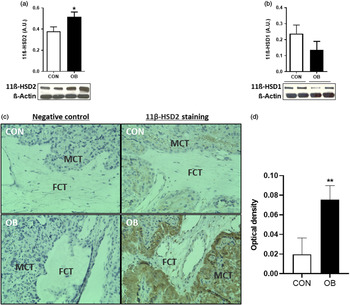
Western blot determined that 11β-HSD2 protein abundance in gestational day 135 placental cotyledonary tissue was higher (p < 0.05) in OB than CON (Fig. 3a), whereas 11β-HSD1 protein expression was similar in the two groups (Fig. 3b). Immunostaining of 11β-HSD2 protein in placentomal tissues was greater in OB than CON tissues and was mainly localized within the maternal–fetal interface with an increased expression in the maternal caruncle tissue than in the fetal cotelydonary tissue (Fig. 3c and d). In peripheral tissues, 11β-HSD1 protein was increased (p < 0.05) in the liver of OB vs. CON fetuses (Fig. 4a). There was a trend (p < 0.07) for increased H6PD liver protein in OB vs. CON fetuses (Fig. 4b). However, 11β-HSD2 protein remained similar between the groups (Fig. 4c). Further, protein abundance of the 11β-HSD1 transcription factor, C/EBPα, was increased (p < 0.01) in the OB liver compared to CON fetuses (Fig. 4d). No difference (p < 0.05) was observed in expression of the GR protein between the groups (Fig. 4e). In fetal perirenal adipose tissue, protein abundance of 11β-HSD1 and its cofactor, H6PD, was increased (p < 0.05) in OB vs. CON fetuses (Fig. 4f and g), whereas expression of 11β-HSD2 protein remained similar in the two groups (Fig. 4h). No group differences were observed for expression of C/EBPα protein in perirenal adipose tissue (Fig. 4i). However, in this tissue, GR protein was increased (p < 0.05) in OB vs. CON fetuses (Fig. 4j).
Protein expression of (a) 11β-HSD2 and (b) 11β-HSD1 in cotyledonary tissue on day 135 of gestation. (c) Immunohistochemical analysis shows tissue localization of 11β-HSD2 staining in placentomal tissues (d) Quantification of 11β-HSD2 staining (Fig c.) in the placentomal tissues. Data are presented as least square (LS) means ± SEM. Differences are considered significant at *p ≤ 0.05, **p ≤ 0.001. MCT, maternal caruncle tissue; FCT, fetal cotyledonary tissue.

Top panels, protein expression of (a) 11β-HSD1, (b) the cofactor H6PD, (c) 11β-HSD2, (d) C/EBPα, and (e) glucocorticoid receptor (GR) in fetal liver on day 135 of gestation. Bottom panels, protein expression of (f) 11β-HSD1, (g) the cofactor H6PD, (h) 11β-HSD2 (i) C/EBPα, and (j) GR in fetal perirenal adipose tissue on day 135 of gestation. Data are presented as least square (LS) means ± SEM. Differences are considered significant at *p ≤ 0.05, with a tendency at # p ≤ 0.07.

Discussion
The intracellular function of GCs is regulated by many factors, including circulating hormone concentration, density of GC/mineralocorticoid receptors, and tissue activity of 11β-HSD1 and 11β-HSD2. Our data strongly support the concept that in the setting of maternal obesity, the elevated cortisol in maternal blood is converted to cortisone in the placenta by the increased activity of 11β-HSD2 at the maternal side of the placenta. This action is generally considered a “protective” function of 11β-HSD2 by which the placenta reduces exposure of the developing fetus to active cortisol, transferred from the mother. Reference Albiston, Obeyesekere, Smith and Krozowski40,Reference Brown, Chapman and Kotelevtsev41 In the presence of elevated levels of both maternal cortisol and placentomal tissue 11β-HSD2 in the OB placenta, fetal blood cortisone levels are higher in OB fetuses than CON. In the future, it will be interesting to measure cortisone production by the placenta, placental consumption of cortisone and its secretion into the fetal compartment. However, while this action of the placenta would appear to be protective, we hypothesized that the increased concentration of cortisone in the blood of OB fetuses could serve as a substrate pool for the increased 11β-HSD1 levels in the fetal liver and perirenal fat resulting in the non-ACTH-dependent increase in plasma cortisol in OB fetuses that we have previously described. Reference Nathanielsz, Ford, Long, Vega, Reyes-Castro and Zambrano35 The enzyme 11β-HSD1 is a bidirectional enzyme capable of both reductase and oxidase activity. In intact cells, cultured cells, including primary rat hepatocytes, the enzyme is predominantly a reductase, regenerating active hydroxylated GCs from their inactive ketone metabolites. Reference Jamieson, Chapman, Edwards and Seckl42–Reference Tomlinson, Walker and Bujalska44 The reductase activity of 11β-HSD1 has been shown to be dependent on the availability of the cofactor Nicotinamide adenine dinucleotide phosphate, derived from H6PD enzymatic activity. Reference Lavery, Walker and Draper45 Our finding in this study of parallel increases in H6PD and 11β-HSD1 in the OB fetal liver and perirenal adipose tissue suggests that the reductase activity predominates, leading to the observed increase in active cortisol in the fetal circulation. Further, increased expression of 11β-HSD1 in the liver and adipose tissues has been demonstrated in OB humans and rodents and plays role in the development of obesity and metabolic syndrome. Reference Paterson, Morton and Fievet46 A key role for 11β-HSD1 in the production of the metabolic syndrome is supported by the finding that 11β-HSD1 null mice are protected against development of this condition. Reference Kotelevtsev, Holmes and Burchell47,Reference Morton, Holmes and Fievet48 In contrast, overexpression of 11β-HSD1 in adipose and liver tissue, the two major tissues in the body expressing 11β-HSD1, leads to a metabolic syndrome phenotype. Reference Paterson, Morton and Fievet46,Reference Masuzaki, Paterson and Shinyama49 While considerable evidence supports a role for 11β-HSD1 in developmental programming of the metabolic syndrome, the mechanism for its increase is unknown. Reference Wyrwoll, Holmes and Seckl50 11β-HSD1 is a target gene for C/EBPs and GR Reference Williams, Lyons and MacLeod51,Reference Yang, Guo, Zhu, Li, Myatt and Sun52 that have been shown to regulate basal and induced expression of 11β-HSD1 in a number of studies. Reference Williams, Lyons and MacLeod51–Reference Yang, Zhu, Guo and Sun54 As previously discussed, 11β-HSD1 is highly expressed in the liver where it regenerates the GC, Reference Williams, Lyons and MacLeod51 thus amplifying their action and contributing to induction of responsive genes, most of which are regulated by members of the C/EBP family of transcription factors. Reference Williams, Lyons and MacLeod51 It has been demonstrated that C/EBPα is a potent activator of the 11β-HSD1 gene in hepatoma cells and that mice deficient in C/EBPα have reduced hepatic 11β-HSD1 expression. Reference Williams, Lyons and MacLeod51 The regulation of 11β-HSD1 expression, and hence intracellular GR levels by members of the C/EBP family, potentially describes a novel mechanism for cross-talk between the C/EBP family of transcription factors and GC signaling pathway. The classical mechanism of action of GCs requires their binding to their cytosolic GR. Once activated by GC, GR form homodimers and translocate into the nucleus, where they ultimately bind to specific GC responsive elements (GRE) on gene promoters to regulate transcription. Reference Hayashi, Wada, Ito and Adcock55,Reference Smoak and Cidlowski56 However, this mechanism does not explain all the actions of GC. Several studies have demonstrated that interaction of GR with other transcription factors could provide an alternative pathway for GC actions. Reference Hayashi, Wada, Ito and Adcock55,Reference Smoak and Cidlowski56 GC have been found to induce C/EBP expression in a number of tissues and cells that these include human adipocyte differentiation at early stages Reference Zilberfarb, Siquier, Strosberg and Issad57 , rat brown adipocytes Reference Hernandez, Teruel and Lorenzo58 , and rat skeletal muscle. Reference Yang, Mammen and Wei59,Reference Yang, Menconi, Wei, Petkova and Hasselgren60 Furthermore, interaction of C/EBPα and GR has been found to regulate cell proliferation. Reference Roth, Johnson and Borger61,Reference Rudiger, Roth and Bihl62 Williams et al. Reference Williams, Lyons and MacLeod51 found that C/EBPα is an important regulator of mouse basal 11β-HSD1 promoter activity in hepatoma cells. Reference Gout, Tirard, Thevenon, Riou, Begeot and Naville63 Yang et al. Reference Yang, Guo, Zhu, Li, Myatt and Sun52 reported that the induction of 11β-HSD1 mRNA expression, and promoter activity by cortisol, involves not only GR but also C/EBPα. The observation that induction of 11β-HSD1 expression could be blocked by a GR antagonist suggests a predominant role of GR in this induction. In addition to the direct interaction of GR with GRE, this study also provided evidence for an indirect role of GR in the induction of 11β-HSD1 promoter activity by cortisol, as the induction of both 11β-HSD mRNA expression and promoter activity by cortisol can also be blocked by C/EBP inhibition. Reference Yang, Guo, Zhu, Li, Myatt and Sun52
We propose the concept that maternal obesity results in elevated fetal extra-adrenal cortisol production, leading to higher fetal blood cortisol concentrations. This outcome results from upregulation of 11β-HSD2 within the placentomal tissues converting the elevated maternal cortisol into cortisone as it crosses the placenta. This increased circulating cortisone then acts as a substrate for 11β-HSD1 in the fetal liver and peripheral fat that in effect removes the protective value of the placental conversion of cortisol to cortisone. Thus, the heretical view we propose is that the placental conversion of cortisol to cortisone can, in the presence of increased activity of the 11β-HSD1 system in OB fetal perirenal adipose tissue and liver, result in increased cortisol in the fetal circulation and tissues predisposing offspring to metabolic dysfunction in postnatal life. This hypothesized cascade of events is depicted in Fig. 5.
Summarized fetal glucocorticoid metabolism. These data suggest there is an upregulation of 11β-HSD2 within placentomal tissues of OB ewes to convert elevated maternal cortisol into fetal cortisone. This increased circulating cortisone, along with an upregulation of 11β-HSD1 and the cofactor H6PD, is then used by OB fetal perirenal adipose tissue and liver to synthesize and release increased concentrations of cortisol into fetal circulation.

In summary, we have provided evidence for an increase in 11β-HSD2 protein within placentomal tissues of OB ewes in the presence of an ACTH-independent increase in fetal cortisol. We also provide evidence of increases in the components of the 11β-HSD1 system that would explain increased peripheral cortisol concentrations by converting elevated fetal cortisone to cortisol, which then passes back into the fetal circulation to increase fetal plasma cortisol in a non-ACTH-dependent manner.
Acknowledgments
The authors would like to thank the students of the Center for the Study of Fetal Programming for their assistance in animal care and data collection on the farm, and Mr. Vince Abushaban, farm manager for animal care and management.
Financial support
The present work was supported by the National Institutes of Health (NIH) 5R01HD70096-05/1R01HD070096-01A1.
Conflicts of interest
None.
Ethical standards
The authors assert that all animal procedures were approved by the University of Wyoming Animal Care and Use Committee.