Introduction
Benign mucosal cysts are most commonly found in the paranasal sinuses and usually involve the maxillary sinuses. They are the commonest solitary lesions affecting the maxillary antra.Reference Halstead1,Reference Paperella2 Their prevalence in normal populations is estimated at 1.6 to 4.2 per cent (from dental screening programmes).Reference Halstead1,Reference Casamassimo and Lilly3–Reference Rhodus5 If more sensitive imaging modalities are used for patients with symptoms of sinus disease, then higher rates, of 12.4–16.4 per cent, are reported.Reference Bhattacharyya6,Reference Scribano, Ascenti, Loria, Cascio and Gaeta7 These cysts are bilateral in 10–20 per cent of cases and can be multiple.Reference Casamassimo and Lilly3,Reference Fisher, Whittet and Croft8 High resolution computed tomography (CT) imaging is able to distinguish maxillary mucosal cysts from other forms of mucosal disease, and in many cases this allows patients to avoid a diagnostic biopsy when the cyst is asymptomatic. Cysts are usually seen as a homogeneous, dome-shaped mass arising from the floor of the antrum.
There is debate as to whether such cysts are an entirely incidental finding or the source of sinus pathology. Many patients are asymptomatic, but a variety of local and systemic symptoms have been associated with maxillary mucosal cysts. Symptoms are variously reported in as few as 5 per cent and in as many as 77 per cent of cases in selected populations.Reference Ence and Parsons9–Reference Gothberg, Little, King and Bean11 Asymptomatic cases predominate in the general population, as opposed to patients in rhinology clinics. If the cyst fills the sinus and exerts pressure on the mucosal lining, the patient may experience facial pain and headache. If the sinus ostium is blocked by the cyst, infection may ensue. Rarely, cysts may arise from a dehiscent infraorbital nerve, and the resultant tension and stretching of the nerve causes pain.Reference Ence and Parsons9 Radiographic follow up of cases suggests that spontaneous regression (6–23 per cent) and resolution (6–41 per cent) is common and may be signalled by a sudden, unilateral nasal discharge of amber-coloured fluid.Reference Halstead1,Reference Casamassimo and Lilly3,Reference Gothberg, Little, King and Bean11 Some cysts may undergo progressive enlargement to form an antrochoanal cyst.Reference Berg, Carenfelt and Sobin12
Mucosal cysts are classified as secretory (mucous retention) cysts and nonsecretory cysts, with the latter being more common.Reference Fisher, Whittet and Croft8 The pathological definition of a secretory cyst is an epithelial-lined cyst containing serous or mucous fluid. A nonsecretory cyst consists of oedema fluid within the subepithelial connective tissue and is not epitheliallined. These should be distinguished from a mucocele, which represents an accumulation of secretions behind the blocked ostium of a sinus and results in slow, progressive expansion of the sinus, with eventual bony erosion. The frontal and ethmoid sinuses are the most common sites of mucosal cysts, but about 10 per cent are found in the maxillary sinus.Reference Ence and Parsons9
The aetiology of mucosal cysts remains unclear, but inflammation due to allergy or infection is postulated by many authors.Reference Berg, Carenfelt and Sobin12–Reference Mills15 In some cases, barotrauma has been implicated in the genesis of these cysts.Reference Garges16 Van Alyea suggested they could be an allergic manifestation in which the allergic oedema eventually causes the mucosa to rupture and form a cyst.Reference Van Alyea13 However, Berg et al. found normal levels of immunoglobulin (Ig) E in 26 out of 27 cases in which the cyst fluid was analysed.Reference Berg, Carenfelt and Sobin12 In addition, they found no evidence of eosinophilia on histological examination of the cyst. Furthermore, only one of their patients had a history of allergic rhinitis. Chronic rhinosinusitis has been proposed as a probable aetiological explanation for mucosal cyst formation. In support of this, Berg et al. found evidence of an inflammatory process, with high concentrations of IgA and IgG and consumption of complement and antiproteases. Anaerobic bacteria were cultured in nine cases. Others have observed varying degrees of inflammatory change in the cyst wall and have noted features of an inflammatory exudate or even pus in the cyst fluid.
The aim of this study was (1) to determine the prevalence of maxillary mucosal cysts in a population with symptoms of chronic rhinosinusitis, and (2) to determine if these cysts were associated with ostiomeatal complex stenosis and sinus disease.
Methods and materials
Consecutive patients who had undergone CT scanning of the paranasal sinuses for possible chronic sinus disease between September 2002 and December 2003 were evaluated until data on a series of 500 cases was acquired. All patients satisfied the standard definition of chronic rhinosinusitis, i.e. persistent nasal symptoms (nasal congestion, discharge, postnasal drip, hyposmia or facial pain) of greater than 12 weeks' duration which were refractory to medical treatment. Exclusion criteria included previous nasal or sinus surgery, facial trauma, nasal polyposis, neoplasia, septal perforation, fungal sinusitis, odontogenic sinusitis, immunodeficiency, and mucociliary disorders.
The sinus CT protocol at The Royal National Throat, Nose and Ear Hospital was to obtain 3 mm thick coronal sections through the ostiomeatal complex and 5 mm thick coronal sections through the rest of the paranasal sinuses. A radiological diagnosis of a mucosal cyst was made if the following characteristics were met: (1) homogeneous, dome-shaped cyst with sharp demarcation of the lateral borders; (2) absence of bony erosion; (3) absence of communication with tooth root (to exclude dentigerous cyst); and (4) a smooth, spherical outline along the free border of the cyst. Each coronal CT scan was evaluated using Radworks diagnostic 5.1 software (Applicare Medical Imaging BU, Zeist, The Netherlands), which allowed the accurate measurement of the size of the cyst. The diameter of the cyst was measured along the longest dimension. The location and number of cysts was recorded. In patients with multiple cysts in a single maxillary sinus, the location and size of the largest cyst was evaluated. Disease in the paranasal sinuses was staged using the Lund–Mackay scoring system, with maxillary mucosal cysts being excluded from the score.Reference Lund and Mackay17 The Lund–Mackay scoring system is known to be one of the most reliable and reproducible computerised tomographic staging systems available.Reference Oluwole, Russell, Tan, Gardiner and White18 All the CT imaging evaluations were performed by the first author to ensure reproducibility of the data. All the data were entered into a computer database and analysed using the Statistical Package for the Social Sciences system, version 11.5 for windows software (SPSS Inc, Chicago, Illinois, USA).
Results
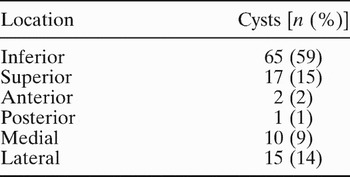
From the total of 500 CT scans, 110 cases of maxillary mucosal cysts were identified, giving an overall prevalence of 22 per cent. The mean patient age was 42.65 years, with a female to male ratio of 0.69:1 (45:65). Solitary cysts were found in 94 (85 per cent) cases. Fourteen (13 per cent) patients had two cysts, one had three cysts and one had four cysts. Bilateral cysts were found in eight patients. Fifty cysts occurred on the left side and 52 on the right side. The mean cyst diameter was 14.27 mm (range 3.9 to 37.86 mm; standard deviation 6.31) and most were located on the inferior surface of the antrum – see Table I.
location of cysts

In four cases, the cyst itself was found in the region of the maxillary infundibulum. However, only in two of these cases was there obstruction of the maxillary ostium with antral mucosal thickening. These four cysts were located superomedially.
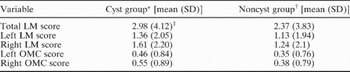
In patients with antral cysts, 52.7 per cent had CT evidence of sinus disease, whereas only 41.3 per cent of noncyst (i.e. control) patients (n=390) had sinus pathology. The total Lund–Mackay score was significantly greater in the cyst group compared with the noncyst group (Mann–Whitney; p<0.05). Subgroup analysis found that patients with left-sided cysts had a higher unilateral mean Lund–Mackay score on the right (noncyst) side (Mann–Whitney; p=0.018), compared with the control group (n=390). There were no differences between the groups with regards to ostiomeatal complex scores – see Table II. Sinus disease was fairly symmetrically distributed; only 21 patients had a higher Lund–Mackay score asymmetry on the right than the left (by two points), and seven patients had the opposite.
data summary

* n=110; †n=390. ‡Lund–Mackay (LM) score significantly higher than that of noncyst (control) group. SD=standard deviation; OMC=ostiomeatal complex
Discussion
This study found a higher prevalence of maxillary sinus cysts than did other workers using CT imaging. It would appear that maxillary cysts are more common in patients with symptoms of chronic rhinosinusitis than in the general population. Bhattacharyya was unable to demonstrate any difference in sinus disease, compared with a control side without cyst involvement, within the same patient.Reference Bhattacharyya6 However, since sinus disease is nearly symmetrically distributed, it is not unexpected that such a comparison would show no differences.
An ideal control group would consist of a random sample of the general population; however, concerns over radiation exposure make this an unethical proposition. We believe a better comparison is with a control group of noncyst patients, rather than the patient acting as their own control. Comparison with a control group of noncyst subjects yielded a significantly higher sinus score in patients with maxillary cysts. In addition, these cysts would appear to be more common in patients with symptoms of chronic rhinosinusitis than in asymptomatic groups.
Bhattacharyya was unable to demonstrate any association between maxillary cysts and ostiomeatal complex obstruction.Reference Bhattacharyya6 This author felt that these cysts did not ‘…reflect obstructive sinus phenomena’. Similarly, we found no significant difference in ostiomeatal complex disease between the two groups, although scores were higher in the cyst group. It is possible that the initial event leading to the formation of these cysts is ostiomeatal complex obstruction, with the ostiomeatal complex subsequently becoming patent while the cyst persists. Only a longitudinal study would be able to assess this hypothesis.
Our findings support the theory that maxillary cysts are manifestations of inflammatory sinus disease. Chronic rhinosinusitis is a group of disorders known to be associated with allergy, asthma, dental disease, nasal polyps, immunodeficiency, mucociliary disorders, trauma, medications, surgery, noxious chemicals and micro-organisms (viral, bacterial and fungal). There are many factors and processes that may play a role in the aetiology of chronic rhinosinusitis. Although we attempted to recruit as homogeneous a group as possible into our study, our series would still contain a group of disorders for which a single, unifying aetiology is probably not possible. Nevertheless, this paper adds to the weight of evidence which points to chronic rhinosinusitis playing an important role in the aetiology of maxillary mucosal cysts.
• The aetiology of maxillary sinus mucosal cysts is uncertain
• This study investigated the coexistence of maxillary sinus cysts with chronic rhinosinusitis by examining computed tomography findings in 500 patients
• Maxillary sinus cysts were significantly more common in patients with chronic rhinosinusitis, suggesting an aetiological relationship