INTRODUCTION
The distribution of white-beaked dolphins (Lagenorhynchus albirostris) is continuous across the North Atlantic in temperate and subarctic waters (Reeves et al., Reference Reeves, Smeenk, Kinze, Brownell, Lien, Ridgway and Harrison1998). In the eastern North Atlantic, they occur in waters off Iceland (Sigurjónsson & Víkingsson, Reference Sigurjónsson and Víkingsson1997), east Greenland, the British Isles, and further north in the Greenland, Norwegian and Barents Seas (Reeves et al., Reference Reeves, Smeenk, Kinze, Brownell, Lien, Ridgway and Harrison1998; Weir et al., Reference Weir, Stockin and Pierce2007). In the western North Atlantic, white-beaked dolphins occur off Newfoundland and Labrador, and in Davis Strait off southern Greenland (Leatherwood et al., Reference Leatherwood, Caldwell and Winn1976; Alling & Whitehead, Reference Alling and Whitehead1987; Kingsley & Reeves, Reference Kingsley and Reeves1998; Reeves et al., Reference Reeves, Smeenk, Kinze, Brownell, Lien, Ridgway and Harrison1998; Lien et al., Reference Lien, Nelson and Hai2001; Compton et al., Reference Compton, Banks, Goodwin and Hooker2007; Heide-Jørgensen et al., Reference Heide-Jørgensen, Borchers, Witting, Laidre, Simon, Rosing-Asvid and Pike2008; Higdon & Snow, Reference Higdon and Snow2008; Hansen & Heide-Jørgensen, Reference Hansen and Heide-Jørgensen2013). The distribution of this species appears linked with bathymetry, where white-beaked dolphins often occur along continental shelves and close to deep water (Northridge et al., Reference Northridge, Tasker, Webb and Williams1995; Weir et al., Reference Weir, Stockin and Pierce2007; Hansen & Heide-Jørgensen, Reference Hansen and Heide-Jørgensen2013). Their distribution is also linked with prey distribution and abundance (Canning et al., Reference Canning, Santos, Reida, Evans, Sabin, Bailey and Pierce2008; Rasmussen et al., Reference Rasmussen, Akamatsu, Teilmann, Vikingsson and Miller2013), where larger groups of white-beaked dolphins have been reported foraging in areas with high prey availability (Hansen & Heide-Jørgensen, Reference Hansen and Heide-Jørgensen2013). Otherwise group sizes generally comprise only a few individuals, ranging approximately from one to 10 dolphins (Kingsley & Reeves et al., Reference Kingsley and Reeves1998; Compton et al., Reference Compton, Banks, Goodwin and Hooker2007). Despite sightings of white-beaked dolphins off west and southern Greenland, the known range of white-beaked dolphins in Davis Strait is not known to extend eastward to the coast of Baffin Island.
MATERIALS AND METHODS
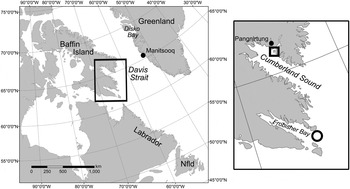
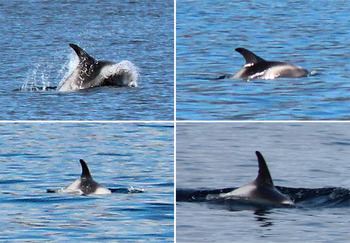
We report two independent sightings of white-beaked dolphins outside their known range, off the south-east coast of Baffin Island (Figure 1). The first encounter took place on 6 September 2004 when 2 white-beaked dolphins were observed at the northern portion of the mouth of Frobisher Bay. The second sighting took place on 25 August 2013 when a group of 6–10 white-beaked dolphins were observed in Cumberland Sound along the coast of south-eastern Baffin Island (65°50′15.6″N 65°44′10.8″W) while conducting boat-based surveys for bowhead whales (Balaena mysticetus). The second sighting took place near the community of Pangnirtung, Nunavut, where the group of dolphins was milling near a cluster of islands at the mouth of Kingnait Fiord. The dolphins were elusive during the brief encounter (~15 minutes); however, photographs were taken to confirm species identification (Figure 2).
Location of two white-beaked dolphins (Lagenorhynchus albirostris) sighted near the mouth of Frobisher Bay (inset) on 6 September 2004 ( ) and a group of 6–10 dolphins sighted in Cumberland Sound (inset) near the mouth of Kingnait Fiord on 25 August 2013 (
 ). Place names mentioned in text are included for reference.

White-beaked dolphins (Lagenorhynchus albirostris) observed on 25 August 2013 in south-eastern Baffin Island.

RESULTS AND DISCUSSION
To the best of our knowledge, there are no published reports of white-beaked dolphin occurrence in waters off south-eastern Baffin Island. Dedicated boat-based surveys have taken place in Cumberland Sound and its associated fiords during four of the previous five summers (2008, 2010–2012), and none have reported any dolphin species other than killer whales (Orcinus orca) (Diemer et al., Reference Diemer, Conroy, Ferguson, Hauser, Grgicak-Mannion and Fisk2011; S. Ferguson, Fisheries and Oceans Canada, unpublished dataFootnote 1 ). Furthermore, there have been no reports of white-beaked dolphins during any of the extensive aerial surveys or boat-based fieldwork conducted by Fisheries and Oceans Canada (DFO) in Cumberland Sound over the past several decades (e.g. Richard & Orr, Reference Richard and Orr1986; Richard & Stewart, Reference Richard and Stewart2009; Richard, Reference Richard2013). Our boat captain during the second observation, who is native to Pangnirtung, stated that he had never seen this species in this area, despite over 30 years of boating throughout Cumberland Sound during the open water season (R. Kilabuk, personal communicationFootnote 2 ). Similarly, previous surveys in the southern Davis Strait near Frobisher Bay did not sight white-beaked dolphins (MacLaren-Atlantic, 1978; MacLaren-Marex, 1979, 1980; McLaren & Davis, Reference McLaren and Davis1982).
The lack of white-beaked dolphin sightings despite considerable opportunity to observe them during research cruises suggests that their occurrence is rare in Cumberland Sound and Frobisher Bay during summer. Observations of white-beaked dolphins in the eastern Davis Strait by Hansen & Heide-Jørgensen (Reference Hansen and Heide-Jørgensen2013) were made as far north as Disko Bay along the west coast of Greenland, with eight observations occurring north of Maniitsoq, Greenland (65°25′N 52°54′W). Our observations occurred at similar latitudes as Maniitsoq (roughly 600 km away). White-beaked dolphins are documented to cover 1090 km in a single month (Rasmussen et al., Reference Rasmussen, Akamatsu, Teilmann, Vikingsson and Miller2013), thus it is not unreasonable to expect at least sporadic, if not occasional, occurrence in the western Davis Strait. In the late 1970s, extensive surveys of the western part of Davis Strait were conducted and no white-beaked dolphins were sighted during these surveys (MacLaren-Atlantic, 1978; MacLaren-Marex, 1979, 1980; McLaren & Davis, Reference McLaren and Davis1982). In comparison to the eastern Davis Strait where directed surveys for cetaceans have occurred at larger spatial scales (e.g. Compton et al., Reference Compton, Banks, Goodwin and Hooker2007; Heide-Jørgensen et al., Reference Heide-Jørgensen, Borchers, Witting, Laidre, Simon, Rosing-Asvid and Pike2008; Hansen & Heide-Jørgensen, Reference Hansen and Heide-Jørgensen2013), limited survey effort and boat-activity in recent decades in the western part of Davis Strait could explain the absence of white-beaked dolphin sightings. However, it is possible that white-beaked dolphins occur along south-east Baffin Island/western Davis Strait, but are rarely observed due to a sparse human population in the area.
Movements of white-beaked dolphins may be linked to movements of their prey (Hansen & Heide-Jørgensen, Reference Hansen and Heide-Jørgensen2013). For example, white-beaked dolphin abundance off Newfoundland is thought to be linked to the presence of spawning capelin (Mallotus villosus) (Lien et al., Reference Lien, Nelson and Hai2001). Moreover, the northward migration of capelin in the Newfoundland region is thought to be mirrored by their dolphin predator (Carscadden et al., Reference Carscadden, Frank and Miller1989). While our sightings may simply reflect solitary occurrences of white-beaked dolphins outside their normal range in the western North Atlantic, it is also possible that their occurrence reflects recent changes in the Cumberland Sound and Frobisher Bay ecosystems, whereby capelin appears to be increasing in occurrence as a main prey source.
Capelin was previously absent in the diet of predators in Cumberland Sound (e.g. Moore & Moore, Reference Moore and Moore1974), but now appears in the diets of Greenland halibut (Reinhardtius hippoglossoides), arctic char (Salvelinus alpinus) (Ulrich, Reference Ulrich2013), and beluga whales (Delphinapterus leucas) (Dennard et al., Reference Dennard, McMeans and Fisk2009; Marcoux et al., Reference Marcoux, McMeans, Fisk and Ferguson2012) in this region. Capelin has also recently appeared in stomach contents of Arctic char in Frobisher Bay (Spares et al., Reference Spares, Stokesbury, O'Dor and Dick2012), where it was previously absent (Grainger, Reference Grainger1953). A similar trend towards an increasing abundance of capelin in the diet of predators is occurring in other areas of the Canadian Arctic (Carscadden et al. Reference Carscadden, Gjøsæter and Vilhjálmsson2013), such as Hudson Bay (e.g. Gaston et al., Reference Gaston, Woo and Hipfner2003, Reference Gaston, Smith and Provencher2012; Chambellant et al., Reference Chambellant, Stirling and Ferguson2013).
Deep bathymetry adjacent to shallower areas in Cumberland Sound and Frobisher Bay provide white-beaked dolphins with their preferred habitat (Northridge et al., Reference Northridge, Tasker, Webb and Williams1995; Weir et al., Reference Weir, Stockin and Pierce2007; IBCAO, 2008; Hansen & Heide-Jørgensen, Reference Hansen and Heide-Jørgensen2013), and combined with the increasing occurrence of capelin in these regions, white-beaked dolphins may be attracted to the areas. White-beaked dolphins consume predominately low energy prey such as Atlantic cod (Gadus morhua), capelin (Mallotus villosus), squid, octopus and benthic crustaceans (Leatherwood et al., Reference Leatherwood, Caldwell and Winn1976; Hai et al., Reference Hai, Lien, Nelson and Curren1996; Canning et al., 2008). Compared to Arctic cod (Arctogadus glacialis), capelin is lower in energy attributable to a difference in fat content (Brekke & Gabrielsen, Reference Brekke and Gabrielsen1994). If white-beaked dolphins are expanding their range into Arctic regions in response to capelin shifts, this highlights concerns that replacement of Arctic cod with a comparatively low energy prey species like capelin may have important implications for the nutritional regime of piscivorous Arctic predators (e.g. Tynan & DeMaster, Reference Tynan and DeMaster1997; Laidre et al., Reference Laidre, Stirling, Lowry, Wiig, Heide-Jørgensen and Ferguson2008). Directed diet studies and systematic capelin and white-beaked dolphin surveys are required to draw conclusions regarding the potential link between the abundance and distribution of capelin and white-beaked dolphins in these regions.
In summary, we report two sightings of white-beaked dolphins, one in September of 2004 in Frobisher Bay, and the second in Cumberland Sound in August of 2013. Both sightings occurred during the open water season. Based on the lack of previous reported sightings in the western Davis Strait, white-beaked dolphins appear rare or absent in Cumberland Sound and Frobisher Bay. We consider the possibility that white-beaked dolphins occur more regularly in the western Davis Strait, but opportunities to observe them may be limited by factors such as sparse human population. Although these sightings could be isolated occurrences, further research is necessary to clarify this species' range in the western North Atlantic, and to determine the extent of their distribution in the western Davis Strait.
ACKNOWLEDGEMENTS
We are appreciative of the logistical support provided by our community guides, Ricky, Eric and Mark Kilabuk. We thank Drs R. Reeves (Okapi Wildlife Associates, Hudson, Quebec) and H. Whitehead (Dalhousie University, Halifax, Nova Scotia) for confirming our identification of white-beaked dolphins and Dr A. Trites for reviewing an earlier draft of this note. Fieldwork was supervised by Dr Steven H. Ferguson (Department of Fisheries and Oceans Canada; University of Manitoba), and funded by Fisheries and Oceans Canada (Emerging Fisheries), Nunavut Wildlife Research Trust Fund, Nunavut General Monitoring Program, Ocean Tracking Network, University of Manitoba, University of British Columbia, and ArcticNet Centre of Excellence.