Introduction
Binge eating disorder (BED), a research category in the Diagnostic and Statistical Manual of Mental Disorders, Fourth Edition (DSM-IV; APA, 1994) and proposed as a formal diagnosis in the Fifth Edition (DSM-5; http://www.dsm5.org), is defined by recurrent binge eating accompanied by feelings of loss of control and marked distress in the absence of inappropriate weight-compensatory behaviors. BED has a lifetime prevalence estimate of 2.8% of adults and is associated strongly with obesity, elevated psychiatric and medical co-morbidity, and psychosocial impairment (Hudson et al. Reference Hudson, Hiripi, Pope and Kessler2007). BED has demonstrated diagnostic validity and differs from obesity, other eating disorders and other forms of disordered eating (Allison et al. Reference Allison, Grilo, Masheb and Stunkard2005; Grilo et al. Reference Grilo, Hrabosky, White, Allison, Stunkard and Masheb2008, Reference Grilo, Crosby, Masheb, White, Peterson, Wonderlich, Engel, Crow and Mitchell2009).
The Eating Disorder Work Group's current proposal for DSM-5, in addition to making BED a formal diagnosis, revised the binge eating frequency and duration stipulations to once-weekly on average for the past 3 months following empirical evidence and partly to parallel the criteria for bulimia nervosa (Wilson & Sysko, Reference Wilson and Sysko2009). The DSM-5 proposal retains the ‘marked distress’ criterion for BED, which was recently supported in an empirical study (Grilo & White, Reference Grilo and White2011), but – in sharp contrast to other eating disorder diagnoses – does not include a cognitive criterion pertaining to body image. DSM-IV (and the current proposal for DSM-5) criteria for bulimia nervosa, but not for BED, require the presence of overvaluation of shape/weight, or the ‘undue influence of body weight or shape on self-evaluation’ (APA, 1994; p. 545). Should the proposed DSM-5 criteria for BED include a construct pertaining to body image (Masheb & Grilo, Reference Masheb and Grilo2000)?
Overvaluation of body shape/weight, a related but distinct construct from the general concepts of body dissatisfaction and shape/weight concerns, is central to understanding the nature of eating disorder psychopathology (Fairburn et al. Reference Fairburn, Cooper and Shafran2003). Although many individuals may be dissatisfied with their appearance, many fewer define their self-worth primarily based on their shape/weight (Hrabosky et al. Reference Hrabosky, Masheb, White and Grilo2007). The conceptual and empirical distinction between overvaluation of shape/weight and body dissatisfaction has been demonstrated by factor-analytic (Hrabosky et al. Reference Hrabosky, White, Masheb, Rothschild, Burke-Martindale and Grilo2008; Grilo et al. Reference Grilo, Crosby, Peterson, Masheb, White, Crow, Wonderlich and Mitchell2010a), longitudinal (Masheb & Grilo, Reference Masheb and Grilo2003), and latent genetic and environmental risk factor analyses in twin studies (Wade et al. Reference Wade, Zhu and Martin2011). Although studies have established that patients with BED and bulimia nervosa have comparable shape/weight concerns despite substantial differences in mean weights and ages (Masheb & Grilo, Reference Masheb and Grilo2000), it was not until recently that researchers comparing these two eating disorders have focused more precisely on the specific construct of overvaluation of shape/weight, leading some to suggest adding overvaluation as a required criterion for BED (Mond et al. Reference Mond, Hay, Rodgers and Owen2007). A series of complementary studies has provided convergent empirical evidence that overvaluation demonstrates concurrent validity, suggesting that overvaluation warrants consideration as a diagnostic specifier because it signals greater severity within BED, but not as a required criterion, because that would result in the exclusion of many persons with clinically significant eating pathology (Hrabosky et al. Reference Hrabosky, Masheb, White and Grilo2007; Grilo et al. Reference Grilo, Hrabosky, White, Allison, Stunkard and Masheb2008, Reference Grilo, Crosby, Masheb, White, Peterson, Wonderlich, Engel, Crow and Mitchell2009, Reference Grilo, Masheb and White2010b, Reference Grilo, White and Masheb2012; Goldschmidt et al. Reference Goldschmidt, Hilbert, Manwaring, Wilfley, Pike, Fairburn, Dohm and Striegel-Moore2010). For example, Grilo et al. (Reference Grilo, Hrabosky, White, Allison, Stunkard and Masheb2008) found that participants with BED categorized with overvaluation had greater eating disorder psychopathology and depression levels than BED participants without overvaluation and both BED groups – regardless of the presence of overvaluation – had significantly greater eating disorder psychopathology and depression than an overweight comparison group without BED.
In addition to concurrent validity, if overvaluation of shape/weight demonstrates predictive or prognostic significance, that would represent additional important support for its consideration as a diagnostic specifier for BED. Overall, finding any reliable pretreatment predictors of treatment outcome for BED (and for bulimia nervosa) has proven difficult (Wilson et al. Reference Wilson, Grilo and Vitousek2007). There are two recent studies (Hilbert et al. Reference Hilbert, Saelens, Stein, Mockus, Welch, Matt and Wilfley2007; Sysko et al. Reference Sysko, Hildebrandt, Wilson, Wilfley and Agras2010) which reported that greater global shape/weight disturbances predicted poorer outcomes at post-treatment (i.e. after 6 months of treatment). Both of these studies, however, reported findings regarding global weight/shape concerns, i.e. using Eating Disorder Examination (EDE) subscales that include an admixture of body image-related behaviors and dissatisfaction about shape/weight in addition to overvaluation, as demonstrated by factor-analytic studies (Grilo et al. Reference Grilo, Crosby, Peterson, Masheb, White, Crow, Wonderlich and Mitchell2010a), and did not provide any longer-term follow-up data. Additionally, two studies have reported that overvaluation of shape/weight predicted poorer outcomes. There is one study (Masheb & Grilo, Reference Masheb and Grilo2008) that found that overvaluation of shape/weight predicted worse post-treatment outcomes in a trial testing 3-month guided self-help cognitive–behavioral therapy (CBT) and guided self-help behavioral weight loss (BWL) treatments. A second study (Grilo et al. in press) found that overvaluation significantly predicted lower rates of remission and reductions in binge eating at post-treatment in a trial testing 4-month CBT and medication treatments. Extension of such specific analyses to more intensive treatments for BED and, importantly, to longer-term outcomes including follow-ups after treatment completion is needed. Thus, this study examined the concurrent and predictive significance of overvaluation in obese patients with BED participating in a controlled study testing the effectiveness of CBT and BWL delivered in traditional intensive 6-month group formats and followed up for 12 months after completing treatments (i.e. 18 months after starting treatment). We hypothesized that overvaluation would be associated with greater eating psychopathology at baseline and would predict poorer long-term outcomes.
Method
Participants
Participants were 90 patients who met DSM-IV (APA, 1994) BED criteria and participated in a randomized controlled trial comparing CBT and BWL (Grilo et al. Reference Grilo, Masheb, Wilson, Gueorguieva and White2011). Eligibility also required age of 18–60 years and body mass index (BMI) ⩾30 kg/m2. Exclusionary criteria included certain medical conditions (e.g. diabetes or thyroid problems) that influence eating/weight, severe psychiatric conditions (e.g. psychosis, bipolar disorder, current substance dependence, and imminent suicide risk) that if present would suggest need for alternative treatment methods different from our CBT or BWL for BED, concurrent treatments (psychotropic or psychosocial) for eating/weight, and pregnancy. The study received Institutional Review Board approval and all participants provided written informed consent.
A total of 125 consecutively evaluated participants were randomized to one of three treatments (CBT, BWL, or sequential CBT + BWL). Only the 90 participants receiving CBT or BWL treatments were eligible for this study. Participants (n = 35) in the CBT + BWL treatment were excluded from the present study because it was 4 months longer than the two mono-therapies (CBT or BWL) and since analyses revealed no advantage to the longer sequenced treatment (Grilo et al. Reference Grilo, Masheb, Wilson, Gueorguieva and White2011), clinicians will be unlikely to deliver such a long treatment making analyses of overvaluation as a predictor/moderator irrelevant. Participants had a mean age of 44.9 (s.d. = 9.5) years and mean BMI of 38.7 (s.d. = 5.7) kg/m2. Of the participants, 62% (n = 56) were female, 85.6% (n = 77) attended/finished college, and 77.8% (n = 70) were Caucasian, 13.3% (n = 12) African-American, 5.6% (n = 5) Hispanic-American, and 3.3% (n = 3) ‘other’ ethnicity.
Diagnostic assessments and repeated measures
Diagnostic and assessment procedures were performed by doctoral-level research clinicians. DSM-IV psychiatric disorder diagnoses, including BED, were based on the Structured Clinical Interview for DSM-IV Axis-I Disorders (SCID-I/P; First et al. Reference First, Spitzer, Gibbon and Williams1996) and eating disorder psychopathology was assessed with the EDE (Fairburn & Cooper, Reference Fairburn, Cooper, Fairburn and Wilson1993). Inter-rater reliability for SCID-I/P diagnoses reported in this study was good, with κ coefficients ranging 0.67–1.0; κ = 1.0 for BED.
The EDE (Fairburn & Cooper, Reference Fairburn, Cooper, Fairburn and Wilson1993), a semi-structured, investigator-based interview, with established reliability (Grilo et al. Reference Grilo, Masheb, Lozano-Blanco and Barry2004) and validity (Grilo et al. Reference Grilo, Masheb and Wilson2001a, Reference Grilo, Masheb and Wilsonb), was administered at baseline and re-administered at post-treatment and at 6- and 12-month follow-ups. The EDE focuses on the previous 28 days except for diagnostic items, which are rated for DSM-IV duration stipulations. The EDE assesses the frequency of objective bulimic episodes (OBE; i.e. binge eating defined as unusually large quantities of food with a subjective sense of loss of control), which corresponds to the DSM-IV definition of binge eating. The EDE also comprises four subscales (dietary restraint, eating concern, weight concern, and shape concern) and a total global score reflecting associated eating disorder psychopathology. Items are rated on seven-point forced-choice scales (range 0–6), with higher scores reflecting greater severity/frequency. Inter-rater reliability, determined using 42 cases, was excellent, with Pearson reliability coefficients of 0.99 for binge eating frequency and ranging 0.87–0.97 for EDE subscales.
Self-evaluation unduly influenced by shape and weight was measured using two specific EDE items: ‘Over the past 4 weeks, has your shape influenced how you feel about (judge, think, evaluate) yourself as a person?’ and ‘Over the past 4 weeks has your weight influenced how you feel about (judge, think, evaluate) yourself as a person?’ Given the complexity of these concepts, a second probe is used as a starting point for ensuring that participants understand these items (‘If you imagine the things which influence how you feel about (judge, think, evaluate) yourself – such as your performance at work, being a parent, your marriage, how you get along with other people – and put these things in order of importance, where does your shape (or weight) fit in?’). The two overvaluation items are rated on a seven-point forced-choice scale anchored with 0 (no importance) to 6 (supreme importance: nothing is more important in the person's scheme for self-evaluation) in reference to each of the past 3 months.
Participants were categorized with or without overvaluation (i.e. present/absent) consistent with the DSM-IV and DSM-5 criterion ‘D’ for bulimia nervosa (‘undue influence’ of weight/shape concerns) and following exactly the definition and threshold used in prior studies with both BED and bulimia nervosa (Grilo et al. Reference Grilo, Hrabosky, White, Allison, Stunkard and Masheb2008, Reference Grilo, Crosby, Masheb, White, Peterson, Wonderlich, Engel, Crow and Mitchell2009, Reference Grilo, White and Masheb2012). This categorization also follows exactly Fairburn & Cooper's (Reference Fairburn, Cooper, Fairburn and Wilson1993) clinical cut-off score of 4 or greater (i.e. moderate importance) on the EDE interview to categorize overvaluation as present. This specific ‘moderate’ cutpoint was supported in a study using receiver operating characteristics analyses by Goldschmidt et al. (Reference Goldschmidt, Hilbert, Manwaring, Wilfley, Pike, Fairburn, Dohm and Striegel-Moore2010) predicting membership in a severe BED group in a community-based study; additionally, discriminant function analysis revealed this cutpoint accurately predicted BED versus other psychiatric diagnoses. Thus, in the present study, as in the previous studies (Grilo et al. Reference Grilo, Hrabosky, White, Allison, Stunkard and Masheb2008, Reference Grilo, Crosby, Masheb, White, Peterson, Wonderlich, Engel, Crow and Mitchell2009, Reference Grilo, White and Masheb2012), the overvaluation group included individuals who reported that their shape and/or weight are high on the list of things that influence their self-evaluation (i.e. score ⩾4 on either item). The non-overvaluation group included individuals who reported either no influence, or only a mild influence of shape/weight on their self-evaluation (i.e. score <4 on both items). Also like previous studies, the composite shape/weight overvaluation category was defined as having either or both shape and weight overvaluation items at a score of four or greater. The separate shape and weight overvaluation scores were highly correlated (r = 0.88, p < 0.0001) and the separate shape overvaluation and weight overvaluation categories were highly associated [χ2(1, n = 90) = 58.44, p < 0.001, Φ coefficient = 0.81], supporting the creation of the composite overvaluation variable.
The Beck Depression Inventory (BDI; Beck & Steer, Reference Beck and Steer1987) is a widely used 21-item measure of depression levels and is a useful marker for broad psychosocial distress (Grilo et al. Reference Grilo, Masheb and Wilson2001c). Studies have reported good reliability and validity (Beck et al. Reference Beck, Steer and Garbin1988). In the present study, internal consistency (coefficient α) for the BDI was 0.86.
The Rosenberg Self-Esteem Scale (RSES; Rosenberg, Reference Rosenberg1965) is a well-established 10-item measure of global self-esteem, with good reliability and validity (Griffith et al. Reference Griffith, Beumont, Russell, Schotte, Thornton, Touyz and Varano1999). In the present study, internal consistency (coefficient α) for the RSES was 0.90.
Randomization and treatment conditions
Randomization to the treatment conditions was performed without any restriction or stratification using a computer-generated sequence. Participants were randomized in the order in which they completed all assessments, and were kept blind to their assigned condition until their first treatment session.
A total of five therapists (doctoral-level psychologists with experience with obesity and eating disorders) delivered all treatments. Therapists received intensive training in both CBT and BWL and were supervised throughout the study by the investigators. Treatments were delivered in groups sessions co-led by two therapists; during the study, each therapist delivered both treatments. CBT was administered in 16 group 60-min sessions over a 24-week period following a manualized protocol (Fairburn et al. Reference Fairburn, Marcus, Wilson, Fairburn and Wilson1993a) considered ‘the treatment-of-choice’ for BED (National Institute for Clinical Excellence, 2004), and previously delivered effectively in groups (Wilson et al. Reference Wilson, Grilo and Vitousek2007). BWL was administered in 16 group 60-min sessions over a 24-week period following the manualized LEARN® Program for Weight Management (Brownell, Reference Brownell2000) which is widely used (Foster et al. Reference Foster, Wyatt, Hill, McGuckin, Brill, Mohammed, Szapary, Rader, Edman and Klein2003) and previously delivered effectively in BED (Wilson et al. Reference Wilson, Grilo and Vitousek2007).
As we reported previously (Grilo et al. Reference Grilo, Masheb, Wilson, Gueorguieva and White2011), CBT and BWL did not differ significantly in treatment completion rates (76% and 69%, respectively), and follow-up data success rates were quite similar at the 6-month follow-up (82% and 87%, respectively) and identical at the 12-month follow-up (82% for both CBT and BWL). Thus, we observed no differential attrition and data collection rates that might confound analyses.
Statistical analyses
Concurrent validity: comparison of participants with versus without overvaluation
Participants categorized with versus without overvaluation were compared on demographic, psychiatric co-morbidity, and clinical eating/weight variables at baseline using χ2 analyses for categorical and analyses of variance (ANOVAs) for continuous measures.
Predictive validity: overvaluation and treatment outcomes
Analyses, performed for all randomized participants (intent-to-treat), compared participants categorized at baseline with versus without overvaluation on primary outcome of binge eating using two complementary approaches. First, ‘remission’ from binge eating [zero binges (OBEs) during the previous 28 days determined by EDE interview] was defined separately at post-treatment and at 6- and 12-month follow-ups; for treatment drop-outs and instances of missing data, baseline data were carried forward. Remission rates between participants with versus without overvaluation were compared using χ2 analyses. Second, participants with versus without overvaluation were compared on binge eating frequency using mixed models (SAS proc mixed; SAS Institute, Inc., USA) that use all available data throughout the study without imputation during 12 months of follow-up after treatment completion. A mixed model was fitted with overvaluation status (present/absent) and treatment condition (CBT versus BWL) as between-subject factors, time as a within-subject factor (with levels representing relevant assessment time points), and all relevant interaction effects. Distributions of data were examined and transformations were applied to satisfy model assumptions (e.g. binge eating frequency data were log-transformed) and different variance–covariance structures were evaluated and the best-fitting structure was selected based on the Schwartz Bayesian information criterion.
Results
Demographic and psychiatric characteristics of overvaluation
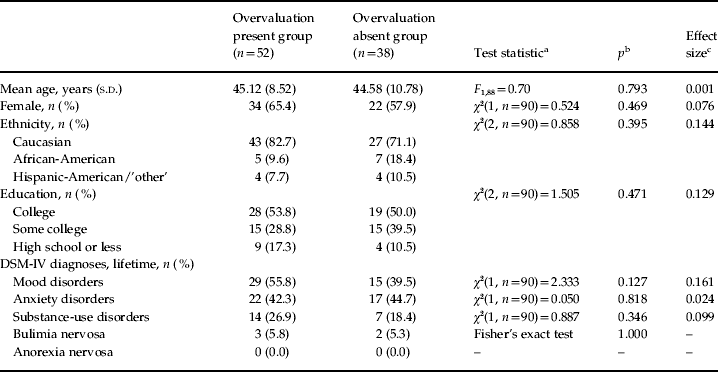
Of the 90 participants, 52 (58%) were categorized with overvaluation at baseline and 38 (42%) without overvaluation. Table 1 summarizes the demographic and psychiatric characteristics of the groups with and without overvaluation and the statistical tests. The two groups did not differ significantly in age, gender, ethnicity/race or education. The two groups did not differ significantly in lifetime rates of mood, anxiety, substance-use disorders, or other eating disorders (bulimia nervosa, anorexia nervosa) characterized by shape/weight concerns.
Demographic and psychiatric characteristics of overvaluation present and overvaluation absent groups

s.d., Standard deviation; DSM-IV, Diagnostic and Statistical Manual of Mental Disorders, Fourth Edition.
a Test statistic = χ2 for categorical variables and analyses of variance (F values) for dimensional variables.
b p Values are for two-tailed tests.
c Effect size measures are Φ coefficients for categorical variables and partial η2 for dimensional variables.
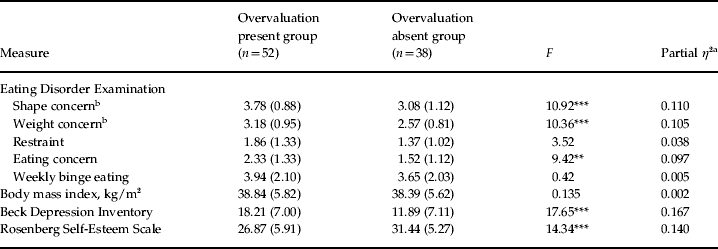
Table 2 summarizes descriptive statistics and findings from ANOVAs, including effect size measures (partial η2) comparing the overvaluation groups on the clinical study measures at baseline. The overvaluation groups did not differ significantly in BMI. Moreover, BMI was not significantly correlated with (continuous) scores on the overvaluation shape/weight composite (r = 0.023, p = 0.833), overvaluation weight item (r = 0.041, p = 0.698), or overvaluation shape item (r = 0.002, p = 0.987); change in (continuous) scores of overvaluation from baseline to 12-month follow-up was not significantly correlated with change in BMI (r = 0.066, p = 0.585). As shown in Table 2, the groups also did not differ in binge eating frequency or EDE restraint scores. The overvaluation group reported significantly greater levels of eating disorder psychopathology (EDE eating-, shape- and weight-concern scales, with the relevant items excluded from the scores) and depression levels, and significantly lower self-esteem.
Clinical characteristics of overvaluation present (n = 52) and overvaluation absent (n = 38) groups
Data are given as mean (standard deviation).
a Partial η2 is an effect size measure (cut-off conventions are 0.01–0.09 for small effects and 0.10–0.24 for medium effects).
b The Eating Disorder Examination shape concern and weight concern scale scores were calculated without their respective overvaluation items included in the interview's standard scoring methods. If the overvaluation items were to be included, the means of these scales would be as follows: 3.87 (s.d. = 0.86) (shape concern) and 3.45 (s.d. = 0.76) (weight concern) for the group categorized with overvaluation present and 2.87 (s.d. = 1.01) (shape concern) and 2.42 (s.d. = 0.66) (weight concern) for the group categorized as overvaluation absent.
** p < 0.01, *** p < 0.001.
Overvaluation of shape/weight and binge eating remission outcomes
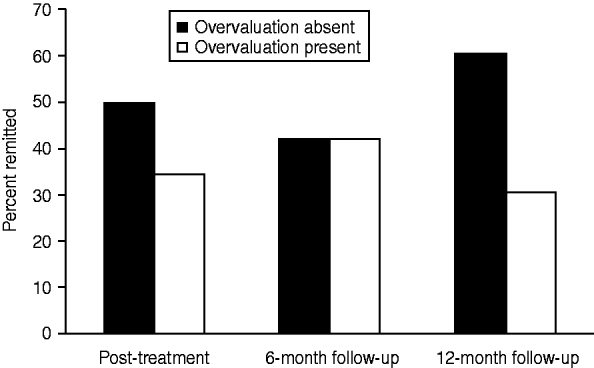
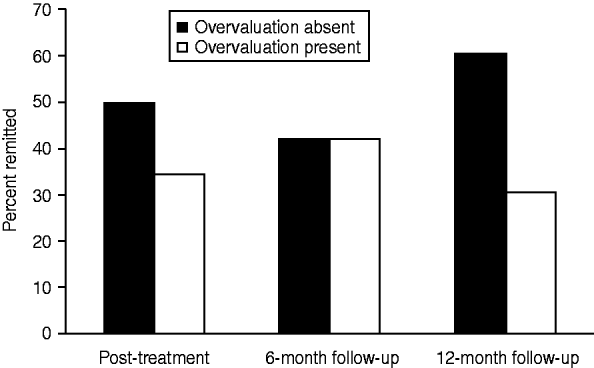
Overall, the following rates of binge eating remission were observed over time: 41.1% (n = 37) at post-treatment, 42.2% (n = 38) at the 6-month follow-up and 43.3% (n = 39) at the 12-month follow-up. Fig. 1 summarizes the proportion of participants with versus without overvaluation who achieved binge eating remission at post-treatment and at the 6- and 12-month follow-ups. Overvaluation did not significantly predict remission at post-treatment or at the 6-month follow-up. Patients categorized with overvaluation at baseline did not have significantly different remission rates at post-treatment (34.6%, n = 18/52) than patients without overvaluation (50%, n = 19/38) [χ2(1, n = 90) = 2.15, p = 0.14, Φ coefficient = 0.15]. Similarly, patients categorized with overvaluation at baseline did not have significantly different remission rates at the 6-month follow up (42.3%, n = 22/52) than patients without overvaluation (42.1%, n = 16/38) [χ2(1, n = 90) = 0.00, p = 0.985, Φ coefficient = 0.002]. However, patients categorized with overvaluation at baseline were significantly less likely to remit at the 12-month follow-up (30.8%, n = 16/52) than patients without overvaluation (60.5%, n = 23/38) [χ2(1, n = 90) = 7.92, p = 0.005, Φ coefficient = 0.30]. The significant association between overvaluation at baseline and lower likelihood of remission at the 12-month follow-up was also observed when using an even more stringent definition of remission (i.e. zero binge eating episodes during the previous 3 months) [χ2(1, n = 90) = 8.37, p = 0.004, Φ coefficient = 0.31].
Baseline overvaluation of shape/weight and binge eating remission rates during 12 months of follow-up. Percentage of participants categorized with overvaluation present versus absent at baseline who achieved remission from binge eating at post-treatment, and at 6-month and 12-month follow-up assessments. Data are for all randomized patients (n = 90) in intent-to-treat analyses (baseline carried forward method for instances of missing data).
Since the overvaluation group had significantly higher depression levels and lower self-esteem levels than the group without overvaluation at baseline, we tested whether adjusting for these group differences (BDI and RSE scores) would attenuate the findings for overvaluation. Logistic regression predicting remission at 12 months adjusting for both depression and self-esteem revealed that overvaluation remained a significant predictor [χ2(1) Wald statistic = 3.93, p < 0.05; Exp(B) = 2.63 (95% confidence interval 1.01–6.86)]; BDI and RSE were both non-significant in this model [(χ2(1) Wald statistic = 0.03, p = 0.86 and χ2(1) Wald statistic = 2.02, p = 0.16, respectively].
Overvaluation and time course of binge eating frequency
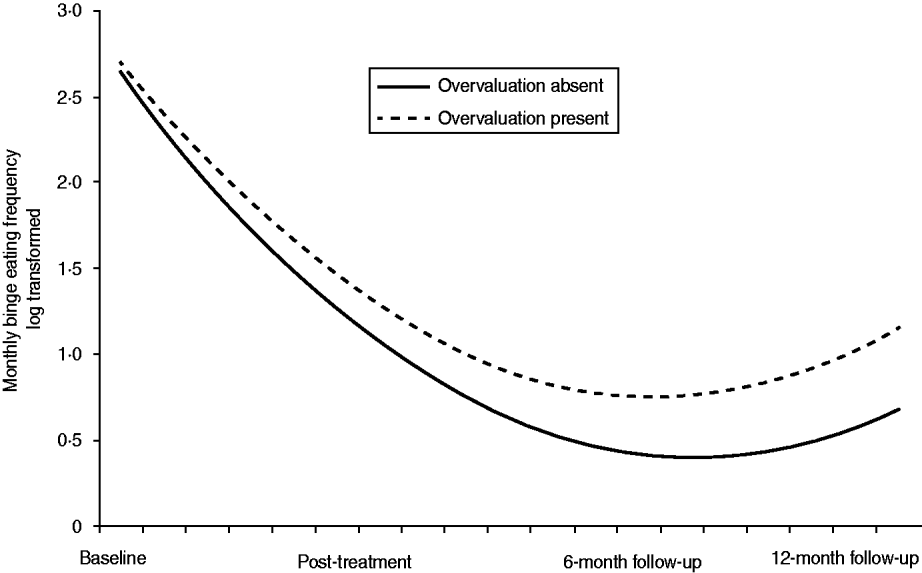
Fig. 2 shows the frequency of binge eating by participants categorized with versus without overvaluation throughout the course of the study. Data shown in Fig. 2 are estimated parabolas for estimated marginal means of log-transformed data derived from mixed-models analyses with time modeled continuously; a significant interaction between overvaluation and linear time was found (F 1,127 = 4.20, p = 0.042). The final model, however, had a significant quadratic effect of time (F 1,175 = 89.58, p < 0.0001), which makes it difficult to directly interpret the significant interaction (i.e. where exactly are the slopes different). Thus, mixed models were performed with time categorically modeled and these revealed significant main effects for treatment (F 1,72.3 = 5.92, p < 0.02) and for time (F 3,67.4 = 107.14, p < 0.0001) and a significant two-way interaction between overvaluation and time (F 3,67.4 = 2.97, p = 0.04). Follow-up tests revealed that participants categorized with overvaluation at baseline had significantly greater frequencies of binge eating than those without overvaluation at the 12-month follow-up (F 1,72.2 = 6.37, p = 0.01). The three-way interaction between overvaluation, time and treatment was not statistically significant (F 3,67.4 = 1.72, p = 0.17); thus, the effects of overvaluation did not vary significantly by treatment (i.e. overvaluation did not significantly moderate CBT versus BWL treatment outcomes over time, although this study was not powered for a three-way interaction).
Baseline overvaluation of shape/weight and binge eating frequency during 12 months of follow-up. Monthly frequency of binge eating by participants categorized at baseline with overvaluation present versus absent throughout the course of the treatment study and follow-up period. The data shown are based on estimated marginal means of log-transformed data (derived from mixed-models analyses) for all 90 participants.
We performed a further analysis using the same models in which we tested the effects of overvaluation adjusting for depression and self-esteem levels. Relevant interactions between both BDI and RSES and other factors were considered and non-significant interactions were dropped from the model one at a time to ensure that the model at each step was hierarchically well formulated. Analyses revealed that adjusting for both BDI and RSES did not alter the significance of the other effects of the models reported above. When adjusting for both depression and self-esteem, the interaction between overvaluation and time remained significant (F 3,67.46 = 2.98, p = 0.038) and the overvaluation group had significantly higher binge eating frequency at the 12-month follow-up (F 1,75.6 = 5.00, p = 0.028).
Discussion
The present study examined the concurrent and predictive significance of overvaluation of shape/weight in obese patients with BED participating in a randomized clinical trial testing CBT and BWL treatments through to 12 months of follow-up after completing treatments. Overall, 58% of participants with BED were categorized with overvaluation, a figure that is comparable with that reported for previous clinical samples (Hrabosky et al. Reference Hrabosky, Masheb, White and Grilo2007; Grilo et al. Reference Grilo, Hrabosky, White, Allison, Stunkard and Masheb2008, Reference Grilo, White and Masheb2012). Participants categorized with overvaluation did not differ significantly in demographic features or psychiatric co-morbidity from participants categorized without overvaluation. Overvaluation was not associated with either BMI or binge eating frequency at baseline – suggesting it does not merely reflect concerns about excess weight or more frequent binge eating – but was associated with significantly greater eating disorder psychopathology, higher depression levels and lower self-esteem. In terms of predictive significance, the presence of overvaluation at baseline significantly predicted lower rates of remission from binge eating and higher frequency of binge eating at 12-month follow-ups after completing treatments.
These findings extend reports regarding concurrent validity from specialty research clinics (Hrabosky et al. Reference Hrabosky, Masheb, White and Grilo2007; Grilo et al. Reference Grilo, Crosby, Masheb, White, Peterson, Wonderlich, Engel, Crow and Mitchell2009), generalist primary care settings (Grilo et al. Reference Grilo, White and Masheb2012) and community samples (Goldschmidt et al. 2001; Grilo et al. Reference Grilo, Masheb and White2010b). The prognostic findings also extend those reported for shorter-term post-treatment outcomes by Masheb & Grilo (Reference Masheb and Grilo2008) for guided self-help treatments and Grilo et al. (in press) for CBT and medication to longer-term (12-month follow-up) outcomes for intensive group-delivered CBT and BWL treatments for BED. We note that unlike the two previous studies (Masheb & Grilo, Reference Masheb and Grilo2008; Grilo et al. in press), the differences between overvaluation groups did not diverge significantly until the 12-month follow-up. We note that the different findings observed at post-treatment across these studies may perhaps be due partly to the different patterns of outcomes – i.e. the intensive CBT and BWL treatments in the current study produced significant and robust outcomes with fewer differences between study treatments than the previous studies that included less effective methods. Thus, the effective treatments in the present study may have dampened to some degree the negative impact of overvaluation until the follow-up period. These findings are consistent with those from two studies of bulimia nervosa that reported prospective associations between overconcern with shape/weight and the relapse process following remission in a naturalistic follow-up study (Keel et al. Reference Keel, Dorer, Franko, Jackson and Herzog2005) and specifically during the 12-month follow-up period after completing a 4-month controlled treatment study (Fairburn et al. Reference Fairburn, Peveler, Jones, Hope and Doll1993b). Collectively, these findings suggest that overvaluation plays a role in the course of BED and bulimia nervosa consistent with cognitive–behavioral models of eating disorders (Fairburn et al. Reference Fairburn, Cooper and Shafran2003).
Importantly, the significant predictor findings for overvaluation of shape/weight (for both lower remission rates and higher binge eating frequencies at 12-month follow-ups) persisted even after adjusting for group differences at baseline on both depression levels and self-esteem. This is important because prior research has suggested that higher depression coupled with lower self-esteem signals a more disturbed variant of BED (Grilo et al. Reference Grilo, Masheb and Wilson2001c). Grilo et al. (in press) also reported that controlling for depression levels did not change the significant finding for overvaluation predicting lower binge eating remission rates in a study testing CBT and medication. Such findings suggest that, among patients with BED, the presence of overvaluation predicts prospectively unique and meaningful variations in binge eating treatment outcomes.
Collectively, our findings indicate that overvaluation of shape/weight has diagnostic and clinical relevance and warrants consideration as a diagnostic specifier for BED in the DSM-5. Unlike the case of bulimia nervosa, in which clinicians must rate the present or absence of overvaluation for determining the diagnosis, in the case of BED, the presence of overvaluation could denote the presence of a relevant clinical feature (significant body image disturbance) that also signals greater severity. Such specifiers (or subtypes) have been used for some diagnostic categories such as, for example, mood disorders (e.g. with mood-congruent psychotic features, with melancholic features) and other eating disorders (e.g. purging versus non-purging subtypes of bulimia nervosa, binge–purge versus restricting subtypes of anorexia nervosa). The addition of a cognitive feature pertaining to body image to the BED diagnosis would parallel the nosologic structure of other eating disorder diagnoses. In BED, the presence of overvaluation would convey important information about individual differences, not just in the disorder severity, about a clinically significant cognitive feature that has negative prognostic significance. The presence of this cognitive feature could signal to clinicians a more disturbed variant of BED, thus alerting them to patients who might require greater attention.
Strengths of this study include the prospective design (randomized controlled trial testing distinct and effective manualized treatments) and rigorous multi-method assessments administered by doctoral research clinicians through to 12 months of follow-up. In terms of potential limitations, our findings are limited to treatment-seeking obese persons with BED who responded to advertisements for treatment studies at a university medical center and may not generalize to different clinical settings, treatment methods (e.g. medication or other forms of interventions), persons not willing to participate in research, or to patient groups of different ethnic/racial or educational backgrounds, or to persons with BED without co-morbid obesity. A recent study performed in a general primary-care setting with an ethically diverse patient group reported overvaluation did not differ across ethnic/racial groups and similar findings regarding the concurrent validity of overvaluation but did not report outcome or predictive validity results (Grilo et al. Reference Grilo, White and Masheb2012). Although we observed no association between BMI and overvaluation, it is possible that our inclusion requirement of BMI of ⩾30 kg/m2 may have obscured a potential limitation. However, we note that previous studies with wider weight ranges and with different diagnostic groups also did not observe an association between overvaluation and BMI (Grilo et al. Reference Grilo, Crosby, Masheb, White, Peterson, Wonderlich, Engel, Crow and Mitchell2009). Our findings may not generalize past 12 months of follow-up. In addition, BWL was delivered by specialist doctoral-level research clinicians and it remains uncertain whether similar outcomes would be achieved by generalist clinicians who typically deliver BWL in non-university settings. Finally, we note that our sample size was not powered to detect a three-way interaction (needed to indicate moderation). However, we emphasize that although overvaluation did not moderate treatment outcomes (the three-way interaction was non-significant), such a finding is not needed to argue for overvaluation as a specifier. The non-specific prediction of treatment outcomes found here and previously (Grilo et al. in press) suffices as rigorous support for a specifier. Larger prospective outcome studies with more diverse patients and clinical settings are needed.
Acknowledgements
This research was supported by National Institutes of Health grants to C.M.G. (no. R01 DK49587 and K24 DK070052).
Declaration of Interest
None.