INTRODUCTION
South Atlantic reefs have a relatively poor, but endemic-rich coral fauna, which is constituted mainly of massive corals (Leão & Dominguez, Reference Leão and Dominguez2000). These coral forms do not create a large number of microhabitats, since they are structurally less complex than corals from other regions such as the tropical Caribbean and Indo-Pacific (e.g. Acropora spp.). One exception are the fire corals Millepora spp. (Hydrozoa), which act as important foundation species contributing to the establishment of reef-associated organisms (Garcia et al., Reference Garcia, Matthews-Cascon and Franklin-Junior2008, Reference Garcia, Matthews-Cascon and Franklin-Junior2009). The powerful nematocysts of Millepora spp. are noted for producing an intense burning sensation in humans, exceeding the irritation produced by contact with most scleractinian coral colonies (Lewis, Reference Lewis1989). The two most abundant Millepora species along the Brazilian coast and oceanic islands are the branching M. alcicornis (Linnaeus, 1758) and M. braziliensis Verrill, 1868 (Amaral et al., Reference Amaral, Steiner, Broadhurst and Cairns2008).
The structural complexity generated by the colony branches of Millepora species harbours a great diversity of organisms, including crustaceans, worms, fishes and other organisms living in close association (Patton, Reference Patton1994; Garcia et al., Reference Garcia, Matthews-Cascon and Franklin-Junior2008, Reference Garcia, Matthews-Cascon and Franklin-Junior2009; Coker et al., Reference Coker, Pratchett and Munday2009). These animals may stay near to the branching coral or even live among its branches, probably due to the proximity to their food items, which can be the coral or epibionts (see Ciardelli, Reference Ciardelli1967; Rotjan & Lewis, Reference Rotjan and Lewis2008). Moreover, other organisms may associate with branching corals during breeding or for shelter and protection against predators (Munday et al., Reference Munday, Jones and Caley1997; Gibran et al., Reference Gibran, Santos, Santos and Sabino2004).
Several fish species feed on calcareous cnidarians in reefs or use these substrata to feed on the associated macrofauna (Cole et al., Reference Cole, Pratchett and Jones2008; Rotjan & Lewis, Reference Rotjan and Lewis2008; Garcia et al., Reference Garcia, Matthews-Cascon and Franklin-Junior2009). However, detailed descriptions of such relationship are poorly described for south-west Atlantic reefs, where branching corals are relatively scarce (Leão & Dominguez, Reference Leão and Dominguez2000). In this context, the present study is the first to describe the foraging behaviour of reef fishes on the colonies of the branching fire corals Millepora spp.
MATERIALS AND METHODS
For this study, approximately 40 hours of underwater observations (snorkelling and SCUBA diving) were performed in two different reef systems of Pernambuco State (north-eastern Brazil); Tamandaré reefs (8°44′S and 35°05′W) and Fernando de Noronha archipelago (3°54′S 32°25′W). Both sites feature large and prominent colonies of Millepora spp. (Eston et al., Reference Eston, Migotto, Oliveira Filho, Rodrigues and Freitas1986; Maida & Ferreira, Reference Maida and Ferreira1997) and have relatively clean, transparent and warm waters. The prominent coral reef in Tamandaré is located approximately 300 m offshore and has a substrate dominated by macroalgae (including the genera Sargassum, Padina and Caulerpa) and massive corals (e.g. Montastraea and Mussismilia). On the other hand, Fernando de Noronha contains several habitat types, including oyster reefs, rocky shores, reef flats and parts of shipwrecks which are sparsely distributed in specific areas of the shore (Eston et al., Reference Eston, Migotto, Oliveira Filho, Rodrigues and Freitas1986; Souza et al., Reference Souza, Ilarri and Rosa2011). In this system the benthos is mostly represented by encrusting coralline algae, foliose seaweeds, algal turfs and cnidarians (Eston et al., Reference Eston, Migotto, Oliveira Filho, Rodrigues and Freitas1986). During dives, 66 colonies were randomly investigated (46 on Tamandaré reefs and 26 on Fernando de Noronha archipelago) and all predation events towards the hydrocoral polyps and/or skeleton were noted on PVC slates. The studied colonies were located 0.5 to 6 m below the surface.
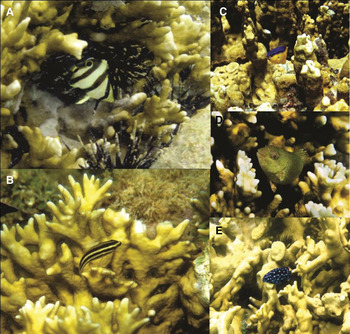
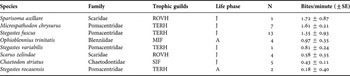
RESULTS
A total of eight reef fish species (predominantly juveniles) were recorded feeding on colonies of Millepora spp. during 35 records (Table 1; Figure 1). In Tamandaré, the highest bite rate was recorded for the grey parrotfish Sparisoma axillare (Steindachner, 1878) (1.72 ± 0.87 bites.min−1), followed respectively by the yellowtail damselfish Microspathodon chrysurus (Cuvier, 1830) (1.61 ± 0.21 bites.min−1), Brazilian dusky damselfish Stegastes fuscus (Cuvier, 1830) (1.35 ± 0.93 bites.min−1), the redlip blenny Ophioblennius trinitatis (Miranda Ribeiro, 1919) (0.97 ± 0.35 bites.min−1), cocoa damselfish Stegastes variabilis (Castelnau, 1855) (0.81 ± 0.24 bites.min−1), Zelinda's parrotfish Scarus zelindae (Moura, Figueiredo & Sazima, 2001) (0.58 ± 0.35 bites.min−1) and banded butterflyfish Chaetodon striatus (0.43 ± 0.11 bites.min−1). In Fernando de Noronha, adults of Rocas gregory Stegastes rocasensis were also recorded feeding on the polyps of the fire coral at a low rate. However, S. rocasensis juveniles were constantly found in close association with Millepora spp. colonies using the corals as a refuge.
Chaetodon striatus (A) and Scarus zelindae (B) feeding on the fire coral polyps in Tamandaré reef; Stegastes rocasensis (C), Sparisoma axillare (D) and Microspathodon chrysurus (E) were also recorded feeding on the Millepora spp. colonies.

List of reef fishes and families, trophic guilds*, and life phase (A, adult; J, juvenile). N, number of observed individuals feeding on the Millepora spp. coral colonies.

*, trophic guilds based on Ferreira et al. (Reference Ferreira, Floeter, Gasparini, Joyeux and Ferreira2004): ROVH, roving herbivores; TERH, territorial herbivores; MIF, mobile invertebrate feeders; SIF, sessile invertebrate feeders.
DISCUSSION
In the present study, the fish predation events on Millepora spp. were performed mostly by fish that are predominantly considered herbivorous (e.g. damselfishes and parrotfishes) (Ferreira et al., Reference Ferreira, Floeter, Gasparini, Joyeux and Ferreira2004). Since most of the predation recorded here was performed by juvenile individuals of these groups, this could be indicative that these fishes may often search for other food items during their juvenile stage (Ferreira et al., Reference Ferreira, Gonçalves, Coutinho and Peret1998). Moreover, all predation events seemed to focus on the polyps or mucus, with no apparent injuries to the skeleton of the hydrocorals.
In Brazilian waters, Bonaldo et al. (Reference Bonaldo, Krajewski, Sazima and Sazima2006) and Francini-Filho et al. (Reference Francini-Filho, Moura, Ferreira and Coni2008) recorded corallivorous behaviour for reef fishes. The former study was also performed in Fernando de Noronha and recorded that two parrotfish species (Sparisoma amplum and S. frondosum) occasionally took bites of Millepora spp., but the authors argued that this behaviour may have related to territorial behaviour of the adults, which does not apply to our study, since our records refer primarily to juveniles, that may use the hydrocorals for shelter and feeding. Francini-Filho et al. (Reference Francini-Filho, Moura, Ferreira and Coni2008) analysed the foraging behaviour of parrotfish on massive corals (e.g. Mussismilia braziliensis, Montastrea cavernosa and Siderastrea spp.) on Abrolhos Bank (eastern Brazil) and found high feeding rates of Scarus trispinosus (17.8± 1.8 bites.min−1) and juvenile Sparisoma amplum (7.0 ± 0.7 bites.min−1).
Parrotfishes are the main group that feed on corals in the western Atlantic, both on Caribbean (Bruckner & Bruckner, Reference Bruckner and Bruckner1998; Reyes-Nivia et al., Reference Reyes-Nivia, Garzón-Ferreira and Rodríguez-Ramírez2004; Rotjan & Lewis, Reference Rotjan and Lewis2006) and Brazilian reefs (Bonaldo et al., Reference Bonaldo, Krajewski, Sazima and Sazima2006; Francini-Filho et al., Reference Francini-Filho, Moura, Ferreira and Coni2008). In these systems, parrotfish densities are relatively high (Bonaldo et al., Reference Bonaldo, Krajewski, Sazima and Sazima2006; Francini-Filho et al., Reference Francini-Filho, Moura, Ferreira and Coni2008) and since the coral consumption by parrotfish can be detrimental for corals (Francini-Filho et al., Reference Francini-Filho, Moura, Ferreira and Coni2008), it should be expected that these species may play an important role in the ecology of Millepora spp. in Brazil. However, the impact of these fish on tropical reefs has been controversial, because many species cause only minor damage to the corals (mucus-feeders), although a few excavators feed by removing live coral tissue with major portions of the underlying skeleton (Rotjan & Lewis, Reference Rotjan and Lewis2008, Bonaldo et al., Reference Bonaldo, Krajewski and Bellwood2011).
The family Chaetodontidae is well known for using corals as a main food resource, both in studies from stomach contents analysis (Sano, Reference Sano1989) and in observations of feeding behaviour (Gregson et al., Reference Gregson, Pratchett and Berumen2008). Moreover, it was established that juvenile buterflyfishes can cause a decline in coral tissue (Pratchett & Cole, 2010). Nevertheless, Bonaldo et al. (Reference Bonaldo, Krajewski and Sazima2005) and Bellwood et al. (Reference Bellwood, Klanten, Cowman, Pratchett, Konow and Van Herwerden2010) noted low foraging rates for Chaetodon striatus, which may be associated with peak activity of the species throughout the day or even rejection of corals from the genus Millepora in the diet of this species.
Four species from the family Pomacentridae were observed in feeding association with fire coral in this study. Moreover, in Tamandaré reefs (Pernambuco State) the genus Stegastes occurs in high frequency on colonies of Millepora spp., using them as a shelter or even as part of the territory (Leal et al., unpublished data). Pomacentridids are reef fishes that most often live associated with the structure of staghorn coral colonies (Precht et al., Reference Precht, Aronson, Moody and Kaufman2010; Johnson et al., Reference Johnson, Holbrook, Schmitt and Brooks2011), and there is a wide variation in food frequency between species. The presence of these individuals is so significant that they can even modify the structures of the fish communities associated with hard corals (Johnson et al., Reference Johnson, Holbrook, Schmitt and Brooks2011).
A high diversity of fauna associates with the complex structure of Millepora spp., including micro- and macrofaunal invertebrates (e.g. protozoans, molluscs, crustaceans and annelids) (Lewis, Reference Lewis1989; Amaral et al., Reference Amaral, Steiner, Broadhurst and Cairns2008; Garcia et al., Reference Garcia, Matthews-Cascon and Franklin-Junior2008) and the number of associated individuals has been reported to be directly related to the volume of the colony (Garcia et al., Reference Garcia, Matthews-Cascon and Franklin-Junior2009). These invertebrates are often eaten by reef fish feeding on other substrata such as algae and seagrass beds (McCormick, Reference McCormick1995; Pereira et al., Reference Pereira, Ferreira and Rezende2010), thus the occurrence of associated fauna and provided refuge may support the frequent foraging behaviour observed in the present study. The observed feeding events mostly occurred on the body and extremities of the Millepora spp. colonies, areas with a greater availability of crustaceans and echinoderms (Garcia et al., Reference Garcia, Matthews-Cascon and Franklin-Junior2008).
This study indicated that fish may associate with Millepora spp. not only for shelter, but that juvenile fishes may feed on the soft tissues of the hydrozoan, its mucus or small epibionts. The relationships between reef fishes and hydrocorals of the genus Millepora have not been evaluated properly on south-west Atlantic reefs and so further studies of the diets and the feeding behaviours of the associated ichthyofauna should be undertaken.
ACKNOWLEDGEMENTS
We thank CAPES, CNPQ and IDEA WILD for financial and technical support, and Joao Lucas Feitosa, Roberta Bonaldo and Juergen Herler for reviewing the manuscript.