1 Introduction
One of the notable properties of adjectives is that they can be doubly modified (e.g. Oostdijk Reference Oostdijk and Aijmer2001). They can be modified by deadjectival (and other) adverbs and they can be graded by adverbs such as more and most. (Grading can be seen as a special case of modification.) Comparison markers precede the adjective to be expanded, as in (1a), while some deadjectival adverbs may precede or follow the adjectival head, as shown in (1b) and (1c), respectively.
(1)
(a) Such communities are likely to be more conservative.
(b) Such communities are likely to be linguistically conservative.
(c) Such communities are likely to be conservative linguistically.
The fact that adjectives can be graded and modified at the same time in the same position creates an intriguing sequencing conflict. Does the comparison marker precede or follow the deadjectival adverb? Surprisingly perhaps, the grammar of English does not decide this issue categorically. Both options are well-formed, as can be seen in (2a) and (2b). There is, of course, no obstacle to grading a postmodified adjective, as exemplified in (2c).
(2)
(a) Such communities are likely to be more linguistically conservative.
(b) Such communities are likely to be linguistically more conservative.
(c) Such communities are likely to be more conservative linguistically.
All three variants are no doubt impeccable. While they are largely interchangeable, there are subtle differences in information structure. These tripartite ADJPs are hierarchically structured. Following Dryer (Reference Dryer1992), we distinguish between branching and non-branching categories. The former are of a phrasal and the latter of a more lexical nature. Given that lexical elements form paradigms in a way that phrasal elements do not, a lexical unit may be argued to serve as a kind of frame into which the branching phrase is integrated. Bearing in mind that paradigms are micro-systems built on contrast (e.g. Jakobson Reference Jakobson, Jakobson and Halle1971), we may begin to understand the difference between (2a) and (2b). In (2b), the lexical element is the adverb linguistically. This adverb provides the domain ‘language’ to which more conservative is applied. It creates an implicit contrast with technologically, financially, politically etc. In (2a), by contrast, the comparative marker more is the non-phrasal element with which linguistically conservative is associated (see next section for a closer analysis). The item more thus forms an implicit contrast with its antonym less and perhaps other more lexical degree adverbs such as highly and moderately. In a nutshell, the order in (2b) profiles the domain while the order in (2a) profiles the comparison.
Option (2c) is similar to (2b) in that the domain adverb linguistically is highlighted. The fact that this adverb precedes the phrasal constituent in (2b) but follows it in (2c) has a pragmatic effect. Due to the principle of end-of-sentence focus (e.g. Quirk et al. Reference Quirk, Greenbaum, Leech and Svartvik1985; Lambrecht Reference Lambrecht1994; Crystal Reference Crystal2004), more emphasis is put on linguistically in final position in (2c) than in non-final position in (2b).
Relatively little is known about the modification patterns of complex ADJPs. It is worth noting that introductory textbooks (e.g. Radford Reference Radford1988; Brinton & Brinton Reference Brinton and Brinton2010; Burton-Roberts Reference Burton-Roberts2011) mention only a single type, which is exemplified in (3).
(3) Boston is more distinctly European than any other US city.
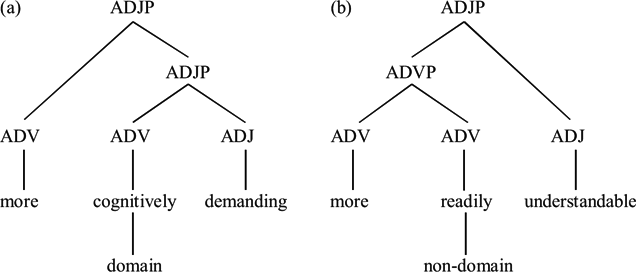
The comparative marker modifies the adverb distinctly rather than the adjective European (how European?). On a traditional Immediate Constituents analysis, the modification of the deadjectival adverb by the comparative marker yields a left-branching structure, as in (4). It is striking that this is the mirror image of the structure of the ADJP in (2c) with exactly the same word order, as shown in (5).
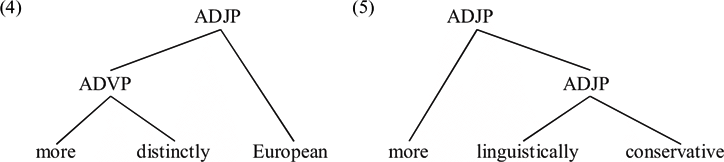
The structural contrast displayed in (4) and (5) is reminiscent of syntactic ambiguity in identical surface strings such as more interesting ideas. This NP has a left-branching structure when more is a comparison marker but a right-branching structure when more functions as a quantifier. Even closer to the ADJPs in (4) and (5) are the disparate structural representations required by non-identical strings such as The policeman watched the spy with suspicion vs The policeman watched the spy with freckles. Whereas the former sentence links up the PP with the VP, the latter sentence integrates the PP into the object-NP. Thus, there is a certain independence between surface strings and their structural representations.
The theoretical issue raised by cases like (4) and (5), for instance, is the nature of the input that is necessary to erect a syntactic representation. It is far from obvious how much lexical information has to go into building phrase markers. As the above examples show, terminal nodes alone cannot do the job. The word classes and their order are identical in (4) and (5). It has to be determined therefore how deep we have to reach into the lexicon in order to gain access to all the information which is needed to build up the appropriate phrase structure. As is evident, this touches on the relationship between lexicon and grammar and the degree of their mutual influence.
The focus of the ensuing analysis is on the internal structure and the order of the constituents of tripartite ADJPs. These two issues are rather closely related. Order variation tends to go together with structural variation. For example, no order other than quantifier–adjective–noun as in some interesting ideas is acceptable in English. This rigidity obviously limits structural variation. With more ordering freedom, as found in complex ADJPs for example, the potential range of structural variation expands considerably. However, what effect order freedom has on structural representations has yet to be ascertained.
The present article offers a corpus-based syntactic analysis, setting up a complete inventory of ADJPs and determining their textual frequency. It thus has both a qualitative and a quantitative grounding. This combined approach allows us to examine branching direction and ordering preferences in different types of ADJPs. From a broader perspective, this study can be viewed as an extension of previous corpus work on morphological structures (Berg Reference Berg2003) to the syntactic level (see also Berg Reference Berg2011). This seems all the more desirable as quantitative syntactic investigations of branching direction are at a premium.
2 Structure, function and some predictions
The following predictions will be developed largely on the basis of the ADJP more linguistically conservative in its different order manifestations because this type of ADJP allows for maximum order variation. Our first task is to determine the branching direction of the three possible word orders in (2). The only order which requires little discussion is (2b). The ADJP linguistically more conservative is clearly right-branching since the comparison marker grades the adjectival head while the adverb modifies the ADJP more conservative. It seems only logical to extend this reasoning to the adverb-final order in (2c). Because the adverb frames more conservative to its left, a left-branching structure appears appropriate for more conservative linguistically. The main argument against right-branching is that the comparison marker modifies the adjective, not the adverb. Sceptics might object that the pronominalization test identifies conservative linguistically as a constituent, as in Some communities are more conservative linguistically while others are less so. However, the proform so is notorious for the variety of constituents (and non-constituents) that it can replace (Keizer Reference Keizer2012). In the case at hand, it probably replaces the adjective on its own rather than the fake constituent conservative linguistically. Therefore, pronominalization by means of so is not a compelling argument against the left-branching analysis of (2c).
The most interesting case is undoubtedly the more–adverb–adjective string. As we saw in (4) and (5), this particular word order may give rise to left- and right-branching. One wonders which factor (or set of factors) brings about this disparity in branching direction. It is an indisputable fact of English grammar that, generally speaking, both adjectives and adverbs can be graded. Does this imply that the comparison marker in more linguistically conservative can modify linguistically or conservative? To be on the safe side, let us replace the concocted example (2a) with an authentic example. Not surprisingly, the linguistic behaviour of social groups is a recurrent theme in sociolinguistic (and other) research. Here is a typical example borrowed from Joseph (Reference Joseph and Preece2016: 25).
(6) Since the 1970s, it has been a regular finding in sociolinguistic research that women are more linguistically conservative than men.
Obviously, the author makes no claim as to women's conservative attitudes in general. Instead, reference is made to linguistic conservatism and the finding that this conservatism is stronger in one social group than another. Hence, more linguistically conservative is unequivocally right-branching in (6). Ultimately, the reason for this particular structure is that, as noted in the introductory section, the adverb linguistically defines a domain. Crucially, domain adverbs cannot be graded (Quirk et al. Reference Quirk, Greenbaum, Leech and Svartvik1985: 569; Ernst Reference Ernst2002: 282). Domains are present or absent and thus leave no room for gradience. By contrast, because the deadjectival adverb in more distinctly European is not a domain adverb, it is susceptible of modification by the comparison marker in (4).
English is known to be a predominantly right-branching language (Berg Reference Berg2009) and right-branching is widely regarded as easier to process than left-branching (e.g. Yngve Reference Yngve1960). This asymmetry leads to the prediction that right-branching ADJPs should be more common than left-branching ones in English. This prediction can be broken down into two more specific hypotheses. The right-branching structure linguistically more conservative (2b) is expected to be more frequent than the left-branching structure more conservative linguistically (2c). Additionally, the right-branching structure more linguistically conservative (2a) is predicted to be of higher frequency than the left-branching structure more distinctly European (4), all other things being equal.
Turning to word order, we may formulate two rival predictions as to the frequency of the three ordering options in (2). Berg (in press) argues that there is a pervasive tendency in English and other languages to have the more frequent element precede the less frequent one in the linear representation of speech. Because more as a grammatical marker occurs more often than most other adverbs, ADJPs with more in initial position (2a, c) may be predicted to be of higher textual frequency than ADJPs with the deadjectival adverb in first and more in second position (2b).
On the other hand, options (2b) and (2c) would appear to involve a more natural serialization strategy than (2a). In (2b) and (2c), the comparative marker is adjacent to the adjective to be graded. This word order honours the principle of proximity whereby syntactic relationships are more likely to hold between adjacent than between non-adjacent units (e.g. Behaghel Reference Behaghel1932; Givón Reference Givón1991; Rys & De Cuypere Reference Rys and Cuypere2014). By contrast, (2a) places the comparative marker next to the deadjectival adverb, which it does not modify. The proximity principle would accordingly predict ADJPs with more being followed by an adjective (2b, c) to be more frequent than ADJPs with more being followed by an adverb (2a). As regards the options (2a) and (2b), this is the exact opposite of what the frequency hypothesis leads us to expect.
While option (2c) (more conservative linguistically) is supported by both proximity and frequency, it conflicts with a general ordering rule of English which puts the adverb in front of the adjective. Bipartite ADJPs such as awfully cold do not permit the placement of the adverb in phrase-final position. This ban forms the basis for the prediction that the more–adjective–adverb order in (2c) is a dispreferred option.
Combining the structural and the positional arguments yields a heterogeneous picture which is complicated by the fact that the relative strength of the various factors is hard to assess. On the assumption that branching direction predominates, the left-branching ADJP more–adjective–adverb (2c) is expected to be the least frequent of the three options. Whether the order more–adverb–adjective (2a) is more or less frequent than the order adverb–more–adjective (2b) depends on the relative weight of proximity and frequency. If the proximity principle wins out, option (2b) will outnumber option (2a); if, by contrast, the frequent-unit-first hypothesis prevails, option (2a) will be preferred to option (2b).
3 Method
A sample of ADJPs was compiled on the basis of the British National Corpus (BNC). All ADJPs consisted of the following three components: the adjectival head, a deadjectival adverb ending in -ly and a grading adverb, henceforth called ‘grader’ for short. All three possible orders inside ADJPs were taken into consideration. Thus, the following three BNC search terms were used.
• grader *ly&AVO&AJ?
• *ly&AVO grader & AJ?
• grader & AJ? *lyAVO
The large number of potential graders made it necessary to limit the analysis to a few items. The principal criterion for inclusion was not the frequency of the individual graders in general language usage but rather the frequency with which the graders occurred in ADJPs with two preposed modifiers. In addition to the two main comparison markers more and most, the negative comparison marker less and the intensifier very were included in the analysis. Of all degree adverbs, very turned out to be by far the most frequent, while many others such as moderately and relatively occurred so seldom in tripartite ADJPs that they could not be subjected to statistical testing. Because the same was true of the superlative least, it was also discarded. The inclusion of four graders allowed us to examine grader-specific effects.
The computer-assisted search was almost arbitrarily limited to the BNC files A0–B7 consisting of 18.281.219 orthographic words. The hits yielded by this search were subsequently checked for their validity. The first and foremost requirement was that all three constituents had to belong to the same ADJP. That is, all cases in which one constituent associates outside the ADJP were eliminated. Several degrees of certainty may be distinguished here. Two very clear cases are shown in (7) and (8). Henceforth, the critical parts are italicized for easy identification.
(7) He even disquieted the hardened revolutionaries he moved among, most notably old Bakunin.
(8) If the police are to continue to exercise control over an increasingly pluralist society, which is better educated and less willing simply to accept any version of events handed out by the powerful, then it seems essential that . . .
In (7), there is no ADJP. The ADVP most notably modifies the nominal old Bakunin. Together the two constituents form an NP. The adverb simply in (8) is not associated with the preceding ADJP but rather with the following non-finite VP.
The variable scope of adverbs may cause difficulties in their unequivocal association. Consider the phrase-final adverb in (9) and the phrase-initial adverb in (10).
(9) His brother said that he had been more excitable lately, and more ineffective, and running up and down more.
(10) Expect to pay around £16 to £18 for five litres in white (colours are generally more expensive).
Example (9) contains the adverb lately in phrase-final position, which is a wide-scope temporal adverb and as such likely to be part of the VP. While the structural analysis is reasonably clear for (9), cases like (10), for instance, defy an unequivocal interpretation. The qualifying adverb generally allows for the two alternative representations shown in (11) and (12).

There seems to be no principled basis for arbitrating between (11) and (12). The difference in scope between (11) and (12) does not entail any tangible difference in meaning partly because of the minimum semantic content contributed by the copula to be. Both structural representations may therefore be regarded as equally valid. Remarkably, this ambiguity is absent from (13) and (14).
(13) . . . the interchange which has taken place outside the meeting has been at least as useful, and generally more enjoyable, than the actual meeting itself.
(14) . . . we might be entering into a generally more droughty phase than anybody has experienced over the past hundred years or more . . . (from COCA)
The position of generally in (13) in the coordinated ADJP is revealing of its structural representation. Since generally is placed after the conjunction, which itself acts as a barrier, it is obvious that the adverb modifies more enjoyable and thus partakes of the ADJP. The case is equally clear in (14) where the adjective is used attributively (a generally more droughty phase). The occurrence of the adverb inside an NP precludes its attachment to a VP node.
It was decided to employ a maximally inclusive strategy. That is, all cases which are compatible with an ADJP-internal analysis were taken into account. Thus, examples such as (10) found their way into the calculation.
The preceding discussion focused on difficulties surrounding the association of adverbs to ADJPs or higher phrases. The opposite situation also obtains. Some adverbs have to be linked to nodes below the critical ADJP-level. A pertinent example is given in (15).
(15) The West German vessel is considered the world's most sophisticated conventionally powered submarine.
Case (15) illustrates the coordination of the two ADJPs most sophisticated and conventionally powered. Since the adverb conventionally does not modify most sophisticated, such cases were discarded from the analysis.
The items more, most and less serve the double function of comparison markers and quantifiers. While the former modify adjectives and adverbs, the latter modify nouns. Because of this structural difference, all cases in which these words functioned as quantifiers were filtered out. Note that the search term also generated the adverb only. This item was also excluded because it is not a deadjectival adverb.
4 Data analysis
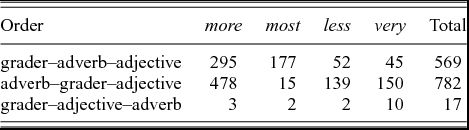
A first survey of the data on which this study rests is displayed in table 1. At this stage, all deadjectival adverbs are treated indiscriminately.
Rate of different orders in ADJPs by type of grader

Table 1 documents an extreme asymmetry in the frequency of the three different word orders. Whereas the adverb-medial and the adverb-initial orders are fairly common, the adverb-final order occurs very seldom. The uncommonness of the grader–adjective–adverb order is largely as predicted, even though it is more extreme than expected. This result meshes well with the general aversion to left-branching in English. The interpretation of the moderate frequency difference between the grader–adverb–adjective and the adverb–grader–adjective order must await a more detailed analysis of the data to which we turn shortly. The major distinction that will be drawn is between domain and non-domain adverbs (see (4) and (5) above). The special nature of domain adverbs, which has repeatedly been commented on in the pertinent literature (e.g. Bellert Reference Bellert1977; McConnell-Ginet Reference McConnell-Ginet1982; Sullivan Reference Sullivan2013), is the chief motivation for this decision.
4.1 Adjective phrases containing domain adverbs
The three possible orders inside ADJPs with domain adverbs are exemplified in (16)–(18).
(16) The relationship with Callaghan was easier not only because his policies were less socially divisive but also because . . . the Thatcherite dream of a . . . meritocracy had no place for a family which reigned simply by blood-right.
(17) Each party puts forward a list of candidates for election in multi-member constituencies, which can often be geographically very large.
(18) In sum, it enables the body to be most able to deal with danger and to be most efficient physically.
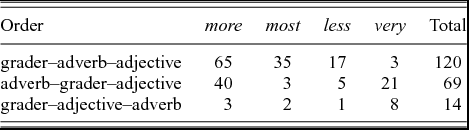
The domain adverb appears in phrase-medial position in (16), in phrase-initial position in (17) and in phrase-final position in (18). As can be seen in table 2, these three orders combine with all four graders.
Rate of different orders in ADJPs with domain adverbs by type of grader

Generally speaking, the grader–adverb–adjective order occurs significantly more often than the adverb–grader–adjective order (binomial, p < 0.001). However, a closer look reveals that this is not completely true. The grader very is heavily biased towards the adverb–grader–adjective order. This preference suggests that very is so closely attached to the adjective that it strongly disfavours an intervening domain adverb. Support for this conclusion comes from the observation that the majority of the ADJPs with grader–adjective–adverb order contain very. Like the adverb–grader–adjective order, this order places very and the adjective next to each other.
By contrast, the link between the three comparison markers and the adjectival head is much weaker. In fact, it is so weak that the insertion of a domain adverb between grader and adjective is considerably more frequent than the adjacency of grader and adjective. The recovery of the syntactic link between the comparison marker and the adjective is not apparently jeopardized by intervening material. It transpires that the three comparison markers and the degree adverb very exhibit quite distinct properties.
The domain adverbs appear to form a rather homogeneous class. No evidence was found for particular adverbs to prefer certain positions in ADJPs.
It may be concluded that the grader–adverb–adjective order stands out as the most frequent one. It is necessary to restrict this conclusion to graders which function as comparison markers. The intensifier very is less compatible with the grader–adverb–adjective order. It is no doubt surprising that the most frequent order is a non-iconic one. It places the grader next to the adverb which it does not modify. In view of the fact that English adheres rather strictly to the proximity principle, this is a noteworthy result.
4.2 Adjective phrases containing adverbs other than domain adverbs
As in the preceding subsection, we begin by illustrating the three different orders, exemplified in (19)–(21).
(19) . . . clinical priorities would determine that the most serious cases are operated on first, with broader and broader indications being accepted as funding becomes more widely available.
(20) Although these rigs will probably be slightly less successful than the hair they will still be consistent catchers but a little bit more attention needs to be paid to ensure that the bait is correctly mounted.
(21) You know, a hung Parliament and a coalition government would be extremely tough for me, very tough internally.
The adverb occurs in phrase-medial site in (19), in phrase-initial site in (20) and in phrase-final site in (21). The three orders are not structurally identical. The simplest case is the grader–adjective–adverb order in (21). The fact that the grader very modifies the adjective tough supports a left-branching analysis. It is a little less obvious to argue that, because less modifies successful in (20), the ADJP slightly less successful possesses a right-branching structure. Apart from the disparate order, a crucial difference between (20) and (21) is the type of adverb involved. While internally cannot modify very in (21), degree adverbs like slightly in (20) for example are in principle compatible with graders, which are by definition quantitative. However, slightly and less do not form a syntactic unit. At least, none of the standard constituency tests yields an unequivocal result. This tallies with the argument from semantics. The ADJP slightly less successful can be paraphrased as ‘less successful (if only) to a minimum degree’. Thus, a right-branching analysis is appropriate for (20).
The grader–adverb–adjective order in (19) also requires some discussion. The comparison marker more can in principle modify widely or available or rather widely available. Collocational strength fails to decide the issue. A Google search returns a similarly large number of hits for more widely (9.0 million), more available (8.4 million) and widely available (also 8.4 million). However, there is a subtle meaning difference between the left- and the right-branching analysis. An adequate paraphrase of (more widely) available would be ‘available on a wider scale’ whereas more (widely available) can be paraphrased as ‘widely available to a greater degree’. As the former paraphrase reflects the intended meaning more faithfully, the ADJP more widely available was assigned a left-branching structure. This analysis agrees not only with more distinctly European in (4) but also with previous analyses of individual examples in the relevant literature (e.g. Bresnan Reference Bresnan1973).
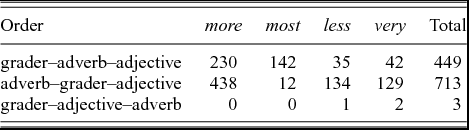
Since the non-domain adverbs form a heterogeneous set, two quantitative analyses were performed. The first focuses on the interaction of word order and type of grader, while treating type of adverb indiscriminately. The second highlights the interaction of word order and type of adverb, with all graders lumped together. The results of the first analysis are reported in table 3.
Rate of different orders in ADJPs with non-domain adverbs by type of grader

Generally speaking, the adverb–grader–adjective order occurs significantly more often than the grader–adverb–adjective order (binomial, p < 0.001). This is true of 3 of the 4 graders. However, it is not true of most, which occurs far more frequently in phrase-initial than in phrase-medial position. In this respect, it stands in stark contrast to more. In the light of the fact that more and most are members of the same paradigm, this is no doubt a surprising finding. The relatively high frequency of the most–adverb–adjective order rules out the possibility that most is generally banned from complex ADJPs. The unexpectedly low frequency of the adverb-most-adjective order suggests a certain incompatibility either between the deadjectival adverb and most or between most and the adjectival head.
There is a notable difference between more and most in that the comparative marker is compatible with degree adverbs whereas the superlative marker is not. The essence of most is to express a maximum degree. Clearly, a maximum is an absolute and as such incompatible with degree adverbs. A hypothetical example such as slightly most beautiful is nonsensical. Thus, one explanation for the uncommonness of the adverb–most–adjective order is the incompatibility between the superlative marker and certain adverbs. Note, however, that this can only be a partial explanation. The extreme infrequency of the adverb–most–adjective order suggests that other kinds of adverbs also avoid the modification of most + adjective phrases. Why this is so is currently unknown.
We now direct our attention to the deadjectival adverbs. From a semantic viewpoint, non-domain adverbs fall into a relatively large number of classes. Various partially overlapping classifications have been proposed in the pertinent literature (e.g. Quirk et al. Reference Quirk, Greenbaum, Leech and Svartvik1985; Laenzlinger Reference Laenzlinger1998; Cinque Reference Cinque1999). Rather than relying on any one of them, I preferred to adopt a ‘bottom-up approach’ and set up categories as required by the empirical data. The following categories were recurrent in the corpus of ADJPs: (i) modal (e.g. possibly); (ii) amplifying (e.g. infinitely); (iii) downtoning (e.g. slightly); (iv) focusing (e.g. exclusively); (v) emphasizing (e.g. particularly); (vi) evidential (e.g. obviously); (vii) restricting (e.g. usually); and (viii) frequentative (e.g. rarely). The delineation of these eight categories is not always straightforward, as the semantic differences between them may be rather subtle. However, no theoretical argument will be based on possible quantitative differences between them. What unifies the eight categories is what may somewhat loosely be called their more or less grammatical nature. Two criteria are of importance here. These categories have a relatively abstract, schematic meaning, which may be coded by grammatical means in other languages. Furthermore, they are more relational in that they depend heavily on other material.
These eight categories contrast with more contentful deadjectival adverbs such as seductively and dangerously. These may conveniently be regarded as lexical elements. Not surprisingly, these adverbs constitute a mixed bag. They were not further classified and collectively labelled ‘manner adverbs’.
It has repeatedly been shown that adjectives and adverbs are subject to fairly strong collocational restrictions (e.g. Paradis Reference Paradis1997; Desagulier Reference Desagulier, Glynn and Robinson2014; Erman Reference Erman2014). However, it is not obvious whether these restrictions can be turned into predictions regarding word order. According to the null hypothesis, adverb type does not interact with ordering option. In fact, the corpus provides examples of one and the same adverb occurring in all three positions. A case in point is the adverb potentially, as used in (22)–(24).
(22) In the most potentially serious accident, a ski-rack came off worse than the out-of-control 10-year-old who hit it.
(23) [This approach] seems to result in services that are more fluid, creative, and egalitarian, and potentially more responsive to client and community needs.
(24) I found it an impressive programme and I hope it will not lead Mr Haseltine to conclude that chess sets are less harmful potentially than television sets.
The adverb potentially occurs phrase-medially in (22), phrase-initially in (23) and phrase-finally in (24). However, as table 4 demonstrates, it would be quite mistaken to conclude from these examples that all adverb types display the same positional preferences. Because the grader–adjective–adverb order was so extremely infrequent in the data (see table 3), it was left out of consideration.
Rate of different orders in ADJPs with non-domain adverbs by type of adverb

It is immediately obvious from table 4 that adverb type and word order interact heavily. The adverbs that typically occur in the grader–adverb–adjective order are quite unlike those that typically occur in the adverb–grader–adjective order. This is most clearly seen in the manner adverbs, which constitute the absolute majority in the grader–adverb–adjective order but only a small minority in the adverb–grader–adjective order. At the same time, the majority of the more grammatical adverb categories are much more frequently encountered in the adverb–grader–adjective than in the grader–adverb–adjective order. This interaction of adverb type and word order is hugely significant (χ2(1) = 403.5, p < 0.0001, with the more grammatical classes pooled).
Let us illustrate the disparate preferences of the adverb types on the basis of the manner adverb worryingly in (25) and the evidential adverb seemingly in (26).
(25)
(a) More worryingly insidious is their ability to act as magnets to acid rain, taking it from the atmosphere and releasing it into the soil, where it leaches down and enters the water system.
(b) That ought, on paper, to have made corporate America worryingly more vulnerable to recession, and to a downturn in cash flow.
(26)
(a) Glorification rather than the more seemingly fitting excommunication is the response of the Roman Catholic Church to the terrorist.
(b) Lost or deliberately discarded fishing nets pose the biggest threat, but seemingly more innocent items like plastic bags, plastic pellets and polypropylene packing tape can also be killers of wildlife.
Interestingly, (25) and (26) display complementary patterns. Whereas the manner adverb in (25) strongly prefers the grader–adverb–adjective to the adverb–grader–adjective order, the opposite is true of the modal adverb in (26). It is not difficult to see why. Recall from section 2 that the grader modifies the adverb in the left-branching grader–adverb–adjective structure, while the grader modifies the adjective in the right-branching adverb–grader–adjective structure. Lexical material lends itself much more naturally to grading than grammatical material. There are many different degrees of being worried and these degrees may be naturally expressed by graders. Therefore, more worryingly insidious in (25a) is a typical case. In contrast, more grammatical adverbs are less easy, though not impossible, to grade. If something is described as seemingly true, the speaker or writer takes a certain stance on the truth value of a proposition. This stance cannot be readily modified because it is rather more qualitative than quantitative. Thus, more seemingly fitting in (26a) is a marked option. By contrast, it is no problem for a modal adverb to modify a graded adjective, which is fundamentally lexical and hence open to adverbial modification, as exemplified by seemingly more innocent in (26b).
It remains for us to explain the unnaturalness of (25b). The relatively low frequency of manner adverbs in adverb–grader–adjective strings is suggestive of a certain difficulty in having a manner adverb modify a graded adjective. What is ‘wrong’ with worryingly more vulnerable in (25b)? The answer appears to lie in a conflict between a lexical adverb and a lexical adjective. A lexical adverb cannot easily modify a (graded) lexical adjective. Modification is an essentially asymmetrical syntactic process. The modifier is clearly subordinated to the head. However, if modifier and head are both lexical, they are, as it were, on a par. A mild incompatibility thus arises from a symmetry at the semantic level and an asymmetry at the syntactic level. The same reasoning explains the naturalness of (26b). The ADJP seemingly more innocent is fine because the asymmetrical syntactic relationship between seemingly and more innocent matches their unequal status in the lexicon.
Summarizing, a clear frequency profile emerges in the data. The adverb-initial order is by far the most frequent, the adverb-medial order much less frequent and the adverb-final order close to non-existent. This distribution is largely consistent across graders even though most exhibits a deviant behaviour. This result comes somewhat unexpectedly because most forms a paradigm with more and less, which behave differently. The degree adverb very is part of a different paradigm but patterns like more and less. An analysis of the deadjectival adverbs reveals a connection between word order and adverb type. Lexical adverbs are attracted by the grader–adverb–adjective order, whereas more grammatical adverbs are attracted by the adverb–grader–adjective order. However, there is no effect of adverb type on branching direction. All grader–adverb–adjective structures are left-branching, while all adverb–grader–adjective structures are right-branching.
4.3 Comparing ADJPs with domain adverbs to those with non-domain adverbs
The first difference to note about tables 2 and 3 above is that ADJPs with non-domain adverbs are approximately six times more frequent than ADJPs with domain adverbs. This does not really come as a surprise. Domain adverbs have a lower type frequency than other adverbs in my sample (147 vs 697, with the three different word orders counted separately) and this difference is reflected in the token frequency of the two types of ADJP.
A more interesting difference emerges in the frequency of the various word orders. Whereas the grader–adverb–adjective order is the most common type in ADJPs with domain adverbs, the adverb–grader–adjective order predominates in ADJPs with other adverbs. This shows that the type of adverb impacts on the frequency of word order options within ADJPs.
This is not the only effect of adverb type. It is striking that branching direction is also under the sway of adverb type. While the grader–adverb–adjective order is right-branching in ADJPs with domain adverbs (e.g. more cognitively complex), the same order is left-branching in ADJPs with non-domain adverbs (e.g. most obviously causal). No such disparity is observed in the adverb–grader–adjective order, which is right-branching in both ADJPs with domain adverbs and those with non-domain adverbs.
While the actual numbers are too low for a serious argument, it is notable that the grader–adjective–adverb order is more frequent in ADJPs with domain adverbs than in ADJPs with non-domain adverbs, although overall the former type of ADJP occurs markedly less often than the latter (see above). Placing the adverb in phrase-final site is mainly an option for domain adverbs, albeit a dispreferred one. It is hardly an option for other adverbs. Domain adverbs appear to be more versatile than non-domain adverbs inside ADJPs. This difference cannot be put down to branching direction as both types of ADJP are left-branching.
5 Theoretical discussion
Our point of departure is the null hypothesis that one and the same structural pattern gives rise to one and only one structural representation. For example, the null hypothesis predicts that only one structural analysis is available for the grader–adverb–adjective order. For a start, such a hypothesis appears perfectly reasonable in that it allows for maximum applicability of a structural representation. Furthermore, in a child's language acquisition, it guarantees a maximum facilitation of the child's learning task. However, the empirical analysis leads us to reject the null hypothesis. Branching direction is systematically and predictably determined by the nature of the adverb. In the grader–adverb–adjective order, domain adverbs favour right-branching whereas non-domain adverbs opt for left-branching.
This more complex mapping of two different structural representations onto the same terminal string requires special motivation. Giving up a one-to-one mapping between structure and surface form brings with it an increase in the flexibility of language use. One and the same terminal string can be used for coding different schematic meanings. From the speaker's perspective, this is a highly economical strategy which keeps the number of different word orders to a minimum. While this many-to-one mapping is to the listener's disadvantage, the increase in processing difficulty is only slight because the different structures correlate perfectly with the different types of adverb. Note that this account relies on the assumption that listeners are able to distinguish between domain and non-domain adverbs.
In addition to adverb type, the following five factors have their role in an account of the empirical patterns: branching direction, frequency, proximity, analogy/uniformity and modifier–head order. Let us examine their contributions one by one. As was noted in section 2, English exhibits a general penchant for right-branching. This bias would lead us to expect a higher rate of right-branching than of left-branching ADJPs. This is in fact the case. While there is no difference in branching direction between the two major types of ADJP with domain adverbs, ADJPs with non-domain adverbs divide into two structural types. The right-branching adverb–grader–adjective order is appreciably more frequent than the left-branching grader–adverb–adjective order. The claim is, then, that the right-branching bias boosts the occurrence of the (non-domain) adverb–grader–adjective order.
Obviously, branching direction cannot explain the quantitative difference between the two major types of ADJP with domain adverbs, both of which are right-branching. Why does the grader–adverb–adjective order outnumber the adverb–grader–adjective order? A possible explanation derives from the fact that graders have a much higher token frequency than deadjectival adverbs. While this is not necessarily true of all grader–adverb sequences, it is certainly true of the graders included in this study, which were selected on the basis of their high textual frequency. As argued by Berg (in press), because frequent units are retrieved more rapidly from memory than infrequent ones, they are available earlier in the language production process and may therefore be expected to occur earlier in the linear structure of an utterance. In line with this reasoning, the early availability of the graders may be claimed to favour their phrase-initial placement. Thus, the frequency bias raises the incidence of the grader–adverb–adjective order in the case of domain adverbs.
It might be held that the frequency bias would predict a higher rate of the grader–adverb–adjective order in the case of non-domain adverbs than is actually observed. While it is likely that the facilitatory effect of frequency is by and large the same in ADJPs with domain and those with other adverbs, the left-branching nature of the grader–(non-domain) adverb–adjective order clamps down on frequency. This proposal requires us to assume that the inhibitory effect of left-branching is stronger than the facilitatory effect of frequency. Indeed, this meshes well with Berg's (in press) assessment that the impact of frequency on serial order is pervasive, albeit relatively weak.
The frequency effect is also in conflict with the proximity principle, which is violated by grader-initial ADJPs with domain adverbs (e.g. more cognitively complex). The proximity principle accounts for basically all types of ADJP with non-domain adverbs: the grader invariably modifies the immediately following word. When the grader occurs in phrase-initial position, it modifies the following adverb (or occasionally the following adjective); however, when it occurs in phrase-medial position, it modifies the following adjective. It is thus the speaker's intention which, in congruence with the proximity principle, determines the position of the grader.
It is highly remarkable that the proximity principle is strictly adhered to in ADJPs with non-domain adverbs, whereas it is customarily violated in ADJPs with domain adverbs. What is it that gives domain adverbs the power to override the proximity principle, a power that non-domain adverbs lack? Here is one possible scenario. Our starting point is the syntactic flexibility of adverbs in general. To reiterate, they can occur in all three positions in ADJPs. As shown in the empirical section, ADJPs with non-domain adverbs are the predominant type. The claim that will be defended here is based on the related notions of analogy and uniformity. By means of analogy, domain adverbs in ADJPs inherit their positional flexibility from non-domain adverbs in ADJPs. Analogy is facilitated by two constraints both of which are satisfied in the present case. The first is that the analogical effect is likely to spread from the major (non-domain adverbs) to the minor (domain adverbs) pattern rather than vice versa. The second factor is a similarity constraint. Analogy takes effect only when the source and the target unit are sufficiently similar. This is obviously true in the case at hand since non-domain and domain adverbs are formally indistinguishable. Thus, the mere fact that a domain adverb is an adverb allows it to occur in all syntactic positions in which non-domain adverbs may occur.
The net result of analogy is increasing uniformity. By syntactically assimilating domain adverbs to non-domain adverbs, adverbs as a class exhibit a uniform behaviour. However, uniformity is not for free. It is bought at the expense of proximity. Hence, uniformity outcompetes proximity. This is not really surprising. Haspelmath (Reference Haspelmath, MacWhinney, Malchukov and Moravcsik2014) convincingly argues that there is a strong and pervasive tendency for morphological and syntactic rules to apply to sets of lexical items rather than to individual items. These rules target word classes rather than words. This is exactly what we find in ADJPs. The syntactic rules of adverb placement apply to all adverbs indiscriminately. In other words, they ignore the distinction between domain and non-domain adverbs.
What remains to be explained is the infrequency of adverb-final ADJPs. Adverbs modifying adjectives show a strong tendency to heed the modifier–head order. While English is an inconsistent modifier–head order language, it is rather consistent at the level of individual ordering decisions, even in the case of the highly versatile class of adverbs. The reasons for the general adverb–adjective order are not immediately relevant to the concerns of the present article. Suffice it to note that, as their name suggests, domain adverbs invoke a domain which provides a frame within which the information coded by the adjective can be interpreted. It makes good sense to have the more general information precede the more specific information.
By way of summary, the frequency patterns observed in ADJPs with domain adverbs and those with non-domain adverbs reflect the interplay of five factors, all of which have been independently established. The preponderance of the adverb–grader–adjective order in ADJPs with non-domain adverbs emanates from the right-branching bias in English. The less frequent grader–adverb–adjective order in ADJPs with non-domain adverbs is inhibited by its left-branching structure but facilitated by the high token frequency of the graders. That this order is at all grammatical stems from the uniform behaviour of adverbs. The lower frequency of the adverb–grader–adjective order compared to the grader–adverb–adjective order in ADJPs with domain adverbs may be attributed to the fact that the former order constitutes a violation of the proximity principle while the latter order does not. The infrequency of the grader–adjective–adverb order in both types of ADJP results from the violation of the modifier–head order which is so characteristic of adjectives modified by adverbs in English. These five factors may be ranked as follows (> means ‘stronger than’): uniformity > proximity, branching direction, modifier–head order > frequency.
The foregoing analysis raises issues of wider theoretical interest. Traditional models assume that terminal nodes form the joint between syntactic structure and the lexicon. By their very nature, these models predict a sensitivity of structural representations to word class, though not to lexicon-internal information. The distinction between domain and non-domain adverbs is just one such piece of lexicon-internal information. As has been argued in the above, there is an interaction between branching direction and type of adverb: phrase-medial domain adverbs give rise to right-branching structures whereas phrase-medial non-domain adverbs are conducive to left-branching.
How can this interaction be modelled? It seems necessary to posit that the syntax has to reach more deeply into the lexicon than has commonly been assumed. This proposal is diagrammed in (27).
(27)

The main claim embodied in (27) is that syntactic decisions are influenced not only by terminal nodes but also by non-terminal (i.e. lexicon-internal) nodes such as the subcategories of adverbs. By implication, we have to distinguish (at least) two syntactically relevant classes of adverbs and thereby side with what Croft (Reference Croft, Vogel and Comrie2000) called the ‘splitters’. This splitting presents the notion of terminal nodes in a new light. While they derive their name from their final position in the syntactic tree, they are non-terminal in the sense that they draw on information further down the line in a parallel processing system. This proposal blurs the boundary between syntax and lexicon and thus is in line with recent usage-based models of grammar.
We finally leave the categorical distinction between domain and non-domain adverbs for the non-categorical distinction between lexical and grammatical adverbs. It is notable that the former distinction impacts on branching direction and word order while the latter distinction is relevant to word order but irrelevant to branching direction. This state of affairs is schematically represented in (28).
(28)

On the assumption of a hierarchical layering of adverb types, it can be gleaned from (28) that word order reaches further down the hierarchy of adverb classes than branching direction does. This is a noteworthy finding which suggests that branching direction is a more coarse-grained parameter while word order is a more sensitive parameter. This hypothesis dovetails with the following asymmetry between branching direction and word order: the same branching direction is compatible with different orders, whereas the same order is not ordinarily compatible with different branching directions. The empirical analysis provided examples of both types. Left-branching was argued to be appropriate for both the grader–adjective–adverb and the grader–adverb–adjective order in the case of non-domain adverbs. Recall also that the grader–adverb–adjective order was left-branching in the case of non-domain adverbs but right-branching in the case of domain adverbs. However, this structural ambiguity is the exception rather than the rule. The fact that structural ambiguity has attracted so much attention in syntax should not mislead us into believing that it occurs frequently.
6 Conclusion
The broader perspective which is opened up by the analysis of ADJPs is the extent to which grammar and lexicon penetrate each other. Construction Grammar represents a most radical attempt at overcoming the dichotomy of grammar and lexicon. While the present investigation is certainly at variance with a strict separation between these two components, it also acknowledges their existence and places limits on how far one component can penetrate the other. To be specific, the distinction between lexical and grammatical non-domain adverbs has no effect on the structural representation. Clearly, this study is only just a beginning. More extensive research is needed on how impervious the two components can be. To take but one example, how impervious is verb–object order to lexical information? Can the animacy of the object or the telicity of the verb affect word order? Such questions take us well beyond English into the typological arena.