Introduction
Intimate partner violence (IPV) is a major public health problem in the United States. IPV includes psychological, physical, and sexual abuse in romantic relationships. National estimates from the National Intimate Partner and Sexual Violence Survey show that around 42.4 million women (35.6% of women) and 32.3 million men (28.5% of men) have experienced IPV including rape, physical violence, and/or stalking at least once by an intimate partner in their lifetime (Black et al., Reference Black, Basile, Breiding, Smith, Walters, Merrick and Stevens2011). The psychological and physical consequences of IPV can be devastating, including the need for medical care, chronic disease, pregnancy, post-traumatic stress disorder symptoms, and depression (Campbell, Reference Campbell2002). In addition, having experienced IPV increases subsequent risk for revictimization in future relationships (Kuijpers, van der Knaap, & Lodewijks, Reference Kuijpers, van der Knaap and Lodewijks2011). Unfortunately, interventions and treatments offered or mandated when people are already in the criminal justice system are limited in success (Dutton, Reference Dutton2012; Stover, Meadows, & Kaufman, Reference Stover, Meadows and Kaufman2009).
“Before the fact” prevention of IPV is increasingly recognized as an important strategy (Tharp, Reference Tharp2012). Understanding the etiology of IPV is key in the development of effective prevention and intervention programs. This has led to a paradigm shift to studying the emergence and course of IPV from a developmental perspective that recognizes that IPV is predictable from earlier socialization experiences (Capaldi & Kim, Reference Capaldi and Kim2007; Langhinrichsen-Rohling & Capaldi, Reference Langhinrichsen-Rohling and Capaldi2012). In addition, IPV in couples is increasingly recognized as a dyadic and mutual behavior emerging from reciprocal interactions between romantic partners (Capaldi & Kim, Reference Capaldi and Kim2007; Dutton, Reference Dutton2012). Because of the longitudinal and dyadic data requirements, there are only limited studies that are able to investigate longitudinal predictors of IPV across developmental periods in which both partners’ IPV is investigated.
To close this gap, we investigate the emergence of IPV in couples from a developmental perspective using data from a multimethod longitudinal study design spanning 15 years. Social learning models emphasize that individuals learn about how romantic relationships function from earlier interactions with close others (Bandura, Reference Bandura1977). Thus, we investigate how conflictual and coercive relationships with parents and deviant friendships during adolescence predict IPV in couples in adulthood. These negative socialization relationships with parents and friends during adolescence have also been associated with the development of violent behavior, substance use, and high-sexual-risk behavior, which in turn are major risk factors for IPV (Capaldi, Knoble, Shortt, & Kim, Reference Capaldi, Knoble, Shortt and Kim2012; Jessor, Reference Jessor1991). However, the developmental pathways linking these risk factors is less clear, as previous studies often have not considered these risk factors simultaneously in longitudinal prospective designs. We investigated whether violent behaviors, substance use, and high-risk sexual behavior in early adulthood mediated links between family conflict and coercive relationship talk with friends in adolescence and dyadic IPV in adulthood.
Dyadic IPV and longitudinal family and peer predictors
Capaldi and Kim (Reference Capaldi and Kim2007) proposed the dynamic developmental systems theory as a dyadic framework to better understand the emergence and course of IPV. This theoretical framework recognizes that IPV in couples is a dyadic behavior that emerges from mutual or reciprocal interactions between romantic partners. Previously, IPV has mostly been studied as a gendered phenomenon in which males are perpetrators and females are victims, which limits our understanding of IPV (Dutton, Reference Dutton2012). Accumulating evidence indicates that boundaries between roles are diffuse, with partners taking on both perpetration and victimization roles in different contexts (Bates, Reference Bates2016). This is confirmed in observational studies showing that aggression during conflict discussions in late adolescent and adult couples was mostly mutual and instigated by both males and females (Capaldi & Crosby, Reference Capaldi and Crosby1997; Capaldi & Kim, Reference Capaldi and Kim2007; Ha, Kim, & McGill, Reference Ha, Kim and McGill2019; Ha, Otten, McGill, & Dishion, Reference Ha, Otten, McGill and Dishion2019; Whitaker et al., Reference Whitaker, Morrison, Lindquist, Hawkins, O'Neil, Nesius and Reese2006). Furthermore, both men and women reported simultaneous engagement as victims and perpetrators in minor and major IPV episodes (Costa et al., Reference Costa, Soares, Lindert, Hatzidimitriadou, Sundin, Toth and Barros2015). Therefore, in the current study we investigate IPV within couples in which both romantic partners report on their own engagement in IPV (perpetration) and their partners IPV (victimization).
The dynamic developmental systems theory also emphasizes how a partner's current relationship and past romantic interaction experiences impacts IPV, and how both partners developmental histories, including socialization experiences, are risk factors for current IPV. Interactions between parents and children have been considered key socialization contexts for the development of future IPV. Social learning models (Bandura, Reference Bandura1977) have predominated in explaining how children learn the acceptance of violence as a strategy to attain a goal. Children derive thoughts, feelings, and behaviors about how intimate relationships function via observation and modeling of daily conflictual interactions they have with parents (Dishion, Reference Dishion, Dishion and Snyder2016). In addition, negative parenting may increase the use of violence through negative reinforcement by, for example, giving into youth's aggressive behaviors (Patterson, Reference Patterson1982). This acquiescence by parents in the face of the child's aversive behavior serves as a negative reinforcement mechanism that encourages future aggressive, aversive behavior. This suggests that individuals who have experienced aggressive and conflictual family relationships may develop relationship beliefs and schemas that prioritize aggression as a means to resolve conflict (Gay, Harding, Jackson, Burns, & Baker, Reference Gay, Harding, Jackson, Burns and Baker2013), and may in turn become vulnerable to aggression in their own romantic relationships, as either a victim, a perpetrator, or both (Hassija, Robinson, Silva, & Lewin, Reference Hassija, Robinson, Silva and Lewin2018).
Previous research has mostly focused on relationships with parents in early childhood, but parental relationships remain important in adolescence. Positive and supportive family relationships in early adolescence promote constructive conflict resolution and regulation of negative affect in future romantic relationships in early adulthood (Conger, Cui, Bryant, & Elder, Reference Conger, Cui, Bryant and Elder2000). In contrast, conflict with parents predicted higher levels of violence perpetration toward dating partners in a sample of adolescents (Foshee et al., Reference Foshee, Reyes, Ennett, Suchindran, Mathias, Karriker-Jaffe and Benefield2011). Andrews, Foster, Capaldi, and Hops (Reference Andrews, Foster, Capaldi and Hops2000) found that observed aversive family interactions during adolescence predicted higher observed aversive interactions and higher physical abuse with romantic partners at age 23 years. Similarly, disruptive family relationships during early adolescence predicted observed coercive communication between romantic partners at age 30 years (Ha, Otten, et al., Reference Ha, Otten, McGill and Dishion2019). These prospective studies underscore that negative family relationships in adolescence may have a direct long-term impact on IPV in adulthood. In addition, conflictual family interactions may be associated with the development of deviant peer friendships during adolescence.
Adolescence is a sensitive developmental period for susceptibility to peer influences (Monahan, Steinberg, & Cauffman, Reference Monahan, Steinberg and Cauffman2009). This increases the importance of parental monitoring and limit setting but conflictual relationships with parents can prohibit these positive parenting strategies (Dishion, Ha, & Véronneau, Reference Dishion, Ha and Véronneau2012). Furthermore, conflictual family interactions predict adolescent aggressive and antisocial behaviors (Ha, Otten, et al., Reference Ha, Otten, McGill and Dishion2019). Family conflict creates a parenting vacuum in which adolescents’ antisocial behaviors develop while not being monitored well, which enables adolescents to form deviant peer relationships based on similarity and proximity (Dishion & Tipsord, Reference Dishion and Tipsord2011). Deviant friendships can promote violence through positive reinforcement of deviant or aggressive talk by laughter or other expressions of approval, a process known as deviancy training (Dishion, Spracklen, Andrews, & Patterson, Reference Dishion, Spracklen, Andrews and Patterson1996). Therefore, socialization effects within conflictual family interactions and deviant peer friendships may be important for the developmental of future IPV, but have rarely been considered together in longitudinal studies.
Social learning processes in these deviant friendships have been shown to predict IPV. For example, observed deviancy training in male adolescent friendships predicted IPV in early adulthood (Capaldi, Dishion, Stoolmiller, & Yoerger, Reference Capaldi, Dishion, Stoolmiller and Yoerger2001). Ha, Kim, Christopher, Caruthers, and Dishion (Reference Ha, Kim, Christopher, Caruthers and Dishion2016) identified a specific form of deviancy training, which consisted of reinforcement of coercive and objectifying romantic relationship norms during observed adolescent friendship interactions. This “coercive relationship talk” predicted sexual coercion and observed coercive interactions with romantic partners in adulthood (Ha et al., Reference Ha, Kim, Christopher, Caruthers and Dishion2016; Ha, Otten, et al., Reference Ha, Otten, McGill and Dishion2019), but has not been tested with IPV as an outcome. In contrast, high-quality friendships during adolescence lower the likelihood of IPV in adulthood (Linder & Collins, Reference Linder and Collins2005). These studies highlight how deviant adolescent friendships can establish coercive relationship norms about dating that have a long-term impact on IPV. However, more research is needed to disentangle the socialization effects of family conflict and coercive relationship talk during adolescence as predictors of future IPV.
Violent behaviors, substance use, and sexual risk taking as mediators
Understanding the effects of family conflict and deviant peer relationships during adolescence on future IPV is important, but there are likely to be intermediate cascading mechanisms. Social learning processes in conflictual relationships with parents and deviant peer relationships are theorized to lead to low self-control (Gottfredson & Hirschi, Reference Gottfredson and Hirschi1990), and difficulties with emotion regulation (Gardner, Dishion, & Connell, Reference Gardner, Dishion and Connell2008) and social cognitive processing (Prinstein & Dodge, Reference Prinstein and Dodge2008), which underlie the development of antisocial and problem behaviors. Indeed, a substantive body of research finds that conflictual parental relationships and deviancy training in peer relationships during adolescence predict violent behavior, substance use, and high-risk sexual behavior (e.g., Johnson, Giordano, Longmore, & Manning, Reference Johnson, Giordano, Longmore and Manning2016; Van Ryzin & Dishion, Reference Van Ryzin and Dishion2012, Reference Van Ryzin and Dishion2013, Reference Van Ryzin and Dishion2014), which in turn are all risk factors for IPV (Capaldi et al., Reference Capaldi, Knoble, Shortt and Kim2012).
These findings support a conceptual mediation model in which violence, substance use, and high-risk sexual behavior mediate between conflictual parental relationships and coercive relationship talk with peers during adolescence and IPV in couples in adulthood. These behaviors co-occur and are part of a “risk behavior syndrome” (Jessor, Reference Jessor1991), and have yet to be tested in a unified model to identify their relative importance for the development of future IPV. One mediation study among adolescent girls, which included a composite score of delinquency, substance use, and high-sexual-risk behaviors found that an overall risky lifestyle partially mediated the associations between deviant peer affiliation and dating violence victimization, and fully mediated between deviant peer affiliation and physical/sexual victimization (Vézina et al., Reference Vézina, Hébert, Poulin, Lavoie, Vitaro and Tremblay2011). However, this study did not identify the relative importance of delinquency, substance use, and high-sexual-risk behaviors as it used a composite score and was a cross-sectional study, which limits conclusions about temporal order and developmental processes.
Furthermore, less is known about the impact of violent behavior, substance use, and high-risk sexual behavior during early adulthood on future IPV. While these behaviors emerge during adolescence, they tend to peak in early adulthood followed by a general decline across adulthood. This pattern has been found for antisocial behaviors (Odgers et al., Reference Odgers, Moffitt, Broadbent, Dickson, Hancox, Harrington and Caspi2008), alcohol use (e.g., Chassin, Sher, Hussong, & Curran, Reference Chassin, Sher, Hussong and Curran2013), marijuana use (Epstein et al., Reference Epstein, Hill, Nevell, Guttmannova, Bailey, Abbott and Hawkins2015), and sexual risk behaviors (Fergus, Zimmerman, & Caldwell, Reference Fergus, Zimmerman and Caldwell2007). Given the high prevalence of these risk behaviors during early adulthood, it remains important to identify the relative importance of these risk factors for IPV as mediators for adolescents’ conflictual relationships with parents and coercive relationship talk with peers.
Of these risk factors, adolescent antisocial and violent behaviors are arguably the most robust predictor of IPV in adulthood (Capaldi et al., Reference Capaldi, Knoble, Shortt and Kim2012). For example, in the Dunedin study, adolescent antisocial behaviors were the most consistent predictor of IPV perpetration in adulthood for males and females (Magdol, Moffitt, Caspi, & Silva, Reference Magdol, Moffitt, Caspi and Silva1998). Within the broader cluster of behavioral problems, violence and aggression have received the strongest support as risk factors for the development of IPV (Capaldi et al., Reference Capaldi, Knoble, Shortt and Kim2012; Ehrensaft et al., Reference Ehrensaft, Cohen, Brown, Smailes, Chen and Johnson2003; Lussier, Farrington, & Moffitt, Reference Lussier, Farrington and Moffitt2009). In the Oregon youth study, antisocial behaviors and externalizing problems during mid- and late adolescence were predictive of IPV in early adulthood (Capaldi et al., Reference Capaldi, Dishion, Stoolmiller and Yoerger2001; Capaldi & Clark, Reference Capaldi and Clark1998; Low et al., Reference Low, Tiberio, Shortt, Mulford, Eddy and Capaldi2019). Furthermore, a recent study among maltreated children showed that the aggregate number of maltreatment types predicted early adolescent antisocial behaviors, which in turn predicted self-reported negative interactions with romantic partners in early adulthood (Handley, Russotti, Rogosch, & Cicchetti, Reference Handley, Russotti, Rogosch and Cicchetti2019). However, little is known about the importance of aggressive and violent behaviors during early adulthood in predicting IPV.
Substance use is another well-established risk factor for IPV, although the effects are less strong as compared to violence and aggression (Capaldi et al., Reference Capaldi, Knoble, Shortt and Kim2012). Most research has been conducted on the effects of alcohol on IPV, because of its disinhibitory effects on violent behaviors that may trigger IPV. A meta-analysis reported small to moderate effect sizes between alcohol use and both IPV perpetration and victimization (Foran & O'Leary, Reference Foran and O'Leary2008). Other substances are less investigated as compared to alcohol use, although another meta-analysis reported small to moderate effect sizes for the effect of cocaine and marijuana on IPV (Moore et al., Reference Moore, Stuart, Meehan, Rhatigan, Hellmuth and Keen2008), and a moderate effect size for substance use (drug use and alcohol use) on IPV (Cafferky, Mendez, Anderson, & Stith, Reference Cafferky, Mendez, Anderson and Stith2018). There is some indication that co-occurrence of alcohol, marijuana, and hard drugs predicted the highest IPV perpetration among men (Feingold, Kerr, & Capaldi, Reference Feingold, Kerr and Capaldi2008). However, studies have also found no effect of substance use on IPV after taking violence into account (Feingold et al., Reference Feingold, Kerr and Capaldi2008), suggesting that substance use may be a comorbid risk behavior with antisocial and violent behavior, but not a cause of IPV.
High-risk sexual behaviors are the least investigated risk factor for IPV. National data among adolescents showed that sexual risk taking was prevalent among adolescents who had experienced both physical and sexual IPV (Vagi, Olsen, Basile, & Vivolo-Kantor, Reference Vagi, Olsen, Basile and Vivolo-Kantor2015), which also has been found in recent reviews among college students (e.g., Duval, Lanning, & Patterson, Reference Duval, Lanning and Patterson2020). Furthermore, research among men aged 18–35 years showed that increased sexual behavior such as infidelity, unprotected sex, and forced sexual intercourse, were related to IPV (Raj et al., Reference Raj, Santana, La Marche, Amaro, Cranston and Silverman2006). There is some evidence to indicate that abused women have a history of sexually transmitted infections due to unprotected sex and high engagement in non-committed relationships (Alleyne, Coleman-Cowger, Crown, Gibbons, & Vines, Reference Alleyne, Coleman-Cowger, Crown, Gibbons and Vines2011; Hess et al., Reference Hess, Javanbakht, Brown, Weiss, Hsu and Gorbach2012). Although these studies indicate that sexual risk behaviors are associated with IPV, longitudinal studies among community samples are scarce. Little is known about whether sexual risk taking during early adulthood would predict IPV in couples and mediate between adolescents’ conflictual relationships with parents and coercive relationship talk with peers and IPV.
Gender differences in IPV
Research on gender differences in IPV has mainly focused on investigating whether males or females are more likely to engage in IPV. Several reviews and meta-analyses show that males and females are equally likely to engage in IPV (Capaldi et al., Reference Capaldi, Knoble, Shortt and Kim2012; Desmarais, Reeves, Nicholls, Telford, & Fiebert, Reference Desmarais, Reeves, Nicholls, Telford and Fiebert2012). A study that included participants from six European countries found no gender differences in the prevalence of victimization and perpetration except for sexual coercion, which was more often perpetrated by men (Costa et al., Reference Costa, Soares, Lindert, Hatzidimitriadou, Sundin, Toth and Barros2015). Thus, contrary to popular belief, IPV perpetrator and victims are often both male and female (Langhinrichsen-Rohling & Capaldi, Reference Langhinrichsen-Rohling and Capaldi2012). There is a lack of prospective studies predicting IPV that longitudinally follow both men and women, and therefore less is known about gender differences in developmental pathways leading to IPV. A few prospective studies showed that there are generally few gender differences in the longitudinal prediction from coercive parenting and peer deviancy training during adolescence to sexual coercion and observed coercive interaction dynamics in adulthood (Ha et al., Reference Ha, Kim, Christopher, Caruthers and Dishion2016; Ha, Otten, et al., Reference Ha, Otten, McGill and Dishion2019; Handley et al., Reference Handley, Russotti, Rogosch and Cicchetti2019; Smith, Ireland, Park, Elwyn, & Thornberry, Reference Smith, Ireland, Park, Elwyn and Thornberry2011). Gender differences in the longitudinal mediation of a cluster of behavioral problems between relationships with parents and friends and IPV are unclear. Therefore, we consider gender differences in the present study.
The current study
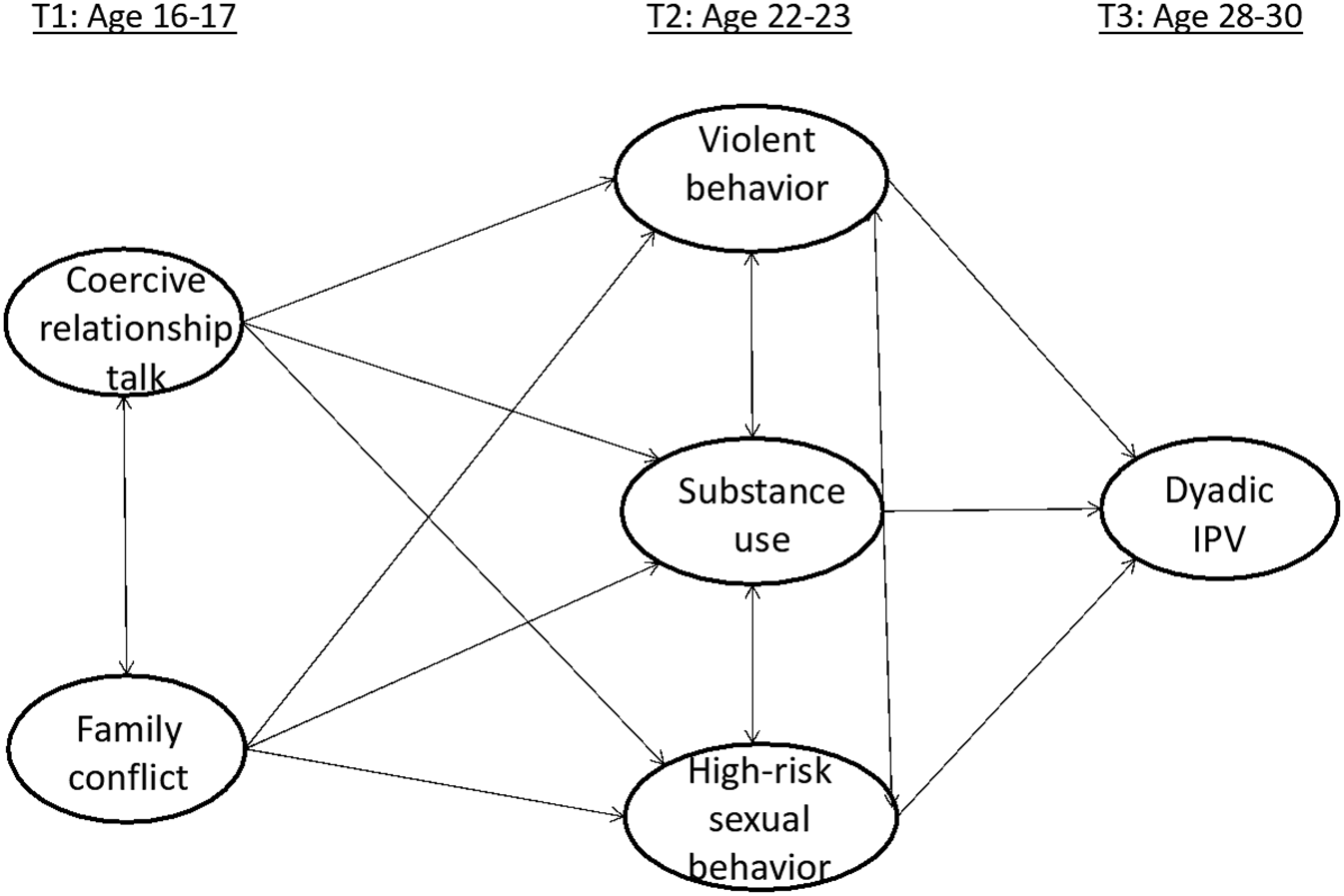
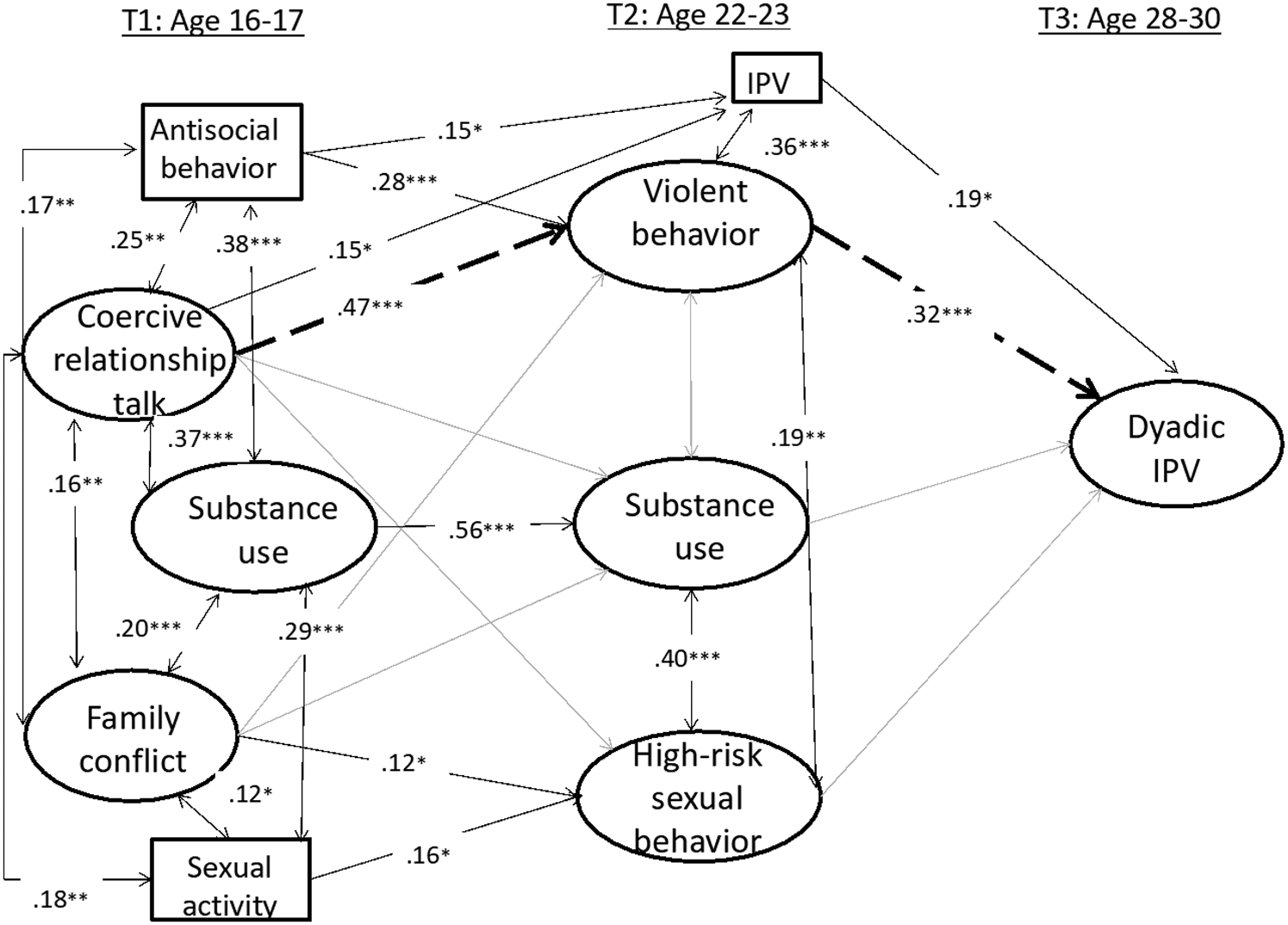
In this longitudinal prospective study, we investigated whether violent behavior, substance use, and high-risk sexual behavior during early adulthood (ages 21–23 years), mediated associations between conflictual relationships with parents and coercive relationship talk within peer relationships in adolescence (ages 16–17 years) and dyadic IPV in adulthood (ages 28–30 years; Figure 1). Controls for violent behavior, substance use, and high-risk sexual behavior at ages 16–17 years and IPV at ages 21–23 years were included in the longitudinal mediation model to reduce bias in estimates (Maxwell & Cole, Reference Maxwell and Cole2007). In line with the dynamic developmental systems theory (Capaldi & Kim, Reference Capaldi and Kim2007), IPV was considered to be a dyadic and reciprocal behavior in couples. We used multiple methods and reporters to investigate this research question, including observations of parent–child conflict and coercive relationship talk in peer relationships, and we included parent and self-reports of violent behaviors and romantic partner reports of IPV. Previous research found that violent behaviors and substance use were the most robust predictors of IPV. Therefore, we hypothesized that violent behaviors and substance use would mediate between conflictual relationships with parents and coercive relationship talk within peer relationships in adolescence (ages 16–17 years) and adult IPV (ages 28–30 years; Figure 1). Evidence for high-risk sexual behaviors is less strong but high-risk sexual behavior was still hypothesized to be a mediator. We also tested for gender differences within this longitudinal mediation model.
Theoretical longitudinal mediaton model across adolescence and adulthood. Note: For presentation purposes, covariates are not displayed.

Method
Sample
This study was part of a larger project that implemented a randomized trial of the family check-up (FCU), a family-centered intervention starting in middle school (Dishion & Kavanagh, Reference Dishion and Kavanagh2003). The goal of the intervention was to reduce adolescent problem behavior and improve mental health by supporting parenting practices through assessment-driven feedback to motivate parents to change. Half of the participants in the study sample were randomly assigned to the intervention. Potential intervention effects were not a focus of this study, we controlled for intervention status in all analyses. Others have described the intervention and its effectiveness (e.g., Connell, Dishion, Yasui, & Kavanagh, Reference Connell, Dishion, Yasui and Kavanagh2007).
Participating youth (N = 998) were recruited in sixth grade from three middle schools in a metropolitan community in the northwestern United States and were followed across 10 waves of data collection until approximately ages 28–30 years, with 83% retention. At the beginning of the study, research or school staff approached parents of all sixth-grade students in two cohorts to determine if they would want to participate; 90% consented. The sample included 526 males (52.7%) and 472 females (47.3%). There were 423 European Americans (42.3%), 291 African Americans (29.1%), 68 Latinos (6.8%), 52 Asian-American families (5.2%), and 164 (16.4%) of other ethnicities (including biracial). Biological fathers were present in 585 families (58.6%). Family income ranged from less than $5,000/year to more than $90,000/year, with the median being $30,000–$40,000. Youth were randomly assigned at the individual level to either control (n = 498) or intervention (n = 500) classrooms in the spring of sixth grade. Research staff obtained parental consent and youth assent at each subsequent wave of data collection until youth turned 18, at which point youth provided consent directly.
For the current study, we examined data collected at three different time points. Time 1 (T1) corresponds with ages 16–17 years (10th and 11th grade), Time 2 (T2) corresponds with ages 22–23 years, and Time 3 (T3) corresponds with ages 28–30 years (adulthood). This relationship dynamics and young adult drug use and abuse study received approval from the Institutional Review Board of the Oregon Research Institute (protocol number 00000278).
Procedure
At T1 participants (ages 16–17 years) received invitations to take part in videotaped observations of Family × Youth interactions and Peer × Youth interactions. Participants could decline participation in any specific data collection activity; thus, the completion rates vary by tasks. Six-hundred forty-nine participants took part in the FAST (Dishion & Kavanagh, Reference Dishion and Kavanagh1997), a structured videotaped observation task in which the target youth and parents discuss eight different topics. Topics included (a) areas of growth for their child, (b) teen-led discussion of an area in which they would like to grow, (c) parental monitoring, (d) disagreement between the parents and youth, (e) a family problem-solving activity, (f) substance use, (g) planning a fun family activity, and (h) positive recognition of family members. Each interaction task lasted 5 min except for the substance use section, which lasted for 8 min. Trained coders used a defined system of macro-impression ratings of the family interactions (Dishion, Peterson, Winter, Jabson, & Hogansen, Reference Dishion, Peterson, Winter, Jabson and Hogansen2007). Approximately 20% of the videotaped interactions were coded by two coders for reliability, with an overall interrater agreement of 84.19%.
Seven hundred twenty-one participants completed a videotaped interaction task with a self-nominated, same sex friend between 14 and 21 years of age. Informed consent was given by the friends who were 18 years or older and by the parents if the friend was younger than 18 years. The interaction task with the friend lasted 45 min. Participants and their friends discussed eight different topics for 5 min each. Topics included (a) planning an activity, (b) a problem of the participant, (c) a problem of the peer, (d) drug and alcohol use, (e) goals for the next year, (f) friends and peer groups, (g) dating, and (h) planning a party. The first topic was a practice discussion and was not included in the analyses. We coded each interaction in real time with the Noldus Observer Pro for duration and sequence of behaviors as defined in the topic code (Piehler & Dishion, Reference Piehler and Dishion2004). The topic code contains two categories for talk used by members of the dyad: “following the rules” and “breaking the rules”. In addition, coders provided global coder impressions of peer interaction dynamics (Dishion, Peterson, Piehler, Winter, & Woodworth, Reference Dishion, Peterson, Piehler, Winter and Woodworth2006). We randomly sampled approximately 15% of the data to assess that interrater agreement remained at least 80% for the real-time coding (κ = 0.79) and 85% or more for global coder impressions.
At T2, participants (ages 22–23 years) and their parents completed surveys administered either through the mail or online. Arrest records were obtained from state circuit courts.
At T3, if a participant reported being in a committed relationship (married, engaged, or living with a partner), we invited the participant and partner to participate together. In total, we recruited 421 couples, of which 371 completed surveys, including measures of IPV. Participants received $50 for completing the surveys. The mean age was 28.99 years (SD = .81), and ethnic representation included 48.1% European American, 23.2% African American, 9.2% Latinx, 8.1% mixed ethnic background, and less than 5% Native American and Asian American/Pacific Islander. Most of these couples were in a relationship for 2 or more years (87.5%), with 46.5% being married, 16.2% engaged, 33.5% living together, and 1.6% dating the same person regularly.
Measures
Antisocial behavior (T1 covariate, ages 16–17 years)
Antisocial behaviors were included as a covariate based on adolescents’ self-reports of their problem behaviors during the previous month by responding to nine items at age 16 years (Van Ryzin & Dishion, Reference Van Ryzin and Dishion2013). This measure included antisocial behaviors, such as intentionally hitting or threatening, spending time with gang members as friends, hit someone at school, carrying weapons, and staying out all night without parental permission. Each item's score ranged from 1 (never) to 6 (more than 20 times), and the items were averaged to yield a global score of antisocial behaviors (α = .69).
Sexual activity (T1 covariate, ages 16–17 years)
Adolescents reported the number of opposite and same sexual partners in the past year and this was included as a covariate.
Substance use (T1 covariate, ages 16–17 years, and T2 mediator, ages 22–23 years)
Substance use was included as a covariate at T1 and as a mediator at T2. Self-reported frequency of alcohol, and marijuana use within the past 3 months were included as indicators for the latent variable “substance use” at T1 as a covariate and as a mediator at T2. Alcohol frequency of use was assessed on a scale from 0 (never) to 8 (two to three times a day or more). Marijuana frequency of use was assessed on a scale from 0 (never) to 7 (two to three times a day). Responses were rescaled to reflect a 1-month time period. These scores were used as indicators for a latent variable representing substance use.
Intimate partner violence (T2 covariate, ages 22–23 years)
This was included as a covariate for dyadic IPV at T3. Eight items were positively worded, such as “My partner lifts my spirits when I am down” and “My partner treats me with respect and kindness.” Four negative items were “My partner puts me down, insults me, verbally threatens me. My partner hurts me physically or threatens to. My partner makes me do things I don't want to. My partner yells at me”. Response scales ranged from 1 (never) to 5 (very frequently). A principal axis factor analysis was conducted using the 12 items. The screen plot suggested two factors with eigenvalues 5.91 and 1.86 (all others were <1.0). The two factors explained 64.76% of the variance. The factor structure was clean, with no cross-loadings > .30. The two factors were composed exclusively of the positively and negatively worded items, respectively. After Promax rotation, the factor loadings for the four negatively worded items were, respectively, .67, .72, .61, and .73. These four items were averaged to form a composite measure. Cronbach's alpha was .75.
Family conflict (T1, ages 16–17 years)
Family conflict was based on the fourth parent–child discussion task, in which parents and teens were asked to discuss a recent disagreement. Coders rated both parents and the adolescent individually on criticizing others (i.e., blaming, putting each other down), contempt, and escalation of conflict and negativity, ranging from 1 (not at all) to 9 (very much). These items were averaged to create separate child, mother, and father family conflict scores with alphas of .86, .82, and .86, respectively. These scores were used as indicators for a latent variable representing family conflict.
Coercive relationship talk (T1, ages 16–17 years)
A latent variable was used to represent coercive relationship talk based on three observational indicators: shallow talk, coercive joining, and deviancy training (Ha et al., Reference Ha, Kim, Christopher, Caruthers and Dishion2016; Ha, Kim, et al., Reference Ha, Kim and McGill2019).
Shallow talk was based on seven coder macro ratings that measured the extent to which friends discussed superficial qualities and negative aspects of potential partners, as well as engagement in sexual risky activities. Each item was rated on a 9-point scale (ranging from not at all to very much). A mean score of both dyad members of all items was used to measure shallow talk. Cronbach's alpha for shallow talk was .81.
Coercive joining was based on all eight peer interaction tasks; coders provided overall ratings for each member of the dyad on (Van Ryzin & Dishion, Reference Van Ryzin and Dishion2013): (a) dominant behavior, (b) hostile or abusive references toward others, and (c) obscene language and gestures. Each item was rated on a 9-point scale (ranging from not at all to very much). Ratings from both members of the friendship dyads were used to measure coercive joining. Cronbach's alphas for the ratings were .73, .81, and .71, respectively. All three measures were moderately correlated (r values between .28 and .55, p < .01) and combined in a single latent construct.
Deviancy training was based on the real-time coding of the eight peer interaction tasks using the topic code microcoding system (Piehler & Dishion, Reference Piehler and Dishion2007; Van Ryzin & Dishion, Reference Van Ryzin and Dishion2013). Deviancy training was coded as all verbal and nonverbal behaviors that were not appropriate to the setting or task, or that violated community or societal rules (e.g., references to all illegal activities, crude gestures, songs, or talking about or doing gross activities). A percent duration score of deviant talk was created, which is the percentage of the total time an individual engaged in deviant talk. Peer deviancy training scores were averaged to form an overall percent duration score for the dyad. A larger percentage of the interaction devoted to discussing deviant topics was thought to reflect more extensive deviant influence within the dyad.
Violent behavior (T2, ages 22–23 years)
This construct was assessed with five indicators (Van Ryzin & Dishion, Reference Van Ryzin and Dishion2013). First, participants reported the number of times they carried a weapon in the past 3 months. Participant responses were dichotomized (0 = no weapon carrying, 1 = weapon carrying). Second, self-reports were used of violent response to stress using the life events and coping inventory (Dise-Lewis, Reference Dise-Lewis1988). Responses to seven items (e.g., hit something, break things, vandalize) were averaged (Cronbach's alphas were .80 at age 22, .76 at age 23). Scores from age 22 and 23 years were significantly correlated (r = .46, p < .01) and averaged. Third, arrest records were gathered from state circuit courts; a score of 1 indicated that the participant had been arrested for a violent crime (e.g., assault, murder) at least once; otherwise the score was 0. Fourth and finally, mother and father reports of aggressive behavior at age 22–23 years were used and measured with the adult version of the child behavior checklist, which is for ages 18–59 years and completed by someone who knows the adult well (Achenbach, Reference Achenbach1991). This captures parents’ ratings of a youth's behavior in the past 6 months in terms of aggressive, disruptive, or delinquent behaviors. In this analysis, we used the subscale for aggressive behavior. The data demonstrated good reliability (.91 for mother report, .90 for father report). These five constructs were used as indicators for a latent variable representing violent behavior.
Substance use (T2, ages 22–23 years)
The same substance use measure was used as at T1 (see description above).
High-risk sexual behavior (T2, ages 22–23 years)
This construct included five measures of risky sexual behavior in the last 3 months, including: (a) number of sexual partners, (b) number of sexual partners with whom the participant was not in a dating relationship, (c) number of sexual partners who were also in sexual relationships with others, (d) number of sexual partners that the participant did not know well, and (e) number of sexual partners who were intravenous (IV) drug users. Participants responded using a scale that included the following categories: 0, 1, 2, 3, 4, 5 to 10, 11 to 20, 21 to 40, and 41 or more. These five risky sexual behaviors were used as indicators for a latent variable representing high-risk sexual behavior.
Dyadic IPV (T3, ages 28–30 years)
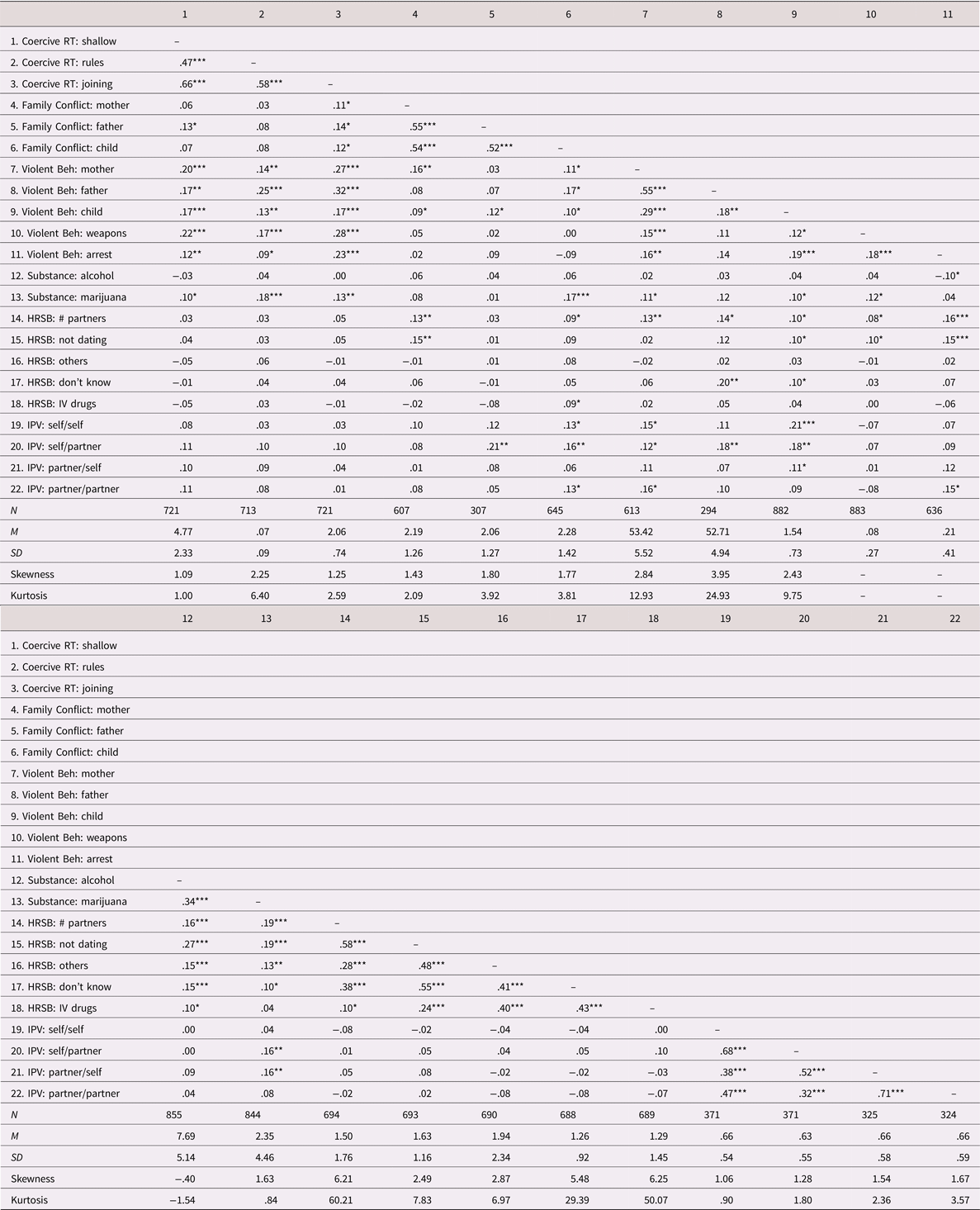
This construct was measured with the original Conflict Tactic scale (Straus, Reference Straus1979), using only the partner–partner subscales. Participants and their romantic partners completed 36 items about the frequency of both their own and their partner's behaviors throughout their relationship. Specifically, these items tapped into verbal aggression, minor violence, and severe violence. Participants rated items on a 5-point scale ranging from 0 (never) to 4 (11 or more times). Example items include: “Insult or swear at you/your partner” (verbal aggression); “Pushed, grabbed or shoved you/your partner” (minor violence); and “Threaten you/your partner with a knife or gun” (severe violence). Two items of the original scale were not administered “Hit or tried to hit him/her with something” and “Used a knife or fired a gun” (severe violence), and “Tried to physically restrain” was added. Four mean scores of IPV were calculated for target participants reporting about their own IPV and their partners’ level of IPV; romantic partners also reported about their own IPV and their partners’ IPV – alphas were, respectively, .86, .85, .88, and .86. Scores were strongly associated between romantic partners and between reports about self and partner levels of IPV (r = .38–.71; see Table 1); therefore, these scores were included as indicators of a latent construct of dyadic IPV.
Descriptive data and intercorrelations

Note: Coercive RT = coercive relationship talk; Violent Beh = violent behavior; Substance = substance use; HRSB = high-risk sexual behavior; IPV: self/self = report of target participant about their own intimate partner violence engagement (perpetration); IPV: self/partner = report of target participant about their partners’ engagement in intimate partner violence (victimization); IPV: partner/self = partners’ report about the target participants’ engagement in intimate partner violence (perpetration); IPV: partner/partner = partners’ report about the own engagement in intimate partner violence (victimization).
* p < .05. **p < .01. ***p < .001.
Analysis plan
A test of mediation traditionally includes an initial direct-effects model that tests the path between the predictor and outcome, followed by a mediation model in which the following paths are tested: (a) the predictor to the presumed mediator, (b) the mediator to the distal outcome, and (c) the combined indirect effect between the predictor and the outcome via the mediator, while controlling for the direct effect (commonly referred to as c’; Judd, Kenny, & McClelland, Reference Judd, Kenny and McClelland2001; MacKinnon & Dwyer, Reference MacKinnon and Dwyer1993). Thus, we initially tested a direct-effects model that included the effects of family conflict and coercive relationship talk with friends on IPV. Following this, we fit a mediational model that simultaneously tested the effects of family conflict and coercive relationship talk with friends on the mediators (i.e., violent behavior, substance use, and high-risk sexual behavior), the effects of the mediators on IPV, and the indirect effects of family conflict and coercive relationship talk in friendships on IPV (Figure 1). Measures of antisocial behavior, substance use, and sexual behavior at age 16 (T1), as well as IPV at ages 22–23 years (T2) are included in the model as controls but not presented in Figure 1 to enhance clarity.
We evaluated the direct effects and mediated models using structural equation modeling, which can fit all model pathways simultaneously and evaluate indirect effects (i.e., from family/peer factors through early adult behavioral problems to IPV). All modeling was conducted using maximum likelihood estimation in Mplus 7.1 with robust standard errors, which can provide unbiased estimates in the presence of missing and/or nonnormal data (Muthén & Muthén, Reference Muthén and Muthén2012). Standard measures of fit are reported, including the chi-square (χ2), comparative fit index (CFI), non-normed or Tucker–Lewis index (TLI), and root-mean-squared error of approximation (RMSEA). CFI/TLI values greater than .95, RMSEA values less than 0.5, and a non-significant χ2 (or a ratio of χ2/df < 3.0) indicate good fit (Bentler, Reference Bentler1990; Bentler & Bonett, Reference Bentler and Bonett1980; Hu & Bentler, Reference Hu and Bentler1999). The effects of the FCU were controlled throughout the model by estimating the FCU effects on all latent variables of the model, that is, family conflict, coercive relationship talk, violent behaviors, substance use, high-risk sexual behaviors, and dyadic IPV, but none of these effects (direct or indirect) was significant, so they are not presented. We tested for gender as a moderator of model paths in the final model.
Results
Descriptive data and intercorrelations among the model variables are presented in Table 1. Covariates, antisocial behaviors, substance use, and sexual activity at T1 and IPV at T2 are not displayed in Table 1, but were correlated in the expected direction with other model variables (r = .17 to .39, p < .001); on average adolescents showed low levels of antisocial behaviors (M = 1.30, SD = .39), substance use (alcohol M = 1.10, SD = 2.33; marijuana M = 1.34, SD = 3.31), and sexual activity (M = 1.05, SD = 2.38), and low levels of IPV at T2 (M = .38, SD = .53).
For missing data analyses, we compared those missing IPV data at T3 with those who did have IPV data, either from themselves or themselves and their partner. The results are presented in the Supplementary Material 1. Significant results were found for two measures of high-risk sexual behavior; those with missing IPV data reported higher levels as compared to those not missing IPV data. There was also a significant finding for violent crime arrests; those with missing IPV data were arrested more often than those who were not missing IPV data.
Dyadic IPV
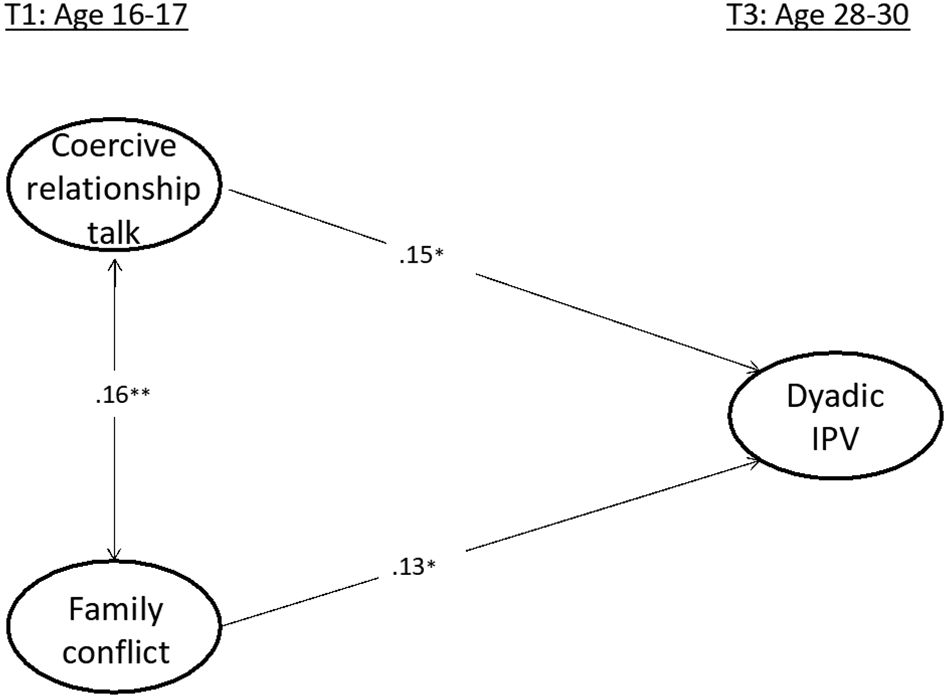
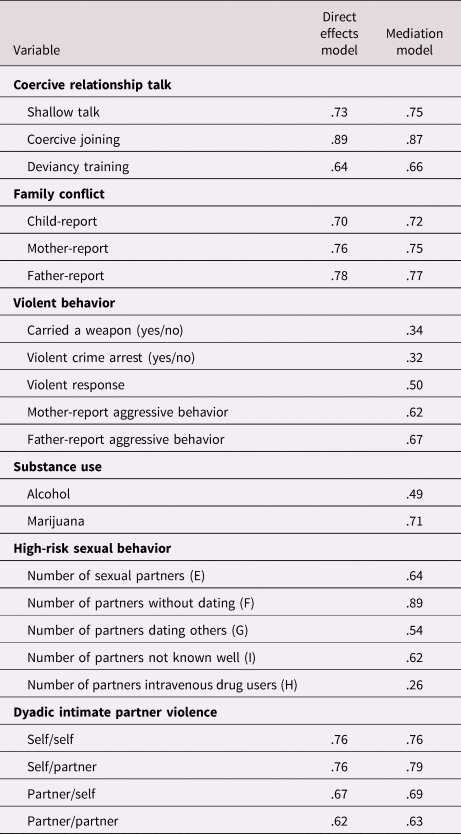
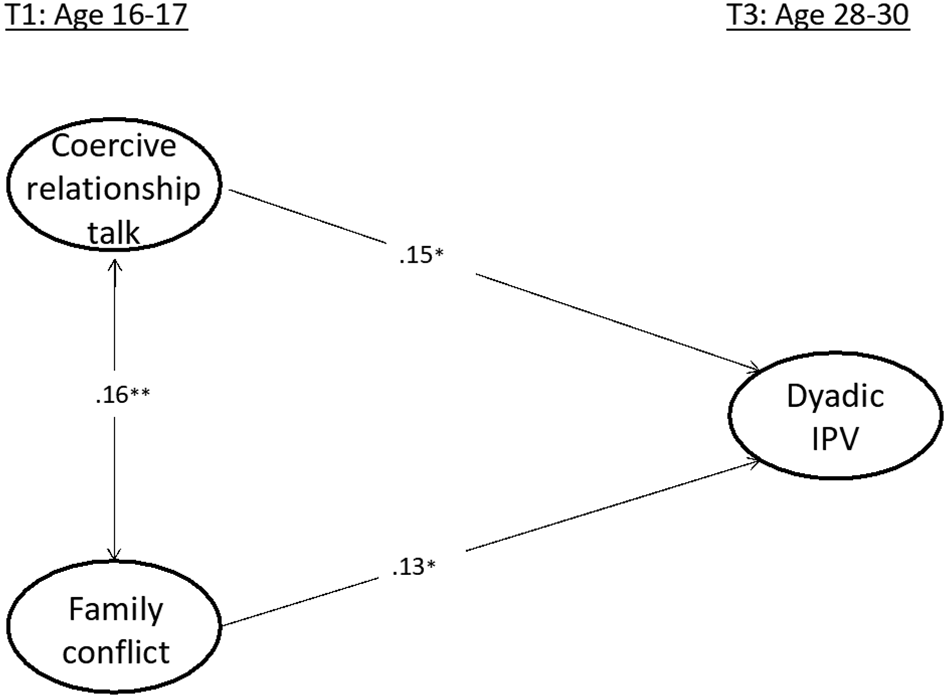
When fitting the direct effects model to the data with Mplus, we found model fit was good, CFI = .95, TLI = .93, RMSEA = .030 [.018|.041], χ2 (37) = 67.28, p < .01, χ2/df = 1.82 (Figure 2). Factor loadings were above .30 (Table 2). Both family conflict and coercive relationship talk at age 16 years had significant direct effects on dyadic IPV at age 30.
Direct effects model.
Factor loadings of latent variables
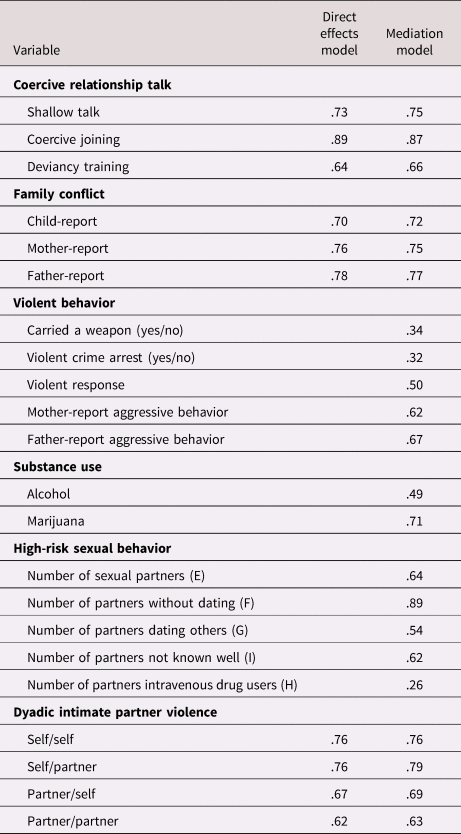
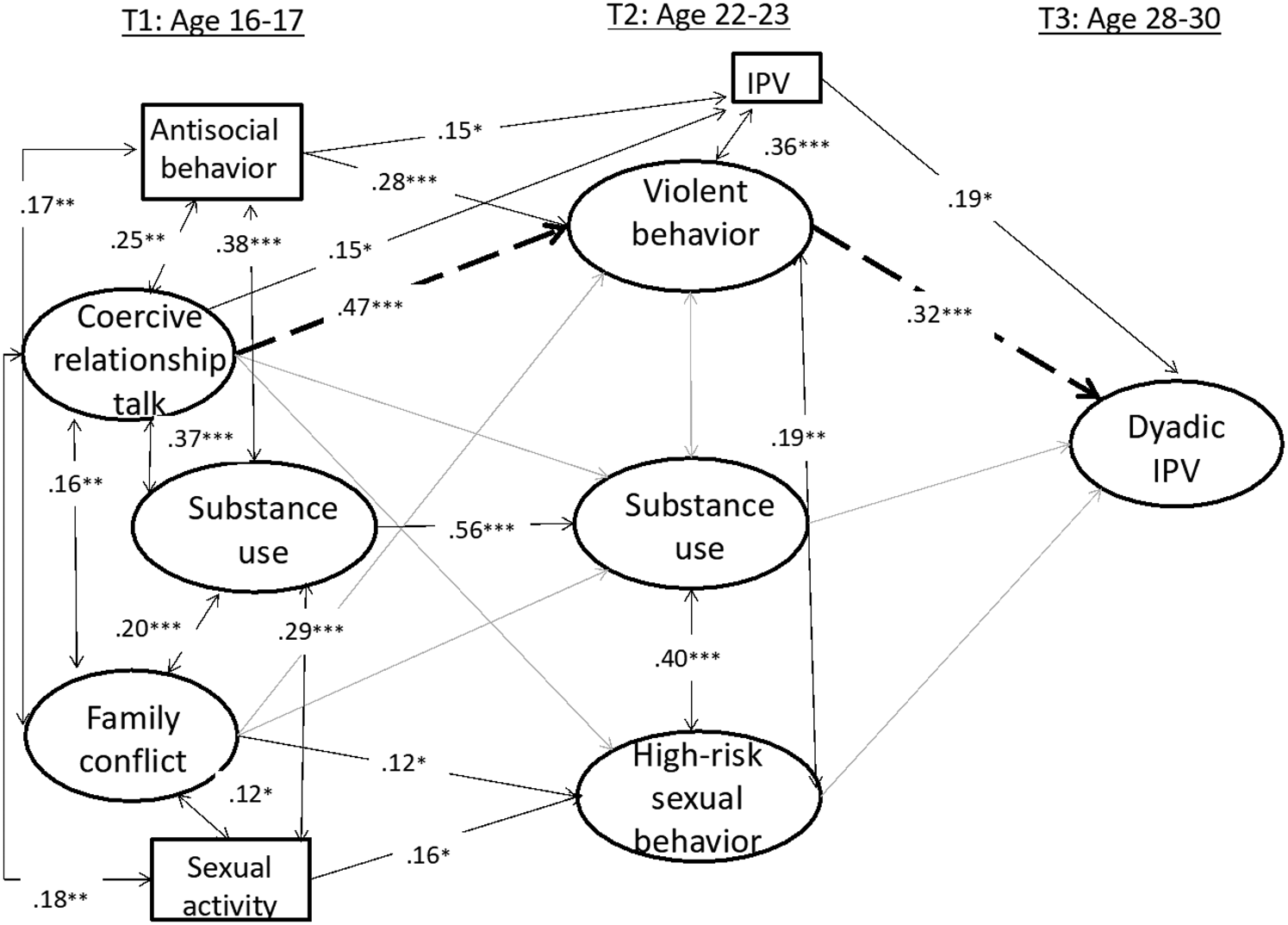
Finally, the mediational model was fitted. The model fit was good, CFI = .93, TLI = .91, RMSEA = .031 [.028|.035], χ2 (295) = 585.11, p < .001, χ2/df = 1.98 (Figure 3). Factor loadings were generally above .30 (Table 2). Antisocial behaviors, substance use, and high-risk sexual behavior at T1 were all associated with coercive relationship talk and family conflict at T1, and respectively predicted violence, substance use, and high-risk sexual behavior at T2. Antisocial behaviors and coercive relationship talk at T1 predicted IPV at T2, which in turn was associated with IPV at T3. Controlling for these covariates, we found significant pathways from family conflict at T1 to high-risk sexual behavior at T2 and from coercive relationship talk at T1 to violence at T2, but only violent behavior predicted IPV at T3; the links from substance use and high-risk sexual behavior at T2 to IPV at T3 were not significant. The direct paths from family conflict and coercive relationship talk at T1 to dyadic IPV at T3 were no longer significant. Indirect effects from coercive relationship talk on IPV via violent behavior were significant (β = .15, p < .05) but no other indirect pathways were significant. Gender differences in model results were not significant, χ2 (33) = 22.68, ns.
Full longtudinal mediation model including control variables. Note: Direct effects from coercive relationship talk and family conflict to intimate partner violence (IPV) were not significant and thus are not presented to enhance clarity. Furthermore, only significant pathways for control variables are displayed. Dashed arrows indicate a significant mediation pathway.
Sensitivity analyses: IPV perpetration and victimization
Sensitivity analyses were conducted to test two similar indirect models as presented in Figure 1. First, a model with IPV perpetration as an outcome was tested and then a model with IPV victimization as an outcome. For both perpetration and victimization models, model fit was adequate and overall results were similar to the dyadic IPV model and again gender differences were not significant (Supplementary Material 2).
Discussion
Drawing upon dynamic developmental systems theory we studied whether IPV in couples in adulthood cascades from developmental histories and socialization experiences earlier in life (Capaldi & Kim, Reference Capaldi and Kim2007). In particular, we investigated how conflictual relationships with parents and coercive relationship talk in friendships during adolescence predicted IPV in couples in adulthood. In accordance with social learning theory (Bandura, Reference Bandura1977), we hypothesized that adolescents who experienced aggressive and conflictual family and peer relationships may develop relationship beliefs and schemas that prioritize aggression as a means to resolve conflict, which would predict IPV in adulthood. Furthermore, we expected that family conflict and deviant peer relationships characterized by coercive relationship talk during adolescence would be associated with increased problem behaviors during early adulthood, which in turn would predict IPV. Therefore, violent behavior, substance use, and high-risk sexual behavior during early adulthood were investigated as mediators between family conflict and coercive relationship talk in peer relationships in adolescence and IPV in couples in adulthood.
In this longitudinal prospective study, we found that violent behavior during early adulthood mediated the link between coercive relationship talk in friendships during adolescence and IPV in couples in adulthood. In addition, family conflict predicted high-risk sexual behavior at age 21 years, but this was not predictive of adult IPV. Importantly, these associations were found while controlling for earlier levels of the mediators during adolescence and previous IPV during early adulthood. No gender differences were found. Sensitivity analyses showed that when investigating IPV perpetration and victimization, results were similar to dyadic IPV. These results support a developmental perspective on IPV in adulthood that is highlighted by dynamic developmental systems theory (Capaldi & Kim, Reference Capaldi and Kim2007) and social learning theory (Bandura, Reference Bandura1977). These theories emphasize the far-reaching impact of youth's social experiences on newly formed relationships later in life.
Two important results emerged from this study. First, only violent behaviors during early adulthood mediated between coercive relationship talk in peer relationships during adolescence and adult IPV in adulthood. These results were not found for substance use and sexual risk behaviors as mediators, which suggests that IPV in romantic relationships during adulthood emerges from a general tendency to violent behavior that is acquired from socialization of violence in earlier relationships with peers. Adolescents and adults who are violent tend to engage in multiple forms of violent behaviors (Donovan & Jessor, Reference Donovan and Jessor1985), and the current results underscore that violent behaviors change form depending on interpersonal context (Low et al., Reference Low, Tiberio, Shortt, Mulford, Eddy and Capaldi2019). Second, peer coercive relationship talk indirectly contributed to IPV through violent behaviors, but this was not found for family conflict. This is in contrast to the intergenerational transmission of violence model, which primarily focused on witnessing violence in parental relationships and coercive parenting, to show that adolescents’ negative socialization experiences in peer relationships is perhaps an equally important risk factor for the development of IPV in adulthood (Ehrensaft et al., Reference Ehrensaft, Cohen, Brown, Smailes, Chen and Johnson2003).
Social learning theory (Bandura, Reference Bandura1977) emphasizes how children learn that violence is an acceptable way to attain goals through interaction patterns that emerge from real-time exchanges among parents and peers (Dishion & Patterson, Reference Dishion, Patterson and Cicchetti2016). Previous studies have shown the importance of adolescent antisocial behaviors that emerge in the context of less parental monitoring, coercive parent–child relationships, and deviant peer relationships in future romantic relationships (Capaldi et al., Reference Capaldi, Dishion, Stoolmiller and Yoerger2001; Ha et al., Reference Ha, Kim, Christopher, Caruthers and Dishion2016; Ha, Kim, et al., Reference Ha, Kim and McGill2019; Handley et al., Reference Handley, Russotti, Rogosch and Cicchetti2019; Low et al., Reference Low, Tiberio, Shortt, Mulford, Eddy and Capaldi2019). The current study extends these findings by showing the continued importance of violent behaviors during early adulthood for the development of IPV that emerge from microsocial coercive relationship talk within Adolescent × Peer interactions. Early adulthood violent behaviors may be indicative of continued high levels of violence during a developmental time in which violence typically decreases (e.g., Odgers et al., Reference Odgers, Moffitt, Broadbent, Dickson, Hancox, Harrington and Caspi2008). Violence during early adulthood may indicate macrosocial influences on future IPV, in which early adults experience difficulties adjusting to new roles and developmental tasks such as engagement in work, education, and healthy romantic relationships.
In contrast to social learning theory and previous intergenerational models of violence, only coercive relationship talk and not family conflict predicted IPV via violent behaviors. Interestingly, coercive relationship talk in adolescent peer relationships was also a direct predictor of the IPV control variable during early adulthood. This extends recent work that increasingly acknowledges that how adolescents engage with friends has long-term links to quality of romantic relationships in adulthood (Allen, Narr, Kansky, & Szwedo, Reference Allen, Narr, Kansky and Szwedo2020; Olsen, Parra, & Bennett, Reference Olsen, Parra and Bennett2010). Furthermore, it is in line with previous studies that have examined coercive relationship talk based on only 45 min of observed friendship interactions, and shows that reinforcement of deviant and objectifying relationship norms during adolescence is prognostic of violent behavior and subsequently how one orients to intimacy in future romantic relationships (Capaldi et al., Reference Capaldi, Dishion, Stoolmiller and Yoerger2001; Ha et al., Reference Ha, Kim, Christopher, Caruthers and Dishion2016; Ha, Kim, et al., Reference Ha, Kim and McGill2019).
Our results are not meant to minimize the role of parenting in the etiology of IPV. Rather, it is possible that conflictual relationships with parents are more important during late childhood and early adolescence. According to social learning theories, children first learn coercive interactions with parents, which then transfers to peer relationships in adolescence when there is a normative shift away from family and toward peers. Conflictual family interactions promote the development of adolescent aggressive and antisocial behaviors, which are amplified by selecting, and being socialized by, deviant peers (Dishion & Tipsord, Reference Dishion and Tipsord2011). Thus, conflictual relationships with parents may be a precursor to adolescent coercive relationship talk and the development of antisocial and violent behaviors (Ha, Kim, et al., Reference Ha, Kim and McGill2019).
While a generally risky lifestyle has been identified as predictive of IPV (Capaldi et al., Reference Capaldi, Knoble, Shortt and Kim2012), the current study did not find that substance use or high-risk sexual behaviors in early adulthood were predictive of dyadic IPV. Previous studies often do not consider violence, substance use, and high-risk sexual risk behaviors simultaneously, despite conceptual and behavioral overlap (Capaldi et al., Reference Capaldi, Knoble, Shortt and Kim2012). The current results indicate that violence during early adulthood is a more important predictor of IPV when considered relative to substance use and high-risk sexual risk behaviors across this long developmental span. Alternatively, substance use and high-risk sexual risk behaviors might be contributing to IPV in a more immediate or proximal “in the moment” way. Daily diary studies investigating alcohol use and IPV show that men's and women's normative and heavy drinking increases same-day physical IPV perpetration (de Bruijn & de Graaf, Reference de Bruijn and de Graaf2016; Testa & Derrick, Reference Testa and Derrick2014). Similarly, proximal effects of high-risk sexual behaviors may characterize volatile romantic relationships, reflecting a pattern of quickly changing or sexual relationships outside the romantic relationship. The unpredictability and volatile nature of these relationships could give rise to high levels of negativity, anger, and control between partners (Giordano, Copp, Longmore, & Manning, Reference Giordano, Copp, Longmore and Manning2016), and hence be more proximal predictors of IPV. Furthermore, it may be that the intersection of distal violent behaviors and proximal alcohol use or high-risk sexual behaviors – that is, moderation – are the strongest predictors of dyadic IPV. In addition, sexual IPV was not included in the current study, which may explain the lack of results for sexual risk behaviors. Thus, substance use and high-risk sexual behaviors may have predicted dyadic IPV in this study if it was measured more proximally.
The current lack of gender differences in the longitudinal mediation models is in line with an emerging literature that shows little gender difference in the developmental predictors of IPV (Smith, Greenman, Thornberry, Henry, & Ireland, Reference Smith, Greenman, Thornberry, Henry and Ireland2015) across areas of risk such as negative and abusive familial relationships, adolescent risk behaviors, peer risks, and sociodemographic risks (Costa et al., Reference Costa, Soares, Lindert, Hatzidimitriadou, Sundin, Toth and Barros2015). Prior research has been largely gendered in nature, with studies investigating IPV perpetration in males and victimization in females. There is now increasingly more support for similarities than gender differences in the prediction of IPV perpetration and victimization, with the exception of depression, which seems a more important risk factor for female IPV perpetration (Capaldi et al., Reference Capaldi, Knoble, Shortt and Kim2012). Furthermore, the current results support the conceptualization of IPV as a mutual or reciprocal behavior (Dutton, Reference Dutton2012). Results for the perpetration and victimization were almost identical to the dyadic IPV model, which showed better model fit and is a better estimation of relationship levels of IPV from a measurement perspective. This emphasizes the importance to move towards a more nuanced understanding of the impact of partner selection and couple dynamics that give rise to IPV.
Limitations
Although this longitudinal study followed participants for 15 years using a multiple reporter and method approach, limitations should be noted. Even though both partners reported IPV, this study did not distinguish between assortative mating effects, in which romantic partners tend to select partners with similar characteristics that may impact specific relationship socialization dynamics between partners. In addition, this study did not investigate specific IPV subgroups, such as symmetric and asymmetric IPV couples. Sexual IPV was not measured in couples and should be included in future studies. Moreover, while IPV during early adulthood was included as a control variable, this study did not have information on adolescent IPV, which is crucial as IPV starts in adolescent romantic relationships (e.g., Ha, Kim, et al., Reference Ha, Kim and McGill2019). Adolescent IPV increases risks of experiencing IPV in future romantic relationships, and continues to increase into adulthood (Johnson, Manning, Giordano, & Longmore, Reference Johnson, Manning, Giordano and Longmore2015). However, there is also variability in the development of IPV over time (Johnson et al., Reference Johnson, Manning, Giordano and Longmore2015; Shortt et al., Reference Shortt, Capaldi, Kim, Kerr, Owen and Feingold2012; Timmons Fritz & Smith Slep, Reference Timmons Fritz and Smith Slep2009), indicating that these negative relationship experiences are open to change and possibly intervention. More knowledge about how romantic relationship dynamics develop over time is an important direction for future research. In addition, substance use and high-risk sexual behaviors were considered distal predictors of IPV and it might be more important to investigate these as proximal risk factors.
Concluding Statement
Understanding the etiology of IPV is key in the development of effective prevention and intervention programs. The current study investigated whether violent behavior, substance use, and high-risk sexual behavior in early adulthood mediated between observed conflict with parents and observed coercive relationship talk in friendships in adolescence and IPV in adult couples. Results indicate that early adult violent behaviors were the only risk factor to mediate between coercive relationship talk in friendships during adolescence, and future IPV in couples. While the impact of conflictual relationships with parents has long been recognized, less attention has been paid to the importance of peer relationships in predicting the future of dyadic IPV. The current study underscores the long-term consequences of coercive relationship talk in friendships on dyadic IPV 15 years later through violent behaviors. Therefore, intervening in coercive relationship talk in peer relationships that set violent and objectifying dating norms is an important “before the fact” prevention target for IPV.
Supplementary Material
The supplementary material for this article can be found at https://doi.org/10.1017/S0954579421000602
Authors’ Contribution
All authors developed the study concept and contributed to the study design. Thao Ha and Mark J. Van Ryzin performed the data analysis, and all authors contributed to interpreting the data. Thao Ha drafted the article, and Mark J. Van Ryzin and Kit Elam provided critical revisions. All authors approved the final version of the article for submission.
Acknowledgments
We gratefully acknowledge the contribution of the Project Alliance staff, Portland public schools, and the participating youths and families.
Funding Statement
The National Institute on Drug Abuse grant DA07031 and National Institute on Alcoholism and Alcohol Abuse grant AA022071 provided support for Thao Ha during the work reported in this article. Kit Elam received support from DA042828 from the National Institute on Drug Abuse and National Institutes of Health: Office of the Director, and Office of Behavioral and Social Sciences Research. The content is solely the responsibility of the authors and does not necessarily reflect the official views of the National Institute on Drug Abuse or the National Institute on Alcoholism and Alcohol Abuse.
Conflicts of Interest
None.