


1. Introduction
Several philosophers—including Baker (Reference Baker2005, Reference Baker2009), Colyvan (Reference Colyvan1998, Reference Colyvan2001), Lange (Reference Lange2013, Reference Lange2017, Reference Lange2019), Lipton (Reference Lipton and Cornwell2004, Reference Lipton, Henk, de Regt and Eigner2009), Mancosu (Reference Mancosu and Mancosu2008), Pincock (Reference Pincock2007), and Steiner (Reference Steiner1978)—have argued that there are noncausal scientific explanations where mathematical facts play a special role. According to Jha et al. (Reference Jha, Campbell, Montelle and Wilson2024, 887), “Marc Lange’s account … stands out as the most persuasive defense of the purported existence” of distinctively mathematical explanations (DMEs). However, Jha et al. (ibid.) argue against Lange’s account, concluding “that purported mathematical explanations are essentially causal explanations in disguise and are no different from ordinary applications of mathematics.” This article will respond to their arguments, defending the view that there are distinctively mathematical scientific explanations.
2. Are DMEs just disguised causal explanations?
According to Lange, DMEs are “explanations by constraint,” where a “constraint” is modally stronger than ordinary causal laws (such as Coulomb’s law of electrostatics). Mathematical facts are constraints because they are mathematically necessary, but there are other constraints as well. On Lange’s view, an explanation by constraint is noncausal because its explanatory power does not derive from its describing the world’s causal network.
However, Jha et al. argue that Lange’s alleged distinction between DMEs and causal explanations is bogus. Jha et al. (Reference Jha, Campbell, Montelle and Wilson2024, 901–903) give one of their arguments by using an explanation (discussed by Lange 2013, 491; Reference Lange2017, 10,16, 130–31) where the explanandum is the law that any long, linear, static electric charge distribution with uniform charge density λ has an electric field of strength of 2λ/r (in Gaussian CGS units) everywhere at distance r from the line-charge. Any introductory textbook in electricity and magnetism explains why this law holds by deriving it mathematically from Coulomb’s law: that any static point charge q has an electric field q/r
2 pointing away from the charge. The explanation proceeds by combining (i.e., integrating over) the contributions (given by Coulomb’s law) to the line-charge’s field from all the line-charge’s pointlike elements. When the integral is simplified, it becomes (λ/r)
 $\mathop \smallint \nolimits_{-\pi /2}^{\pi /2} \cos {\rm{\theta }}\ d\theta .$
The explanation concludes by appealing to the mathematical fact that
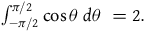 $\mathop \smallint \nolimits_{-\pi /2}^{\pi /2} \cos {\rm{\theta }}\ d\theta\ = 2.$
Lange’s point is that although this explanation appeals to a mathematical fact, it is not a distinctively mathematical explanation. That is because it works by virtue of providing information about the world’s causal network. In particular, it operates by taking a possible effect (a line-charge’s electric field) and tracing it back to its causes (the line-charge’s elements). Coulomb’s law helps to explain the line-charge law by specifying each element’s effect. By contrast, a DME would not acquire its explanatory power by virtue of describing causal relations.
However, Jha et al. (ibid., 903) argue that this example shows how Lange’s alleged distinction between DMEs and causal explanations breaks down: We can “reformulate” this causal explanation so that Lange is committed to counting it as a DME. “If Lange agrees with this assessment, then his account loses its appeal as a philosophically illuminating account of the ‘distinctive’ role mathematics plays in explaining such physical facts in the world because any application of mathematics, when suitably reformulated as a constraint, can be termed as a DME.” In particular, “Consider this example on the use of integrals in calculating the electric field strength pertaining to a linear charge distribution, which Lange (Reference Lange2013) believes to be a causal explanation but when seen in the light of the points just discussed (and based on Lange’s own position) should actually be classified as a DME” (Jha et al. Reference Jha, Campbell, Montelle and Wilson2024, 901). According to Jha et al. (ibid.), “[w]e could reformulate this case” by taking the why question to be as follows: Why is it that if any static point charge q has an electric field of strength q/r
2 pointing away from the charge (Coulomb’s law), then for any long, linear, static charge distribution with uniform charge density λ, its electric field strength at a distance r is 2λ/r? When the explanandum is expressed by this conditional, the explanans is the mathematical fact that
 $\mathop \smallint \nolimits_{-\pi /2}^{\pi /2} \cos {\rm{\theta }}\ d\theta = 2.$
Jha et al. (ibid., 902) point out that according to Lange, this is a DME: “When reformulated like this, subsuming all the causal contingencies into the ‘why’ question, this explanation, too, fits into Lange’s version of DMEs, even as he claims otherwise.” In short, Jha et al. argue that what Lange characterizes as an ordinary causal explanation can be “reformulated” to be an explanation that Lange characterizes as a DME. Lange therefore fails to show that DMEs are distinct from ordinary causal explanations.Footnote
1
It seems to me, however, that Lange does not give an “inconsistent classification of such examples” (ibid., 903); it is not the case that “Lange’s account is inconsistent in classifying many examples of causal explanations as DMEs, and vice versa” (ibid., 888). Lange does not characterize the same explanation sometimes as a DME and sometimes as causal. Rather, there are two distinct explanations in the line-charge case. In Lange’s original example, the explanandum is the law that any uniform line-charge’s electric field has strength 2λ/r. By contrast, the explanandum in Jha et al.’s “reformulation” of this explanation is the fact that if Coulomb’s law holds, then any uniform line-charge’s electric field has strength 2λ/r. This conditional is reached by taking the original explanandum and (as we just saw Jha et al. say) “subsuming all the causal contingencies into the ‘why’ question”—that is, into the antecedent of the conditional that expresses the new explanandum. But this conditional is not a “reformulation” of the original explanandum; the conditional is not logically equivalent to the original explanandum. Rather, the conditional’s truth is a new explanandum. So, it is not inconsistent for Lange to treat the new explanandum as having a DME and the original explanandum as having only ordinary causal explanations.
The new explanandum is mathematically necessary whereas the original explanandum is not. It should be unsurprising, then, for the new explanandum to have a DME even though the original explanandum does not. Indeed Jha et al. (ibid., 897) quote Lange (Reference Lange2017, 419) as having already pointed out that whenever there is a causal explanation where a more fundamental law of nature C mathematically entails and thereby explains a derivative law E (as in the line-charge example), there will be a DME of the fact that if C, then E:
[I]f we have a scientific explanation in which the explanandum E follows from the explanans C by some mathematical proof, then (in an appropriate context) an answer to “Why is it the case that if C, then E?” can be “Because this conditional fact is mathematically necessary.” This would be a “distinctively mathematical” explanation. (Lange Reference Lange2017, 419)
Thus, Lange has recognized that any such causal explanation of E by C is associated with a DME. But Lange has emphasized that the DME’s explanandum is different from the causal explanation’s explanandum. In a passage that Jha et al. (Reference Jha, Campbell, Montelle and Wilson2024, 897) quote, Lange (Reference Lange2018, 87) comments on his above remark: “In this case, the explanandum is changed from E to the fact that if C then E. The reason why it is the case that if C then E, rather than its not being the case that if C then E, is that the latter is mathematically impossible.” Lange (ibid.) goes on to emphasize that this is to “alter” the explanandum. There is no inconsistency in Lange’s deeming E to have a causal explanation while the associated explanation of “If C, then E” (or of “E, given C”) is a DME.
Thus, Jha et al. have not revealed one of Lange’s purported DMEs to be (by Lange’s own lights) a causal explanation. So they have not thereby shown that on Lange’s account, “all purported DMEs are essentially run-of-the-mill examples of the ordinary applications of mathematics in causal explanations” (Jha et al. Reference Jha, Campbell, Montelle and Wilson2024, 903).
3. Are DMEs boring?
Let’s consider another argument from Jha et al. against DMEs. Jha et al. examine Lange’s (Reference Lange2013, Reference Lange2017) example where we explain the failure of Mother’s attempts to distribute her 23 strawberries evenly (without cutting any) among her three children. Jha et al. (Reference Jha, Campbell, Montelle and Wilson2024, 900) say that regarding the question “Why are 23 objects not evenly divisible into three collections of whole and unbroken objects?,” the explanans is not just the mathematical fact that 3 does not divide 23 evenly. Rather, the why question’s “answer not only involves contingent background facts (e.g., the existence of strawberries, a mother dividing them, and so on) but also, crucially, disguised contingent causal presuppositions, namely, the principle of mass conservation and the individuality of the strawberries” (ibid., 901). Hence, the explanation is causal.
Contrary to Jha et al., I do not see that we need anything about Mother and strawberries to answer the question “Why are 23 objects not evenly divisible into three collections of whole and unbroken objects?” The explanandum makes no mention of Mother or strawberries. But suppose that the question is instead “Why does Mother fail whenever she tries to divide her 23 strawberries evenly among her three children?” Even then it is not the case that part of the answer is “the existence of strawberries, a mother dividing them, and so on” because the question presupposes their existence. (That is, we must reject the question if we believe that they do not exist.) The question could be expressed as “Why is it that if Mother has exactly 23 strawberries and exactly three children and tries to divide the strawberries evenly (without cutting any) among the children, she fails?” or “Given that Mother has exactly 23 strawberries to distribute evenly (without cutting any) among exactly three children, why does she fail whenever she tries to do so?” or “Why does Mother fail rather than succeed if she tries to distribute exactly 23 strawberries evenly (without cutting any) among exactly three children?” None of the explanations answering these questions includes “Because Mother exists, strawberries exist, Mother has 23 strawberries...”. Nor do those explanations explain why Mother exists, strawberries exist, and so on. The fact that these all exist is explanatorily irrelevant because of the conditional explanandum’s antecedent (in the first why question in the preceding text), the explanandum’s “given” (in the second), and the contrast class (in the third).
Moreover, Jha et al.’s main point here seems to be that once the explanandum has been “reformulated like this, subsuming all the causal contingencies into the ‘why’ question” (ibid., 902), there is nothing left to explain. That is, suppose we recognize that the antecedent of the conditional explanandum, expressed more explicitly, makes the question “Why is it that if Mother has exactly 23 strawberries and exactly three children and she tries to divide the strawberries evenly (without cutting any) among the children and the number of strawberries and children do not change as Mother makes her attempt, then she fails?” In that case, Jha et al. (ibid., 901) say that “because these [contingent causal] principles are presupposed as a part of the ‘why’ question in Lange’s account, thereby reducing a physical situation to a largely (if not purely) mathematical situation, there is nothing interesting (or even barely scientific) left to be explained, really!”
I disagree. There is a fact to be explained—and that 23 fails to divide three evenly explains it. Perhaps this explanation is so obvious that it is uninteresting. But an obvious or uninteresting scientific explanation is still a scientific explanation. Furthermore, not all DMEs are obvious or uninteresting. For example, it is not obvious (until you have learned it from Euler!) that the reason why no one ever managed to cross the “Königsberg” arrangement of bridges (while holding that arrangement fixed, where a “crossing” must be a continuous path exclusively on land that crosses each bridge exactly once, and so on) is that doing so is impossible (in a stronger sense than any causal law can make it). It is interesting to learn that this is the reason, rather than that no one ever tried to cross them, that no one ever thought of using a certain crossing strategy, or that one bridge was always blocked by a villain. There is certainly something to be explained scientifically when some arrangement that is mathematically possible to cross (some such “non-Königsberg” arrangement) has never been crossed—namely, the fact that (given all of the “causal contingencies”) no one has ever crossed it. So the analogous fact regarding the “Königsberg” arrangement must also be something to be explained scientifically.
Another argument made by Jha et al. is that on Lange’s account, DMEs are very common because, on Lange’s account, mathematics textbook word-problems all identify facts explained by DMEs: “Lange … argues that the word allusions one finds in mathematics textbooks illustrate instances of DMEs. For example, ‘if Farmer Brown, with fifty feet of negligibly thin and infinitely bendable fencing, uses the fencing to enclose the maximum area in a flat field, then Brown arranges it in a circle’ is an instance of a DME as per Lange (Reference Lange2013, 500)” (ibid., 902).Footnote 2 If there are so many DMEs, then (according to Jha et al.) Lange’s account cannot be philosophically illuminating: “[I]f that is the case, then all other applications of mathematics (suitably reformulated) must be given the same status: this trivializes DMEs as torch-bearing the ‘distinctive’ role played by mathematics in such explanations” (ibid., 903).
To my mind, that DMEs are so plentiful suggests that they cannot easily be disregarded as peripheral cases of explanation. Rather, it is important for DMEs to be covered by a philosophical account of scientific explanation. Furthermore, the lessons that Lange aims to draw from the existence of DMEs are not mitigated by DMEs being plentiful. Lange aims to use DMEs to argue that some scientific explanations are noncausal. Lange also casts DMEs as the prototype for all “explanations by constraint,” even those using constraints (such as, perhaps, the law of energy conservation or the coordinate transformation laws) that are not mathematically necessary. For both of these purposes, that DMEs are common poses no problem. So contrary to Jha et al. (ibid., 903), it is not the case that “there is nothing to gain from Lange’s account.”Footnote 3
Yet another argument made by Jha et al. is that it is cheating for Lange to put various contingent facts into the antecedent of the conditional that expresses the explanandum (or into the “given,” or into every member of the contrast class). In doing so, they say, Lange “manipulates questions pertaining to the ordinary application of mathematics to the physical world” (Jha et al. Reference Jha, Campbell, Montelle and Wilson2024, 888; emphasis in original). Because a DME’s purported explanandum results from such a manipulation, “all DMEs are causal explanations in disguise, where the guise primarily concerns how contingent facts are moved around in the associated conditional (as presuppositions) to fabricate DMEs” (ibid.). Jha et al. (ibid., 897) say that Lange’s procedure is to put various facts into the conditional’s antecedent, “cherry-pick the left-out mathematical facts (wrapped in a physical guise) and then claim that we have a DME”. All of this manipulating, cherry-picking, fabricating, and disguising seems underhanded.
But it is perfectly appropriate (for scientists and philosophers alike) to carefully specify an explanandum’s antecedent, “given,” or contrast class. Even causal explanations routinely pack a great deal into these elements; their doing so raises no suspicion of foul play. For instance, we might wonder why St. Paul’s Cathedral survived the Blitz. The reasons why St. Paul’s was built in London in the first place do not belong in an answer to this question; they are explanatorily irrelevant, even though they are among the causal antecedents of St. Paul’s standing in London in 1945. To express our why question more explicitly, we have to ask, “Given that St. Paul’s Cathedral was standing in London in 1939 and that the City was blitzed, why was it standing there in 1945?” or “Why was St. Paul’s Cathedral standing in London in 1939 and 1945 rather than standing in London in 1939 but not still standing in London in 1945?” Specifying the “given” (or the contrast class) in this way is crucial.
Moreover, Lange argues that to understand how there can be both causal explanations and explanations by constraint in various cases, we must distinguish carefully among different possible conditional antecedents (or “givens” or contrast classes) in the explananda. Only in this way can we distinguish the facts having only causal explanations from the facts having only explanations by constraint. For instance (Lange Reference Lange2019), consider a rocket at rest enclosing a hot gas. When a valve in the rocket’s left wall is opened, gas escapes leftward and the rocket accelerates rightward. Lange argues that the momentum conservation law, the rocket’s initial zero momentum, the system’s being closed, and the exhaust’s escaping leftward cannot explain why the rocket begins moving rightward, since the exhaust’s escaping is not a cause of the rocket’s accelerating (just as its accelerating is not a cause of the gas’s escaping). The escaping and accelerating have a common cause. But we can refine (“manipulate”?) the explanandum into a fact that has an “explanation by constraint” provided by momentum conservation. We can ask why it is, with the rocket beginning at rest and the system remaining closed, that if gas escapes leftward, the rocket accelerates rightward (rather than its being the case that if gas escapes leftward, the rocket does not accelerate rightward). Similarly, we can ask “Given that gas starts moving leftward, why does the rocket start moving rightward?” According to Lange, the conservation law as constraint would provide a noncausal explanation answering these why questions. Lange (Reference Lange2017, 119–23) maintains that the same distinction between stronger and weaker antecedents (or “givens” or contrast classes) is crucial to understanding Salmon’s “friendly physicist” example and the sense in which magnetism’s existence is explained by the Lorentz transformations. Therefore, I deny that “there is nothing to gain from Lange’s account” (Jha et al. Reference Jha, Campbell, Montelle and Wilson2024, 903).
4. Final thoughts
I have argued that Jha et al.’s objections fail to undercut Lange’s proposals regarding DMEs. But I will conclude by identifying two points in Lange’s account that are perhaps vulnerable.
Firstly, what sort of conditional (material? indicative? subjunctive?) figures in “Why is it that if the gas escapes leftward, the rocket accelerates rightward (rather than its being the case that if the gas escapes leftward, the rocket does not accelerate rightward)?” Is this why question equivalent to “Given that the gas starts moving leftward, why does the rocket start moving rightward?” Perhaps the latter (but not the former) carries the implication that we do not need to explain why the gas starts moving leftward. Lange has left these matters underexplored.
Secondly, although Lange sometimes says that in a DME, “the fact to be explained is mathematically inevitable” (2017, 39), he also recognizes that in (what he calls) “type-(n)” explanations by constraint, “the explanandum is not a constraint. For example, one type-(n) explanation by constraint explains why it is that whenever Mother tries to distribute her strawberries evenly among her children (without cutting any), she fails.” This explanandum does “not specify the numbers of children and strawberries, so it is not necessary enough to be a constraint.” Its explanans “includes the contingent facts that Mother has 23 strawberries and 3 children” (ibid., 131). Despite being contingent, these facts are explanatorily prior to the explanandum because they are “presupposed by the why question” (ibid., 31). It would be good to better understand how they are presupposed.
For instance, perhaps Lange could maintain that when the why question presupposes Mother’s trying “to distribute her strawberries evenly among her children,” the terms “her strawberries” and “her children” are rigid designators. For any metaphysically possible world where there are referents for these terms, they refer to exactly her actual strawberries and to exactly her actual children (respectively). Thus, it is metaphysically necessary that “her strawberries” are 23 and “her children” are three. That Mother fails to distribute her strawberries evenly among her children (the explanandum) is then mathematically contingent under a de dicto reading but mathematically necessary under a de re reading. Under the latter reading, it could have a DME. Lange has not tried employing rigid designation to understand type-(n) explanations by constraint. (Until now.)
However, these concerns are not among the motivations that Jha et al. give for their objections.


