Introduction
Depression is a highly prevalent condition with marked personal, social and economic consequences (Spijker et al. Reference Spijker, Bijl, de Graaf and Nolen2001; Kessler et al. Reference Kessler, Berglund, Demler, Jin, Koretz, Merikangas, Rush, Walters and Wang2003; Hasin et al. Reference Hasin, Goodwin, Stinson and Grant2005; Moussavi et al. Reference Moussavi, Chatterji, Verdes, Tandon, Patel and Ustun2007). Its chronic and recurrent nature has been shown both in the general population (Keller et al. Reference Keller, Lavori, Mueller, Endicott, Coryell, Hirschfeld and Shea1992; Eaton et al. Reference Eaton, Anthony, Gallo, Cai, Tien, Romanoski, Lyketsos and Chen1997; Spijker et al. Reference Spijker, Bijl, de Graaf and Nolen2001; Pirkola et al. Reference Pirkola, Isometsa, Suvisaari, Aro, Joukamaa, Poikolainen, Koskinen, Aromaa and Lonnqvist2005) and in psychiatric settings (Keller et al. Reference Keller, Lavori, Mueller, Endicott, Coryell, Hirschfeld and Shea1992; Melartin et al. Reference Melartin, Rytsala, Leskela, Lestela-Mielonen, Sokero and Isometsa2004), but only a few studies have reported the course and outcome of depression in primary health care. While information on outcome and predictors for chronicity and recurrence in primary care is of major importance for rational planning of treatment and services, it is currently largely missing.
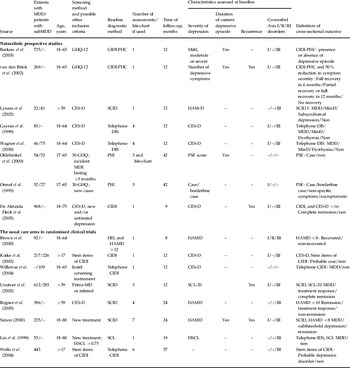
The few existing studies on outcome of depression in primary care have significant limitations (Table 1), the most important of which is the almost exclusively cross-sectional nature of reported outcome, i.e. reporting only the status of the patient at the end of the follow-up period, thus ignoring relapses, recurrences and chronicity. Bearing in mind this shortage, naturalistic medium-term follow-ups have suggested full recovery from major depressive disorder (MDD) in a quarter to one-half of patients, and chronic course in a third (Ormel et al. Reference Ormel, Oldehinkel, Brilman and vanden Brink1993; Gaynes et al. Reference Gaynes, Magruder, Burns, Wagner, Yarnall and Broadhead1999; Wagner et al. Reference Wagner, Burns, Broadhead, Yarnall, Sigmon and Gaynes2000; Lyness et al. Reference Lyness, Caine, King, Conwell, Duberstein and Cox2002; van den Brink et al. Reference van den Brink, Ormel, Tiemens, Smit, Jenner, van der Meer and van Os2002; Barkow et al. Reference Barkow, Maier, Ustun, Gansicke, Wittchen and Heun2003; De Almeida Fleck et al. Reference De Almeida Fleck, Simon, Herrman, Bushnell, Martin and Patrick2005). Moreover, up to one-fifth of subthreshold forms of depression appear to proceed to a major depressive episode (MDE) (Wagner et al. Reference Wagner, Burns, Broadhead, Yarnall, Sigmon and Gaynes2000; Lyness et al. Reference Lyness, Caine, King, Conwell, Duberstein and Cox2002). Outcome has also been reported for control groups of intervention studies (Table 1). Although their findings are informative to some extent, generalizability remains uncertain due to stringent inclusion and exclusion criteria and the necessity of patients to accept the randomization that render their patient populations not representative of typical patients. The wide variation in definition and assessment of remission in available studies also obscures the picture of possible partial recovery and residual symptoms. Only one naturalistic prospective study has reported recurrences in primary care, finding 40% of cases to have had a recurrence in 3.5 years (Oldehinkel et al. Reference Oldehinkel, Ormel and Neeleman2000). In an intervention study with a 1-year follow-up, recurrences occurred in one-third of patients (Lin et al. Reference Lin, Simon, Katon, Russo, Von Korff, Bush, Ludman and Walker1999). A follow-up using medical records suggested a recurrence rate of only 40% over 10 years (van Weel-Baumgarten et al. Reference van Weel-Baumgarten, van den Bosch, van den Hoogen and Zitman1998); however, the shortcomings in detection and recording the diagnosis of depression in primary care may influence this estimation (Coyne et al. Reference Coyne, Schwenk and Fechner-Bates1995; Harman et al. Reference Harman, Schulberg, Mulsant and Reynolds2001). Overall, the outcome of depression in primary care is not well known in terms of prevalence of chronicity, relapses and recurrences, as well as residual symptoms.
Prospective outcome studies in primary care with a follow-up of over 6 months, diagnostic interview and usual care arms in case of randomized clinical trials

MDD, Major depressive disorder; subMDD, subsyndromal depressive disorder; GHQ, General Health Questionnaire; CIDI-PHC, Composite International Diagnostic Interview – Primary Health Care Version; CES-D, Center for Epidemiologic Studies Depression Scale; SCID, Structured Clinical Interview for DSM; HAMD, Hamilton Depression Rating Scale; MinD, minor depression; DIS, Diagnostic Interview Schedule of the National Institute of Mental Health; MDE, major depressive episode; PSE, Present State Examination; CIDI, Composite International Diagnostic Interview; Prime-MD, Primary Care Evaluation of Mental Disorders; SCL, Symptom Checklist; HSCL, Hopkins Symptom Checklist; IDS, Inventory of Depressive Symptoms.
Little is also known about the factors influencing the outcome of depression in primary care. The findings from the available studies are difficult to interpret because of methodological limitations, including inconsistent use of structured or semi-structured interviews for both MDD and co-morbid disorders, not taking into account the effects of additional co-morbid disorders or other possible predictors and not using a life-chart methodology – already a ‘gold standard’ in follow-up studies in psychiatric settings (Keller et al. Reference Keller, Lavori, Friedman, Nielsen, Endicott, McDonald-Scott and Andreasen1987). Only one previous study exists with a life-chart methodology and information regarding predictors for duration of MDE (Oldehinkel et al. Reference Oldehinkel, Ormel and Neeleman2000). Moreover, although depression in primary care is highly co-morbid (Vuorilehto et al. Reference Vuorilehto, Melartin and Isometsa2005), the impact of Axis I disorders on outcome has been investigated seldom (Ormel et al. Reference Ormel, Oldehinkel, Brilman and vanden Brink1993; Gaynes et al. Reference Gaynes, Magruder, Burns, Wagner, Yarnall and Broadhead1999; Wagner et al. Reference Wagner, Burns, Broadhead, Yarnall, Sigmon and Gaynes2000; Lyness et al. Reference Lyness, Caine, King, Conwell, Duberstein and Cox2002; van den Brink et al. Reference van den Brink, Ormel, Tiemens, Smit, Jenner, van der Meer and van Os2002; Barkow et al. Reference Barkow, Maier, Ustun, Gansicke, Wittchen and Heun2003; De Almeida Fleck et al. Reference De Almeida Fleck, Simon, Herrman, Bushnell, Martin and Patrick2005). The influence of Axis II co-morbidity has been assessed in only one intervention study (Brown et al. Reference Brown, Schulberg and Prigerson2000) (Table 1), and that of chronic medical conditions in only a few intervention studies (Brown et al. Reference Brown, Schulberg and Prigerson2000; Simon, Reference Simon2000; Koike et al. Reference Koike, Unutzer and Wells2002; Wells et al. Reference Wells, Sherbourne, Schoenbaum, Ettner, Duan, Miranda, Unutzer and Rubenstein2004). Due to focusing on only a narrow scope of possible predictors in cross-sectional outcome, the picture of predictors for the duration of depression or the risk of recurrence remains largely obscure.
In this naturalistic prospective study, we assessed the outcome of DSM-IV MDD and subsyndromal depressive disorders in a representative sample of 137 primary-care patients, among whom we had retrospectively found high rates of recurrence and chronicity in baseline assessment (Vuorilehto et al. Reference Vuorilehto, Melartin and Isometsa2005). Now, we investigated the outcome of this cohort prospectively. We overcame some major limitations of previous studies by using a life-chart methodology and semi-structured interviews for baseline diagnoses of all Axis I and II disorders, along with information on medical co-morbidity. We hypothesized that features of depression itself (severity, duration and recurrences before entry) and co-morbidity (Axis I, II and III disorders) would effectively predict chronicity and recurrence of depression.
Method
The Vantaa Primary Care Depression Study (PC-VDS) is a naturalistic and prospective cohort study on depressive disorders. Its study protocol was approved by the pertinent ethics committee in December 2001. The PC-VDS is a collaborative research project between the Department of Mental and Alcohol Research of the National Public Health Institute, Helsinki, and the Primary Health Care Organization of the City of Vantaa, Finland. The catchment area comprises a population of 63 400, served by 30 general practitioners with population-based responsibility. The baseline methodology is described in detail elsewhere (Vuorilehto et al. Reference Vuorilehto, Melartin and Isometsa2005).
Screening and baseline evaluation
In the first stage between 2 January and 31 December 2002, a total of 1119 consecutive patients aged 20–69 years received the screening questionnaire of the Primary Care Evaluation of Mental Disorders (PRIME-MD; Spitzer et al. Reference Spitzer, Williams, Kroenke, Linzer, deGruy, Hahn, Brody and Johnson1994) in general practitioners' waiting rooms in two health centres. Altogether 375 patients had positive screen results, having answered ‘yes’ to either of the questions concerning depressed mood or anhedonia during the last month [(1) feeling down, depressed or hopeless or (2) having little interest or pleasure in doing things]. Over the telephone, we ensured that at least one core symptom of MDD was present according to the Structured Clinical Interview for DSM-IV Axis I Disorders (SCID I/P; First et al. Reference First, Spitzer and Gibbon2001). We excluded patients with diagnosed psychosis (other than depressive), bipolar or organic mood disorder, or who were currently receiving treatment in psychiatric care.
In the second stage, after receiving written informed consent, we interviewed all 175 potentially eligible patients face to face using the SCID-I/P with psychotic screen. Inclusion criteria were current (1) MDD, (2) dysthymia, (3) subsydromal MDD with two to four depression symptoms (minimum one core symptom) and lifetime MDD and (4) minor depression (MinD) otherwise similar to subsyndromal MDD, but without MDD history. Distress or functional impairment was required for all. Dysthymia was regarded as subsyndromal MDD or MinD according to a positive or negative history of MDD. The joint diagnostic reliability for current depressive disorders was 100% (κ=1.0 for depression diagnoses). Patients who refused to participate in the study (15%) did not differ significantly in age or gender from those who consented (Vuorilehto et al. Reference Vuorilehto, Melartin and Isometsa2005).
Other research instruments
Current and lifetime psychiatric disorders were assessed with use of the SCID-I/P and the Structured Clinical Interview for DSM-IV Axis II Disorders (SCID-II; First et al. Reference First, Spitzer and Gibbon1997). Observer and self-report scales included the 17-item Hamilton Depression Rating Scale (HAMD; Hamilton, Reference Hamilton1960), the Scale for Suicide Ideation (Beck et al. Reference Beck, Kovacs and Weissman1979) and the Social and Occupational Functioning Assessment Scale for DSM-IV (Goldman et al. Reference Goldman, Skodol and Lave1992). Self-report scales included the 21-item Beck Depression Inventory (BDI; Beck et al. Reference Beck, Ward, Mendelson, Mock and Erbaugh1961), the Beck Anxiety Inventory (BAI; Beck et al. Reference Beck, Epstein, Brown and Steer1988), the Beck Hopelessness Scale (Beck et al. Reference Beck, Weissman, Lester and Trexler1974) and the Perceived Social Support Scale – Revised (Blumenthal et al. Reference Blumenthal, Burg, Barefoot, Williams, Haney and Zimet1987). A self-report questionnaire, medical records and interview were used for chronic medical illnesses. Lifetime course for depression (age of onset, duration and recurrences before entry as well as chronicity of MDD according to DSM-IV criteria) was reconstructed from the interview and medical and psychiatric records.
Follow-up
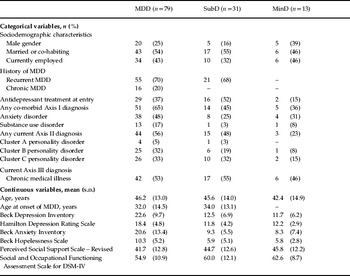
The median time for 18-month interviews was 18.7 months (interquartile range 18.1–19.6). Of the 137 subjects initially included in the study, only three subjects (2%) dropped out from all follow-ups. In addition, two more subjects (2%) were missing at 6 months and altogether 10 subjects (7%) at 18 months. The diagnosis of four patients (3%) switched to bipolar disorder during the 18-month follow-up, and they were censored in the survival analysis at the time-point in the life-chart where the switch occurred. The final follow-up group in the survival analysis consisted of 134 patients, all with information from at least one of the three follow-up points: 89 patients with baseline MDD and 45 with baseline subsyndromal depressive disorder, of the latter 32 with a history of MDD and 13 with baseline MinD, thus without a history of MDD. Baseline characteristics along with antidepressant treatment of the 123 patients who completed the 18-month follow-up (the four patients whose diagnoses switched to bipolar were not included) are shown in Table 2.
Baseline characteristics of the 123 patients with depressive disorder followed-up for 18 months in The Vantaa Primary Care Depression Study
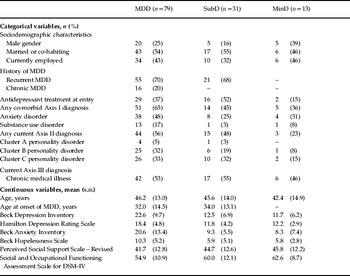
MDD, Major depressive disorder; subMDD, subsyndromal depressive disorder with a history of MDD; MinD, minor depression without a history of MDD; s.d., standard deviation.
Outcome measures
After the baseline assessments, patients were prospectively followed-up with a life-chart – similar to the Vantaa Depression Study methodology (Melartin et al. Reference Melartin, Rytsala, Leskela, Lestela-Mielonen, Sokero and Isometsa2004) – to determine the exact duration of the index episode and the timing of possible relapses and recurrences. To ensure accuracy of the life-chart, we gathered information at three different time-points: the BDI was rated at 3, 6 and 18 months, self-report scales were included at 3, 6 and 18 months, and the current diagnosis of depression was investigated by telephone at 6 months and face to face at 18 months by SCID-I interviews. In addition, observer scales were used at the 18-month assessment. We gathered all available data, including medical and psychiatric records, which were then integrated into the graphic life-chart. We also used probes related to important life events to improve the accuracy of the assessment of change points in the psychopathologic states. The life-chart was based on DSM-IV criteria and definitions.
The time after the baseline interview was divided into three kinds of periods: (1) state of MDE (five or more of the nine MDE criteria symptoms); (2) state of partial remission (one to four symptoms); or (3) state of full remission (no symptoms). In patients with baseline MDD, we calculated from the first baseline interview (1) the uninterrupted duration of the episode in the state of MDE (duration of MDE with full criteria) and (2) time to the first onset of state of full remission lasting at least two consecutive months (time to full remission). In patients with baseline subsyndromal depression, we calculated from the first baseline interview (1) time to the first onset of state of full remission lasting at least two consecutive months (time to full remission) and (2) time to the first onset of state of MDE with full criteria (time to MDE).
Definitions of remission and relapse followed DSM-IV criteria, and recurrence followed the DSM-IV definition for ‘296.3× MDD, Recurrent’. State of remission (further specified as full or partial) required at least two consecutive months in which MDE criteria were not met. Relapse referred to the return of symptoms fulfilling MDE criteria after a period of more than 2 weeks but less than 2 months with symptoms below the MDE threshold. Recurrence referred to the return of MDE after at least two consecutive months of partial or full remission.
Statistical methods
We used Kaplan–Meier survival curves to estimate the probability of remaining ill during the 18-month follow-up. The results were reported in probabilities of achieving a symptom state below the MDE criteria and of achieving full remission. Cox proportional hazards models were used in the multivariate analyses for predicting time (1) from baseline MDD to symptom state below MDE criteria, (2) and to full remission, and time (3) from symptom state below MDE criteria to a recurrent or relapsing MDE, (4) from baseline subsyndromal depressive disorder to a non-symptomatic state or (5) to a new MDE. In these analyses, censored data included subjects who had not achieved the focused symptom state by the end of the follow-up period or by the time they left the study or whose diagnosis switched to bipolar disorder. In analyses of recurrences, only those who completed the whole 18-month follow-up were included.
In our final models, we included variables on the basis of our primary hypothesis, but we also considered their clinical and statistical validity and relevance (e.g. state versus trait). The predetermined independent variables at baseline comprised BDI (alternatively HAMD), pre-entry chronicity (MDE duration of at least 24 months), history of former MDE, antidepressive medication at entry, BAI, substance-use disorder, cluster A, B and C personality disorder, chronic medical illness, employment status and health centre. For the final models, we omitted the non-significant variables. All models were adjusted for age and gender. SPSS software (version 14.0; SPSS Inc., Chicago, IL, USA) was used.
Results
Baseline major depressive disorder
Outcome of index MDE
Of the 79 patients with baseline MDD who were followed-up for the entire 18-month period, slightly more than one-third [38% (30/79)] achieved full remission of the index episode. Another third [37% (29/79)] achieved partial remission (one to four residual depressive symptoms), and a quarter [25% (20/79)] remained with full MDE criteria throughout the study.
Duration of index MDE with full criteria
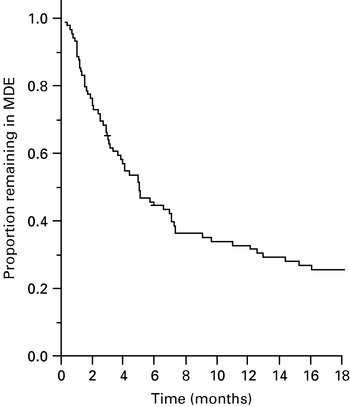
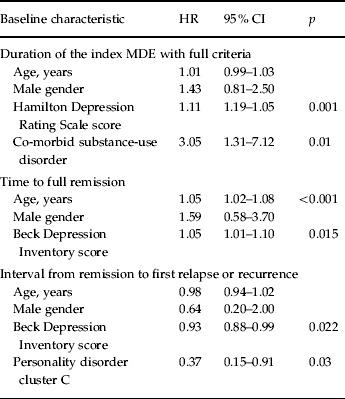
The median duration of MDE with full criteria was 6.00 months [95% confidence interval (CI) 4.00–8.00] after entry (Fig. 1). In a Cox regression model, longer duration of MDE was predicted by higher severity of depression in baseline HAMD (Table 3) or BDI [in an alternative model, hazard ratio (HR) 1.95, p<0.001, 95% CI 1.03–1.09], as well as by baseline co-morbid substance-use disorder (Table 3). Other psychiatric or somatic co-morbidities or any sociodemographic characteristics at baseline did not predict duration of MDE.
Survival analysis of remaining in major depressive episode (MDE) among primary-care patients with major depressive disorder (n=89) (Kaplan–Meier survival curve).

Predictors of outcome among 85 patients with MDE in The Vantaa Primary Care Depression Study in a Cox regression model
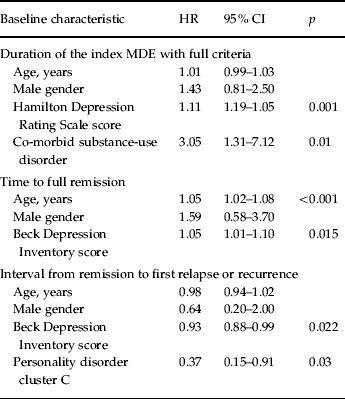
MDE, Major depressive episode; HR, hazard ratio; CI, confidence interval.
Time to full remission after index MDE
In a Cox regression model, longer time to full remission was predicted only by older age and more severe symptoms of depression at baseline (Table 3).
Relapses and recurrences
Of the patients with baseline MDD, 75% (59/79) achieved a symptom state below full MDE criteria. In one-third [32% (19/59)], symptoms fulfilling MDE criteria returned, either in the state of partial remission [15% (9/59)] or in the state of already total remission [17% (10/59)]. Of these patients, 8% (5/59) relapsed immediately (return of criteria for MDE, after a period with symptoms below the MDE threshold exceeding 2 weeks, but less than 2 months), 27% (16/59) had a recurrence (return of MDE after at least two consecutive months of partial or full remission) and in 3% (2/59) both conditions occurred.
In a Cox regression model, longer time to first relapse or recurrence was predicted by milder depressive symptoms and by not having a cluster C personality disorder at baseline (Table 3).
Baseline subsyndromal depressive disorders
Outcome of the index subsyndromal symptom state
During the 18-month follow-up the index subsyndromal symptom state improved to a non-symptomatic state in about half of the patients [55% (24/44)]. The subsyndromal state remained persistent with one to four depressive symptoms in one-fifth [20% ([9/44)], and proceeded to MDE in one-quarter of patients [25% (11/44)].
Time to change from subsyndromal symptom state
The median time from entry to a non-symptomatic state was 6.53 months (95% CI 3.63–9.43). In a Cox regression model, slower improvement was predicted by chronic medical illness (HR 2.785, p=0.031, 95% CI 1.10–7.05). Slower progress to an emerging or recurrent MDE was predicted by baseline diagnosis of MinD (never having suffered from MDD) (HR 15.08, p=0.021, 95% CI 1.50–151.86).
Discussion
Our medium-term prospective life-chart study verified the chronic and recurrent nature of depression in primary care. Only one-quarter of patients with MDD achieved and maintained full remission for 18 months, while another quarter failed to remit at all. The remaining patients suffered either from residual symptoms or recurrences during follow-up. While severity of depression was the most robust predictor of recovery, presence of co-morbid substance-use disorders, chronic medical illness and cluster C personality disorders also contributed to adverse outcome.
The major strengths of this study comprise a medium-sized (n=137) cohort of primary-care patients with either MDD or subsyndromal depressive disorder, effectively representing the primary health care patients in a Finnish city, and use of structured interviews with excellent reliability for the diagnosis of MDD (κ=1.0), plus information on all co-morbid Axis I, II, and medical disorders at baseline, although the reliability of co-morbid disorder diagnoses and outcome variables remains unknown. Moreover, the patients were followed-up using a life-chart. Besides diagnostic characteristics and symptom ratings, we included predictors from several other potentially relevant domains at baseline, such as functional status, perceived social support and treatment received. Finally, attrition is unlikely to have biased our findings, as 90% of the cases could be assessed face to face at least once after baseline, and for 98% some or all ratings were available.
However, some methodological choices need to be clarified. First, by using a screen at intake, we aimed to provide an accurate picture of the clinical caseload of depressive disorders, both recognized and unrecognized, met by primary-care doctors in everyday work. The probability that a depressive patient will appear in this kind of prevalence-based cohort is proportional both to the incidence of onsets and to the duration of the depression; therefore, compared with incidence-based studies, cases of long duration are enriched in our cohort (Cohen & Cohen, Reference Cohen and Cohen1984). Moreover, as the patients were not recruited at similar points in the course of their depression, the duration of the episodes in follow-up are not comparable with results of incidence-based studies. Second, we investigated the outcome of depression by using a graphic life-chart, which is similar but not identical to the Longitudinal Interval Follow-up Evaluation (LIFE) methodology used in NIMH-CDS (Keller et al. Reference Keller, Lavori, Mueller, Endicott, Coryell, Hirschfeld and Shea1992). We used probes related to important events when inquiring about change points in the psychopathologic state, BDI ratings at three time-points and patient records. Some underestimation or inaccuracy of reported symptoms may, however, have taken place due to possible recall bias. Unlike in the LIFE, we classified patients' follow-up time into periods compatible with DSM-IV MDE, partial remission and full remission. With use of rather stringent definitions in the DSM-IV, we found a cross-sectional full remission rate (26.6%) that falls in the lower end of remission rates (from 29% to 37%) of available outcome studies on prevalent cases (Gaynes et al. Reference Gaynes, Magruder, Burns, Wagner, Yarnall and Broadhead1999; Wagner et al. Reference Wagner, Burns, Broadhead, Yarnall, Sigmon and Gaynes2000). Third, we deliberately confined ourselves to predictors of outcome that were present and recognizable to the doctor at intake. We thus disregarded all events during follow-up that may have influenced the course of depression, including many psychosocial factors together with the complex process of seeking, receiving and complying with treatment. The adequacy of treatment during follow-up is a subject of a further study. Finally, while the cohort probably represents Finnish urban and suburban primary health care patient populations well, the generalizability to rural or foreign patient populations remains unknown. To the extent that other studies have investigated the same characteristics in primary care, no major differences between our findings and those in other countries are apparent.
This longitudinal study revealed the adverse prognosis of MDD in primary care: only one-quarter of patients remained with a sustained favourable outcome and one-third of those with some remission experienced recurrence or relapse. As in previous cross-sectional outcome studies (Gaynes et al. Reference Gaynes, Magruder, Burns, Wagner, Yarnall and Broadhead1999; Barkow et al. Reference Barkow, Maier, Ustun, Gansicke, Wittchen and Heun2003; De Almeida Fleck et al. Reference De Almeida Fleck, Simon, Herrman, Bushnell, Martin and Patrick2005), also large proportions of partial remission (37%) and chronic course (25%) emerged in our study. Remission appeared slowly; at 6 months, only half of the patients had shown some recovery. The duration of MDE has earlier been investigated in primary care in only a cohort of new patients, where the median duration was 8 months (Oldehinkel et al. Reference Oldehinkel, Ormel and Neeleman2000). Overall, our cross-sectional findings were consistent with previous primary-care studies, although the life-charts also revealed apparent recurrences and fluctuations of symptoms alongside chronicity. In our view, this information is important for developing management of depression in primary health care towards the multifaceted collaborative care models, likely to be effective and already endorsed in some clinical guidelines (NICE, 2004; Gilbody et al. Reference Gilbody, Bower, Fletcher, Richards and Sutton2006).
Higher severity of depression was the main predictor for poor outcome. As in studies in the general population (Spijker et al. Reference Spijker, de Graaf, Bijl, Beekman, Ormel and Nolen2002) and in psychiatric patients (Keller et al. Reference Keller, Lavori, Mueller, Endicott, Coryell, Hirschfeld and Shea1992; Mueller, Reference Mueller1996; Meyers et al. Reference Meyers, Sirey, Bruce, Hamilton, Raue, Friedman, Rickey, Kakuma, Carroll, Kiosses and Alexopoulos2002; Melartin et al. Reference Melartin, Rytsala, Leskela, Lestela-Mielonen, Sokero and Isometsa2004), baseline severity of depression was associated with both chronicity and relapses/recurrences. Moreover, to a lesser extent, co-morbid substance-use disorders predicted chronic course of depression consistently with an earlier reported result of an univariate analysis in primary care (Barkow et al. Reference Barkow, Maier, Ustun, Gansicke, Wittchen and Heun2003). To our knowledge, we were the first to investigate Axis II disorders as predictors of outcome in primary care. We found co-morbid cluster C personality disorders (avoidant, dependent, obsessive–compulsive) to predict early recurrences. Earlier, a general population survey (Johnson et al. Reference Johnson, Cohen, Kasen and Brook2005) reported a similar association, while in specialist care, cluster C personality disorders have mainly been associated with longer duration of MDE (Viinamaki et al. Reference Viinamaki, Hintikka, Honkalampi, Koivumaa-Honkanen, Kuisma, Antikainen, Tanskanen and Lehtonen2002; Farabaugh et al. Reference Farabaugh, Fava, Mischoulon, Sklarsky, Petersen and Alpert2005). Finally, chronic medical illnesses, a known predictor for adverse cross-sectional outcome (Wagner et al. Reference Wagner, Burns, Broadhead, Yarnall, Sigmon and Gaynes2000; van den Brink et al. Reference van den Brink, Ormel, Tiemens, Smit, Jenner, van der Meer and van Os2002), also formed a risk factor for slow recovery from subsyndromal depression in this cohort. However, some of our expectations were not fulfilled; co-morbid anxiety disorders, a strong predictor of slower recovery in specialized care (Parker, Reference Parker2000; Melartin et al. Reference Melartin, Rytsala, Leskela, Lestela-Mielonen, Sokero and Isometsa2004), were not a predictor of outcome in this study, neither were sociodemographic factors, other than age. In studies on psychiatric patients and in the general population (Mueller, Reference Mueller1996), controlling for depression severity has diminished the predictive power of sociodemographic factors. Overall, among primary-care patients with mild to moderate MDD, severity of depression served well as a predictor of outcome.
The follow-up of subsyndromal depressive disorders revealed the significance of lifetime history of MDD for expected outcome. While ‘proper’ MinD (without history of MDD in DSM-IV) seldom proceeded to MDE, an adverse progression of symptoms to a new MDE was seen in one-third of those who were in partial remission or in a potential prodromal phase of lifetime MDD. Overall, however, as in the few existing cross-sectional studies (Ormel et al. Reference Ormel, Oldehinkel, Brilman and vanden Brink1993; Wagner et al. Reference Wagner, Burns, Broadhead, Yarnall, Sigmon and Gaynes2000; Lyness et al. Reference Lyness, Caine, King, Conwell, Duberstein and Cox2002), the group with subsyndromal depressive disorders had a better prognosis. They had at entry fewer co-morbid psychiatric disorders (Vuorilehto et al. Reference Vuorilehto, Melartin and Isometsa2005) and may therefore represent a group in a clinical subgroup of patients more likely to recover. In clinical decision-making, a history of previous MDD should not be ignored by primary-care doctors.
Conclusions
This prospective longitudinal investigation verified the longitudinally fluctuating course of depression in primary care, with high rates of recurrence and chronicity of depressive episodes. Severity of depressive symptoms and co-morbidity are important predictors also in primary care. Treatment of depression in primary care should be based on the management of a chronic disease in order to improve outcome.
Acknowledgements
This study has been funded by the Primary Health Care Organization of the City of Vantaa, and the National Public Health Institute, Helsinki, Finland.
Declaration of Interest
None.