Medical and public health professionals are key to disaster preparedness, response, and recovery, and with approximately 50% of all Americans living with at least 1 chronic disease requiring prescription medicationsReference Raghupathi and Raghupathi1 and polypharmacy increasing in the United States,Reference Charlesworth, Smit and Lee2 pharmacists are among the most accessible and trusted of health professionals to US communities.Reference Malewski, Ream and Gaither3–Reference Qato, Zenk and Wilder7 As a field, the pharmacy profession has played an essential role in several hurricane disasters,Reference Ford, Dallas and Harris8,Reference Pincock, Montello and Tarosky9 such as in Hurricanes Hugo, Andrew, Iniki, Georges, Ivan, Katrina, Sandy, Matthew, Harvey, Irma, Maria, and most recently, Florence. Pharmacists of all sectors, such as those employed in locally owned, hospital, or retail pharmacies, are important stakeholders in disasters in that they are involved in preparedness activities, as in stockpiling essential medications and medical devices for community residents, shelter evacuees, and shelter-in-place patients at hospitals and nursing homes.Reference Aucoin10–Reference Traynor16 They also contribute to response and recovery efforts and help to maintain continuity of care during and after hurricane disasters.Reference Melin and Rodriguez-Diaz4,Reference Jimenez-Mangual, Cuevas-Acevedo and Quiles-Alves6,Reference Ford, von Waldner and Perri12–Reference Nitzki-George, Palowitz and Sowerby14,Reference Broz, Levin and Mucha17–Reference Storch, Shah and Salloum30
However, pharmacies are among several health facilities that may encounter significant damage due to hurricanes in the form of structural damage, interrupted telecommunications, staffing difficulties, medication shortages, power issues, restricted access to flooded areas, and a variety of other complications.Reference Melin and Rodriguez-Diaz4,Reference Nitzki-George, Palowitz and Sowerby14,Reference Melin, Maldonado and Lopez-Candales25,Reference Arya, Medina and Scaccia31–Reference Lavery, Patel and Boehmer34 Such issues can greatly hinder the ability of pharmacists to provide health care to communities during disaster events.
Hurricane Florence made landfall at Wrightsville Beach near Wilmington, North Carolina on September 14, 2018.Reference Schembri35–Reference Stewart and Berg38 Hurricane Florence was a Category 1 storm with 90 miles per hour (MPH) winds and a 400-mile-wide zone of tropical storm-force winds.Reference Shultz, Kossin and Galea36–Reference Stewart and Berg38 As the storm moved inland over North Carolina and South Carolina, it stalled to forward speeds of approximately 2-3 MPH, causing rainfall totals near 36 inches in parts of North Carolina and near 24 inches in parts of South Carolina.Reference Schembri35–Reference Stewart and Berg38 Due to this substantial rainfall, Hurricane Florence primarily caused significant damage in areas of North Carolina and South Carolina, totaling nearly $22 billion of damage in North Carolina and $2 billion in South Carolina.Reference Feaster, Weaver and Gotvald37,Reference Stewart and Berg38 It was documented that over 820 roads in the Carolinas were still inaccessible 1 wk after the storm’s landfall, with 656 in North Carolina and 169 in South Carolina.Reference Feaster, Weaver and Gotvald37 It was also reported that over 1 million power outages and 52 deaths occurred across the Carolinas.Reference Feaster, Weaver and Gotvald37,Reference Stewart and Berg38
During Hurricane Florence, there were accounts of several local pharmacies being rendered nonfunctional or closed up to 4 d after the storm, and hospital-based pharmacies made efforts to counterbalance this reduction in available pharmacies by serving community residents in need of medications and primary care.Reference Traynor15,Reference Tanz, Hoffman and Dandeneau39 As a result, the need for prescription medications was especially evident during the Florence event, particularly in emergency departments across North Carolina.Reference Tanz, Hoffman and Dandeneau39 With community pharmacies, whether chain or retail, independently owned, or hospital-based, fulfilling such an essential role in hurricane disaster preparedness, access to operating pharmacies in the context of imminent hurricane disasters may serve as a key indicator of community preparedness for such disaster events. Measuring pharmacy functionality, or the volume of pharmacies that are operational, during and after severe hurricane weather can also serve as an indicator for effective disaster response and recovery efforts. Thus, it is important to understand the spatial distribution and temporal aspects of access to operational pharmacies before, during, and after severe hurricane events, such as Hurricane Florence. The main objective of this study was to quantify and spatially assess pharmacy functionality in North Carolina and South Carolina counties that were impacted by the Hurricane Florence disaster event.
METHODS
Geographic Scale of the Analysis
Historically, counties have been considered the primary and most efficient agents of planning and implementing emergency management efforts.Reference Waugh40 Decision-makers at the county level are able to effectively represent their constituents and local interests as well as coordinate the provision of emergency management services and resources.Reference Waugh40 Also, counties are administrative extensions of US states with regard to governance, which enables local emergency preparedness, response, and recovery efforts to be conducted with state-level support, funding, and resources.Reference Waugh40 Because of these justifications, we selected the county level as the geographic scale for the analysis.
Data Sources
Data on Hurricane Florence disaster declarations and assistance eligibility for the states of North Carolina and South Carolina were obtained from the Federal Emergency Management Agency (FEMA). Under the FEMA Disaster Declarations DR-4393 and DR-4394, designated counties in North Carolina and South Carolina, respectively, that were affected by Hurricane Florence were eligible for individual assistance and/or public assistance from FEMA. While the public assistance program directs federal financial assistance to governments, nonprofit organizations, and other entities for disaster recovery, the individual assistance program provides disaster aid directly to individual persons and families, thus counties eligible for individual disaster assistance were the emphases of this study.
Data on pharmacy operating status were obtained from Healthcare Ready, which is a national nonprofit organization that supports patient access to pharmacies during and after disasters. Healthcare Ready hosts Rx Open, which is a publicly available, interactive database that maps the operational status of approximately 90% of US pharmacies in real-time for areas affected by a specific disaster event. When activated for disasters and other emergencies, Healthcare Ready collects and maps data on pharmacies twice a day from the National Council for Prescription Drug Programs, which provides contact and location information for all US pharmacies.41 Data are also obtained from eRx Network and RelayHealth, which provide information on pharmacy billing activity with insurance companies.41
Pharmacies registered to participate in the Rx Open database are assigned open, closed, or unknown operational status indications within Healthcare Ready’s interactive map based on billing activity. Open pharmacies are those that have prescription billing activity within a 12-h period during a disaster event, and closed pharmacies are those that have reported closures or operational issues to Healthcare Ready.41 Pharmacies with an unknown operational status are those that have not billed any prescriptions within a 12-h period or could not be reached for communication.41 For the Hurricane Florence event, Healthcare Ready activated Rx Open on September 12, 2018. For this study, data on pharmacy operational status were collected from the date of activation (September 12, 2018) through 1 wk after landfall of the storm (September 20, 2018).
Data Management and Analysis
The Hurricane Florence disaster declaration data for the states of North Carolina and South Carolina were downloaded from the FEMA GIS Data Feeds database (https://gis.fema.gov/DataFeeds.html), and the pharmacy data were downloaded from Healthcare Ready’s Rx Open database (https://www.healthcareready.org/rxopen). The disaster declaration and pharmacy data were cleaned, uploaded, and joined by state in ArcGIS version 10.5 (Environmental Systems Research Institute Inc., Redlands, CA) to compute and visualize pharmacy functionality measures for counties with individual assistance designations for the Hurricane Florence event. All data from North Carolina and South Carolina were merged and projected in the USA Contiguous Albers Equal Area Conic projection coordinate system.
Pharmacy functionality was defined as the operating pharmacy capacity (OPC) of a county of interest. The OPC for a county i was calculated as the number of operational, or open, pharmacies located in county i divided by the total number of pharmacies located in county i, multiplied by 100:
 $${\rm{OP}}{{\rm{C}}_{\rm{i}}} = \left[ {{{\sum {{\rm{open}}{\mkern 1mu} {\rm{pharmacie}}{{\rm{s}}_{\rm{i}}}} } \over {\sum {{\rm{open}}{\mkern 1mu} {\rm{pharmacie}}{{\rm{s}}_{\rm{i}}} + \sum {{\rm{unknown}}{\mkern 1mu} {\rm{pharmacie}}{{\rm{s}}_{\rm{i}}} + \sum {{\rm{closed}}{\mkern 1mu} {\rm{pharmacie}}{{\rm{s}}_{\rm{i}}}} } } }}} \right] \times 100$$
In the denominator, the total number of pharmacies per county included pharmacies with an open operational status, an unknown operational status, and a closed operational status, in accordance with the Healthcare Ready operational status definitions. Pharmacies with an unknown status were included, as these were likely closed or nonfunctional facilities with the inability to report operational issues to Healthcare Ready due to power outages or structural damage, or these were likely functional facilities with the inability to electronically document filling prescriptions due to interrupted technological systems. Healthcare Ready also assigns pharmacies that are not registered for the Rx Open database an operational status of nonparticipating. These pharmacies were not included in the OPC computation, as data on their functionality could not be collected. In the Supplementary Material, Table S1 provides data on the number of open pharmacies (numerator) and total pharmacies (denominator) that were captured within the Rx Open database for each county of interest on each day of the study period.
County-level OPC measures were computed for 3 periods of the disaster management cycle: the disaster preparedness, response, and recovery periods. The disaster preparedness period was considered to be the period directly preceding a hazardous event, and the disaster response period was referred to as the period immediately following a hazardous event that requires rapid assistance to stabilize conditions in an affected area.Reference Wisner and Adams42 The disaster recovery period was defined as the period postevent during which long-term restoration, reconstruction, and rehabilitation actions are emphasized.Reference Wisner and Adams42 OPC measures were computed for the disaster preparedness period or pre-Hurricane Florence (September 12-13, 2018), the disaster response period or during the Hurricane Florence event (September 14-17, 2018),Reference Stewart and Berg38 and the disaster recovery period or post-Hurricane Florence (September 18-20, 2018).
GeoDaReference Anselin, Syabri and Kho43 version 1.12 (University of Chicago, Chicago, IL) was used to calculate Getis-Ord Gi*(d)Reference Getis and Ord44 statistics to detect local clustering of optimal or suboptimal pharmacy functionality within the Hurricane Florence-impacted region. For this analysis, a high cluster is a county with a high OPC value and is surrounded by other counties with high OPC values, and a county with a low OPC value with neighboring counties of low OPC was identified as a low cluster. Statistically significant high clusters were identified as hot spots, and statistically significant low clusters were identified as cold spots. For the Gi*(d) analysis, a k-nearest neigh–or (KNN) spatial weights matrix was specified. A KNN spatial weights matrix with a specification of 5 nearest neighbors was applied to ensure all counties had a sufficient number of neighbors. Statistically significant hot spots or cold spots of pharmacy functionality were determined by pseudo P-values at a 0.05 alpha level using 999 permutations. Results from the Gi*(d) analysis were exported and mapped in ArcGIS.
Ethics Statement
All data used for this study were publicly accessible and in de-identified formats, thus the research activities described in the article did not meet the definition of human subjects research, and this study was not subjected to review and approval by an institutional review board.
RESULTS
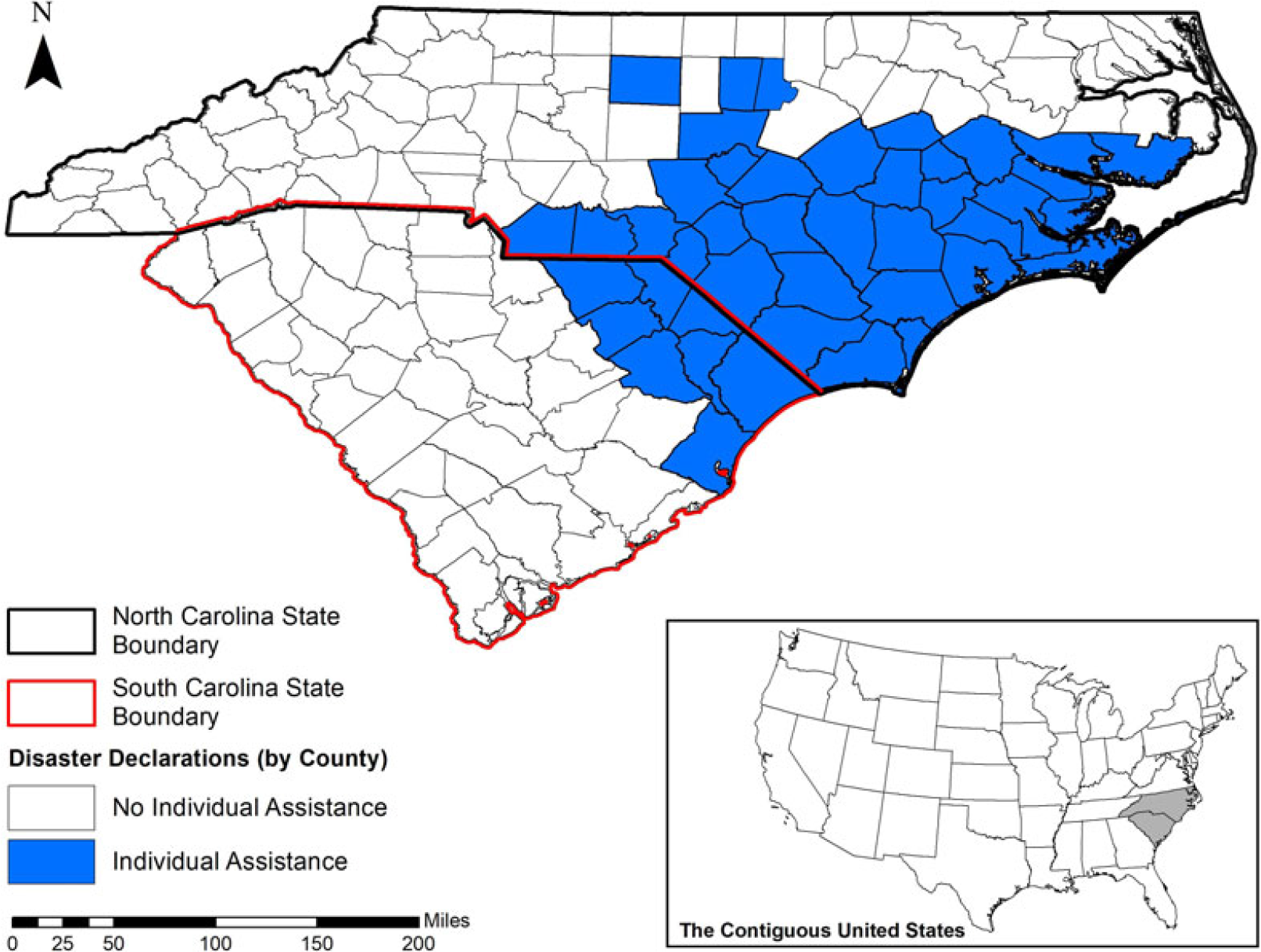
The spatial distribution of the counties in North Carolina and South Carolina that were eligible for federal individual assistance after the Hurricane Florence disaster is presented in Figure 1. In total, 42 counties were eligible for individual assistance, with 34 counties being eligible in North Carolina and 8 being eligible in South Carolina. Most of the North Carolina counties designated to receive individual assistance were located in the southeastern and south central regions of the state. For South Carolina counties designated for individual assistance, all were located in the northeastern part of the state.
North Carolina and South Carolina Counties Designated for Individual Federal Disaster Assistance for the Hurricane Florence Event, September 2018.

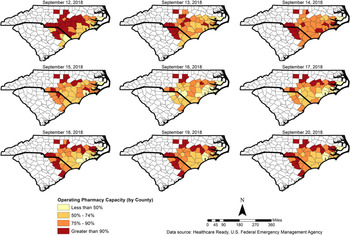
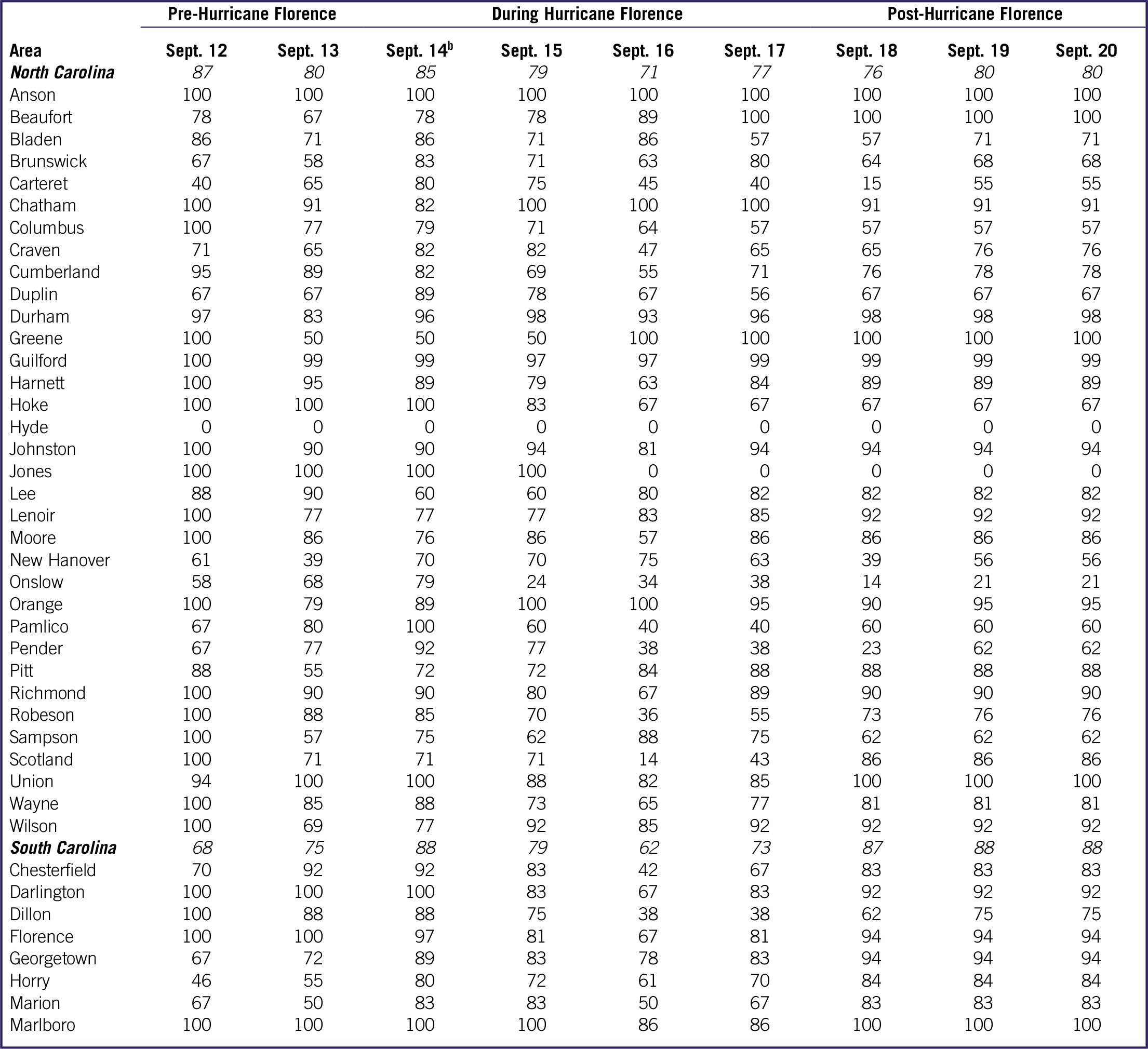
The spatial pattern of operating pharmacy capacity between September 12, 2018, and September 20, 2018, was mapped for North Carolina counties eligible for individual disaster assistance (see Figure 2). Spatially, pharmacy functionality over the time period was highest for counties located more centrally within the state. Temporally, pharmacy functionality was most optimal during the preparedness period on September 12 (2 d before landfall) and during the early response period on September 14 (the date of landfall), with OPC measures for the Hurricane Florence-impacted region in North Carolina being reported at 87% and 85%, respectively, as shown in Table 1. Subsequently, this area sustained low capacity of operational pharmacies over a 4-d period during the disaster response period and the early part of the recovery period between September 15 and September 18. September 16 had the worst spatial pattern with regard to pharmacy functionality, especially among counties along the North Carolina coast, and the overall OPC measure for the region was 71% on this date. Pharmacy functionality on September 17 and 18 followed with sub-optimal OPC measures at 77% and 76%, respectively. Pharmacy functionality recovered to pre-Hurricane Florence levels roughly 1 wk after landfall during the disaster recovery period at 80% OPC.
County-Level Operating Pharmacy Capacity Before, During, and After Hurricane Florence in North Carolina and South Carolina Counties Designated for Individual Federal Disaster Assistance, September 12, 2018 - September 20, 2018.

Operating Pharmacy Capacity Measuresa for the Hurricane Florence Event by County Eligible for Individual Federal Disaster Assistance: North Carolina and South Carolina, September 12, 2018 – September 20, 2018

September 12 - 13, 2018 represent the disaster preparedness period or pre-Hurricane Florence period; September 14 - 17, 2018 represent the disaster response period or during Hurricane Florence period, and September 18 - 20, 2018 represent the disaster recovery period or post-Hurricane Florence period.
a Operating Pharmacy Capacity measures are percentages (%).
b September 14, 2018 is the date of landfall for Hurricane Florence.
Also, in Figure 2, the spatiotemporal distribution of operating pharmacy capacity is shown for South Carolina counties that were eligible for individual disaster assistance. Spatially, counties located more inwardly within South Carolina tended to have higher pharmacy functionality, in general, throughout the Hurricane Florence event period. Temporally, pharmacy capacity during the preparedness period leading up to the Hurricane Florence event was lower than that on the date of landfall at 68% and 75% for September 12 and 13, respectively. With OPC being reported at 88%, overall pharmacy functionality for the area was greatest during the early disaster response period on September 14, as Hurricane Florence made landfall and progressed into northeastern South Carolina. During the response period between September 15 and September 17, pharmacy functionality declined greatly. Similarly to North Carolina, functionality was lowest on September 16, with an OPC measure of 62% for South Carolina. Also, like in North Carolina, operating pharmacy capacity returned to high functionality levels approximately a week post landfall during the recovery period, with capacity for September 18-20 being 87-88%.
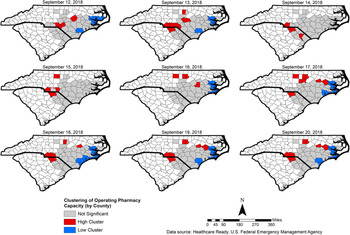
Spatial clustering of pharmacy functionality among counties eligible for individual assistance is presented in Figure 3. The cluster map indicates there were 4 hot spots among central counties and 4 cold spots among counties along the coast on September 12. With a similar spatial distribution, there were 8 hot spots among central areas and 3 cold spots along the coast on September 13. As Hurricane Florence made landfall, there were 3 hot spots on September 14 and 4 hot spots on September 15 among centrally located counties. Among counties on the coast of the Hurricane Florence-impacted region, 3, 4, and 6 cold spots were identified on September 16, 17, and 18, respectively. Four, 7, and 5 hot spots were found primarily among centrally located counties also on September 16, 17, and 18, respectively. On September 19 and 20, 7 hot spots were detected primarily in central areas, with 5 cold spots along the coast.
Clusters of Operating Pharmacy Capacity Before, During, and After Hurricane Florence in North Carolina and South Carolina Counties Designated for Individual Federal Disaster Assistance, September 12, 2018 – September 20, 2018.

DISCUSSION
Health-care professionals have served as fundamental stakeholders in implementing effective preparedness, response, and recovery efforts for several major hurricane events. However, hurricane disasters can have catastrophic impacts on the health-care sector and the individuals and communities served by it. Such impacts may be more evident and comprehensible when examining pharmacies, considering the accessibility and volume of pharmacy facilities located in communities throughout the United States. In this study, we sought to evaluate the preparedness and resilience of community pharmacies for Hurricane Florence, a recent hurricane disaster. We computed, mapped, and analyzed the capacity of operational pharmacies in North Carolina and South Carolina before, during, and after the 2018 Hurricane Florence event.
The findings of this research demonstrate there is some degree of disaster preparation made by community pharmacies in anticipation of potential hurricane disasters. In North Carolina, half of the counties eligible for individual assistance were found to have increased operating pharmacy capacity between September 13 and 14 before the landfall of Hurricane Florence. Another 7 counties maintained high operating pharmacy capacity of 90% or higher in preparation of Hurricane Florence’s landfall also. Similarly, nearly all counties eligible for individual assistance in South Carolina either increased or maintained high pharmacy functionality between September 13 and 14 in advance of Hurricane Florence’s landfall.
This study also highlights the extent to which the stalling of Hurricane Florence and ensuing damage adversely impacted the volume of operational pharmacies in North Carolina and South Carolina. Overall pharmacy capacity decreased for the Hurricane Florence-impacted region up to 3 to 4 d after landfall during the disaster response period, which is consistent with what was previously documented for medical facilities in North Carolina.Reference Traynor15 Furthermore, pharmacy functionality recorded on September 16 was especially less than optimal compared with functionality before and 1 wk after the landfall of Hurricane Florence. This demonstrates that, although pharmacy operations increased immediately before Hurricane Florence’s landfall in preparation for severe hurricane weather, several community pharmacies were not prepared to manage the subsequent inundation caused by the storm after it stalled, presenting an opportunity for community pharmacies to establish or improve hurricane response protocols.
Another significant finding was that after a week post landfall of Hurricane Florence during the disaster recovery period, overall pharmacy functionality recovered to high, prehurricane levels. This indicates that immediate recovery efforts with regard to pharmacies can be identified and measured as early as 1 wk after hurricane disasters, such as Hurricane Florence. Not only did this study identify when medical reinforcements may be needed once a disaster occurs, this study also demonstrated where access to pharmacy-based care may be limited during a hurricane disaster. Notably, counties along the North Carolina southeastern coastline had the most suboptimal operating pharmacy capacity over the course of the Hurricane Florence event. Cluster analysis further confirmed that cold spots, or areas with low pharmacy functionality, were concentrated along the coast and that hot spots of optimal pharmacy functionality were clustered within more centrally located areas in North Carolina and South Carolina.
Examining the timing and spatial clustering of optimal or poor pharmacy functionality can assist disaster management stakeholders with understanding when and where pharmacy reinforcements may be needed before, during, and in the aftermath of a disaster event. For instance, in preparation for the next hurricane disaster, North Carolina officials may be interested to know that persons living in counties along the coast may benefit from mobile pharmacies and other mobile health-care resources after a disaster. Also, responders assigned to evacuation shelters, hospitals, and disaster medical assistance teams in these areas may benefit from knowing that there is a possibility that accessing pharmaceutical supplies from local pharmacies may be difficult during a disaster. This is especially pertinent for when state-level policy and decision makers need to make an assessment as to which counties in their jurisdictions should be provided medical assistance and ancillary resources from the federal government for a disaster event.
While studies have documented operational issues with pharmacy facilities in the aftermath of hurricane disasters, to our knowledge, there has been no prior research conducted to quantify or spatially assess pharmacy functionality in the context of a hurricane disaster, thus the novelty of this work. There are several implications of this research. The findings can be used to guide investments in infrastructure that facilitate pharmacy continuity of operations in preparedness for disaster events. This study also provides an insightful view as to how the data-rich, publicly accessible Healthcare Ready Rx Open database can be used by emergency responders and health-care planners for targeting where medical supplies should be diverted in an emergency. This work may also be used to anticipate the disaster impacts on population health due to lack of access to medications in future severe hurricane events. Lastly, the finding that pharmacy services were restored within 4 d of the event suggests that disaster recovery of pharmacy operations can be expected to occur relatively quickly for a Category 1 storm, like Hurricane Florence.
Limitations
This study is subject to some limitations that should be addressed. First, the modifiable areal unit problem, a bias that stems from how data are aggregated, may distort inference regarding spatial access to operational pharmacies. Counties with low or high operating pharmacy capacity may not precisely reflect pharmacy access. For instance, although individuals may reside in a county with low operating pharmacy capacity, this does not mean they primarily frequent pharmacies in their county of residence. Dependent on where within a county someone lives, works, or socializes, a pharmacy in a neighboring county may be closer, thus more attractive due to distance. Other indicators of attractiveness, such as pharmacy type or servicing aspects (ie, express pickup or drive-thru servicing), may influence whether or not individuals use a pharmacy in their residential county as well.
Second, we assessed the volume of operational pharmacies by county without considering pharmacy density by population density. Being that some counties may have very few total pharmacies per person before any disaster event, the pharmacy functionality measure included in this study may not precisely measure the outcome of interest of this study, because it may not reflect that pharmacy deserts may be present in certain counties at the outset.
Third, there may be misclassification for pharmacies with an unknown status indication. Rx Open identifies pharmacies as open based on filed prescription claims to a health insurance company. However, during and after disasters, interrupted communication systems render documenting medication provisions electronically to be difficult, thus pharmacies with an unknown status indication may actually be serving patients and filling prescriptions.Reference Arya, Medina and Scaccia31 Additionally, for pharmacies that were closed in accordance with Healthcare Ready, the reason for a pharmacy’s inoperability (ie, flooding, low stock, damaged stock, etc.) was not provided in the Rx Open database, which may be beneficial to know for preventing and mitigating low to no pharmacy functionality in future disasters. Similarly, for pharmacies that were deemed open, we assumed they had full ability to conduct servicing duties typical in nondisaster situations, which may not be an appropriate assumption to make in the context of disasters.
Fourth, the Rx Open database is updated twice daily every 12 h by Healthcare Ready. The 12-h time periods may not be the most optimal temporal construct to use, because shorter periods may be more conducive for real-time reporting of operational pharmacy data; however, 12-h intervals likely work best for the national Rx Open database considering the range of time zones within the United States.
Finally, the pharmacy data provided by Healthcare Ready may differentially exclude certain types of pharmacies. Pharmacies must register to be included in the Rx Open database, and unregistered pharmacies do not have data on their functionality reported, as they are listed with a nonparticipating indication within the Rx Open map.Reference Arya, Medina and Scaccia31,41 Although roughly 90% of all pharmacies in the United States are captured by Healthcare Ready, nonparticipating unregistered pharmacies are more likely to be independent, locally owned pharmacies that may encounter longer recovery times after a disaster compared with hospital-based or retail pharmacies with greater resources.41 For instance, OPC measures of 0% were reported for Hyde County in North Carolina during the entire Hurricane Florence event, which may be due to the prevalence of unregistered, locally owned pharmacies in this county. In future research, investigating the characteristics and spatial distribution of unregistered pharmacies may help inform where locally owned pharmacies are likely located. Also, future validation studies on the completeness of the Rx Open database may better inform data capture differences by pharmacy type.
Despite these limitations, the novelty of the study’s research scope and accessibility of the methods used in this study combined with the key role of community pharmacists with regard to preparing for, responding to, and recovering from disasters reinforces the significance of the findings from this research.
Future Research
There are additional studies that would be logical progressions from this current study. One avenue is the investigation of the relationships between operating pharmacy capacity and factors related to disaster vulnerability. Future studies on pharmacy functionality in the context of hurricane disasters may benefit from incorporating measures from the Social Vulnerability Index (CDC SVI), which was developed by the Centers for Disease Control and Prevention to model an area’s susceptibility to be adversely affected by disasters and other hazards.Reference Flanagan, Gregory and Hallisey45 In particular, using CDC SVI data, geographically weighted statistics may provide insight into how county-level operating pharmacy capacity is spatially related with county-level socioeconomic status, household composition, minority composition, housing quality, transportation access, and other community-level sociodemographic factors. Doing so would better inform the understanding of how determinants of social vulnerability are associated with pharmacy functionality in disaster situations as well as provide guidance as to where pharmacy operations may be more needed for vulnerable populations.
In the present study, differences in functionality by pharmacy type were not investigated. Previous work has found that pharmacy disaster operations may differ for retail pharmacies, independently owned pharmacies, hospital pharmacies, or pharmacies at shelters.Reference Jhung, Shehab and Rohr-Allegrini46 Because different types of pharmacies may have different scales of resources, different types of pharmacies may also have different levels of disaster preparedness, response, and recovery capabilities. Thus, future research should investigate the differences between continuity of operations by the type of pharmacy to discern which pharmacies are more susceptible to disrupted service or closures during disaster events.Reference Arya, Medina and Scaccia31 In addition, this research specifically evaluates pharmacy operations for Hurricane Florence, which was a Category 1 storm. Because Category 1 is the lowest gauge for a hurricane on the Saffir-Simpson scale, future studies should also examine pharmacy functionality for major hurricanes, or storms gauged to be Categories 3 to 5 by the Saffir-Simpson scale. Such research would further inform how pharmacy operations are managed for more severe hurricane events.
Another insightful follow-up study would be to assess how pharmacy functionality by county spatially relates to the prevalence of chronic illness by county. The magnitude of persons in the United States with 1 or more chronic illnesses that require continuous, daily use of prescription medications may further clarify the importance of pharmacy functionality before, during, and after disasters. Counties demonstrating low operating pharmacy capacity during a disaster that also have a substantial population of persons with chronic illnesses may encounter exacerbations of these persons’ chronic illnesses that may place a strain on local hospitals or evacuation shelters that serve and accommodate these persons. For example, research has shown that persons living with diabetesReference Arrieta, Foreman and Crook47,Reference Lee, Gupta and Carr48 as well as persons living with HIVReference Clark, Besch and Murphy49–Reference Pouget, Sandoval and Nikolopoulos51 encounter medication and health-care access issues during and after hurricane disasters. A study to quantify and spatialize pharmacy inaccessibility for persons living with chronic illnesses in the scope of a disaster event would further inform the potential medical resources and reinforcements needed by medically vulnerable populations residing in affected areas.
CONCLUSIONS
In the United States, hurricane disasters are becoming more frequent.Reference Shultz, Kossin and Galea36 Because pharmacies are abundant within most communities throughout the United States,Reference Qato, Zenk and Wilder7 and because pharmacies serve a vital role in providing care before, during, and after disaster events, pharmacy functionality can be a suitable indicator of community-level disaster preparedness, response, and recovery.
Considering the spatial distribution of low operational pharmacies in the Hurricane Florence-impacted region, the findings from this research suggest that health-care preparedness, response, and recovery efforts for severe hurricane weather should be targeted toward pharmacies in coastal communities, because counties located in more central areas documented less disruption in pharmacy operations.
Overall disaster preparedness and recovery efforts of community pharmacies in North Carolina and South Carolina were adequate, yet suboptimal functionality following Hurricane Florence’s landfall and continuing 3 to 4 d post landfall during the disaster response period signify that improvements in hurricane response plans would be beneficial for pharmacies in the Hurricane Florence-impacted region.
By identifying areas and periods after landfall of a hurricane that are likely to experience sub-optimal pharmacy operations, tailored disaster preparedness, response, and recovery initiatives can better address the development of local hurricane readiness plans and provision of funding and additional resources to community pharmacies in hurricane-prone areas throughout the United States.
Authors’ Contribution
All authors contributed to the study conception and design, analysis, and interpretation of the data, drafting or revising the manuscript, and approving the final manuscript version.
Acknowledgments
The content is solely the responsibility of the authors and does not represent the official views of the National Institutes of Health.
Funding
This work was supported by the National Institute of General Medical Sciences of the National Institutes of Health (award R25GM99644-3S1) and the Laney Graduate School at Emory University.
Conflicts of Interest
The authors declare no potential conflicts of interest with respect to the research, authorship, and/or publication of this article.
Human Participant Protection
No protocol approval was necessary because no human participants were involved, and all data were de-identified and obtained from publicly available secondary sources.
Supplementary material
To view supplementary material for this article, please visit https://doi.org/10.1017/dmp.2019.114