1. INTRODUCTION
The aim of this article is to explore the emergent cross-disciplinary field between sound art, performance art and contemporary art discourses, focusing on ‘situations’ as a general term embracing the social, situative and collaborative aspects of sound art. Through an analysis of two recent sound art situations, the article poses questions concerning the various manifestations of performativity and temporality of sound and sound art that can arise when performed in a social and political context.
Theoretically, the article combines aspects from three fields of research that are of relevance to the discussion of sound art situations: sound art, performance studies and discourses surrounding the social in the field of contemporary art studies and curating.
The article takes its point of departure in how site-specific, performative and social aspects have and have not been addressed in selected literature of sound art: how it was almost neglected in writings of the late 1990s (e.g. Motte-Haber Reference Motte-Haber1999); included in writings on, primarily, soundscapes and field recordings (Westerkamp Reference Westerkamp2002; Kreutzfeldt Reference Kreutzfeldt2009; Truax Reference Truax2012; Groth and Samson Reference Groth and Samson2013; Groth Reference Groth2014); and how it has been the carrier of the narration in recent writings (e.g. LaBelle Reference LaBelle2006, Reference LaBelle2010; Kim-Cohen Reference Kim-Cohen2009).
To elaborate the three thematic aspects addressed above, we turn to the field of performance studies, where the tradition of site-specificity has been strongly developed in relation to performance art and theatre (Irwin Reference Irwin2007; McAuley Reference McAuley2007; Pearson Reference Pearson2010). The notion of site-specificity in performance studies is useful when exploring the relationship between art and site. However, during the process of our work, we discovered that this term, and concept, does not seem to be able to encompass the diverse and complex issues that arise within sound art when seen in such expanded contexts as the two cases offer. Therefore, we argue to replace the term ‘site-specific’ with that of ‘situations’.
Examining recent elaborations on this term, we are drawn to the field of contemporary art. Art historian Claire Doherty explains ‘situations’ as messy and complex, as they ‘are displayed by a complex network of artworks, projects, events, interventions, happenings, small gestures and spectacular intrusions over time’ (Doherty Reference Doherty2009: 13).
Also in relation to this term, Claire Bishop introduces the ‘social turn’ (Bishop Reference Bishop2012) to reflect artworks engaging with the social. Kester goes one step further and introduces the collaborative artwork (Kester Reference Kester2011). These recent notions consider the artwork within an expanded field and might answer some of the questions posed in sound art studies when examining how sound art engages with and is entangled in its surroundings. The ‘social turn’, ‘situations’ and collaborative artworks all share the characteristics of emphasising direct engagement rather than reflective interpretation and tend to consider the artwork in larger networks where, for instance, public engagement and participation become part of the artwork. As noted by both Doherty and Bishop, this social, situative and collaborative approach has roots in the avant-garde movements of the 1960s. In relation to sound, the happenings of the Fluxus movements serve as a key reference. Allan Kaprow, for instance, notes how happenings rely on context, how the audiences ‘are commingled in some way with the event, flowing in and among its parts’ (Kaprow 1961/Reference Kaprow2009: 116) and how happenings take place in natural surroundings such as lofts, the street and vacant stores. Also, the Situationist International and their Theory of Moments and the Construction of Situations from 1960 is another highly relevant reference for understanding sound art situations.
The article concludes with an analysis of two sound art situations. As part of the annual international Performance Studies International conference, the authors curated two site-specific sound art performances/installations by the American artists Brandon LaBelle and Jeremy Woodruff, both of whom have strong relations to the Berlin scene of sound art and work as practitioners and theoreticians.
Thus, the article takes the discussion of the site-specific work further in order to rethink sound art as sound art situations rather than site-specific performances that in various ways and with variable temporalities engage with social, political and material entanglements of, for instance, urban environments.
2. THEORETICAL CONSIDERATIONS: FROM THE SITE-SPECIFIC TO SITUATIONS
The following three subsections discuss how the site-specific, performative and social aspects are and are not represented within the fields of sound art studies, performance studies and contemporary art studies.
2.1. Sound art studies
During the past 20 years, histories and aesthetics of sound art have been mapped out and theoretically explored through numerous exhibitions, seminars, articles and books. From the mid-1990s to the early 2000s, much effort was expended on discussing how sound art could and should be defined. To identify sound art as a new art form, German musicologist Helga de la Motte-Haber argued that the phenomenon should be considered in terms of both music and visual art. In the introduction to the very first anthology on sound art as such, she stressed that although sound art had a short history, it still drew upon the much longer traditions of music and visual arts (Motte-Haber Reference Motte-Haber1999). The most significant characteristic of sound art in its emergence as a new art form was, after all, the re-evaluation of time and space as separate categories.
With the post-war avant-garde art experiments, the role of the artist changed. Motte-Haber puts it this way:
Their intention was much less to bring forth a formally complete work of art than to create a specific esthetic situation for the viewer/listener, for eyes and ears. […] Form […] shows itself in another ‘Gestalt’, as action, as process, or as a concept for a process of perception. […] The distinction between arts of time and of space, demanded by the classicistic esthetic theories, was outmoded. (Motte-Haber Reference Motte-Haber2002: 33)
This meant reconsideration of the classical ideas of art as a final object that is studied from a distance. Instead, dynamics, change and process were acknowledged as important factors in its perception (Motte-Haber Reference Motte-Haber1990).
During the 1990s, Motte-Haber maintained a central position in the Berlin scene of sound art, and her thoughts on and definitions of sound art became influential in central Europe during the establishment of this relatively new and emerging art form. Even though she recognises artworks as open, she never goes as far as to erase the borders between everyday life and art. What Motte-Haber describes as the merging of art and life as a utopia born of a ‘short phase of revolt’ (Motte-Haber Reference Motte-Haber2002: 32) has, we will argue, returned in the intention of many present-day aesthetic approaches. Besides the distinction between life and art mentioned above, Motte-Haber, and several curators and producers on the Berlin scene of Klangkunst, also argued for an overall distinct delineation of the art form: art that was primarily presented in galleries (or produced and framed by galleries) and was both visual and audible. Installation works of Minard, Panhuysen, Kuhn, Kubisch and Julius became exemplary for the scene, while radio art, contemporary music and soundscape composition were related to the field but were not considered Klangkunst. Elaborations of Klangkunst for the most part maintained this focus on the perception of space and sound. Political and social issues were very rarely mentioned even though the careful selection of sites – central public sites or abandoned buildings in former East Berlin – called for political and social discourses as well (Glandien Reference Glandien2015).Footnote 1
Seeking for a contextualisation of this approach, it has been helpful to visit the American musicologist Anne Shreffler’s reflections on German, predominantly from Berlin, post-war musicology. Shreffler concludes that the insistence on placing the autonomous musical work at the centre of Western art music is closely related to the contemporary idea of ‘freedom’ (e.g. Saunders Reference Saunders1999) and to art’s role in a democratised society. Transversely, ‘music can be a force for resistance […] in the context of a repressive authoritarian society’ (Shreffler Reference Shreffler2015: 5).
Motte-Haber’s thoughts and work on sound art were developed in such a post-war/early post-wall musicological discourse, where the East still figured as an implicit Other to the Western free world, where explicit political statements or practices did not belong to the discourse as such. This quite distinct definition of and approach to sound art, which also had a great influence on curatorial practices (e.g. Matthias Osterwold and Carsten Seiffert) at the time, was soon to be challenged both directly through debates and public discussions and indirectly through Anglo-Saxon narratives on sound art.
2.1.1. Social aspects of sound art
American artist and writer Brandon LaBelle published his contribution to histories on sound art in 2006 (LaBelle Reference LaBelle2006, Reference LaBelle2015a). The book never enters a direct discussion with the German discourse, but, referring to mainly American post-war avant-garde pieces, he contributes to, and thus breaks open, the sound art canon by addressing works developed outside of a central European context, analysing contributions by artists such as Acconci, Cage, Lucier, Neuhaus, Tone and Westerkamp.
Although the point of departure takes place in quite a different theoretical context, namely post-structuralism, LaBelle focuses on similar aspects of sound art while also recognising the social and political aspects of sound:
The artistic development of the 1960s introduce questions of phenomenology and presence alongside social and political concerns, demanding that art become indistinguishable from life and that objects take on relational dialogue with people. (LaBelle Reference LaBelle2006: xiii)
Paying attention to sound art’s relational qualities (further elaborated in LaBelle Reference LaBelle2010: xvii), he also pays attention to the performative properties of sound and sound arts:
Sound […] performs with and through space: it navigates geographically, reverberates acoustically, and structures socially, for sound amplifies and silences, contorts, distorts and pushes against architecture; it escapes rooms, […] it misplaces and displaces; like a car speaker blasting too much music, sound overflows borders. It is boundless on the one hand, and site-specific on the other. (LaBelle Reference LaBelle2006: xi)
Thus, sound performs in more than one place at a time and is to be understood as a process of displacement – processes that reach beyond art and into ubiquitous everyday practices.
In the book Acoustic Territories (2010), LaBelle leaves the sound art scene and shifts into a dialogue with sounds in urban environments. As elaborated by LaBelle and others (e.g. Bijsterveld and Pinch Reference Bijsterveld and Pinch2012; Sterne Reference Sterne2012), studies in sound art relate very closely to the field of sound studies. In general, through its inclusion of sounds from contexts other than those of the artistic, the field of sound studies employs a broader approach to empirical material than writings on sound art traditionally have. In general, one might say that in sound studies, sound can be, but is not necessarily, dealt with as art. Aesthetic and philosophical issues can be addressed, but historical, anthropological, sociological, socio-material and other aspects are just as, or even more, important.
German sound studies scholar Holger Schulze approaches the field of sound studies with a methodological inspiration derived from anthropology. In a recent interview he explains:
Anthropology of sound relates to […] symmetrical anthropology as you call it, a cultural and historical anthropology […] speaking about its [the human’s] relations to machines, to other creatures, animals, to architectures, to urban lifestyle, to digital lifestyles, to various and changing sensory experiences and to the body in its changing form, in a changing perception. (Groth Reference Groth2015)
This last perspective is of relevance in the present article insofar as it opens towards aspects of sound that are not bound to the sound work’s identity and function as an artwork as such, but can be approached more broadly: as a ‘situation’. However, where sound studies tends to leave the artistic contexts of art, the sense-making of the empirical analyses in this article remains bound to such context.
The approaches of Motte-Haber, LaBelle and Schulze exemplify discourses around the field of sound art that together bring in important dimensions to the assembly of what we here label ‘sound art situations’: Motte-Haber stresses the processual aspects and time-space dimensions, LaBelle the critical and performative dimensions, while Schulze’s anthropological approach places the human being in the centre and hereby brings forth the social aspect.
2.2. Performance studies and site-specificity
To further investigate the various discourses related to sound art situations, we now turn to performance studies, where the term site-specificity has been explored in relation to the situation in which performances take place. British artist and scholar Mike Pearson works with the archaeological and historical knowledge inherent in sites (Pearson Reference Pearson2010). In accordance with other writings on site-specificity (e.g. Irwin Reference Irwin2007; McAuley Reference McAuley2007; Hannah Reference Hannah2011), Pearson defines site-specific performance according to three parameters: 1) The performance; 2) The place; and 3) The public. All three parameters are considered entangled and active agents. ‘The performance is an active agent and embodies all the performers’ and musicians’ efforts, all scripts, sets, music and action’ (Pearson Reference Pearson2010: 37). But in the site-specific performance in particular, ‘the performance must be conceived in order to engage with its other two partners (place and public) to develop the notion of work’ (ibid.). Furthermore, the place is considered an active agent, either formally (architectural and spatial) or socially and culturally, and includes both political and historical meanings. Finally, the public is an active agent. In correspondence with performance studies’ broad interest in the audience as an active and participating part of the performance (e.g. Schechner Reference Schechner2006; Fischer-Lichte Reference Fischer-Lichte2008), Pearson focuses on the public as a key component for closing the open-ended performance piece (Pearson Reference Pearson2010: 37). In that regard, and in particular when site-specific performance takes place in urban spaces, it is necessary to consider what is public. Is the public for instance the audience to the performance; is it the passers by, invited guests and participants; and does the public include inhabitants and users of a given environment? Where Pearson sees the public mainly as the audience, we will argue that the public can be more broadly understood. Here we turn to the notion of ‘supporting publics and participants’ as suggested by Shannon Jackson.
Bridging the fields of theatre, art and performance, theatre, dance and performance studies scholar Shannon Jackson expands the performance definition from the site-specific to a more direct engagement with the social as she compares performances with contemporary social art practices. In her book Social Works (2011), she considers artworks that act in the social realm. She foregrounds ‘performance as a series of supporting relations, relations that sustain entities that are, for all intents and purposes, living’ (Jackson Reference Jackson2011: 42).
Jackson focuses on trained visual artists who ‘turn to performance to expand their practice and engage with wider systems of social and aesthetic support’ (Jackson Reference Jackson2011: 41). These hybrids and crossover articulations between aesthetic practices are fruitful for the definition of sound art situations as well. Drawing upon Jackson, we argue that sound art situations are placed somewhat in-between performance, sound art and contemporary social art. Furthermore, we claim that the notion of site-specificity does not cover the complexities and relational aspects involved in sound art situations. Likewise, the notion of the public suggested by Pearson must be expanded to include more than just the audience, encompassing institutions, inhabitants and the everyday uses of the site as well. As we will see, sound art situations become more than site-specific as they support and directly intervene in existing sociocultural and political relations. Thus, Jackson’s notion of supporting publics is a useful analytic frame for understanding sound art situations.
2.3. Situations and the social turn in contemporary art discourse
To understand the expansion of sound art as a situation, we also suggest looking further into contemporary visual art discourse. Since Nicolas Bourriaud’s book Relational Aesthetics from 1998, relational aspects have been held in focus in contemporary art discourse. In the following, perspectives from recent discussions in contemporary art and curating relating to the concepts of situations, social aesthetics and the social turn are introduced to shed light on how sound situations perform and relate to a broader contextual framework.
In relation to and as a critique of Bourriaud’s relational aesthetics, curator and art critic Claire Bishop defines what she labels the ‘social turn’ in contemporary art (Bishop Reference Bishop2012). Revisiting the historical avant-garde in the twentieth century, Bishop examines how collaborative art and process-based participatory art has come to influence contemporary art. She correlates this widespread social turn to the rise of buzzwords such as ‘creativity’ that has been used, for instance, to brand cities, to establish new creative economies and to frame the idea that everyone has a creative potential to unfold. Thus, she argues, participatory and collaborative art projects – such as Superflex working with ‘tools’ to create urban place-making, for instance, or Charles Esche’s Tenantspin (Bishop Reference Bishop2012: 16) – must broadly be understood as an instrumentalisation of art and aesthetics. In these projects, the work of art loses its Kantian autonomy as it becomes an instrument in social and even economical processes. By losing its autonomy, art also loses its antagonistic capacity as defined by Chantal Mouffe (Reference Mouffe2007). Bishop thus argues against the collapse of aesthetics and ethics, art and the social. As she points out towards the end of Artificial Hells:
That the ‘political’ and ‘critical’ have become shibboleths of advanced art signals a lack of faith both in the intrinsic value of art as a de-alienating human endeavour […] and in democratic political processes. (Bishop Reference Bishop2012: 284)
By questioning the role and the limits of art in an expanded social field, Bishop advocates a strong artistic presence, through which the artist realises more than the mere facilitation of projects. Thus she critically questions art situations that are inserted in, and extract material from, social, economic or cultural contexts.
Contrary to Bishop, art historian Grant H. Kester displays an affirmative approach to the social turn in contemporary art. By focusing on collaboration in social artworks, he states that the micro-utopias in relational art (Bourriaud Reference Bourriaud1998) and antagonism and rupture (Mouffe Reference Mouffe2007; Rancière Reference Rancière2009; Bishop Reference Bishop2012) have ‘foreclosed the possibility that social interaction or political engagement itself might transform subjectivity or produce its own forms of insight’ (Kester Reference Kester2011: 59). Thus Kester sees a potential in the social and collaborative aspects of a work of art and points to the direct political and social agency of art. Art is no longer merely a semantic reflection of social and political situations, rather it has the potential to change and intervene in the social through temporal processes and collaborative practices. We will return to Kester’s work in the analysis of Woodruff’s work.
Retuning to Jackson’s performance definition in Social Works, Jackson notes how social practices ‘provoke reflection on the supporting infrastructures of both aesthetic objects and living beings’ (Jackson Reference Jackson2011: 39). Whereas Bishop is interested in the work of art as both autonomous and overlapping social reality, Jackson is interested in what the work of art or performance do, how it supports existing relations and how it might strengthen and intervene in the social sphere with its infrastructures and communicative bonds. Kester takes the discussion one step further by rejecting the concept of autonomous work and replacing aesthetic contemplation with direct engagement.
3. ANALYSIS: TWO SOUND ART SITUATIONS
We argue that when analysing sound art situations, applying a combination of perspectives from performance, sound art and contemporary social art becomes necessary to encompass the complexities of the situation. The intention is to take studies of sound art to a point where the discussions of the artistic work as such can be left behind in order to direct our attention to the situation. Situations are here defined as what occurs when the artwork, the site and the social are interrelated to such a degree that the difference between aesthetic experience and social engagement disappears.
The following analysis focuses on sound art approached as sound art situations. In both our cases an analysis of the situations, contexts and the audience are crucial for understanding the effects and affects of the installations. Therefore, we provide a description of the time, site and the social context of each sound installation. In both cases the invited audience comprised mainly of participants in the PSi conference, Fluid States North: academics, performance artists, participating students as well as a film crew performing documentation.
The event was also open to the public; due to the fact that both sound situations took place outdoors in the Urbanplanen in Copenhagen Denmark, inhabitants and people working in and passing through the area were able to join in or use the chosen sites during their everyday routines. Everyday life thus formed one component of the site-specific aspect of these works. Before elaborating further on the two sound art situations, we will first introduce the history of the site, Urbanplanen.
3.1. The situation of the site
Urbanplanen was built in line with modernist urban planning ideals as a residential area between 1966 and 1997. Today the area is Copenhagen’s largest car-free neighbourhood with 2,500 homes and around 5,400 citizens, among which 60 per cent are immigrants. Apart from housing, Urbanplanen contains an old farmhouse with pigs, chickens and other farm animals, kitchen gardens, new courtyards, playgrounds, a library, a church and an activity centre. The buildings consist of social housing in several five-storey housing blocks and two eight-storey apartment buildings as well as smaller terraced houses.
As with most public housing of the European modernist urbanisation of the 1960s, the Urbanplanen has been neglected, and the modernist social ideals have been forgotten along with the buildings. However, when the recent Ørestad Plan was devised in the 1990s, Urbanplanen was thrust into the spotlight again. Decay, ghettoisation and crime in the area were discussed. Especially the derelict Solvang Centret (a small shopping mall) was a contested site due to its vandalisation. Despite many efforts to restore the place, among other temporary art projects such as SOUP (see Yde et al. Reference Yde, Juul, Nyborg, Bretton-Meyer, Hoff, Kjær and von Platen2009), Solvang Centret was demolished in June 2015 during the period the performances transpired.
3.2. Brandon LaBelle’s On the Productions of a Poor Acoustics
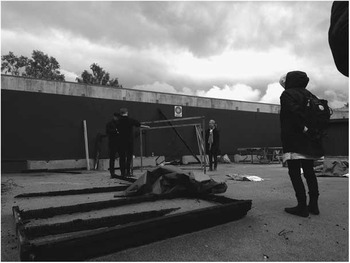
The first site was for Brandon LaBelle’s On the Productions of a Poor Acoustics. Working with issues of the expelled, the fragile and the displaced, LaBelle’s work connected well to the site situation of the derelict Solvang Centret. As the shopping mall could not be entered due to the fact that it was soon to be demolished, the sound performance took place close to the construction fence. Not only did the fence convey an impression of the temporary, but also the black branches from a burned down shelter and a few burned down trees contributed to the scene. The site included a small sandpit and a small concrete square with no distinctiveness apart from a grey and dull atmosphere.
3.2.1. The arrival
Before arriving at the site, the audience was led through the Urbanplanen along small pedestrian paths. Walking between the houses, past green shrubs and along the narrow paths for pedestrians, the route gave a labyrinthine, yet very immediate impression of the Urbanplanen. On the way to the site we passed the construction site of the Solvang Centret where the demolition was already in progress. The ideals and history of the Urbanplanen were briefly announced to the participants before arriving at the Prospect. But situated as walking bodies within the modernist plan of social housing, participants were not likely to perceive any of the original ideals. At the end of the 10-minute walk in the grey and derelict backyard of the Solvang Centret – arguably the dullest part of the Urbanplanen – the participants were located squarely in a site that could be interpreted as signifying both failed modernism and a decaying welfare society. The utopia inherent in both the welfare state and the modernist planning had, in other words, turned into a dystopia.
3.2.2. A social sound situation
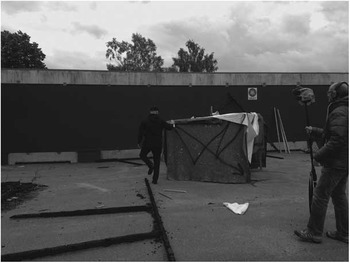
The arrival and confrontation with LaBelle’s sound performance took place in medias res, as the artist had already started the performance. The sound installation was divided into two parts: a spatial intervention and an auditory intervention. In the first part, LaBelle performed as a kind of construction worker in blue overalls, constructing a small shelter from cheap materials, some sticks and a plastic tarpaulin (Figure 1). Fragile as the surroundings, the shelter needed to be held erect as it was constructed. LaBelle called upon the audience for help, and the audience participated in constructing the shelter. The construction took around 20 minutes, but as the actions performed were monotonous and the site chilly and grey, it felt unbearably long. This sensation was underlined by the recurring, monotonous sound of LaBelle’s drilling machine. At repeated short intervals he would drill another screw into the materials, attempting to stabilise the shelter as some kind of deviant construction (Figure 2).
Brandon LaBelle performing his piece On the Productions of a Poor Acoustics in Urbanplanen, Copenhagen, Denmark, June 2015.

Brandon LaBelle performing his piece On the Productions of a Poor Acoustics in Urbanplanen, Copenhagen, Denmark, June 2015.

For the second part of the performance LaBelle brought out a megaphone, through which he played a pre-recorded speech. Whereas the first part focused on the construction of the temporary shelter, the second part was composed with merely the soft but persistent voice of LaBelle, addressing an ‘I’ and a ‘You’. The text concerned various ways of reflecting and acting upon the current political situation:
You say then
I say now
You say to produce
I say to have and to need
You say when
I say whenever
[…]
Shall we turn the other way?
Shall we strike?
Shall we refuse to pay the rent?
Shall we build an underground culture, secret?
(LaBelle Reference LaBelle2015b)
The dramaturgy was minimalistic, as each uttered sentence shifted dialectically between the two positions ‘I’ and ‘you’. The pauses between the sentences carried a great impact as the ping-pong between the ‘I’ and ‘you’ became gradually more intense. The pauses added suspense to the semantics of the reading and slowed down the stream of meaning, opening space for audience reflections in the gaps. In Woodruff’s dissertation, ‘A Musical Analysis of the People Microphone’, he noted how LaBelle uses his voice to create reflections: ‘Brandon LaBelle’s smooth voice creates an ideally reflective surface off of which to let the text’s own images resonate with the listener. LaBelle’s reading features highly nuanced pause length and some very long pauses denoting the end of sections’ (Woodruff Reference Woodruff2014: 85).
As the reflective sound of LaBelle’s voice was uttered through the megaphone, the intimacy of the voice was mediated and distorted through a medium bearing strong political connotations. The megaphone is often used in, and thus strongly associated with, political demonstrations with the purpose of amplifying political slogans and demands.
As such, the sound performance was twofold: it consisted of an intervention in the construction/destruction site of the Urbanplanen with direct audience participation, and it consisted of the reflective sound performance piece addressing the audience through questions such as ‘Shall we run? Shall we gather?’ Both parts of the performance shaped a disturbing experience. The media used for constructing the shelter (drilling machine, audience participation, cheap materials) and for the dialogic piece (megaphone, the soft but persistent voice of LaBelle) clearly created an uncomfortable situation in which sound and its mediation played an important role.
3.2.3. Reflexion
Thus the performance was largely focused on the perception of time, space and the social situation. The sonic aspects of this sound performance cannot be understood in terms of a reduction which sees them as comprising the formal aesthetics of LaBelle’s performance. Rather, the sonic dimension can better be understood in terms of various situations being folded together. These situations occur in relation to the time and duration of the work – for instance, the time LaBelle spent constructing the shelter. This duration was answered by a stillness and passive receptivity of the audience, which included a new awareness of everyday life taking place around the performance. Furthermore, the performance created an awareness of the social and political situation of the site, its past and futures, and the awkward situation of being reminded of an ‘us’ and a ‘them’ – a situation created through the awareness of being an audience to an existing reality when the inhabitants walked by, and a situation created in the sound performance when LaBelle in the second part addressed an ‘I’ and a ‘you’. As audience member, you had the feeling that the ‘you’ was directly addressed to yourself, which made you feel responsible for the situation – both the situation created in the performance and the social and political situation in Urbanplanen.
Claire Bishop notes that the social turn in contemporary art has led to a tendency towards using art as a transformation tool. Working within real-life situations, the artwork risks losing its potential for creating political awareness and reflection outside of the specific situation. Despite addressing transformation issues – spatial, political and discursive themes of immigration and settlement – LaBelle’s performance, however, also operates on a highly reflective understanding of art’s role in society. Bishop sympathises with the avant-garde notion of art, for instance the Brechtian notion of Verfremdung, in which the audience experiences disruption and through the aesthetic experience, becomes disconnected from the social situation. Bishop sees in this a potential for art, because such distance might instead create reflection. In many ways LaBelle’s performance intervention can be seen as seeking disruption by creating an awareness of the distance between ‘us’ and ‘them’ – with the purpose of making the audience reflect on the political and sociocultural situation in the Urbanplanen. As audience we contribute both as active collaborators (watching and co-constructing the shed) as well as reflective listeners. Thus, the situation created in LaBelle’s performance was not soothing; it did not integrate viewers and performers, neither did it directly create an integration between ‘us’ and ‘them’. Instead it can be argued that it created a disturbing contemplation within the audience on the social, political and spatial situations in Urbanplanen.
3.3. Jeremy Woodruff: Green Interactive Biofeedback Environments (GIBE)
American, currently based in India, sound artist and academic Jeremy Woodruff’s work, Green Interactive Biofeedback Environments (GIBE), was presented to the public as a site-specific sound art installation and performance installed in little shelters in the public playground in Urbanplanen. This playground invites both grownups and children to interact with materials for wood crafting and an outdoor kitchen with fire pit. The area also has trees, urban gardening projects (UrbanplanTen), regular playground activities and shelters constructed and built by children, under the guidance of social and cultural workers from the municipality of Copenhagen.
3.3.1. The performance
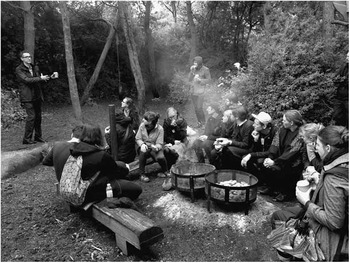
Upon arrival, the audience met an open fire, a coffee wagon and lunch served around the fire. The weather was cold and wet, so the facilities were very convenient, and, compared to the dull setting of the previous sound intervention, the overall atmosphere was welcoming. Woodruff himself was present at the venue. In a brief introduction he thanked the participants and explained where to go to experience the work, refraining from saying much more than that (Figure 3).
Jeremy Woodruff presenting his piece Green Interactive Biofeedback Environments (GIBE) at Urbanplanen, Copenhagen, Denmark, June 2015.

The duration of the sound compositions in the shelters was around 60 minutes. During this time one could hear six different sound pieces installed in various shelters and playing simultaneously (5–14 minutes each and continually looped). In a shelter placed in the middle, Woodruff sat, mixing the installation.
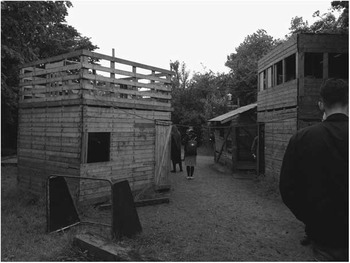
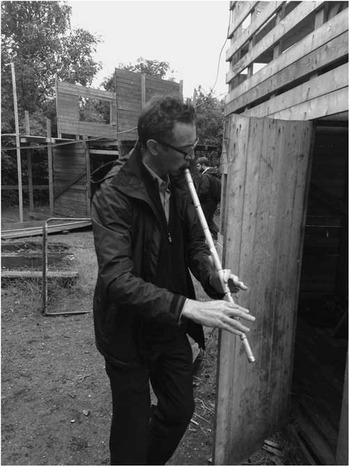
From the position of the audience/listener, the structure of the work was open in the sense that the beginning of the piece was not fixed – one was free to leave the open fire, walk through an area with trees and join the sound installation (Figure 4). The physical installation of the speakers invited the possibility of oscillating between a focused listening to one track, inside a shelter or through a window opening, or listening while taking a walk between the shelters, experiencing the various tracks as a mixed soundscape. The end of the performance was marked by Woodruff coming out of the ‘mixing shelter’ playing a Turkish ney while the electronic tracks tuned out (Figure 5).
Jeremy Woodruff’s installation Green Interactive Biofeedback Environments (GIBE).

Jeremy Woodruff ending his performance Green Interactive Biofeedback Environments (GIBE) playing a Türkish ney.

The various sound tracks playing in the shelters were titled: ‘Playground’, ‘Chili Tasting’, ‘Kur’an Soundscape’, ‘Bee in Heaven’, ‘Democracy’ and ‘Watering’. These titles were not communicated in any way during the performance, but refer to files Woodruff shared on his webpage afterwards. He explains: ‘This recording was made with a sound compost composed of sounds donated by people living in Urbanplanen, […]. Sounds were recorded at UrbanplanTen the permaculture urban garden project of Partnerskabet’ (Woodruff 2015).
In these tracks we hear a mix of interviews, informal conversations, recordings of children playing, animal and insect sounds, various noises, watering of the garden and interviews with children carrying out their own democratic election. Some parts are in English, other parts in Turkish or Danish. In the piece ‘Ku’ran soundscape’, the dominant sonic element is the voice of a man reciting the Quran in Arabic. Dominant sound elements in other tracks are music (classical, rap, disco, Danish political pop and ethnic folk), sounding as if played from older analogue apparatus (record players or tape recorders). Woodruff later explained that the music samples were donated by the users of the gardens from their own private collections.
During the event, the recordings of music were very significant within the enjoyment of the overall soundscape, while the interviews, conversations and recordings of children invited more intense listening inside the shelters. Recordings of bees, roosters and various noises helped the electronic sound to (more or less) blend in with the site. When listening to the remixed samples after the event, one can consider the tracks convincing both as aesthetic expressions and as portraits of the activities and citizens of Urbanplanen.
3.3.2. Reception
In a review of the event by theatre and performance studies scholar Sarah Bay-Cheng, we discover quite a sceptical attitude towards the setting. Bay-Cheng writes:
I must confess that my experience in Woodruff’s installation felt at times like an intrusion into someone else’s space. Installed within children’s playhouses, the audio equipment squatting within the corners seemed to take the place of children playing (no children were present). Although the purpose of the project was ostensibly to record and replay a community’s audio life back to itself, I wondered where exactly the play would happen amidst such an installation. Stepping cautiously throughout the space, both avoiding the equipment and not disturbing the play-structures, it occurred to me just how physical sound can be. Though itself invisible, sound’s production displaced the capacity for human presence. (Bay-Cheng Reference Bay-Cheng2015)
It is clear that the spectator in this case was troubled in her engagement with the piece. Too many obstacles (technology, uncomfortable feeling of not being welcome on the site, etc.) meant that the visitor in her reflection never got to a point where she could include the sound pieces and their contribution into her reflections – only the concept and the site were taken into consideration, not the actual sound emerging from the shelters. This clearly indicates that sound art situations are highly complex and involve much more than the act of listening.
If we view the case with inspiration from Kester, additional layers can be added to the piece. After a discussion of a work by Elmgreen and Dragset, he writes: ‘I’ll be tracing a shift from an aesthetic discourse centred primarily on questions of visual signification to one concerned with the generative experience of collective interaction’ (Kester Reference Kester2011: 24). In his book, Kester discusses activist art in both a global political and an art historical view. One of his main theses is that
we might view the recent proliferation of collaborative practices as part of a cyclical paradigm shift within the field of art, even as the nature of this shift involves an increasing permeability between ‘art’ and other zones of symbolic production (urbanism, environmental activism, social work, etc.) As the history of modernism has repeatedly demonstrated, the greatest potential for transforming and reenergizing artistic practice is often realized precisely at those points where its established identity is most seriously at risk. (Kester Reference Kester2011: 7)
Following Kester, Woodruff’s performance could be viewed through such a lens: the work of art should be recognised beyond the open work. Art has crossed the boundary with everyday life and can be considered to be activism and social work as much as it is considered to be art. Adding this approach to Woodruff’s work opens towards a broader understanding of his performance, an understanding that includes an expanded time dimension, the complex entanglements of the site and the social, and his direct engagement with the inhabitants in Urbanplanen.
3.3.3. Temporality and social engagement
The time of the artwork, in this case, reaches beyond the time of the actual performance and back to his first emails from India concerning his research phase of Urbanplanen. From India, Woodruff reached out to the site and began corresponding with the social workers on location before arriving. Upon arrival, he went straight to Urbanplanen to arrange sessions with the users of the facilities: a group of Kurdish women meeting every week to take care of the gardens, among others. During the sessions he spoke with them about what they did, recording their conversations. He allowed them to record the soundscapes around themselves, and he also received old tapes from them, with samples from their own private music collection.
In her review, Bay-Cheng questions the success of the sonic feedback in this work, whether the sound of the habitants of the place is actually heard. Following Kester, we argue that the feedback did take place, but did so through the process of collecting the sounds for what we as an audience would experience as the artistic work. Asking for sounds and working with sounds together with the habitants of Urbanplanen, Woodruff inherently stimulated hearing and listening not only to everyday sounds and music, but also to one another’s voices. He stimulated a dialogue between himself, the local community, us as curators and, finally, the visitors (audience) at the site by means of the final sound productions.
In all its ‘physicality’ (cf. Bay-Cheng), the sound collages added to the site also added an extended time dimension to what we already could see and hear. With Woodruff’s installations we would hear fragments of children talking about democracy, for example, and moments from the local chilli tastings together with mixings of the tapes that had been given. With a bit of imagination, patience and concentrated listening, the sound pieces in Woodruff’s performance held the potential to unfold an engagement with the social and the site through sound.
4. DISCUSSION
With this article, we have argued that ‘sound art situations’ is a useful term for the theoretical analysis and interpretation of sound art pieces, where contexts are entangled into the piece to such an extent that they are inseparable from what might be reckoned as the artwork.
Sound art situations are hereby extensions of previous approaches to sound art. A sound art situation is, as also described by Motte-Haber in her writings on early sound art, a processual phenomenon, especially characterised by its investigations of time-space. A sound art situation is also a critical situation, as noticed by LaBelle, engaging in an active dialogue with the surroundings rather than merely instrumentalising them as neutral tools. Hereby, the sound art situation establishes strong performative utterances that are expressed in various ways: not only do the performing artist’s actions become performative, but also so do the site, the public, the history, the audience and the social circumstances.
These various performative utterances open towards an expansion of space and time: the site of the performance is more than what we immediately experience, but refers also to social and temporal issues that go beyond the immediate experience. This aspect we recognised in Woodruff’s work, with his inclusion of the local citizens of Urbanplanen and in LaBelle’s work through the pauses in his speech.
The two examples also stimulate expanded audience and participatory situations. LaBelle’s piece establishes a reflective situation in which the audience is confronted with its own position. Woodruff’s Biofeedback works through a process that involves situations of direct engagement with inhabitants. Both sound installations work with feedback situations. In LaBelle’s sound performance, the sociocultural and political situation of the Urbanplanen feeds into the sound performance, and the situation of sound performance and the site-specific situation creates feedback through the direct involvement of participants, through constructing the shelter and engaging in immediate thought reflections to Labelle’s voice. These situational reflections may differ – from empathy and understanding of the sociospatial implication of the environment to a resistance to and rejection of being labelled within the dichotomy ‘us’ and ‘them’.
Thus LaBelle’s sound situation is directed towards a reflective (Bishop) and emancipatory spectator (Rancière). On the other hand, Woodruff’s Biofeedback system works directly with the feedback transformation in the environment. He brought in recorded and found sound material into the work of art and fed it back into the urban environment of the public playground. This work engages the inhabitants as an active public as they participate as co-producers of the installation, and hereby Woodruff’s installation dealt with the public in a much broader sense than it did with the audience. However, the invited audience could choose to participate by engaging in the environment. On the other hand, the audience could choose to withdraw into the reflective mode of listening and reflect on the sound art situation, as Sarah Bay-Cheng chose to do. Furthermore, they could play along with the biofeedback environment by blending in with the inhabitants and children playing at the site.
Summing up the discussion made on behalf of the two cases and the theoretical framework, we conclude that sound art situations:
-
∙ support publics, understood as social communities, and extend site-specificity and the public to encompass the inhabitants, practices of every day life and the political and social dramas of a given site.
-
∙ engage critically and in a transformative manner with their surroundings.
-
∙ work with temporal processes that reach beyond the presence, and the experienced timeframe of the artwork, as they are dependent on past and future temporalities.
-
∙ open up for direct experience and participation by calling upon reflective modes of listening and/or more direct intervention and engagement.
-
∙ are unpredictable in the sense that the given situation, with its richness of social and cultural complexity, influences the work of art beyond the intentions of the artist.