The first difficulty with Slater and Budd's (Reference Slater and Budd2019) interpretation is that Cambrowania (~5 mm in diameter; Fig. 1.1) is at least an order of magnitude (three orders of magnitude in volume) larger than Leiosphaeridia (typically <200 µm in diameter; Fig. 1.2) (Jankauskas et al., Reference Jankauskas, Mikhailova and German1989; Butterfield et al., Reference Butterfield, Knoll and Swett1994). Although rare leiospheres can reach as much as 1 mm in diameter (Slater and Budd, Reference Slater and Budd2019), they are still significantly smaller than Cambrowania.
Size and morphological differences between Cambrowania (1) and Leiosphaeridia (2–5). (1) Backscattered electron scanning elelctron microscopic photograph of Cambrowania from the early Cambrian Hetang Formation, preserved on bedding surface; HT-T8-9V-25, VPIGM-4729. (2–5) Acid-extracted specimens of Leiosphaeridia from the Tonian Gouhou Formation; (3) is a magnification of (2), showing concentric folds; 11-GH-10-SEM-3-19, VPIGM-4795; (4, 5) light microscopic and SEM photographs, respectively, of the same specimen, showing spindle-like lanceolate folds (arrowheads); 11-GH-10-SEM-5-17, VPIGM-4796; (1 and 2) are shown to the same scale (the 2 mm scale) to emphasize the size difference between typical Cambrowania and Leiosphaeridia specimens. The 100 µm scale applies to (3–5).

A second difficulty, related to the first, is that Slater and Budd (Reference Slater and Budd2019) speculated that Cambrowania represents unusually large Leiosphaeridia filled with cell aggregates. However, they presented no evidence for the existence of such cell aggregates in Cambrowania. In fact, our own observation using backscattered electron scanning electron microscopy revealed no trace of cell aggregates (Tang et al., Reference Tang, Hu, Xie, Yuan, Wan, Zhou, Dong, Cao, Lieberman, Leys and Xiao2019). Notably, this technique has previously been used to visualize cell aggregates in carbonaceous compression specimens such as Chuaria (Tang et al., Reference Tang, Pang, Yuan and Xiao2017b).
A third difficulty with Slater and Budd's (Reference Slater and Budd2019) argument pertains to their suggestion that the biological structures we identified as crossbars and outgrowths in Cambrowania were instead taphonomic artifacts. In particular, Slater and Budd (Reference Slater and Budd2019) illustrated Cambrian Leiosphaeridia specimens with lanceolate folds to suggest that these might be the double crossbars and blades we found in Cambrowania. However, Slater and Budd's (Reference Slater and Budd2019) claimed similarity is superficial at best because compressed vesicles of Leiosphaeridia generally have concentric marginal folds in addition to lanceolate ones (Fig. 1.3). Indeed, concentric marginal folds have been documented extensively in the literature (Tang et al., Reference Tang, Pang, Xiao, Yuan, Ou and Wan2013, Reference Tang, Pang, Yuan, Wan and Xiao2015, Reference Tang, Hughes, McKenzie, Myrow and Xiao2017a; Slater and Willman, Reference Slater and Willman2019). However, no Cambrowania specimens have concentric folds. An additional problem with Slater and Budd's (Reference Slater and Budd2019) suggestion that folds of Leiosphaeridia are the same as double crossbars of Cambrowania is that Slater and Budd (Reference Slater and Budd2019) compared transmitted light photographs of Leiosphaeridia with SEM images of Cambrowania, and such comparison can be misleading. This is because the former integrates light transparency through the entire thickness of the specimen, whereas the latter only illustrates surficial morphology. When a comparison is made using scanning electron microscopy, lanceolate surficial folds in Leiosphaeridia (Fig. 1.5) are clearly different from double crossbars in Cambrowania (Fig. 1.1). An additional difficulty with Slater and Budd's (Reference Slater and Budd2019) suggestion that the crossbars in Cambrowania are better interpreted as pyritized folds in carbonaceous vesicles of Leiosphaeridia is that the crossbars in Cambrowania are thin cylindrical structures (see figure 6 in Tang et al., Reference Tang, Hu, Xie, Yuan, Wan, Zhou, Dong, Cao, Lieberman, Leys and Xiao2019), whereas the folds of Leiosphaeridia are generally spindle-shaped and do not form cylinders. Yet another problem with Slater and Budd's (Reference Slater and Budd2019) assertion about the equivalence of crossbars and folds is that the number and size of lanceolate folds on a Leiosphaeridia (or any other acritarch) vesicle are limited by the surface area of a sphere relative to that of a compressed disc. By contrast, the distribution of crossbars in Cambrowania is remarkably dense (compare Fig. 1.1 with Fig. 1.3, 1.4). A final problem related to Slater and Budd's (Reference Slater and Budd2019) claim that outgrowths in Cambrowania can be simply interpreted as pyritized folds, tears of the vesicle wall, or excystment structures is that none of these interpretations accounts for cylindrical crossbars that extend beyond well-preserved vesicle margins that show no evidence of tearing or excystment structures (e.g., figure 3.8 in Tang et al., Reference Tang, Hu, Xie, Yuan, Wan, Zhou, Dong, Cao, Lieberman, Leys and Xiao2019). At this time, of course, we cannot rule out that there could be some folds in some specimens of Cambrowania, but the totality of evidence suggests a lack of homology between the crossbars of Cambrowania and vesicle folds of Leiosphaeridia. Therefore, crossbars in Cambrowania appear to represent biological structures and not taphonomic artifacts.
Finally, and critically for the argument of Slater and Budd (Reference Slater and Budd2019), bona fide Leiosphaeridia fossils have previously been reported from the Hetang Formation (Zhang et al., Reference Zhang, Danelian, Feng, Servais, Tribovillard and Caridroit2013), but they are fundamentally distinct from Cambrowania in their size, morphology, and preservation. In particular, they are invariably <100 µm in diameter, within the standard size range of acritarchs, and much smaller than Cambrowania. Further, these fossils show both lanceolate and marginal concentric folds, and poorly preserved but coherent vesicle walls, as they should, but they do not have any structures resembling cylindrical rods seen in Cambrowania. Furthermore, one of the distinctive structures of Cambrowania is the prominent (either raised or depressed) terminal aperture present in some specimens (e.g., figure 3.1–3.5 in Tang et al., Reference Tang, Hu, Xie, Yuan, Wan, Zhou, Dong, Cao, Lieberman, Leys and Xiao2019), but this structure is not found in any of Zhang et al.’s (Reference Zhang, Danelian, Feng, Servais, Tribovillard and Caridroit2013) specimens of Leiosphaeridia from the Hetang Formation.
Whether one would like to expand the diagnosis of Leiosphaeridia and force Cambrowania ovata into the genus Leiosphaeridia is a subjective matter, because Leiosphaeridia is a morphogenus after all. But we would like to point out that no existing Leiosphaeridia species can accommodate Cambrowania ovata because of the morphological differences discussed above, and that Cambrowania ovata is drastically different from Leiosphaeridia baltica Eisenack, Reference Eisenack1958, which is the type species of Leiosphaeridia and only 84 µm in diameter.
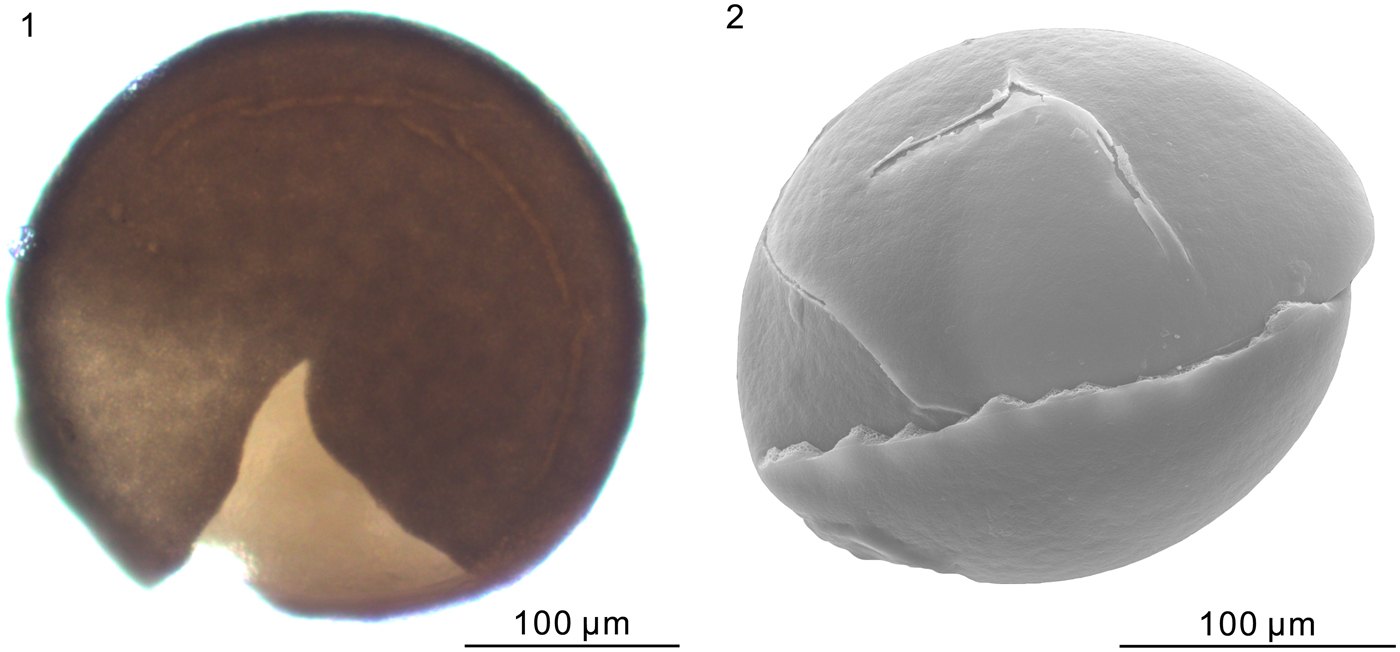
Slater and Budd's (Reference Slater and Budd2019) phylogenetic comment re-emphasizes the challenges in determining the affinities of long-extinct taxa such as Cambrowania. As we acknowledged in the original publication (Tang et al., Reference Tang, Hu, Xie, Yuan, Wan, Zhou, Dong, Cao, Lieberman, Leys and Xiao2019), what we presented were two hypotheses that need additional testing. On the other hand, even if Cambrowania ovata would be taxonomically forced into Leiosphaeridia, this does not necessarily mean that “a metazoan affinity can be ruled out” (Slater and Budd, Reference Slater and Budd2019). This is because Leiosphaeridia and leiospheric acritarchs in general are polyphyletic assemblages. Acritarchs, including both leiospheres and acanthomorphs, can be remarkably similar to the resting eggs of animals in their size, shape, ornament, medial split structure, and concentric marginal and lanceolate folds (van Waveren, Reference van Waveren, Head and Wrenn1992; van Waveren and Marcus, Reference van Waveren, Marcus, Molyneux and Dorning1993). Consider, for example, the extant brine shrimp Artemia, which produces “leiospheric” resting eggs with smooth-walled vesicles and medial split structures (Fig. 2). One of the best ways to differentiate smooth-walled resting cysts of animals, algae, and protists is via comparison of ultrastructure (Cohen et al., Reference Cohen, Knoll and Kodner2009).
Resting eggs of extant brine shrimp showing a leiospheric vesicle wall and medial split structure. (1, 2) Transmitted light and scanning electron microscopy photographs, respectively; VPIGM-4797 and VPIGM-4798, respectively.