





1. Introduction
In Hamlet (2.2.310–11), Polonius exaggerates the absurdity of excessive genre-based classification and definition: ‘… tragedy, comedy, history, pastoral, pastorical-comical, historical-pastoral, tragical-historical, tragical-comical-historical-pastoral …’.Footnote 1 One approach to untangle, or begin to untangle, these genres is to consider what features or texts may constitute one of the types mentioned by Polonius above. This article, however, will not offer an attempt to define or classify early modern genre-based forms. Instead, it seeks to explore the genre-based terms or metalanguage surrounding these dramatic genres by contextualising them in the discourse of Early Modern English. In particular, this article uses collocational networks from corpus linguistics to explore whether this approach can shed further light on how these genres may have been discussed and recorded in early modern print culture.
As the often-cited Polonius quote above demonstrates, genre is a fluid and dynamic concept that is often difficult to assign to a text. As Colie (Reference Colie1973: 8–9) notes in her lectures: ‘it was not entirely obvious in the Renaissance what the genres of literature surely were, nor yet how to identify them’. Of course, Polonius’ words illustrate the absurdity and extremes that could result from attempted genre classification, but it also serves to emphasise the issues surrounding genre identification. How do we start to draw these genre-based boundaries around texts? How do we know what to ‘accept’ as a suitable label for a particular text? How may we even begin to identify what a ‘genre-based category’ may be? These are all profoundly difficult endeavours, especially when dealing with historical texts. For historical texts, we have the added complication of changing, dynamic perceptions and definitions of genres over time: we have the potential for modern impressions to mix, change or misunderstand the original/historical. This change can even happen in a relatively short space of time; for example, one need only compare Shakespeare’s 1623 First Folio, with its distinctive genre-based segmentation of the works, to some of the plays’ earlier quarto titles. To illustrate the potential for genre label change we can consider Troilus and Cressida. This play is grouped under the tragedies in the First Folio but is entitled The Historie of Troylus and Cresseida and is thus labelled a ‘Historie’ in the earlier 1609 quarto (Pendergast Reference Pendergast2002: 127; Arnold Reference Arnold2018: 537; Kesson Reference Kesson2018: 87). In addition, some of the genre-based terms appear to be closely related with multiple terms used to describe single plays. For example, several of the plays labelled ‘history’ in the Folio are referred to as a ‘tragedy’ in quarto, such as The Tragedy of Richard III and The Tragedy of Richard II (Pendergast Reference Pendergast2002: 127; Kesson Reference Kesson2014: 214). Even within a small sample of dramatic texts (and without exploring the contents of the texts themselves), we can begin to see how fuzzy and interchangeable these categories can be for individual plays. Subsequently, we can begin to question which genre categorisation – if any – we should accept as an appropriate label. It has even been suggested that the Polonius’ words may represent the inflated state of literary ‘kinds’ or genres within the period (Pendergast Reference Pendergast2002: 129). Regardless of the extent to which the quotation may present the genre ‘status quo’ of Early Modern English drama, it does serve to question how these genre-based forms may have been understood or used in the period. In particular, it raises queries about how these genre-based labels may have worked as a system and their relation to each other. This article seeks to explore and contextualise some of these terms to reveal more about how they may have been conceptualised at the time.
Collocation and collocation networks offer a potential means to begin to explore these metalinguistic terms in the discourse of the period. Collocation is the concept, adopted from Firth, that you shall know a word by the company it keeps (Firth Reference Firth and Firth1957). Or in other words, the characteristics of a particular term can be observed through consideration of the words that habitually co-occur with the term of interest. This article aims to explore the potential of the application of collocation networks to historical datasets. In particular, this article seeks to investigate whether first-order collocation networks can be used to explore metalinguistic terms in an Early Modern English corpus.
2. Literature review
2.1. Dramatic metalanguage: genres and modes
This section outlines both genres and the related concept of modes before presenting the dramatic metalinguistic terms that will be explored in this article.
The term ‘genre’ itself is relatively new in the context of literary theory’s long history. It was first borrowed from French in around the late eighteenth century, and has gained currency denoting ‘a particular style or category of works of art; esp. a type of literary work characterized by a particular form, style, or purpose’.Footnote 2 Literally meaning ‘kind’ or ‘type’ in French, the term has come to represent the discussions of literary texts that preceded the introduction of the term itself into English (Corbett Reference Corbett, Brown and Anderson2006: 26). In modern scholarship, ‘genre’ has gained a broader definition and is used generally to denote recurring types of literary (and non-literary) texts (Duff Reference Duff2000: xiii). However, the many discussions around genre have meant that it is often considered to have a fuzzy, rather than clear-cut, meaning with different scholars proposing that ‘genre’ can represent or embody many diverse aspects of a text (e.g. see Fowler (Reference Fowler1982), Frow (Reference Frow2006) and Busse (Reference Busse, Stockwell and Whiteley2014) as examples of extended discussions about the different understandings of genre).
Like ‘genre’, the word ‘mode’ also has differing usage in relation to genre in literary theory, with some scholars choosing not to distinguish between modes and genres. Again, Fowler (Reference Fowler1982: 289) observes and comments on the conflicting usage of these terms by his contemporary critics.Footnote 3 Yet, if we do embrace the distinction between modes and genres, Frow (Reference Frow2006: 71) argues that modes ‘start their life as genres but over time take on a more general force’. In other words, in the literary mode we see the enlargement of a genre into what Baldick (Reference Baldick2015: 736) terms ‘a broad but identifiable kind of literary method, mood, or manner’. Fowler (Reference Fowler1982: 107) also discusses the relationship between ‘modes’ and ‘genres’, and explains that they represent an ‘incomplete repertoire, a selection only of the corresponding kind’s feature’. In these quotations above, we see a proposed acknowledgement of the progression from genre (or kind) into ‘mode’ through the uptake of some features into a more generalised state of literature. A ‘mode’ is still inherently identifiable as a kind of literature but is much broader and more general than the genres discussed above. One of the clearest distinctions made between genres (and kinds) and modes is their descriptive form: by ‘form’, I here refer to their part of speech or word class. As Fowler (Reference Fowler1982: 106) highlights and Frow (Reference Frow2006: 71) reiterates, a generic ‘mode’ takes the adjectival form and a genre takes the nominal form.
The difference between genres and modes appears to operate on a cline. For example, we can observe this cline in the case of Marlowe’s tragedy Tamburlaine the Great. Although aligned with the tragedy genre, this text has also been referred to as a ‘tragic play’, such as by Johar (Reference Johar1988: 57). Here we see the modification of the genre ‘play’ with the adjective ‘tragic’, aligning this text closely with the separate genre, ‘tragedy’. In this case, a ‘tragic play’ is synonymous with ‘tragedy’ given the dramatic form that the genre tragedy takes. So, generic modes can also represent already established genres, as in the case of Tamburlaine, but importantly can also serve to modify or qualify other distinct genres, such as Polonius’ absurd example of ‘tragical-comical-historical-pastoral’. In a way, modes serve to create a generic association and begin to highlight that genres can begin to mix and incorporate aspects of different genres into a single work.
Based on the descriptions of genres and modes above, to explore the discourses surrounding various early modern dramatic forms, this article will examine both the genre (nominal) and mode (adjectival) metalinguistic terms. Due to limitations of scope, this article will only focus on two contrasting genres and their related terms.
These are the genre-based terms of ‘comedy’, ‘tragedy’ and ‘tragicomedy’, alongside the modes ‘comic(al)’ and ‘tragic(al)’. ‘Tragicomedy’ offers an opportunity to explore the relationship between ‘comedy’ and ‘tragedy’ in the formation of (what has become recognised as) an additional genre in the period. Future research could explore other Early Modern English dramatic terms such as ‘history’, ‘romance’ and ‘pastoral’ using a similar methodology as a comparison.
2.2. Critical semantics
Importantly for this research into Early Modern English discussion and understanding of these genre-based terms, we need to distance our own modern understandings of these terms and concepts, and use the language of the period in question to inform the investigation (Guillén Reference Guillén1971: 386). The importance of the intersection between so-called ‘keywords’ (aligning with the work of Raymond Williams, and not to be confused with the statistically significant, corpus linguistic sense of ‘keywords’) and the ‘period’s explicit values’ is stressed in the work of Greene (Hirschfeld Reference Hirschfeld2018a: 4). Greene (Reference Greene2013: 12) terms this type of investigation ‘critical semantics’ and defines it as the considerations of contemporary meanings of chosen words and their cultural associations. He argues that ‘we should see in the words the stages and reactions of the given period’ (emphasis mine) (Greene Reference Greene2013: 13). This article will adopt some of the principles of Greene’s work; that is, the perceived intersection between certain words and their broader (contemporary) meanings as demonstrative of thought at the time. In addition, Greene (Reference Greene2013: 176) invites ‘literary criticism to operate within a wider economy than it has often done before’ and to consider questions of literary focus beyond just literary texts, something he terms ‘the Shakespeare problem’. This article will also seek to extend this process of critical enquiry through the application of corpus methods. Contemporary meaning is at the heart of this approach to semantics, so understanding the early modern definitions or associations of words, and the differences between modern meanings, is crucial.
But how might we begin to reveal the contemporary understandings of these metalinguistic terms? This is where collocation (and collocation networks) from corpus linguistics provides a useful methodology to observe and contextualise broader contemporary associations and discourse surrounding these terms.
2.3. Collocation and historical linguistics
As mentioned in the Introduction, collocation and collocation networks are firmly rooted in the Firthian linguistic tradition. Collocation is the notion that ‘important aspects of the meaning of a word’ can be found in the ‘characteristic associations that the word participates in’ (McEnery & Hardie Reference McEnery and Hardie2012: 122–3). Collocation and the visual representation of collocates in the form of networks are tools frequently used in corpus linguistics to explore meanings and characteristics of words. Collocation has been used for a number of different applications including critical discourse studies (Salama Reference Salama2012; Wilkinson Reference Wilkinson2019), lexicography (Moon Reference Moon2007: 168) and language teaching (Pereira Reference Pereira and Sinclair2004; Gablasova & Brezina Reference Gablasova and Brezina2025). Although often used for explorations of present-day languages, applications of collocation to historical varieties seem to be less common. That said, some studies have utilised collocation to explore the nature of specific linguistic phenomena in historical corpora. Examples of studies using collocation to explore historical corpora include: investigation of specific concepts in a period such as prostitution (McEnery & Baker Reference McEnery and Baker2017a), national identities and characterisation in Shakespeare (Culpeper & Findlay Reference Culpeper and Findlay2020; Murphy, Archer & Demmen Reference Murphy, Archer and Demmen2020), and identification of texts containing metalanguage (Andreani & Russo Reference Andreani and Russo2023); exploration of broader changes in the meaning of terms over time (McEnery, Brezina & Baker Reference McEnery, Brezina and Baker2019; Ratia Reference Ratia, Rautionaho, Nurmi and Klemola2020); and observations of historical grammatical changes and their effect on meaning (Hilpert Reference Hilpert, Allan and Robinson2011; Li, Szmrecsanyi & Zhang Reference Li, Szmrecsanyi and Zhang2024; Coussé Reference Coussé2014; Hilpert Reference Hilpert2024). In addition, as with some present-day dictionaries, collocation has also been used to guide the production and composition of entries in an encyclopedia of Shakespearean English (Culpeper, Hardie & Demmen Reference Culpeper, Hardie and Demmen2023: xii).
Although collocation has been used in the studies mentioned above, few make use of collocation networks as a means of visualising the relationships between the terms of interest (nodes) and the collocates. One of the few studies that utilises collocation networks in this way is McEnery (Reference McEnery2006) and the later replication of the same study in Brezina, McEnery & Wattam (Reference Brezina, McEnery and Wattam2015). In the original study, McEnery (Reference McEnery2006: 182–6) uses simple collocation networks to explore the types of words that frequently co-occur with the terms ‘swearing’ and ‘drunkenness’ in the Society for the Reformation of Manners corpus. By ‘simple’, I here refer to what is known as ‘first-order’ collocation networks that only display the nodes and its collocates (Brezina, McEnery & Wattam Reference Brezina, McEnery and Wattam2015: 152); in contrast, ‘second-’ and ‘third-order’ collocation networks consider the collocates of the original collocates (Brezina, McEnery & Wattam Reference Brezina, McEnery and Wattam2015: 152). Through the collocation network approach, McEnery (Reference McEnery2006: 183–4) observes a number of shared collocates between the two terms including ‘cursing’, ‘lewdness’ and ‘profanation’ which are suggested to signify the grouping together of further negative acts with both of these terms, leading to the larger ‘moral panic’ related to these sorts of acts in the period. In the replication study, Brezina, McEnery & Wattam (Reference Brezina, McEnery and Wattam2015: 157) observe further collocates of McEnery’s original terms. In particular, Brezina, McEnery & Wattam (Reference Brezina, McEnery and Wattam2015: 157) note the additional semantic field associated with religion, which includes collocates such as ‘vain’, ‘sinful’, ‘damn’ and ‘condemn’. These further collocates add to the impression of the ‘moral panic discourse’ originally observed and extended to bring in further cultural concerns such as a strong religious context. In addition to replication, Brezina, McEnery & Wattam (Reference Brezina, McEnery and Wattam2015: 163) extend the network into the fifth-order collocates and observe the ‘prophaners’ of these acts including ‘swearers, drunkards and (lewd) persons’. They note that this reveals more about the personalised nature of the ‘moral panic’ discourse and the ‘metaphorical finger pointing to specific offenders’ (Brezina, McEnery & Wattam Reference Brezina, McEnery and Wattam2015: 163). These studies utilising collocation networks demonstrate the types of insights that this method can bring to historical data and, in particular, the types of discourses surrounding specific terms. This is a method that I believe has the potential to reveal some of the discursive contexts around dramatic metalinguistic terms.
3. Methodology
3.1. The corpus
The corpus used for this study is Early English Books Online (EEBO) version 3 which is accessible via CQPweb (Hardie Reference Hardie2012). The EEBO corpora have been used across many different studies of the language of Early Modern English (e.g. Steggle Reference Steggle2014; McEnery & Baker Reference McEnery and Baker2017a,Reference McEnery and Bakerb; Nevalainen Reference Nevalainen2018). Generally, the EEBO corpora have been found to be ‘impressively balanced in their representation [of surviving books]’, yet it is also encouraged to use EEBO critically with awareness of what the different available corpora actually contain (Mäkelä et al. Reference Mäkelä, Misson, Singh and Tolonen2026: 251).Footnote 4
However, it is important to note that there are many different versions and types of EEBO: in other words, there is no one EEBO corpus but rather a series of different available corpora based on EEBO. Importantly, scholars often make reference to using EEBO, but what is often being referred to is EEBO-TCP which is a transcribed subsection of the original EEBO corpus (Kichuk Reference Kichuk2007: 292). Figure 1 illustrates some of the different versions of EEBO available for research and the respective number of volumes available for searching.
Graphic demonstrating the different EEBO datasets available in different software. Note, the size of the boxes demonstrates the relative size of the number of volumes within that collection (except ESC:EEBO which is too small to scale relative to the others). Dates have been added to the EEBO-TCP phases for the working periods of transcription and the public release. The dotted lines represent the adaptation of EEBO-TCP into three different corpus software (and where smaller EEBO subsets have been created). Sizes correct as of 2025.

Figure 1. Long description
A flowchart organized into five vertical levels.
* Level 1: A large box at the top labeled E E B O, approximately 125,000 volumes.
* Level 2: Three arrows point down to a segmented row.
* Left: E E B O dash T C P Phase 1, approximately 25,000 volumes transcribed between 2000 and 2009.
* Center: E E B O dash T C P Phase 2, approximately 35,000 volumes transcribed between 2009 and 2020.
* Right: E E B O left to be transcribed, approximately 65,000 volumes.
* Level 3: Solid arrows from Phase 1 (dated 2015) and Phase 2 (dated 2020) converge on a central box labeled Publicly available E E B O dash T C P, approximately 60,000 volumes total, released August 2020.
* Level 4: Three dashed arrows labeled added annotation point downward to specific software platforms.
* Left: E E B O on english dash corpora dot org, approximately 25,000 volumes.
* Center: E E B O v 3 on C Q P web, approximately 45,000 volumes.
* Right: E E B O on EarlyPrint, approximately 59,000 volumes on website.
* Level 5: A final dashed arrow labeled further annotation points from the C Q P web box to a small box at the bottom labeled E S C forward slash E E B O on C Q P web, approximately 5,700 volumes.
For this project, I use the EEBOv3 version of EEBO-TCP available on CQPweb (Hardie Reference Hardie2012), which contains 44,422 volumes and 1,202,214,511 word tokens.Footnote 5 This version of EEBO-TCP has additional linguistic annotation and processing, including the addition of automatic spelling regularisation (alongside the original spellings), part of speech and semantic tagging.Footnote 6
3.2 Collocation parameters
Following Brezina (Reference Brezina2018b: 75), the collocation parameters notation (CPN) for this exploratory study of genre-based metalanguage is displayed in table 1. In this section, I briefly justify some of the parameters chosen for the collocation (and networks), and in particular, their suitability for an Early Modern English corpus like EEBOv3.
Collocation Parameter Notation (CPN) table for this study

Table 1. Long description
The table consists of two columns: Collocate type and lemma.
* Row 1: Statistic is Mutual Information.
* Row 2: Statistic cut-off is 6.
* Row 3: Window span is 3 to and from.
* Row 4: Frequency (node, collocate) is 5.
* Row 5: Frequency (collocate) is 5.
For the association measure, mutual information (MI) was chosen, but each association measure has its own benefits and drawbacks (see Pecina (Reference Pecina2005) and Evert et al. (Reference Evert, Uhrig, Bartsch and Proisl2017) for further discussions of different measures available). Unfortunately, most extended discussions of the suitability of association measures relate to use with modern English corpora. Subsequently, very few (if any) papers on historical corpora justify why a particular association measure was chosen so different measures have been used in previous studies (e.g. log-likelihood was used by Findlay (Reference Findlay, Dawson and McHardy2018) and McEnery & Baker (Reference McEnery and Baker2017b), MI used by Ratia (Reference Ratia, Rautionaho, Nurmi and Klemola2020: 61–2) and in combination with log-ratio by Culpeper & Findlay (Reference Culpeper and Findlay2020)).
MI was chosen for this study for several reasons. Firstly, it is well established, and often used, as an effect measure in collocational analysis (Gablasova, Brezina & McEnery Reference Gablasova, Brezina and McEnery2017: 161). Given the desire to build a simple collocation network from the collocational analysis, I wanted to ensure the statistic I chose fitted this intention. MI works well in simple collocation networks as it has an ‘undirected’ or ‘non-directional’ property (Stubbs Reference Stubbs1995; Brezina Reference Brezina2018b: 35). Being ‘undirected’ means that the direction between the node and collocate does not affect the association strength; in other words, you can swap the node with the collocate and get the same result. For example, if we search for collocates of the word form ‘comedy’ in EEBOv3 within a (L3/R3) span, we get the collocate ‘epilogue’ with an MI score of 6.470.Footnote 7 When we do the reverse, i.e. search for collocates of ‘epilogue’, we get the same MI score for ‘comedy’ of 6.470. Therefore, by being undirected, MI removes a level of complexity in the construction of the network. Secondly, MI is a good choice of statistic because EEBOv3 is a historical corpus, and historical corpora are commonly associated with ‘making the most of bad data’ and are dependent on the ‘random preservation’ of material (Nevalainen Reference Nevalainen1999: 503). Given that MI favours low frequency items (Baker, Hardie & McEnery Reference Baker, Hardie and McEnery2006: 38), this may work well for historical corpora given both the restricted size and possible spelling variants present within the corpus.
Having chosen MI as my association measure, the next issue is to select a minimum statistic cut-off score. In the literature, 3 has been generally accepted as a level of significance, based on the work of Hunston (Reference Hunston2002: 71). However, some scholars have found 3 to be too generous a cut-off and proposed that we ‘revise upwards’ to ensure what we collect is significant enough. For example, Durrant & Doherty (Reference Durrant and Doherty2010: 145) use a higher cut-off in their study of lexical primings and suggest that 6 is acceptable as a psychologically significant cut-off for potential collocates. This study also adopts the revised upward cut-off of 6 for the MI statistic like Baker (Reference Baker2016: 142). The range of MI scores for the genre-based terms in the EEBOv3 corpus is fairly spread, with a maximum value of 14.703, a minimum value of -0.3807 and a median value of 0.791.
The only other parameter changed was the use of lemmatised word forms for the nodes, these are the dictionary headword equivalent of the word form. For example, the lemma of the verb ‘re-act’, which is a collocate for ‘tragedy’, contains various inflections of the verb, including: ‘re-act’, ‘re-acted’ and ‘re-acting’. All of these inflections are grouped into the single lemma which reduces the repetition in the nodes (and splitting the association measure value between different inflected forms of an individual word). However, with historical data, this lemmatisation is not always successful in capturing all forms of a word in a lemma, and we do see the plural of words such as ‘actor’ and ‘buskin’ being listed as separate nodes. Yet, using lemmatised collocations does begin to reduce the number of inflected word forms.
Most other parameters, including the span of L3/R3 and frequency cut-off for nodes and collocates were left as the default of 5 in CQPweb.
3.3. The metalinguistic terms
The key part of collocational analysis is to select what terms to search for and retrieve them from the corpus along with their collocates. In this case, we are interested in the words that are often used in the proximity of the genre and modes relating to Early Modern English dramatic metalanguage. I chose to include both genre and mode forms, to enable potential differences and similarities between these types of genre-based vocabulary to be observed. The metalinguistic nodes used are the genres ‘comedy’, ‘tragedy’ and ‘tragicomedy’, and the modes ‘comic(al)’ and ‘tragic(al)’.
Historical corpora may contain irregular spellings. For EEBOv3 on CQPweb, the extent of the spelling variation present in the corpus is unclear, based on conflicting reports in previous studies. In McEnery & Baker (Reference McEnery and Baker2017a: 20), ‘powerful software [is used] to deal with the issue of spelling variation in the [EEBO version 3] data’ (emphasis mine). As such, McEnery & Baker (Reference McEnery and Baker2017a) do not appear to search for variant spellings of their terms of interest as spelling variation does not seem to be considered an issue. In contrast, the same authors in a later paper change this position and account for spelling variation in their search terms. They state:
the EEBO corpus has been annotated with normalised spellings by VARD … but we became aware in the course of our examination of concordance lines that VARD had not provided a normalised form for some terms. Hence, we searched for the poore alongside the poor. (McEnery & Baker Reference McEnery and Baker2017b: 56)
Likewise, Appolloni (Reference Appolloni2024: 63) observes that ‘the EEBO v3 uploaded on CQPweb is partially not normalised’, which confirms the observations in McEnery & Baker (Reference McEnery and Baker2017b). Therefore, even with the use of spelling regularisers like VARD2 (Baron & Rayson Reference Baron and Rayson2008), spelling variants are still potentially problematic in this particular version of the EEBO corpus. As such, I compiled different possible variant spellings for the search terms to assess the extent of possible spelling variation. To do this, CQP syntax queries were written to try to retrieve as many spelling variants of the nodes as possible in EEBOv3. To construct the queries, the OED was consulted and the listed variants were adapted into the CQP syntax. Given the nature of the CQP syntax, the number of variants that the queries retrieved were broader than those listed in the OED. Table 2 presents the CQP queries used for each metalinguistic term. Taking ‘tragical’ as example, the query looks for any word made up of ‘tra’ followed by an optional ‘d’; then a ‘g’ followed by one of either ‘e’, ‘i’, ‘y’; then ‘cal’ and an optional additional ‘l’. The whole search is also followed by ‘%c’ which ignores the case of the word (i.e. both ‘tragical’ and ‘Tragical’ will be retrieved by this query). In the queries for genres (nouns), the plural forms are factored in with optional plural inflections included in the search query.Footnote 8
CQP query syntax and raw frequency count for each search

Table 2. Long description
The table consists of three columns: Term, C Q P query syntax, and Frequency.
* Row 1: Term is comedy. C Q P query syntax is [word = "com(m)?(ae|e|er|o|oe)d(ie|y|ye)(s)?"%c]. Frequency is 9,653.
* Row 2: Term is comic. C Q P query syntax is [word = "com(m)?(i|y)(c|ck|cqu|k|qu)(e)?"%c]. Frequency is 1,090.
* Row 3: Term is comical. C Q P query syntax is [word = "com(m)?(i|y)(c|qu)al(l)?(e)?"%c]. Frequency is 1,490.
* Row 4: Term is tragedy. C Q P query syntax is [word = "tra(d)?(g|j)(a|ae|e|i|ie|oe|y)d(e|ee|eie|ie|y|ye)(s)?"%c]. Frequency is 13,975.
* Row 5: Term is tragic. C Q P query syntax is [word = "tra(d)?gi(c|ck|k|qu)(e)?"%c]. Frequency is 2,322.
* Row 6: Term is tragical. C Q P query syntax is [word = "tra(d)?g(e|i|y)cal(l)?"%c]. Frequency is 4,502.
* Row 7: Term is tragicomedy. C Q P query syntax is [word = "trag(ae|e|i|y)(-)?com(m)?(ae|e|o|oe)d(ie|y)(s)?"%c]. Frequency is 773.
Using the queries in table 2, the collocates of the terms above were extracted.Footnote 9 The inclusion of spelling variants improved the recall of the queries as shown in table 3. For example, by including other possible spellings for ‘tragicomedy’, these additional variants constitute 18.9 per cent of all returned hits. Although the EEBOv3 corpus has undergone a level of spelling regularisation using VARD, spelling variants still need to be accounted for when searching for terms as shown in table 3. It is important to note here that the collocates are not retrieved or grouped in the same manner as the search terms; this is discussed directly in section 4.5. Instead of multiple variant spellings being grouped under one term (as in the searches), the collocates may appear as multiple individual terms where spellings may not have been standardised completely by VARD.
Proportions of spelling variants using the CQP queries in table 2

Table 3. Long description
The table consists of four columns: Term, percent hits for V A R D-regularized forms (including plurals and hyphens), percent hits for variants, and Number of variant spellings.
* Comedy/Comedies: 91.9 percent regularized, 8.1 percent variants, 28 variant spellings.
* Tragedy/Tragedies: 96.8 percent regularized, 3.2 percent variants, 29 variant spellings.
* Tragicomedy/Tragicomedies: 81.1 percent regularized, 18.9 percent variants, 32 variant spellings.
* Comic: 86.3 percent regularized, 13.7 percent variants, 8 variant spellings.
* Comical: 97.8 percent regularized, 2.2 percent variants, 5 variant spellings.
* Tragic: 97.3 percent regularized, 2.7 percent variants, 4 variant spellings.
* Tragical: 99.5 percent regularized, 0.5 percent variants, 5 variant spellings.
3.4. Constructing the network
One way to ‘see’ collocates and lexical connections between search terms is to visualise them through the form of collocation networks (Brezina, McEnery & Wattam Reference Brezina, McEnery and Wattam2015: 142). As Brezina (Reference Brezina, Almela-Sánchez and Cantos-Gómez2018a: 59) argues, the networks not only offer a means of visualising the tabular outcome from a collocational analysis but also provide a ‘novel analytical technique’. The main justification for this argument is that the networks enable connections which are shared between the nodes to be observed (Brezina Reference Brezina, Almela-Sánchez and Cantos-Gómez2018a: 60). For most collocational networks, pre-built software is used. This visualisation software can be built into the corpus tool itself or can be standalone software. One example of this software is GraphColl, which is built into LancsBox or is available to download on its own (Brezina, McEnery & Wattam Reference Brezina, McEnery and Wattam2015). This exploratory article aims only to produce a fairly simple collocation network. However, given that this research is conducted on the EEBOv3 corpus as part of the CQPweb interface, GraphColl would not work for my purposes. Instead, an alternative and simple collocation network script was produced in the R programming language, specifically for use with the collocation output from the CQPweb interface.Footnote 10 The result of the network plotting is displayed in figure 2.
Complete collocational network diagram for all metalinguistic nodes. Colouring depicts the different subgroups that have been manually identified.

Figure 2. Long description
The diagram consists of several central yellow nodes acting as hubs for a network of smaller, multicolored nodes.
At the top left, the hub labeled tragedy connects to a dense arc of blue, green, and orange nodes including terms like othello, hamlet, and lear. Below this, the hub labeled tragic connects to a cluster on the far left containing green nodes such as poesy and buskin.
In the center, the hubs labeled tragical, comic, and tragicomedy form a bridge toward the right side of the diagram. These connect to terms like poet, scene, and prologue.
On the right, the hubs labeled comical and comedy anchor the largest cluster. This group features a high density of blue, red, and orange nodes. Key terms in this area include transformation, romance, and historical.
Lines of varying thickness represent the strength of connections between the central metalinguistic nodes and the peripheral terms. The coloring of the outer nodes indicates manually identified subgroups within the linguistic data.
The network in figure 2, represents the collocational information from EEBOv3 via CQPweb, with the settings outlined in table 1. The network is a simple one with only first-order collocates shown (i.e. node to collocate and not between collocate relationships) due to the exploratory nature of this article; further research could extend this network into second- or third-order collocates to explore the terms further. Graphically, the collocations are represented as follows: each of the circles represent either a node or a collocate of the metalinguistic terms. Note how the nodes themselves can be connected to demonstrate that they can be collocates of other nodes. Both the width and length of the edges (lines) represent the strength of the collocation. In other words, the closer a node is to a collocate, the stronger the collocation (and the higher the MI score). This logic also applies for the thickness of the line: the thicker the line, the stronger the collocation too.
Alongside the network itself, coloured groupings have been added to the network to provide further information about the collocates, as means of additional annotation and initial analysis. The addition of groups was done after manual inspection of the corresponding concordance lines for the collocate.Footnote 11 The collocates have been grouped as follows:
-
1. orange: general collocates (ungrouped)
-
2. yellow: the genre-based metalinguistic terms
-
3. dark blue: contemporary play titles/charactersFootnote 12
-
4. light blue: classical play titles/charactersFootnote 13
-
5. teal: contemporary authors
-
6. red: print marks from contemporary catalogues, such as dates and material format (i.e. octavo/quarto)
-
7. dark green: collocates arising from standardisation errors
-
8. pink: classical authors
-
9. light green: spelling variants of metalinguistic terms
The additional colouring enables common patterns or types of words clustering around the genre-based terms to be observed easily.
4. Results and discussion
The network in figure 2 illustrates all the collocates for the genre and mode metalinguistic terms that match the criteria given in section 3.2. The network itself is quite large and some of the terms are difficult to see on the diagram; as such, I take each coloured group in turn and present the separate, smaller networks alongside a discussion of some individual collocates within each group in the next sections.
4.1. General observations
Before turning to the individual groups, there are some patterns that can be observed in figure 2. Firstly, both ‘tragedy’ and ‘comedy’, marked in yellow in the top left and far right respectively, have the largest number of collocates. Many of these collocates are also unique to each genre-based term suggesting a degree of conceptual difference or separation between these terms. For example, ‘tragedy’ has the unique adjective collocates of ‘bloody’, ‘woeful’ and ‘piteous’, whereas ‘comedy’ has the unique adjective collocates of ‘lascivious’, ‘bawdy’ and ‘conceited’. Although these collocations may not be surprising, they do reinforce the contrast of contemporary thought (and potential play content) between these two different genres.
There are also some collocates that are shared between the metalinguistic nodes, albeit there are far less shared collocates than unique. For example, the collocates ‘scene’ and ‘scenes’ are shared between six of the seven metalinguistic terms;Footnote 14 again, this is an expected observation as ‘scene’ is a word associated with all dramatic forms. As such, we would probably associate the term ‘scene’ as part of the semantic domain of drama (both historically and contemporarily). However, there are also some more unexpected shared collocates between some of the nodes. For example, ‘Thalia’ is a collocate that is shared between ‘comedy’, ‘comic’ and ‘tragedy’. Thalia is the Greek muse of comedy so the association of ‘Thalia’ with ‘tragedy’ is perhaps unexpected (Grimal Reference Grimal, Kershaw and Maxwell-Hyslop1991: 425). Inspection of the concordance lines does offer some explanation as to why this may be the case, as shown in examples (1)–(3); examples here and throughout present the concordance line with the node in bold and collocate of interest underlined, followed by the corpus text ID italicised and in brackets.Footnote 15 As examples (1)–(3) illustrate, ‘Thalia’ is used in the context of comparison with ‘tragedy’: the example concordance lines show discourse discussing and listing the different Greek muses including both Melpomene for tragedy and Thalia for comedy. This collocate and its respective concordance lines demonstrate that collocates can also be used as points of comparison, suggesting that ‘tragedy’ (and its related concepts) may often be discussed in direct comparison to ‘comedy’ in the discourse of the period. This relationship between ‘tragedy’ and ‘comedy’ is also shown through their own collocation (as can be seen in figure 2) as these terms do statistically co-occur too.
-
(1) Of the same in prose. Clio invented Histories. Melpomene invented Tragedies Thalia invented Comedies. Euterpe invented Flutes and such like. Terpsichore (A14502)
-
(2) the illustrious Throne of four great Empresse, Melpomene the Empress of Tragedy; Thalia of Comedy; Euterpe of Pastorals, and Calliope of (A42320)
-
(3) same. To be brief, Clio first found Histories, Melpomene Tragedies, Thalia Comedies, Polyhimnia Rhetoric, Calope Poetry, or rather (A48803)
Further metalanguage surrounding types of texts can also be observed in figure 2 in the form of collocates surrounding some of the nodes.Footnote 16 For example, ‘masque’, ‘farce’, ‘pastorals’, ‘romances’ are some of the collocates of ‘comedy’ associated with other types of texts; ‘opera’ and ‘pastoral’ are collocates of ‘tragicomedy’; and ‘epic’ and ‘fable’ are collocates of ‘tragedy’. Although each of these other types of texts warrants further comment, especially in relation to the node it attaches to, due to restrictions of space, I will focus briefly on ‘history’ which is a collocate of both adjectival modes ‘tragical’ and ‘comical’. As both a noun and also a type of text, this co-occurrence suggests that in the period it could incorporate and be associated with aspects of both ‘tragedy’ and ‘comedy’ via these modal extensions. Direct modification with the modes ‘tragical’ and ‘comical’ is shown in examples (4)–(7); often, these modifications are found in the titles of the plays.
-
(4) THE most famous and Tragical HISTORY of Pelops and Hippodamia (A02273)
-
(5) THE TRAGICAL HISTORY OF PIRAMVS AND THISBE. Written, By A. C. f (A19481)
-
(6) THE GREAT DUKE OF FLORENCE. A Comical History. As it hath been often presented with good allowance (A07239)
-
(7) The Second Part of the Comical History of Don Quixote, a Comedy, by Mr. Durffey. (A36266)
The co-occurrence of other metalanguage surrounding types of texts in the period suggests that the terms of interest to this research are often found in discursive contexts related to textual categorisation. These terms, alongside their other metalinguistic collocates, make up a broader semantic field or domain associated with text types in the period.
Broadly speaking, the coloured collocate groupings can provide insight into the types of discourse topics that are associated with each term. For example, the light blue collocates tend to cluster more around the genre metalanguage rather than the mode metalanguage (with the exception of ‘comical’). These particular collocates come from classical characters/play titles such as ‘Medea’, ‘Eunuchus’ and ‘Hecuba’. In addition to clustering with ‘tragedy’ and ‘comedy’, the light blue collocates are not shared between nodes but are rather unique to their respective genres. This result suggests that genres are often a feature of Early Modern English print discourse alongside the titles of various classical plays – a result I also return to later at length in section 4.2. Similar to the light blue collocates, the red and teal collocate groups are only found clustering with the genre terms rather than the modes; again, I discuss the implications of this later in section 4.3. The dark green collocate group is only found clustering with the ‘tragic’ node suggesting that the observed standardisation errors are unique to this metalinguistic term which are discussed in section 4.5. Each of the different coloured groups are considered in the following sections.
4.2. Classical influence on genres
‘Shakespeare’s was a period obsessed with classical dramatic precedents’ states Mukherji (Reference Mukherji2016: 269), an observation that is reinforced via this exploratory collocational analysis of dramatic metalinguistic terms. There are a number of collocates associated with classical play titles and dramatists in the network; these are shown by the light blue and pink coloured collocate nodes, respectively (figures 3a and 3b). All of the light blue collocates cluster around either ‘comedy’ or ‘tragedy’, which indicates that the classical play titles or characters are discussed in relation to their respective genres rather than modes. Likewise, figure 3b displays the classical author name collocates in the network. Here, we can see a clear distinction between those associated with comedy (both genre and mode) and those associated with tragedy. None of the collocates for tragedy/tragical/tragic are shared with those from comedy/comic/comical; this network separation presents a distinction in association of these authors in the discursive context surrounding the two genres.
Collocates related to the classical tradition (a) Collocational network for the metalinguistic terms and classical play titles and characters (b) Collocational network for the metalinguistic terms and classical authors

Figure 3. Long description
The image consists of two panels, a and b.
Panel a, titled Collocational network for the metalinguistic terms and classical play titles and characters, features two main yellow hubs: tragedy and comedy. The tragedy hub is connected to a large fan of blue nodes including andromache, telephus, aiax, electra, octavia, oedipus, atreus, thyeste, coloneus, creon, antigone, thyestes, octavia, hippolytus, spurius, troade, medea, hecuba, hippolitus, and agave. The comedy hub is connected to blue nodes including aulularia, phormio, andria, plutus, and eunuchus. Smaller yellow nodes for tragicomedy, comic, comical, tragical, and tragic act as bridges or secondary hubs between the two main clusters.
Panel b, titled Collocational network for the metalinguistic terms and classical authors, follows a similar structure but uses pink nodes for authors. The tragedy hub connects to thespis, seneca, senecae, euripides, accius, sophocles, and aeschylus. The comedy hub connects to menanders, terentius, plautus, aristophanes, terence, and menander. The comic hub at the bottom connects to philemon, philippides, and cratinus. The yellow metalinguistic nodes tragedy, tragic, tragical, tragicomedy, comedy, comical, and comic are interconnected in the center of the web.
Generally, this group and the number of nodes within this identified category indicates that there may have been a focus on classical traditions in the genre-based discourse of the sixteenth and seventeenth centuries, something Fowler (Reference Fowler1982: 57) summarises as a ‘consciousness of tradition’. This may be expected given the rise of ‘imitatio’ and the emphasis thereby placed upon the creative transformation or imitation of previous texts, such as classical ones, a practice that was also found in early modern schools (Miola Reference Miola2000: 2).
Examples of imitatio and imitation in schools can be seen in some of the texts that have collocates in figures 3a and 3b. For instance (8) comes from the text Six comedies of that excellent poet Publius Terentius, an African of Carthage, in English and Latine: for the use of young scholars, that they may the more readily attain the purity of the Latine tongue for common discourse. Likewise, (9) comes from the volume The comedye of Acolastus translated into oure englysshe tongue, after suche maner as chylderne are taught in the grammer schole, fyrst worde for worde, as the latyne lyeth, and afterwarde accordynge to the sence and meanyng of the latin sentences. Finally, (10) is found in Virgils Eclogues […] Written chiefly for the good of schooles, to be vsed according to the directions in the preface to the painfull schoole maister. All of these examples provide evidence that the metalinguistic terms of ‘comedy’ and ‘tragedy’ were used to denote recognisable categories of texts (both contemporary and classical) in the period, and are categories that were often used instructionally from which children could learn.
-
(8) TERENCE’S EUNUCHUS ENGLISH AND LATIN. EUNUCHUS A COMEDY Of Publius Terentius An African of Carthage. Acted At the Megalesian (A64394)
-
(9) prorecenter. begone at home at our house. The approved fables. i.comedies of Plautus and also of Terence, being as it were at (A01349)
-
(10) in Sophocles stately style. which alone are worthy of Because Sophocles tragedies were acted in buskins, therefore his lofty style is termed by (A14494)
In addition to texts that may have contained both the original Latin/Greek alongside an English gloss for school use, such as examples (8) and (9), there also are many instances of the collocations associated with the classical tradition coming from volumes translated from Greek or Latin into English. As Olk (Reference Olk and Schmidt2013: 257) notes, there was a rise in popularity in translated classical texts in the mid sixteenth century, an observation that is reflected in the types of texts that contain these collocates. Examples (11)–(13) are from works translated into English containing these collocates. Examples (12) and (13) are volumes that have been translated into English from Latin, according to their title pages, whereas (11) is a volume translated from Greek.
-
(11) man that speaks and acts inconsiderately, see how Medea in the Tragedy laments her self, who when through excess of love, she (A43737)
-
(12) this I speak considering the saying of the poet Seneca in his tragedy of Medea, where his words seem in all points to agree (A20032)
-
(13) being the flower of all tragical wryters, had finished his tragedy called Oedipus: Nor Cato, that was above fourscore and ten (A09530)
It has been observed by some scholars that the Roman poet Seneca was one of the more influential classical playwrights in this period, especially with regard to contemporary playwrights such as Shakespeare (Highet Reference Highet2015: 132; Halpern Reference Halpern2016: 21). ‘Seneca’ and ‘Senecae’ (a spelling variant) collocates have MI scores of 6.534 and 7.763 respectively for ‘tragedy’ but what is notable is that Seneca is not the only playwright to feature surrounding ‘tragedy’. Notably Seneca has the lowest MI of the authors in the group and others like ‘Sophocles’ and ‘Euripides’ have higher MIs of 8.905 and 8.803. Instead of the possible expected dominance of certain playwrights in the period, like Seneca, we see both Roman playwrights (‘Terence’, ‘Plautus’) and plays/characters (‘Aulularia’, ‘Troade’) and Greek playwrights (‘Sophocles’, ‘Euripides’) and plays/characters (‘Hecuba’, ‘Oedipus’) feature in the network indicating that both may have informed Early Modern English discourse on dramatic genres. This is a finding that supports the arguments made by Pollard (Reference Pollard, Deutermann and Kiséry2013) on the influence of the Greek dramatic tradition, not only on the types of plays printed, but also how the Greek influence may have contributed to the conceptualisation and development of genre in the early modern period.
4.3. Genre-based metalanguage and catalogues in EEBOv3
Some of the coloured clusters reveal more about the types of texts that feature the metalinguistic terms. These texts illustrate how these terms may have been used and for what purpose in the period. The first example is the group of red collocates; these are collocates that relate to early modern print culture, such as print marks and dates (figure 4). Through inspection of the concordance lines, it is clear that most of the collocates in this group come from catalogues of books in the period, in particular a large proportion come from Langbaine’s The lives and characters of the English dramatick poets. In fact, all the ‘4to.’ collocates for both ‘tragedy’ (149) and ‘comedy’ (249) come from this catalogue alone. Other catalogues that are found to contain these collocates include William London’s A catalogue of the most vendible books in England and other work by Langbaine such as An account of the English dramatick poets and A new catalogue of English plays.
Collocational network for the metalinguistic terms with collocates related to catalogue print marks

Figure 4. Long description
The network consists of yellow central nodes and red peripheral nodes connected by gray lines of varying thickness.
At the center is the node comedy, which has the highest density of connections. Radiating from comedy to the left in a semi-circle are red nodes labeled with years: 1633, 1668 dot, 1662, 1637 dot, 1661 dot, 1632, 1678 dot, 1668, 1692, and 1640 dot. Below comedy is a yellow node labeled tragical, which connects to a yellow node labeled comical at the bottom right.
Above comedy is a cluster of three yellow nodes: tragic, comic, and tragicomedy.
- tragicomedy is at the top and connects to red nodes fol dot, actus, and quarto at the very top of the diagram.
- comic and tragicomedy both connect to a dense cluster of red nodes on the right labeled fol, 8vo dot, 4o, and 4to dot.
- comedy also connects to the red node 4to at the bottom right.
To the right of comedy is the yellow node tragedy. It connects back to comedy, comic, and comical. It also has a single long connection to a red node on the far right labeled 1680 dot.
These print culture collocates include ‘fol’/‘fol.’, ‘4to’/‘4o’/‘4to.’ and ‘8vo.’, which are shorthand for ‘folio’, ‘quarto’ and ‘octavo’ respectively. These terms are used to mark the physical printed format of the plays available in the print catalogues. More broadly, these collocates reflect the regular layout of catalogues, such as Langbaine’s, which typically consists of the following structure: play title, genre, format, year (see (14) and (15) for examples from Langbaine’s catalogue). The explicit reference to a genre category in a standardised list format means that these collocates only occur with the genres ‘tragedy’, ‘comedy’ and ‘tragicomedy’ and not any of the modes as shown by the network. Although this group of collocates does not reveal much about the semantic and syntagmatic relationships of the genre-based terms, these collocates do illustrate how these terms may have been recognised, assigned and utilised in the period.
-
(14) English Lawyer, a Comedy, 4to. 1678. acted at the Theatre Royal, translated from the Latin Ignoramus (A49536)
-
(15) The Italian Husband, a Tragedy, 4to. 169. acted at the Theatre in Little-Lincolns-Inn-Fields (A49536)
Alongside catalogues that explicitly seek to list plays with their recognisable genre group and respective print characteristics, the collocates associated with print culture can also be observed in other types of texts in the period. For example, inspection of the concordance lines and the available metadata in EEBOv3 revealed that some volumes have lists of texts at the end and are often printed by the same printer. These sorts of lists appear to be used to advertise the other texts that are available from the printer of the volume – as a form of marketing known as ‘publishers’ catalogues’ (Taylor Reference Taylor1957: 82; Coppens Reference Coppens2008: 561). This practice of appending lists of available plays to volumes by a bookseller became common in the mid 1600s with the closure of the theatres and the desire to sell texts, as observed by Hooks (Reference Hooks2008: 445, 448). One example from my collocation analysis is the bookseller Humphrey Moseley, known as the publisher of the Beaumont and Fletcher Folio (Hooks Reference Hooks2008: 447). Moseley was well known as a printer who utilised this method to advertise the texts available to purchase (Taylor Reference Taylor1957: 84; Hooks Reference Hooks2008: 457). An example of Moseley’s catalogue from the end of a volume entitled Considerations upon the lives of Alcibiades and Coriolanus by Marques Virgilio is shown in (16).Footnote 17 As shown in (16), the catalogue lists not only the format of the play (i.e. quarto ‘4o’), but also the title, author of the play and the genre. The co-occurrence of the title and author with the genre in these publishers’ catalogues helps to explain some of the collocates observable in figures 5a and 5b.
-
(16)
-
20. The Sophister, a Comedy, in 4o.
-
21. The Woman Hater, or the Hungry Courtier, a Comedy written by Francis Beaumont and John Fletcher Gent. in 4o.
-
22. The Tragedy of Thierry King of France, and his Brother Theodoret, written by Francis Beaumont & John Fletcher, Gen. 4o
-
23. The Vnfortunate Lovers, a Tragedy written by William Davenant Knight, in 4o.
-
24. Love and Honour a Comedy written by William Davenant Knight, in 4o.
-
25. Madagascar with other Poems written by William Davenant Knight, in
-
Networks for collocates associated with contemporary print culture such as catalogues and advertising (a) Collocation network for the metalinguistic terms with collocates related to contemporary character names and play titles (b) Collocation network for the metalinguistic terms with collocates related to contemporary author names

Figure 5. Long description
The image consists of two panels, a and b.
Panel a: Collocation network for metalinguistic terms with character names and play titles.
At the center are several yellow hub nodes labeled tragedy, comedy, tragicomedy, tragic, tragical, comic, and comical.
Lines connect these hubs to a large number of blue peripheral nodes.
Tragedy is the largest hub in the upper left, connected to names like Hamlet, Othello, and Lear.
Comedy is the largest hub on the right, connected to terms like cuckold, bachelor, and elvira.
Tragicomedy is a hub in the lower left connected to nodes like lovers, bridegroom, and venice.
Smaller hubs like comic and comical bridge the space between tragedy and comedy.
Panel b: Collocation network for metalinguistic terms with contemporary author names.
Yellow hub nodes for tragedy, comedy, tragicomedy, comic, comical, tragic, and tragical are clustered in the center.
Green peripheral nodes representing authors are connected to these hubs.
Tragedy is connected to rawlins, corneille, lodowick, chapman, and dryden.
Comedy is connected to moliere.
A cluster of authors including shakespeare, fletcher, and shirley are positioned between and connected to both the tragedy and comedy hubs.
Tragic and tragical are located at the bottom of the cluster, connected to each other and the comedy hub.
These lists demonstrate the use of the genre-based metalanguage to signify recognisable categories of types of plays that must have been understood by both the sellers and purchasers of printed play texts. Indeed, the importance of these terms and the catalogues in which they occur, that I have found quantitatively, has also been noted by other scholars. Hooks (Reference Hooks2008: 446) argues that ‘the catalogues indicate that drama was valued not only as a commercial product, but as a viable conceptual category as well. This valuation both manifested and shaped notions of genre that have proven to be remarkably persistent, for the drama of early modern England …’.
As discussed in this section, there are various collocates related to early modern print culture that are found within different types of catalogues in the period. These include catalogues that solely list types of plays, such as Langbaine’s The lives and characters of the English dramatick poets, and those that are found at the end of other printed volumes, known as publishers’ catalogues. Both catalogues demonstrate the significance and use of these terms in delineating types of textual categories to early modern readers and booksellers alike.
4.4. Individual collocates
The final group I am going to consider are those collocates that have not been assigned to a specific semantic group or domain. These are all shown in figure 6.
Collocation network for the metalinguistic terms with general (ungrouped) collocates

Figure 6. Long description
A network diagram features six central yellow nodes representing core metalinguistic terms: tragedy, tragical, tragic, comedy, comical, and comic. These hubs are interconnected by thick grey lines and surrounded by smaller orange nodes representing collocates.
* Tragedy (Center-Left): Connected to terms like exclamations, piteous, baleful, woeful, and fables. It shares connections with tragical and tragic.
* Tragical (Top-Center): Linked to massacre, revolution, misfortunes, and episode. It bridges connections between tragedy and comical.
* Tragic (Bottom-Left): Connected to buskins, poesy, accent, and theme. It shares a cluster with comic involving terms like writers and Athenian muse.
* Comical (Top-Right): Linked to satyr, pastime, ridiculous, facetious, and witty. It has a strong link to comedy.
* Comedy (Center-Right): The largest hub, connected to pastoral, satire, masking, romances, and comedian. It shares a dense central cluster with tragedy and tragical containing terms like player, epilogue, interlude, and tragicomedy.
* Comic (Bottom-Center): Linked to sock, sport, mirth, and diadem. It shares several nodes with comedy and tragic, including actor, catastrophe, and prologue.
Dense overlapping regions in the center of the diagram show terms that collocate with multiple metalinguistic categories, such as scene, poet, and theatre story.
Although detailed research into some of the collocates in figure 6 could reveal more about the nature of these metalinguistic terms in the period, I am going to focus here on a single pair of related terms that demonstrate some of the different characteristics of these dramatic genres. This pair of collocates are ‘socks’ and ‘buskins’ (including the singular ‘buskin’) which co-occur with ‘comic’ and ‘tragic’ respectively. To a modern reader, these may be surprising and unusual collocates to find associated with genre-based metalanguage. To understand these associations, we again have to return to the classical tradition. In the classical tradition, ‘socks’ and ‘buskins’ are the types of footwear worn by actors depending on the type of play being performed. Comedy plays involved actors wearing ‘socks’, anglicised from ‘soccus’, which were thin, low shoes or slippers (Jonson Reference Jonson and Parfitt1988: 555; Stern Reference Stern2016: 492). In contrast, tragedy involved actors wearing heeled boots known as ‘buskins’, also known as ‘cothurnus’ (Jonson Reference Jonson and Parfitt1988: 555; Bishop Reference Bishop2015: 37).Footnote 18 These types of footwear became associated due to differences in actors’ appearance and performance with the two different types of classical play. However, these collocates are not representative of what the actors would have actually worn in the early modern period to perform the different play types; instead, these terms are used in a metaphorical and iconographic sense in discussions of genre types (Stern Reference Stern2016: 492). The metaphorical/iconographic use of these terms and the extension of the meaning from the physical shoes used in classical drama have been noticed by other scholars too (Danson Reference Danson2000: 19; Fowler Reference Fowler2003: 191). Stern (Reference Stern2016: 492) observes the associated connotations of these shoe forms with the understanding and contrasting of the different dramatic forms; she states: ‘Tragedy, like the buskin, was viewed as a raised and artificial form of performance; comedy as a lowered and homely form, like the sock.’ Based on the awareness of both the origins and metaphorical associations of these terms with the dramatic metalanguage, we can observe how these terms are used in EEBOv3 metaphorically in examples (17)–(21).
-
(17) To advance our youthful Poet, and his Muse With a kind Doom; And he’ll tread boldly then In’s best new Comic Socks, this Stage again. (A19883)
-
(18) Where e the sweet delights of learnings treasure, That won with Comic sock to beautify The painted Theaters, and fill with pleasure The listners eyes, and ears with melody (A12774)
-
(19) The Tragic Buskin traverses our stage In bloody Fillets, fitter for this Age, Where Treason, Murder, Lust, and every Vice Grows impudent, and rifles for the Dice. (A51867)
-
(20) One while, my Muse, in Tragic Buskins Trod, All very solemn, grave, and some said good: Another Work, with Care and Pains I wrote (A30403)
-
(21) Love has made her change her tragic Buskin, and now she delights in the soft steps of Comic love. (A47372)
In these examples, the ‘comic sock’ and ‘tragic buskin’ act as metaphorical attire denoting the presence/arrival of the forms or themes associated with comedy/tragedy. In some cases, the ‘sock’ and ‘buskin’ are figuratively worn by author or muse (examples (17) and (20)) to denote the embodiment of the tragic/comic style. In others, the presence of the footwear itself denotes the type of style/performance that an audience could expect, such as example (19) from the prologue of a play and example (21) from the dialogue in a play. There are also instances that show how the metaphorical footwear is used to mark progression or innovation via comparison to classical authors, as in example (22). Here, the metaphorical sock is ‘worn out’ and ‘torn’ indicating how old/tired the ‘wits’ of Terence and Plautus when compared to the early modern dramatic works. Likewise, the ‘tragic buskins are thrown away’, metaphorically marking a new departure in the genre in this work.
-
(22) TErence and Plautus Wits we now do scorn, Their Comic Socks worn out, in pieces torn, Only their rags of Wit remain as toys For Pedants to admire, to teach School Boys; […] Nor Phoenix like ever out of those will rise; Old Tragic Buskins now are thrown away, When we read your each Passion in each Play (A53060)
Beyond examples that refer to theatres and dramatic works specifically, the sock/buskin metaphor can be found to extend beyond this semantic domain into tragic/comic events more generally. An example of this is shown in the religious text in example (23).
-
(23) And if this teacher can add: Peter calls Christ the son of God therefore Christ is only God: oh / he shall have A Comic applause: he may put on the Tragic buskin / and thensforth trudge from Conventicle to Conventicle / in the office of an Apostle. (A18926)
As such ‘sock’ and ‘buskin’, although perhaps surprising to a present-day English reader, can carry strong metaphorical implications in the early modern discourse surrounding these modes. Deriving from the classical tradition and the physical shoes worn on the stage, these terms have become adapted to figuratively represent the style/dramatic form of the ‘comic’ and ‘tragic’. Although the example concordance lines do not seem to make explicit reference to the types of prestige that Stern (Reference Stern2016: 492) observes, they do illustrate the conceptualised distinction between these dramatic forms via metaphor in the early modern discourse.
4.5. Issues with the data
There are a number of collocations that reveal some of the potential problems of using the collocational approach with this dataset which are also applicable more broadly to other historical-based collocational studies. These are collocates that arise with both transcription and standardisation issues in the data itself.
The first example of this is the cluster of collocate nodes around the ‘tragic’ node in figure 7. These are coloured in green as transcription and encoding errors, given that they arise from the regularisation process in the EEBOv3 corpus. As discussed in section 3.3, EEBOv3 on CQPweb has been standardised using VARD to regularise spelling across the corpus.
Collocational network for the metalinguistic terms with collocates that arise from transcription and encoding errors

Figure 7. Long description
The diagram consists of nodes connected by thick gray lines.
At the top, a yellow cluster of six nodes forms an interconnected web. The central node in this group is comedy, which connects to comical, tragical, tragicomedy, comic, and tragic. Other connections in this upper group include comical to tragical and tragedy; tragedy to tragicomedy and comedy; and tragicomedy to comic.
At the bottom, the node tragic serves as a central hub for a radial star-shaped network. It connects upward to the yellow comedy node and outward to 15 green nodes arranged in a semi-circle. Moving clockwise from the top-left of this lower cluster, the green nodes are labeled: sylvestre, quibusdam, silvestri, sylvestris, pratensis, aurea, 6 8 9, saxatilis, acceden, agrestis, dulcis, linaria, esula, filix, and passerina.
One of the implications of this is that the (semi-)automated standardisation process appears to have regularised Latin words, alongside the intended English ones. As such, some Latin words have been changed into English words based on the rules in VARD. We can see the effect of this on the collocation network in figure 7; in this figure, we see ‘tragic’ regularised in error by VARD for the Latin word ‘tragi’. To confirm this is the case, the alternative spelling view in CQPweb can be consulted and examples are shown in (24)–(26). In these examples, the text ID is given first followed by the standardised spelling in (a) then the non-standardised spelling is given in italics in (b) to demonstrate the spelling changes. Many of these Latin words come from texts related to botany such as Parkinson’s Theatrum botanicum: Theatre of Plants (1640) and Gerard’s The herball or Generall historie of plantes (1633). These texts list various plant species in Latin with their descriptions (in either Latin or English) such as ‘Sylvestri Tragi Lobelio’ and ‘Vulgaris Tragi’. ‘Tragi’ is a now-obsolete botanical label or potentially a reference to the notable renaissance botanist Hieronymus Bock whose name is Latinised to Hieronymus Tragus (Isely Reference Isely1994: 23–5).Footnote 19 Each of the collocates shown around ‘tragic’ in figure 7 relate to the incorrect standardisation of the Latin ‘tragi’ to the English ‘tragic’ and thus are irrelevant to this study on genre-based metalinguistic terms. None of the other metalinguistic terms feature this sort of systematic standardisation error.
-
(23) (A51379)
-
(a) annuus siliquis & foliis hirsutis floribus parvis, nobis. Foenograeco silvestri Tragic in quibusdam accedens planta, I. B. Hic pusillus Astragalus repertus circa
-
(b) annuus siliquis & foliis hirsutis floribus parvis, nobis. Foenograeco silvestri Tragi in quibusdam accedens planta, I. B. Hic pusillus Astragalus repertus circa
-
-
(24) (A09011)
-
(a) Saxatilis Clusii. 1043 Saxatilis foliis non serratis, ibid. Saxatilis Tragic. 1044 Filum maritimum Germanicum, 1261. Nigrum Scoticum. ibid Fistula
-
(b) Saxatilis Clusii. 1043 Saxatilis foliis non serratis, ibid. Saxatilis Tragi. 1044 Filum maritimum Germanicum, 1261. Nigrum Scoticum. ibid Fistula
-
-
(25) (A01622)
-
(a) Linosyris Nuperorum, Lob. Golden Star-floured Tode-slax. 10 Linaria aurea Tragic. Golden Tode-flax. 11 Scoparia sive Osyris Graecorum. Bushieor Besom
-
(b) Linosyris Nuperorum, Lob. Golden Star-floured Tode-slax. 10 Linaria aurea Tragi. Golden Tode-flax. 11 Scoparia sive Osyris Graecorum. Bushieor Besome
-
The second type of collocates related to standardisation errors are shown in figure 8. As shown in the subnetwork, both ‘comedy’ and ‘tragedy’ have several spelling variants present in the collocations. Although the spelling variants were accounted for in the CQP search strings, the collocates themselves can be variant forms of the metalinguistic terms (as mentioned briefly in section 3.3). There are six variants of ‘comedy’/‘comedies’: ‘comedys’, ‘comoedy’, ‘comoedies’, ‘comodies’, ‘commedies’ and ‘comedies’. Four further variants feature for ‘tragedy’/‘tragedies’: ‘tragoedia’, ‘tragedys’, ‘tragoedies’ and ‘tragedies’. The final two spelling variants relate to ‘tragicomedy’ and features as two hyphenated forms: ‘tragi-comedy’ and ‘tragi-comedies’. In addition to standardisation errors related to spelling, there are numerous collocates that should have been captured by the lemmatisation process. For example, both ‘tragedies’ and ‘comedies’ should have been lemmatised to be grouped under both the lemma ‘comedy’ and ‘tragedy’ and thus should not appear as separate nodes on the network.
Collocational network for metalinguistic terms with collocates associated with standardisation errors

Figure 8. Long description
A diagram consisting of nodes and connecting lines. The nodes are color-coded: yellow for central terms and green for peripheral spelling variations.
* Central Hubs: On the left, a large yellow node labeled tragedy serves as a major hub. To its right, a cluster of yellow nodes includes comedy, comic, tragic, tragicomedy, comical, and tragical. These central nodes are interconnected by thick grey lines.
* Left Peripheral Cluster: Radiating from the tragedy hub are eight green nodes representing spelling variations: tragoedia, commedies, comodies, comoedies, tragi-comedy, comoedy, comedys, and a second tragoedia.
* Right Peripheral Cluster: Radiating from the comedy hub are green nodes labeled tragedys and tragoedies.
* Inter-hub Connections: The central yellow nodes are densely linked. For example, tragedy is linked to comic, tragi-comedies (yellow), and comedy. The node comedy is linked to tragic, tragi-comedies, comic, tragicomedy, and tragical.
* The node tragedies (green) is positioned on the far right, connected to both comedy and tragicomedy.
The presence of spelling variants and plurals is problematic as they split the association measure between the collocates. Instead of being grouped under one standardised collocate, the association measures between these terms and the nodes are dispersed across the variants. Quantitatively, this can be observed via the MI scores for some of genre-based nodes. Given that MI is an undirected measure, we would expect the same MI score for the node and collocate when reversed (see section 3.2). When this is applied to ‘comedy’ and ‘tragedy’ which collocate with each other, we see that this is not the case. As a collocate of ‘comedy’, ‘tragedy’ has an MI score of 9.319; whereas when ‘comedy’ is a collocate of ‘tragedy’ the score is 9.430. The likely reason for this is the use of the spelling variants in the search term for the nodes – as such, all the different spelling forms are captured when the term is the node, but only the literal string of ‘comedy’/‘tragedy’ is considered when the collocates are collected. These differences show the effect (although seemingly small) these spelling variants can have on the collocation procedure.
As I aimed to use the EEBOv3 corpus without further processing, this is a feature of the data in its current form. Future research could conduct further standardisation on the corpus before the collection of collocates to overcome this issue. However, this is something that future studies looking to utilise large, historical reference corpora such as EEBOv3 may need to consider in their methodological design.
5. Conclusion
This exploration into Early Modern English metalinguistic terms via collocational analysis has produced mixed results. Although the application of the collocation network methodology to the dataset in this study is broadly exploratory, there have been various observable and explainable trends in the collocation networks. These findings via collocation have revealed more about the discourse surrounding these terms and the different types of texts in which these terms are found, including the classical influence on genres, genre as a marketing and conceptual category in early modern print, and contemporary metaphorical associations of terms.
Broadly, there appears to be a separation or distinction between comedy and tragedy, and their related modes, given the lack of shared collocates between these different generic terms. The collocational analysis also shows that the generic words in this period are closely associated with the classical tradition through concepts, plays and playwrights. Not only are these referring to the specific entities named but are also used in a metaphorical sense to represent the differences and iconography of classical theatres. We see this in the metaphorical use of ‘sock’ and ‘buskin’, as discussed above. The networks have revealed a potential emphasis towards and an extension of classical influences, suggesting that these traditions may be at the core of early modern understandings of these genres and their related terms. In addition, the collocational analysis has found that the genre-based metalanguage is used in marketing and organising printed texts by printers and publishers. As such, these categories must have been recognised and conceptually distinct to be recognised by potential customers. The collocation network approach has revealed several discursive contexts that illustrate some of the contemporary understanding of these terms, in a manner that extends Greene’s Critical Semantics.
However, this study has also shown that care does need to be taken when applying quantitative methods like collocation to historical corpora such as EEBOv3. Although EEBOv3 is a valuable resource for historical research, there are several shortcomings in this dataset when conducting quantitative and collocational research. My study has shown that a number of collocates (and assigned groupings), alongside the proportion of irregular spellings found for the search terms, can cause limitations related to interpretation; the splitting of nodes and collocates across different spelling variants affects the results and ease of analysis, with many spelling variants featuring individually in the network. In addition, the standardisation of Latin terms to English terms also increases the amount of ‘noise’ or irrelevant collocations appearing in the network. These findings demonstrate that EEBOv3 requires further standardisation and management of languages other than English. Furthermore, the composition of the corpus can also be seen as problematic for this study. The collocational network reveals that catalogues may have greatly influenced the outcome of my analysis, such as large catalogues like Langbaine’s The lives and characters of English dramatick poets. These catalogues have led to the increase in the number of named plays and print marks observed in the network. Although the catalogues reveal some of the nature about how these terms may have been used in the early modern print culture as culturally recognised textual categories, the catalogues introduce some overly unique collocates into my network.
Critically, this study is limited in its approach as it aimed to assess the suitability of applying a method like simple collocation networks to a historical corpus like EEBOv3. The use of first-order collocation networks was practical (especially given the issues regarding spelling variation above) but also limited the scope of the study. First-order collocates typically prioritise lexical associations and limit some of the broader generalisations that can be drawn from this study. As such, future studies could extend this one to consider (i) further orders of collocates to explore broader semantic behaviours of the metalinguistic terms; (ii) any changes in the semantics of the nodes via tracking the diachronic progression of collocates (such as noting ‘initiating’ and ‘terminating’ collocates (McEnery & Baker Reference McEnery and Baker2017a: 27, Reference McEnery and Baker2017b: 57) or even conducting a Usage Fluctuation Analysis to explore potential semantic shifts (McEnery, Brezina & Baker Reference McEnery, Brezina and Baker2019)); (iii) the suitability of different statistics for historical corpora like EEBOv3; and (iv) the effect that limited standardisation in historical corpora like EEBOv3 has on the collocational approach quantitatively.
Overall, this article has demonstrated that a simple collocation network can be helpful in beginning to uncover more about metalinguistic discourse in the early modern period.
Acknowledgements
I wish to thank Hanna Schmück for her insightful and encouraging discussion around collocation networks during the early refinement of this article. I am grateful for the feedback and comments from Emily Smith, the two anonymous reviewers and the special edition editors, Angela Andreani and Daniel Russo. Any remaining errors are my own.


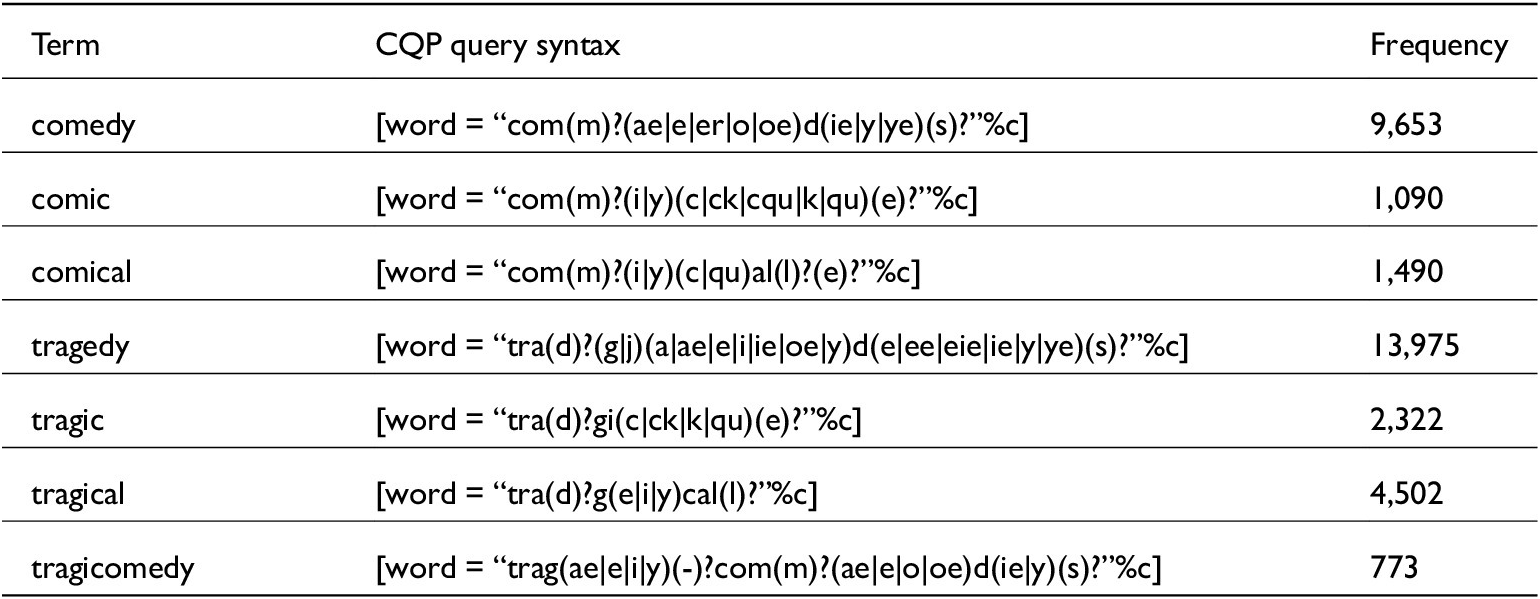
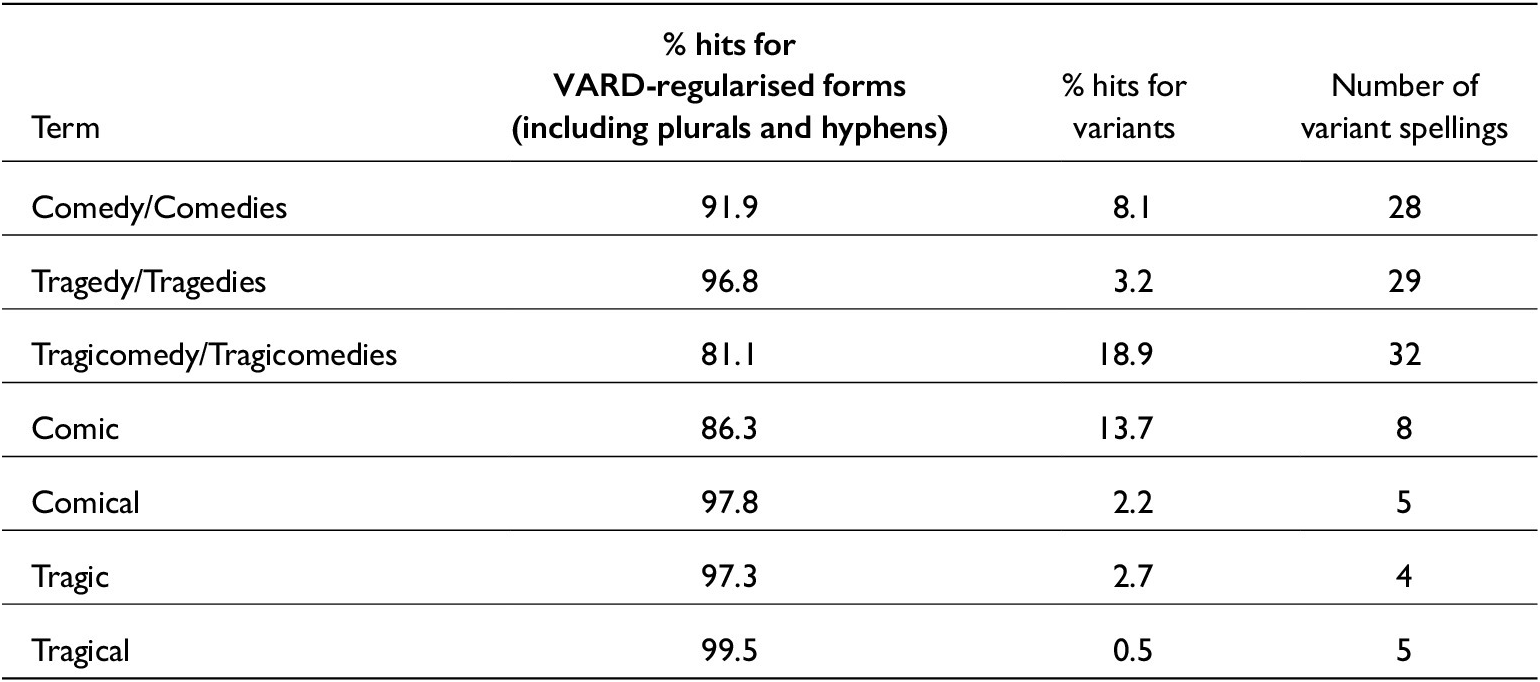


 Open access

