




Introduction
Neonatal mortality remains a major global public health challenge despite substantial progress in reducing under-five mortality over the past two decades. Globally, an estimated 2.3 million newborns die each year, accounting for approximately 47% of all deaths among children under five years of age (WHO, 2022; Maguire et al., Reference Maguire, O’Connor, Ryan and Gallagher2025). Nearly 99% of these deaths occur in low- and middle-income countries (LMICs), with sub-Saharan Africa bearing the highest burden at approximately 28 neonatal deaths per 1,000 live births (Ekwueme et al., Reference Ekwueme, Kassa, Haile, Worku and Gashaw2024). Most early neonatal deaths are largely attributable to preventable causes, including prematurity, birth asphyxia, and infections, highlighting the importance of effective interventions delivered immediately after birth (Chan et al., Reference Chan, Valsangkar, Kajeepeta, Boundy and Wall2016).
Skin-to-skin contact (SSC), defined as placing a newborn directly on the mother’s bare chest immediately after birth, is a simple and evidence-based essential newborn care intervention (Aboagye et al., Reference Aboagye, Seidu, Ahinkorah, Arthur-Holmes, Cadri, Dadzie and Yaya2022). SSC improves thermoregulation, cardiorespiratory stability, glucose regulation, breastfeeding, and maternal-newborn bonding, while reducing hypothermia and other neonatal complications (Singh et al., Reference Singh, Story and Moran2017; Ekholuenetale et al., Reference Ekholuenetale, Onikan and Ekholuenetale2020). These benefits are particularly important for preterm and low-birthweight newborns, for whom SSC forms a central component of Kangaroo Mother Care (KMC). Systematic reviews indicate that KMC can reduce neonatal mortality among preterm and low-birthweight newborns by approximately 37–40% compared with conventional care, while also reducing severe infections and long hospitalizations (Muttau et al., Reference Muttau, Bwalya, Changwe, Mukwato and Chomba2022). The World Health Organization therefore recommends immediate and uninterrupted SSC for all newborns following birth as part of routine newborn care (WHO, 2022). Despite these benefits and strong policy recommendations, SSC is not consistently implemented across many LIMCs. Maternal and newborn healthcare worker shortages, inadequate training, competing clinical priorities, weak supervision, and limited caregivers’ newborn care counselling can hinder SSC practice ( Alenchery et al., Reference Alenchery, Thoppil, Jose, Harrison and Minz2018; Kinshella et al., Reference Kinshella, Hiwa, Vidler, Dube, Goldfarb, Kawaza and Nyondo-Mipando2020; Aboagye et al., Reference Aboagye, Seidu, Ahinkorah, Arthur-Holmes, Dowou, Dierickx and Yaya2023; Ekwueme et al., Reference Ekwueme, Kassa, Haile, Worku and Gashaw2024). Thus, delivery in a health facility does not necessarily guarantee that newborns receive recommended immediate postnatal care.
Malawi has made notable progress in improving access to maternal and newborn health services. Institutional delivery increased from 52% in 2000 to 96% in 2024, reflecting substantial improvements in delivery under the supervision of skilled birth attendants in Malawi (NSO, 2024). The country was also among the earliest countries in sub-Saharan Africa to adopt and institutionalize Kangaroo Mother Care (KMC) within national newborn health programmes. Nevertheless, neonatal mortality remains high at 24 deaths per 1,000 live births (NSO, 2024), and the country continues to experience one of the highest rates of preterm birth globally, estimated at approximately 18–19% of all live births (Kawaza et al., Reference Kawaza, Machenga, Phiri, Thomas and Lufesi2020; Nyondo-Mipando et al., Reference Nyondo-Mipando, Kinshella, Bohne, Suwedi-Kapadia, Hiwa, Dube and Kawaza2020). These statistics suggest that increasing institutional delivery alone may be insufficient to achieve substantial reductions in neonatal mortality unless accompanied by improvements in the quality of essential newborn care.
In Malawi, existing studies have identified persistent challenges in implementing SSC and KMC despite long-standing policy support, including staffing shortages, inadequate monitoring and supervision, resource constraints, limited caregiver awareness, and gaps in facility readiness (Kawaza et al., Reference Kawaza, Machenga, Phiri, Thomas and Lufesi2020; Kinshella et al., Reference Kinshella, Hiwa, Vidler, Dube, Goldfarb, Kawaza and Nyondo-Mipando2020; Nyondo-Mipando et al., Reference Nyondo-Mipando, Kinshella, Bohne, Suwedi-Kapadia, Hiwa, Dube and Kawaza2020; Peven et al., Reference Peven, Purssell, Taylor and Bick2021). However, previous studies have been limited in explaining the factors of SSC practice and how it varies across health facilities. An important question therefore remains: among newborns delivered in health facilities, what factors are associated with missed SSC? Examining this group separately can help identify whether delivery mode, facility type, or other maternal and delivery characteristics are associated with not receiving SSC despite access to facility-based care. Therefore, this study estimates the prevalence and predictors of immediate SSC in Malawi. Additionally, the present study examines missed SSC among newborns delivered in health facilities. To our knowledge, this is among the first nationally representative analyses in Malawi to separately model predictors of missed SSC specifically among facility-based deliveries, thereby offering a more granular understanding of within-facility gaps in essential newborn care.
Methods
Data source and study design
We used the Malawi Demographic and Health Survey (MDHS) 2024, which is cross-sectional secondary data. The survey conducted by the National Statistical Office (NSO) in collaboration with the Ministry of Health and the DHS Program. The survey collects information on a wide range of demographic and health indicators, including maternal and newborn health practices. The MDHS employed a stratified two-stage cluster sampling design. In the first stage, enumeration areas (EAs) were selected from the 2018 Malawi Population and Housing Census sampling frame using probability proportional to size. In the second stage, households were systematically selected within each cluster. Standardized questionnaires were used to collect information from eligible women aged 15–49 years.
The present study utilized the Kids Recode (KR) file of the MDHS 2024 data, which contains information on 6,997 women with birth history during the five years preceding the survey. To minimize recall bias and ensure comparability of newborn care experiences, the analysis was restricted to the most recent live birth (index child) of each woman. After excluding observations with missing information on maternal age (n = 290) and child birth weight (n = 642), the final analytic sample consisted of 6,065 mother–newborn pairs (weighted sample: 6,142).
Variables
Outcome variable
The outcome variable was mother–newborn skin-to-skin contact (SSC) immediately after birth. In MDHS, women were asked whether their newborn was placed on their chest and touching bare skin after delivery. Responses were categorized as ‘put on chest, touching bare skin’, ‘put on chest, not touching bare skin’, ‘put on chest, do not know whether touching bare skin’, and ‘not placed on chest’. Following previous DHS-based studies (Ekholuenetale et al., Reference Ekholuenetale, Onikan and Ekholuenetale2020; Aboagye et al., Reference Aboagye, Seidu, Ahinkorah, Arthur-Holmes, Cadri, Dadzie and Yaya2022; Almutairi, Reference Almutairi2022; Giang et al., Reference Giang, Hwang, Nguyen and Lee2022), newborns who were reported as having been placed on their mother’s chest with direct bare-skin contact were coded as having received skin-to-skin contact (1), while all other responses were categorized as not having received skin-to-skin contact (0).
Explanatory variables
Based on previous literature on skin-to-skin contact (Ekholuenetale et al., Reference Ekholuenetale, Onikan and Ekholuenetale2020; Aboagye et al., Reference Aboagye, Seidu, Ahinkorah, Arthur-Holmes, Cadri, Dadzie and Yaya2022, Reference Aboagye, Seidu, Ahinkorah, Arthur-Holmes, Dowou, Dierickx and Yaya2023), several explanatory variables were selected. These variables were broadly categorized into child-level, delivery-level, maternal-level, and contextual-level factors. The child-level variables included sex of the child, birth order, birth weight category, and type of birth (singleton or multiple birth). The delivery-level variables included place of delivery, recoded for the multilevel models as institutional (government, CHAM/mission, or private/NGO facility) versus home delivery, with facility type (government, CHAM/mission, private/NGO) examined separately among institutional deliveries; mode of delivery (vaginal or caesarean section); and antenatal care (ANC) attendance categorized as no visits, 1–3 visits, and four or more visits. The maternal-level variables included maternal age at delivery (recoded as 15–19, 20–24, 25–29, 30–34, and 35–49 years), educational attainment, marital status (recoded as never in union, currently in union [married or cohabiting], and formerly in union [widowed, divorced, or separated]), and employment status. The contextual-level variables included household wealth quintile, place of residence (urban or rural), exposure to radio, exposure to television, exposure to newspapers or magazines, and community cluster.
Statistical analysis
Data were checked for completeness before analysis. The baseline sample comprised 6,734 mother–newborn pairs with non-missing outcome data. Missingness was mainly observed for low birth weight (8.7%), while missing values for other covariates were minimal. A complete-case analysis was conducted (Little and Rubin, Reference Little and Rubin2019), resulting in a final analytic sample of 6,065 mother–newborn pairs for Tables 1–3. For the institutional-delivery sub-analysis (Table 4), the sample was restricted to 6,028 institutional deliveries after excluding 37 home births. Descriptive statistics were presented using survey-weighted frequencies and percentages, while row percentages showed the prevalence of skin-to-skin contact (SSC) across categories. Design-based Pearson’s chi-square tests assessed bivariate associations (Agresti, Reference Agresti2007). Multilevel mixed-effects logistic regression was used to account for the hierarchical structure of the DHS data, with women nested within survey clusters (Gelman and Hill, Reference Gelman and Hill2007). A null model was first fitted to assess cluster-level variation, followed by models including child-, delivery-, maternal-, and contextual-level factors, culminating in a fully adjusted model. Results are presented as adjusted odds ratios (aORs) with 95% confidence intervals (CIs). Cluster-level variation was assessed using the intraclass correlation coefficient (ICC) (Hox et al., Reference Hox, Moerbeek and Van de Schoot2010), while the Akaike Information Criterion (AIC) and Bayesian Information Criterion (BIC) were used to assess model fit (Burnham and Anderson, Reference Burnham and Anderson2004). Sampling weights (v005/1,000,000) and the complex survey design were accounted for in all analyses (Heeringa et al., Reference Heeringa, West and Berglund2017). Statistical significance was set at p ≤ 0.05, and analyses were conducted using Stata version 19.5 (StataCorp, College Station, Texas, USA).
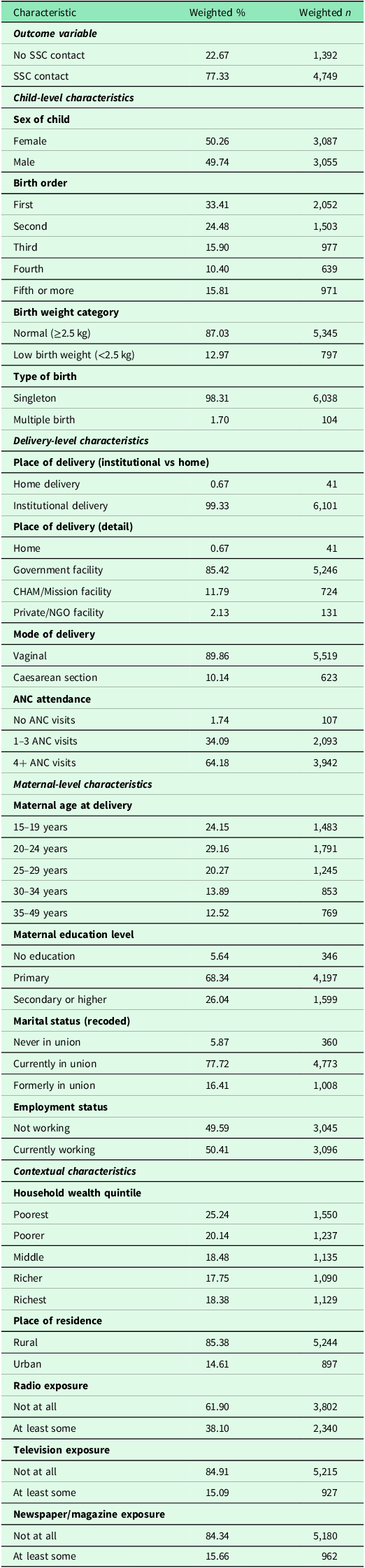
Background characteristics of the analytic sample, women aged 15–49, Malawi, MDHS 2024

Table 1. Long description
The table presents the background characteristics of women aged 15-49 in Malawi, based on the MDHS 2024 data. It includes 18 rows and 3 columns. The columns are labeled ‘Characteristic’, ‘Weighted %’, and ‘Weighted n’. The table is divided into several sections: Outcome variable, Child-level characteristics, Delivery-level characteristics, Maternal-level characteristics, and Contextual characteristics. Each section lists specific characteristics and their corresponding weighted percentages and weighted numbers. For example, under Child-level characteristics, the sex of the child is divided into female and male with weighted percentages of 50.26 and 49.74, respectively. The table provides detailed data on various aspects such as birth order, birth weight category, type of birth, place of delivery, mode of delivery, ANC attendance, maternal age at delivery, maternal education level, marital status, employment status, household wealth quintile, place of residence, radio exposure, television exposure, and newspaper/magazine exposure.
Source: 2024 Malawi Demographic and Health Survey (MWKR81 FL). Analytic sample restricted to the most recent live birth per woman aged 15–49, with complete-case exclusion of observations missing the outcome or any explanatory variable (n = 6,065 unweighted; weighted population estimate ≈ 6,142). Percentages are survey-weighted.
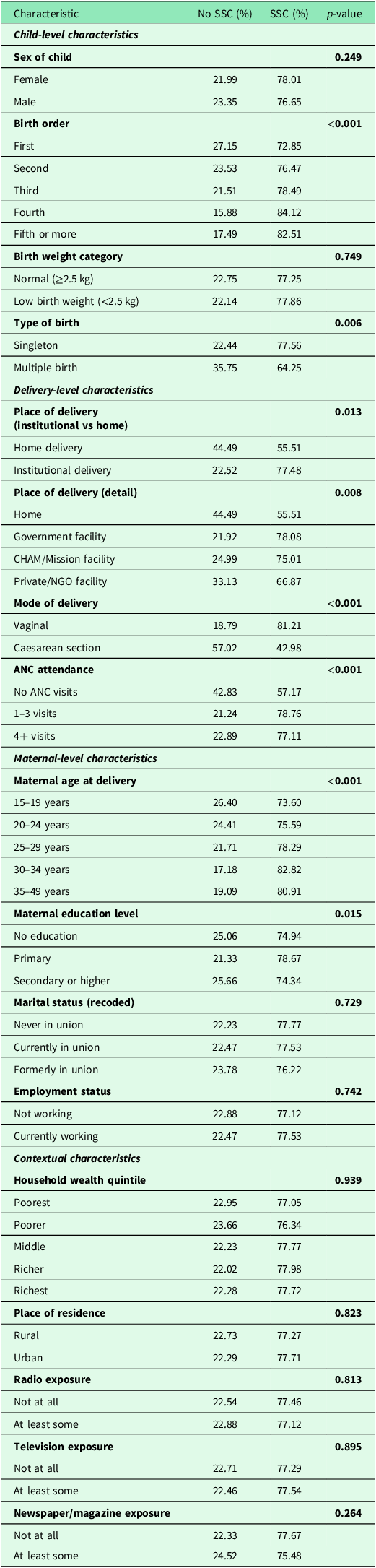
Prevalence of skin-to-skin contact by background characteristics of women aged 15–49, Malawi, MDHS 2024

Table 2. Long description
A table comparing the prevalence of skin-to-skin contact by background characteristics of women aged 15-49 in Malawi. The table has 30 rows and 4 columns. Column headers are: Characteristic, No SSC (%), SSC (%), and p-value. Row labels include Child-level characteristics, Delivery-level characteristics, Maternal-level characteristics, and Contextual characteristics. Row 1: Sex of child, Female, 21.99, 78.01, 0.249. Row 2: Sex of child, Male, 23.35, 76.65. Row 3: Birth order, First, 27.15, 72.85, 0.001. Row 4: Birth order, Second, 23.53, 76.47. Row 5: Birth order, Third, 21.51, 78.49. Row 6: Birth order, Fourth, 15.88, 84.12. Row 7: Birth order, Fifth or more, 17.49, 82.51. Row 8: Birth weight category, Normal (2.5kg), 22.75, 77.25, 0.749. Row 9: Birth weight category, Low birth weight (<2.5kg), 22.14, 77.86. Row 10: Type of birth, Singleton, 22.44, 77.56, 0.006. Row 11: Type of birth, Multiple birth, 35.75, 64.25. Row 12: Place of delivery (institutional vs home), Home delivery, 44.49, 55.51, 0.013. Row 13: Place of delivery (institutional vs home), Institutional delivery, 22.52, 77.48. Row 14: Place of delivery (detail), Home, 44.49, 55.51, 0.008. Row 15: Place of delivery (detail), Government facility, 21.92, 78.08. Row 16: Place of delivery (detail), CHAM/Mission facility, 24.99, 75.01. Row 17: Place of delivery (detail), Private/NGO facility, 33.13, 66.87. Row 18: Mode of delivery, Vaginal, 18.79, 81.21, 0.001. Row 19: Mode of delivery, Caesarean section, 57.02, 42.98. Row 20: ANC attendance, No ANC visits, 42.83, 57.17, 0.001. Row 21: ANC attendance, 1-3 visits, 21.24, 78.76. Row 22: ANC attendance, 4+ visits, 22.89, 77.11. Row 23: Maternal age at delivery, 15-19 years, 26.40, 73.60, 0.001. Row 24: Maternal age at delivery, 20-24 years, 24.41, 75.59. Row 25: Maternal age at delivery, 25-29 years, 21.71, 78.29. Row 26: Maternal age at delivery, 30-34 years, 17.18, 82.82. Row 27: Maternal age at delivery, 35-49 years, 19.09, 80.91. Row 28: Maternal education level, No education, 25.06, 74.94, 0.015. Row 29: Maternal education level, Primary, 21.33, 78.67. Row 30: Maternal education level, Secondary or higher, 25.66, 74.34.
Source: 2024 Malawi DHS. Row percentages are survey-weighted. p-values are design-based F-statistics from complex survey cross-tabulations (svy: tab). SSC = skin-to-skin contact.
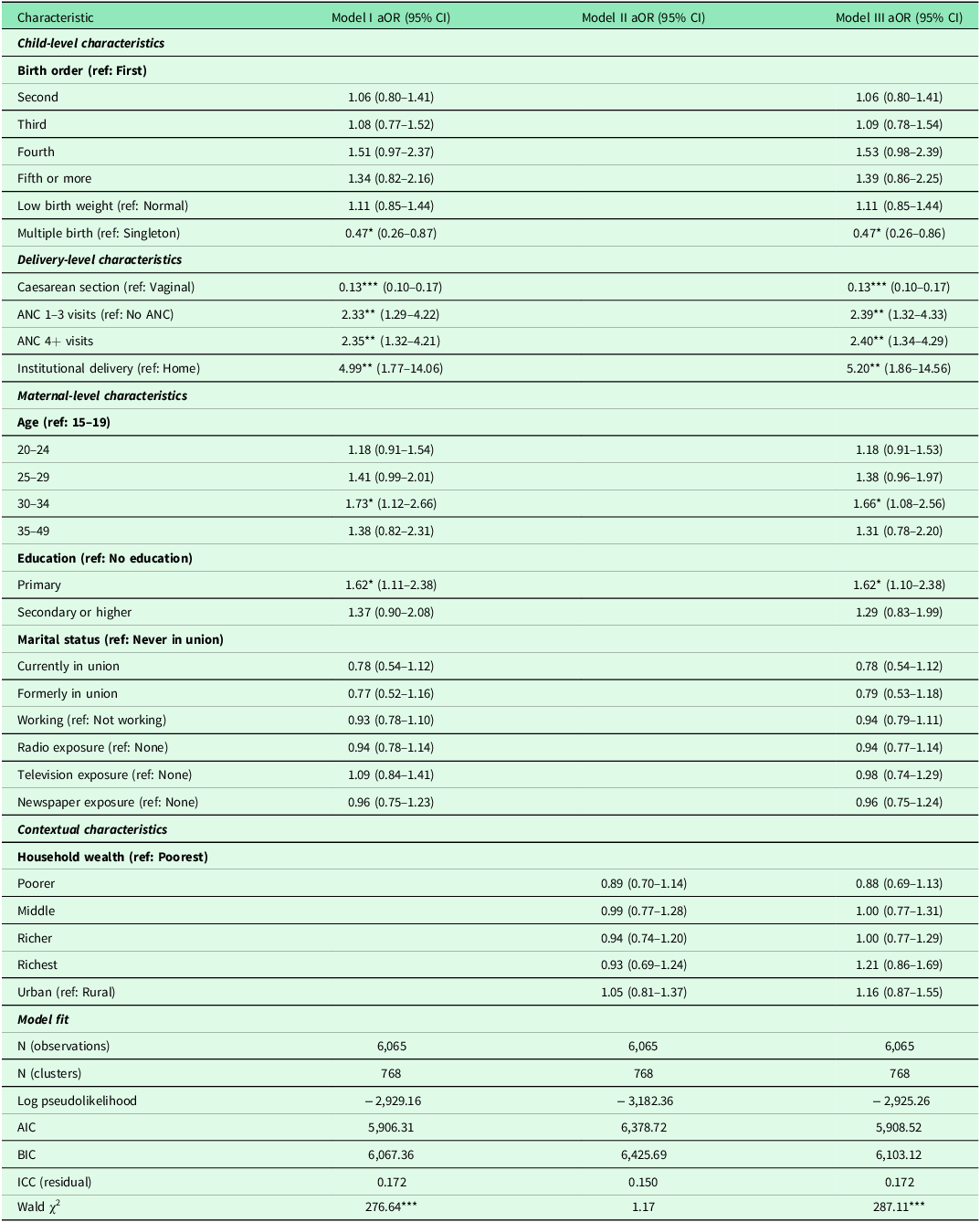
Multilevel mixed-effects logistic regression of factors associated with skin-to-skin contact, Malawi MDHS 2024

Table 3. Long description
The table presents the results of a multilevel mixed-effects logistic regression analysis of factors associated with skin-to-skin contact in Malawi MDHS 2024. It includes three models: Model I, Model II, and Model III, each with adjusted odds ratios (aOR) and 95% confidence intervals (CI). The table is organized into several sections: Child-level characteristics, Delivery-level characteristics, Maternal-level characteristics, and Contextual characteristics. Each section lists specific variables and their corresponding aOR and CI values across the three models. For example, under Child-level characteristics, birth order and low birth weight are analyzed. Delivery-level characteristics include variables like Caesarean section, ANC visits, and institutional delivery. Maternal-level characteristics cover age, education, marital status, and radio, television, and newspaper exposure. Contextual characteristics include household wealth and urban/rural residence. The table also provides model fit statistics such as the number of observations, clusters, log pseudolikelihood, AIC, BIC, ICC, and Wald chi-square.
Notes: aOR = adjusted odds ratio; CI = confidence interval; ICC = intraclass correlation coefficient. The outcome is skin-to-skin contact (SSC = 1). An aOR>1 indicates higher odds of receiving SSC, while an aOR<1 indicates lower odds. Model I includes child-level, delivery-level, and maternal-level characteristics. Model II includes contextual characteristics. Model III is the fully adjusted model. *p < 0.05, **p < 0.01, ***p < 0.001.
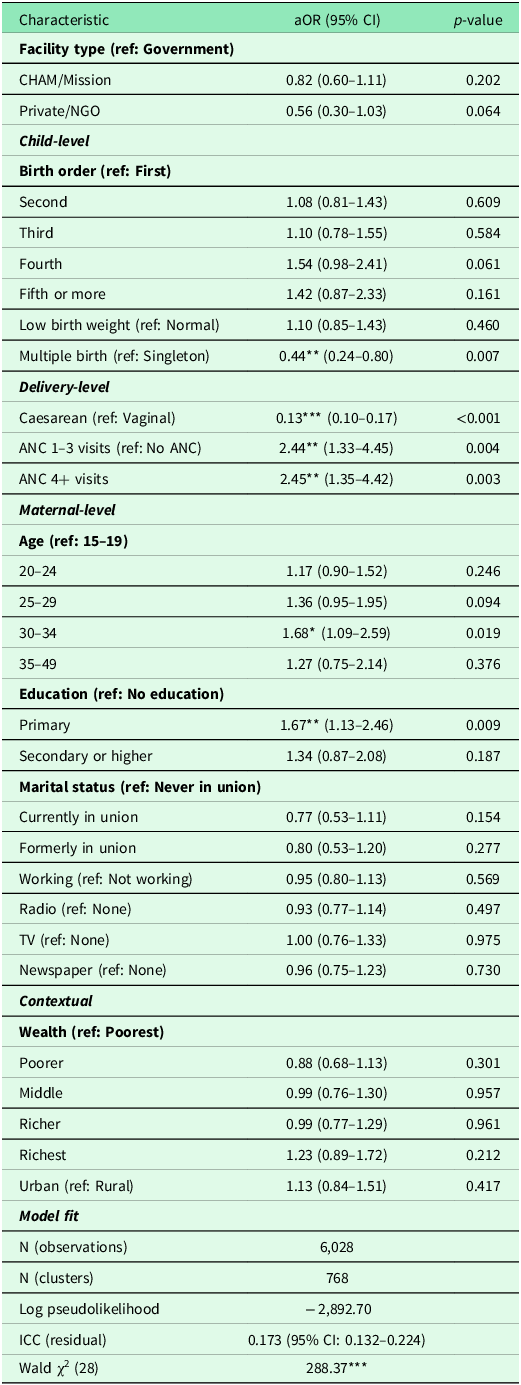
Multilevel mixed-effects logistic regression of factors associated with skin-to-skin contact among institutional deliveries, Malawi MDHS 2024

Table 4. Long description
The table presents a multilevel mixed-effects logistic regression analysis of factors associated with skin-to-skin contact among institutional deliveries in Malawi MDHS 2024. It includes 10 rows and 5 columns. The columns are labeled Characteristic, aOR (95% CI), and p-value. The table is divided into sections: Facility type, Birth order, Delivery-level, Maternal-level, and Contextual. Each section lists specific characteristics and their associated adjusted odds ratios (aOR) with 95% confidence intervals (CI) and p-values. Notable characteristics include Facility type with categories like CHAM/Mission, Private/NGO, and Government; Birth order with categories like Second, Third, Fourth, Fifth or more; Delivery-level with categories like Caesarean, ANC 1-3 visits, ANC 4+ visits; Maternal-level with categories like Age, Education, Marital status, Working, Radio, TV, Newspaper; and Contextual with categories like Wealth and Urban. The table provides detailed statistical analysis results for each characteristic.
Sub-analysis restricted to the 6,028 institutional (facility) deliveries within the complete-case analytic sample. The outcome is skin-to-skin contact (SSC = 1). aOR = adjusted odds ratio; CI = confidence interval; ICC = intraclass correlation coefficient. *p < 0.05, **p < 0.01, ***p < 0.001.
Results
Background characteristics of the study sample
Overall, 77.33% of newborns received skin-to-skin contact (SSC) immediately after birth (Table 1). Nearly all women delivered in health facilities (99.33% institutional delivery), predominantly government facilities (85.42%), and 10.14% delivered by caesarean section. Nearly two-thirds attended four or more antenatal care visits (64.18%). The sample was largely rural (85.38%), with most women having primary education (68.34%) and being currently in union (77.72%); women aged 20–24 years formed the largest age group (29.16%). Most newborns were singleton births (98.31%) with normal birth weight (87.03%).
Prevalence of skin-to-skin contact practice
SSC prevalence differed significantly by birth order, type of birth, place of delivery, mode of delivery, antenatal care attendance, maternal age, and maternal education (p < 0.05) (Table 2). Delivery characteristics showed particularly marked differences: SSC prevalence was higher among births in government facilities (78.08%), CHAM/Mission facilities (75.01%), and private/NGO facilities (66.87%) than among home deliveries (55.51%), and institutional deliveries overall had higher prevalence than home deliveries (77.48% versus 55.51%). SSC was also substantially higher following vaginal than caesarean delivery (81.21% versus 42.98%). Prevalence was lower among women with no ANC visits (57.17%) than among those attending 1–3 visits (78.76%) or 4+ visits (77.11%). SSC was also higher among singleton than multiple births (77.56% versus 64.25%) and among women with primary education than those with no formal education (78.67% versus 74.94%).
Predictors of skin-to-skin contact practice
In the fully adjusted model (Table 3, Model III), multiple births, caesarean delivery, antenatal care attendance, institutional delivery, maternal age, and education remained significantly associated with SSC. Multiple births were associated with lower odds of SSC than singleton births (aOR = 0.47, 95% CI: 0.26–0.86), while caesarean delivery was associated with 87% lower odds of SSC than vaginal delivery (aOR = 0.13, 95% CI: 0.10–0.17). Women who attended 1–3 ANC visits had more than twice the odds of SSC compared with those with no ANC visits (aOR = 2.39, 95% CI: 1.32–4.33), with a similar association among those attending four or more visits (aOR = 2.40, 95% CI: 1.34–4.29). Institutional delivery was also strongly associated with SSC, with more than five times the odds compared with home delivery (aOR = 5.20, 95% CI: 1.86–14.56). Among maternal characteristics, women aged 30–34 years had higher odds of SSC than those aged 15–19 years (aOR = 1.66, 95% CI: 1.08–2.56), while women with primary education had higher odds than those with no education (aOR = 1.62, 95% CI: 1.10–2.38). The associations for other maternal and contextual characteristics were not statistically significant in the fully adjusted model. Between-cluster variation was substantial: the ICC was 0.149 in the null (empty) model and increased to 0.172 in the fully adjusted model (Model III), suggesting that differences between clusters remained, and were not fully explained by, the observed individual, delivery, maternal, and contextual characteristics.
Adjusted variation in missed skin-to-skin contact across facility deliveries
Among institutional deliveries (Table 4), private/NGO facilities showed lower odds of SSC than government facilities, although this did not reach statistical significance in the fully adjusted model (aOR = 0.56, 95% CI: 0.30–1.03, p = 0.064), while CHAM/Mission facilities did not differ significantly from government facilities (aOR = 0.82, 95% CI: 0.60–1.11). Multiple births were associated with lower odds of SSC than singleton births (aOR = 0.44, 95% CI: 0.24–0.80), while caesarean delivery showed the strongest negative association, with 87% lower odds of SSC compared with vaginal delivery (aOR = 0.13, 95% CI: 0.10–0.17). In contrast, antenatal care attendance was associated with higher odds of SSC: women attending 1–3 ANC visits had more than twice the odds of SSC compared with those with no ANC visits (aOR = 2.44, 95% CI: 1.33–4.45), as did those attending four or more visits (aOR = 2.45, 95% CI: 1.35–4.42). Among maternal characteristics, women aged 30–34 years had higher odds of SSC than adolescents aged 15–19 years (aOR = 1.68, 95% CI: 1.09–2.59), while women with primary education had higher odds than those with no education (aOR = 1.67, 95% CI: 1.13–2.46). Birth order, birth weight, marital status, employment, household wealth, place of residence, and media exposure were not significantly associated with SSC. Cluster-level variation remained similarly substantial in this sub-model: the ICC was 0.173 (95% CI: 0.132–0.224), indicating that approximately 17.3% of the residual variation in SSC among institutional deliveries was attributable to differences between clusters, closely matching the ICC observed in the full-sample model (0.172).
Discussion
This study found that seven out of ten newborns experienced skin-to-skin contact (SSC) immediately after birth. Although this is higher than estimates reported in several sub-Saharan African settings, a substantial proportion of newborns still missed this recommended practice. Institutional (facility) delivery was associated with higher likelihood of SSC, consistent with evidence from sub-Saharan Africa (Aboagye et al., Reference Aboagye, Seidu, Ahinkorah, Arthur-Holmes, Cadri, Dadzie and Yaya2022; Ekwueme et al., Reference Ekwueme, Kassa, Haile, Worku and Gashaw2024). This may reflect greater access to skilled birth attendants and a more structured environment for providing immediate newborn care. However, the remaining gap among facility births suggests that delivering in a health facility does not necessarily ensure consistent implementation of SSC.
Consistent with previous evidence from Ethiopia, Nigeria, and other LMICs, caesarean delivery was associated with lower likelihood of SSC (Safari et al., Reference Safari, Saeed, Said and El-Demerdash2018). This may be related to maternal recovery, postoperative monitoring, and the need for immediate newborn assessment, which can delay mother–newborn contact. Multiple births were also associated with lower likelihood of SSC, potentially because these newborns are more likely to require additional assessment and monitoring, particularly when prematurity or other complications are present. In contrast, ANC attendance was associated with higher likelihood of SSC. ANC provides opportunities for health education and counselling, which may increase mothers’ awareness of recommended newborn care practices (Bedaso et al., Reference Bedaso, Kebede and Adamu2019; Ekholuenetale et al., Reference Ekholuenetale, Barrow and Arora2022). Maternal age and education were also associated with SSC. The higher likelihood among advance reproductive aged women and those with primary education may reflect differences in health knowledge, previous childbirth experience, and confidence in interacting with healthcare providers. Similar associations between maternal education and SSC have been reported in low- and middle-income countries (Ali et al., Reference Ali, Islam, Khan, Jahan, Rahman, Hoque and El Arifeen2021;Obioha et al., Reference Obioha, Martin, Obioha and Padron-Monedero2021; Debella et al., Reference Debella, Mussa, Getachew and Eyeberu2024). These findings suggest that maternal counselling and education during ANC and maternity care may be important opportunities for reinforcing SSC.
Private/NGO facilities showed a pattern of lower likelihood of SSC compared with government facilities, although this association did not reach conventional statistical significance in the fully adjusted model. A similar pattern was reported in Afghanistan, where SSC was less likely among women delivering in private clinics or hospitals (Tawfiq et al., Reference Tawfiq, Ahinkorah, Seidu and Yaya2025). In Malawi, this pattern may reflect variation in the organization of immediate newborn care, provider practices, training, supervision, and implementation of SSC protocols across facility sector (Zimba et al., Reference Zimba, Kinney, Kachale, Nyondo, Blencowe, Lawn and Wall2012; Masefield et al., Reference Masefield, Msosa and Grugel2020). The higher use of caesarean delivery in private facilities may contribute to the observed pattern, given the strong negative association between caesarean delivery and SSC (Opiyo et al., Reference Opiyo, Sheffel and Kanyangarara2022). These factors were not directly measured in the DHS and therefore require further facility-level investigation. The lack of a significant difference between CHAM/Mission and government facilities may reflect their similar role within Malawi’s subsidized health system and their integration into the broader national maternity care system.
The multilevel analysis further showed meaningful variation in SSC between clusters. In the null model, 14.9% of the variation in SSC was attributable to differences between clusters; this proportion remained substantial at 17.2% in the fully adjusted model, indicating that cluster-level differences were not explained away by the individual, delivery, maternal, and contextual characteristics included in the model. This suggests that SSC is influenced not only by maternal and newborn characteristics but also by factors shared within geographic or service-delivery settings. Such differences may include the organization of maternity services, availability and practices of healthcare workers, and facility-level implementation of newborn care protocols, although these factors were not measured in the DHS (Mvula et al., Reference Mvula, Likomwa, Kachale, Banda and Lufesi2024). Improving SSC in Malawi may therefore require both individual-level counselling and consistent facility-level implementation, particularly for caesarean and multiple births and in private/NGO facilities.
Policy implications
The findings underscore the importance of strengthening the implementation of SSC within routine maternal and newborn healthcare services. Particular attention should be directed towards improving SSC among caesarean deliveries and multiple births, where coverage remains substantially lower. Antenatal care platforms should continue to incorporate counselling on SSC, while quality improvement initiatives should ensure consistent adherence to newborn care guidelines across government, CHAM, and private health facilities. Given the observed differences across facility sectors, strengthening provider training and supportive supervision may improve SSC coverage nationwide.
Strengths and limitations
This study used nationally representative data from the 2024 Malawi Demographic and Health Survey, enhancing the generalizability of the findings to Malawi’s population. The use of multilevel modelling also accounted for the hierarchical nature of the data and clustering at the community level. However, the cross-sectional design of the DHS precludes causal inference and limits the interpretation of observed associations. Second, information on SSC was self-reported and may therefore be subject to recall bias. Third, the analysis was restricted to variables available in the DHS dataset, preventing assessment of important facility-level factors such as provider knowledge, staffing levels, and availability of newborn care resources. Fourth, although multilevel models accounted for clustering at the community (PSU) level, we were unable to identify the specific health facility at which each delivery occurred, so facility-level quality could only be approximated through facility type; residual confounding by unmeasured facility characteristics is therefore possible. Finally, as with all DHS-based analyses, the SSC indicator relies on a single retrospective maternal report rather than direct clinical observation, which may not fully capture the duration or quality of contact.
Conclusion
Approximately three-quarters of newborns in Malawi received immediate skin-to-skin contact (SSC) after birth, indicating substantial coverage but a persistent gap in this essential newborn care practice. Institutional delivery and antenatal care attendance were associated with higher likelihood of SSC, whereas caesarean delivery and multiple births were consistently associated with lower likelihood of receiving SSC. Maternal age and education were also associated with SSC, while substantial residual variation between geographic clusters suggests that implementation differs across settings. These findings suggest that increasing access to facility-based delivery alone is insufficient to ensure universal SSC. Strengthening routine implementation and monitoring of SSC guidelines within maternity services, with particular attention to caesarean births and multiple births, should be prioritized. Antenatal care provides an additional opportunity to counsel women and families about SSC and reinforce expectations for immediate newborn care. Efforts to improve SSC should also address facility- and provider-level variation to ensure that recommended care is consistently delivered across health facilities in Malawi. As this study is based on retrospective maternal reporting, further facility-based research using direct observation could help identify specific organizational and clinical barriers to implementation.
Data availability statement
The data that support the findings of this study are publicly available from the DHS Program upon request and approval. The 2024 Malawi Demographic and Health Survey dataset used in this study can be obtained from the DHS Program website after registration and authorization. No new data were created or collected for this study.
Acknowledgements
The authors thank the DHS Program and ICF for granting access to the 2024 Malawi Demographic and Health Survey dataset used in this analysis.
Author contributions
Redson Mwandama: Conceptualization, Methodology, Formal analysis, Data curation, Investigation, Validation, Visualization, Writing – original draft, Writing – review and editing. John Kadzandira: Conceptualization, Methodology, Supervision, Writing – review and editing, and Validation. Ben Kalukuni Lwanja: Writing – review and editing, and Validation. Sydney Nkhoma: Writing – review and editing, Validation. Margubur Rahaman: Conceptualization, Methodology, Supervision, Writing – review and editing, and Validation.
Funding statement
The authors received no financial support for the research, authorship, and/or publication of this article.
Competing interests
The authors declare no conflicts of interest relevant to this work.
Ethical standards
The 2024 Malawi Demographic and Health Survey (MDHS) received ethical approval from the National Health Sciences Research Committee (NHSRC) of Malawi and the Institutional Review Board (IRB) of ICF International. Written informed consent was obtained from all participants before data collection. This study involved secondary analysis of anonymized publicly available MDHS data obtained from the DHS Program following formal authorization. No additional ethical approval was required because the dataset contains no personally identifiable information.

 Open access

