Introduction
Recent epidemiological studies have estimated that the global prevalence of Alzheimer's disease (AD) will rise from 27 million people worldwide in 2006 to 66 million in 2030 and 115 million in 2050 (Brookmeyer et al., Reference Brookmeyer, Johnson, Ziegler-Graham and Arrighi2007). These prevalence rates increase with age so that by 2050, one in three persons aged 80 years and above are likely to suffer from dementia, most probably from the AD type (Lee and Krishnan, Reference Lee and Krishnan2010). It is not surprising, therefore, that AD has been called an epidemic (Korczyn and Vakhapova, Reference Korczyn and Vakhapova2007; Cumming and Brodtmann, Reference Cumming and Brodtmann2010; Lee and Krishnan, Reference Lee and Krishnan2010) or a rising tide (Larson, Reference Larson2010).
Indeed, even now, the impact of AD is deleterious at the societal, familial, and individual levels (Alzheimer's Association, 2011), and western societies are preparing themselves to battle and manage these effects. At the societal level, increased efforts and budgets are invested in finding a treatment for the disease (Lee and Krishnan, Reference Lee and Krishnan2010) while emphasizing prevention and early diagnosis (Larson, Reference Larson2010; Savica and Peterson, Reference Savica and Peterson2011). Moreover, new health and social services for persons with dementia and their families are being developed, especially (but not exclusively) at the community level. At the familial level, the impact of unique and novel psychosocial interventions aimed at easing the burden of family caregivers are being assessed and implemented. Finally, at the individual level, studies are examining the impact of the diagnosis on the individual (Alzheimer's Association, 2011), as well as how this diagnosis influences decision-making, especially regarding end-of-life issues (Robinson et al., Reference Robinson2010).
An additional aspect that might have an effect on the measures to be taken to deal with the upcoming “epidemic” of AD is the extent to which laypersons are taking steps in preparation for the disease in the event that they should be affected. Surprisingly, apart from advanced decision-making for end-of-life issues (Drabsch, Reference Drabsch2007; Robinson et al., Reference Robinson2010), very few studies have examined advanced preparation for the possibility of developing AD (Anderson et al., Reference Anderson, Day, Beard, Reed and Wu2009), and those indicate a lack of preparation. For example, in a study on the beliefs of American laypersons concerning AD, the majority of the sample (77%) did not feel well prepared for a diagnosis of AD in a family member (Connell et al., Reference Connell, Roberts and McLaughlin2007). Similarly, a survey of 1,008 Americans aged 18 years and above showed that the majority of the participants (58–87%) had not taken any basic steps toward making personal, financial or living arrangements if they were to develop AD (Harris Interactive Inc., 2006). Finally, a qualitative sample examining the fear of dementia among older adults found that older adults avoid talking, thinking, and planning for dementia (Corner and Bond, Reference Corner and Bond2004). Despite the importance of these pioneer studies, they were limited to elderly persons and did not examine the factors associated with preparedness.
Studies examining elderly persons’ preparations for future care needs in general are also few and mostly qualitative, but they give us several hints regarding the determinants of preparedness as they show that preparedness is associated with the participants’ beliefs about the disease, and especially with their perceptions of risk or vulnerability (Pinquart and Sörensen, Reference Pinquart and Sörensen2002), and to their sociodemographic characteristics (Mitchell et al., Reference Mitchell, Mathews and Hack2000; Sörensen and Pinquart, Reference Sörensen and Pinquart2001; Friedemann et al., Reference Friedemann, Newman, Seff and Dunlop2004). Since previous studies have shown that knowledge about AD was associated with health behaviors (Werner, Reference Werner2003), the current study also examines this as a determinant of preparedness.
In sum, the first aim of this study was to expand knowledge in the area of preparedness for AD by assessing it in younger and older Israeli laypersons. The second aim was to explore the determinants of preparedness with special attention to sociodemographic characteristics, knowledge and beliefs about AD.
Methods
Participants
The study was based on a national representative sample of the adult (18+), non-institutionalized population in Israel. Of 1,292 phone calls made using random digit dialing, 74 phone numbers were disconnected or were either commercial or fax numbers. A further 182 phone calls encountered a language problem. Of the remaining 936 calls made, 404 people refused to participate. Thus, 632 interviews were completed, representing a response rate of 67.5%. For the aim of the present study, those participants who reported that they had not heard about AD at all (n = 81) or did not respond to this item (n = 132) were excluded. The remaining 419 participants were split according to age into those aged 18–54 years (68%) and those aged 55 and over (32%). The younger group had a mean age of 37.2 years (SD = 10.1); 52.5% were female; 88.6% were Jewish; and they had an average of 14.3 (SD = 2.8) years of education. In the older group, the mean age was 64.7 years (SD = 7.1); 41.4% were female; 98.5% were Jewish; and they had an average of 14.2 (SD = 3.6) years of education.
Measures
Dependent variable
Preparedness for AD. General and specific preparedness were assessed. Participants’ overall sense of preparedness was assessed by asking them the extent to which – on a scale from 1 (not at all) to 5 (very much) – they have prepared for the possibility that they could develop AD.
Three additional items (measured on a yes/no scale) were used to assess specific preparedness in different areas: (1) Have you chosen someone to look after your affairs in case you become sick with AD? (2) Have you considered which treatment possibilities would be available to you if you became sick with AD? (3) Have you made financial arrangements for the possibility that you might become sick with AD? An overall index of these items was calculated by summing all positive answers to these items (Cronbach's α = 61).
Independent variables
The independent variables included beliefs about AD and sociodemographic information.
Beliefs related to AD. These were measured using four items:
• Vulnerability was assessed by a single question: “How likely do you think it is that you will develop AD?”, rated on a 5-point Likert-type scale, ranging from 1 (not at all likely) to 5 (very likely).
• Worry was assessed by two questions: “How much do you worry that you will develop AD?” and “How much do you worry that you will have to be a caregiver for a person with AD?” Each item was rated on a 5-point Likert-type scale ranging from 1 (not at all worried) to 5 (very worried).
• Fear was assessed by a single question: “How much do you fear developing AD?”, rated on a 5-point Likert-type scale ranging from 1 (no fear at all) to 5 (very fearful).
• Perceptions about the importance of planning for the future were assessed by a single item rated on a 5-point Likert-type scale ranging from 1 (not important at all) to 5 (very important).
Knowledge. The participants’ perception about knowledge of AD was assessed by a single question: “How much do you know about AD?”, rated on a 5-point Likert-type scale ranging from 1 (nothing) to 5 (very knowledgeable).
Sociodemographic information. This included age (years), gender (male/female), education (in years), ethnic group (Jewish vs. Arab), and financial situation (ranging from 1 to 5, with 5 indicating a better situation).
Procedure
Structured telephone interviews were conducted during January 2009 using random digit dialing. Respondents from all eligible households were selected on the basis of their last birthday. After listing all adults associated with the selected telephone number, the adult with the most recent birthday was designated as the respondent. If that person was absent, the next eligible adult was selected as the respondent.
Statistical analyses
Data were cleaned, coded and analyzed using SPSS version 14.0 (SPSS Inc., Chicago, IL). Descriptive statistics were used to describe the sample and the main variables. Statistical comparisons between the groups were performed using χ2 and t-tests. Pearson correlations were calculated to assess relationships among the different variables. Determinants of preparedness were assessed using multivariate linear regressions. The dependent variable in the first equation was the participants’ general preparedness and the independent variables were sociodemographic characteristics, beliefs and knowledge. The dependent variable in the second equation was the specific preparedness summative index and the general preparedness variable was added to the other independent variables examined.
Ethical considerations
The study was approved by the Ethics Committee of the Faculty of Social Welfare and Health Sciences of the University of Haifa.
Results
Age group differences in preparedness
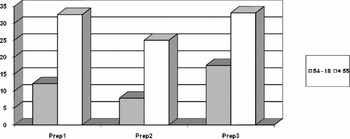
The mean score on the item reflecting a general sense of preparedness (mean = 1.5 in the younger group and 1.8 in the older group, p < 0.01), as well as the percentage of participants reporting preparations in the three more specific items (Figure 1), reflected relatively low levels of preparations for AD in the future. Participants in the older group reported consistently higher levels of preparation than younger participants.
Age differences in specific preparedness (%).
All differences were statistically significant at the p < 0.001 level.
Prep1 = Have you chosen someone to look after your affairs in case you become sick with AD?
Prep2 = Have you considered which treatment possibilities would be available to you if you became sick with AD?
Prep3 = Have you made financial arrangements for the possibility that you might become sick with AD?

Determinants of preparedness in different age groups
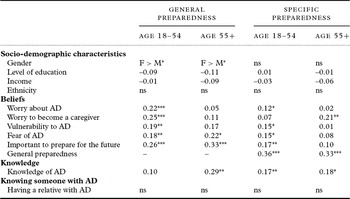
The results of the bivariate analyses for the item reflecting a general sense of preparedness and for the index reflecting specific preparedness in each age group are presented in Table 1. Feeling generally prepared for developing AD in the younger group was significantly associated with a greater sense of worry about AD and about becoming a caregiver in the future; with increased vulnerability, fear, perceptions regarding the importance of preparing for the future, and knowledge of AD. Female participants in this group reported higher levels of general preparedness.
Pearson correlations and t-test among preparedness and study's correlates (n = 419)

**p≤0.01 *p≤0.05.
General preparedness in the older group was associated with fewer variables: statistically significant and positive correlations were found with fear of AD, perceptions regarding the importance of preparing for the future, and increased knowledge. In this group, too, female participants reported higher levels of general preparedness.
Specific preparedness (as reflected in the index) in both age groups was only significantly associated with a few of the variables. In the younger group, statistically significant and positive correlations were found with worry, vulnerability, and fear, as well as with perceptions regarding the importance of preparing for the future, and knowledge of AD. In the older group, statistically significant associations were found only with general preparedness, worry about becoming a caregiver, and knowledge of AD.
In order to examine the relative importance of each determinant, two linear regressions were conducted: the first to predict general perceived preparedness, and the second to predict specific preparedness as assessed by the summative index (also including general preparedness as a predictor). In both equations we included only variables that were found to be significant at the bivariate level.
The only variable found to be a significant predictor of specific preparedness was general preparedness (β = 0.25 and 0.29for younger and older persons respectively, p < 0.00). This variable explained 11% of the variance for the group aged 18–54 and 12% for the group aged 55+. The variables predicting general preparedness were perceptions regarding the importance of planning for AD (β = 0.18 and 0.25 for the younger and older group respectively, p < 0.01) and knowledge of AD among the older group (β = 0.20, p < 0.05). These variables explained 10% and 19% of the variance in the younger and older groups.
Discussion
Preparedness for AD
Little is known about the preparedness of the general public for the future event of developing AD. Our findings expand on the current literature by quantitatively examining this topic in younger and older persons and showing that laypersons in both groups are generally unprepared for developing AD. Although these results are consistent with previous findings in the area of AD (Harris Interactive Inc., 2006; Connell et al., Reference Connell, Roberts and McLaughlin2007), and in the area of future serious illnesses in general (Carrese et al., Reference Carrese, Mullaney, Faden and Finucane2002), they are a cause of concern. Preparation for future care needs has been found to be associated with better coping (Sörensen and Pinquart, Reference Sörensen and Pinquart2000) and with increased satisfaction with the planning among family members (Sörensen and Zarit, Reference Sörensen and Zarit1996). Given the dramatic increase expected in the number of persons with AD in future years, this low propensity to plan for future AD care needs might have harmful effects at the individual, family, and societal levels.
One potential explanation for this finding might be the fact that individuals prefer not to think of the daunting possibility of coping with AD (Corner and Bond, Reference Corner and Bond2004) or with future illness at all (Carrese et al., Reference Carrese, Mullaney, Faden and Finucane2002). Indeed, a study assessing older persons’ attitudes towards future planning showed that there is a tendency to “live for today”, avoiding thinking about future contingencies (Samsi and Manthorpe, Reference Samsi and Manthorpe2011).
Another possible explanation is the public's low levels of risk perceptions and knowledge regarding AD. It has been well documented that laypersons perceive their vulnerability to AD to be low (Werner and Davidson, Reference Werner and Davidson2004; Chung et al., Reference Chung, Mehta, Shumway, Alvidrez and Perez-Stable2009) and they have limited knowledge as well as misperceptions about the disease (Roberts et al., Reference Roberts2003; Werner, Reference Werner2003; Low and Anstey, Reference Low and Anstey2007). These factors might affect their involvement in planning and preventive measures (Werner, Reference Werner2003; Chung et al., Reference Chung, Mehta, Shumway, Alvidrez and Perez-Stable2009). Alternatively, the low levels of preparedness might be associated with perceptions regarding contextual factors (such as the inadequacy of the social and health system to provide an option for future needs) rather than to personal factors (Pinquart and Sörensen, Reference Pinquart and Sörensen2002).
Age differences in preparedness for AD
Compared with younger participants, those aged 55 and above reported significantly higher levels of preparedness in all areas, possibly because they face a much more tangible threat. Although based on samples of older persons (≥ 65 years), other studies have also shown positive associations between age and preparedness for future care needs (Pinquart and Sörensen, Reference Pinquart and Sörensen2002; Black and Reynolds, Reference Black and Reynolds2008).
Examining the determinants of general and specific preparedness in both groups reveals some interesting insights. First, correlative analyses show that a greater number of factors are associated with preparedness in the young group than in the older group. More specifically, with the exception of perceptions regarding the importance of preparing for the future and the general perception of preparedness, none of the beliefs assessed in the study was associated with specific preparedness in the older group. Cognitive models – such as the Health Belief Model (Sheeran and Abraham, Reference Sheeran, Abraham, Conner and Norman1998) and the Protection Motivation Theory (Boer and Seydel, Reference Boer, Seydel, Conner and Norman1998) – state that increased participation in preventive health behaviors is associated with increased beliefs about the threat of a disease to the person. Since preparing for the future contingency of AD might be considered a preventive behavior, we could hypothesize that the importance of health beliefs in general, and particularly those associated with increased fear and worry, have a greater importance among younger persons than among older persons for whom the threat is more tangible.
Secondly, regression analyses assessing the concurrent explanatory value of all of the factors that were significant in the bivariate analyses show that, for both groups, general preparedness was the only predictor of specific preparedness. Pinquart and Sörensen (Reference Pinquart and Sörensen2002) in a qualitative study assessing factors that promote or prevent elderly women's advanced care planning found that making general plans might be a coping behavior and a needed antecedent to specific planning as a result of the uncertainty of the future. Our results seem to confirm this finding in the area of AD planning and extend it to younger persons as well.
Regarding the prediction of specific preparedness, in accordance with cognitive theories we found that positive attitudes toward planning in general were the main predictor of specific preparedness in both groups.
Limitations of the study
This study has a number of limitations. First, we used a correlational design, limiting our capacity to demonstrate causal relationships. Second, single questions were used to assess several of the concepts under study. Third, the question used to assess knowledge reflected perceived knowledge (i.e. an individual's subjective assessment of general knowledge) rather than their actual knowledge (i.e. the extent to which an individual is able to recognize general factual information about a disease). Finally, the variables included in this study explained a small portion of the variance in preparedness for AD. Future studies should consider assessing the effects of a wider range of characteristics such as personality traits, which have recently been found to be important predictors of preparing for future care needs among older adults (Sörensen et al., Reference Sörensen, Duberstein, Chapman, Lyness and Pinquart2008).
Conclusions and implications
Despite these limitations, the present study contributes to a surprisingly narrow body of research on preparedness for the possibility of developing AD. It specifically contributes to our understanding about differences that may exist between age groups in preparedness for AD and its determinants. Overall, it shows that Israeli laypersons (young and old) are not preparing enough for future needs related to AD, and that attitudes and beliefs play an important role in this preparation. Based on these findings, policy-makers and AD educators should try to emphasize the importance of planning for the future contingency of AD in younger and older persons and should expand the knowledge of older persons regarding the disease.
It is clear that we need more research to better understand which variables significantly affect the decision to prepare for AD. The present study provides us with a first step in this direction.
Conflict of interest
None.