Implications
The use of timed artificial insemination (TAI) has been increasing in herds in order to produce higher-quality calves, and we are describing novel approaches to artificial insemination (AI) in cattle, optimized for TAI management in tropical regions. Estrus presence and greater estrus/heat expression scores (HEATSC) improved pregnancy in progesterone TAI-based protocols, so the use of HEATSC in Bos indicus cows subjected to TAI is useful to identify cows with greater estrus expression and consequently improved pregnancy rates in TAI, allowing the cows with low HEATSC to be targeted for additional treatments aimed at improving artificial insemination pregnancy rates (P/AI).
Introduction
In tropical areas of the world, such as the Pantanal wetlands and Cerrado biomes of Brazil, beef production is based on Zebu cattle (B. indicus) due to their greater adaptation to the humid tropical climate and to grazing in extensive management systems (Baruselli et al., Reference Baruselli, Reis, Marques, Nasser and Bo2004). Artificial insemination is the primary tool used to increase production with the use of superior sires. Timed AI partly solves the issues encountered with the traditional technique of AI, promoting advancement in the animal insemination in Brazil, especially in extensive farming areas. The number of inseminated cattle has increased with 13.4 million doses of semen sold in Brazil in 2017, the majority (84.60%) used for TAI (ASSOCIAÇÃO BRASILEIRA DE INSEMINAÇÃO ARTIFICIAL, 2015).
Estradiol benzoate (EB) is used at the beginning of the protocol to synchronize the follicular wave, and estradiol cypionate (EC) or EB at the end of the protocol to synchronize ovulation for TAI. Similar P/AI result when the time between device removal-estradiol (EC or EB) application and TAI is adequate (i.e. 44 to 56 h) (Ayres et al., Reference Ayres, Martins, Ferreira, Mello, Dominguez, Souza, Valentin, Santos and Baruselli2008; Torres et al., Reference Torres, Penteado, Sales, Sa Filho, Ayres and Baruselli2014).The overall conception rate for TAI in Brazilian beef cattle averages approximately 50% with these relatively simple protocols, particularly effective in anestrous beef cattle, which represent most of the cows receiving TAI in Brazil (Meneghetti et al., Reference Meneghetti, Sa Filho, Peres, Lamb and Vasconcelos2009; Sa Filho et al., Reference Sa Filho, Meneghetti, Peres, Lamb and Vasconcelos2009; Baruselli et al., Reference Baruselli, Sales, Sala and Vieira2012; Wiltbank and Pursley, Reference Wiltbank and Pursley2014).
Using this protocol, producers in Brazil generally breed all cows at TAI, regardless of whether the cow expressed estrus or not. Previous studies indicated that expression of estrus near TAI is associated with greater fertility (Kasimanickam et al., Reference Kasimanickam, Cornwell and Nebel2005; Sa Filho et al., Reference Sa Filho, Santos, Ferreira, Sales and Baruselli2011; Gentry et al., Reference Gentry, Walker and Gentry2016; Richardson et al., Reference Richardson, Hill, Stevenson, Djira and Perry2016). It follows that estrus detection could improve TAI fertility or direct TAI management with the use of sexed semen or highly desirable sires, or would allow targeting cows with no estrus expression for additional treatments aimed at improving P/AI.
It is known that estrus behavior is related to E2 concentration, associated with the peak of LH and the timing of ovulation. In TAI protocols, is reported lesser estrus expression when EC is used despite presenting similar results in pregnancy rates when using EC or EB as inducers of ovulation at the time of progesterone device withdrawal (Sales et al., Reference Sales, Carvalho, Crepaldi, Cipriano, Jacomini, Maio, Souza, Nogueira and Baruselli2012; Uslenghi et al., Reference Uslenghi, Chaves, Cabodevila and Callejas2014).
Tail head chalking is mainly used by the dairy industry to locate cows in standing heat in large, confined herds where tail heads are marked daily by an AI technician. If the chalk is rubbed off by the next observation, it indicates the cow was mounted and is possibly in estrus. The use of markers or patches for evaluation of standing estrus is practical and efficient to indicate estrus (Sa Filho et al., Reference Sa Filho, Santos, Ferreira, Sales and Baruselli2011); but does not evaluate its intensity, particularly in B. indicus beef cows, because of extensive management of such herds. However, it could be used in TAI protocols where cows are rounded up into pens at specific times.
The present study aimed to evaluate the influence of estrus manifestation and validate the use of HEATSC with tail chalking and two estradiol esters (EB or EC) on P/AI of postpartum Nelore cows submitted to TAI in a progesterone-E2-based protocol.
Material and methods
Experiment 1
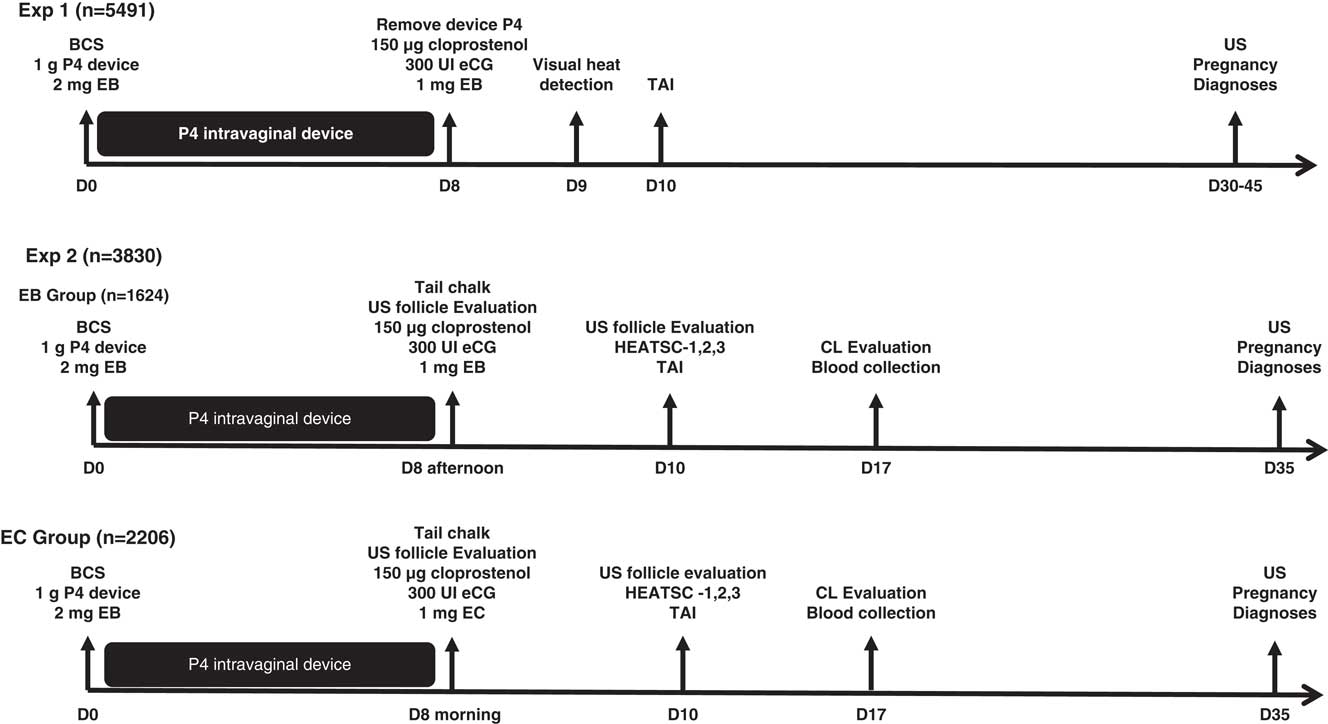
This study was performed in three commercial farms located in the Pantanal region, Mato Grosso do Sul State, Brazil, during the regular breeding season (November to March). Data were used from 5491 multiparous lactating Nelore cows (B. indicus, 40 to 60 days postpartum), classified by body condition score (BCS scale 1 to 5) as low BCS (⩽2.75, n=2264) or moderate BCS (>2.75, n=3227) subjected to the following TAI protocol: at random stages of the estrous cycle (day 0, D0), cows were scored by body condition and received 2 mg of EB (RIC-BE®; Syntex, Buenos Aires, Argentina) and an intravaginal progesterone device (1 g progesterone – PRIMER®; Tecnopec, Brazil). On D8, the progesterone device was removed and 150 μg of d-Cloprostenol (Prolise®; ARSA, Buenos Aires, Argentina), 300 IU of equine chorionic gonadotrophin (eCG) (Folligon ®, 5000 UI; MSD, São Paulo, Brazil) and 1 mg of EB was administered. On the afternoon of D9, cows were observed in groups of 200 animals to evaluate standing estrus (based on mounting activity, with cows marked with liquid ink and recorded the ID of cows standing to be mounted by other cows or vasectomized bull fit with a chin ball). On D10, AI was performed on all cows between 44 to 48 h after progesterone removal with frozen semen from five bulls with known fertility, distributed equally between treatments. Cows that presented estrus in the afternoon of D9 were inseminated first followed by cows that did not express estrus (Figure 1).
Timed artificial insemination (TAI) synchronization protocol in experiment 1 with visual estrus detection on day 9, and in experiment 2, with application in day 8 of different estradiol esters (EB or EC), and estrus expression on scores (HEATSC) evaluation using tail chalk marker on day 10 in Bos indicus cows. BCS=body condition score (1 to 5); P4=progesterone; eCG=equine chorionic gonadotrophin; EB=estradiol benzoate, EC=estradiol cypionate; CL=corpus luteum.

Experiment 2
As reported by others (Sa Filho et al., Reference Sa Filho, Santos, Ferreira, Sales and Baruselli2011; Richardson et al., Reference Richardson, Hill, Stevenson, Djira and Perry2016) and verified in experiment 1 (Exp. 1) with visual observation, cows that presented estrus before TAI showed greater P/AI. Based on this finding, a second experiment was conducted to test an alternative to visual estrus observation. We evaluated the effect of estrus scores with the aid of tail chalk on larger follicle diameter (LFD) and pregnancy rates in B. indicus beef cows subjected to TAI protocols with the use of two ovulation inducers, EB and EC.
At four farms in Mato Grosso do Sul, a total of 3830 multiparous lactating Nelore cows (30 to 50 days postpartum) were subjected to TAI protocol and evaluated for the expression of estrus at the time of insemination. At random stages of the estrous cycle (D0), all cows received 2 mg of EB (RIC-BE®; Agener União, Sao Paulo, Brazil) and an intravaginal device with 1 g of progesterone (Primer®; Agener Uniao, Sao Paulo, Brazil). On D8, animals were divided into two treatments: EB group (n=1624) with progesterone device removal and application of 1 mg of EB in the afternoon of D8; and EC Group (n=2206) with progesterone device removal and application of 1 mg EC (ECP®; Zoetis, Sao Paulo, Brazil) on the morning of D8. All animals also received 150 μg of d-cloprostenol and 300 IU of eCG (Folligon®, 5000 UI; MSD, São Paulo, Brazil). Cows were randomly assigned to the EB and EC treatments within farm (Farm 1 – 459 EB, 492 EC; Farm2 – 504 EB, 816 EC; Farm3 – 205 EB, 244 EC; Farm 4 – 456 EB, 654 EC).
At the time of progesterone device removal, all cows were marked in the sacral and tail head region with chalk (Raidl-Maxi; RAIDEX GmbH, Dettingen/Erms, Germany). The chalk was applied from the imaginary line between the hook of hip bones back to and including the tail head.
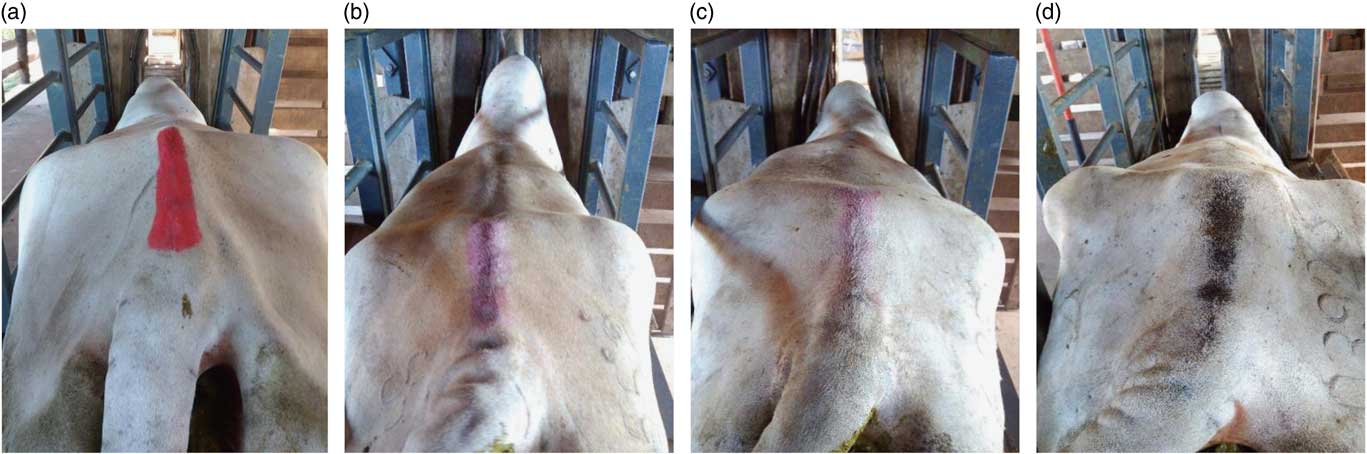
On D10, 44 to 48 h and 50 to 54 h (for groups EB and EC, respectively, according to Torres et al., Reference Torres, Penteado, Sales, Sa Filho, Ayres and Baruselli2014) after implant removal, cows received semen from six bulls with known fertility, distributed equally between treatments (Figure 1). Estrus expression, assessed at the time of TAI (D10), was classified according to the proportion of tail chalk removed (HEATSC1 to HEATSC3, Figure 2).
(a) Chalk application on day 8 in Bos indicus cows; (b) to (d) heat/estrus expression scores (HEATSC), assessed at the time of timed artificial insemination (day 10), classified according to the proportion of tail chalk removed: (b) HEATSC1 – no or few chalk removal=no estrus expression; (c) HEATSC2 – partial chalk removal (<75%)=low estrus expression; (d) HEATSC3 – near-complete (>75%) or complete removal of chalk=high estrus expression.

Ultrasonography
In Exp. 2, a subset of cows in one farm (n=300) had ovaries examined by transrectal ultrasonography to evaluate the dominant LFD (cm) at the time of progesterone device removal (LFD8), at larger follicle timed artificial insemination (LFTAI) and corpus luteum (CL) area (cm2) on D17 using a Mindray DP 20 vet ultrasound (5 to 9 MHz) with transrectal linear probe (Mindray Medical International Limited, Shenzhen, China). Follicular diameter was determined at the widest circumference of the follicle. The maximum CL area was determined using a B-mode still image and the tracing function. For CL with an anechoic fluid-filled cavity, the area of the cavity was subtracted from the total area (Kastelic et al., Reference Kastelic, Pierson and Ginther1990). Pregnancy diagnosis was performed by 30 to 45 days (Exp. 1) or 35 days (Exp. 2) after TAI by ultrasonography.
Blood sample collection
In a subset of cows (n=200), blood samples were collected via venipuncture (coccygeal vein) into10-ml vacutainer tubes on D17 at the time of CL evaluation. Blood was allowed to clot at room temperature and centrifuged at 2000×g for 20 min. Serum was harvested and stored at −20°C until serum concentration of progesterone was determined by radioimmunoassay (RIA).
Radioimmunoassay
Serum concentrations of progesterone (ng/ml)in serum samples were analyzed at the Faculty of Veterinary Medicine (FMVA), Araçatuba-UNESP Campus, Laboratory of Endocrinology, Department of Field Support, Animal Production and Health (DAPSA) using an antibody-coated-tube RIA Kit (Diagnostic Products Corporation, Los Angeles, CA, USA). Intra- and inter-assay CV for progesterone were 0.97% and 17.27%, respectively, and the assay sensitivity was 0.2 ng/ml.
Statistical analysis
Binomial variable, P/AI was analyzed using SAS GLIMMIX (SAS, 9.2) procedures in both experiments. Continuous variables in Exp. 2 (CL area and progesterone concentrations on D17, and follicular diameter on D8 and D10) were analyzed by ANOVA (PROC GLIMMIX, SAS, 9.2. The model included the main effects of estrus expression (Exp. 1), estradiol esters and HEATSC (Exp. 2) and their interactions.
The relationship between the diameter of LFTAI, progesterone concentration and CL area on pregnancy probabilities for a subset of cows was determined in Exp. 2. Logistic regression using PROC LOGISTIC curves was created using the coefficients provided by SAS interactive data analysis and the formula y=exp (̨x+b)/[1+exp(x+b)].
In both experiments, farm was a random effect and other variables were included in the models, if appropriate (P⩽0.10), it included BCS (1 to 5), farm, bull, technician and interactions. Covariables observed to be insignificant (P>0.10) were removed from the statistical model.
The results are expressed as means±SE or as percentages. In all analyses, differences were considered significant when P⩽0.05, whereas differences between P>0.05 and P⩽0.10 were considered tendencies/trends.
Results
Experiment 1
The mean of BCS was 2.61±0.09 for low BCS and 3.21±0.26 for the moderate BCS group (P<0.05). The rate of estrus observation was greater (P<0.05) for females of moderate BCS (44.5%, 1437/3227) than for those of low BCS (35.5%, 803/2264; P<0.005). Estrus detection was 40.8% (2240/5491) and varied between farms (P<0.05). Artificial insemination pregnancy rates was greater for females exhibiting estrus than females that did not display estrous behavior (P<0.01, Table 1).
P/AI according to estrus observed and body condition score (BCS, 1 to 5) in Bos indicus cows (Exp. 1)

P/AI=artificial insemination pregnancy rates.
a,bValues with different lowercase superscript differ between columns for P/AI (P<0.05).
A,BValues with different uppercase superscript differ between lines for P/AI (P<0.05).
Artificial insemination pregnancy rates in cows observed in estrus with moderate and low BCS was greater (P<0.01) than in cows that did not present estrus (Table 1).
Experiment 2
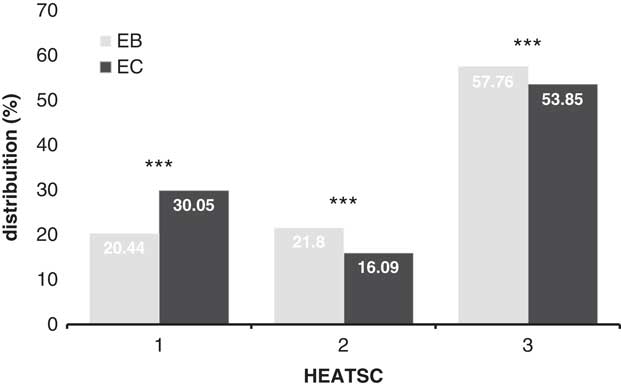
The distribution of animals within the HEATSC classes was: HEATSC1 – 25.98%, HEATSC2 – 18.51% and HEATSC3 – 55.51%. The expression according to inducers is presented on Figure 3, with greater estrus expression (HEATSC2 and HEATSC3) with EB more than EC inducer (79.56 v. 69.98; P<0.001).
Distribution in HEATSC according to ovulation inducer (EB=estradiol benzoate-1 mg on day 8; EC=estradiol cypionate-1 mg on day 8, n=3830; ***P<0.001) in Bos indicus cows (Exp. 2). HEATSC=estrus expression scores, assessed at the time of timed artificial insemination (day 10), classified according to the proportion of tail chalk removed: HEATSC1 – no or few chalk removal=no estrus expression; HEATSC2 – partial chalk removal (<75%)=low estrus expression; HEATSC3 – near-complete (>75%) or complete removal of chalk=high estrus expression.

As observed in Exp. 1, cows with moderate BCS presented greater P/AI than cows with lower BCS (P<0.05, Table 2).
P/AI according to HEATSC and body condition score (BCS) (1 to 5) class in Bos indicus cows (Exp. 2)

P/AI=artificial insemination pregnancy rates; HEATSC=estrus expression scores, assessed at the time of timed artificial insemination (TAI) (day 10), classified according to the proportion of tail chalk removed; HEATSC1 – no or few chalk removal=no estrus expression; HEATSC2 – partial chalk removal=low estrus expression; HEATSC3 – near complete/complete chalk removal=high estrus expression.
a,b,cValues with different lowercase superscript differ between columns for P/AI (P<0.05).
A,B,CValues with different uppercase superscript differ between lines for P/AI (P<0.05).
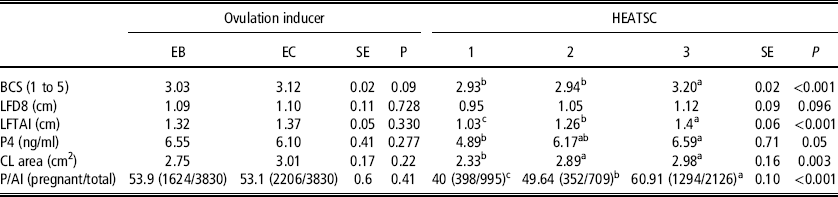
There was a difference in P/AI (P<0.001) according to estrus expression scores, but no difference was observed between farms (P=0.6280), ovulation inducers (P=0.41; Table 3), nor was there interaction between inducers and HEATSC (P=0.46).
Body condition score (BCS) (1 to 5), large dominant follicular diameter (cm) on day 8 (LFD8) and at timed artificial insemination (LFTAI), progesterone(P4) (ng/ml), CL area (cm2) and P/AI according to ovulation inducer HEATSC in Bos indicus cows (Exp. 2)

P/AI=artificial insemination pregnancy rates, Ovulation inducer: EB=estradiol benzoate; EC=estradiol cypionate; HEATSC=estrus expression scores, assessed at the time of TAI (day 10), classified according to the proportion of tail chalk removed: HEATSC1 – no or few chalk removal=no estrus expression; HEATSC2 – partial chalk removal=low estrus expression; HEATSC3 – near complete/complete chalk removal=high estrus expression; CL=corpus luteum.
a,b,cValues within a row with different superscripts differ significantly at P<0.05.
A trend was observed in LFD8 according to HEATSC (P=0.09), and a difference was observed in LFTAI according to HEATSC (P<0.001); nevertheless, there was no difference between inducers (P=0.33; Table 3).The CL area was smaller in HEATSC1 animals, compared to HEATSC2 and HEATSC3 (P=0.003), but did not differ between inducers EB or EC (P= 0.22, Table 3).
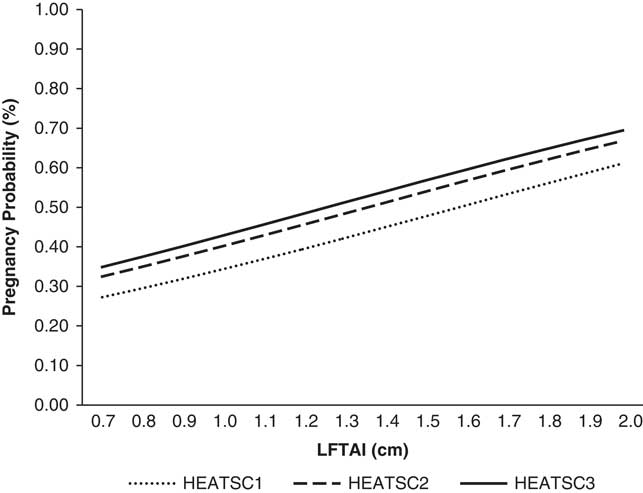
The P/AI probability was influenced by the HEATSC evaluated with tail-chalk according to progesterone concentration in D17 (P=0.013), as well as the LFTAI (P=0.003; Figure 4). In contrast, CL area did not influence the probability of pregnancy (P=0.205).
Probability of pregnancy on day 30 after timed artificial insemination (TAI) of Bos indicus cows with synchronized time of ovulation (n=300) according to the diameter of the large dominant follicular diameter at TAI (LFTAI) and estrus expression scores (HEATSC), assessed at the time of TAI (day 10), classified according to the proportion of tail chalk removed: HEATSC1 – no or few chalk removal=no estrus expression; HEATSC2 – partial chalk removal=low estrus expression; HEATSC3 – near complete/complete chalk removal=high estrus expression (P=0.003).

Discussion
The results of both experiments confirm greater pregnancy rates in Nelore cows that presented estrus after implant withdrawal in TAI with progesterone-based protocols and the pronounced effect of body score on the expression of estrus and P/AI. Similarly, it was reported that increasing BCS during synchronization protocol enhanced the proportion of high-producing dairy cows (Hillegass et al., Reference Hillegass, Lima, Sa Filho and Santos2008) or Beef cows (Sa Filho et al., Reference Sa Filho, Santos, Ferreira, Sales and Baruselli2011) displaying estrus after synchronization protocol.
In a meta-analysis study (Richardson et al., Reference Richardson, Hill, Stevenson, Djira and Perry2016), estrus expression after PGF2α and before TAI has been reported to change the uterine environment and increase accessory sperm numbers, fertilization rates and overall embryo survival. Thus, expression of estrus can strongly impact pregnancy rates in fixed-TAI protocols, with BCS having great influence on the expression of estrus, confirmed by our results, with observation of greater estrus expression in cows with greater BCS and greater P/AI.
The success of any estrus-based AI program requires detecting animals in standing estrus and inseminating them at the correct time after the detection. In Exp. 1 and Exp. 2, all animals were inseminated by TAI, so this had minor relevance, but estrus expression was close to 40% in Exp. 1 and 55.5% in Exp. 2 (considering only HEATSC3), probably due to lack of estrus detection, time of visual observation or errors in accurately detecting estrus in Exp. 1. Accurate detection of estrus can be difficult and time-consuming, as it is laborious and requires human intervention, even with a short time period (D9) as used in Exp. 1. Consequently, the strategy of classifying estrus after progesterone withdrawal with the help of tail-chalk marks proved to be effective in identifying animals without or with mild and high estrus expression, associated with follicular diameter and pregnancy rate of cows submitted to TAI with progesterone + eCG + EB or EC protocols. This strategy could become routine on large extensive farms, which have extra difficulty performing traditional AI (Batista et al., Reference Batista, Abreu, Ferraz Filho and Rosa2012), saving labor to observe estrus, but considering that, some points should be observed because low tree branches, gates, humidity, and rain smearing tail chalk marks can lead to a false positive result.
In a study comparing visual estrus detection every 3 h (eight times daily), a marker bull with a deviated penis, and (ESTROTECT Inc, Hermitage, TN, USA) patches resulted in a similar percentage of animals correctly identified in standing estrus (92%, 92% and 91%, respectively; Perry and Perry, Reference Perry and Perry2008). Our study using tail chalk marker demonstrated efficiency in estrus detection, comparable with mounting detection aids. To our knowledge, this is the first study using estrus score classification (1 to 3, HEATSC) in B. indicus beef cows in TAI using two ovulation inducers (EB or EC).
Classification of estrus scores proved to be efficient for detecting cows with HEATSC1 (no estrus), although there were no differences between cows with HEATSC2 and HEATSC3, which presented low and high estrus expression, respectively, in CL diameter and concentration of progesterone on D7 post-TAI. Despite this, LFTAI and P/AI was greater in cows with greater estrus expression (HEATSC3), which may be explained by greater concentrations of estrogen. Expression of estrus is stimulated by increasing estradiol concentrations when progesterone is low, and estradiol secretion is greater in heifers and cows that show estrus compared to those not detected in estrus. The preovulatory secretion of estradiol by a dominant follicle coordinates several physiological processes that are required for the establishment of pregnancy. Some of these effects occur during the preovulatory period (e.g. estrus expression, induction of the gonadotropin surge that induces ovulation and sperm transport) while others are manifested during the luteal phase (e.g. preparation of maternal environment for pregnancy) (Perry et al., Reference Perry, Smith, Lucy, Green, Parks, MacNeil, Roberts and Geary2005).
An important issue related to the mechanisms that cause decreased fertility in cows that do not express estrus is reduced circulating E2 concentrations during the periovulatory period. This has been implicated in inefficient sperm transport, suboptimal oviductal or uterine environment, and impaired oocyte fertilization (Hawk and Cooper, Reference Hawk and Cooper1975; Ryan et al., Reference Ryan, Prichard, Kopel and Godke1993; Buhi, Reference Buhi2002). One factor in these E2 actions involves the induction of estrogen-dependent glycoproteins, a family of secretory glycoproteins expressed by the oviduct (Buhi, Reference Buhi2002). Maximum synthesis and secretion of these glycoproteins occurs during estrus (Pereira et al., Reference Pereira, Wiltbank and Vasconcelos2016).
The present study also demonstrated a differential pattern of estrus expression when EB v. EC was used as an ovulation inducer at progesterone device withdrawal, as well as similar P/AI, despite differences in the action mechanism of the two hormones (Ayres et al., Reference Ayres, Martins, Ferreira, Mello, Dominguez, Souza, Valentin, Santos and Baruselli2008). Estradiol cypionate has low solubility in water and slow release from the injection site, prolonging plasma concentrations of E2 for up to 98 to 170 h after administration of high doses (5 to 10 mg; Burton et al., Reference Burton, Dziuk, Fahning and Zemjanis1990; Vynckier et al., Reference Vynckier, Debackere, De Kruif and Coryn1990). Such a pattern of release appears to reduce EC efficacy for synchronizing follicular development and ovulation, especially when used at low doses (Torres et al., Reference Torres, Penteado, Sales, Sa Filho, Ayres and Baruselli2014). Accordingly, the use of 0.5 mg EC was not enough to induce a consistent preovulatory LH rise and effective synchronization of ovulation, resulting in lower P/AI compared to 1 mg EC at implant removal or 1 mg EB 24 h after removal. In our experiments, 1 mg EB (Exp. 1 and Exp. 2) or EC (Exp. 2) was used at progesterone device removal to reduce labor associated with animal handling, and the timing to TAI was observed (44 to 48 h for EB, and 50 to 54 h for EC). Accordingly, the use of EB at withdrawal and insemination at 54 h led to a decrease in P/AI (Ayres et al., Reference Ayres, Martins, Ferreira, Mello, Dominguez, Souza, Valentin, Santos and Baruselli2008). Using EB v. EC did not influence LFD at TAI that was similar between groups.
A similar study (Sa Filho et al., Reference Sa Filho, Santos, Ferreira, Sales and Baruselli2011) show positive effect of estrus on P/AI in Nelore cows with protocols using EC or GnRH and estrus evaluated with tail chalk, the authors classified animals based on positive or negative estrus, and the application of EC increased estrus manifestation. Furthermore, EC increased the proportion of Nelore cows displaying estrus after progesterone device removal, compared with cows receiving only GnRH as an ovulatory stimulus. As in our study, P/AI and LFD at TAI was greater in animals with greater estrus expression, as well as greater CL and progesterone 7 days after TAI than in cows without estrus expression.
In the present study, the concentration of progesterone and LFD at TAI had a significant effect on P/AI probability, regardless of ovulation inducers. This finding was expected since expression of estrus may also decrease embryonic mortality, as observed by Pereira et al. (Reference Pereira, Wiltbank and Vasconcelos2016). Moreover, Jinks et al.(Reference Jinks, Smith, Atkins, Pohler, Perry, Macneil, Roberts, Waterman, Alexander and Geary2013) observed a positive correlation between follicle diameter at progesterone device removal and estrogen, and progesterone concentration at the time of embryo transfer (ET-7 days post-estrus). Another study (Busch et al., Reference Busch, Atkins, Bader, Schafer, Patterson, Geary and Smith2008) observed a lower progesterone concentration in cows with small follicles at the second application of GnRH in CO-Synch protocol, which may partly explain better pregnancy rates in cows with larger follicles and greater estrus expression. The increase in fertility with increasing progesterone is consistent with the previous observations that greater progesterone during early luteal phase increases embryo length and IFN-τ production shortly after implantation (Mann et al., Reference Mann, Lamming, Robinson and Wathes1999; Carter et al., Reference Carter, Forde, Duffy, Wade, Fair, Crowe, Evans, Kenny, Roche and Lonergan2008; Clemente et al., Reference Clemente, de La Fuente, Fair, Al Naib, Gutierrez-Adan, Roche, Rizos and Lonergan2009).
Influence of CL diameter on P/AI or pregnancy at ET is controversial because some authors suggest that the area of luteal tissue positively influences conception rates in recipients used in embryo transfer (Binelli et al., Reference Binelli, Thatcher, Mattos and Baruselli2001; Bó et al., Reference Bó, Tríbulo, Caccia and Tríbulo2001). However, another study (Spell et al., Reference Spell, Beal, Corah and Lamb2001) showed that fluctuation of progesterone reflects a combination of different development rates of the CL and secretion of progesterone during the early stages of the estrous cycle.
Conclusion
In conclusion, estrus expression influences pregnancy rates in B. indicus cows subjected to TAI with progesterone-E2-based protocol, and the use of HEATSC with tail chalking to evaluate manifestation of estrus at the time of TAI is a simple, useful strategy to identify cows with greater expression of estrus to achieve greater TAI pregnancy rates. Cows with low HEATSC could receive additional treatments aimed at improving P/AI. Two different ovulation inducers (benzoate or EC) presented different estrus expression, but with similar pregnancy rates when timing to insemination was adequate.
Acknowledgments
This research was supported by Embrapa (+Cria project). The authors thank Dr Guilherme de Paula Nogueira-UNESP Aracatuba, for progesterone dosages, and Farms Morrinho, Alvorada, EMA Agropecuaria, and Panorama-SA for support and animals. E.N. thanks EMBRAPA for visiting scholar support at the University of Missouri, Columbia.
Declaration of interest
The authors declare no conflicts of interest.
Ethics statement
The experiment was approved by the Animal Care and Use Committee of the EMBRAPA (CEUA;+Cria Project- Protocol 002/2015).
Software and data repository resources
The data/models regarding the published article are not deposited in any official repository.