


Introduction
Despite the significant impact BN has on individuals physically, emotionally and socially, appropriate services are often not accessed (Hepworth and Paxton, Reference Hepworth and Paxton2007). This may be due to feelings of shame, fear of stigma or poor mental health literacy in relation to treatment options. Studies of help-seeking behaviour for mental health problems have indicated that self-help strategies are a popular option for many individuals with mental health problems, including those with BN (Mond et al., Reference Mond, Marks, Hay, Rodgers, Kelly and Owen2007; Griffiths and Christensen, Reference Griffiths and Christensen2007; Jorm, Reference Jorm2000). Websites have also been identified as a helpful method of receiving help for mental health problems (Oh, Jorm and Wright, Reference Oh, Jorm and Wright2009).
Therapy-based, structured self-help materials have shown efficacy in treating many mental health problems including depression (Proudfoot et al., Reference Proudfoot, Ryden, Everitt, Shapiro, Goldberg and Mann2004), addiction (Carlbring and Smit, Reference Carlbring and Smit2008) and anxiety disorders (James, Soler and Weatherall, Reference James, Soler and Weatherall2005), which represent co-morbid problems often seen in those with BN. A number of studies have also shown the efficacy of online CBT self-help for BN (Sanchez-Ortiz, Munro, Stahl et al., Reference Sanchez-Ortiz, Munro, Stahl, House, Startup and Treasure2011; Pretorius et al., Reference Pretorius, Arcelus, Beecham, Dawson, Doherty and Eisler2009; Carrard et al., Reference Carrard, Rouget, Fernandez-Aranda, Volkart, Damoiseau and Lam2006, Reference Carrard, Fernandez-Aranda, Lam, Nevonen, Liwowsky and Volkart2010). However, rates of attrition are high in computerized self-help interventions (Eysenbach, Reference Eysenbach2005; Christensen and Mackinnon, Reference Christensen and Mackinnon2006; Christensen, Griffiths and Farrer, Reference Christensen, Griffiths and Farrer2009). Little is known about attitudes towards these evidence-based self-help tools and the support users would require whilst using them in order to maximize application, engagement and outcomes. Gaining this knowledge may improve the delivery of such interventions and therefore reduce drop-out rates.
The importance of users having guidance whilst engaging in the self-help approach is outlined in the NICE eating disorder guidelines (2004) and has also been highlighted in many studies that focus on computerized cognitive behavioural therapy (cCBT) for low mood (Gellatly et al., Reference Gellatly, Bower, Hennessy, Richards, Gilbody and Lovell2007) and bulimia nervosa (BN) (Pretorius, Rowlands, Ringwood and Schmidt, Reference Pretorius, Rowlands, Ringwood and Schmidt2010; Sanchez-Ortiz, Munro, Startup, Treasure and Schmidt, Reference Sanchez-Ortiz, Munro, Startup, Treasure and Schmidt2011). However, very little is currently known about the impact of guidance/support on outcomes from computerized interventions for eating disorders (Murray et al., Reference Murray, Schmidt, Pombo-Carril, Grover, Alenya and Treasure2007). The obvious location of such cCBT packages is at step 1 of the stepped care model, the guided self-help stage (Bower and Gilbody, Reference Bower and Gilbody2005). To date, no studies have explored potential users’ preferences with regard to frequency, duration and type of support required within a sample of community-based individuals. Gaining this information may aid the delivery of online self-help packages including cCBT and maximize improvements by tailoring the support component of such interventions to the specific intervention and population who are using the package.
The current study was the first stage in the recruitment for a RCT of an online package for eating disorders and aimed to investigate attitudes towards online self-help for eating disorder in a self-referred community-based sample. The main aim of this study was to gain information regarding how individuals with bulimic symptoms would like to be supported whilst using an online self-help package for their eating problems. Second, in order to better understand the high rates of attrition in self-help studies, participants were asked various questions relating to any perceived difficulties in using online self-help or barriers to accessing this form of treatment.
Method
Design
A survey investigating attitudes towards online self-help for eating disorders was carried out as part of the recruitment process for a RCT of an online self-help package for BN. This questionnaire was written by the authors to determine attitudes towards self-help for eating disorders, past use of the internet for eating disorder help and preferences relating to the content, frequency and duration of support sessions. Finally, participants were asked to indicate any perceived difficulties they may have in using an online self-help package for their eating problems.
Ethics approval
The study was approved by the College of Medical Veterinary and Life Science Ethics Committee, University of Glasgow (Ref. FM03508). The participant information sheet (PIS) was made available to participants on the study website or a hard copy was posted to participants if required. Upon registration, individuals were asked to confirm that they had read the PIS. Potential participants were then asked to complete an online consent form. The eligibility of all consenting individuals was then assessed.
Recruitment
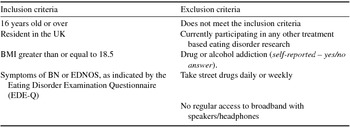
Participants were recruited from the general community rather than eating disorder clinics. The majority of the recruitment process took place online. Information about the research was placed on the Beat website (the leading UK eating disorders charity), and on the Living Life to the Full website (an online self-help resource that teaches life skills and techniques to improve and maintain mental health). An advert was also placed on the Overcoming Bulimia Online website. The study was advertised through other mental health organizations and through the distribution of flyers in university fresher's packs. Finally, posters were displayed in and around universities in Glasgow and were posted to various public buildings such as libraries, dentists, health clubs, colleges, student counselling services and secondary schools. Those people who visited the online research site were asked to complete information about themselves, their weight and eating. Inclusion and exclusion criteria are summarized in Table 1.
Eligibility criteria of the study

Participants
Three-hundred and ninety-eight individuals consented to take part in the study in the survey. Of these 253 participants, 246 females and 7 males, completed the survey. The mean age of the sample was 29.11 (SD = 8.67; min = 16, max = 64). All participants had bulimic symptoms; the average number of bingeing and self-induced vomiting episodes in the previous 4 weeks was 19.08 (SD = 16.70) and 21.50 (SD = 25.80) respectively. The mean global score, as measured by the EDE-Q6, was 4.84 (SD = 0.10; min = 0.73, max = 6.0) and the mean BMI was 24.27 (SD = 5.24; min = 18.5, max = 49.7).
Instrumentation
Attitudes Questionnaire
The questionnaire entitled “Attitudes towards online self-treatment packages for BN and support needed whilst using them”, is reported here. This is a 9-item questionnaire designed by the researchers specifically to investigate participants’ opinions about the self-help approach for the treatment of eating disorders (see Appendix 1). The questionnaire is unpublished and was designed in light of gaps in the literature and questions were decided upon in discussions with professionals in the field of eating disorders and research. To date no studies had investigated attitudes toward the frequency, medium, duration and type of support that should accompany online self-help packages. Therefore, the majority of the questions focused on the support required whilst using online self-help materials. Additionally, because drop-out rates are high in online studies, the authors included a question regarding expected obstacles in the successful use of an online self-help package.
The questionnaire was completed via a specifically designed study website, with participants being asked to select answers from drop down menus. Open text/comments boxes were also included after some questions where it was believed that participants may want to give additional details to support their response.
Eating Disorders Examination (EDE-Q6)
The Eating Disorders Examination Questionnaire 6.0 (EDE-Q6) (Fairburn and Beglin, Reference Fairburn, Beglin and Fairburn2008) is the questionnaire version of the Eating Disorders Examination Interview (Fairburn and Cooper, Reference Fairburn, Cooper, Fairburn and Wilson1993) which is considered the gold standard in the assessment of eating disorders. The EDE-Q is a 36-item self-report questionnaire that asks various questions relating to thoughts, feeling and behaviour with regard to food, eating and body shape and weight concerns in the past 28 days. The majority of questions are answered on a 7-point Likert scale with 0 indicating “no days” and 6 indicating “every day”. The questionnaire also collects data relating to the number of bingeing and reversing/compensatory episodes in the specified time period. This questionnaire is valid and reliable and its subscales have acceptable internal consistency with alphas between 0.70–0.83 (Peterson et al., Reference Peterson, Crosby, Wonderlich, Joiner, Crow and Mitchell2007). The EDE-Q is widely used in eating disorder research and the scores on this self-report questionnaire are highly comparable to the EDE Interview, despite some of the items being less stable than others (Sysko, Walsh and Fairburn, Reference Sysko, Walsh and Fairburn2005). This questionnaire is not a diagnostic instrument and therefore was used only to determine whether bulimic symptoms had been present in the 4 weeks prior to completing the survey.
Qualitative analysis
Participants were invited to make comments to supplement their responses to each survey item. Comments for each of the questions were analyzed using thematic analysis. This method of analysis was chosen as the identified themes are data driven. As such, themes are identified without trying to fit them into a pre-designed coding framework (Braun and Clarke, Reference Braun and Clarke2006). Each statement was read and grouped, with themes and sub-themes being identified by the researcher. All extracts were put into the appropriate themes and sub-themes and the final names of the themes and sub-themes were reconsidered and amended as appropriate. Statements that illustrated each theme were selected to represent the meaning of the themes.
Results
Overall, 95.6% of the responding participants (n = 252) had used the internet to find out about eating disorders and their treatments. The majority of participants (98%; 245 of the 250 respondents) thought that self-help treatments would be useful for those with an eating disorder.
Support
Support whilst using an online self-help package for eating problems was important to the majority of participants (n = 252) with 73.8% indicating that some form of support whilst engaging in such a treatment would be useful. Only 1.6% (n = 4) of individuals said that support would not be useful, with the remainder of respondents being unsure about this issue.
Types of support content
Participants were asked to indicate all types of support content they thought would be helpful whilst using an online self-help package. “Supportive encouragement and motivation” was most often selected as being a useful type of support, with 81% (n = 204) choosing this option; 61.5% (n = 155) and 54% (n = 136) of participants believed “someone checking up on you” and “simple reminders to use the package” to be useful types of support. Another type of support content chosen by many participants was “help in understanding the package”, over half (58.3%; n = 147) of participants considered this as useful when using online self-help materials. “Someone setting deadlines” (44%; n = 111) and “technical support” (25%; n = 63) were less popular options.
Support medium
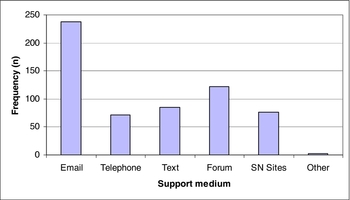
Participants were also asked to select all support formats they thought would be helpful. As illustrated in Figure 1, support via e-mail was the most popular support medium with 94.4% (n = 238) of participants choosing this as a useful way of receiving support whilst using an online SH package.
Preferred support format

Frequency of support
Participants selected their preferred frequency of support sessions. The majority of participants who answered this question (n = 238), said that weekly support would be most helpful (71.4%), followed by fortnightly support (24.2%). Only 2.5% indicated that support sessions should be delivered monthly. Twenty-six (10.9%) individuals selected “other” in response to this question. Suggestions made by these participants included having support more often than weekly, having support sessions as and when required, and being able to e-mail their support worker anytime.
Duration of support sessions
Of the 247 participants who responded to the question relating to their preferred duration of support sessions, 66.8% indicated that this should be flexible. Overall, of those stating a specific time, almost a third (27.9%) identified a support time of 20 minutes or less as desirable.
Anticipated problems with using online self-help
Worries about confidentiality (24.6%; n = 55) and lack of privacy (16.7%; n = 38) when using a computer were most commonly identified as possible difficulties in using online self-help for participants who answered this question. The majority (90.8%; n = 226) of participants said that access to a computer or the internet would not be a problem and 89.3% (n = 201) indicated that they did not expect computer literacy to be a difficulty for them.
Findings from open ended questions
Three main topics were identified in the qualitative dataset: (i) the support given as part of the online self-help approach; (ii) the advantages and disadvantages of accessing online self-help; and (iii) help-seeking and traditional treatments for eating disorders.
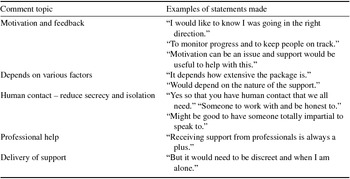
Participants were asked if it would be useful to receive support to help them progress through an online self-help package for their eating problems. Many of the comments related to the feeling that some form of human support is needed to accompany remotely accessed self-help materials (see Table 2). Furthermore, many participants made statements regarding how the support should be delivered. The need for encouragement and motivation whilst engaging in the self-help approach featured many times in the participants’ comments.
The support element of the online self-help approach

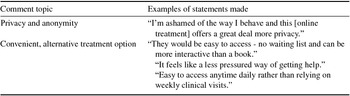
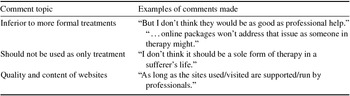
As outlined in Table 3, participants cited many advantages of online self-help. The most commonly expressed advantages were that this approach is easily accessible and convenient and that self-help materials are private and the user can remain anonymous. In contrast, some participants said that they considered online self-help as less helpful than face to face therapy and others had concerns about the content of some eating disorder websites. The key disadvantages of online self-help cited by participants are outlined in Table 4.
Perceived advantages of online self-help

Disadvantages of online self-help

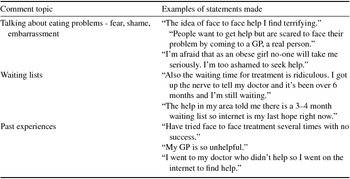
The majority of the comments relating to accessing traditional treatments were negative. Many participants had concerns about face to face treatment due to fear, embarrassment and an apprehension towards talking about their eating problems (see Table 5). There was also an expressed awareness of the long waiting lists for specialist treatment among some participants.
Help-seeking and traditional treatments for eating problems

Discussion
Attitudes towards online self-help for EDs
The majority of participants had positive attitudes towards online self-help packages for eating disorders, stating that they thought such interventions would be helpful. This finding is in line with previous studies that have indicated that the internet is a popular source of information for individuals with mental health problems and that self-help strategies are often the preferred treatment option for such individuals (Oh et al., Reference Oh, Jorm and Wright2009). The internet was used as a major source of recruitment for this study; it is therefore not unsurprising that help delivered via the internet is positively endorsed by this sample, and that the majority of respondents described ready access to internet content.
Attitudes towards the support needed whilst using online self-help resources
In response to questions regarding support, approximately three quarters of participants said that, if they were using an online self-help intervention, it would be helpful to have some support to aid them in working with such resources. This view that support may be integral to succeeding in using online materials is highlighted in the NICE guidelines and previous studies (McClay, Waters, McHale, Schmidt and Williams, Reference McClay, Waters, McHale, Schmidt and Williams2013; Pretorius et al., Reference Pretorius, Rowlands, Ringwood and Schmidt2010; Sanchez-Ortiz, House et al., Reference Sánchez-Ortiz, House, Munro, Treasure, Startup, Williams and Schmidt2011).
Despite support being a clearly valuable and desirable aspect of the online self-help approach, information regarding user preferences concerning the frequency, duration, content and medium of support had not been previously addressed in the literature. In terms of support content, “Supportive encouragement and motivation” was the most frequently selected (80.6%), suggesting that participants had a good understanding of the commitment and motivation required when using self-help interventions. This type of support content does not require any specialist eating disorder therapeutic input and therefore could be delivered by non-clinicians who are selected for engagement and support skills, as well as having a strong understanding of how to help people work through and apply the package content.
The fact that e-mail support was the most frequently selected support medium suggests that the majority of participants felt that more remote, online forms of support would be most helpful whilst using an online self-help package and that more immediately interactive forms of support such as telephone support may perhaps seem more threatening. This issue of individuals with eating disorders often being apprehensive about talking about their problems was also identified in some of the comments made by participants as part of this survey.
The majority of respondents who indicated their preferred duration of support said that this should be flexible, and with around a third suggesting sessions be 20 minutes or less, and delivered weekly. Future research should investigate how long and frequent the support sessions should be so as to preserve the possible economical nature of online self-help compared to face to face treatments, whilst still optimizing the effectiveness of the intervention.
Anticipated problems in using online self-help
Respondents were generally very positive regarding their ability to use an online self-help package and the majority did not anticipate experiencing many problems with using such a self-help intervention. The vast majority of participants said that access to a computer or the internet would not be an obstacle to using an online self-help package and few respondents said that computer literacy would be a difficulty for them. This is not unexpected for this sample of people recruited online. However, our recent national surveys of access to online resources via the NHS in Scotland (Kenicer, McClay and Williams, Reference Kenicer, McClay and Williams2012) and England (Andrewes, Kenicer, McClay and Williams, Reference Andrewes, Kenicer, McClay and Williams2013) has identified a lack of provision for those who do not have their own access to computers at home. In effect this means that those who are unemployed or older may have limited opportunity to access such resources. It may be useful to carry out specific focus group work on those groups to better understand how to enhance access to online self-help resources, including cCBT for example, when it might be appropriate.
Some participants indicated that worries about confidentiality and a lack of privacy may be obstacles to them using the online self-help approach. This is valuable information regarding the possible problems users may perceive having when trying to use such resources and suggests that the desire for privacy and secrecy regarding eating problems may act as a significant barrier to help-seeking and use of treatment resources. This is supported by literature that indicates that individuals with BN often have feelings of shame and a fear of stigma, which can affect presentation for treatment (Hepworth and Paxton, Reference Hepworth and Paxton2007; Evans et al., Reference Evans, Hay, Mond, Paxton, Quirk and Rodgers2011; McClay et al., Reference McClay, Waters, McHale, Schmidt and Williams2013). It raises issues about the extent to which it is helpful to record and store data on individuals, and also whether individuals should have the right (as offered by certain packages such as www.llttf.com) to delete their own account and all linked data if they so wish. However, it must be noted that such concerns were identified by less than a quarter of participants and, in the qualitative data gathered, the most commonly voiced advantage of online self-help was the fact that it was private and the users could remain anonymous. Further research would be useful to determine whether participants are referring to concerns about privacy in their own home/in libraries when using online resources or concerns about confidentiality and privacy with regard to the storage of personal data on online packages.
Limitations of the study
Although the aim of the study was to recruit participants solely from the community, this limits the extent to which the results can be generalized. The majority of participants were recruited online and had volunteered to possibly take part in a RCT in which they would have access to an online self-help package for BN. Therefore these are likely to be individuals who have generally positive attitudes towards online approaches. Future studies should include individuals who lack access to the internet at home, those who lack confidence in using computers, and those who are approaching their GP for initial help, in addition to those who have an eating problem but are not considering treatment. This would help to gain a more balanced view to understanding the range of attitudes and practical problems likely to be identified when considering how online treatment approaches could be offered within services. Additionally, because all of the entry assessments were completed online, it was not possible to confirm the individuals’ ED diagnosis, only the presence of significant bulimic symptoms. Therefore, it may be advantageous to include a diagnostic interview as part of the screening process in future studies of this kind. A final limitation of the study is that the questionnaire used was developed by the authors and has not undergone piloting. Therefore the validity and reliability of this measure has not been ascertained. However, participants were given the opportunity to write comments to elaborate on their responses to the questions, meaning qualitative data could be analyzed to supplement to quantitative data collected. This qualitative data can now be used to add other response options to the survey as appropriate.
Strengths of the study and conclusions
Due to the online recruitment method employed, the study provides some valuable information regarding the opinions of a relatively large sample of individuals in the community, and as such represents those individuals who are perhaps most likely to find online self-help approaches attractive. Therefore the study specifically recruited the group of individuals that online self-help interventions are primarily aimed at. This is an advantage as the study gained key information from the group of individuals that are most likely to enter into and use online treatments. Additionally, the individuals surveyed had significant symptoms of BN and therefore the results are relevant to individuals currently experiencing eating problems.
The results of this study could be used to inform the development of future support strategies to accompany the delivery of online CBT as it provides previously unknown information about preferences with regard to content, medium, frequency and duration of support sessions. A significant challenge for services may be finding ways to deliver online self-help effectively, as recent surveys of health boards in Scotland indicated that over a third of health boards do not allow clinicians to send e-mails to patients (Kenicer et al., Reference Kenicer, McClay and Williams2012). Similarly, 46% of English mental health trusts do not allow such contact with patients (Andrewes et al., Reference Andrewes, Kenicer, McClay and Williams2013). Therefore local and national IT policy in the NHS may need to be adapted in order to facilitate the optimal and efficient delivery of online treatments, including cCBT, for various mental health problems, and allowing clinicians and support staff to communicate in ways that are desirable to their patients.
Acknowledgements
Dr Chris Williams has developed a number of online self-help packages and holds IPR in them and a range of other free and licensed self-help computerized and book resources.
Appendix 1: Attitudes questionnaire
Please complete all nine questions in the questionnaire below and add any additional comments where appropriate.
-
1. Do you use the internet to find out about eating disorders and their treatments?
-
○ Yes
-
○ No
-
-
2. Do you think online self-help packages would be useful for people with an eating disorder?
-
○ Yes
-
○ No
Comments:
-
-
3. If you were using one of these online programmes, would it be useful to receive support to help you to progress through the online package?
-
○ Yes, I think support would be useful
-
○ No, I would rather have no support
-
○ I am unsure
Comments:
-
-
4. Which types of support do you think may be useful for you whilst using an online self-help package? (Tick any you think may apply)
-
○ Supportive encouragement/motivation
-
○ Simple reminders to use package
-
○ Someone else checking up on your progress
-
○ Someone else setting deadlines for completing each section
-
○ Helping you understand sections of the treatment i.e. help in understanding what the program is asking you to think about, write, do
-
○ Giving you technical support in the use of the package
-
○ I don't think I need support
-
○ Other:
Comments:
-
-
5. What do you think would be the most helpful way for you to receive support whilst using online packages? (Tick any you think may apply)
-
○ E-mails from the support worker
-
○ Telephone support
-
○ Support/communication via text
-
○ Forum for people with similar problems
-
○ Social networking sites for those with eating disorders and support workers to use
-
○ No support is needed
-
○ Other:
Comments:
-
-
6. When do you think this support should be provided?
-
○ At specified weekly appointments
-
○ At specified fortnightly appointments
-
○ At specified monthly appointments
-
○ No support needed
-
○ Other:
Comments:
-
-
7. How long should each support session last?
-
○ 5 minutes
-
○ 10 minutes
-
○ 15 minutes
-
○ 20 minutes
-
○ 25 minutes
-
○ 30 minutes
-
○ Duration of support sessions should be flexible
-
○ Other:
Comments:
-
-
8. Is there anything that you think would make it difficult for you to use an online self-help package?
-
○ Lack of access to a computer/internet YES/NO/Not sure
-
○ Don't know how to use computer/internet YES/NO/Not sure
-
○ Lack of privacy when using the computer YES/NO/Not sure
-
○ Worries concerning confidentiality YES/NO/Not sure
-
○ I don't like using computers for things like this YES/NO/Not sure
-
○ Other:
Comments:
-
-
9. Do you have any other comments about online self-help packages or support given whilst using these packages?



Comments
No Comments have been published for this article.