INTRODUCTION
In Spain, citrus orchards cover around 273 000 ha of which up to 41% is clementine mandarin, with ‘Nules’ clementine (Citrus clementina × Citrus reticulata) as the leading cultivar (MARM, 2007). Nules clementine is a seedless mandarin of excellent quality for consumption as a fresh fruit; however, this cultivar has an alternate-bearing pattern and poor fruit-set, bearing many small-sized fruits during ‘on’ year cropping (El-Otmani et al., Reference El-Otmani, Ait-Oubahou, El-Hassainate, Kaanane and Lovatt2004). The number of harvested fruits does not normally exceed 10% of formed flowers, occasionally reaching values as low as 0.1–3.5% (Monselise, Reference Monselise and Monselise1986). To overcome this low fruit-set problem in Nules and other clementines, growth regulators such as cytokinins and gibberellins are used to raise fruit-set rate (El-Otmani et al., Reference El-Otmani, Coggins, Agustí and Lovatt2000). Accordingly, gibberellic acid (GA3) is routinely used in the production of seedless mandarins to increase both fruit set and fruit size (Chao and Lovatt, Reference Chao and Lovatt2006). Previous researchers have shown that maximum fruit set occurs when GA3 is applied between anthesis and petal fall (García-Martínez and García-Papí, Reference García-Martínez and García-Papí1979). In Spain and several citrus-growing areas of Morocco, Cuba, Argentina and Israel low concentrations of GA3 (5–10 mg l−1) are usually applied to clementine mandarin trees in full to late bloom (90–100% petal fall) to enhance fruit set (Chao and Lovatt, Reference Chao and Lovatt2006; del Rivero et al., Reference Del Rivero, Veyrat and Gómez de Barreda1969). Other authors state that the application of GA3 soon after flowering at doses between 10 and 15 mg l−1 can result in delayed abscission and increased fruit set in clementine (El-Otmani et al., Reference El-Otmani, Ben Ismail, Ait Oubahou and Achouri1994).
As stated above, currently, use of GA3 is the only alternative cultural practice that growers have to increase fruit set. Therefore, research into alternative environmentally friendly products is being carried out to improve knowledge of how much these products improve fruit set. Diverse studies have shown the synergetic and complementary action of indole-acetic-acid (IAA) and different gibberellins on fruit set (de Jong et al., Reference De Jong, Mariani and Vriezen2009). Other studies have shown that the concentration of gibberellins can be modulated by the intracellular concentration of cyclic adenosine monophosphate (cAMP; Uematsu et al., Reference Uematsu, Nakajima, Yamaguchi, Yoneyama and Fukui2007). In consequence, the effect of increasing the intracellular concentrations of both IAA and cAMP might modulate the concentration of endogenous gibberellins and, through this action, improve citrus fruit-setting ability.
In order to investigate the hypothesis of fruit set improvement in citrus, we have studied the action of a combination of theophylline, a methyl-xanthine compound, with an IAA precursor (3-ethyl-indole). The potential action of this treatment on fruit set is based on two complementary effects. Firstly, theophylline increases the internal concentration of cAMP by inhibiting the activity of several phosphodiesterases, which is closely correlated to concentration of gibberellin (Uematsu et al., Reference Uematsu, Nakajima, Yamaguchi, Yoneyama and Fukui2007). Secondly, 3-ethyl-indole activates IAA biosynthesis (García-Mina Freire and Cenoz, Reference García-Mina Freire and Cenoz2004; San-Francisco et al., Reference San-Francisco, Houdusse, Zamarreño, Garnica, Casanova and García-Mina2005). Consequently, use of the combination principally boosts the concentration and function of gibberellin and IAA, hormones responsible for fruit set that act during the early stages of fruit development (de Jong et al., Reference De Jong, Mariani and Vriezen2009).
Thus, we have compared the efficiency of a new product (MX) composed of 3-ethyl-indole and theophylline of plant origin, with that of the routinely used growth regulator (GA3), to increase fruit set and, consequently, yield in Nules clementine mandarin, grown commercially in Spain. Effects of one GA3 treatment and three concentrations of MX were studied and compared. Observations were recorded over three consecutive growing seasons and impact was assessed using different agronomic and fruit quality indices.
MATERIALS AND METHODS
Experimental site and soil conditions
The study was performed over three growing seasons (2005, 2006 and 2007) in a commercial orchard of clementine cv. Nules mandarin trees (Citrus clementine × Citrus reticulata) grafted onto citrange Carrizo rootstock (Citrus sinensis× Poncirus trifoliate), in Puzol, Valencia (latitude 39°34′N; longitude 00°24′W) in the east of Spain. The trees were grown on a Cambic Arenosol soil (62.6% sand, 19.2% silt, 18.2% clay; pH 8.2; organic matter content 1.03% and a bulk density of 1.6 kg m−3) with low water-holding capacity (16%), planted at a spacing of 3.5 m × 5.6 m (i.e. 510 trees ha−1).
Cultural practices and experimental design
The amount of water applied to each tree was equivalent to the total seasonal crop evapo-transpiration (ETc) calculated using the formula ETc = ETo × Kc (Aboukhaled et al., Reference Aboukhaled, Alfaro and Smith1982) where ETo is the reference crop evapo-transpiration under standard conditions and Kc is the crop coefficient. This coefficient (Kc) accounts for crop-specific effects on overall crop water requirements and is a function of canopy size and leaf properties. The ETo values were determined using the Penman-Monteith approach (Allen et al., Reference Allen, Pereira, Raes and Smith1998). The Kc values were based on guidelines provided by Castel and Buj (Reference Castel and Buj1994). Irrigation water requirements were met by the effective rainfall (≥3 mm and ≤ 45 mm which resulted in soil water saturation) of the entire year plus irrigation water (5138, 5445 and 5162 m3 ha-year−1 for the three years of the trial, respectively). Trees were drip-irrigated, through eight pressure-compensating emitters (4 l h−1 each) per tree, placed every 88 cm in two drip lines, located within 100 cm of the tree trunk and producing a 33% wetted area (Keller and Karmelli, Reference Keller and Karmelli1974). The plants were fertirrigated 0–3 times per week, according to evapo-transpiration demand and effective rainfall.
The nutrient-fertilizer rate and seasonal distribution for citrus plants was calculated for a 3.10 m canopy diameter in citrus trees grown under drip irrigation. Nitrogen (N) requirements were 400 g N tree−1 year−1 based on Legaz and Primo-Millo (Reference Legaz and Primo-Millo1988), of which 336 g were supplied as potassium nitrate. The remaining N was provided by typical irrigation water in the Mediterranean area, with 2.8 mS cm−1 of electrical conductivity, containing an average of 272, 212 and 100 mg l−1 of NO3−, Ca2+ and Mg2+, respectively. The quantity of N contributed by the irrigation water was calculated using the formula described by Martinez et al. (Reference Martínez, Bañuls, Quiñones, Martín, Primo-Millo and Legaz2002). Phosphorus and potassium fertilizer demand was 98 g P2O5 tree-year−1 applied as phosphoric acid (48% P2O5) and 235 g K2O tree-year−1 applied as potassium nitrate (44% K2O equivalent). The basic iron needs per tree were distributed throughout the growing cycle in a similar way to N. Foliar spray treatments of zinc (Zn) and manganese (Mn) were applied as organic commercial fertilizer at 0.5% w/v (Zn: 6.6% w/w and Mn: 4.8% w/w) to correct deficiencies.
Gibberellic acid and the new bioregulator (MX), containing methyl-xanthine (theophylline) and an auxin precursor (3-ethyl-indole) of plant origin, were applied to reduce fruitlet abscission during fruit set. A randomized complete block design was adopted where each treatment (control and four foliar spray treatments) was replicated four times with eight trees per plot. Each year, in addition to the untreated trees, which were not sprayed with growth regulators (control treatment), a group of trees received single application of GA3 at 6.4 mg l−1 and MX at 0.25, 0.5 and 1.0% (GA3, MX0.25, MX0.50 and MX1.00 treatment, respectively). In the case of the MX treatments, another group of trees received a second application at the same dosage. The second spray application of MX were applied 22 days after the first. The trial was repeated during three consecutive years, each year a new population of trees was used to assess whether the same results were obtained in both ‘on’ and ‘off’ years. The MX contains 0.5% theophylline and the equivalent of 6% of indole. These plant regulators were applied at the end of flowering to full petal drop (69 growth stage on the citrus BBCH phenological scale, full petal drop, Agustí et al., Reference Agustí, Zaragoza, Bleiholder, Buhr, Hack, Klose and Staub2003) using a turbosprayer (60 atm), spraying around 6.0 l tree−1. The treatments included a surfactant (20% w/w) at a rate of 0.05% (v/v) active ingredient.
Sample collection and measurements
Spring-flush leaves from non-fruiting shoots (around 10 leaves per tree) were randomly sampled in November, from around the canopy. Chlorophyll content was assessed in these leaves with the Minolta SPAD Chlorophyll Meter (Minolta 502, Osaka, Japan). Chlorophyll a, b and total chlorophyll concentrations (μg g−1 dry weight (DW), Moran and Porath, Reference Moran and Porath1980) were calculated from chlorophyll absorbance measured with a spectrophotometer (Perkin Elmer, Lamda25 UV/VIS Spectrometer, Waltham, Massachusetts, USA) at 647 and 664 nm wavelength. Then, leaves were frozen in liquid-N2 and freeze-dried. Samples were ground with a water-refrigerated mill, then sieved through a 0.3 mm mesh sieve and stored at −20°C for further analysis, no more than one month later. Total N content of spring flush leaves was determined using an Elemental Analyser (NC2500 Thermo Finnigan, Bremen, Germany). Other macronutrients were measured by simultaneous ICP emission spectrometry (iCAP-AES 6000, Thermo Scientific. Cambridge, UK). Results were expressed as percentage of DW. In November of each year (19, 17 and 22 November in the first, second and third year of the trial), which is the commercial harvest period, the yields of all replicates of each treatment were weighed and a representative sample of 40 fruits per replication (5 fruits per tree from 8 trees per replication) was collected at random, weighed and internal fruit quality (including fruit weight, fruit diameter, peel thickness, peel and juice weight, total soluble solids (TSS) content, total acidity (TA) and colour index (CI)) was measured. Fruit set is a phenomenon which immediately follows flowering and it was calculated indirectly by the increase of fruit number per tree over the control treatment. The number of fruits was calculated using the ratio of yield to average weight of individual fruit. So, the higher the yield for equal average fruit size, the greater number of fruits per tree and hence the higher fruit set. Fruit weight, peel and juice content were determined gravimetrically. Equatorial fruit diameter of samples was measured for each fruit using digital calipers (Mitutoyo CD-15D, Japan) and the average value of the sample was calculated. Total soluble solids content of juice (Brix) was measured using a digital refractometer (Atago PR-101 Alfa, Tokyo, Japan) and TA was assessed by titration with 0.1 N NaOH, using phenolphthalein as indicator. The ratio between TSS and TA, commonly called maturity index (MI), was calculated. Colour index was measured taking three readings around the equatorial surface of each fruit using a Minolta chromameter CR-300 (Minolta Camera Co. Ltd., Osaka, Japan). The results are given in the Hunter Lab Colour Scale. This system is based on L, a and b measurements. The L values represent light from zero (black) to 100 (white). The a values changes from –a (greenness) to +a (redness), while the b value is from –b (blueness) to +b (yellowness). From L, a and b values, a ratio of 1000 × a/L × b is calculated to give the citrus colour index (Ladaniya, Reference Ladaniya2008).
Statistical analyses
Data were summarized in figures and tables as means from four replicates ± s.e. All data were statistically analysed using PROC ANOVA (SAS version 9, SAS Institute, Cary, NC, USA) and least significant difference multiple range-tests were used to identify differences among the means of the parameters examined. Significance was accepted at p < 0.05.
RESULTS
Effects of foliar applications on yield and weight of individual fruit, number of fruits for tree and fruit diameter
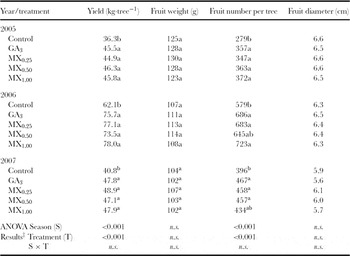
A significant effect of season was observed on yield and fruit number per tree parameters (Table 1), showing the alternate bearing pattern of trees during the trial with years of low production (off year) followed by years of high yield (on year). Moreover, application of bioregulators (GA3 and MX) significantly decreased fruit-drop percentage measured as number of fruits in the three years of the trial, compared to untreated trees (Table 1). This increase in the number of fruits obtained together with the fact that fruit size (weight and diameter of individual fruit) was maintained within the average commercial characteristics (MAPA, 2002) of this variety, led to higher yields in treatments with exogenous application of growth regulators. Increasing MX concentrations from 0.25 to 1.00% did not have any significant effect on these four variables. Fruit set was significantly increased in treated trees by up to 20% for both GA3 and MX treatments compared to untreated control trees.
Effects of treatments on ‘Nules’ clementine mandarin fruit characteristics yield, fruit weight, number and diameter at commercial harvest period, in the three years of the trial†.

†Data represent mean value of four replicates.
‡Mean values within columns for a year/parameter followed by the same superscripted letter were not significantly different at p = 0.05 level and ns: not significant, on the basis of the least significant difference test.
Effects of foliar applications on fruit quality
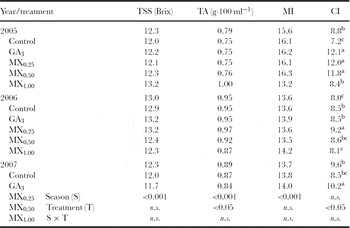
When assessing growth regulators, it is important to analyse how they affect characteristics that influence the commercial acceptability of the fruit, such as the TSS, etc. Values of these variables (Table 2) remain within acceptable agronomic characteristics for this variety (MAPA, 2002). However, significant seasonal variation was found for TSS, TA and MI, possibly due to the relationship between these variables and fruit size. In the first year of the trial although not significant, increased fruit size (fruit weight) corresponded with lower TSS and TA of fruit juice. This pattern gave rise to fruits with higher MI due to the low acidity values of the juice (Table 2). The opposite trend was observed in 2006 while an intermediate response was obtained in 2007 as smaller fruits were collected. Furthermore, TSS and MI values were similar for both regulators. However, the results revealed that foliar applications of both bioregulators significantly affected TA of juice. Acidity was greater in control trees than in those receiving foliar applications (GA3 and MX treatments).
Effects of treatments on ‘Nules’ clementine mandarin fruit characteristics (TSS: total soluble solids; TA: total acidity; MI: maturity index; CI: colour index) at commercial harvest period, in the three years of the trial†.

†Data represent mean value of four replicates.
‡Mean values within columns for a year by parameter followed by the same superscripted letter were not significantly different at P = 0.05 level and n.s.: not significant, on the basis of the least significant difference test.
The methyl-xanthine plant growth regulator (MX) affected CI with respected to untreated and GA3 fruits. In general, GA3 applications lead to the lowest CI values while in contrast CI values in MX-treated trees were considerably higher than in controls (Table 2).
Effects of foliar applications on foliar nutrient concentration
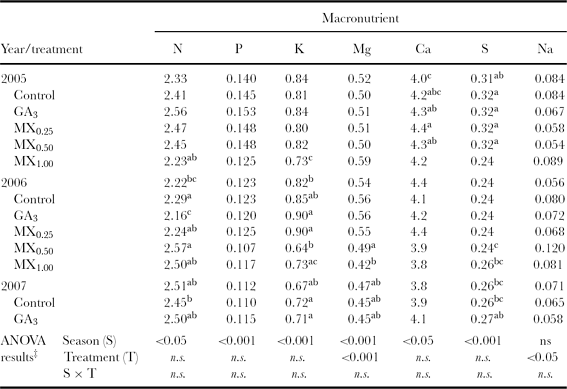
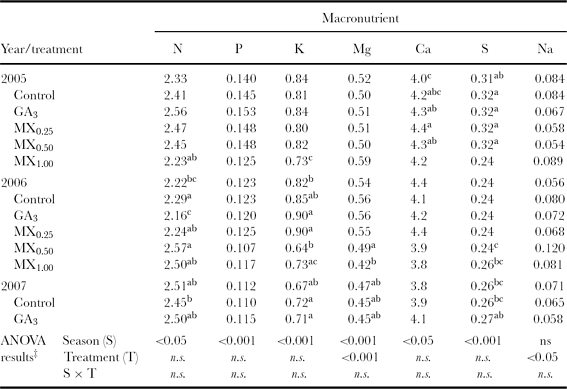
Regarding macronutrient concentration in the leaves, significant differences were observed resulting from seasonality in most of the nutrients analysed (Table 3). However, foliar concentrations did not differ between GA3 and MX treatments. Nevertheless, a significantly different trend was observed for foliar Mg concentrations between control and GA3 treated trees. A higher Mg foliar concentration was observed in leaves from controls than in GA3 trees.
Effects of treatments on macronutrient concentrations of spring flush leaf from nonfruiting shoots of ‘Nules’ clementine mandarin (% of dry weight) on the three years of the trial†.
†Data represent mean value of four replicates.
‡Mean values within columns for a year by parameter followed by the same superscripted letter were not significantly different at p = 0.05 level and n.s.: not significant, on the basis of the least significant difference test.
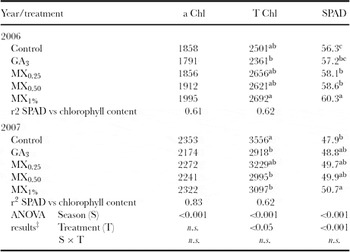
As expected, results showed a strong linear correlation between SPAD measurements and total chlorophyll and a chlorophyll concentration (Table 4), with r 2 = 0.83 to 0.61. Total chlorophyll concentration of spring flush leaves was significantly lower for GA3 treatments and, together with the control plants, gave the minimum SPAD index. However, application of this new growth regulator significantly enhanced total leaf chlorophyll concentration and the SPAD index compared to control or GA3 treated trees, with an important increment in this trend on increasing application concentration.
Effects of treatments on total chlorophyll (T Chl) and a chlorophyll (a Chl) concentration (μg per g dry weight) and SPAD index of spring flush leaf from non-fruiting shoots of ‘Nules’ clementine mandarin on last two years of the trial†.

†Data represent mean value of four replicates.
‡Mean values within columns for a year by parameter followed by the same superscripted letter were not significantly different at p = 0.05 level and n.s.: not significant, on the basis of the least significant difference test.
Effects of number of methyl-xanthine foliar applications on foliar characteristics and fruit quality
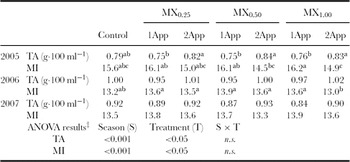
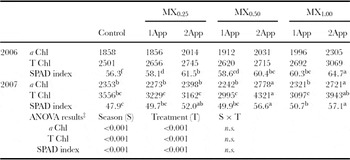
The number of foliar applications of MX only affected TA, MI and leaf chlorophyll variables (Tables 5 and 6). This factor had no significant effect on the other variables of fruit quality and leaf macronutrient concentration (data not shown). For all seasons, a second foliar application of MX increased TA concentration in the fruit of trees receiving MX treatments with respect to control. This implies lower MI values with two foliar applications due to a greater accumulation of TA in these fruits. Despite the different values found in TA and MI, all of them were within the normal agronomic range (MAPA, 2002). Furthermore, the data reveal that only the delayed second application of MX increased total chlorophyll and a chlorophyll concentrations, and therefore the SPAD index of the leaves.
Effect of season, number of foliar applications (No. App.) and methyl-xanthine concentration (%) on total acidity (TA) and maturity index (MI) on ‘Nules’ clementine mandarin fruits at commercial harvest period of methyl-xanthine treatments (MX)†

†Data represent mean value of four replicates.
‡Mean values within rows for a year by parameter followed by the same superscripted letter were not significantly different at p = 0.05 level and n.s.: not significant, on the basis of the least significant difference test.
Effect of season, number of foliar applications (No. App.) and methyl-xanthine concentration (%) on total chlorophyll (T Chl) and chlorophyll a (a Chl) content (μg·g−1 dry weight) and SPAD index of spring flush leaf from non-fruiting shoots of ‘Nules’ clementine mandarin of methyl-xanthine treatments (MX)†.

†Data represent mean value of four replicates.
‡Mean values within rows for a year by parameter followed by the same superscripted letter were not significantly different at p = 0.05 level and n.s.: not significant, on the basis of the least significant difference test.
DISCUSSION
Annual variation in yield and fruit number were recorded over the years of the trial as a consequence of this variety's alternate bearing pattern. Similar results were also observed by other authors. Accordingly, El-Otmani et al., Reference El-Otmani, Ait-Oubahou, El-Hassainate, Kaanane and Lovatt2004, among others, concluded that Nules clementine mandarin is a cultivar with an alternate-bearing pattern and poor fruit-set with a large number of small-sized fruits during the ‘on year’ crop mainly. Yield was significantly increased by both regulators (GA3, MX0.25, MX0.50 and MX1.00) for all three years of the present trial. Furthermore, an application of 0.25% of MX (MX0.25) was sufficient to retain 20% more fruits than control trees, a percentage similar to that obtained for GA3 treatment. Previous studies have shown that GA3 increases fruit set when applied to clementine mandarin during the bloom-to-petal period (El-Otmani et al., Reference El-Otmani, Coggins, Agustí and Lovatt2000; Reference El-Otmani, Ait-Oubahou, El-Hassainate, Kaanane and Lovatt2004; Soost and Burnett, Reference Soost and Burnett1961), but this is the first report of MX treatments having a similar effect. Opposite results were found by Chao and Lovatt (Reference Chao and Lovatt2006) when foliar applications (10 ppm GA3) were performed at 75% petal fall, and in July this lead to lower total yield (kg per tree) than in untreated trees. However, these authors achieved a greater total yield in the large and mammoth size categories by delaying the first application of 10 ppm of GA3 until 90% full bloom, 10 days after 75% petal fall. On the other hand, the application of GA3 to the basal part of shoots of nectarine and peach, during flower bud induction reduced flowering in the following season (Stern and Ben-Arie, Reference Stern and Ben-Arie2009). In persimmon orchards, two applications of GA3 is a common practice to increase fruit set; however, according to Steyn et al. (Reference Steyn, Ungerer and Theron2008) its effectiveness remains unclear. These results show the importance of timing for GA3 application; however, there are no reference works regarding MX applications.
Our results also confirm that the increase in yield was mainly due to an increment in fruit number rather than fruit size in the ‘Nules’ cultivar. Krezdorn (Reference Krezdorn1969) showed that most GA3 treated trees produced smaller-sized fruit than the untreated controls due to competition between fruits. Nawaz et al. (Reference Nawaz, Ahmad, Ahmad and Khan2008) found that exogenous application of growth regulators (2,4-D; GA3 and NAA) significantly decreased fruit drop, leading to an increase in the total number of fruits per tree in kinnow mandarin.
Although our experiments do not permit us to elucidate the mechanism of action of applied plant growth substances in fruit set at physiological and molecular levels, others studies show the synergetic action of indoles increasing IAA leaf biosynthesis (San Francisco et al., Reference San-Francisco, Houdusse, Zamarreño, Garnica, Casanova and García-Mina2005) and theophylline enhancing leaf cyclic nucleotides concentration and, thereby, leaf concentration of gibberellins (Uematsu et al., Reference Uematsu, Nakajima, Yamaguchi, Yoneyama and Fukui2007). This simultaneous increase in auxin and gibberellic activities promotes fruit set (de Jong et al., Reference De Jong, Mariani and Vriezen2009). The results of gibberellin application experiments suggest that fruit-set depends on gibberellins (Sjut and Bangerth, Reference Sjut and Bangerth1982/1983) and overexpression of genes of IAA biosynthesis (Pandolfini et al., Reference Pandolfini, Rotino, Camerini, Defez and Spena2002); auxin application (Abad and Monteiro, Reference Abad and Monteiro1989) also induce fruit set and growth (Alabadí et al., Reference Alabadí, Agüero, Pérez-Amador and Carbonell1996).
As for fruit quality, research into foliar applications of growth regulators by other authors obtain very different results for clementine mandarin and other varieties, which makes it difficult to draw conclusions. The absence of effects on certain fruit quality variables (peel thickness, juice content, TSS and MI) was also reported by Chao and Lovatt (Reference Chao and Lovatt2006). However, Chundawat and Randhawa (Reference Chundawat and Randhawa1971) on sweet lime found that rind thickness and total acidity were increased due to GA sprays, while El-Otmani et al. (Reference El-Otmani, Ait-Oubahou, El-Hassainate, Kaanane and Lovatt2004) on clementine mandarin and El-Moneim et al. (Reference El-Moneim, El Migeed and Ismai2007) on Washington navel orange trees also observed an increase in TA of GA3-treated trees. By contrast, Saleem et al. (Reference Saleem, Malik, Pervez, Khan and Khan2008) observed that peel thickness and peel quantity in sweet orange were significantly decreased by growth regulator treatment (GA3 and 2,4-D) as compared to the control while juice and pulp content (%) were significantly improved by GA3 treatments. In other crops, combined treatment of choline chloride and GA in peach increased the soluble solid content (Kang et al., 2004). However, GA applications in strawberry had significantly increased juice content (%) in fruit, TSS and acidity decreased slightly over control (Sharma and Singh, Reference Sharma and Singh2009). Similar results were found in grapes (Basiouny, Reference Basiouny1994). The research described in this paper is a preliminary study into the effects of MX on these quality variables and further research seems to be needed to explain these contradictory observations.
On the other hand, the use of GA3 on clementine mandarin may also delay the development of orange peel colour under some conditions (Krezdorn, Reference Krezdorn1969) and lead to lower CI values. Alos et al. (Reference Alós, Cercós, Rodrigo, Zacarías and Talón2006) also reported the delay in degreening caused by GA spraying on Clementine de Nules falvedo, as well as it has been described for Tarocco oranges by Tumminelli et al. (Reference Tumminelli, Conti, Maltese, Pedrotti and Bordonaro2005). Therefore, it is important to remark that an advantage of MX is that this new growth regulator does not affect CI. Thus, the use of MX foliar application can be considered advantageous in citrus early varieties since rind colour change is not delayed.
In the present study, regulators did not affect leaf mineral nutrition; however, significant differences were observed resulting from seasonality in most of the nutrients analysed and may be due to inter-annual variability associated with climate conditions. These results are in disagreement with those reported by Dawood et al. (Reference Dawood, Meligy and El-Hamady2001) who found that GA sprays enhanced leaf N content in Balady mandarin. As expected, the Minolta SPAD Chlorophyll Meter was shown to be an accurate tool to compare chlorophyll content of the leaves (Papasavvas et al., Reference Papasavvas, Triantafyllidis, Zervoudakis, Kapotis, Samaras and Salahas2008). Moreover, these authors observed a linear correlation between SPAD readings and the physiological parameters of the leaves, such as photosynthesis, transpiration and stomata conductance. It has been postulated that this increase in leaf chlorophyll concentration is linked to more efficient capture of the available light, thereby maximizing carbon gain (Nemali and Van Iersel, Reference Nemali and Van Iersel2004). Therefore, these results could indicate a higher photosynthetic rate in leaves of trees which received a second MX application.
CONCLUSIONS
The foliar applications of a new product combining both methyl-xanthine (theophylline) and an auxin precursor (3-ethyl-indole) exerted a similar effect to gibberellic acid with respect to fruit set, fruit quality and nutrient content of treated trees, while colour index remained unaffected. A single foliar application of the bioregulator was enough to increase fruit set; while a second application at 0.5 and 1.0% concentrations remarkably increased total acidity content of fruit juice, total chlorophyll and SPAD index. The latter could be an advantage in some citrus varieties.
Acknowledgements
This research was supported by INIA (Ministerio de Educación y Ciencia, Spain) and the financial aid from the European Community (FEDER and ESF funds) and TIMAC-AGRO S.A. The authors wish to thank: M. C. Prieto, J. Giner, and T. García-Estellés for technical assistance.