


%20--%3e%3c!DOCTYPE%20svg%20PUBLIC%20'-//W3C//DTD%20SVG%201.0//EN'%20'http://www.w3.org/TR/2001/REC-SVG-20010904/DTD/svg10.dtd'%3e%3csvg%20version='1.0'%20id='Layer_1'%20xmlns='http://www.w3.org/2000/svg'%20xmlns:xlink='http://www.w3.org/1999/xlink'%20x='0px'%20y='0px'%20width='64px'%20height='64px'%20viewBox='5.5%20-3.5%2064%2064'%20enable-background='new%205.5%20-3.5%2064%2064'%20xml:space='preserve'%3e%3cg%3e%3ccircle%20fill='%23FFFFFF'%20fill-opacity='0'%20cx='37.785'%20cy='28.501'%20r='28.836'/%3e%3cpath%20fill='%23595959'%20d='M37.441-3.5c8.951,0,16.572,3.125,22.857,9.372c3.008,3.009,5.295,6.448,6.857,10.314%20c1.561,3.867,2.344,7.971,2.344,12.314c0,4.381-0.773,8.486-2.314,12.313c-1.543,3.828-3.82,7.21-6.828,10.143%20c-3.123,3.085-6.666,5.448-10.629,7.086c-3.961,1.638-8.057,2.457-12.285,2.457s-8.276-0.808-12.143-2.429%20c-3.866-1.618-7.333-3.961-10.4-7.027c-3.067-3.066-5.4-6.524-7-10.372S5.5,32.767,5.5,28.5c0-4.229,0.809-8.295,2.428-12.2%20c1.619-3.905,3.972-7.4,7.057-10.486C21.08-0.394,28.565-3.5,37.441-3.5z%20M37.557,2.272c-7.314,0-13.467,2.553-18.458,7.657%20c-2.515,2.553-4.448,5.419-5.8,8.6c-1.354,3.181-2.029,6.505-2.029,9.972c0,3.429,0.675,6.734,2.029,9.913%20c1.353,3.183,3.285,6.021,5.8,8.516c2.514,2.496,5.351,4.399,8.515,5.715c3.161,1.314,6.476,1.971,9.943,1.971%20c3.428,0,6.75-0.665,9.973-1.999c3.219-1.335,6.121-3.257,8.713-5.771c4.99-4.876,7.484-10.99,7.484-18.344%20c0-3.543-0.648-6.895-1.943-10.057c-1.293-3.162-3.18-5.98-5.654-8.458C50.984,4.844,44.795,2.272,37.557,2.272z%20M37.156,23.187%20l-4.287,2.229c-0.458-0.951-1.019-1.619-1.685-2c-0.667-0.38-1.286-0.571-1.858-0.571c-2.856,0-4.286,1.885-4.286,5.657%20c0,1.714,0.362,3.084,1.085,4.113c0.724,1.029,1.791,1.544,3.201,1.544c1.867,0,3.181-0.915,3.944-2.743l3.942,2%20c-0.838,1.563-2,2.791-3.486,3.686c-1.484,0.896-3.123,1.343-4.914,1.343c-2.857,0-5.163-0.875-6.915-2.629%20c-1.752-1.752-2.628-4.19-2.628-7.313c0-3.048,0.886-5.466,2.657-7.257c1.771-1.79,4.009-2.686,6.715-2.686%20C32.604,18.558,35.441,20.101,37.156,23.187z%20M55.613,23.187l-4.229,2.229c-0.457-0.951-1.02-1.619-1.686-2%20c-0.668-0.38-1.307-0.571-1.914-0.571c-2.857,0-4.287,1.885-4.287,5.657c0,1.714,0.363,3.084,1.086,4.113%20c0.723,1.029,1.789,1.544,3.201,1.544c1.865,0,3.18-0.915,3.941-2.743l4,2c-0.875,1.563-2.057,2.791-3.541,3.686%20c-1.486,0.896-3.105,1.343-4.857,1.343c-2.896,0-5.209-0.875-6.941-2.629c-1.736-1.752-2.602-4.19-2.602-7.313%20c0-3.048,0.885-5.466,2.658-7.257c1.77-1.79,4.008-2.686,6.713-2.686C51.117,18.558,53.938,20.101,55.613,23.187z'/%3e%3c/g%3e%3c/svg%3e)
%20--%3e%3c!DOCTYPE%20svg%20PUBLIC%20'-//W3C//DTD%20SVG%201.0//EN'%20'http://www.w3.org/TR/2001/REC-SVG-20010904/DTD/svg10.dtd'%3e%3csvg%20version='1.0'%20id='Layer_1'%20xmlns='http://www.w3.org/2000/svg'%20xmlns:xlink='http://www.w3.org/1999/xlink'%20x='0px'%20y='0px'%20width='64px'%20height='64px'%20viewBox='5.5%20-3.5%2064%2064'%20enable-background='new%205.5%20-3.5%2064%2064'%20xml:space='preserve'%3e%3cg%3e%3ccircle%20fill='%23FFFFFF'%20fill-opacity='0'%20cx='37.637'%20cy='28.806'%20r='28.276'/%3e%3cg%3e%3cpath%20fill='%23595959'%20d='M37.443-3.5c8.988,0,16.57,3.085,22.742,9.257C66.393,11.967,69.5,19.548,69.5,28.5c0,8.991-3.049,16.476-9.145,22.456%20C53.879,57.319,46.242,60.5,37.443,60.5c-8.649,0-16.153-3.144-22.514-9.43C8.644,44.784,5.5,37.262,5.5,28.5%20c0-8.761,3.144-16.342,9.429-22.742C21.101-0.415,28.604-3.5,37.443-3.5z%20M37.557,2.272c-7.276,0-13.428,2.553-18.457,7.657%20c-5.22,5.334-7.829,11.525-7.829,18.572c0,7.086,2.59,13.22,7.77,18.398c5.181,5.182,11.352,7.771,18.514,7.771%20c7.123,0,13.334-2.607,18.629-7.828c5.029-4.838,7.543-10.952,7.543-18.343c0-7.276-2.553-13.465-7.656-18.571%20C50.967,4.824,44.795,2.272,37.557,2.272z%20M46.129,20.557v13.085h-3.656v15.542h-9.944V33.643h-3.656V20.557%20c0-0.572,0.2-1.057,0.599-1.457c0.401-0.399,0.887-0.6,1.457-0.6h13.144c0.533,0,1.01,0.2,1.428,0.6%20C45.918,19.5,46.129,19.986,46.129,20.557z%20M33.042,12.329c0-3.008,1.485-4.514,4.458-4.514s4.457,1.504,4.457,4.514%20c0,2.971-1.486,4.457-4.457,4.457S33.042,15.3,33.042,12.329z'/%3e%3c/g%3e%3c/g%3e%3c/svg%3e)
Introduction
Antimicrobial resistance (AMR) is a serious global public health concern. In Japan, efforts to reduce antimicrobial use and the incidence of resistant organisms have been promoted under the “National Action Plan on AMR.” 1,2 Under the Japanese national healthcare system, outpatient antimicrobial prescriptions may be dispensed either within dental clinics or community pharmacies, reflecting different degrees of separation between prescription and dispensing processes. The dental field is predominantly characterized by outpatient care, in which antimicrobials are frequently prescribed and account for approximately 10% of the total antimicrobial consumption in Japan. However, in Japanese dental practice, oral third-generation cephalosporins are used more frequently than amoxicillin, which is recommended as the first-line agent, and this prescribing pattern has been noted to diverge from international guidelines. 3–Reference Baddour, Wilson and Bayer5
To address this discrepancy, it is important to focus not only on improving knowledge but also on the role of “attitudes,” including a sense of urgency regarding the AMR problem, self-efficacy in being able to prescribe in accordance with guidelines, and professional role awareness. Studies conducted overseas have shown that although educational interventions can improve knowledge, such improvements do not necessarily lead to sustained behavioral changes. Reference Sneddon, Cooper and Afriyie6 In addition, domestic surveys have reported that while dentists demonstrate a high level of awareness of AMR, inappropriate or uniform prescribing practices remain common, suggesting a gap between knowledge and actual prescribing behavior. Reference Ohtaki, Hama and Takata7,Reference Koizumi, Kusama and Ishikane8
Recent systematic reviews have also identified dentists’ attitudes as factors that may influence their prescribing behavior. Reference Vázquez-Cancela, Fernández-González and Varela-Centelles9 However, studies that quantitatively assess attitudes toward AMR and examine their association with specific antimicrobial choices remain limited, both domestically and internationally. In particular, the relationship between AMR-related attitudes and the selection of oral third-generation cephalosporins has not been sufficiently elucidated.
Therefore, we aimed to examine the association between dentists’ multidimensional awareness of AMR and the selection of oral third-generation cephalosporins by analyzing data from an existing questionnaire survey conducted for educational purposes.
Methods
Study design
This was a cross-sectional secondary analysis of questionnaire data collected for educational purposes.
Participants and survey content
This study was a secondary analysis of data from a questionnaire survey conducted among dentists in the Department of Infection Control at Kagawa University Hospital. The survey was conducted between November 29, 2024, and January 18, 2025, and targeted 406 dentists affiliated with the Kagawa Dental Association. The questionnaire was distributed via Google Forms and fax through the Department of Pharmacy at Kagawa University Hospital, and the responses were collected voluntarily. During the survey period, 111 responses were obtained (response rate, 27.3%), all of which were included in the analysis.
The questionnaire was developed based on previous studies.Reference Sneddon, Cooper and Afriyie 6 – Reference Koizumi, Kusama and Ishikane 8 , Reference Angarita-Díaz, Pardo-García and Martínez-Delgado 10 The survey items included the selection of oral third-generation cephalosporins (binary variable), sex, years of clinical experience, purpose of antimicrobial prescription (including posttreatment prophylactic use), practice type categorized as in-house dispensing (medications dispensed within the dental clinic) or external pharmacy dispensing (prescriptions filled at community pharmacies under the separation of prescription and dispensing processes), and attitude related to AMR and appropriate antimicrobial use assessed using Likert scales.
AMR attitude score
Items assessing attitudes toward AMR were quantified to calculate the overall AMR attitude scores. Based on previous studies, AMR-related attitudes were categorized into three domains: “sense of crisis,” “self-efficacy,” and “role awareness.” Reference Sneddon, Cooper and Afriyie6
The “sense of crisis” domain comprised items reflecting perceptions of the seriousness of AMR and the importance of adherence to the guidelines. The “self-efficacy” domain included items related to confidence in being able to prescribe in accordance with the guidelines and the perceived ease of referring to such guidelines. The “role awareness” domain comprised items evaluating dentists’ sense of professional responsibility in reducing the risk of AMR.
Outcome measures
The primary outcome was the selection of oral third-generation cephalosporins, defined as dentists’ self-reported selection of these agents.
AMR attitudes were quantified using overall and domain-specific scores, including a sense of crisis, self-efficacy, and role awareness. In addition to the primary analysis focusing on the overall score, domain-specific scores were examined separately to explore their individual associations with prescribing behavior.
Statistical analysis
For the primary analysis, multivariable logistic regression analysis was performed, with the selection of oral third-generation cephalosporins as the dependent variable and the overall AMR attitude score as the main independent variable. Years of clinical experience, sex, use of prophylactic prescriptions, and practice type (in-house dispensing vs external pharmacy dispensing) were prespecified as covariates and were included in the models for adjustment. Because domain-specific attitude scores were likely to correlate with the overall score, exploratory analyses were performed, in which each domain score was entered separately into individual models, distinct from the primary analysis. The overall and domain-specific scores were not included in the same model to avoid multicollinearity.
For the sensitivity analysis, models that excluded cases involving prophylactic prescriptions were also fitted. A two-sided P-value of <.05 was considered statistically significant. All analyses were performed using R version 4.4.3 (R Foundation for Statistical Computing, Vienna, Austria). The model fit for each logistic regression analysis was assessed using likelihood ratio tests, and multicollinearity was examined using variance inflation factors. Because the aim of this study was to evaluate the independent association between AMR attitudes and prescription choices while accounting for potential confounders, only adjusted odds ratios (ORs) derived from multivariable analyses are presented as the primary results.
Ethics statements
This secondary analysis was performed using existing questionnaire data that had been collected for educational purposes. Before the analysis, the researchers removed personal identifiers, including names, contact information, and facility names, from the free-text responses and anonymized the data. No new surveys or research interventions were conducted. For these reasons, the study was exempted from ethical review by the Ethics Review Board of Kagawa University (approval number: 2025-194).
Results
Participant characteristics
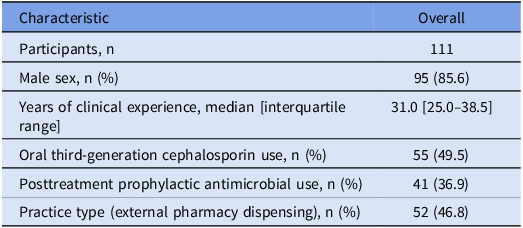
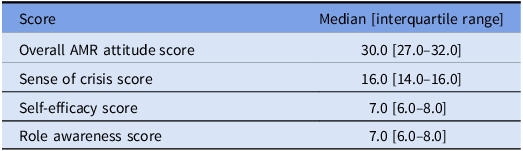
In total, 111 dentists were included in the analysis. The detailed participant characteristics and practice-related variables are shown in Table 1. The median number of years of clinical experience was 31.0 (25.0–38.5) years, and 55 dentists (49.5%) reported selecting oral third-generation cephalosporins. The distributions of the overall and domain-specific AMR attitude scores are summarized in Table 2.
Participant characteristics

Table 1. Long description
A table summarizing characteristics of 111 dentists, including clinical experience, antimicrobial use, and practice type. The table has two columns: Characteristic and Overall. The characteristics listed are Participants, Male sex, Years of clinical experience, Oral third-generation cephalosporin use, Posttreatment prophylactic antimicrobial use, and Practice type. The overall values are 111 participants, 95 male (85.6 percent), a median of 31.0 years of clinical experience with an interquartile range of 25.0 to 38.5 years, 55 using oral third-generation cephalosporins (49.5 percent), 41 using posttreatment prophylactic antimicrobials (36.9 percent), and 52 engaged in external pharmacy dispensing (46.8 percent).
For each variable, values are presented as numbers (percentages) or median (25th–75th percentile interquartile range), as applicable.
Antimicrobial resistance attitude scores

Table 2. Long description
A table with four rows and two columns. The columns are labeled ‘Score’ and ‘Median [interquartile range]’. The rows are labeled with different scores: Overall AMR attitude score, Sense of crisis score, Self-efficacy score, and Role awareness score. Each row contains a score value and a median value with an interquartile range. Row 1: Overall AMR attitude score, 30.0; 27.0-32.0. Row 2: Sense of crisis score, 16.0; 14.0-16.0. Row 3: Self-efficacy score, 7.0; 6.0-8.0. Row 4: Role awareness score, 7.0; 6.0-8.0.
Values are presented as median (25th–75th percentile interquartile range). The overall AMR attitude score represents the sum of all attitude items. Domain-specific scores include a sense of crisis, self-efficacy, and role awareness.
AMR, antimicrobial resistance.
Overall AMR attitude score and prescribing behavior
High overall AMR attitude scores were negatively associated with the selection of oral third-generation cephalosporins (OR, 0.82; 95% confidence interval [CI], 0.72–0.92; P = .001). In addition, the practice type involving external pharmacy dispensing was independently associated with a low likelihood of selecting oral third-generation cephalosporins (OR, 0.34; 95% CI, 0.15–0.77; P = .011). In contrast, years of clinical experience, sex, and use of posttreatment prophylactic antimicrobials were not significantly associated with prescription selection (Table 3).
Factors associated with selection of oral third-generation cephalosporins: multivariable logistic regression analysis

Table 3. Long description
A table with four columns and five rows, plus a header row. The columns are labeled Variable, Overall AMR attitude score, Sense of crisis score, Self-efficacy score, and Role awareness score. The rows list different variables and their associated scores and confidence intervals. Row 1: AMR attitude score (per 1-point increase), 0.82 (0.72-0.92), 0.001, 0.77 (0.61-0.96), 0.021, 0.50 (0.34-0.73), <0.001, 0.59 (0.42-0.84), 0.003. Row 2: Years of clinical experience, 1.01 (0.97-1.05), 0.62, 1.01 (0.97-1.05), 0.58, 1.00 (0.96-1.05), 0.89, 1.01 (0.97-1.05), 0.67. Row 3: Male sex, 1.32 (0.44-3.94), 0.62, 1.28 (0.42-3.89), 0.66, 1.41 (0.44-4.48), 0.56, 1.36 (0.43-4.28), 0.60. Row 4: Posttreatment prophylactic antimicrobial use, 1.88 (0.78-4.54), 0.16, 1.94 (0.80-4.69), 0.14, 2.69 (1.07-6.75), 0.036, 1.97 (0.80-4.86), 0.14. Row 5: Practice type (external pharmacy dispensing), 0.34 (0.15-0.77), 0.011, 0.34 (0.16-0.77), 0.009, 0.29 (0.13-0.69), 0.005, 0.33 (0.15-0.75), 0.008. The table includes the number of participants as 111 for each variable.
Values are adjusted odds ratios with 95% confidence intervals and P-values. The outcome was the selection of oral third-generation cephalosporins. Each model included years of clinical experience, sex, posttreatment prophylactic antimicrobial use, and practice type (external pharmacy dispensing). The overall and domain-specific antimicrobial resistance attitude scores were entered into separate models to avoid multicollinearity.
AMR, antimicrobial resistance.
Domain-specific attitude scores and prescribing behavior
Sense of crisis score
A high sense of crisis score was significantly associated with a low likelihood of selecting oral third-generation cephalosporins (OR, 0.77; 95% CI, 0.61–0.96; P = .021). Practice type involving external pharmacy dispensing was also associated with prescription selection (OR, 0.34; 95% CI, 0.16–0.77; P = .009) (Table 3).
Self-efficacy score
High self-efficacy scores were strongly associated with a low likelihood of selecting oral third-generation cephalosporins (OR, 0.50; 95% CI, 0.34–0.73; P < .001). In contrast, the use of posttreatment prophylactic antimicrobials was positively associated with prescription selection (OR, 2.69; 95% CI, 1.07–6.75; P = .036). Practice type involving external pharmacy dispensing was negatively associated with prescription selection (OR, 0.29; 95% CI, 0.13–0.69; P = .005) (Table 3).
Role awareness score
High role awareness scores were significantly associated with a low likelihood of selecting oral third-generation cephalosporins (OR, 0.59; 95% CI, 0.42–0.84; P = .003). Practice type involving external pharmacy dispensing was similarly associated with prescription selection (OR, 0.33; 95% CI, 0.15–0.75; P = .008) (Table 3).
Model fit
The likelihood ratio tests were statistically significant for all multivariable logistic regression models. The variance inflation factors for all explanatory variables ranged from 1.0 to 1.1, indicating no evidence of problematic multicollinearity.
Discussion
In this study, we assessed dentists’ attitudes toward AMR and examined their cross-sectional association with the selection of oral third-generation cephalosporins. A distinctive feature of this study is that it focused on a population of dentists who primarily prescribed antimicrobials in outpatient settings, allowing us to assess prescription choices in a context similar to real-world clinical practice. The results suggested that dentists with high overall AMR attitude scores had low odds of selecting oral third-generation cephalosporins. These findings indicate that heightened awareness of AMR may extend beyond knowledge or attitudes alone and be reflected in actual prescribing decisions, thereby contributing to behaviors aligned with appropriate antimicrobial use Reference Teoh, Stewart, Marino and McCullough11,Reference Stein, Farmer, Singhal, Marra, Sutherland and Quiñonez12 .
In exploratory analyses according to domain, self-efficacy and professional role awareness showed strong associations with prescription selection. These findings suggest that, in addition to awareness of the AMR problem itself, self-efficacy in being able to prescribe in accordance with the guidelines and recognition of professional responsibility for appropriate antimicrobial use may be associated with prescription decisions. Previous studies have shown that psychological and behavioral factors such as attitudes and self-efficacy are more influential than knowledge levels alone in antimicrobial stewardship, and the results of this study are consistent with these findings. Reference Teoh, Marino, Stewart and McCullough13,Reference Lucet, Nicolas-Chanoine and Roy14
Although the sense of crisis score was also associated with prescription selection, the strength of this association was limited compared with that of self-efficacy and role awareness. These findings suggest that while a sense of urgency regarding AMR is an important prerequisite for behavioral change, perceptions of being able to act (self-efficacy) and recognition that such actions are part of one’s professional role may be critical in translating awareness into actual prescribing behavior. Reference Cope, Francis, Wood and Chestnutt15,Reference Charani, Castro-Sánchez and Holmes16 In other words, a sense of crisis alone may be insufficient to induce behavioral change, and psychological factors that support action may mediate this process.
In addition, the type of practice involving external pharmacy dispensing was significantly associated with the selection of oral third-generation cephalosporins. In the Japanese healthcare system, external pharmacy dispensing reflects a great separation between prescription and dispensing processes in outpatient dental practice. In systems involving outpatient prescriptions, pharmacists may play a role in reviewing prescription content, providing information, and offering feedback. This suggests that institutional and environmental factors, together with individual dentists’ attitudes, may influence prescribing behavior. Although causality cannot be inferred from this cross-sectional analysis, previous studies have revealed that external review mechanisms can contribute to appropriate antimicrobial use. The findings of this study extend this line of evidence. Reference Özdemir Kabalak, Aytac and Tarhan17
This study has several limitations. First, because of its cross-sectional design, causal relationships between attitudes and prescribing behaviors cannot be directly inferred, and the possibility of reverse causation cannot be excluded. Second, the outcome was based on whether a specific antimicrobial was selected for prescription and did not assess the prescription frequency, appropriateness of indications, or inappropriate prescription. Third, the generalizability of the findings may be limited because the study population was limited to dentists from a specific geographic region.
Despite these limitations, this study provides evidence of the associations between the multidimensional aspects of AMR-related attitudes and antimicrobial selection in dental settings. Although causal inferences cannot be drawn from this cross-sectional analysis, the strong associations observed between self-efficacy and professional role awareness and prescribing behavior suggest that future AMR interventions may need to move beyond the provision of knowledge or the promotion of a sense of crisis alone and instead place emphasis on psychological and professional factors that support appropriate prescribing behavior. Future studies using longitudinal designs or interventional approaches are warranted to examine whether educational and institutional interventions aimed at strengthening self-efficacy and role awareness can influence antimicrobial prescribing behaviors in dental practice.
In this study, we conducted a multidimensional assessment of dentists’ attitudes toward AMR and examined its association with the selection of oral third-generation cephalosporins. Our findings showed that dentists with high overall AMR-related attitude scores were unlikely to select broad-spectrum antimicrobials. Particularly, components such as self-efficacy and professional role awareness were strongly associated with prescribing behavior.
These results suggest that promoting appropriate antimicrobial use in dental practice requires not only the provision of knowledge and raising risk awareness but also interventions that enhance dentists’ self-efficacy in prescribing in accordance with the guidelines and their recognition of professional responsibility. This study provides a foundation for developing educational and institutional interventions for AMR stewardship in the field of dentistry.
Data availability statement
Data are available upon request and subject to privacy, ethics, and other restrictions.
Acknowledgements
We thank the local dental associations and all participating dentists for their cooperation.
During the preparation of this manuscript, generative AI (ChatGPT, GPT-5) was solely used to assist with language refinement and improve readability. The authors retain full responsibility for the content, and no AI tools were used for the generation, analysis, interpretation of data, or derivation of the conclusions.
Author contributions
All authors meet the ICMJE authorship criteria. Tatsuya Tai designed the study, collected the data, and prepared the manuscript. Yuichi Muraki participated in study design and manuscript editing. Takahiro Motoki, Kazunori Yamaguchi, Naohiro Kurokawa, Sayaka Yamashita, Hiroaki Tanaka, and Shinji Kosaka assisted with manuscript preparation.
Financial support
No financial support was provided for this article.
Competing interests
YM received grants from Pfizer Japan Inc.; Kowa Company Ltd.; the Japan Pharmaceutical Association; the Japan Society for the Promotion of Science, and the Ministry of Health, Labour and Welfare. YM is also a board member of the Japanese Society of Pharmaceutical Health Care and Sciences and the Japanese Society for Infection Prevention and Control, and a committee member of the AMR Clinical Reference Center and the AMR One Health Surveillance Committee. These relationships had no role in the design, conduct, analysis, or reporting of the present study and are not considered to represent conflicts of interest related to this study.
The other authors have no conflicts of interest to declare.


 Open access

