INTRODUCTION
Breast cancer is the most common cancer in women in Sweden, with a total of about 6,500 new cases a year, and the leading attributable cause of cancer death (National Board of Health and Welfare, Center for Epidemiology, 2005). Many women diagnosed with breast cancer suffer from considerable traumatic stress related to the diagnosis, surgery, and medical treatment. In one group of women with early breast cancer, almost 50% suffered from depression, anxiety, or both in the first year after diagnosis (Burgess et al., 2005). The suicide risk relative to the general population has been found to be increased in women with breast cancer in Sweden (Björkenstam et al., 2005) and Denmark (Yousaf et al., 2005). In connection with radiotherapy treatment for cancer, significantly higher levels of stress have been shown among women as a group than among men, and women with breast cancer reported the highest levels (Sehlen et al., 2003).
It is thus important to develop strategies to strengthen coping resources in women with breast cancer (Boman et al., 1997; Koopman et al., 2001). Coping with breast cancer has been found to be significantly related to how women experience their bodies and relate to others. Being able to integrate body image and bodily functions after surgery are important aspects of the coping process (Manderson, 1999; Pikler & Winterowd, 2003).
Coping has been defined as “realistic and flexible thoughts and acts that solve problems and thereby reduce stress” (Lazarus & Folkman, 1984, p. 118). The literature on coping distinguishes between coping resources and coping strategies. Coping resources include social and material resources, health and energy, positive beliefs, problem solving skills, and social skills, and can act as a buffer against negative effects of stressful situations in life (Lazarus & Folkman, 1984). Coping resources can change over time. Coping strategies depend on coping resources and can be understood as “the things that people do in reaction to specific stressors occurring in a specific context” (Hammer & Marting, 1988, p. 2). Schnoll et al. (1998) showed that coping strategies contributed more than age or stage of the disease to how women with breast cancer adjusted to their situation with breast cancer.
Coping possibilities may be gendered in women diagnosed with breast cancer, as breasts symbolize cultural values such as sexuality, motherhood, and caring, that are closely connected to femininity. As the prevailing representations of femininity are reproduced in human encounters, in the media, and in medical practices, they will affect the daily life of many women, their identities, and relations (Yalom, 1997; Bassett-Smith, 2001). The gender structure of everyday life shapes women's individual lifestyle and their sense of well-being. For instance, women generally adapt and respond to demands made by people in their environment, and this may reduce their own coping resources (Doyal, 1995).
Art therapies are, in terms of Western definitions of complementary and alternative medicine (CAM), classified as mind–body interventions (Suzuki, 2004). A mind–body intervention is used to support “the power of the mind to influence the body in ways which encourage and stimulate health and well-being” (Malchiodi, 1999, p. 17). An increasing demand for CAM from patients has highlighted the need for research in the field, as knowledge on the topic is becoming necessary for health care providers. In a review of the literature, 17 studies (N = 546) were found describing the effectiveness of art therapy. The results provide evidence of positive effects of art therapy despite heterogeneity in samples and therapy designs. An increase in self-esteem and cohesion, a decrease in anxiety and depression, a reduction in levels of stress, and significant improvement in global health were found (Reynolds et al., 2000). Evidence has shown that brief psychological interventions focusing on problems can help reduce symptoms of anxiety and depression and improve patient quality of life (Watson, 2001). Art therapy can be compatible with brief approaches such as solution-focused therapy (Malchiodi, 1999). Today, many art therapists working within cancer care and rehabilitation, providing imaginative interventions through individual sessions and open/closed groups, have documented their methods and individual art therapy processes (Ziesler, 1993; Pratt & Wood, 1998; Malchiodi, 1999; Luzzatto & Gabriel, 2000; Gabriel et al., 2001; Borgmann, 2002; Luzzatto et al., 2003).
Many illuminating case studies, but no randomized controlled studies, have been found describing art therapy and coping among adults in a cancer care setting. The aim of the present study was to describe the effects of a clinically applicable art therapy intervention program on coping resources in women undergoing radiotherapy for breast cancer.
MATERIALS AND METHODS
Participants and Study Design
In the present article, we report some results of a study of 42 Swedish women with nonmetastatic breast cancer referred to the Department of Oncology at Umeå University Hospital for postoperative radiotherapy. The women were distributed fairly widely over socioeconomic backgrounds and ages and lived in the northern region of Sweden consisting of one-third of the total Swedish area. During the time of the data collection, September 2001–December 2004, altogether 143 women initially answered a written invitation to participate for 6 months in a study related to the start of radiotherapy.
Only women without dementia or severe psychiatric illness were invited to participate in the study. Fifty-five women decided to participate and met individually with one of the two trained art therapists who carried out the data collection and the art therapy sessions.
The patients were randomized to either a study group with five individual art therapy sessions or to a control group. The randomization was computer generated at the Regional Center of Oncology at Umeå University. Stratification was done according to whether patients had received postoperative chemotherapy treatment or not. Nine women in the study group and 10 women in the control group had received chemotherapy. The chemotherapy consisted of eight cycles of 5-FU, epirubicin, cyclophosfamide (FEC) given over a 6-month period before the start of radiotherapy.
Thirteen women dropped out of the study, five from the study group and eight from the control group. Causes of dropping out were too much strain (n = 7), disease complication (n = 2), and dissatisfaction with the randomization outcome (n = 4). A total of 42 women out of 55 completed the study, each during 6 months. The youngest participant was 37 years and the oldest was 69 years old. Median age was 59 years.
All 42 patients completed questionnaires in connection with three interview occasions during 6 months. The questionnaires assessed coping, quality of life, symptoms, and self-image. In addition, all women were asked to write a weekly diary about their experiences of breast cancer during the 6 months of participation. To make participants feel free to express both negative and positive experiences about the art therapy, they were interviewed by the art therapist not leading the art therapy sessions. All women signed a written consent form in which they were assured that ending their participation would not affect the care or medical treatment in any way.
This article focuses on changes in coping resources, as measured by the Coping Resources Inventory (CRI; Hammer & Marting, 1988), administered once before and twice after completed radiotherapy. Data from one woman were excluded from the analyses because they were incomplete. The analyses therefore comprise 41 women: 20 women in the study group (art therapy) and 21 women in the control group.
Art Therapy Design
The 5-week design of the individual art therapy intervention was adapted to the fact that, due to long travel distances, most of the women only stayed in Umeå during the 5 weeks of radiotherapy, when they were accommodated in an outpatient lodging. The overall aims of the art therapy intervention were to (1) give each woman time and space to reflect over, and express, her experiences, thoughts, and feelings about her situation using both nonverbal and verbal methods; (2) give her support in the process of restoring her body image; and (3) reduce stress and strengthen her ability to cope with the breast cancer experience. In all sessions, the same material was offered: sheets of paper, roll paper, oil pastels, water colors, lead pencils, charcoal, tape, scissors, and paintbrushes. All art therapy sessions included steps similar to the phenomenological method of art therapy, as presented by Betensky (1995, p. 14–23).
The first art therapy session was based on drawing analogs (Grätz, 1978; Edwards, 1987, p. 66–95), which is a way to create visual images that are analogous for different feelings. After explaining the design to the participating woman, the art therapist divided a sheet of paper into 16 sections. Then she read 16 words out loud, one at a time, all connected to different common feelings. After each word spoken out, the woman first wrote the word on a section of the divided sheet of paper. Thereafter, she tried to imagine the feeling connected to the word and made marks equivalent to her feeling with a lead pencil on the paper. As a next step, the woman was encouraged to choose one or several words in the list, or other words not included in the list, and create one or several images in color.
The second session focused on a life-size body outline (Luzzatto et al., 2003). The woman selected an oil pastel color for the art therapist to draw her contour on a large sheet of paper fastened on the wall. Within the body outline, the woman expressed different feelings in her body through shapes and colors.
The third and fourth sessions followed the woman's own choice. As she now was familiar with the material, individual adapted art therapy interventions were applied where necessary.
The fifth and final session was devoted to displaying all of the woman's images. Finally, the theme suggested to the woman was to create an image as a summary of her creative journey.
Instrument
The instrument used to measure coping resources was the CRI, a questionnaire identifying resources currently available to people for managing stress (Hammer & Marting, 1988). This inventory comprises 60 statements and is divided into five domains: a cognitive, social, emotional, physical, and spiritual/philosophical domain. Definitions of each domain are as follows (Hammer & Marting, 1988, p. 3): Cognitive (COG): the extent to which individuals maintain a positive sense of self-worth, a positive outlook towards others, and optimism about life in general. Social (SOC): the degree to which individuals are imbedded in social networks that are able to provide support in times of stress. Emotional (EMO): the degree to which individuals are able to accept and express a range of affect, based on the premise that a range of emotional response can aid in ameliorating long-term negative consequences of stress. Spiritual/philosophical (S/P): the degree to which actions of individuals are guided by stable and consistent values derived from religious, familial, and/or cultural tradition, or from personal philosophy. Physical (PHY): the degree to which actions of individuals enact health-promoting behaviors believed to contribute to increased physical well-being.
For each statement, respondents are asked to indicate how frequently they have engaged in a described behavior during the past 6 months: (1) never or rarely, (2) sometimes, (3) often, and (4) always or almost always. The total CRI score consists of the sum of the scores for the five domains. Higher scores indicate higher coping resources (Hammer & Marting, 1988; Ekekrantz & Norman, 1991). To make a comparison across domains, the raw scores are converted to standard scores, with a mean of 50 and a standard deviation (SD) of 10. Because men and women tend to score differently, the scale constructors have provided separate profiles and conversion tables (Hammer & Marting, 1988).
The CRI has been found to be reliable and valid. For the total scale, Cronbach's alpha coefficients of about .90, and for each of the subscales, .56–.87 have been reported (Ghazinour et al., 2004). Swedish standardization work is currently underway (Ekekrantz & Norman, 1991; Ghazinour et al., 2004).
The study protocol was approved by the Umeå University Ethical Committee at the Medical Faculty (archive number 99-386).
Data Analysis
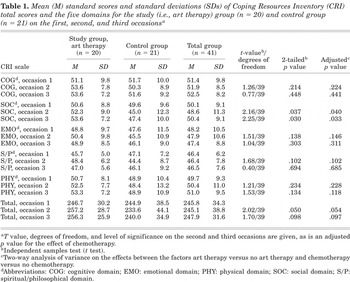
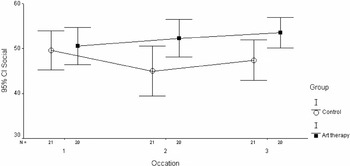
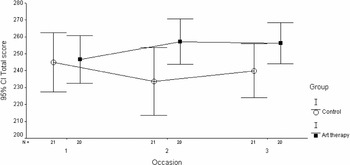
Data analyses were conducted using Statistical Package for Social Sciences (SPSS), version 11.5. Means and SDs will be presented for the study group (who were given art therapy; n = 20) and control group (n = 21), divided for the five domains and total standard scores for the three occasions of completing the instrument. The independent samples test (t test) was used to compare means between the groups on occasions two and three. Differences between the study group and the control group on the first measurement occasion are random. A p value <.05 was considered as the level of significance (Table 1). Figures 1 and 2 graphically represent results for the study and control groups, divided into the social domain and total scores for the three measurement occasions.
Mean (M) standard scores and standard deviations (SDs) of Coping Resources Inventory (CRI) total scores and the five domains for the study (i.e., art therapy) group (n = 20) and control group (n = 21) on the first, second, and third occasionsa


Comparisons of results in the social domain (SOC) in the study group (n = 20) and the control group (n = 21) on the first, second, and third occasions.

Comparisons of results from the study group (n = 20) and the control group (n = 21) on the first, second, and third occasions regarding total scores.
A follow-up, two-way analysis of variance (ANOVA) was carried out to determine whether, and where, interaction effects existed between groups regarding art therapy versus no art therapy and chemotherapy versus no chemotherapy (Table 1). A linear regression analysis was also carried out to detect factors related to the prospective effect of art therapy.
The internal dropouts were handled according to the CRI manual. The score was settled by multiplying the raw score for the items that had been answered, by the total number of possible items on the scale, then by dividing this by the number of items answered, and rounding to the nearest whole number (Hammer & Marting, 1988). Ten participants had left statements unanswered. In total, only 16 answers out of 7,380 statements for all women and occasions were missing. Six women had left one statement unmarked, three had left two, and only one woman had left four statements unmarked.
RESULTS
The results indicate that women who participated in art therapy had significantly improved their coping resources in the social domain by the second and third occasions; also, they had improved their total scores on the second occasion (Table 1). The results remained after adjustment for the effects of chemotherapy (calculated by ANOVA). The distribution of the results from each occasion and on separate subscales is presented in Table 1.
The figures show the significant scores in the social domain and the total scores of the CRI for the study (art therapy) group (n = 20) and the control group (n = 21).
The results for the study group in the social domain were significantly positive and the scores were overall higher compared with the control group at both 2 and 6 months.
The results within the total scores show that on the second occasion, the overall coping resources were higher for the study group compared with the control group. A nonsignificant difference on the second occasion was observed.
The results from the linear regression analysis show only tendencies, which, however, indicate an increase in coping resources in the study group in all five domains and in total scores. The results were negative in all domains for the control group, except for the physical domain, where the gradient = 0. No results from the linear regression analysis were significant.
DISCUSSION
In this discussion, we focus on two significant facets of this study—the fact that social coping dimensions were improved in the study group and the gender aspects of breast cancer. This gives two separate angles to elucidate, angles that were also closely connected in this particular patient group.
In our study, participation in individual art therapy made a difference, manifested in increased coping resources. In art therapy, women's own experiences, emotions, thoughts, and reflections are in focus, and the woman has space to process specific topics of concern to her. This is in contrast to a medical monovocal discourse in which the hard work of healing processes is usually made invisible, which conceals the importance of women's stories (Sandell, 2001). Women in our study group explored, through creating images, the very personal experiences of effects of breast cancer and different treatments to the body and consequences on daily life and relations. A positive body image was seen to influence self-efficacy in coping with breast cancer. Social support and the possibility of expressing negative feelings are also affected by body image (Pikler & Winterowd, 2003). In rehabilitation, methods for bodily empowerment and strengthening of our own boundaries are useful in learning to economize our use of strength and energy (Morén Hybinette, 2004).
There are specific threats to coping related to the experience of physical femininity/attraction, and, in addition, indirectly related to femininity in a social sense. After surgery, chemotherapy, radiotherapy, and hormone treatments, women with breast cancer describe great changes to their bodies, such as wounds, pains, body hair loss, extreme fatigue, nausea and vomiting, lack of appetite, lymphedema, negative effects on the radiated skin, and postmenopausal symptoms (Manderson, 1999; Bassett-Smith, 2001). After radiotherapy, fear of not being able to control the disease and loss of physical fitness can result in increased restrictions in the social environment (Sehlen et al., 2003). Breasts take on complex and different interrelated meanings that can be divided into the functional breast, the sexualized breast, the medicalized breast, and the gendered breast. Breast cancer represents the threat of disfigurement, disability, fear of loss of intimacy and love, and reduced self-esteem. The medicalized breast is decontextualized from the whole of women's bodies and lives and from their personal and cultural meanings (Langellier & Sullivan, 1998).
Due to highly increased levels of depression and anxiety in the first year after a breast cancer diagnosis, Burgess et al. (2005) advocate a focus on improving social support for these women. Mobilization of social support can serve several purposes, such as gathering information, relaxation, problem solving, and distraction (Rosberger et al., 2002). In one study, women with a recent diagnosis of primary breast cancer attributed significantly more importance to positive relations than participants in a healthy control group (Lampic et al., 2003). Affirming relationships and support through being respected as a human being, that is, being shown interest, understanding, and consideration, being listened to and being consoled, have been found to be important to women with breast cancer (Pålsson, 1995).
Rehabilitation is often gender blind, as it does not consider that gender organizes social relationships, in which women still take the main responsibility for domestic work and social support (Doyal, 1995). Relationships can be both a source of support and a source of distress (Helgeson et al., 2004). Conflict solving between household members is often an invisible major burden of women. Research has also shown that, unlike men, women when suffering from ill health express concern about putting too much burden on other people (Doyal, 1995). Therefore, many women need to be encouraged and offered their own time and space for reflection in order to be able to build up their coping resources.
However, further studies need to be carried out to examine the effects of similar or different art therapy designs in various patient groups regarding setting, ethnicity, gender, class, age, and other demographic variables (Reynolds et al., 2000). Additional studies about the prolonged effect on coping resources of an art therapy intervention among women with breast cancer during radiotherapy would also be of great importance. Despite the small study population, significant differences were found between the study group and control group regarding the social dimension and total scores of the CRI scale. The results from the present study need to be confirmed in further studies with larger populations of women with breast cancer and a compatible study design.
Implications for Breast Cancer Survivors and Their Caregivers
This study highlights the need for adequate support for women undergoing treatment for breast cancer and suggests that art therapy can be one way to strengthen coping resources. Coping resources are important for the rehabilitation process, which may also have economic benefits for patients, their caregivers, and the insurance system. The results of the present study indicate that art therapy can be a valuable complementary therapy in routine oncology practice. The main study comprised a broad data sampling including both qualitative and quantitative data. These different angles of approach will be explored in forthcoming articles and hopefully give more insight into the connections between art therapy and coping resources.
ACKNOWLEDGMENTS
Contract grant sponsors of the study were the Swedish Research Council, the County Council of Västerbotten, the Cancer- and Traffic-Injured Rehabilitation Foundation (CTRF), the Elsa and Folke Sahlberg Fund for Medical Research, and the Medical Faculty of Umeå University. We express our gratitude to all women who participated in the study. We also thank Ulla Sandgren, of the Department of Oncology, for help with administration in the recruitment of the patients; statistician Björn Tavelin, of the Department of Radiation Sciences, for help with statistical analyses; and Ulf Isaksson, of the Department of Nursing at Umeå University, for help with data processing. The authors also thank Professor Martin Eisemann, at the Department of Psychiatry, University of Tromsö, Tromsö, Norway, for valuable discussions and advice regarding the study design and the results.