Problematic gambling that is persistent and recurrent may lead to clinically significant impairment and distress (American Psychiatric Association [APA], 2013). There are distinct similarities between problem gambling and substance use disorder (SUD) in neurocognitive and physiological pathways (Paris, Franco, Sodano, Frye, & Wulfert, Reference Paris, Franco, Sodano, Frye and Wulfert2009; Tamminga & Nestler, Reference Tamminga and Nestler2006) that have led to gambling disorder being recently reclassified as an addiction in the Diagnostic and Statistical Manual of Mental Disorders (5th ed.; DSM-5; APA, 2013). Evidence continues to accumulate in support of the efficacy of short-term psychological interventions for gambling disorder — particularly for variants under the rubric of cognitive-behavioural therapy (CBT; Cowlishaw et al., Reference Cowlishaw, Merkouris, Dowling, Anderson, Jackson and Thomas2012; Gooding & Tarrier, Reference Gooding and Tarrier2009). Indeed, a meta-analysis of 20 studies of CBT for gambling disorder involving cognitive therapy, motivational interviewing and imaginal desensitisation identified most CBT treatments that evoked medium to very large effect sizes at 0–3 months post-treatment for gambling behaviour and symptom severity relative to a control group (e.g., treatment as usual, no treatment or wait list; or another form of treatment; Gooding & Tarrier, Reference Gooding and Tarrier2009).
However, only a small number of studies have investigated CBT approaches that are specific to problem gambling-related cognitions (e.g., correcting erroneous perceptions of randomness) and psychobiological states (e.g., cue exposure for urge reduction and extinction; Echeburua, Baez, & Fernandez-Montalvo, Reference Echeburua, Baez and Fernandez-Montalvo1996; Jimenez-Murcia et al., Reference Jimenez-Murcia, Aymamí, Gómez-Peña, Santamaría, Álvarez-Moya, Fernández-Aranda and Menchón2012), and the evaluation of their differential efficacy in randomised trials is rare. This topic seems essential to any further investigation into explicit change processes of CBT effect. In response to this need to develop the limited evidence-base (Echeburua et al., Reference Echeburua, Baez and Fernandez-Montalvo1996), a randomised trial evaluated the benefits of cognitive therapy (CT) versus exposure therapy (ET; Smith, Battersby, Harvey, Pols, & Ladouceur, Reference Smith, Battersby, Harvey, Pols and Ladouceur2013).
The cognitive approach was based on the principle that problem gamblers hold erroneous perceptions of randomness, erroneous beliefs (e.g., ‘luck helps me win’), and inaccurate perceptions (e.g., ‘gambling makes things better for me’; Ladouceur et al., Reference Ladouceur, Sylvain, Boutin, Lachance, Doucet, Leblond and Jacques2001; Raylu & Oei, Reference Raylu and Oei2004a) that are rewarded, learned, and become habitual. The specified theory for CT resolves problem gambling cognitions by conveying a rational set of gambling-related beliefs from teachings encompassing the concept of randomness, increasing awareness of distorted perceptions, and restructuring of faulty gambling thoughts (Ladouceur et al., Reference Ladouceur, Sylvain, Boutin, Lachance, Doucet, Leblond and Jacques2001). Previous studies have shown that CT can alleviate a range of symptoms, including gambling-related ‘desire’ (a similar construct to urge; Ladouceur et al., Reference Ladouceur, Sylvain, Boutin, Lachance, Doucet and Leblond2003; Ladouceur et al., Reference Ladouceur, Sylvain, Boutin, Lachance, Doucet, Leblond and Jacques2001).
Contrasting with CT, exposure therapy (ET) has a greater focus on behaviours; specifically, urge to gamble (Battersby, Oakes, Tolchard, Forbes, & Pols, Reference Battersby, Oakes, Tolchard, Forbes, Pols, Zangeneh, Blaszczynski and Turner2008). ET is grounded in both operant and classical conditioning paradigms, where cue-exposure with extinction processes (e.g., elimination of gambling urge) has been proposed to be more beneficial for gambling addiction than other types of behavioural therapy (e.g., aversive therapy; Brown, Reference Brown1987). ET is founded upon urge deconditioning with exposure to gambling cues and response prevention (i.e., resisting gambling), resulting in habituation of urge within a session and ultimately the extinguishing of urge — with exposure task repetition. Existing evidence shows that ET can lessen craving in alcohol use disorder, alongside greater improvements in self-efficacy when compared to standard CBT, that is, without the ET components (Loeber, Croissant, Heinz, Mann, & Flor, Reference Loeber, Croissant, Heinz, Mann and Flor2006).
While results of Smith et al.’s (Reference Smith, Battersby, Harvey, Pols and Ladouceur2013, Reference Smith, Battersby, Harvey, Pols and Ladouceur2015) comparison of CT and ET possessed comparable outcomes (e.g., reduction in problem gambling symptom severity), other important changes might have been lost using traditional pre-post analyses (Hayes, Hope, & Hayes, Reference Hayes, Hope and Hayes2007; Laurenceau, Hayes, & Feldman, Reference Laurenceau, Hayes and Feldman2007). The availability of frequent measurement occasions over a short period of time presents an opportunity to examine change processes during treatment with greater precision (Flora, Reference Flora2008). This continuity of change allows more sophisticated process analyses and therefore facilitates the refinement of ‘… therapies, integrate important principles and components that cut across therapies, and continue focused treatment development efforts’ (Laurenceau et al., Reference Laurenceau, Hayes and Feldman2007, p. 683).
Frequent measurement occasions can be explicitly tailored to focus on describing change during a specific window of time or phase of treatment (Flora, Reference Flora2008). This is particularly advantageous when testing competing theories of change in CBT, as key variables unfold during different phases (Addis & Jacobson, Reference Addis and Jacobson2000). For example, in the delivery of web-based CBT to individuals with symptomatic substance use (mean number of sessions = 8.8), distinct change points in outcomes were shown at 4 weeks and 12 weeks (Acosta et al., Reference Acosta, Possemato, Maisto, Marsch, Barrie, Lantinga and Rosenblum2017, p. 271, Figure 3). In gambling disorder, it is possible that the structural relationship between urge, cognitions and therapy type differ at various change points. For instance, a ‘rapid response’ phenomenon may occur where the majority of observed improvement from CBT ensues in the early phase (first few weeks) of treatment (Ilardi & Craighead, Reference Ilardi and Craighead1999; Laurenceau et al., Reference Laurenceau, Hayes and Feldman2007; Ougrin, Reference Ougrin2011; Ougrin et al., Reference Ougrin, Zundel, Kyriakopoulos, Banarsee, Stahl and Taylor2012; Wilson, Reference Wilson1999) prior to the potent components of pure cognitive techniques being sufficiently administered in subsequent phases (Hayes et al., Reference Hayes, Hope and Hayes2007).
Therefore, the present study seeks to investigate CT and ET patterns of change for gambling-related urges and cognitions on a session-by-session basis by undertaking an analysis of data derived from the aforementioned randomised trial (Smith et al., Reference Smith, Battersby, Harvey, Pols and Ladouceur2015). The study objective was to test whether the relationship between urge, cognitions, and treatment group at different phases of therapy varies at a statistically significant level in accordance with CT and ET specified theory. Study findings have the capacity to contribute to the development of more targeted interventions and techniques in a flexible, cost-effective and efficient manner for both the therapist and subgroups of patients.
Method
Study Design and Participants
The main trial was a two-group randomised, parallel design investigating CT versus ET among treatment-seeking problem gamblers presenting to the Statewide Gambling Therapy Service (SGTS) in South Australia. The study received approval from the Southern Adelaide Health Service and Flinders University Human Research Ethics Committee, and was registered with the Australian New Zealand Clinical Trials Registry (ACTRN12610000828022) at the trial's inception. To assess study eligibility, an independent clinician conducted semistructured interviews by telephone with treatment-seeking problem gamblers who contacted SGTS during the recruitment period. The interview included assessment of individual demographics, recent gambling activities, and administration of the South Oaks Gambling Screen (SOGS; Lesieur & Blume, Reference Lesieur and Blume1987). The SOGS is a 20-item questionnaire based on Diagnostic and Statistical Manual of Mental Disorders (4th ed., text rev.; DSM-IV-TR; APA, 2000) criteria for gambling disorder using a binary response method. A score of 5+ is indicative of probable disordered gambling. In gambling treatment samples, the scale has good reliability, exhibits high correlations with DSM-IV-TR diagnostic criteria, and good to excellent classification accuracy (Stinchfield, Reference Stinchfield2002).
Study eligibility was based on the following inclusion criteria: 18 years of age or older; treatment seeking for gambling disorder with electronic gaming machines (EGMs); not involved in a concurrent gambling treatment program; not received psychological treatment for gambling disorder in the previous 12 months; willing to participate in the study; a willingness to read and respond to self-rated questionnaires written in English; willing to be randomised to one of two psychological treatments; gambled in the past month using EGMs; willing to provide follow-up data; willing to have treatment sessions audio-recorded; scoring 5+ on the South Oaks Gambling Screen; and, not suicidal or experiencing mental distress such as mania that would indicate that the problem gambler would not be able to participate fully in the treatment offered.
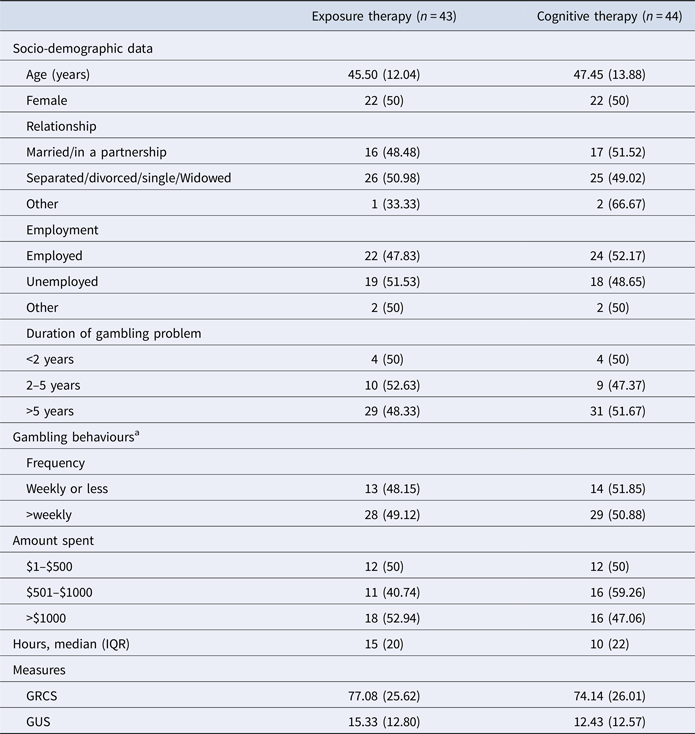
This study focused on putative change processes using data collected from trial participants during the intervention period. The average intervention period for study participants was one therapy session every 2 weeks, for approximately 18 weeks (Smith et al., Reference Smith, Battersby, Harvey, Pols and Ladouceur2015). Participant socio-demographics and baseline clinical measures are presented in Table 1. Applying DSM-IV-TR criteria, 83 out of 87 (95.4%) participants were diagnosed pretreatment as pathological gamblers, based on clinical assessment undertaken by study therapists. The treatments were manualised, and therapist fidelity was independently assessed using audio-recorded therapy sessions. Participants were classified as treatment drop-outs if they stopped attending therapy before completion of the therapy program — either without discussion with the therapist or when the therapist believed the participant was in need of further therapy. A detailed description of the study protocol and treatment conditions has been reported elsewhere (Smith, Battersby et al., Reference Smith, Battersby, Harvey, Pols and Ladouceur2013).
Baseline Socio-Demographics and Clinical Characteristics

Note: GRCS = Gambling Related Cognitions Scale; GUS = Gambling Urge Scale.
Data are mean (SD), or n (%) unless otherwise indicated.
aBased on gaming machine use in previous month.
Treatments
SGTS therapists experienced in administering CT to individual problem gamblers delivered structured treatment according to a manual that outlined procedures for each of the 12 weekly sessions. The first three CT sessions involve development of participants’ measurable problems, and goals and analysis of a gambling session to identify erroneous beliefs. The therapist also explains the concept of randomness with examples, such as the independence and impossibility of controlling outcomes in tossing a coin. The ABCD (situation, thoughts, behaviour, consequences) model is then introduced in Session 4 with exercises to focus on the gambling thoughts or ‘inner dialogue’. The ABCD model is then used in Sessions 5 to 7 to help the patient identify erroneous thoughts or ‘gambling traps’ that underpin the emotions that overwhelm reason, using practical exercises to help the patient organise and act upon thoughts. The final sessions focus on the patient skill development to challenge and cast doubt on the erroneous thoughts that lead to excessive gambling (Ladouceur et al., Reference Ladouceur, Sylvain, Boutin, Lachance, Doucet and Leblond2003).
Cognitive therapists’ training and supervision relating to the individual therapy component of this study was provided by Ladouceur et al. (Reference Ladouceur, Sylvain, Boutin, Lachance, Doucet, Leblond and Jacques2001, Reference Ladouceur, Sylvain, Boutin, Lachance, Doucet and Leblond2003) and a registered clinical psychologist with extensive training in CBT protocols. The supervisors also conducted therapist fidelity checks for both CT and ET groups. Two cognitive behavioural therapists provided CT; each therapist had qualifications in clinical psychology and 4–6 years of practical experience, including 2 years in treating individuals with gambling disorders.
The SGTS has established treatment methods and a treatment manual for the conduct of ET for up to 12 individual weekly sessions; these were used by therapists (Battersby et al., Reference Battersby, Oakes, Tolchard, Forbes, Pols, Zangeneh, Blaszczynski and Turner2008). The initial ET procedure is introduced in Session 2 and comprises a therapist guiding the patient through a scene that is usually audiotaped and then instructing the patient to imagine a typical gambling scenario (imaginal exposure). This is a graded experience, and the patient is asked to rate his or her urge to gamble at regular intervals while verbalising the scenario and to stay with the urge until habituation occurs. Habituation to urge usually occurs by the end of Session 5. In Sessions 6 to 10, patients are then introduced to a variety of graded, live tasks at gambling venues (in-vivo exposure) challenging the triggers of urges, and eventually, habituation of urges when sitting in a gaming room with a small amount of money and not experiencing an overwhelming urge to gamble (Battersby et al., Reference Battersby, Oakes, Tolchard, Forbes, Pols, Zangeneh, Blaszczynski and Turner2008).
Therapists who administered ET received supervision from MB. Fidelity checks of the audio recordings were also conducted by MB and RP. Exposure therapy was provided by two cognitive behavioural therapists with postgraduate qualifications in CBT: a registered mental health nurse and an honours psychology graduate with 10 years and 3 years’ clinical experience respectively, including 2 years in delivering CBT treatments to gambling patients at SGTS using the ET program.
All therapy sessions were audio-recorded and 20% were randomly selected from early, mid, and late study phases and checked for therapy fidelity by two independent clinicians for each study group. For this, a 9-item checklist was developed based on the Cognitive Therapy Scale (CTS), which is an 11-item instrument with good reliability when used by experienced clinicians (Smith et al., Reference Smith, Battersby, Harvey, Pols and Ladouceur2015; Young & Beck, Reference Young and Beck1980). Items 1 to 8 related to case conceptualisation for each therapy (response options: Yes/No/or N/A) and item 9 related to overall integrity (0–10 Likert scale).
Measures
During the treatment intervention period, a research assistant administered self-report measures of gambling related urge and cognitions to participants at the commencement of each therapy session. For treatment drop-outs, questionnaires were mailed out as per study protocol (i.e., 4 weeks and 12 weeks post final therapy session; Smith, Battersby et al., Reference Smith, Battersby, Harvey, Pols and Ladouceur2013). To improve response rates to mailed questionnaires, multiple contacts were implemented with phone calls and reminder letters.
Gambling Urge Scale (GUS)
This is a self-report questionnaire measuring the extent of gambling urge (Raylu & Oei, Reference Raylu and Oei2004b). The development of the scale was based on a questionnaire initially developed to assess craving in alcohol use disorder. GUS consists of six items rated on a Likert (1–7) scale, including statements such as ‘I crave a gamble right now’ and ‘All I want to do is gamble’. A final score is generated as a total of the response to each item. Higher scores indicate greater urges to gamble. Research into GUS psychometric properties in both community and clinical samples has shown the instrument to be both reliable and valid (Raylu & Oei, Reference Raylu and Oei2004b; Smith, Pols, Battersby, & Harvey, Reference Smith, Pols, Battersby and Harvey2013). Cronbach's alpha coefficient for baseline data in the current study was 0.96, indicating good internal consistency (Terwee et al., Reference Terwee, Bot, de Boer, van der Windt, Knol, Dekker, Bouter and de Vet2007).
Gambling Related Cognitions Scale (GRCS)
This is a self-report questionnaire that records common thoughts associated with gambling disorder (Raylu & Oei, Reference Raylu and Oei2004a). The development of the scale was based on ‘think aloud’ techniques where gamblers have verbalised their perceptions and beliefs during gambling activities (Gadboury & Ladouceur, Reference Gadboury and Ladouceur1989). The 23 items of the GRCS contribute to five subscales reflective of the broader categories of maladaptive gambling-related cognitions that have been described in the literature: interpretative bias (GRCS-IB; e.g., ‘Relating my winnings to my skill and ability makes me continue gambling’), illusion of control (GRCS-IC; e.g., ‘Praying helps me win’), predictive control (GRCS-PC; e.g., ‘Losses when gambling are bound to be followed by a series of wins’), gambling-related expectancies (GRCS-GE; e.g., ‘Gambling makes me happier’), and a perceived inability to stop gambling (GRCS-IS; e.g., ‘I can't function without gambling’), in addition to the scale total. Problem gamblers responded to items using a 7-point Likert scale (1 = strongly disagree, 2 = moderately disagree, 3 = mildly disagree, 4 = neither agree nor disagree, 5 = mildly agree, 6 = moderately agree, 7 = strongly agree) to indicate how much they agree with each of the statements. A total score is derived by summing the item values, where a greater score reflects more maladaptive gambling-related cognitions. Research into GRCS psychometric properties in a community sample has shown that total items are internally consistent and valid indicators of an overall latent construct, ‘gambling related cognitions’ (Raylu & Oei, Reference Raylu and Oei2004a). GRCS structural validity has also been confirmed in a a sample of treatment-seeking problem gamblers (Smith, Woodman, Drummond, & Battersby, Reference Smith, Woodman, Drummond and Battersby2016). The Cronbach's alpha coefficient for total GRCS items at baseline in the current study was 0.91, indicating good internal consistency (Terwee et al., Reference Terwee, Bot, de Boer, van der Windt, Knol, Dekker, Bouter and de Vet2007).
Statistical Analyses
Statistical analyses were conducted using Stata 14.1 software (StataCorp, 2015b). All available data were used and followed an intent-to-treat (ITT) principle to investigate any statistically significant differences between cognitive and exposure therapy across the study intervention period.
Corresponding with the study aim, the analysis sought to investigate whether the relationship among urge, cognitions and treatment group differed as a function of therapy phase. Questions seeking to address issues such as whether it is possible for the structural relationship between urge, cognitions and therapy type to differ at various change points can be sufficiently examined by adopting piecewise linear-mixed effects models (Flora, Reference Flora2008), a parsimonious modelling framework with stand-alone capabilities (Greene, Rolfson, Garellick, Gordon, & Nemes, Reference Greene, Rolfson, Garellick, Gordon and Nemes2015). By using a mixed-effects approach to model intra-individual change for distinct portions of therapy, each person acts as his or her own control. As a result of compartmentalising variance in this way, most participant-to-participant variability can be explained by intervention effects, thus enhancing study power (Guo, Logan, Glueck, & Muller, Reference Guo, Logan, Glueck and Muller2013). Further, the availability of more frequent observations increases the precision with which parameters of change are estimated for different portions of treatment (Laurenceau et al., Reference Laurenceau, Hayes and Feldman2007).
The fixed effects (time-invariant variables) in these models consisted of intervention group (CT or ET), continuous time (intervention period), and interaction between group and time (group X weeks). Treatment effect estimates were adjusted for any baseline differences caused by chance. A covariate term was also included to adjust for the number of treatments received by individual participants. Random effects in the model were at study participant level and represented an upward or downward shift in the outcome measure from an average regression line and rate of change; an unstructured variance-covariance pattern was specified. This meant that participant-specific baseline scores (intercepts) and rates of change across time (slopes) were assumed to be correlated. This assumption was tested statistically by comparing the model with an unstructured pattern to a model with an independent structure (all correlations zero) using a likelihood-ratio test. Maximum likelihood estimation was used where both fixed effects and random effects contributed to the estimation of model parameters. Therefore, all available data were used in analyses, allowing those with only baseline data to contribute to the intercept estimates as well as the variance of the random intercepts.
The treatment group was included in the random component of mixed models to assess individual deviations from an average level or heteroskedastic effects specific to CT and ET (Rabe-Hesketh & Skrondal, Reference Rabe-Hesketh and Skrondal2012). Linear splines were estimated to evaluate the shape of the underlying relationship between dependent variables and change points during treatment (Rabe-Hesketh & Skrondal, Reference Rabe-Hesketh and Skrondal2012).
A range of knots, integral to piecewise linear models, were manually tested in order to best represent the first few weeks of treatment (i.e., ‘rapid response’) and then a second change point where CT or ET effects had a chance to unfold. Model selection was based on the Bayesian Information Criterion (BIC), which combines fit and complexity. The model with the smaller BIC value is considered to be better when comparing two models from the same data (StataCorp, 2015a). Knots tested for the first change point were 3, 4, 5, and 6 weeks. For the second change point, knots at 12 and 14 weeks were tested. Based on BIC values, the selected knots were at 4 weeks and 12 weeks of therapy to allow testing for differential treatment effects between intervals 0 to 4 weeks (phase 1), 4 to 12 weeks (phase 2), and 12 to 18 weeks (phase 3).
For each of the piecewise models, tests for interactions were used to assess the heterogeneity of treatment effects across different subgroups of treatment drop-out and treatment success. The null hypothesis tested was whether the treatment effect observed in the whole study sample was homogeneous across subgroups or whether the variation was too large to be accounted for by chance alone (Sormani & Bruzzi, Reference Sormani and Bruzzi2012). To do this for treatment drop-out, a binary variable that represented treatment completion status (completer vs. drop-out) was included as a three-way interaction effect, with time and treatment group for each portion of therapy in the GUS and GRCS piecewise mixed-effects models.
To identify treatment success effects, two outcome assessments from the main trial were used: self-report VGS self-harm subscale and clinician administered DSM-IV-TR (Smith, Battersby et al., Reference Smith, Battersby, Harvey, Pols and Ladouceur2013). The 15-item VGS self-harm subscale was utilised as the primary outcome measure in the main trial. This instrument measures the severity of problem gambling symptoms in the previous 4 weeks with scores ranging from 0 = no harm to self to 60 = high harm to self. The subscale has been validated for use in an Australian population (Ben-Tovim, Esterman, Tolchard, & Battersby, Reference Ben-Tovim, Esterman, Tolchard and Battersby2001), as well as a clinical population of problem gamblers (Tolchard & Battersby, Reference Tolchard and Battersby2010). A score of 21+ identifies a problem gambling. A binary variable for treatment success (vs. treatment failure/drop-out) was quantified as the proportion of patients who had VGS scores in the non-problem gambling range (<21) at final treatment and had experienced a reliable therapeutic change from baseline to treatment-end, dependent on the reliable change index (RCI). RCI was calculated using the formula SE diff = SDb∗21/2∗(1-r)1/2, where SE diff was the standard error of difference, SD b was baseline standard deviation and r was Cronbach's alpha coefficient for VGS at baseline (Jacobson & Truax, Reference Jacobson and Truax1991). A reliable change was indicated when the difference between treatment-end and baseline were outside the range of 1.96*SE diff with 95% confidence. Using the aforementioned criteria, 41 (47%) participants were classified as achieving treatment success.
DSM-IV-TR diagnostic criteria for pathological gambling were administered by the study therapists at pretreatment assessment and treatment-end. The criteria relate to the extent of persistent and recurrent maladaptive gambling behaviour using 10 questions with response options of ‘yes’ or ‘no’. A total score was obtained by summing across the 10 responses. A score of 5 or more indicated pathological gambling (APA, 2000). At treatment-end, 50 (57%) participants were rated as non-problem gamblers. Binary variables that represented VGS treatment success (VGS <21 plus reliable change) and DSM-IV-TR treatment success (DSM <5) were then analysed in separate GUS and GRCS piecewise mixed-effects models to test three-way interaction effects with time and treatment group.
As ML models were based on the assumption that data were missing at random (MAR), sensitivity analyses were performed via a pattern mixture approach with multiple imputation (MI). If data were missing not at random (MNAR), it was likely that the mean at follow-up (for participants for whom it was missing) was higher (GUS and GRCS) than predicted under MAR. Based on mean differences between baseline and follow-up for observed data, we used the distributions N (M = 3.0, SD = 10.0) for GUS, and N (M = 10.0, SD = 24.0) for GRCS, to summarise the assumed difference between MNAR and MAR.
Results
Implementation of CT and ET
For participants randomised to an intervention (n = 87), the median number of CT sessions was 8.5 (interquartile range [IQR], 4–11.5) and 5 for ET sessions (IQR, 3–9; p = .046). There was no significant difference in duration of treatment episode (weeks) between CT (median = 16.6; IQR, 11.9–24.1) and ET (median = 18.1; IQR, 12.0–28.7; p = 0.893). Based on therapist judgement, 41% (36/87) of participants were classified as treatment drop-outs: 31.8% (14) for CT, and 51.2% (22) for ET. Follow-up of all randomised individuals was attempted during the intervention period irrespective of treatment completion status.
Therapy fidelity checks indicated that the techniques of cognitive and exposure therapies were reproducible gambling-specific interventions. The overall mean treatment integrity score was 98.5% for CT (SD = 4.4%) and 99.5% for ET (SD = 2.8%). There was no evidence of cointervention bias from techniques being introduced by a therapist from an alternative therapy.
Measurement Response Rates
The average number of GUS and GRCS assessments per individual was 6.3 (range, 1–14) and a total of 551 observations across the 18-week intervention period. By phase, the average number of assessments per individual was: phase 1 = 2.8 (SD = 1.2), phase 2 = 3.4 (SD = 1.7), and phase 3 = 2.0 (SD = 1.2). For CT participants, data were available for 93.2% (41/44) on at least one follow-up occasion post-baseline and 88.4% (38/43) for ET.
A sensitivity analysis for GUS data indicated that treatment effect estimates were similar for observed data (βET-CT = −2.50; 95% CI [−6.48, 1.49]; p = .216), under MAR conditions (βET-CT = −2.36; 95% CI [−6.47, 1.75]; p = .256), and MNAR (βET-CT = −2.25; 95% CI [−6.63, 2.13]; p = .309). These results suggested mixed models were plausible under MAR assumption for participants with baseline data only. Similar patterns of estimates were found for the GRCS measure.
Piecewise Linear Mixed-Effects Models
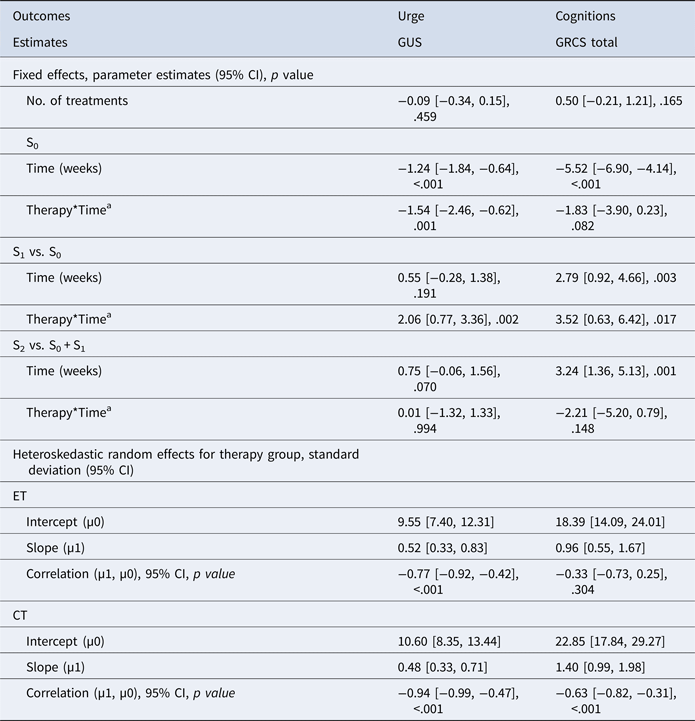
Using all available data for the study intervention period, a likelihood-ratio test comparing a mixed-effects model with one-level (fixed effects) ordinary linear regression was highly significant and indicated that there was sufficient individual variability across the intervention period to adopt a random effects component for measures GUS and GRCS (p < .001). Therefore, piecewise linear heteroskedastic mixed-effects models were used to analyse repeated continuous measures for GRCS and GUS total scores to determine whether their association with the treatment group differed significantly as a function of therapy phase. The results are shown in Table 2 and described below.
Intent-to-Treat Analysis (n = 87): Association Between Gambling Symptoms and Therapy Group in Piecewise Linear Heteroskedastic Mixed-Effects Models

Note: GUS = gambling urge scale; GRCS = gambling related cognitions scale; CI = confidence interval; ET = exposure therapy; CT = cognitive therapy; S0 = slope if time < 4 weeks; S1 = slope if 4 ≤ time < 12 weeks; S2 = slope if 12 ≤ time ≤18 weeks.
aCoefficient for interaction term is the difference between ET and CT population slopes.
Gambling urge
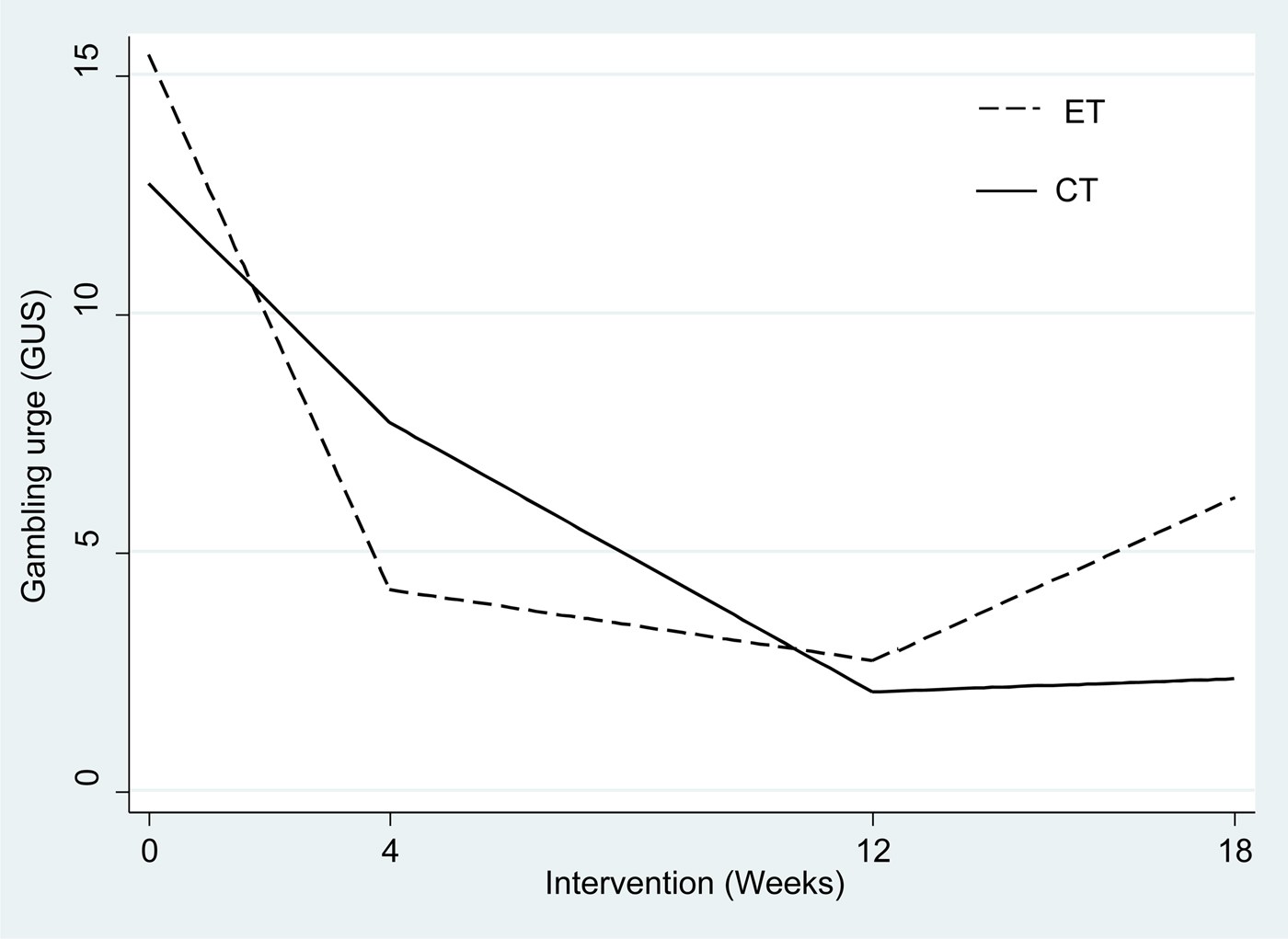
Figure 1 shows a plot of predicted estimates from the GUS mixed model. For phase 1 (baseline to 4 weeks), ET individuals experienced a statistically significant faster rate of reduction in gambling urge (i.e., improvement) compared to CT participants (p = .001). As shown in Table 2, CT participants then experienced a statistically significant improvement relative to ET participants in phase 2 (4 to 12 weeks; p = .002). There was no further improvement by either group in phase 3 (12 to 18 weeks), where trajectories of change tapered off at comparable levels (p = .994). When mixed-effects models were compared for unstructured versus independent covariance patterns, there was a statistically significant negative correlation between random intercept and slope for ET (−0.77) and CT (−0.94), with upper limits of 95% confidence intervals less than zero. This result indicated that problem gamblers with higher baseline scores were more likely to experience improvement at a faster rate. The participant-specific deviations from an average were homoskedastic across treatment groups (p = .578), meaning that the variation in individual trajectories from a population average did not significantly differ between CT and ET. The results of tests for three-way interaction effects across completers versus drop-outs were consistently in favour of the primary results in phase 1 (p = .102), phase 2 (p = .305), and phase 3 (p = .430), indicating weak evidence for subgroup heterogeneity. Similar patterns of results were found for treatment success as defined by VGS outcome (phase 1 [p = .689], phase 2 [p = .668], and phase 3 [p = .082]); and DSM-IV-TR (phase 1 [p = .089], phase 2 [p = .363], and phase 3 [p = .409]).
Mean trajectory of GUS for exposure therapy (ET) and cognitive therapy (CT) from piecewise linear model.

Gambling cognitions
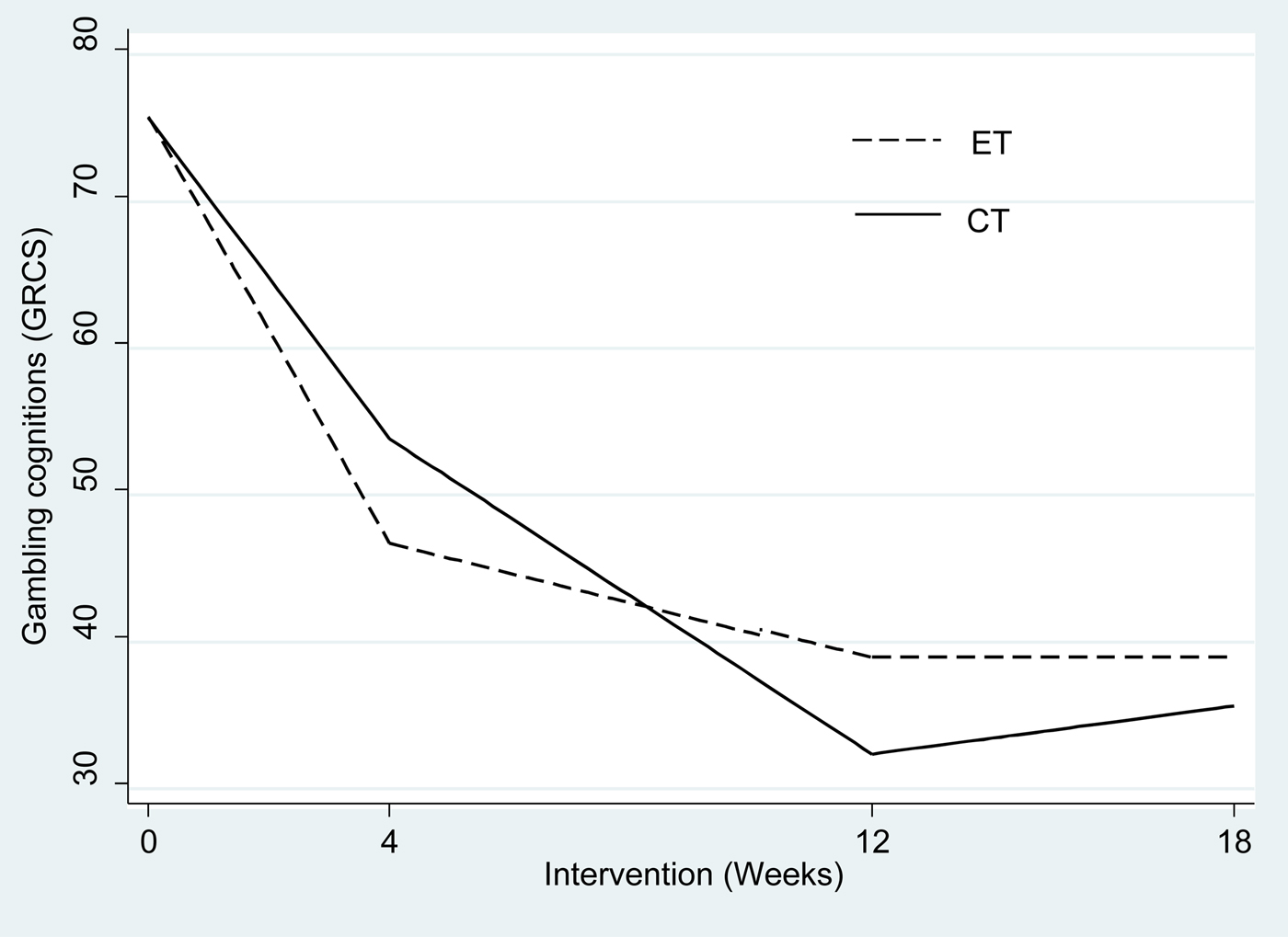
Figure 2 shows a plot of predicted estimates from the GRCS mixed model. In phase 1, both ET and CT experienced similar reductions (improvement) in GRCS scores (p = .082; Table 2). CT participants then experienced a statistically significant improvement relative to ET participants in phase 2 (p = .017). No further significant improvement occurred for either group in phase 3, and trajectories of change were similar, with a levelling-off effect (p = .148). When statistical models were compared for unstructured versus independent covariance patterns, results showed a significant negative correlation between random intercept and slope for CT participants (-0.63), but not for ET participants. This indicated that CT problem gamblers with higher baseline scores were more likely to experience an initial faster rate of improvement compared to ET individuals. Based on the random-effect estimates in Table 2, the participant-specific deviations from an average appeared to be more variable in the CT group. The participant-specific deviations from an average were homoscedastic across treatment groups (p = .481). Tests for subgroup heterogeneity indicated that any variation was most likely accounted for by chance alone in treatment completers versus drop-outs (phase 1 [p = .815], phase 2 [p = .756], and phase 3 [p = .792]), VGS outcome (phase 1 [p = .398], phase 2 [p = .351], and phase 3 [p = .658]); and DSM-IV-TR (phase 1 [p = .763], phase 2 [p = .878], and phase 3 [p = .999]). These results supported those of primary GRCS findings, that is, CT versus ET effects in the whole study sample were homogenous across subgroups.
Mean trajectory of GRCS for exposure therapy (ET) and cognitive therapy (CT) from piecewise linear model.

Discussion
This analysis of data derived from a randomised trial involving treatments for gambling disorder sought to illuminate underlying profiles of in-treatment change processes. During phase 1 (i.e., 0 to 4 weeks) of the intervention period, those receiving ET treatment were observed to have a statistically stronger reduction in gambling-related urge compared to CT participants. This discrepancy constituted a plausible signal of ET change processes, incorporating the assumption that therapy non-specific effects were approximately similar between groups. Previous GUS validation studies have shown that even a few symptoms of gambling-related urge are sufficient indicators of a person being a problem gambler (Raylu & Oei, Reference Raylu and Oei2004b; Smith, Pols et al., Reference Smith, Battersby, Harvey, Pols and Ladouceur2013). For GRCS scores in early treatment, the best estimate of the population difference between treatments and range of plausible values (95% confidence interval) generally possessed small effect sizes (Raylu & Oei, Reference Raylu and Oei2004a). At phase 2 (i.e., 4 to 12 weeks), CT participants experienced a faster rate of improvement in the GUS and GRCS composite scores, although for both CT and ET there was significant heterogeneity in individual treatment response patterns on both measures. A statistically strong correlation between baseline scores and rates of change across time was found for GUS in CT and ET, and GRCS in CT.
These results extend new insight into the action of core therapeutic components underpinning gambling disorder-specific CBT. The small number of existing studies using pre-post designs has produced mixed findings. Echeburua et al.’s (1996) trial indicated that a more ‘cost-effective’ individual exposure-based program led to higher success rates compared to group cognitive restructuring on its own, and combined with exposure. On the other hand, Jimenez-Murcia and colleagues’ (2012) study suggested that CBT alone versus CBT plus exposure generated similar outcomes at treatment-end, although findings may have been limited owing to the quasi-experimental design.
So, how can findings from this study assist researchers and clinicians in everyday gambling help service contexts? The substantial variation in trajectories of change during therapy at the individual and symptom subtype levels suggests that the emphasis on cognitive or exposure aspects of therapy should remain flexible and determined by the symptoms reported by the individual seeking treatment. The identification of trigger points for critical change processes in both CT and ET will help inform the development of a more streamlined gambling-specific, cognitive-exposure therapy program. This suggests benefits are afforded by intensifying the required treatment specificity within a limited number of sessions. Both urge and cognitions have been recognised as antecedents to relapse in gambling disorder (Hodgins & el-Guebaly, Reference Hodgins and el-Guebaly2004; Oakes et al., Reference Oakes, Pols, Battersby, Lawn, Pulvirenti and Smith2012; Raylu & Oei, Reference Raylu and Oei2002; van Holst, van den Brink, Veltman, & Goudriaan, Reference van Holst, van den Brink, Veltman and Goudriaan2010) and as phasic or transient processes; that is, they are generally responsible for the ‘push’ towards relapse and when relapse occurs (Hendershot, Witkiewitz, George, & Marlatt, Reference Hendershot, Witkiewitz, George and Marlatt2011; Oakes et al., Reference Oakes, Pols, Battersby, Lawn, Pulvirenti and Smith2012). Targeting these constructs promptly in treatment may, at the very least, reduce the intensity of gambling following an early relapse. Indeed, neuroimaging research has previously established links between gambling disorder and substance use disorder (Paris et al., Reference Paris, Franco, Sodano, Frye and Wulfert2009; Tamminga & Nestler, Reference Tamminga and Nestler2006) where analogous urge or craving states experienced by individual users are central to relapse after a period of abstinence (Bohn, Krahn, & Staehler, Reference Bohn, Krahn and Staehler1995; Tiffany, Reference Tiffany1992). Alongside craving, both implicit (or automatic) and explicit (or controlled) cognitive processes have also been established as playing a key role in relapse in substance related problems (Marhe, Waters, van de Wetering, & Franken, Reference Marhe, Waters, van de Wetering and Franken2013).
Introducing exposure tasks at the beginning of treatment to patients who present with gambling-related urges means they would receive a therapy with a rapidly acting mechanism via a relatively simple technique. ET directly targets the actionable events and responses concerning gambling-related arousal. This approach remains commensurate with the empirically grounded clinical perspective advising that gambling urge should be targeted early in treatment (Vale, Smout, & Blaszczynski, Reference Vale, Smout and Blaszczynski2015). A single session of exposure for gambling disorder has also been shown to be clinically efficacious in short- and long-term follow-up (Tolchard, Thomas, & Battersby, Reference Tolchard, Thomas and Battersby2006). Further, if exposure were to be prioritised in the first or second session, sufficient time would remain to permit introduction of cognitive work, as the average duration of a full gambling disorder-specific exposure session has been found to be relatively brief — approximately 43 minutes (Smith et al., Reference Smith, Battersby, Harvey, Pols and Ladouceur2015). The early initiation of ET may then provide the ‘royal road’ to cognitions and enable optimal conditions for CT, commonly taking several weeks to fully implement (Beck, Reference Beck1991; Friedman & Thase, Reference Friedman, Thase, Fatemi and Clayton2008; Ougrin, Reference Ougrin2011). CT includes patients identifying erroneous thoughts or ‘gambling traps’ that underlie emotions overwhelming reason, and the acquisition of skills to challenge and debunk inaccurate thoughts leading to excessive gambling.
Ultimately, the ET-CT dose-response relationship should be managed through collaborative empiricism between therapist and patient, who jointly develop hypotheses about the patient's cognition and urge patterns. This partnership would enable patient-wise adjustments in treatment levels and treatment types (Friedman & Thase, Reference Friedman, Thase, Fatemi and Clayton2008; Laurenceau et al., Reference Laurenceau, Hayes and Feldman2007) while augmenting patient self-efficacy through strengthening their sense of control of gambling urges and cognitions (Larimer, Palmer, & Marlatt, Reference Larimer, Palmer and Marlatt1999). If improvement in these symptoms are not observed early in therapy, treatment should address other patient vulnerabilities to sustain more durable outcomes, including treatment continuation (Vale et al., Reference Vale, Smout and Blaszczynski2015). This has important implications for the current study as the degree of premature drop-out was notable; so, too, was a substantial proportion of patients who reported significant levels of psychological disturbance at pretreatment (Smith et al., Reference Smith, Battersby, Harvey, Pols and Ladouceur2015). The highly structured, goal-oriented techniques of CT and ET may have lacked scope and traction for those struggling with other conditions where patients may be too distracted or less willing to focus on engaging in therapy and resultantly terminate their treatment. Also, specific components of therapy may have been less tolerated by individuals. For example, qualitative interviews with trial patients indicated that imaginal tasks in the early phase of treatment were a potential deterrent to therapy adherence due to a perceived inappositeness of eliciting a gambling urge in the ‘office’ (Smith, Pols, Lavis, Battersby, & Harvey, Reference Smith, Pols, Lavis, Battersby and Harvey2016). Adjunct interventions early on in treatment, such as motivational interviewing (MI), may help to retain the problem gambler in therapy long enough to experience benefits from gambling-specific mechanisms of change. Importantly, there may have been some cases who were classified as ‘drop-out’ but in fact had achieved their personal goals relatively early in therapy and consequently self-terminated treatment based on a decision that any further involvement would not provide additional benefits (Hembree et al., Reference Hembree, Foa, Dorfan, Street, Kowalski and Tu2003).
Expanding mechanisms of CBT for gambling disorder will help illuminate the connections between therapy components and assorted outcomes such as treatment success, failure, and drop-out. Further, the concepts of treatment ‘success’ and treatment ‘completion’ also require more explicit delineation, as even regularly treated patients may not be abstinent or in remission of gambling disorder. Problem gamblers with more severe difficulties and co-occurring conditions (e.g., depression) may need more time and effort in treatment to produce meaningful and reliable therapeutic change (Melville, Casey, & Kavanagh, Reference Melville, Casey and Kavanagh2007). While treatment effects were mostly homogenous for the whole cohort in this study, more targeted subgroup analyses involving large sample sizes is recommended.
Despite the mechanisms underpinning behavioural interventions for gambling disorder still being poorly understood (Potenza et al., Reference Potenza, Balodis, Franco, Bullock, Xu, Chung and Grant2013), neuroimaging studies have established links between intensities of self-reported gambling urges and changes in brain activity — including retrieval and processing of emotion and impulse regulation (Balodis, Lacadie, & Potenza, Reference Balodis, Lacadie and Potenza2012; Potenza et al., Reference Potenza, Steinberg, Skudlarski, Fulbright, Lacadie, Wilber and Wexler2003). Perhaps studies of brain mechanisms in other related disorders such as substance use disorders offer some early insights facilitating the integration of a neuroscience perspective into gambling disorder therapy. For instance, in tobacco use disorder, functional magnetic resonance imaging showed that cue exposure tasks attenuate amygdala response to smoking cues over a 2–4 week treatment phase. The amygdala is a key structure due to it possessing an important role in the evaluation of the emotional or reward content of stimuli (McClernon et al., Reference McClernon, Hiott, Liu, Salley, Behm and Rose2007).
Limitations
This study, like all studies, has a number of limitations that need to be declared. A main limitation of this secondary analysis was that the findings were predicated on a small number of subjective instruments used to assess gambling symptoms. Missing data for some participants constituted a further shortcoming of this study. However, sensitivity analyses indicated that departures from the MAR assumption did not have a discernible impact on treatment-effect estimates. Treatment attrition may have also resulted in a loss of study power towards the end of phase 3 (12 to 18 weeks) due to treatment drop-outs reducing the number of completed GUS and GRCS assessments. Yet, the GUS slope estimate was very close to zero, and the 95% confidence interval (a function of sample size) was narrow, suggesting a high degree of accuracy. The GRCS estimate was less precise, with a possible group difference as great as 5.20 points, but population differences were more likely to be near the middle (i.e. βCT-ET = 2.21). Another limitation was that the generalisability of findings is restricted to a small group of help-seeking individuals where the primary gambling form was EGM use. Further advances in the understanding and treatment of different subgroups of problem gamblers is needed — for instance, multiple gambling activities versus participating in one gambling activity.
Future Research
More work is required to formally reveal change processes in gambling disorder based on recommended criteria (Kazdin, Reference Kazdin2007), where questions such as ‘What is the extent of the dose-response relationship between the application of imaginary exposure tasks and gambling related urge?’ and ‘Does a person's acquisition of more accurate gambling related beliefs precede a desired outcome — such as abstinence?’ need to be resolved. Aside from standard quantitative approaches, different types of studies, including qualitative interviews, would help to further unpack these issues by expanding explanatory capacity. Further, the specific role of CBT homework compliance on temporal changes in gambling-related urge and cognitions needs to be investigated under RCT conditions. It is possible that this relationship plays a central role in determining the observed outcomes. In a naturalistic study involving help-seeking problem gamblers, Riley (Reference Riley2015) found that engaging in homework has a strong association with immediate and short-term outcome.
Conclusion
The findings of this study provide evidence for ET being associated with faster initial change in urge, compared to CT, among problem gamblers in a community-based gambling help service. Results from these data have implications for further treatment development, including a combined cognitive and exposure approach that is flexibly adapted to the patient. Further testing remains to be done within a larger and more definitive trial context. This would enable the formal establishment of mechanisms and mediators, and subsequent ascertainment of what works for whom. Such information would provide therapists capacity to offer each patient a clear direction and an expedited pathway to their desired therapy outcome.
Funding
This work was funded by the Victorian Department of Justice, Office of Gaming & Racing (tender 061/09), and management of the grant was transferred to the Victorian Responsible Gambling Foundation in July 2012. The SGTS was funded by the Office of Problem Gambling, Department of Families and Social Inclusion, Government of South Australia.
Conflict of Interest
None.