“The Stranger”
On 6 January 1943 it was Alfred Schutz's turn to present his work in front of his colleagues in the “General Seminar” of the Graduate Faculty of the New School for Social Research.Footnote 1 Five years had passed since the day he received the news that his native Vienna was annexed to Hitler's Germany, and that he should find a shelter outside Austria.Footnote 2 Schutz chose New York City to be his new home, whither he moved together with his family. Despite his impressive list of scholarly contributions, until late in his life Schutz was not a full-time academic. In Vienna he led a career as a legal consultant, while maintaining his involvement in serious intellectual and musical undertakings. Coming to New York, Schutz was lucky enough not only to win a position with Reitler and Co. Bank, his former Vienna employer, but also to become involved with the “University in Exile” of the New School for Social Research.
The “General Seminar,” the forum where Schutz delivered his lecture, was the crown jewel of the New School's “Graduate Faculty,” where all the members could come together for a weekly discussion about themes of general relevance.Footnote 3 The majority of the seminar participants were German émigrés, who had escaped Germany with the rise of Nazism, almost a decade earlier.Footnote 4 On the face of it, the “General Seminar” seemed to be the ideal audience for Schutz's new lecture, which he titled: “The Stranger.”Footnote 5
In this study Schutz intended to “study in terms of a general theory of interpretation the typical situation in which a stranger finds himself in his attempt to interpret the cultural pattern of a social group which he approaches and to orient himself within it.” The term “stranger,” according to Schutz, refers to “an adult individual of our times and civilization who tries to be permanently accepted or at least tolerated by the group which he approaches.” The paradigmatic example for such a stranger is, according to Schutz, the immigrant.Footnote 6 While the immigration experience was hardly foreign to any of the participants in this conversation, Schutz's presentation was ill-received. Schutz, taken aback by the harsh criticism, reported about it to his surprised close friend, the political scientist Eric Voegelin. In the letter, Schutz expresses his doubts regarding the desirability of publishing the article, “because I am a stranger myself and, in this regard, I am confronted with a rather delicate situation.”Footnote 7
In order to understand the negative reaction to Schutz's presentation we will have to pay attention to a conference that was held in the New School a few years prior to Schutz's lecture, on the occasion of the Graduate Faculty's fourth anniversary. The conference focused, similarly to Schutz's lecture, on the question of immigration.Footnote 8 Both the diagnosis and the prognosis of the 1936 conference, however, could not have been more different. The bottom line of the 1936 conference was that the conditions of immigration have no substantial effect on the intellectual. The intellectual, they argued, is, by definition, a stranger in his own home. The philosopher and theologian Paul Tillich, for example, declared that “there is … an essential relationship between mind and migration.” The experience of immigration, he explained, is a necessary step in the intellectual's liberation from national parochialism and, therefore, essential to the production of universal knowledge.Footnote 9 Schutz, in his lecture, took the opposite approach. Immigration, according to him, is nothing less than an existential crisis. The assimilation of an adult into a new culture is, for several different reasons, impossible. The immigrant, he argued, will have to compromise on essentially inadequate translations, and get used to an incessant state of frustration. The cause for the immigrant's frustration is the impotency of the “recipes” that were perfectly adequate in the native culture but, when implemented in the new context, fail to provide the expected results.Footnote 10
Two fundamental questions stood at the center of this debate. The question about the repercussions of the immigration process was entangled with the question about the nature of intellectual work and its representation. Both parties, so it seems, could only answer the first question, through the perspective set by their answer to the latter. Schutz did not think of the intellectual as transcendent to society, but as an integral part thereof. The intellectual, he believed, is as entangled in language and the practicality of everyday life as any other person. From the perspective of his German colleagues, who saw in their forced exile an opportunity to transcend into a higher realm of culture and morality, Schutz's approach might seem petty.Footnote 11 Schutz, nevertheless, had to agree with Voegelin, who explained the German grandiosity by referring to their sheltered existence. “As a result of their isolation at the New School,” he argued, they “have not yet gotten through the transition period you speak of and, for that reason, are overly sensitive about it.”Footnote 12
In his lecture Schutz argues that in order to navigate in society, to do things, to understand others, and to be understood by them, one employs “recipes” that guarantee that a specific set of actions will yield desired results. When those “recipes” become “unworkable,” as happens in the process of emigration, “a ‘crisis’ arises.”Footnote 13 In normal situations those “recipes” are understood by the member of the in-group as the way in which things are done. “We may say,” Schutz argues, “that the member of the in-group looks in a single glance through the normal social situations occurring to him and that he catches immediately the ready-made recipe appropriate to its solution.”Footnote 14 Intellectual work is no exception in Schutz's world. The practicality of the everyday life of the intellectual is also composed by a plethora of recipes. The present paper will focus on one of them: the formation and participation in “intellectual Kreise (circles).”
Participation in intellectual Kreise was integral to the life of the intellectual in interwar Vienna.Footnote 15 This article argues that the Viennese Kreis culture continued to play a role in the émigrés’ lives even after they emigrated to America. In line with Schutz's description, we will see how the émigrés attempted to use this “recipe” in order to “act” as intellectuals in their new homes, and to make sense of their recipient culture. As Schutz predicted, the attempts to use this old recipe in new environments resulted, many times, in disappointments and misunderstandings. In other cases, however, the émigrés were able to come to terms with the demands made by their new environments, and to contribute to it. Successes or failures notwithstanding, the group of Viennese émigrés we will follow here shared a specific worldview. They all shared the ideal of an involved intellectual who exists in culture and society rather than outside or above it. To be sure, the leisure to participate in intellectual Kreise reflects a relative freedom from mundane obligations, to the same extent that it reflects the value they ascribed to intellectual and cultural engagement that extended beyond their professional engagement. Unlike Schutz's German colleagues, his Viennese friends believed that the life of the mind should not be lived in isolation and in separation from the social process, and that an “objective” worldview should be acquired from the “inside” rather than by gaining distance.
In Vienna, Schutz was a member of the Geistkreis, an interdisciplinary intellectual circle. This essay argues that the Geistkreis members can serve as an example of a distinct type of intellectual life, to which participation in a Kreis was not a luxury, but rather a way to satisfy a certain need. Both this need and the recipe for its satisfaction were not properly understood or recognized by their new colleagues in the United States. In certain cases, American institutions subscribed to the intellectual ideals brought from places like Vienna, but could not replicate the social and cultural contexts that made these ideals both realizable and desirable.
The Kreis—as a practice, a concept, a model, and a tradition—makes an interesting case study for transnational intellectual history because it captures a mid-register between individuals and institutions, between the personal and the public spheres, and between formal and informal forms of sociability. The Kreis was, on the one hand, not an established institution that could travel as an institution. But, on the other hand, it was interpersonal by nature, i.e. it demanded cooperation between the émigré and his new environment.
The study of intellectual life in motion usually focuses on ideas, texts, knowledge production practices (both explicit and tacit), and so forth.Footnote 16 One aspect that is often lost, however, in the study of intercultural translations, is the role of the scholarly persona. Gadi Algazi defines persona as “a cultural template for a codified social role,” i.e. sets of ideas, practices, and forms of presentation and socialization that are shared in specific intellectual communities and define them.Footnote 17 Algazi reminds us that the persona—as a cultural model—is not fashioned by the actors but reflects a compromise among diverse external forces.Footnote 18 In Vienna, participation in Kreise was embedded in the shared notion of scholarly persona and thus became essential to both the self-understanding and the self-fashioning of individuals as scholars. This feature of intellectual life, however, relied on external forces and conditions, such as the meager opportunities for pursuing an academic career in Vienna, the anti-Semitic hiring policy at the university, the light workload of white-collar workers, the domestic division of labor of the bourgeoisie family that enabled men to spend long hours outside the domestic sphere, and even the density level of the urban space. After emigration, the émigrés still defined themselves as intellectuals using their old cultural templates, and they acted according to their old recipes. Those models and recipes, however, were not recognized by their new peers, and did not sit comfortably with the external forces that were in play in their new society. The Kreis is of a particular interest to the study of scholarly personae in motion and translation because, by definition, it presupposes an active collaboration with others. The necessity to cooperate with others, who do not necessarily share the émigré's image of scholarly life, raised the tension between the émigré and his surroundings, and thus revealed the underlying forces that shaped the different scholarly personae in both the originating and the receiving cultures.
Different Geistkreis members resorted to the Kreis in their life as émigrés in the United States in a variety of ways. By exploring a number of case studies I show that that, after emigration, the Kreis served three distinct roles in the lives of the Geistkreis members. First, the émigrés remained in touch; the Kreis was, for them, a social network on which they could rely. Second, the Kreis was an idea through which they interpreted the new intellectual world they encountered. Finally, the Kreis was a model that they tried to adapt to their new social contexts.Footnote 19 Their experience with the Kreis culture of interwar Vienna, I argue, is key for understanding their later engagements with the American intellectual world. Therefore, before we can proceed to the case studies we should acquaint ourselves briefly with Kreis culture in general, and with the Geistkreis in particular.
The Geistkreis and other Kreise
The Kreis was a popular form of organization in the modern German-speaking world. Kreise were gathered around political, artistic, and intellectual causes. In most cases, Kreise were assembled around charismatic leaders.Footnote 20 In interwar Vienna, the best-known Kreis is, undoubtedly, the Wiener Kreis (the Vienna circle). Mortiz Schlick and his Kreis, however, worked in a very dense network of overlapping intellectual, artistic, and political Kreise that penetrated every corner of the public, intellectual, and cultural life of interwar Vienna. There is no single explanation for this booming culture of intellectual Kreise. Possible explanations include the long tradition of intellectual and artistic novelty organized outside formal institutions, the existence of a large and affluent middle class centered in what used to be the capital of a vast empire that did not shrink in proportion to its loss, or in some disciplines the limited capacity of the local university, which could not contain the bubbling intellectual scene (especially considering its anti-Semitic hiring policy).Footnote 21 Either way, Vienna's intellectual Kreise became, by the late 1920s, central hubs for intellectual exchange. For aspiring intellectuals, participation in such Kreise was essential for sharpening their scientific arguments and their social skills alike.Footnote 22 In Vienna, we might say, it was not that the intellectuals assembled themselves into Kreise, it was the participation in those Kreise that made them intellectuals in the first place. It was an essential component of their intellectual persona.
The intricate network of Kreise in Vienna enabled and supported a robust intellectual and artistic scene that far exceeded the limits of the university or similar official institutions. Many of the great artistic, intellectual, and political projects and movements since the turn of the century—such as logical empiricism, psychoanalysis, the secession, the Austrian school of economics, Zionism, to name only a few notable examples—took shape around such Kreise. Frequent personal contact helped to maintain the creative spirit and to push those movements forward. The many points of intersection between the different Kreise, and especially those individuals who participated in multiple Kreise, created, according to Timms, the unique Viennese flavor of interdisciplinary cross-fertilization that could not be found in comparable metropolitan centers.Footnote 23 The coming together of professional scholars with white-collar workers in those Kreise expanded the ranks of contributing amateur scholars. In sum, the intellectual infrastructure of interwar Vienna emphasized cross-disciplinarity, was based on lively discussion among peers, did not equate intellectual work with the professor's job, and in general did not see the university as having a monopoly on the production of knowledge. The Geistkreis members found their formation as young men and aspiring intellectuals in such an environment. This intellectual upbringing, this article shows, led to the development of a set of expectations, tastes, needs, and habits of mind which proved difficult to implement and satisfy in a foreign intellectual environment.
In this dense network of intellectual Kreise, the Geistkreis was, in more than one way, an outlier. The Geistkreis was formed in 1921 by Josef Herbert Furth and Friedrich Hayek, university friends who decided to form their own interdisciplinary Kreis.Footnote 24 The Geistkreis met regularly, once a month, until the Anschluss (1938).Footnote 25 The meetings were held in the private apartments of the members, and consisted of a paper presentation followed by vigorous discussion.Footnote 26 As a rule, the paper's topic was supposed to be other than the lecturer's central professional or intellectual interest, i.e. his “hobby,” rather than to conform to the main theme or purpose of the seminar.Footnote 27 The list of the topics included specific questions in economics, legal theory, political science, philosophy, and mathematics; general questions on methodology; discussions of current events and pressing social questions; both recent developments in and the history of the fine arts, music, and literature; and reports about trips they had taken, especially to the United States.Footnote 28
Another, not less important, distinctive structural difference was that unlike any of the above-mentioned Kreise, the Geistkreis did not have a charismatic older leader. Therefore it was not structured on the model of the university seminar and did not replicate its teacher–student relationship. The Geistkreis was by design an opportunity to form close friendships, and, therefore not a professional space per se.Footnote 29 All these distinctive features—interdisciplinarity, lack of an older charismatic leader, uni-generationality, and being located in a social rather than a professional space—not only set the Geistkreis members apart from their immediate intellectual environment, but also had an impact on their process of emigration, and the kind of experience they sought to re-create in their new environments.
The Kreis after emigration
It was the Anschluss that put the final nail in the Geistkreis's coffin and led many of its members to look for shelter overseas.Footnote 30 The members who emigrated to the United States found themselves scattered around the continent. Almost overnight, this group of friends had to adjust to living a considerable distance from one another, and to treating their rare meetings as a precious luxury rather than a regular daily occurrence. Nevertheless, the former Geistkreis members remained in touch. In some cases, it was only through the occasional letter or Christmas card, but in many others the written communication was very extensive and touched on every aspect of both their professional and personal lives. Setting aside the personal bilateral ties, this section discusses the different ways in which the Kreis, qua Kreis, remained relevant in the lives of the past Geistkreis members. We can count at least three distinct ways in which this group of people remained relevant in each other's lives after emigration: as an audience for the development of their respective intellectual projects, as a network for mutual aid, and finally, despite the geographical distance, in the (small- and large-scale) “reunions” that former Geistkreis members tried to arrange.
The story of Eric Voegelin can serve as an example of the vicissitudes of the emigration process, and the cushioning role the Geistkreis offered. A founding member of the Geistkreis, Voegelin was also its most prolific member. After the annexation, Voegelin, who “had never made any secret of my anti-National Socialist attitude,” was fired from the University of Vienna, and prepared his escape route.Footnote 31 After countless attempts to find a university position, he finally secured a one-year fellowship at Harvard, a post that led eventually to a permanent position at Louisiana State University (LSU). While he was considered for positions at Yale (an “intellectual slum,” in his words), Harvard (an “intellectual brothel”), and the New School, he remained at LSU until 1958, when he was invited to take Max Weber's former chair and to establish the Institut für Politische Wissenschaft at Ludwig Maximillian University in Munich.Footnote 32
During his time in Baton Rouge, Voegelin felt particularly secluded. Unlike many of his friends who found themselves in larger and more central metropolitan areas, where they had other Viennese émigrés around them, Voegelin had to make do with what he found in the Deep South. And, in his opinion, it was not much. More than any of his friends, Voegelin found himself reliant on the Geistkreis network in order to find an audience and a critical eye as his work progressed. Perloff describes how her father, Maximillian Mintz, another prolific contributor to the Geistkreis, read and commented on Voegelin's manuscripts.Footnote 33 Other close collaborators were Alfred Schutz, the lawyer-turned-musicologist Emanuel Winternitz, and the historian Friedrich Engel-Janosi. Their correspondence sometimes seems like an academic workshop, where all the parties to the conversation dissect and criticize each other's works. This close network of collaborators suggests that though he moved to Louisiana, Voegelin “brought” his original Viennese network with him.
This long-distance academic relationship, however, was anything but seamless. A case in point: on 2 January 1951, Voegelin writes to Schutz that a long time has passed since he heard from him last, and indeed Schutz's last letter was sent to Voegelin on June of the previous year.Footnote 34 Four months later, on 15 April, Voegelin sends another letter asking Schutz whether he should interpret his long silence as a sign that something bad has happened to either him or his family. In response, a week later, Schutz writes that he “got the impression from some of your earlier letters that in your opinion our ways had parted and that you no longer wanted to have me participate in your work.” He admits that “this impression was very painful to me.” Schutz tells Voegelin that he tried to write him several times, but each time refrained from sending the letter because he was afraid that it would just make the situation worse. “I didn't want to play the role in your life that Felix Kaufmann did,” referring here to their mutual Geistkreis friend “who, with his way of looking at science and the world, got on your nerves over a period of years.”Footnote 35 Thus Schutz reveals to us one of the many difficulties of maintaining a long-distance critical correspondence on intellectual matters; the communication from distance, and the reliance on the written word, make this difficult walk—a fine line that cuts between mere personal animosity and the brand of harsh criticism that the Geistkreis members were so proud of—almost impossible.
Unlike other intellectual Kreise, the Geistkreis was never meant to be a mere professional intellectual circle. The mutual reliance of the old Geistkreis friends exceeded the relief of the immediate repercussions caused by the sudden flight from Europe and penetrated into other aspects of their lives. A clear example is a circular letter dated 27 April 1945, sent by Alfred Schutz to the Geistkreis members concerning the financial state of one of their friends—the lawyer and economist Walter Froehlich. A chronic illness of Froehlich's wife drove his family to financial hardship that Schutz tried to rectify by collecting funds from their Geistkreis friends.Footnote 36 The Geistkreis came together not only in support of the living, but also in order to pay tribute to the dead. Felix Kaufmann passed away in New York in 1949. A year later, Furth wrote to the former members of the Geistkreis asking them to contribute an article for a special issue of Social Research.Footnote 37 This initiative did not come to fruition, probably due to the journal's misgivings, but signifies the kind of mutual responsibility the Geistkreis members felt towards one another, both in life and in death.
Meetings in larger groups were rare. On 1 June 1944, however, Engel-Janosi wrote to Voegelin to finalize the latter's traveling plans to come to visit him in Washington, DC. In the letter Engel-Janosi asked Voegelin if he would be able to give a “kind of English ‘Geistkreis’ talk” during his visit. Engel-Janosi promised Voegelin a distinguished audience that would include, in addition to the “largest part of the Geistkreis,” a number of other prominent intellectuals.Footnote 38 Voegelin's reservations in his response to Engel-Janosi's request open a window for us onto the cultural differences between Austrian and American intellectuals, as they were reflected in Voegelin's mind. Voegelin answered that “he is not sure that such a thing [a Geistkreis-style lecture] would be much appreciated by Americans.” Voegelin tells Engel-Janosi that he participated once in such a talk at Harvard, delivered by the German historian Eugen Rosenstock-Hussey. The American audience, Voegelin reports, had many comments about the “insolence of the Europeans, who believe that everybody has waited for them; who believe that everybody should listen to them.”Footnote 39 While he would be happy to meet their Viennese friends, he refused to have a Geistkreis-style talk with Americans, because “this can make you quite unpopular.”Footnote 40
Perloff describes in her memoir a rather less formal occasion for small-scale Geistkreis reunions—her mother's Jause (“that Austrian cross between a cocktail party and high tea”). The parties took place in their Riverdale apartment. Schutz, Kaufmann, Winternitz, and others who happened to be in New York City were invited, together with their wives, their kids, and other Austrian émigrés, to share wine, champagne, tea, and Brötchen. The luxury of meeting each other semi-regularly was reserved to the émigrés who settled in the Big Apple. Perloff reminds us, however, that for her parents, the convenience of having a considerable part of their old social circle around made their assimilation into American culture more difficult.Footnote 41
The Kreis as an idea
The encounter of our Viennese protagonists with the American university system was confusing for them, to say the least. The American academic system was very different from the system they knew from back home. Voegelin, then a research fellow at Harvard University, described to Schutz his new institution:
I have been intensely exploring the new milieu [Harvard University]. It is a very curious world, in which one must proceed cautiously in order not to give offense. A myriad of groups and circles [Kreisen und Gruppen] … The main thing I learned is that there is a taboo against asking questions. It is not polite to ask questions, and one doesn't get any answers. One acquires information only indirectly through incidental remarks in conversation and must put bits and pieces together oneself. The most extensive circle [Der weiteste Kreis], the one to which everyone belongs, is that of the university “officers” … This is subdivided into “departments.” Each department is a society in itself. For me this found expression in the fact that the dean's wife visited us and invited my wife to the department teas … As far as the exclusively male side is concerned, its center is the “Faculty Club” … Within each department there is a small circle [engerer Kreis], the “faculty,” which meets for faculty dinners. In particular, it seems to me, a certain differentiation takes place owing to the fact that in an organization of this size there is always a larger number of people whose scholarly qualifications are modest and whose intellect does not rise much above the mentality of a schoolteacher. It seems that a natural affinity brings this type together … naturally all of these relationships and connections extend in all directions into circles [andere Kreise] that reach beyond the university …Footnote 42
Voegelin's depiction of Harvard is utterly confusing. Voegelin himself was confused by the institutional structure of the university. He reports to his friend about a taboo against asking questions regarding the structure of the university and argues that such information can only be acquired sporadically and indirectly. Later on, Schutz will argue that the inability of the “stranger” to blend in in the new culture lies exactly there; nobody is able to present to the stranger the culture as a comprehensive and a consistent whole—not due to bad hospitality, but because, for the insider, culture, or any part thereof, does not appear as a coherent, spelled-out whole. This embedded perspective is the very thing the stranger is trying to learn and to imitate, i.e. the “thinking-as-usual” of the insiders, their intuitive understanding of their culture and its institutions and their ability to effortlessly navigate them.Footnote 43 The “stranger,” on the other hand, is bound by his attempts to understand the situation and to gain a clear and general representation thereof, to remain locked out of the world of the insider.
Admittedly, the Harvard of that period was a particularly difficult institution to navigate.Footnote 44 I suggest, however, that Voegelin's repetitive use of the word Kreis in this description amounts to more than a mere linguistic (mis)appropriation; it is a key to understanding his (mis)understanding of the institution. Two things are particularly striking in Voegelin's description: first, instead of turning to a “vertical” model that implies hierarchy, he chooses to talk about the university in a “horizontal” manner, as a “myriad of groups and circles.” Second, Voegelin treats equally elements that we would consider “professional” with elements we would consider “personal.” These two themes—the “horizontal” rather than “vertical” understanding of the university as an institution, and the ignorance in regard to the clearer demarcation between the professional and the personal—refer back to Voegelin's Viennese experience. The permeability of the Kreis culture and the intellectual scene in Vienna which came alongside a different family formation, especially in regard to men's household obligations, contributed to the misunderstandings between the Viennese émigrés and their new American colleagues.
The Kreis as a model
As noted above, Schutz argues that one of the sources of frustration and anxiety in the process of emigration is the impotency of “recipes.” The “recipes” that served the émigrés well in their native culture, when put to use in a new context, not only fail to deliver the expected outcomes but come across as strange or inexplicable. Schutz emphasizes that these “recipes” are not explicit rules of conduct, but more immediate and implicit maxims, that the subject performs, unwittingly, as if these were the only way in which a certain outcome could and should be achieved. A perfect example of the immediacy of the “recipe” can be found in the personal diary of the economist and former Geistkreis member Oskar Morgenstern.
On 27 December 1956, eighteen years after he made Princeton his new home following emigration, Morgenstern noted to himself in his personal diary, “I [have], unfortunately, an intellectual hunger. I do not know how I should change it. I want to have a circle soon, that will come here sometimes in the evenings, for example Gödel, Hempel, Quine, Wigner.—many. That can be set up. The Geistkreis was nice.”Footnote 45 The most striking feature of this quote is how quickly Morgenstern jumps from the definition of the problem (“intellectual hunger”) to the proposed solution (“I want to have a circle soon”), as if the latter is the most obvious and natural solution to the former. This short journal entry, however, should be read not as a mere personal story, but rather as a diagnosis and a prognosis of a situation shared by a specific group of émigrés. Other Geistkreis members found themselves suffering from the same “intellectual hunger” and prescribed for themselves a similar cure “to have a circle.” Unlike Morgenstern, however, some of the past Geistkreis members took steps to make such Kreise a reality. The remainder of this article will focus on two case studies: Fritz Machlup's unhappy experience with the Economic Reading Club at the University of Buffalo in the 1930s, an episode that was partly remedied by his tenure as the president of the “History of Ideas Club” at Johns Hopkins in the early 1950s and the “experiment” that Friedrich Hayek conducted at the University of Chicago in the 1952–3 academic year.
Fritz Machlup, work–life balance, and the place of ideas
In Vienna, Fritz Machlup was the heir to his family business, which included a number of cardboard mills. His interest, however, from an early age was in the study of economics. Machlup did whatever he could in order to land an academic job in Vienna. He was soon to discover the low ceiling that was waiting for a young Jew who was taking his first steps in the University of Vienna. While his application for Privatdozent status was ignored, Machlup was active on the Viennese intellectual scene. He served as Ludwig von Mises's personal assistant and was invited to participate in his Privatseminar, and in the Geistkreis. An academic career in Vienna, he reckoned, was well beyond his reach. The recession that hit Austria in the early 1930s, he recounted, was for him a blessing in disguise. His plummeting business could no longer serve as a good enough justification to reject the Rockefeller fellowship he was offered, and in 1933 he headed to the United States.Footnote 46 After two years as a Rockefeller fellow, Machlup won his first job as a professor of economics at the University of Buffalo. Machlup sold his business and made Buffalo a home for himself and for his wife and their two children. Not even a year passed before Machlup tried to form, in Buffalo, his own intellectual Kreis.
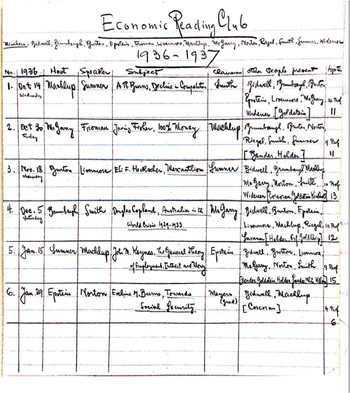
The first year of the Economic Reading Club was quite successful. The group consisted of the faculty of the Economics Department, and a small group of selected students. They met in the professors’ homes, and each meeting was led by a different professor and focused on a single book. The participants were expected to have read the book, and to address certain themes in accordance with Machlup's suggestions.Footnote 47 In the 1936–7 academic year the club convened six times. The first four meetings counted a steady audience of a dozen members. Attendance peaked at the fifth meeting, which was led by Machlup himself and dealt with Keynes's General Theory, which had been published the same year. The sixth and last meeting of the inaugural year of the Economic Reading Club was a bust, with only six members showing up (see Fig. 1).
“Economic Reading Club,” Fritz Machlup Papers, Box 274, Folder 5, Hoover Institution Archives. Copyright Stanford University.

In 1938, after spending a year at Cornell, Machlup was more determined than ever to build a Kreis for himself. In a letter to the faculty he declares that “enthusiastic economists have resolved to give every Friday evening to economic discussion.”Footnote 48 He also suggested changing the format: no longer a lecture to an unprepared audience, but a meeting for which everybody should come prepared. This format, he hoped, would yield more fruitful discussions than the previous iteration of the club.Footnote 49
The rest of the faculty was far less “enthusiastic” than Machlup. Machlup had to count himself in in order to report that only three faculty members attended the first instantiation of his Friday night economic-theory Kreis. Machlup, however, was not the kind of person to believe that you can catch more flies with honey. On the contrary, he added an “extracurricular” meeting on the next Friday night. “In order that the faculty may not get out of the habit of attending each and every Friday,” he added sardonically.Footnote 50 On a second thought, however, considering Machlup's background and intellectual upbringing, the prospect of yet another discussion group meeting might have been as attractive to him as honey is for flies.
Judging from their reactions, his Buffalo colleagues did not seem to share his taste. It took Machlup only eight days, and most probably one additional poorly attended meeting, to realize that his big plans to dedicate Friday nights to his “club” would not materialize. On 4 October he sent out a poll asking his colleagues to choose between different time slots in order to establish a regular meeting time. The results revealed a consensus—(almost) no member of the faculty wanted to dedicate their Friday nights to meet colleagues and discuss general themes in economics with them. Some of the responders added an explanation to their refusal. Some suggested that Friday nights should be dedicated to the family; others insisted that the demands of their specific field forbade them from venturing into neighboring fields or discussing overarching themes of the discipline.Footnote 51 These two lines of explanation must have sounded equally foreign to Machlup's Viennese ears. That was the end of Buffalo's Economic Reading Club.
Buffalo, despite its rich German-speaking and Catholic heritage, was nothing like Vienna. Three major lines of difference between the two cities can serve as an explanation for the failure of the Economic Reading Club. The first distinction, which jumps out from Machlup's colleagues’ responses to his initiative, is the difference in the gendered division of domestic labor. In Vienna, men were not expected to spend almost any time with their children, especially if they dedicated their free time to intellectual or artistic pursuits. Middle-class children were raised by a Kinderfräulein (nanny) who was under the supervision of the mother. The fathers did not have time to spare between their professional obligations and their intellectual pursuits. Perloff, for example, remembers her father as “a distant figure” in her early childhood.Footnote 52 Machlup himself and his wife Mitzi left their two children with another, childless, couple for the two years Machlup spent as a Rockefeller fellow, and reunited with them only after he secured the position in Buffalo.Footnote 53 American professors, we learn from the correspondence, did not enjoy the same kind of freedom. Or, seen from a different perspective, framed their intellectual activities as their “job,” which should thus be carefully distinguished from their family life, and was at least equally important to them.
Second, Machlup's intellectual upbringing, both as a university student and later as part of different Kreise, led him to value general methodological and theoretical debates over the nitty-gritty details of specific studies. In his private correspondence with Mises and Hayek, Machlup discloses his low opinion of American economists, who “have not the slightest ideas of the essential things.”Footnote 54 In a later work he explicitly justifies his long incursions into the realms of philosophy and methodology by his “unbounded intellectual curiosity” that has to do with his background “as an immigrant from continental Europe.”Footnote 55 The story of the Economics Department at Buffalo, however, could not have been more different. Since its foundation in 1846 and up until the 1910s, the University of Buffalo was nothing but a loose administrative connection between several professional schools.Footnote 56 The study of economics was introduced into the university in 1917 as a part of the dentistry school curriculum. The local dentists did not fare well financially at the time, and the university, as a remedy, introduced an economics class in order to hone their skills as businessmen.Footnote 57 The department still showed a practical bent when Machlup joined it in 1935. It was still a part of the Business Administration School until the 1960s when the Economics Department was excluded from the school because it had drifted too far into the realm of theory, and thus failed to give proper guidance in business to its students. Machlup, so it seems, joined the department at the beginning of this process. Ralph Epstein, the first full-time economics professor at Buffalo University, joined the faculty in 1927. He was the one who hired Machlup in 1935.Footnote 58 The first textbook that Epstein compiled, Supplementary Readings in Economics, introduced his students to a large variety of readings of both orthodox and unorthodox economists (the Austrian school was represented by Eugen von Böhm-Bawerk).Footnote 59 Later on, Epstein showed a greater affinity to Keynesian economics.Footnote 60 In his survey of the intellectual trajectories of several Austrian economists after emigration, Klausinger argues that Machlup withdrew from the larger controversies of the discipline and specialized in international monetary theory and later in the economics of the knowledge industry.Footnote 61 From this we learn that Machlup eventually shaped his intellectual output to the requirements of the new environment. Perhaps his bitter experience with the Economic Reading Club was a first step in this process of disillusionment.
A third line of difference between Buffalo and Vienna that impacted Machlup's initiative is the difference in the respective urban geographies of the two cities. In Vienna, all the Geistkreis members lived within walking distance, or a short tram ride, of one another. The university was located in a remarkable Renaissance-style building on the famous Ringstrasse, close to many restaurants, cafes, and other public meeting spaces that are scattered throughout the city.Footnote 62 Hayek, Haberler, Morgenstern, and Machlup, for example, worked in the same block and had lunch together frequently. “There,” Machlup recalls, “the discussions were so close that we never knew who said what, or who had originated something.”Footnote 63 In Vienna the integrity of space supported a form of life that did not require a clear separation between “work” and “home” and between the “personal” and the “professional.” The integrity of space in Vienna was designed to serve the bourgeois citizen.Footnote 64 It was achieved by a mixed use of space that blends residential, commercial, cultural, institutional, private, and public uses together in the same continuous, and well-connected, urban territory.Footnote 65
The Buffalo that Machlup found in the 1930s was nothing like that. We can learn something about Machlup's life in Buffalo from his friend Winternitz's memoir. In March 1940 Winternitz prepared himself to take his first trip out of New York City to visit Machlup in Buffalo. “Fritz Machlup,” he recalls, “wanted to show me his university and his home on the outskirts of Buffalo.”Footnote 66 As a typical Geistkreis member, Winternitz also suggested giving a “small” talk (“On Rhythm and Symmetry in Visual Art and Music”) to “friends or university circle [Universitätkreis]” had Machlup found the appropriate crowd.Footnote 67 Winternitz reports that Machlup's home was on the outskirts of the city. After a tiring night train ride from New York City, Winternitz was still eager to see the sights. Mrs Machlup (Mitzi) drove him to visit the “Niffels” (Niagara Falls) and later the Albright Art Museum (“which impressed me to no end by the number and quality of its exhibits, particularly compared to the expectations I had for a ‘provincial’ museum”).Footnote 68 Machlup, we learn, lived in the suburbs. He, and his wife, relied on automobiles for their transportation. The university itself was also located at the edge of town (on Main Street) before it was transferred to Amherst (a suburb of Buffalo) in the 1960s. The university resided in an old almshouse that was surrounded by vast green areas. Unlike the university of Vienna, which was a part of city, the University of Buffalo was meant to serve as a refuge from one of America's largest industrial centers. Machlup, and presumably many of his colleagues, drove to work.Footnote 69 After Machlup moved to Johns Hopkins he bragged to his friends that in his new institution, unlike the old one, “the faculty parking space is really reserved for the faculty,” and after counting some other perks he found in his new university (the balanced lunches for fifty cents or the fact that he received the filing cabinets which he requested), he adds, “I hope that these pieces of information will not destroy the morale of my academic friends at Buffalo.”Footnote 70
Machlup's letter opens a window onto the kind of life he led when he moved to Baltimore and to his preferences that presumably were shaped in Buffalo. Machlup found downtown Baltimore “repulsive in its ugliness,” and preferred the suburbs, which he found “very pretty, with plenty of parks, parkways, and tree-lined streets.” His apartment, part of a two-family house, was located in one of the suburbs, a twenty-five-minute car ride from the university. He found the people in Baltimore “awfully nice,” but complained about his and his wife's loneliness several times. He mentions a long list of theatrical and musical events that they intend to attend in order to remedy the loneliness caused by the empty nest (his youngest daughter, Hannah, started college at Swarthmore, and his son, Stefan, started school at the Sorbonne after graduating from Swarthmore) and the distance from their old friends. This letter—which starts with the declaration that he has “not yet found anything to gripe about” and ends with somber notes of loneliness and boredom—exemplifies the internal tension of the suburban experience. In Vienna, I argued, the integrity of space supported a continuous form of life with no clear boundaries between “work” and “life.” The segregated spaces of suburbia achieved the opposite result: they created clear demarcations between the different realms of life that could only be bridged by rather lengthy car trips. I do not think it preposterous to argue that the Economic Reading Club failed, partly, because nobody wanted to drive all the way to the university on a Friday.
The correspondence between Machlup and his colleagues exemplifies the differences between these two intellectual personae and cultures, which developed under different cultural, social, and even geographical pressures. As Schutz describes in his article, it is almost impossible for an émigré to see that the values and ideas they take for granted—the desirability of intellectual discussions held between equals (rather than hierarchical teaching), the primacy of general and methodological discussions over the particular research topic of each professor, and the freedom of the (male) “intellectual” from family obligations—are not shared by his recipient culture. In Machlup's correspondence with Buffalo's faculty, he comes across as someone who fails to understand his own situation, as a “stranger.”
Less than a decade later, Machlup took a position at Johns Hopkins University. In 1950–51 he served as the chair of the famous History of Ideas Club. The club was founded by Arthur O. Lovejoy in 1923 and became, over the years, one of the most celebrated American intellectual institutions. It is hard to imagine that in joining the club in the late 1940s, Machlup was not reminded of the Geistkreis; after all, if the structure and the topics were not enough, his old Geistkreis friend Engel-Janosi was also a member. In Machlup's short tenure as the club's president he managed to do two things: to introduce a “constitution” for the club, and to commission the writing of an article about the club's history. The debate that surrounded the writing of this piece emphasizes a fundamental disagreement about the proper understanding of the relationship between ideas and the institutions that produce and maintain them.
The club's constitution, presented and approved in the first meeting of Machlup's tenure, defines the club's scope and purposes.Footnote 71 The document gets into the nitty-gritty details about the rules regarding membership, and the process of nomination of new members. In this sense the club, at least under Machlup's reign, was run in a similar way to a Viennese Kreis; it was exclusive, and the right to nominate new members was reserved to current members; no formal process of application was put in place, and therefore an outsider could not access the club without a personal invitation.Footnote 72 The need for a formal and detailed constitution (which did not exist, as such, in Kreise such as the Geistkreis) reveals, perhaps, the difference between reliance on a long-standing tradition and the adaptation of such a tradition in a new context.
The introduction of the club's constitution can be seen as more pertinent to our purposes when considered alongside Machlup's second contribution to the History of Ideas Club: commissioning an essay about the club's history. This was the first essay about the club as an institution, and the members were excited about it. In 1950 some of the club's original members were still active, and they saw in this publication an opportunity to reflect upon their contribution to the intellectual world. It was Bruce W. Wardropper, the literary scholar, who suggested that Dorothy Stimson, a historian teaching at Goucher College and a club member, author the piece, and Machlup approved.Footnote 73 The choice of Stimson was particularly interesting since she was a historian of knowledge-making institutions, focusing on the Royal Society. Stimson's intellectual background explains her emphases in the interpretation of historical materials. Her approach, however, created turmoil in the club.
Machlup received the final draft of Stimson's article on 21 October 1952 and was happy with it.Footnote 74 The other readers, however, did not share Machlup's opinion, and their criticisms were harsh. What came to symbolize the major problem they had with the article was the “50 cents question.” All the readers but Machlup saw Stimson's description of the deliberations that led the club to raise its membership fees from twenty-five cents to fifty cents not only as an irrelevant part that should be cut from the article, but also as a fundamental misunderstanding of what it means to write a “history of ideas.” An anonymous reviewer captured this attitude best:
The current essay contains interesting matter but it is too much like the old settler's account of Pleasantville before the Greyhound Bus began to go through. It is all right to talk about the “good old days” but in this account they should be remembered as they would be by a dispassionate historian. Accounts of the appearance of distinguished foreigners, Ames’ lecture, the failure of Beard to ring the bell, the minutes of Boas and Malone, Welch's eloquence, chatter in the halls, the rise of the dues from 25c to 50c … etc. seem too much like the memoirs of the Class of 1902 … Most of the things that have happened at the H. of I. Club are really not unique; they could be duplicated at many other universities. To present them as different or as extraordinarily important gives the essay a tone of sentimental provincialism.Footnote 75
The debate between Stimson and Machlup, on the one hand, and the majority of the club members, on other, does resemble, to a certain extent, the differences between Schutz and his colleagues. The majority of the members of both distinguished intellectual fora insisted that intellectual activity exists in a realm separated from the day-to-day dealings of the persons and institutions that engaged in it, and therefore that a detailed description of everyday life is, at best, irrelevant. Schutz, Machlup, and Stimson insisted that those two realms, if distinguishable at all, are inseparable. Machlup, like Schutz, was an “immanent” thinker, i.e. a believer in the inseparability of thinking and life.
No wonder, then, that in his presentation to the History of Ideas Club (14 April 1949) on the topic of “The Idea of Private Property in Ideas,” Machlup argued that there are no such things as “purely intellectual products.” Ideas, he suggested, become protected only when they are “in a form in which they enter commerce” rather than in their solipsistic existence in the mind of their author. An idea, he argues, can only be “yours” when you are prepared to share it with others.Footnote 76 This understanding of intellectual work, and the emphasis given to the concrete institutions in which it takes place, I argue, is part of Machlup's Viennese legacy, a legacy his American colleagues found hard to understand or accept.
Hayek's Chicago “experiment”
In a letter to his colleague Milton Friedman (September 1952), Friedrich Hayek describes his plans for the coming academic year:
I am endeavoring to arrange, as an experiment in interdivisional cooperation, a series of discussions about the character of the scientific method in the different disciplines and more particularly about the differences between the natural and the social sciences … I am of course fully aware that no single specialist can adequately deal with all the problems that will arise and my hope is that these discussions can be conducted as a series of colloquia by members of the different divisions held in front of a selected group of students … I am sending this letter to a limited number of members of the faculty who I hope might be interested and whose participation I should particularly value.Footnote 77
Hayek's “limited number” of faculty members turned out to be higher than fifty—the biggest names the University of Chicago could offer. They were all invited to take part in Hayek's “experiment.” This “experiment,” which Hayek recalled as “one of the greatest experiences of my life,” will be at the center of the present subsection.Footnote 78 The “experiment,” I argue, was conceived under the inspiration of Hayek's experiences in Vienna and to some extent also London in terms of both its content and its structure. Consequently, the reactions of the majority of Hayek's colleagues to his experiment were mixed. In order to understand the intellectual, personal, and institutional background of Hayek's experiment we should follow Hayek's intellectual development during and after World War II, and also learn about this unique institution which hosted Hayek's experiment—the Committee on Social Thought.
Hayek's experiment was in line with his wartime effort to locate the origins of the disasters of the day in the history of Western thought. Hayek pinpointed the origin of modern-day totalitarianism in the “scientific hubris” of the Parisian école polytechnique.Footnote 79 The successes of classical mechanics in solving both technical and theoretical challenges, Hayek argues, led thinkers, at the end of the eighteenth century, to infer that the same methodologies that made the separation between physics and metaphysics possible could also be employed in the study of society. This was the “engineering mentality,” which embraced such beliefs as that all tasks have a single end, that tasks can be performed “in the mind” before being executed, that one can have all the “data” at once and produce a “blueprint”, that the “engineer” does not take part in the social process but lives in a world of his own, and that the “engineer's” knowledge remains identical regardless of context. As an alternative, Hayek presents the archetype of the “Trader” or the “Merchant,” who is social, “i.e. interwoven with the free activities of other people,” not concerned with end results, but rather with doing the best with the means at their disposal; and well versed in the local and particular circumstances of their existence.Footnote 80 In his preference of the “merchant” over the “engineer,” Hayek aligns himself with Schutz and Machlup as an “immanent” thinker. Fighting the “engineering spirit” was for him both an intellectual and a political cause of the highest importance. Therefore he aimed to rethink scientific methodology and to suggest a way to think about science that could compete with the positivist program.
The University of Chicago's Committee on Social Thought was an excellent auspice to Hayek's aspirations. He was invited to join the committee by its founder, the economic historian John Ulric Nef, and arrived in 1950.Footnote 81 The committee was founded by Nef in early 1940s as an attempt to fight the balkanization of the disciplines and to promote interdisciplinary conversations about the future of humanity.Footnote 82 The committee promoted exactly the kind of wide-ranging intellectual projects that Hayek pursued in the 1940s—from both sides it was a match made in heaven.Footnote 83 Hayek used his time in the committee to complete his transformation into a multidisciplinary intellectual. Hayek's “experiment,” therefore, was an important stepping-stone in these three processes: Hayek's intellectual project, Hayek's aspiration to establish himself as a multidisciplinary intellectual in line with the intellectual giants of Chicago, and Nef's aspiration that the committee would bridge the gaps between the disciplines and overcome the fragmentation of knowledge prevalent in the modern university.
Hayek allowed himself to think big. What he had in mind with his “experiment,” which was listed in the university's course offerings as a “Seminar on Scientific Method and the Study of Society,” far exceeds the “normal” seminars he offered either before or after. Hayek wanted to bring together professors from the four corners of the campus to participate in a weekly discussion, in which he would pose the core questions of his intellectual project and let the intellectual elite of Chicago discuss it. No wonder, then, that in the invitation to the seminar he registered his methodological tractate “Scientism and the Study of Society” and his forthcoming contribution to physiological psychology The Sensory Order as background readings.Footnote 84
Hayek realized that his “experiment” was unusual, and so did the invitees. In what follows I argue that there are some important similarities between Hayek's proposed experiment and the Viennese Kreise in general and the Geistkreis in particular. The similarities appear both in the organizational structure of the seminar and in its intellectual structure and content. The remainder of this article will touch on both aspects in order to show that what appeared so unusual to Hayek's colleagues was, as a matter of fact, an adaptation of an old “recipe” into a new, and foreign, environment.
Two things stand out in Hayek's organizational plan for his seminar. First, all the parties involved were expected to join the seminar voluntarily. No credit was offered to the students, and the invitees among the faculty were not offered any sort of compensation.Footnote 85 Second, the gargantuan list of invitees, the diversity of their disciplinary affiliations and intellectual approaches, and the sheer number of heavyweight names it included promised to deliver a meeting of minds that not many places in history have, or could have, offered. He invited future and past Nobel laureates, immigrants and Americans, scientists and humanists, metallurgists and philosophers, city planners and physicists to join his seminar.Footnote 86
The responses to Hayek's invitations were not slow to come.Footnote 87 Hayek received dozens of written responses that were nothing but supportive, congratulating him on the fascinating topic, and his vision to bring together experts from all the fields, a much-needed vision, they said, in the present-day fragmented intellectual climate. Many of the responders, however, indicated that the coming quarter is too busy with inter- or extracurricular activities. Others told Hayek that they preferred to dedicate the little time they had to staying in their laboratories or to working on their own materials, and therefore they could not afford to spend energy outside their principal commitments. That is not to say that nobody showed up. Some, like the Viennese-born economist Bert F. Hoselitz, responded positively to Hayek's invitation.Footnote 88 We know that the famous physicist Enrico Fermi agreed to give a guest lecture without committing to the full schedule.Footnote 89 And it is safe to assume that Hayek's colleagues in the committee answered his invitation orally and perhaps participated in the seminar. The seminar, we learn from Hayek's recollections, was a success, even if it was not a realization of Hayek's initial plan.
The responses to both Hayek's and Machlup's initiatives reveal their inability to comprehend the reigning cultural and institutional norms. Hayek and Machlup, however, were familiar with a different socio-intellectual world, a world in which such initiatives were not peripheral to the intellectual's main calling, but an essential part thereof. The juxtaposition of these two worlds not only emphasizes the differences between them, but also reveals the internal contradiction in institutions such as the Committee on Social Thought. Hayek's experiment epitomized what the committee was supposed to support, at least in spirit. In the material world, however, the institutional framework was ill-suited to such initiatives. The committee was one of several American institutions which adopted intellectual ideals that were integral to the Viennese “Kreis culture,” but often failed to replicate the sociocultural structure that made it possible.
In this “experiment” Hayek brought to the fore not only a “Viennese”-style structure, but also the questions and intellectual sensitivities that were discussed in the Geistkreis days. The syllabus for the fall quarter teaches us that, on the one hand, Hayek turned to his Viennese friends: Karl Popper's The Logic of Scientific Discovery and Felix Kaufmann's Methodology of the Social Sciences are included in the syllabus. But, on the other hand, Hayek gave his “enemies” the full light of day. The syllabus contains works by Rudolf Carnap, Hans Reichenbach, and even J. B. Watson. On the face of it, it seems like Hayek was looking to continue, in a Chicago seminar room, debates that started in interwar Vienna about the nature and definition of science.
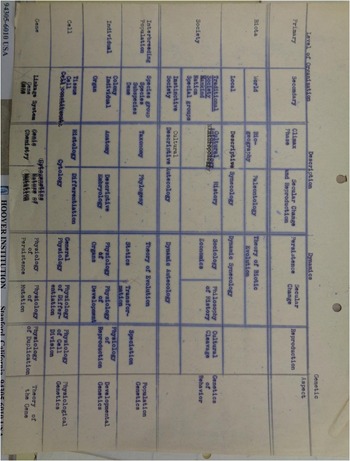
A somewhat cryptic table (Fig. 2) he kept together with the rest of his seminar materials can serve as a window onto Hayek's thoughts about the nature of science, as he worked them out in the seminar.Footnote 90 This chart describes what I believe to be Hayek's attempt to work out a meaningful picture of the relationship between the disciplines. Each line in the table is dedicated to a different “level of organization” in descending order. The top level is “biota” (the entirety of life in a particular region, habitat, or geological period), and after that, in a descending order, “society,” “interbreeding population,” “individual,” “cell,” and “gene.” Most levels of organization are in themselves split into two “secondary” levels of organization. The category “society,” for example, is divided into two categories: “traditional society: mankind, nation, special groups” and “instinctive society.” The rest of the table is dedicated to the specification of the disciplines (or subdisciplines) that study each aspect of the said “level of organization.” All in all, there are six different aspects for most levels. Two are descriptive aspects: one describes the “climax phase” (a “static phase” in which all that has developed can be seen and described), while the other describes “secular change and reproduction.” In the case of (human) “society,” to continue with the example, it is “cultural anthropology” that describes the “climax phase” and “history” that describes the process of “secular change and reproduction.” The next pair of aspects is titled “dynamics” and is divided into “persistence” and “secular change.” In the case of human society, the relevant disciplines would be “sociology” and “economics” to describe the former, and “philosophy of history” to describe the latter. From the different examples we can learn that with “dynamics” Hayek refers to forms of knowledge that articulates general laws rather than descriptive forms of knowledge, which focus on particulars. The two remaining aspects are “reproduction” and “genetic aspect.” Not all levels of organization are capable of reproduction; “biotas,” for example, do not reproduce. Human societies, however, do. And their reproductive mechanism is, according to Hayek, “cultural cleavage.”
“University of Chicago—Seminar Materials: ‘Scientific Method’ outline,” Friedrich A. Hayek Papers, Box 63, Folder 14, Hoover Institution Archives. Copyright the Hayek estate.

This handout is found alongside a handful of index cards that suggest that Hayek occupied himself with different attempts to organize scientific disciplines into meaningful constellations.Footnote 91 The constellation he eventually chose has at least two interesting features: it omits any reference to the physical sciences and the study of matter, and it places the social sciences and even a branch of philosophy (philosophy of history) at the heart of the life sciences.
In his interpretation of Hayek's oeuvre, Bruce Caldwell attributes a pivotal role to this Chicago seminar. According to Caldwell, this mimeographed table is the first sign that Hayek began to take an interest in biology in relation to the social sciences. This newfound (or rather rediscovered) interest led Hayek, eventually, to forgo his early methodological commitments and to substitute the clear demarcation between the natural and the social sciences with a differentiation between sciences that deal with “relatively simple” and “complex” phenomena. For the purposes of this article it suffices to say that, as I mentioned before, in his early methodological work “Scientism and the Study of Society” (1942–4) Hayek argued against the tendency in the social sciences to take after the methodologies of the natural sciences. He argued that the goal of the natural sciences is to challenge our perceptions, ideas, and opinions of the world and to replace our picture of the world with one that fits reality better. The social sciences, however, take our ideas and opinions as their data, and ask to explain how the unintended consequences of our actions (which are guided by those ideas, concepts, and opinions) create complex social mechanisms.Footnote 92 For Hayek, the difference in both objects and objectives between the two branches of science calls for a clear demarcation between them. By 1955, however, Hayek had changed his mind. In his “Degrees of Explanation” Hayek relies on Warren Weaver's “science of complexity” to argue for a completely different demarcation between the sciences that is based on the complexity level of their respective objects. The study of “organized complexity” warrants different methodological tools and provides different kinds of prediction, when compared to fields that study “simple phenomena” (e.g. classical mechanics) that still dominate our image of science.Footnote 93 The study of organisms or physiological psychology (a subject that Hayek dealt with extensively in his The Sensory Order) are examples for (natural-)scientific fields that should be considered alongside economics or sociology as sciences of complex phenomena rather than being bunched together with science of “simple” phenomena such as classical mechanics.
In 1952, in all likelihood, Hayek was still in the process of figuring out his “simple phenomena”/“complex phenomena” dichotomy. The invitation to the seminar, as well as the reading list, still reflects his old commitments, while the mimeographed table hints towards the ideas he would present in print three years later. Hayek's “experiment,” so it seems, was planned, and executed at a decisive crossroads of his intellectual journey. What is pertinent to our interest in the Kreis as a model is that Hayek chose the structure of a conversation between equals, experts in different fields, in order to test and reconsider his methodological commitments.
In the invitation to Friedman, Hayek writes, “I am of course fully aware that no single specialist can adequately deal with all the problems that will arise.”Footnote 94 This sentence echoes a line from The Sensory Order which was published later that year:
Perhaps such an effort [the one he extended in the book] … requires a combination of qualifications which nobody possesses to a sufficient degree and which the specialist who feels sure in his own field therefore hesitates to undertake. To do it adequately one would indeed have to be equally competent as a psychologist and as a physiologist, as a logician and as a mathematician, and as a physicist and as a philosopher … A satisfactory execution of the thesis which I have outlined would probably require the collaboration of several specialists in the different fields.Footnote 95
These quotes, read in light of Hayek's intellectual project, reveal the inadequacy of the tentative distinction I introduced earlier between the “organizational” and “intellectual” aspects of Hayek's experiment. In Hayek's opinion, which was molded in countless hours of Kreis discussions about methodology, the egalitarian Kreis was a preferred forum to discuss the kind of questions he set out to discuss. He, himself, was committed to this idea, to the same extent that he was formed by it. To be sure Hayek in 1952 was significantly older than Machlup was at the time he attempted to form his Economic Reading Club; he was also more used to being an émigré, having left Vienna in 1931, and had a different intellectual and social status.Footnote 96 That can explain the differences in tone and levels of self-consciousness between Hayek's and Machlup's attempts. Hayek, to be sure, was fully aware that his colleagues might raise an eyebrow at reading his invitation, and therefore labeled his seminar an “experiment.” But in his eyes, I argue, it was the “natural” move, the “recipe,” rather than a step into the unknown. Unfortunately, other than Hayek's enthusiastic recap of the seminar, we have no further documentation on what actually happened in that seminar room.Footnote 97
Conclusion
Unwittingly, perhaps, Schutz stumbled into a turmoil. His account of “The Stranger,” the immigrant, did not fit well with the hegemonic narrative in the New School that glorified the experience of immigration. In order to articulate the disastrous effect of immigration on the individual, Schutz coined the term “recipe.” Recipe, he argues, is the tacit knowledge that ensures the coordination of both meanings and expectations between the person and their social environment. Not only do these recipes not travel well, because they are culture-specific, Schutz argues; they also are extremely difficult to learn (in adulthood), because they are tacit and hence cannot be spelled out even by natives.
We know from the many important works in the history of science and intellectual history that tacit knowledge plays a decisive role in the life and work of scientists and intellectuals.Footnote 98 This article has examined a specific aspect thereof, that of the scientific persona, which Algazi defines as a cultural template of a codified social role. In the home culture of our protagonists, I argue, the participation in Kreise was integral to the persona of the intellectual. That was not necessarily true for the American academic culture in which they all found themselves after emigration. I suggested that Kreis participation and Kreis-building recipes are particularly potent case studies for exploring the vicissitudes of intellectual life in motion for two main reasons. First, the Kreis's structured informality emphasizes the tacit dimension that can be found in every social interaction. The less formal an institution is, the more it relies on implied rules and pre-coordinated preferences. Second, Kreise require cooperation among individuals; thus, when performed in a foreign environment, they inevitably reveal the incompatibility of different intellectual personae, and as a result make them more visible for the historian of intellectual life.
I coupled the concepts “recipe” and “persona” because each of them emphasizes a different aspect of the story of the Kreis in America. The term “recipe” brings to mind an algorithm that one could follow in order to achieve a desired result. But, as Schutz explains to us, “recipes” are not as transferable as they seem to be. They cannot function without the right “ingredients” (which can be different in different cultures), and the results will not necessarily be pleasing to every palate (as Voegelin warned Engel-Janosi when the latter asked him to give a Geistkreis-like lecture for Americans) or satisfy every “hunger” (as Morgenstern noted in his diary). I turned to “persona” specifically because it emphasizes that the ways and trajectories of intellectual life are not necessarily shaped by the intellectuals themselves, but rather by “larger and diverse forces.”Footnote 99 Therefore it gives us the opportunity to consider factors such as the gendered division of domestic labor, urban density, geographical distance, and the incentive structure of the university as part of the story. Finally, the final discussion about Hayek's “experiment” suggests that the form of the Kreis (and especially its egalitarian, Geistkreis-like, version) infiltrated Hayek's way of thinking. In The Sensory Order he states that some difficult problems—such as the mind–body problem—require cooperation between different experts, and immediately after that he tried to form such a group to discuss another pressing problem: the nature of the scientific method.
The story of the Geistkreis in America gives us a glimpse into the influence of the Kreis—both as a model and as an idea—on intellectual life in America. In order to provide a more complete picture, however, further research is needed. One strand of such a work should focus on the story of the Wiener Kreis. Those members of the Wiener Kreis who emigrated to America reached more prominent positions in their discipline, but, contrary to the Geistkreis, were also instrumental to the professionalization of American philosophy and thereby (some would add) to the closing of its horizons.Footnote 100 Collecting and analyzing additional stories about the afterlives of different Kreise in the aftermath of World War II would enable us to discern the idiosyncrasies of the Geistkreis from the common traits of the general Kreis culture and promote our understanding of its influence on our intellectual landscape.
Acknowledgments
My thanks to Gadi Algazi, D. Graham Burnett, Bruce Caldwell, Eva-Maria Engelen, Daniel Garber, Michael Gordin, Anthony Grafton, Katja Guenther, Steven Medema, Richard Spiegel, and the four anonymous referees for their helpful suggestions. This paper was greatly improved by the conversations at the Émigré Scholars: Historians in Exile and the Writing of History workshop (Bochum, September 2019), the History of Science Program Seminar (Princeton University, September 2019), Center for the History of Political Economy seminar (Duke University, September 2020), and the Bucerius Young Scholars Forum (German Historical Institute, October 2020). Special thanks are sent to Marjorie Perloff and Stephen Furth and his family for opening their private archives to me.