Introduction
Safety standards can function as non-tariff barriers to trade. They can apply in a manner that could constitute a means of arbitrary or unjustifiable discrimination between customs territories. They can also apply in a manner that could constitute a disguised restriction on trade. Safety standards, therefore, can limit the market access of exporters of goods.
As the eighth largest exporter of goods in the world,Footnote 1 Canada has a strategic interest in the regulation of safety standards. A Member of the World Trade Organization (WTO), Canada is a party to the Agreement on the Application of Sanitary and Phytosanitary Measures (SPS Agreement)Footnote 2 for the regulation of food safety and animal and plant health standards (SPS) and the Agreement on Technical Barriers to Trade (TBT Agreement)Footnote 3 for the regulation of product standards (TBT).Footnote 4 In addition to these multilateral agreements, Canada has subscribed SPS and TBT provisions in its bilateral and regional Preferential Trade Agreements (PTAs). Many of these provisions are ‘WTO-plus’ because their scope is wider than that of WTO obligations.
This article analyses WTO-plus SPS and TBT provisions in Canada's PTAs, from the North American Free Trade Agreement (NAFTA)Footnote 5 between Canada, Mexico, and the United States of America (US) to the Comprehensive Economic and Trade Agreement (CETA)Footnote 6 between Canada and the European Union (EU). It studies the nature of these provisions and their enforceability. For these purposes, the article adopts the methodology that Horn, Mavroidis, and Sapir developed to study the nature and enforceability of WTO-plus provisions in their review of US and EU PTAs.Footnote 7 It finds that, while almost all of Canada's PTAs contain WTO-plus SPS and TBT provisions, half of the TBT obligations and the majority of the SPS obligations are likely to be unenforceable. In comparison to the practice of Canada's major trading partners – the US and the EU – Canada's PTAs are modest in their approach to WTO-plus SPS and TBT provisions, with NAFTA and CETA as exceptions. The article concludes that the depth and width of economic integration and regulatory convergence for safety standards in Canada's PTAs depend more on the political willingness of the parties to cooperate than on the nature and enforceability of the SPS and TBT provisions that they contract.
Nature of WTO-plus SPS and TBT provisions in Canada's PTAs
Canada signed its first PTA, NAFTA, just before the establishment of the WTO. After the establishment of the WTO, Canada continued to sign PTAs. As of 1 August 2015, Canada has signed 11 PTAs (its latest is with South Korea)Footnote 8 and has concluded negotiations for two further PTAs (with the EU and Ukraine).Footnote 9 All of Canada's PTAs contain SPS and TBT provisions.
With the natural exception of NAFTA,Footnote 10 all of Canada's PTAs refer to the obligations of WTO Members under the SPS Agreement and TBT Agreement. And many contain obligations that build upon those obligations.Footnote 11 Accordingly, a significant number of the SPS and TBT provisions in Canada's PTAs warrant classification as WTO-plus.Footnote 12
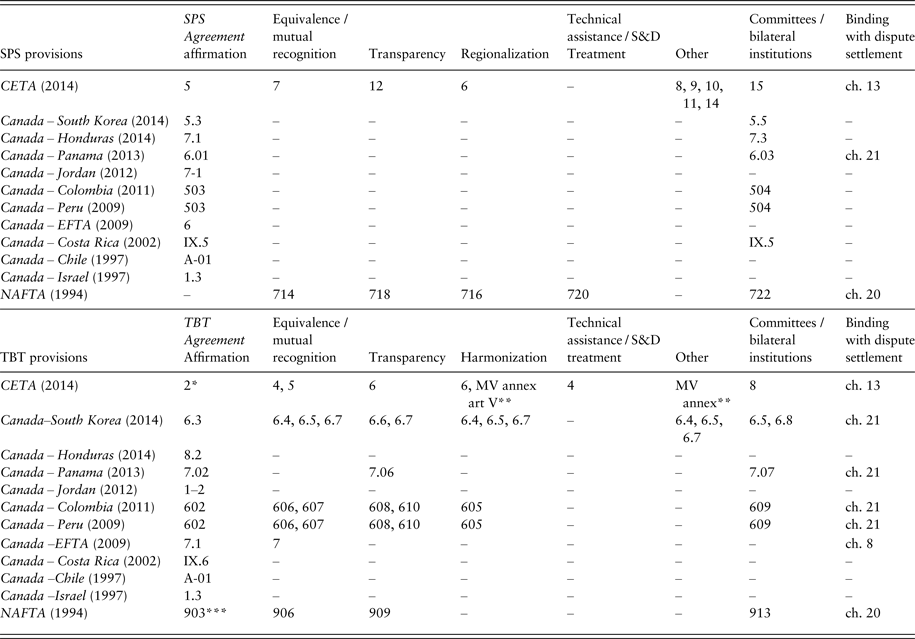
Table 1 catalogues Canada's PTAs in reverse chronological order and the WTO-plus nature of their SPS and TBT provisions. It revolves around the common principles of the SPS Agreement and the TBT Agreement: harmonization with international standards, equivalence and mutual recognition, transparency, technical assistance and special and differential (S&D) treatment, the establishment of committees and other bilateral institutions, and dispute settlement.
Nature of SPS and TBT provisions in Canada's PTAs

Notes:* Articles 2, 3, 4, 5, 6, 7, 8, 9, annex 1, and annex 3 of the TBT Agreement are directly incorporated into CETA.
** This item refers to the CETA Annex on Cooperation in the Field of Motor Vehicle Regulations (MV annex).
*** This provision refers to the GATT Standards Code affirmation in NAFTA.
Table 1 shows that, with the exception of NAFTA, the development of WTO-plus SPS and TBT provisions in Canada's PTAs is a recent practice. Thus, Canada's early PTAs contained rather insignificant WTO-plus SPS and TBT provisions (Canada–Israel Footnote 13 and Canada–Chile Footnote 14 ).Footnote 15 The trend changed after the signature of Canada–Costa Rica.Footnote 16 The experience of this agreement led to the inclusion of extensive WTO-plus SPS and TBT provisions in Canada–EFTA,Footnote 17 Canada–Peru,Footnote 18 Canada–Colombia,Footnote 19 Canada–Panama,Footnote 20 Canada–Honduras,Footnote 21 Canada–South Korea, and CETA. Canada has signed 11 PTAs since the establishment of the WTO, eight of which contain WTO-plus SPS and TBT provisions. This tally represents 75% of Canada's PTAs. Apart from NAFTA, Canada–Panama, Canada–Peru, Canada–Colombia, Canada–South Korea, and CETA represent the most ambitious WTO-plus regimes for SPS and TBT, with relatively extensive provisions on transparency and equivalence and mutual recognition. In addition to a comprehensive TBT chapter, CETA, in particular, has substantial WTO-plus SPS obligations. It is Canada's most important PTA since NAFTA.Footnote 22
A consistent feature of Canada's PTAs is the concern with issue avoidance and resolution, either through the establishment of institutions that promote bilateral cooperation or through the use of soft obligations that facilitate dispute prevention. This concern is evident in Canada–Costa Rica, Canada–Peru, Canada–Colombia, Canada–Panama, Canada–Honduras, Canada–South Korea, and, most specially, CETA.Footnote 23 They all contain provisions for the appointment of ‘Committees’ or ‘Country Coordinators’ to promote bilateral cooperation on SPS and TBT issues. NAFTA also contains provisions for the establishment of similar institutions. Furthermore, many of these PTAs contain provisions for ‘Joint Cooperation’ or ‘Issue Avoidance and Resolution’. While these provisions do not involve the creation of new institutions, they are WTO-plus in the sense that they promote bilateral cooperation on issues that come within the scope of the SPS Agreement and TBT Agreement. The idea is to encourage regular discussion between the parties through a system of bilateral institutions and soft obligations in order to pre-empt the rise of SPS and TBT issues and to resolve them, if they do arise, before formal dispute settlement.
Another notable feature of Canada's PTAs is that they use WTO-plus TBT provisions to a greater extent than they use WTO-plus SPS provisions. TBT-plus provisions tend to focus on transparency and equivalence and mutual recognition.Footnote 24 These provisions often involve obligations that require the exchange of information, the notification of new measures, the provision of reasons for the rejection of equivalence and mutual recognition applications, and the introduction of comment periods into the development process for measures. While most of Canada's PTAs contain TBT provisions that are enforceable through bilateral dispute settlement strategies, some PTAs make SPS matters the exclusive remit of the WTO dispute settlement system. NAFTA and CETA are the exceptions to this rule because they not only contain WTO-plus provisions in relation to most aspects of their SPS and TBT chapters but also permit access to party-to-party conflict resolution for both types of provisions. Thus, other than WTO-plus provisions for the establishment of SPS Committees or Country Coordinators, most of Canada's PTAs concentrate on WTO-plus TBT provisions.
A further feature of Canada's PTAs is their somewhat deficient approach to SPS and TBT obligations in the areas of harmonization and technical assistance and S&D treatment. NAFTA, Canada–Peru, Canada–Colombia, and Canada–South Korea contain provisions that promote harmonization. However, Canada's other PTAs do not contain such provisions. Similarly, among Canada's post-1995 PTAs, only CETA contains provisions on technical assistance and S&D treatment. In terms of harmonization, most of Canada's PTAs only affirm WTO commitments to incorporate international standards in the development of new measures. However, they do not provide obligations that go beyond these commitments. In terms of technical assistance and S&D treatment, almost none of Canada's PTAs makes an attempt to promote development through trade. The lack of provisions for economic development is somewhat of a surprise because many of Canada's PTAs are with developing countries such as Costa Rica, Peru, Colombia, and Panama.
Canada–Israel, Canada–Chile, Canada–Costa Rica, Canada–EFTA, Canada–Jordan, and Canada–Honduras
Most of Canada's PTAs do not contain extensive WTO-plus provisions. Generally, they all affirm the SPS Agreement and TBT Agreement, including Canada–Israel,Footnote 25 Canada–Chile, and Canada–Jordan. However, they do not go much beyond that affirmation. One example is the Free Trade Agreement between Canada and the States of the European Free Trade Association (EFTA) (the Republic of Iceland, the Principality of Liechtenstein, the Kingdom of Norway, and the Swiss Confederation) (Canada–EFTA), which came into force on 1 July 2009. On TBT issues, Canada–EFTA requires the parties to comply with the separate Mutual Recognition Agreements (MRAs) already in place between Canada and the EFTA states but does not require mutual recognition of conformity assessment obligations.Footnote 26 It also contains an unusual provision whereby any disputes between the parties on TBT issues must come before the Joint Committee under the agreement, which would then attempt to find a solution that is in conformity with the TBT Agreement.Footnote 27 Unusually too, the parties must pursue any disputes under the various EFTA MRAs through those agreements and not through Canada–EFTA.Footnote 28 However, the affirmation of bilateral agreements, like the MRA between Canada and Switzerland or the MRA between Canada and Iceland, Lichtenstein, and Norway, does represent a recognition of obligations outside the WTO sphere even if it does not extend those obligations. In that sense, the affirmation is WTO-plus.
The Free Trade Agreement between Canada and the Republic of Costa Rica (Canada–Costa Rica), which came into force on 1 November 2002, and the Free Trade Agreement between Canada and the Republic of Honduras (Canada–Honduras), which came into force on 1 October 2014, are other examples. They provide for the establishment of a SPS Committee with a similar bilateral cooperation mandate to that of SPS Committees in Canada's other PTAs.Footnote 29 They also contain soft obligations to promote cooperation on TBT issues.Footnote 30 On conflict resolution, Canada–Costa Rica, in particular, provides that disputes on SPS issues are the domain of the WTO dispute settlement system.Footnote 31 Disputes on TBT issues, however, can come under the ambit of the party-to-party settlement mechanism on the proviso that the parties refer any disputes in relation to ‘rights and obligations under the TBT Agreement’ to the WTO.Footnote 32 Canada–Honduras specifies that both SPS and TBT dispute settlement is to occur at the WTO level.Footnote 33
Canada–Panama
The Free Trade Agreement between Canada and the Republic of Panama (Canada–Panama) came into force on 1 April 2013. Like all of Canada's post-1995 PTAs, this agreement affirms the SPS Agreement and TBT Agreement.Footnote 34
The SPS chapter calls on the parties to work ‘expeditiously’ to resolve SPS issues.Footnote 35 It appoints a SPS Coordinator for each party in order to facilitate party-to-party communication.Footnote 36 The chapter also requires the parties to meet within 45 days upon request.Footnote 37 Both provisions are WTO-plus in that they introduce a bilateral institution as well as a timeline, features that are not available under the SPS Agreement. The chapter does not exclude the use of the internal dispute settlement mechanism, so, presumably, it is open to SPS provisions. However, the parties must refer any issues that they cannot resolve to the Joint Commission under the agreement.Footnote 38
The TBT chapter starts with a set of general provisions to promote bilateral initiatives on standards, technical regulations, accreditation, conformity assessment procedures, and metrology.Footnote 39 These provisions do not contain hard obligations but they do require that a party give ‘positive consideration’ to a sector-specific TBT proposal at the request of the other party.Footnote 40 It also includes provisions to establish Contact Points, responsible for implementation and administration, exchange of information, joint cooperation, and other TBT matters between the parties.Footnote 41 As a bilateral institution with no equivalent counterpart in the WTO regime, the establishment of Contact Points is a WTO-plus provision. One of the other significant aspects of the TBT chapter is its transparency provisionsFootnote 42 as well as its provisions on equivalence and mutual recognition, such as a mandatory 60-day comment period after the notification of technical regulations or conformity assessment procedures to the WTO TBT Committee.Footnote 43 The chapter also provides that, where a party does not accept the equivalence of technical regulations, that party must provide reasons to the other party. Similarly, where a party does not accept the results of a conformity assessment procedure, that party must provide reasons to other party.Footnote 44 In addition, if an importing party detains a good under a TBT measure, that party must immediately notify the exporting party.Footnote 45 These provisions go well beyond the TBT Agreement.
Canada–Peru and Canada–Colombia
The Free Trade Agreement between Canada and the Republic of Peru (Canada–Peru) and the Free Trade Agreement between Canada and the Republic of Colombia (Canada–Colombia) came into force on 1 August 2009 and 15 August 2011 respectively. They are very similar in their treatment of SPS and TBT issues and so it is appropriate to group them together. Both affirm WTO SPS and TBT commitments.Footnote 46
The main contribution of Canada–Peru and Canada–Colombia to the SPS sphere is the creation of a SPS Committee in their respective SPS chapters, which provides a bilateral forum for the discussion of SPS issues.Footnote 47 The chapters also contain provisions on ‘Sanitary and Phytosanitary Issue Avoidance and Resolution’ that assist the parties to resolve their issues in a preventative manner.Footnote 48 If the parties cannot resolve their issues under the chapter, they can refer them to the Joint Commission.Footnote 49 However, for formal disputes on SPS issues, the parties are to use the WTO dispute settlement system.Footnote 50
On TBT matters, Canada–Peru and Canada–Colombia contain basic provisions under the ‘Joint Cooperation’ section of their respective TBT chapters that commit the parties to strengthen their cooperation.Footnote 51 These provisions do not contain hard obligations. They instead contain a requirement to give positive consideration to sector-specific TBT proposals. The chapters also contain a provision on harmonization to encourage the parties to conform with international standards and a further provision for national standardization bodies to cooperate with each other.Footnote 52 Both provisions are WTO-plus in that they require engagement with and bilateral cooperation on international standards.
Specifically on TBT equivalence, substantial provisions here include the requirement to provide an explanation if a party does not accept another party's rules.Footnote 53 In addition, if a party intends to develop a technical regulation, that party can ask the other party for any information that it used to develop its own.Footnote 54 The chapters also contain extensive provisions on conformity assessment, including an obligation to provide reasons where a party does not accept the results of a conformity assessment or where a party refuses to enter into a mutual recognition agreement.Footnote 55 Other provisions promote mechanisms to facilitate the acceptance of conformity assessment procedures and results of conformity assessment bodies as well as accreditation and cooperation agreements.Footnote 56 All of these provisions represent deeper and wider obligations than those in the WTO regime.
The TBT chapters also contain extensive provisions on transparency.Footnote 57 Under these provisions, a party must notify the other party's Contact Point when it notifies the WTO as well as when it proposes to develop any technical regulations and conformity assessment procedures that may impact on trade. By comparison, the TBT Agreement stipulates that notification is necessary only when technical regulations and conformity assessment procedures are stricter than international standards or when those standards do not exist and the measures may impact on trade.Footnote 58 Under Canada–Peru and Canada–Colombia, the TBT chapters allow a 60-day comment period on proposals for technical regulations and conformity assessment procedures. In addition, the chapters include a requirement to publish comments and to provide reasons for the adoption of a technical rule or any other TBT measure. Other requirements are to give reasonable consideration to any request to extend the adoption period and publish TBT information online. Moreover, if an importing party detains a good, that party must immediately let the exporting party know. These provisions constitute the most comprehensive transparency regime in Canada's PTAs, with the exception of NAFTA and CETA.
Canada–Peru and Canada–Colombia also appoint Country Coordinators on TBT issues.Footnote 59 They have a variety of functions, which include monitoring implementation, promptly addressing issues raised, reporting to the Joint Commission, and establishing ad hoc working groups. They also have the power to consult on any particular issue of the agreement that could prompt the dispute settlement mechanism. The Country Coordinators must meet at least once a year. Again, as a bilateral institution outside of the WTO system, the Country Coordinators are WTO-plus provisions. Moreover, Canada–Peru and Canada–Colombia each has a short section on ‘Information Exchange’ with a provision whereby, if a party demands information under the TBT Agreement,Footnote 60 the other party must provide it within 30 days.Footnote 61
Canada–South Korea
The Free Trade Agreement between Canada and the Republic of Korea (Canada–South Korea) came into force on 1 January 2015. It affirms the SPS Agreement. Canada–South Korea also establishes a SPS Committee to facilitate the implementation of the SPS Agreement and promote cooperation.Footnote 62 The creation of this committee is WTO-plus. Canada–South Korea, however, excludes the SPS chapter from its dispute settlement system.Footnote 63
Canada–South Korea incorporates specific sections of the TBT Agreement into the SPS chapter.Footnote 64 The chapter contains a general cooperation provision that encourages bilateral engagement on a number of TBT issues. It affirms current WTO obligations and, in addition, it requires the parties to provide reasons if they deny negotiations on mutual recognition of conformity assessment procedures.Footnote 65 Unlike Canada's other PTAs, Canada–South Korea contains deep TBT cooperation, harmonization, and mutual recognition provisions in such sector-specific areas as medical devices, pharmaceuticals, telecommunications, and wood building products. It also contains a transparency provision that requires a 60-day comment period for proposed standards-related measures.Footnote 66 Moreover, the agreement contains an extensive provision on automotive standards-related measures to promote equivalence and cooperation in this sector-specific area.Footnote 67 This kind of provision is definitely WTO-plus and more comprehensive than its counterparts in Canada's other PTAs. Canada–South Korea also creates a TBT Committee. Again, this provision is WTO-plus.
Canada–South Korea is different from Canada's other PTAs in that it pursues deep sector-specific TBT integration. Relatively extensive rules on equivalence and mutual recognition for the automotive sector are an example. Canada–South Korea is the first PTA since NAFTA to promote this level of economic integration. The creation of separate subcommittees in the areas of motor vehicles as well as forestry and building products supports this integration. Canada–South Korea also has a dispute settlement system that builds on Canada's other PTAs, including an ad hoc appointment process for panellists and an accelerated timeline for disputes involving perishable goods and motor vehicles.Footnote 68 TBT matters can be adjudicated under the dispute resolution process. These provisions are significant and, together with wide-ranging tariff reductions, make Canada–South Korea a model trade deal, particularly on TBT issues.
NAFTA
NAFTA, which came into force on 1 January 1994, establishes a free trade area between Canada, Mexico, and the US.Footnote 69 The parties negotiated the text of the agreement before the SPS Agreement and TBT Agreement came into force. However, NAFTA does mention the GATT Standards Code Footnote 70 and so it intersects with the multilateral regime in that way.Footnote 71
On SPS issues, despite the fact that it entered into force before the establishment of the WTO, NAFTA provides a number of obligations that go beyond WTO requirements. In relation to equivalence, the agreement contains an obligation to pursue the equivalence of SPS measures ‘to the greatest extent practicable’, language which the SPS Agreement does not use.Footnote 72 Moreover, the parties must provide reasons if they do not accept certain SPS measures as equivalent.Footnote 73 For the development of SPS measures, the parties must ‘consider relevant actual or proposed’ SPS measures of the other parties.Footnote 74 These provisions set bilateral requirements that are stricter than the WTO rules on equivalence, particularly in relation to the requirement to provide reasons.
NAFTA contains extensive transparency provisions.Footnote 75 They require the parties to publish ‘laws, regulations, procedures, and administrative rulings’, and allow a comment period for any measure that they propose to adopt.Footnote 76 Furthermore, NAFTA contains notification provisions in relation to ‘any proposed or actual measure that … might materially affect the operation of this Agreement or otherwise substantially affect’ the interest of the parties.Footnote 77 In respect of SPS measures, the parties must notify any proposal at least 60 days in advance. The notice must name the good in question and outline the reasons for the adoption of the measure. The parties must provide a copy of the relevant SPS measures on request and identify any deviance from the applicable international standards. They must invite comments and take those comments into account. If a party denies market access to a good because of non-compliance with a certain SPS measure, that party must provide an explanation, on request, to the other parties.Footnote 78 These provisions comprise a more stringent notification regime than that under the WTO.Footnote 79
The other major area where NAFTA goes beyond the WTO SPS regime is through its establishment of a SPS Committee.Footnote 80 The creation of this bilateral institution provides an additional forum for consultation. Further, NAFTA includes a section for ‘Technical Consultations’ whereby the parties can formally raise specific issues for consultation by the SPS Committee or a technical working group, which must then provide recommendations to the parties in case of a dispute.Footnote 81 NAFTA integrates these technical consultations into the dispute settlement process so that the parties can continue to pursue the dispute if they cannot reach an agreement at the informal stage.Footnote 82
Other SPS provisions in NAFTA are about technical assistance, where, on request, the parties must provide information on technical cooperation programs.Footnote 83 The parties must also consult prior to the adoption or a change in the application of any SPS measure.Footnote 84 These provisions are generally not part of Canada's other PTAs and they are more extensive than WTO obligations. NAFTA also contains WTO-plus provisions on regional conditions. They require importing parties to pursue, on request, an agreement with exporting parties for goods from areas with low pest or disease prevalence to facilitate their importation and simultaneously achieve the importing party's appropriate level of protection.Footnote 85 NAFTA further prescribes that goods from pest or disease free areas in one country receive no less favourable treatment than goods from a pest or disease free area in another country that poses the same level of risk and, accordingly, that the same risk assessment techniques must apply.Footnote 86 These provisions are beyond WTO requirements.
On TBT issues, NAFTA presents a number of WTO-plus provisions. NAFTA allows the parties to adopt a higher level of protection than they would have under an international standard.Footnote 87 This language is stronger than the form of words that the TBT Agreement employs. In terms of equivalence and mutual recognition, NAFTA also has stronger language in that it calls on the parties to work together ‘to the greatest extent practicable’ so as to make compatible their respective standards-related measures.Footnote 88 This requirement carries over to the section on conformity assessment, which calls for compatibility to the ‘greatest extent practicable’.Footnote 89 NAFTA further requires the parties to make compatible their standards or conformity assessment procedures.Footnote 90 In addition, if a party does not accept a technical regulation as equivalent, that party must provide reasons to the other party.Footnote 91
NAFTA contains fuller obligations on transparency than the WTO. For example, all technical regulations are subject to a 60-day comment period.Footnote 92 This period also applies to conformity assessment procedures and standards proposals that may impact trade and are either not consistent with the relevant international standard or an equivalent international standard does not yet exist.Footnote 93 While the WTO calls for a 60-day comment period for all standards, it is less stringent for technical regulations and conformity assessment procedures. NAFTA also calls for a reasonable adaptation time for all TBT measures, while the WTO only requires adaptation time for technical regulations and conformity assessment procedures.
NAFTA provides for the creation of a TBT Committee with a mandate similar to that of the SPS Committee. In addition, there are working groups for the management of bilateral industry issues between the parties. This role is much more industry-specific than the role of the WTO's TBT Committee.Footnote 94 NAFTA provides for technical consultations on standards-related issues that the parties can choose to integrate into the dispute resolution process under the agreement.Footnote 95 NAFTA also includes a risk assessment section for TBT measures, which outlines the requirements of the parties in the conduct of a risk assessment.Footnote 96 Risk assessment is not generally a subject of Canada's PTAs, and, while it comes under the SPS Agreement, it is not within the scope of the TBT Agreement.
CETA
Canada and the EU concluded negotiations for CETA on 5 August 2014 though they are yet to sign the agreement and bring it into force. It constitutes a comprehensive regime on SPS and TBT issues and it is certainly the most comprehensive among all of Canada's PTAs since NAFTA.Footnote 97 To begin with, CETA affirms the SPS Agreement and TBT Agreement.
The SPS chapter goes on to recognize the progress that the parties have made under an earlier Veterinary Agreement,Footnote 98 and terminates it to allow a new regulatory regime to take over. A WTO-plus aspect of the SPS chapter is its extensive regionalization provisions, whereby the parties agree on a list of animal diseases to which the principles of zoning apply.Footnote 99 If a disease is not on the list, one of the parties can apply for recognition of a special status and, as the importing party, it can then request additional guarantees in respect of certain imports.Footnote 100 The chapter also provides a process to recognize regional conditionsFootnote 101 and it affirms the concept of compartmentalization.Footnote 102 The provisions on plants and plant status are less extensive but provide for recognition of regional conditions. Most of these provisions are WTO-plus and are deeper than those in Canada's other PTAs because they allow for the institutionalization of bilateral cooperation on regionalization.
The equivalence provisions are also WTO-plus and quite extensive. One annex contains principles and guidelines for the determination, recognition, and maintenance of equivalence.Footnote 103 Another annex sets out the measures that warrant recognition of equivalence and the areas where the fulfilment of special conditions combine with the exporting party's measures to achieve an appropriate level of protection.Footnote 104 These provisions are WTO-plus in the sense that they list the specific measures and procedures that achieve equivalence and set out a specific process for the achievement of equivalence. The SPS Agreement does not contain these country-specific provisions.
CETA contains an extensive set of provisions on trade conditions, audit and verification, export certification, and import checks and fees. The chapter requires the importing country to make its general SPS import requirements available and specific import requirements can only apply if the parties have jointly deemed certain commodities a priority.Footnote 105 For priority commodities, it provides specifications for the development of appropriate import and transparency requirements.Footnote 106 It also contains rules for the approval of establishments and facilities.Footnote 107 Among other provisions, the chapter provides a specific procedure for import requirements for plant health.Footnote 108 These provisions go well beyond WTO norms for import requirements.
The SPS chapter also provides for the audit and verification of control procedures and sets out a pathway for agreement by the parties on principles and guidelines for the conduct of those exercises.Footnote 109 It also provides export certification rules for live animals and animal products, including a model attestation.Footnote 110 The chapter provides specific rules for import checks and fees, including transparency measures.Footnote 111 Together with the rules on trade conditions, these provisions are not only WTO-plus but also deeper than those in Canada's other PTAs, including NAFTA ‒ though, of course, such advancements may not compare favourably with the kind of regulatory convergence that the Transatlantic Trade and Investment Partnership between the US and the EU may achieve, if, that is, it ever comes about.
CETA also contains SPS transparency provisions. They provide more specificity than the WTO and are deeper than those in Canada's other PTAs. CETA provides notification procedures for changes in pest or disease status, epidemiological findings with respect to listed diseases, and significant food safety issues that arise between the parties.Footnote 112 Other transparency requirements apply to changes in SPS measures, changes to the structure of competent authorities, results of official controls, results of import checks, risk analysis, and scientific opinions. Some of these transparency requirements are in the WTO agreements, but, on the whole, they are more specific and so they are WTO-plus.
CETA also contains provisions for technical consultations where a dispute arises between the parties as well as specific notice and consultation requirements where a party has taken emergency measures.Footnote 113 These provisions are quite specific and go beyond WTO requirements. In addition, like Canada's other PTAs, the SPS chapter provides for the establishment of a bilateral committee.Footnote 114
Apart from its regulation of SPS issues, CETA contains a unique approach to TBT issues, at least in comparison with Canada's other PTAs. CETA does not merely affirm the TBT Agreement, it directly incorporates a number of its provisions and makes them a part of the TBT chapter.Footnote 115 Furthermore, dispute resolution under CETA is available for several of those provisions.Footnote 116
The TBT chapter contains a general provision to encourage the parties to ‘strengthen their co-operation’ in a number of areas.Footnote 117 It then contains provisions on equivalence that require the parties to share information about the development of equivalent or similar technical regulations.Footnote 118 The equivalence provision entitles a party that requests the recognition of equivalence to a response from the other party.Footnote 119 This provision is WTO-plus because it specifies a more complete procedure for the recognition of equivalence and cooperation on equivalence issues.
While narrow in scope, CETA nevertheless contains provisions that promote harmonization. In particular, the annex to the agreement on Cooperation in the Field of Motor Vehicle Regulations encourages Canada to adopt the World Forum for Harmonization of Vehicle Regulations of the United Nations Economic Commission for Europe.Footnote 120
The regulation by CETA of mutual recognition of conformity assessment has certain WTO-plus aspects. In particular, the TBT chapter incorporates protocols to the Agreement on the Mutual Acceptance of the Results of Conformity Assessment and the Agreement on the Mutual Recognition of the Compliance and Enforcement Program regarding Good Manufacturing Practices for Pharmaceutical Products between the parties.Footnote 121
There is an extensive section on transparency in the TBT chapter and some of its provisions are WTO-plus. The chapter provides for a 60-day comment period after the notification of technical regulations or conformity assessment procedures to the WTO.Footnote 122 It also contains provisions that allow a party to request from the other party its rationale for a certain technical regulation or conformity assessment procedure.Footnote 123 It also allows requests to extend the comment period for technical regulations.Footnote 124 If the importing party detains a good because it did not comply with a technical regulation, the chapter requires the importing party to provide immediate notification of its reasons to the exporting party.Footnote 125 These provisions are WTO-plus in that they go beyond the transparency provisions in the TBT Agreement though they are largely similar to the TBT transparency provisions in Canada's other PTAs.
The TBT chapter also develops a bilateral institution system similar to Canada's other PTAs. Its function is to manage the implementation of the chapter and address any issues that may arise between the parties.Footnote 126 The chapter also contains an annex in respect of cooperation in the field of motor vehicle regulations. This annex represents a sector-specific attempt at regulatory convergence that goes beyond TBT Agreement obligations.
In a broader – global – context, CETA is the most comprehensive regime on SPS and TBT issues, with, perhaps, the exception of NAFTA. First, CETA is one of the few PTAs where both SPS and TBT provisions are subject to dispute settlement under the agreement. It also takes an innovative approach to conflict resolution, different from Canada's other PTAs. This treaty-level dispute settlement system includes a voluntary mediation process and quicker timelines than those under the WTO.Footnote 127 Secondly, the annexes on equivalence and mutual recognition, regionalization, and audits and import checks are much more comprehensive than most other PTAs. Thirdly, CETA contains the first regulatory cooperation chapter in Canada's PTAs, which encourages a high level of interaction between regulatory authorities.Footnote 128 In this respect, CETA also contains an extensive Protocol on the Mutual Acceptance of the Results of Conformity Assessment, which promotes further regulatory convergence and interface with the TBT provisions of the agreement.Footnote 129 A number of other chapters contain provisions that supplement cooperation on standards-related measures, including telecommunications, pharmaceuticals, biotechnology, and agriculture and forestry.Footnote 130 Fourthly, CETA promotes effective administrative governance through the creation of a Committee on Trade in Goods, with jurisdiction over SPS and TBT matters, under the direction of the Joint Committee.Footnote 131
Enforceability of WTO-plus SPS and TBT provisions in Canada's PTAs
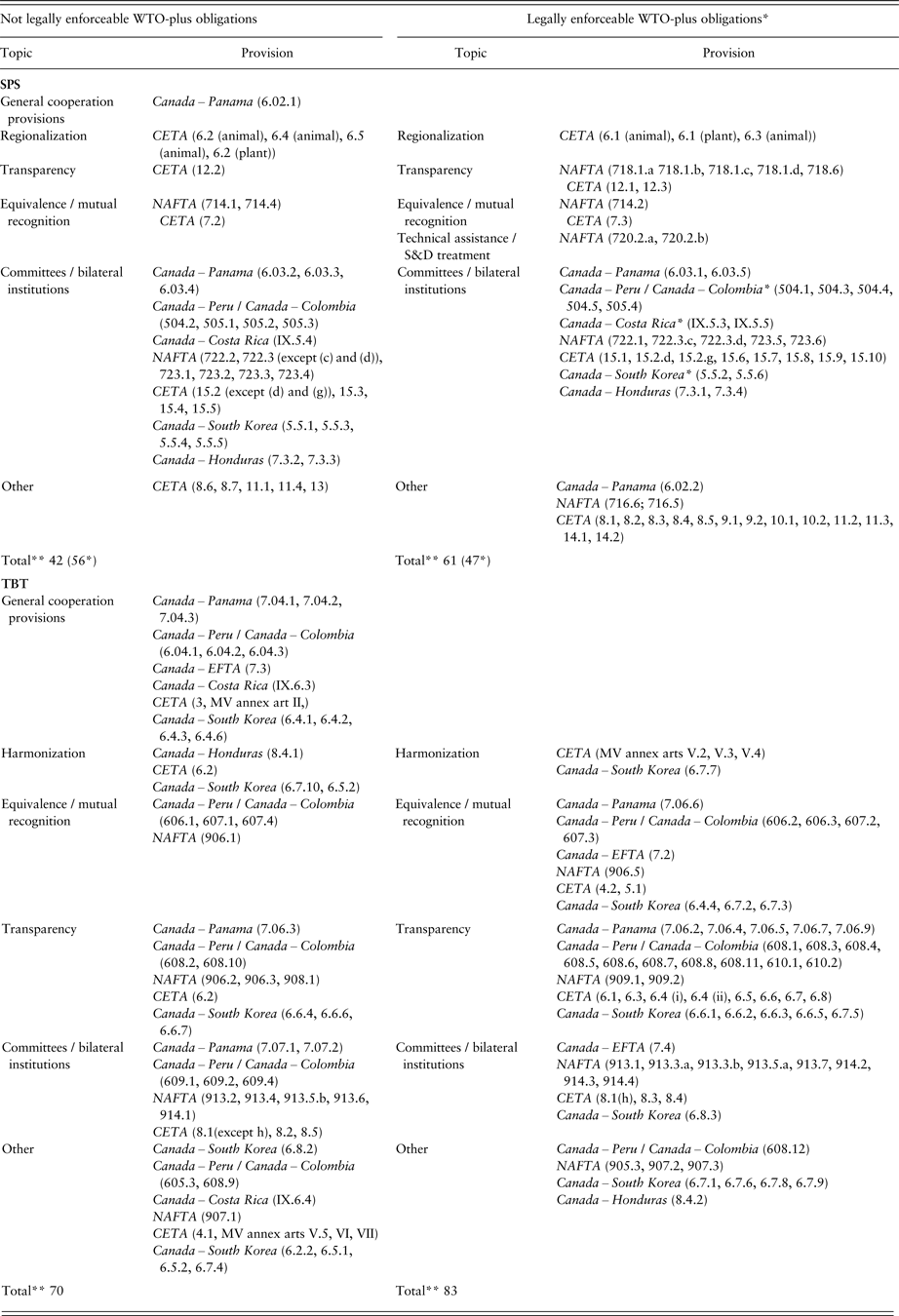
A relevant question for trade practitioners in Canada and its trading partners is: how enforceable are the WTO-plus SPS and TBT provisions in Canada's PTAs? The answer to the question of enforceability is in the language of the obligations. Horn, Mavroidis and Sapir took this approach in their study of the enforceability of 28 EU and US PTAs. They analysed the language of the obligations in these agreements to determine whether they would be enforceable at a bilateral level.Footnote 132 They considered provisions that contain negative obligations, specific timelines, action items, or generally measurable obligations to be enforceable.Footnote 133 However, those provisions that commit the parties to ‘cooperate’ or enter into ‘dialogue’ or that utilize ‘may’ instead of ‘shall’ are, they considered, unlikely to be enforceable.Footnote 134 The basic difference between these provisions is that enforceable obligations contain language that is precise enough to assess whether the parties to the agreement are indeed in compliance with it, while unenforceable obligations are too imprecise in language to demonstrate compliance with any degree of certainty. WTO-plus provisions that specifically exempt either SPS or TBT provisions from the dispute settlement mechanism under the agreement are also unenforceable in their analysis.Footnote 135 On the basis of the methodology that Horn, Mavroidis and Sapir adopted, Table 2 lists the various SPS and TBT provisions in Canada's PTAs and classifies them as legally enforceable (LE) or not legally enforceable (NLE).
Enforceability of WTO-plus SPS and TBT provisions in Canada's PTAs

Notes: * PTAs that exclude the SPS and TBT provisions from their dispute settlement systems transform LE provisions into NLE provisions.
** Note that Canada‒Peru / Canada‒Colombia count for two provisions each. Annexes do not count as separate provisions (except the CETA Annex on Cooperation in the Field of Motor Vehicle Regulations (MV annex), which is counted due to its significance). These scores are approximate because sub-provisions in some categories are not counted as separate provisions (i.e., bilateral institutions). Sub-provisions that are separately enforceable are generally counted as separate provisions.
Generally, Canada's PTAs contain SPS and TBT provisions that are both legally enforceable and not legally enforceable, almost in equal parts. Representative of this trend is NAFTA, which is evenly split between enforceable and unenforceable obligations. Nevertheless, a margin of difference in the enforceability ratio between SPS and TBT provisions is present. It is slight but still present. Approximately 55% of all SPS provisions are unenforceable in comparison with approximately 45% of all TBT provisions. In other words, TBT provisions are more often enforceable than SPS provisions. The explanation for this slight margin lies in a relatively few PTAs. While most of Canada's PTAs contain provisions on SPS matters, Canada–Costa Rica, Canada–Peru, and Canada–Colombia all exempt their SPS provisions from the dispute settlement system of the agreement. As a result, these provisions are not enforceable since a party cannot pursue a claim against the other party for breach of the SPS obligations under the agreement.
SPS obligations
The enforceability of WTO-plus SPS provisions in Canada's PTAs is questionable. To begin with, Canada–Costa Rica, Canada–Peru, Canada–Colombia, Canada–Honduras, and Canada–South Korea all exempt their SPS provisions from the dispute settlement system of the respective agreements. In addition, Canada–Peru, Canada–Colombia, and Canada–Panama contain provisions on general cooperation whose language is too imprecise to be enforceable. These provisions include such broad forms of words as ‘work expeditiously’ to resolve SPS issuesFootnote 136 or call for parties to avail themselves of ‘all reasonable options’ to avoid SPS disputes.Footnote 137 In accordance with the Horn, Mavroidis, and Sapir analysis, it is nearly impossible to determine whether or not the parties have worked ‘expeditiously’ or have availed themselves of all ‘reasonable options’. Such open language makes these provisions difficult to enforce. NAFTA has SPS provisions that would be similarly unenforceable. Under NAFTA, the parties must pursue SPS equivalence to the ‘greatest extent practicable’, an obligation the performance of which would be difficult to measure.Footnote 138 Other provisions require the parties to consider counterpart SPS measures in the development of SPS rules and to consult prior to the adoption or change of any SPS measures. On balance, the total proportion of potentially enforceable SPS obligations is close to 60%, but, due to the dispute resolution exemption factor, only about 45% of provisions are actually enforceable.
Despite the low percentage, some SPS provisions are indeed enforceable. For example, Canada–Panama contains a provision whereby the parties must meet to resolve SPS issues within 45 days of a request to do so.Footnote 139 Canada–Costa Rica, Canada–Peru, Canada–Colombia, Canada–Panama, Canada–Honduras, and Canada–South Korea also contain provisions for the appointment of either a SPS Committee or a Country Coordinator or that specify certain requirements that the other party or both parties must fulfil, including annual meetings. The failure of the parties to provide representatives for the committees or to meet within the requisite timelines could indeed be enforceable. However, the lack of a dispute resolution mechanism for SPS provisions in Canada–Costa Rica, Canada–Colombia, and Canada–Panama limits the enforceability of any SPS Committee provisions in those agreements. Therefore, other than the requirement to meet within 45 days in Canada–Panama, Canada's (in force) PTAs do not contain extensive timeline-like provisions that could be enforceable.
NAFTA is more extensive on SPS enforceability. It requires the parties to provide a response if they do not recognize equivalence, pursue regional area agreements on request, provide technical information, and allow a 60-day comment period before the adoption of any SPS measures. NAFTA also requires immediate notification upon detainment of a good and the establishment of a SPS Committee. In addition, if the parties enter into technical consultations, the SPS Committee or a technical working group must provide recommendations and advice on the conflict that can then set the basis for consultations under the dispute settlement mechanism. The ability of the parties to identify the ‘when’ of compliance by reference to specific timelines increases the enforceability of these provisions. The language makes the parties that did not comply with information exchange, notification, or comment period requirements accountable.
CETA is equally extensive on SPS enforceability. Its provision on regionalization contains a number of enforceable obligations, including principles for regional conditions and recognized diseases. Similarly, enforceable provisions require the parties to make certain SPS rules equivalent. The kind of regulatory convergence present in CETA makes it deeper than Canada's other PTAs. The agreement is also likely to be enforceable in relation to the rules on trade conditions, audit and verification, export certification, and import checks and fees. These rules are beyond NAFTA and Canada's other PTAs in that they give a good deal more specificity to the trade provisions of the SPS chapter. Interestingly, though, the SPS transparency article of CETA is less exact than its counterparts in Canada's other PTAs and, therefore, less enforceable. Nevertheless, apart from the transparency regime, most of the SPS chapter is enforceable. Among the more unusual enforceable obligations is a requirement to notify emergency SPS measures within 24 hours of the decision to implement them. The other major enforceable provisions are those that deal with the SPS Committee, including an obligation to meet annually.
TBT obligations
Canada's PTAs contain a combination of enforceable and unenforceable WTO-plus TBT provisions. Unlike SPS provisions, many TBT provisions are binding through bilateral dispute resolution, which enhances their enforceability. Moreover, all of Canada's PTAs with WTO-plus provisions contain broad commitments to strengthen cooperation on TBT issues, similar to those in their SPS chapters. The problem is that many of the provisions contain language like ‘the parties shall strengthen their joint cooperation [on TBT issues]’ or ‘seek to identify, develop, and promote bilateral initiatives’ and so they are likely to be unenforceable. In other words, it is not at all clear how a party to a dispute would show how another party failed to ‘strengthen joint cooperation’ since such forms of words are so imprecise. These provisions mostly relate to joint cooperation of a general nature but, in some instances, they also relate to equivalence and mutual recognition, transparency, and committee obligations. Examples include the requirement to give ‘positive consideration’ to any reasonable sector-specific proposal of another partyFootnote 140 or to ensure that transparency provisions are in place.Footnote 141 NAFTA contains obligations that are similarly unenforceable, due to their broad language. Examples include obligations to pursue equivalence ‘to the greatest extent practicable’ and that parties ‘shall … seek to promote the compatibility’ of standards and conformity assessment procedures.Footnote 142 As Table 2 shows, nearly half of all the TBT obligations in Canada's PTAs are likely to be unenforceable.
Canada's PTAs do have a number of enforceable TBT obligations. What is more, with the kind of regulatory integration evident in Canada–South Korea and CETA, the practice now is to adopt deeper, more enforceable provisions. For the moment, the most extensive WTO-plus TBT provisions are in NAFTA, Canada–Peru, Canada–Colombia, Canada–Panama, Canada–South Korea, and, of course, CETA. Enforceable provisions in these PTAs include arrangements for a 60-day comment period prior to the adoption of any technical regulations, conformity assessment procedures and standards, and the obligation of an importing party to provide reasons, on request, for a refusal to accept any given technical regulation of the exporting party as equivalent. Canada–Peru, Canada–Colombia, and Canada–Panama build on these obligations. They require the parties, on request, to provide reasons if they reject the results of a conformity assessment procedure and to provide immediate notification if they detain a good. CETA also requires the immediate notification of a detained good. The language of the provisions would allow a party to show how the other party missed a comment period or did not issue a response. Enforceability, thus, is more likely in that context. Moreover, the requirement to provide TBT Committee representatives can also fall under the category of enforceable provision.Footnote 143 In this respect, NAFTA, Canada–South Korea, and CETA contain largely similar obligations to Canada's other PTAs.
Canada–South Korea and CETA allow regulatory convergence that is even more extensive, particularly in the area of sector-specific TBT measures. CETA, for example, contains an annex on cooperation in the field of motor vehicle regulations. Canada–South Korea also contains an article on the same subject. It further contains an article on cooperation in sector-specific initiatives that cover other areas of mutual trade. CETA also contains extensive protocols on mutual acceptance and recognition of conformity assessments. The greater degree of enforceability of these provisions corroborates the intention of Canadian trade policy officials and their partners to create obligations on technical regulations, standards, and conformity assessment procedures that are more binding than provisions related to animal and plant health and food safety.
Putting Canada's PTAs into the global context: general lessons for the multilateral trading system
In recent years, many customs territories around the world have signed PTAs with SPS and TBT chapters of varying depth. Canada joined the PTA bandwagon relatively late and has not concluded too many agreements. Thus, the inclusion of WTO-plus SPS and TBT provisions in Canada's PTAs is a relatively recent practice that is still in development. A question then logically arises: does Canada follow a particular trend, or is it setting one?Footnote 144
A quick comparison of Canada's PTA practice with the PTA practice of Canada's major trading partners – the US and the EU – reveals that Canada has completed nearly as many PTAs as the US but not as many as the EU.Footnote 145 Canada tends to prefer a flexible model of regulatory convergence through the equivalence and mutual recognition of SPS and TBT measures. This model is more akin to the US than the EU approach, which tends to favour harmonization.Footnote 146 A case study is helpful: Canada, the US, and the EU have all concluded PTAs with South Korea, with the EU being the first to do so. In comparison with EU–South Korea and US–South Korea, the WTO-plus SPS and TBT provisions in Canada–South Korea, which is directly comparable, are largely similar to its counterparts in US–South Korea. Despite that similarity, Canada's agreement with South Korea is somewhat deeper than both US and EU agreements, particularly in the sector-specific TBT area relating to motor vehicles, equivalence, and mutual recognition.Footnote 147
WTO affirmation and bilateral institutions
A common feature in all of Canada's PTAs is the affirmation of the WTO's SPS Agreement and TBT Agreement. The totality of Canada's PTAs (12 out of 12) affirms these agreements in some way. Most other PTAs around the world – which, for simplicity, this article calls ‘the world's PTAs’ – also make that affirmation.Footnote 148 Similarly, most of the world's PTAs contain bilateral committees and institutions on SPS and TBT issues.Footnote 149 Whatever form it takes, 67% (8 out of 12) of Canada's PTAs contain a SPS Committee, while 50% (6 out of 12) contain a TBT Committee.Footnote 150 These features are common in the world's PTAs and the Canadian approach is consistent with global trends.
Equivalence and mutual recognition
Canada's PTAs have more TBT provisions than SPS provisions: 50% (6 out of 12) of Canada's PTAs contain provisions on equivalence and mutual recognition for TBT measures; 16% (2 out of 12) provide similar provisions for SPS measures. NAFTA and CETA cover both SPS and TBT measures, while Canada–South Korea and Canada–Peru/Canada–Colombia contain extensive equivalence and mutual recognition provisions but in the TBT area. In this respect, a small selection of Canada's PTAs lead the world's PTAs. The scholarship indicates that fewer than half of the world's PTAs contain extensive TBT equivalence provisions, including a requirement on parties to explain why they do not accept technical regulations as equivalent.Footnote 151 Similarly, while most of the world's PTAs encourage the mutual recognition of TBT conformity assessment procedures, few contain deeper integration provisions such as the obligation to provide reasons for a decision not to recognize a certain conformity assessment procedure, or attach separate MRAs to the agreement.Footnote 152 Those Canadian PTAs that do encourage deeper TBT mutual recognition integration lead the global standard.
Harmonization
Harmonization provisions in Canada's PTAs are also more common in the TBT than the SPS area. In fact, none utilizes SPS harmonization provisions beyond WTO obligations.Footnote 153 In comparison, in the TBT area, 42% (5 out of 12) of Canada's PTAs use WTO-plus harmonization provisions. Even then, most of Canada's PTAs simply invoke international standards. Globally, harmonization is not WTO-plus in the sense that it is no more than a call to utilize international standards and, correspondingly, a majority of the world's PTAs merely call for their adoption.Footnote 154 While some WTO Members, like the EU, promote deeper harmonization, this practice is certainly not the global norm.Footnote 155 In common with most of the world's PTAs, deeper harmonization is not a trend that Canada's PTAs follow.
Transparency
Another common feature of Canada's PTAs is the use of transparency provisions in the TBT area. Indeed, 50% (6 out of 12) of Canada's PTAs contain WTO-plus transparency provisions in that area. Yet, only 16% (2 out of 12) contain similar provisions in the SPS area. On TBT issues, Canada follows the global trend, as most of the world's PTAs do have some kind of transparency provision.Footnote 156 However, even though a majority of the world's PTAs have transparency provisions in one form or another, Canada is a world leader in that a number of its PTAs specify a time period within which the parties can make comments on technical regulations and conformity assessment procedures. Fewer than half of the world's PTAs have this TBT provision.Footnote 157
S&D treatment and technical assistance
Canada's PTAs are definitely lacking in S&D treatment and technical assistance. Only 8% (1 out of 12) of Canada's PTAs in the SPS and TBT areas have extensive WTO-plus provisions in this area. This practice follows a similar global trend in respect of TBT issues, since much less than half of the world's PTAs contain these provisions.Footnote 158
Dispute settlement
Canada's PTAs are mixed in respect of dispute settlement. In the SPS area, only 25% (3 out of 12) of Canada's PTAs are binding with dispute settlement, whereas in the TBT area an impressive 58% (7 out of 12) are binding with dispute settlement. At least in the TBT area, Canada is leading global standards; its PTAs provide opportunities for consultations as well as formal dispute resolution in a number of instances. While consultation processes are relatively common globally, less than half of the world's PTAs allow recourse to formal dispute resolution.Footnote 159 NAFTA, Canada–Peru/Canada–Colombia and, in particular, Canada–South Korea, CETA, with formal dispute resolution processes for TBT issues (and SPS issues under NAFTA and CETA), lead the world in this regard. Nevertheless, the preference is for regulatory cooperation as a means of enforcement of the trade rules, rather than to rely on the strength of dispute settlement mechanisms.Footnote 160 NAFTA and, most specially, CETA exemplify that preference. In general, Canada does not use party-to-party dispute settlement mechanisms to enforce SPS and TPT obligations. Most other trading partners do not use bilateral trade agreements to enforce such obligations either.
NAFTA and CETA as global outliers
Canada has developed deeper PTAs over time. NAFTA, when it entered into force, was a model of deep economic integration, with extensive provisions on both SPS and TBT matters. That model allowed Canada–Peru and Canada–Colombia to contain similarly extensive harmonization, equivalence and mutual recognition, and transparency provisions on both SPS and TBT matters. Canada–South Korea followed, which promotes even deeper integration in sector-specific areas such as automotive standards-related measures. And then came CETA ‒ together, NAFTA and CETA represent Canada's most comprehensive regimes on SPS and TBT matters, including fully developed chapters in nearly all WTO-plus areas, and embody a sincere commitment to cooperation and regulatory convergence in sector-specific initiatives. In comparison to the world's PTAs, NAFTA and CETA clearly stand out as both highly advanced and deeply integrating regimes.
A possible reason for the comprehensiveness of these two regimes is the relative size of the markets of the counterparties, the EU and the US.Footnote 161 The EU and the US, in that order, are the two largest economies in the world by Gross Domestic Product. The frequency and significance of the SPS and TBT issues that these economies raise, by default, need the kind of ambition for regulatory convergence and harmonization that NAFTA and CETA evidence. It is likely no coincidence that PTAs with smaller economies, developing countries, simply cannot allow integration as extensive as NAFTA and CETA. These two agreements are truly outliers, both in the Canadian and global trade context.
Another possible, perhaps more practical, reason is the technical capacity of the EU and the US. The Directorate-General for Trade of the European Commission and the Office of the United States Trade Representative both have large and expert teams of trade lawyers and economists with the capacity to effectively negotiate extensive, deep agreements and credibly implement them. That human and institutional capacity has surely allowed NAFTA and CETA to translate accurately the integrationist enthusiasm of the policy makers into model contractual provisions for regulatory convergence and harmonization.
Conclusion
A number of conclusions emerge from this analysis of SPS and TBT provisions in Canada's PTAs. First, with the exception of NAFTA, which Canada and the other parties negotiated before the establishment of the WTO, the adoption of WTO-plus SPS and TBT provisions in Canada's PTAs is a recent practice that is still in development. Secondly, over half of Canada's PTAs contain SPS and TBT provisions that are WTO-plus in the sense that they relate to matters under the SPS Agreement and TBT Agreement but that go beyond WTO obligations. Thirdly, the most common WTO-plus SPS and TBT provisions are for the establishment of a joint management committee or some other form of bilateral institution. Specifically in the TBT area, the most common WTO-plus provisions are those that promote information exchange and make arrangements for preventative notification and comment periods. NAFTA and CETA have similar provisions in the SPS area. Fourthly, approximately 55% of WTO-plus SPS provisions and 45% of WTO-plus TBT provisions are likely to be unenforceable.
Most of Canada's PTAs do not have extensive WTO-plus SPS and TBT provisions, and, when they do, they have a low level of enforceability. As such, apart from NAFTA because of its obvious precedential value, Canada–South Korea and CETA are Canada's most instructive PTAs since they are newer and have more SPS and TBT disciplines and binding ones at that. The WTO-plus TBT provisions in Canada–South Korea and CETA have a similar substantive and institutional design in that they contain extensive equivalence and mutual recognition provisions, specifically in sector-specific areas like motor vehicles. CETA contains significant SPS and TBT chapters, including bilateral committees and equivalence and mutual recognition provisions in the automotive, telecommunications, biotechnology, and agricultural sectors. Without question, it represents the deepest attempt at regulatory convergence since NAFTA.
With the exception of those trade deals, the majority of Canada's PTAs are not exceptional. The exception to the norm is in Canada's PTAs with larger markets, which do indeed promote deeper economic integration. Thus, the deepest PTAs that Canada has concluded to date are NAFTA and CETA, both with counterparties that are not only the two largest economies in the world but also major trading partners for Canada. Canada is only a leader in WTO-plus SPS and TBT provisions thanks to NAFTA and CETA. In addition to NAFTA and CETA, Canada–South Korea and, to a degree, Canada–Peru/Canada–Colombia represent progressive and relatively expansive regimes, most specially in the TBT area, that promote regulatory convergence and harmonization beyond the global norm.
The main implication of this analysis for Canadian trade practice is that, while Canada's PTAs are full of positive sounding obligations on SPS and TBT measures that go beyond WTO obligations, about half of the SPS and TBT provisions are unenforceable. Generally, the provisions that are enforceable relate to committee and bilateral institution formation and information exchange on TBT matters. Many of the provisions on equivalence and mutual recognition, transparency, and adherence to international standards either uphold current WTO commitments or are in a language that is too imprecise to be enforceable.
This observation, however, does not rule out that WTO-plus measures in Canada's PTAs can have potential positive impacts in implementation.Footnote 162 Political goodwill can indeed come with the conclusion of a trade pact, which can, in turn, encourage the parties to work together within the scope of the agreement in the management of SPS and TBT issues.Footnote 163 Moreover, the creation of institutions like SPS and TBT Committees or Country Coordinators can facilitate bilateral cooperation and issue avoidance and prevention. NAFTA provides a good example of this type of cooperation: NAFTA committees and working groups have had a positive impact on SPS and TBT trade practice.Footnote 164 Indeed, much of the work in the field of SPS and TBT cooperation happens outside the context of the dispute settlement systems of either agreement. The establishment of SPS and TBT Committees and like bilateral institutions in NAFTA, Canada–Costa Rica, Canada–Peru, Canada–Colombia, and Canada–Panama can create potential benefits if they come with the political willingness to pursue issue prevention and resolution through these bilateral spheres.
Moreover, enforceable SPS and TBT provisions that promote information exchange and introduce notification and comment periods can provide an opportunity for convergence and cooperation. The opportunity to provide bilateral comment on a measure before its adoption can promote the resolution of SPS and TBT trade issues and the development of common standards. In addition, the requirement to provide reasons for the non-acceptance of a conformity assessment procedure or equivalence measure can facilitate a proactive alteration of the measure for future negotiations. The extent to which bilateral partners in NAFTA, Canada–Peru, Canada–Colombia, Canada–Panama, Canada–South Korea, and CETA actually rely on these provisions to find convergence on SPS and TBT matters remains an open question that is beyond the scope of this article. Arguably, though, enforceability through dispute resolution can promote proactive cooperation between the parties and, thereby, avoid disputes that can only result in sanctions or, worse still, damage the relational goodwill between the parties. At any rate, the mixed nature of enforceable obligations in Canada's WTO-plus PTA provisions means that, ultimately, many SPS and TBT requirements depend on the political willingness between the trading partners to achieve true regulatory convergence and harmonization.