Staphylococcus aureus is the most common cause of purulent skin and soft-tissue infections (SSTI) in the United States.Reference Fridkin, Hageman and Morrison 1 , Reference Moran, Krishnadasan and Gorwitz 2 The proportion of S. aureus SSTI that are methicillin-resistant has increased considerably, with some studies revealing proportions of up to 60% in adultsReference Frazee, Lynn, Charlebois, Lambert, Lowery and Perdreau-Remington 3 , Reference Moran, Amii, Abrahamian and Talan 4 and as high as 75% in children.Reference Ochoa, Mohr, Wanger, Murphy and Heresi 5 – Reference Sattler, Mason and Kaplan 7 Colonization with methicillin-resistant S. aureus (MRSA) often precedes infection,Reference Fritz, Epplin, Garbutt and Storch 8 , Reference Ellis, Hospenthal, Dooley, Gray and Murray 9 with previous studies demonstrating that colonization leads to subsequent infection in up to 38% of subjects.Reference Ellis, Hospenthal, Dooley, Gray and Murray 9 – Reference Davis, Stewart, Crouch, Florez and Hospenthal 13 Moreover, recurrent infections with MRSA are common, with recurrence rates of 12%–28% within 4 months of initial infection.Reference Marschall and Muhlemann 11 , Reference Miller, Quan and Shay 14 – Reference Duong, Markwell, Peter and Barenkamp 16 The pattern of colonization with S. aureus varies among individuals, including non-carriers, persistent carriers, and intermittent carriers.Reference Marschall and Muhlemann 11 , Reference Williams 17 – Reference Muthukrishnan, Lamers and Ellis 19 Intermittent carriage has been seen in up to 60% of healthy subjects and is also associated with a risk of subsequent infection with MRSA.Reference Marschall and Muhlemann 11 , Reference Williams 17 – Reference Muthukrishnan, Lamers and Ellis 19 To our knowledge, no studies to date have examined the risk factors associated with recurrent MRSA colonization. This information is critical in order to effectively interrupt the colonization-infection cycle in community-dwelling adults and children.
Household reservoirs of MRSA may be important contributors to persistent or recurrent colonization in patients. Indeed, colonization rates as high as 67% have been reported among household members of patients with MRSA SSTI.Reference Fritz, Hogan and Hayek 20 , Reference Mollema, Richardus and Behrendt 21 It is possible that household characteristics (eg, household size, number of household members colonized with MRSA), comorbidities, and/or prior antibiotic use may serve as risk factors for persistent or recurrent colonization and repeated infections.Reference Moran, Amii, Abrahamian and Talan 4 , Reference Calfee, Durbin, Germanson, Toney, Smith and Farr 22 , Reference Dietrich, Auld and Mermel 23 Therefore, the goal of this study was to identify the rate of and risk factors for recurrent MRSA colonization through systematic sampling for colonization among patients presenting with a MRSA SSTI and their household members.
METHODS
Study Design and Study Subjects
We conducted a prospective cohort study to identify risk factors for recurrent MRSA colonization from January 1, 2010, through December 31, 2012, at 5 acute care academic medical centers: the Hospital of the University of Pennsylvania, a 782-bed adult hospital; Penn Presbyterian Medical Center, a 300-bed adult hospital; Pennsylvania Hospital, a 500-bed adult hospital; Children’s Hospital of Philadelphia, a 520-bed children’s hospital; and Penn State Milton S. Hershey Medical Center, a 551-bed adult and pediatric hospital. Adults and children at least 6 months of age presenting to the emergency departments and primary care settings at any of the 5 study sites with an acute community-onset SSTI for which a sample of purulent material was sent for microbiologic culture were approached for entry into the study. Additionally, hospitalized patients were approached if an acute SSTI was identified and a sample was sent for microbiologic culture within the first 72 hours of hospitalization. Eligible subjects were those whose culture subsequently grew MRSA. In order to be enrolled, a study subject (ie, index case) and all members of his/her household were required to agree to participate. All eligible households agreeing to participate were included in the study and each index case and household was enrolled only once. Informed consent was obtained from all adult index cases and household members; parents provided consent for all subjects younger than 18 and children aged 7–17 also provided assent. This study was approved by the institutional review boards of all participating institutions.
Longitudinal Follow-up and Data Collection
Index cases and all household members were asked to perform self-sampling for MRSA colonization from 3 anatomic sites (nares, axillae, groin) every 2 weeks for 6 months from enrollment. Self-collection of swabs has proven highly sensitive compared with swabs collected by research staff.Reference Lautenbach, Nachamkin and Hu 24 Multiple anatomic sites were chosen for sampling in order to maximize the sensitivity of detection of MRSA colonization.Reference Bishop, Grabsch and Ballard 25 , Reference Grmek-Kosnik, Ihan, Dermota, Rems, Kosnik and Jorn Kolmos 26 The ESwab System (Copan Diagnostics) was used for all sample collections. Subjects obtained specimens by placing a swab in the nares; the same swab was used for both nares. The subject then placed a second swab in both axillae followed by the groin. If the skin lesion was still present, that site was also sampled with a third swab. Subjects then mailed the specimens to the study laboratory. At the first enrollment visit to the household, research staff demonstrated the method for sampling each anatomic site. For children unable to self-collect specimens, parents/guardians were instructed to perform the sampling. Subjects collected and returned samples every 2 weeks for 6 months. Only index cases who returned swabs for at least the first 2 consecutive sampling episodes, allowing for determination of clearance of colonization, were included in the analysis.
The following data elements were collected on index cases and household members through the initial home visit interview and review of medical records: demographic data; medical history, including comorbidities and current medications; SSTI lesion characteristics, including presence of abscess, performance of incision, and drainage; number of people in the household; and, for index cases only, antibiotic and steroid use. After the initial home visit, study personnel contacted the index case every 4 weeks to reinforce the sample collection schedule. During these interviews, information about changes in household size was recorded.
Laboratory Testing
Swab samples were plated to BBL ChromAgar MRSA (BD) and processed according to manufacturer’s instructions.Reference Han, Lautenbach, Fishman and Nachamkin 27 All isolates were confirmed as MRSA by mecA polymerase chain reaction assay. Testing for in vitro susceptibility of S. aureus to oxacillin, penicillin, erythromycin, clindamycin, levofloxacin, chloramphenicol, gentamicin, trimethoprim-sulfamethoxazole, rifampin, and vancomycin was performed using the Vitek 2 automated identification and susceptibility testing system with Advanced Expert System (bioMérieux) and interpreted according to established criteria. 28 Isolates that were erythromycin-resistant but clindamycin-susceptible were tested for inducible macrolide-lincosamide-streptogramin resistance by the disk diffusion method (D-test). 28
Data Analysis
Clearance of colonization was defined as 2 consecutive sampling periods with no MRSA identified on surveillance culture. The study cohort comprised index cases with clearance of colonization. Recurrent colonization was defined as any MRSA-positive surveillance culture after clearance of colonization. Subjects with recurrent MRSA colonization were compared with subjects without recurrent MRSA colonization on the basis of baseline demographic variables, household variables, and antibiotic use. Household member colonization and antibiotic and steroid use were examined in 3 distinct periods determined a priori because they were considered to be distinct and clinically relevant periods of risk: (1) the first 14 days after diagnosis of SSTI in the index case (ie, treatment); (2) day 15 through clearance of colonization in the index case; and (3) clearance of colonization to recurrence of colonization in the index case. Differences between the groups were measured using the Pearson χ2 or the Fisher exact test for categorical variables and the t test for continuous variables. Bivariable analyses were performed to identify risk factors for recurrent colonization. Multivariable analyses using logistic regression were then performed; variables were included in the regression model if they were associated with recurrent MRSA colonization on bivariable analysis, using a permissive threshold for inclusion (P≤.20).Reference Maldonado and Greenland 29 Additionally, potential confounders were included in the model a priori, including duration of colonization with MRSA prior to clearance (ie, time at risk), age, and presence of colonization in household members in any of the periods described above. Other variables were maintained in the final model if they remained significantly associated with the outcome using backward selection. A secondary analysis was conducted using survival analysis, where presence of MRSA colonization in household members was treated as a time-varying variable. A Cox proportional hazards model was developed to identify risk factors associated with time to recurrence of colonization.
For all calculations, a 2-tailed P<.05 was considered to be significant. Bivariable and logistic regression results were reported as odds ratios; the results of Cox regression were reported as hazard ratios. Where appropriate, 95% CIs were calculated for analyses. All statistical calculations were performed using commercially available software (SAS, version 9.3; SAS Institute).
RESULTS
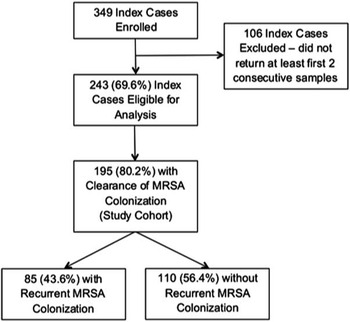
During the study period, a total of 349 households provided informed consent (Figure 1). Of these enrolled households, 243 (69.6%) index cases returned samples for the first 2 sampling periods (permitting a calculation of duration of colonization) and were included in the analysis. The only significant difference between the included and excluded index cases was in the proportion of white subjects (42.8% of included index cases vs 26.4% of excluded index cases, P=.004; there were no differences seen in demographic factors, household size, or comorbidities between races). Among the 243 index cases, 195 (80.2%) were determined to have clearance of MRSA colonization during the study period. These 195 index cases constituted the principal study cohort. The median age of index cases was 16.6 years (interquartile range [IQR], 3.5–39.6 years) and 125 (64.1%) were female. Subsequently, 85 index cases (43.6%) had surveillance cultures positive for MRSA, indicating recurrent colonization. The median time to recurrence of colonization with MRSA after clearance was 53 days (IQR, 36–84 days).
Flow chart of subjects in study of risk factors for recurrent colonization with methicillin-resistant Staphylococcus aureus in community-dwelling adults and children.

In the 195 households of index cases, there were a total of 671 household members. The median age of household members was 21.3 years (IQR, 8.9–35.6 years) and 377 (56.2%) were female. Median duration of follow-up for index cases and household members was 170 days (IQR, 90–194) and 179 days (IQR, 110–193), respectively. Of the potential 14 sampling episodes per subject, index cases and household members returned at least 1 swab for a median of 11 sampling episodes (IQR, 6–14). Furthermore, all 3 swabs were returned 94.6% of the time, and at least 2 swabs were returned 98% of the time.
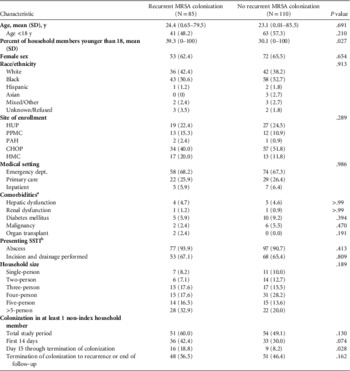
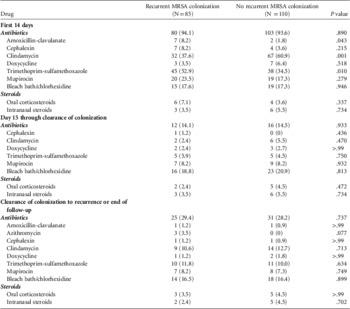
The only significant difference identified on univariate analysis between index cases who had recurrent MRSA colonization and those who did not is the proportion of household members younger than 18, which was higher among those with recurrent colonization (39.3% to 30.1%, P=.027) (Table 1). Subjects who developed recurrent MRSA colonization were more likely to have been prescribed trimethoprim-sulfamethoxazole (52.9% vs 34.5%; P=.010) and amoxicillin-clavulanate (8.2% vs 1.8%; P=.043), but less likely to have been prescribed clindamycin (37.6% vs 60.9%; P=.001) for treatment of the presenting MRSA SSTI than those who did not develop recurrent MRSA colonization (Table 2). The proportion of MRSA isolates that were susceptible to clindamycin among those who received clindamycin as treatment did not differ significantly between the 2 groups: 94.1% in those with recurrent colonization group and 89.2% in those without recurrent colonization (P=.422) There was no difference in receipt of topical mupirocin or bleach baths/chlorhexidine between the 2 groups. There were also no differences noted between the groups in the other 2 periods (ie, day 15 through clearance of colonization and clearance of colonization to recurrence or end of follow-up).
Baseline Characteristics of Subjects With and Without Recurrent Colonization With MRSA

NOTE. Data are number (%) unless otherwise specified. CHOP, Children’s Hospital of Philadelphia; HMC, Penn State Milton S. Hershey Medical Center; HUP, Hospital of the University of Pennsylvania; MRSA, methicillin-resistant Staphylococcus aureus; PAH, Pennsylvania Hospital; PPMC, Penn Presbyterian Medical Center; SSTI, skin and soft-tissue infection.
a Percentages calculated using data available (194 subjects).
b Percentages calculated using data available (189 subjects).
Antibiotic and Immunosuppressant Use After Diagnosis of SSTI in Subjects With and Without Recurrent Colonization With MRSA

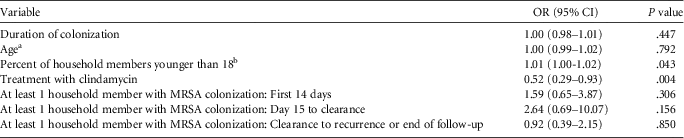
In multivariable analyses (Table 3), index cases who received treatment of the presenting SSTI with clindamycin were less likely to have recurrent MRSA colonization (odds ratio, 0.52; 95% CI, 0.29–0.93; P=.004). Conversely, index cases with a higher proportion of household members younger than 18 were more likely to have recurrent colonization (odds ratio, 1.01; 95% CI, 1.00–1.02; P=.043). On secondary analysis using a Cox proportional hazards model (Table 4), the only variable that was significantly associated with recurrent MRSA colonization in the index case was presence of MRSA colonization in at least 1 household member (hazard ratio, 2.59; 95% CI, 1.65–4.07; P<.001).
Logistic Regression Model of Risk Factors Associated With Recurrent Colonization With MRSA

NOTE. OR, odds ratio.
a OR represents odds for each 1-year increase in age.
b OR represents odds for each 10% increase in number of household members.
Cox Proportional Hazards Model of Risk Factors Associated With Recurrent Colonization With MRSA

NOTE. HR, hazard ratio.
a HR represents odds for each 10% increase in number of household members.
b Time-varying variable, at each visit.
DISCUSSION
Using systematic longitudinal sampling within a large, diverse population, we identified several important features of community-based MRSA colonization. Recurrent MRSA colonization was common, occurring in 43.6% of index cases during 6 months of follow-up. Further, clindamycin use for treatment of the primary MRSA SSTI was associated with lower risk of MRSA recurrence whereas having a higher percentage of household members younger than 18 increased the risk of recurrent colonization with MRSA. Additionally, on secondary analysis, exposure to a MRSA-colonized household member was associated with more rapid time to recurrence of colonization in index cases.
Receipt of clindamycin was associated with a decreased risk of recurrent colonization with MRSA in our study. Clindamycin has been used as a component of MRSA decolonization bundles owing to its activity against MRSA with eradication rates of up to 90%.Reference Tzermpos, Kanni and Tzanetakou 30 , Reference Ammerlaan, Kluytmans and Berkhout 31 Several other agents have also been studied as part of combination antibiotic treatment for MRSA colonization eradication, including doxycyclineReference Ammerlaan, Kluytmans and Berkhout 31 , Reference Simor, Phillips and McGeer 32 and trimethoprim-sulfamethoxazole.Reference Ammerlaan, Kluytmans and Berkhout 31 These antibiotics were not associated with decreased risk of recurrence in our study, however. Additionally, all of the decolonization strategies also included topical treatments and so the specific role of antibiotics remains unclear. Interestingly, prescription of decolonization agents by the treating physician (ie, topical mupirocin, bleach baths, chlorhexidine) was not associated with decreased risk of recurrent colonization in the current study. However, compliance with these measures was not determined and prescription of these drugs may have been given to patients with a perceived higher risk of recurrence. The combination of doxycycline and rifampin in addition to mupirocin and chlorhexidine has been investigated in a randomized controlled trial,Reference Simor, Phillips and McGeer 32 but no such trials have been conducted with clindamycin; future trials may be useful in elucidating its role in preventing recurrent colonization with MRSA.
Our study demonstrated an association between increased proportion of household members younger than 18 and recurrence of colonization with MRSA in index cases. Young age has been identified as a risk factor for longer duration of colonization with MRSAReference Larsson, Gustafsson, Nilsson, Odenholt, Ringberg and Melander 33 as well as for transmission of MRSA within households.Reference Mollema, Richardus and Behrendt 21 , Reference Calfee, Durbin, Germanson, Toney, Smith and Farr 22 , Reference Johansson, Gustafsson and Ringberg 34 It has been postulated that the association between young age and MRSA colonization and transmission is due to crowding in households with many children. Our study did not find that larger household size was a risk factor for recurrent colonization with MRSA, but personal hygiene factors rather than housing could be related to it. On the other hand, Lucet et alReference Lucet, Paoletti and Demontpion 35 found that older age was associated with prolonged MRSA carriage, transmission, and acquisition of MRSA in a home healthcare environment. Given these conflicting study findings, the association between age and the natural history of colonization with MRSA in the community remains unclear and requires further study, perhaps with more precise measures of household crowding.
Although it was not identified as a risk factor in the primary logistic regression analysis, in a time-to-event analysis we found that colonization with MRSA among household members was associated with decreased time to recurrence in the index case. In the logistic regression analysis, higher rates of household colonization were noted in all periods among those subjects who recurred, but only 1 period reached statistical significance on bivariable analysis and none reached statistical significance on multivariable analysis; we may not have had sufficient power to detect modest differences, as indicated by the relatively wide confidence intervals. Previous studies have demonstrated that the presence of colonization with MRSA among household members results in longer duration of colonization with MRSA in index cases.Reference Larsson, Gustafsson, Nilsson, Odenholt, Ringberg and Melander 33 , Reference Rodriguez, Hogan, Krauss, Warren and Fritz 36 Therefore, it is not surprising that presence of colonization in at least 1 household member was identified as a risk factor for more rapid recurrence of colonization in the index case on survival analysis. This finding suggests that early decolonization of household members could prevent recurrence of colonization with MRSA in those presenting with MRSA SSTI. This is supported by the findings of Fritz and colleagues,Reference Fritz, Hogan and Hayek 37 which demonstrated that decolonization of household members may help decrease the burden of MRSA SSTI among pediatric patients. Further studies are needed to determine whether decolonization of household members decreases the rate of colonization with MRSA and subsequent infection in adults as well as children.
This study has several potential limitations. Index cases may have been misclassified in terms of clearance of colonization. However, defining clearance of colonization as all samples negative for 2 consecutive sampling periods decreased the possibility that we were missing true clearance of colonization. Although selection bias is of concern, excluded subjects did not differ substantively from the included subjects on the basis of demographic factors and antibiotic use. Recall bias is also an important limitation because some data were obtained from the subjects. This most likely affected the ascertainment of prior antibiotic use and use of decolonization methods, such as mupirocin or chlorhexidine. However, although antibiotic use was assessed through patient recall, antibiotic use was confirmed via review of medical records. Furthermore, potential interviewer bias was minimized by using a structured data abstraction form utilized by interviewers who were unaware of the subject’s colonization status. In addition, rates and patterns of antibiotic resistance may vary across regions and this variation may reflect differences in the distribution of risk factors. Nevertheless, this study was conducted at multiple sites comprising a geographically, racially, and ethnically diverse population of both adults and children, which should improve the generalizability of these findings. Owing to the observational nature of the study, there may be unmeasured confounders that could account for the findings of this study. Also, other household and community factors not assessed in this study, such as home surface contamination and pet carriage with MRSA, may be associated with risk of recurrent MRSA colonization and should be considered for future studies.Reference Davis, Iverson and Baron 38 – Reference Fritz, Hogan and Singh 40
In conclusion, we found that 43.6% of subjects who initially lost colonization with MRSA later recurred, with a median time to recurrence of 53 days. Receipt of clindamycin in the 14 days following MRSA SSTI diagnosis was associated with a decreased risk of recurrent colonization with MRSA whereas increased proportion of household members younger than 18 was associated with increased risk of recurrence. In addition, we found a significant association between time to recurrence of colonization in index cases and presence of a household member colonized with MRSA. Future studies should examine the impact of recurrent colonization on development of MRSA reinfection as well as the potential role of clindamycin in decreasing the burden of MRSA colonization or as a component of decolonization bundles. Additionally, these results may suggest that total household decolonization efforts in adults and children may delay the time to recurrent colonization and should be studied further.
ACKNOWLEDGMENTS
Financial support. Pennsylvania State Department of Health (Commonwealth Universal Research Enhancement Program grant to E.L.); the National Institutes of Health (grant K24-AI080942 to E.L.); and the Centers for Disease Control and Prevention Epicenters Program (grant U54-CK000163 to E.L.). The funding agencies had no role in the design and conduct of the study; collection, management, analysis, and interpretation of the data; or preparation, review, or approval of the manuscript.
Potential conflicts of interest. All authors report no conflicts of interest relevant to this article.