

Published online by Cambridge University Press: 10 May 2005
Community engagement through service learning has become well institutionalized in American education, yet there has been considerable debate over its effectiveness, especially with regard to its impact on explicitly political engagement. While participation in community service and volunteerism clearly has a positive impact on the propensity of young people to dedicate themselves to further service, the evidence of the effects of service on political engagement is, at best, mixed.
Some evidence that community volunteerism does contribute to increased political engagement can be found in my analysis of the results from the 2002 CIRCLE Youth Survey, as presented in Table 1A. Statistically significant relationships exist between frequency of volunteering and likelihood to join a club or organization that deals with government and politics and likelihood to volunteer in a political campaign, although these relationships are weaker than their non-political counterparts. Although there is a statistically significant relationship between frequency of volunteering and receiving political information from television news, it is quite weak. Yet, even in these data, an examination of the relative frequency of civic behavior for these 15–25 year olds reveals a clear preference for community organizations over political ones. For example, although 38% volunteered for community organizations and 47% joined an organization that does not deal with politics, only 13% volunteered for a political campaign and 13% joined an organization that deals with politics. Youth who pursued both forms of engagement represented only 8% of the sample for both volunteering and joining, respectively. Furthermore, the relationships between volunteering for, or joining, community and political organizations are quite weak, although statistically significant: Tau-c = .109 (p = .000, N = 588) for the association between volunteering for both political and non-political organizations, and Tau-c = .073 (p = .010, N = 582) for the association between joining both.

Several studies report clearly negative results for the hypothesis that community service promotes political engagement in young people. Hunter and Brisbin's (2000) study of service leaning courses failed to show a link between service learning and changes in attitudes toward politics. A survey of youth conducted for the National Association of Secretaries of State concluded that even the simplest forms of political participation seem unaffected by involvement in community service, concluding that “volunteering and voting are unrelated. Voting and volunteering are not statistical predictors of one another, nor are the two variables significantly statistically correlated” (1999). In his review of the literature, Galston posits that youth turn to community service as a rejection of political engagement, since “most young people characterize their volunteering as an alternative to official politics, which they see as corrupt, ineffective, and unrelated to their deeper ideals” (2000, 5).
Cross-sectional data of the 2001 Cooperative Institutional Research Program (CIRP) from my own institution (The College of New Jersey, hereafter TCNJ) support the hypothesis of a disconnection between community engagement and political engagement. The results of comparisons are presented in Table 1B.1
The questions from the CIRP survey included in Table 1B were used to fashion part of an assessment tool for the project described later in this essay.
Given the mixed, but generally discouraging, empirical record, the burden of proof is certainly on any program that purports to increase political engagement through participation in community-based activities. In the remainder of this article, I present a program (and some preliminary assessment data for it) specifically designed to move students from community engagement to political engagement through the use of community-based research (CBR) and deliberative democracy as intermediate steps.
To address the separation of community service and political engagement some have recommended measures for transforming service endeavors directly into political advocacy projects (Robinson 2000; Marullo and Edwards 2000; Mack n.d). Such politicization would seem to be the most direct way to boost the impacts of community-engaged learning experiences on political behavior. But in reality it creates a deep dilemma. Pushing students engaged in service toward traditional advocacy is asking them to engage in the very thing they appear to reject in turning to volunteerism and service. It asks them to take part in some of their least popular activities (Lake et al. 2002, 12). Thus the dilemma: reinforce disconnections between community service and politics by keeping them separate, or lead civic volunteers somewhere they do not want to go, asking young people to engage in a political system they (especially frequent volunteers) increasingly find repugnant.
The Leadership in Public Affairs program has adapted the Community-Based Research (CBR) model to address this dilemma. CBR is a community engagement tool that draws students into longterm applied research projects with community partners. It consists of three essential ingredients: research collaboration between faculty, students, and community partners (research is done with not on community members); employment of multiple sources of knowledge and dissemination with emphasis on the applied value of the research to the community; and an underlying goal of social change for social justice (Strand et al. 2003). CBR addresses many of the shortcomings of traditional service learning projects: their extremely limited duration, the failure to thoroughly integrate the community service component into a challenging academic experience, and an individual amelioration approach which fails to confront students with the broader structural injustices that give rise to need.
However, even with an underlying goal of social justice, CBR projects will not necessarily lead students to direct engagement with the political system. The program developed by the Leadership in Public Affairs (LPA) program focuses CBR onto public policy projects to make the connection to politics explicit throughout. At the same time, the program is infused with the spirit of community-based collaboration that makes service experiences so positive for students. In short, the LPA program is designed to avoid the dilemma of simply politicizing service by moving students from an interest in community service to an interest in political participation by providing them with an alternative, much more appealing, model of political behavior.
The Leadership in Public Affairs program currently consists of two courses, student fellowships, and a public deliberative democracy project. Each component has piloted but is not yet fully sequenced into a developmental model of student learning and engagement.2
Outputs of the Leadership in Public Affairs program can be found at: http://publicleaders.tcnj.edu.
A program of the Corella and Bertram F. Bonner Foundation, primarily funded by Ameri-Corps. For more information see: http://www.bonner.org.
The introductory course in the sequence, Citizen Democracy, involves students in research-based collaboration with local grassroots citizen groups. It comprises the first step in a developmental sequence by introducing students to grassroots politics in a researchdriven, collaborative atmosphere. The course readings range from political science research and debates over the efficacy of citizen participation (Skocpol and Fiorina 1999) to case-study selections highlighting individual achievement in influencing public policy (Frantzich 1999) to applied work on effectively developing grassroots organizations (Rubin 2000). The bulk of the coursework is a small-group CBR project where students function much like political consultants for area grassroots organizations, primarily helping them improve their organizational effectiveness in light of the policy and political contexts within which they operate.
In the spring 2003 semester, the students in Citizen Democracy collaborated with three Trenton, New Jersey-area groups: Trenton Cycling Revolution, which seeks to influence transportation planning and public safety programs for the benefit of bicyclists; Extraordinarily Ewing, which focuses on building public support for approving the budget of the Ewing Township School District in annual elections; and Citizens Against the Power Plant, which successfully derailed a new power plant project in Bordentown Township.
The three student groups conducted their CBR using primary resources, including meetings and interviews with the leadership of their partner organization, organization and newspaper archives, public records, maps and public data, announcements of administrative rulings and legislative proposals, and, in one case, an opinion poll. Class discussions enhanced the use of primary resources by connecting the theoretical and practical wisdom of the course readings on the value of citizen participation to the research problems at hand. In addition to working with the individual student groups, one or more representatives from each of the partner organizations appeared as guest lecturers for an entire class period. Each student group produced an analytical report of about 15 pages with specific recommendations that was forwarded to their partner organization for use and comments.
The second course, Urban Political Economy, is a mid-level course that engages students in understanding the dynamics of urban change and in working with a local organization to help neighborhoods cope with these dynamics. This second course in the developmental sequence develops CBR research and collaboration skills in the context of larger-scale political conflict. The course readings range from a traditional urban politics text (Harrigan and Vogel 2003) to an explicitly pro-participatory work on urban renewal (Sirianni and Freidland 2001) to applied readings on neighborhood indicators projects designed to support the major assignment.
Students taking the course in spring 2003 produced a report for the Trenton Council of Civic Associations (TCCA), an umbrella organization for approximately 20 neighborhood-based community groups. Topics researched included issues in health, education, civic participation, and developments in economic revitalization and public safety. The three most important resources for students were direct regular access to community leaders, including the TCCA and a series of guest speakers, a database/geographic information system of Census 2000 and other public data sources assembled by myself and Bonner Leader students, and a 180-article newspaper archive compiled by Bonner Leader students. This large project necessarily transcended a single semester, and here the Bonner Leader students provided an invaluable contribution to the project by maintaining the continuity of the relationship with the community partner and completing major project objectives. Bonner Leaders worked through the summer editing the report, developing a set of 15 analytical maps, and preparing all of the material for presentation to the TCCA for its use and comment.
The projects undertaken by students in the courses provided extended, academically-intense experiences in a community-based environment. But did their focus on collaborative research achieve the objective of producing the changes in student attitudes expected of both successful service/volunteer programs (such as increased interest in helping others and contributing to community programs) and, at the same time, have a positive impact on student interest in political engagement? Initial assessment of the courses provides a positive answer.
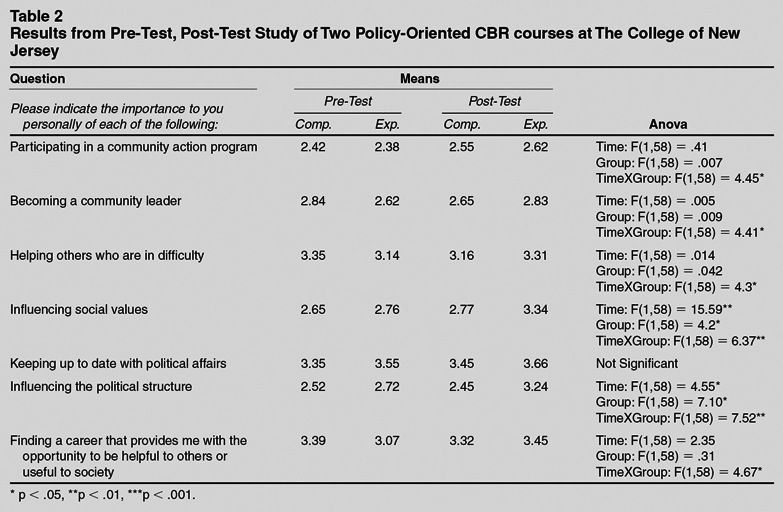
I employed a tool utilizing a pre-test/post-test experimental/comparison group design to assess the two courses. Given their similarity of design and small size, I pooled data from both piloted CBR courses, yielding an experimental sample size of 29 (Bonner Leaders were not assessed in this round). Data from a similar pairing of political science courses taught by different instructors in the same semester (introductory level American Government and intermediate level Civil Liberties) were pooled to form a comparison group with a sample size of 31. Students in each course completed matched questionnaires modeled on the CIRP in the first and last week of the term. Although these course assessments and the CIRP data presented earlier (Table 1B) cannot be directly compared given the radically different research designs and sample sizes, the CIRP data do present a valuable context for the course assessment data, namely the lack of connection between community service and political engagement for entering TCNJ students evident in the CIRP data.
Results of the course assessment for seven selected items which support the effectiveness of policy-oriented CBR courses in both community and political engagement values are presented in Table 2. Statistically significant (p < .05) differences between the CBR classes and comparison classes were found in six of these items. Students completing the CBR courses reported increased interest (versus the comparison group) in helping others, participating in community action programs, and in finding a career providing the opportunity to be helpful to others/society. These outcomes are typical of effective service learning experiences and volunteer programs. Yet these same students also reported increased interest (versus the comparison group) in influencing the political structure (p < .01), influencing social values (p < .01), and becoming a community leader. Of particular note is the strong relationship between completing the courses and increased interest in influencing the political structure, which failed to show a significant relationship in the cross-sectional CIRP data.

The one relationship in Table 2 that failed to show statistical significance (although it did show an increase) was between enrollment in one of the CBR courses and keeping up to date with political affairs. This is probably due to the fact that a majority of the students in all four courses measured were political science majors with very high interest at the outset (as shown by the means in Table 2), and thus restricted variance constrained the possibility of a treatment effect.
Two important qualifications need to be kept in mind in interpreting these results. First, the sample size was quite small, with 29 students combined in the CBR courses and 31 in the comparison courses. Second, students were not randomly assigned to the groups, but rather self-selected courses. However, the CBR nature of the two courses was not advertised in the catalog and students in both groups came from a similar range of backgrounds. The results of this initial assessment must be considered tentative, but they are nonetheless encouraging.
Providing an extended CBR experience within single courses produced promising initial results in terms of bridging the gap from community engagement to political engagement. Yet, fully implementing a developmental model is expected to significantly strengthen the program's ability to turn positive experience with community based collaboration into greater political engagement.
The transition to a developmental basis for the Leadership in Public Affairs program occurred in the 2003–2004 academic year when graduates of the CBR courses were invited to assume Bonner Leader positions. In addition to continuing the above-mentioned duties, the Bonner Leader students played leadership roles in planning and staffing two Public Issues Summits, co-sponsored by the region's primary newspaper. The Summits, involving a total of 270 participants from central New Jersey, engaged the general public in extended, face-to-face deliberations on public policy issues of youth, families, neighborhoods, and communities.
From the students' point of view, the Summits provide a cumulative experience in community leadership development. Students help organize and run large scale, real, political events based on the CBR work originating in the two courses. Moreover, these events operate on the collaborative model of community service rather than the conflict model of traditional politics. Here students have a rare opportunity to join community members as peers in public dialog. As the capstone experience in the LPA program, the Summits not only move students into leadership positions in interaction with local policy agenda-setting processes, the Summits also provide students (and community members) with perspective on the normative shortcomings of those processes and an alternative, more positive vision of citizen-driven democracy. The goal of placing a community based deliberative democracy project at the top of the Leadership in Public Affairs program is not to politicize community engagement, but to do just the opposite, to “communitize” political behavior.
Too few students have been involved in the Summits so far to judge their success in achieving this goal, yet informal reaction from the small group of students and the large number of community members involved has been overwhelmingly positive. In the 2004–2005 academic year the formal assessment of the developmental sequence of the Leadership in Public Affairs program will begin, following cohorts of students through coursework to leadership roles in the Summits to post graduation political behavior as members of the community.

Results from Two Surveys on Service versus Community and Political Engagement among Youth

Results from Pre-Test, Post-Test Study of Two Policy-Oriented CBR courses at The College of New Jersey