





Autism spectrum disorder (ASD) is a lifelong neurodevelopmental condition. It is characterised by difficulties in social interactions and the presence of restricted and repetitive patterns of behaviour. 1 This condition might significantly affect individuals’ daily life domains, including self-care, work and productivity, and social participation. Reference Baker, Stavropoulos, Baker and Blacher2 These limitations in daily life domains could restrict the independence and participation of individuals with ASD, Reference Colombo-Dougovito and Reeve3 and may contribute to poorer health and quality of life. Reference Skaletski, Bradley, Taylor, Travers and Bishop4 Although ASD is categorised as a non-fatal condition, individuals with ASD have an increased risk of premature mortality Reference Jokiranta-Olkoniemi, Gyllenberg, Sucksdorff, Suominen, Kronström and Chudal5 because the condition is statistically linked to several health challenging factors. Reference Dhanasekara, Ancona, Cortes, Hu, Rimu and Robohm-Leavitt6 Therefore, in addition to global studies, there is an increased need to investigate the prevalence and incidence of ASD in specific countries, as epidemiological measures reflecting its burden on individuals and societies could vary. Reference Kang, Liu, Liu, Liang, Yang and Liu7
Over recent decades, global awareness of ASD has increased markedly, potentially influenced by improvements in ASD diagnosis and enhanced access to medical and educational services. Reference Qin, Wang, Ning, Cui and Wang8 These factors could have contributed to raising the awareness and estimate sensitivity of ASD prevalence in many countries. Reference Akomolafe, Abdallah, Mahmood, Elshoeibi, Al-Khulaifi and Mahmoud9 However, interpreting these trends remains challenging, as the noticed increases may not reflect actual changes in the prevalence. This increase in recognised prevalence might be heavily driven by expanded diagnostic criteria, demographic shifts including population growth, and potential environmental and health factors. Reference Liu, Zhu, Ge, Huang and Li10 In this context, standardised and comparable epidemiological assessments are essential to understand long-term trends and inform evidence-based health planning. The Global Burden of Disease (GBD) study has provided a globally adopted and validated comprehensive framework for quantifying the burden of diseases and injuries. These statistics have been conducted across countries, age groups, genders and time, using harmonised methods. 11 Within this framework, ASD is modelled as a non-fatal condition, and its burden is captured through prevalence, incidence and years lived with disability (YLDs). These metrics allow assessment of not only how many individuals were affected, but also the extent of disability associated with ASD at the population level. Despite the availability of GBD estimates, detailed country-specific analyses focusing on ASD remain limited, particularly in low- and middle-income countries such as Jordan.
In the Middle East and North Africa (MENA) region, epidemiological evidence on ASD remains limited and heterogeneous. Most published studies have focused on selected age groups or clinical samples, and reported prevalence estimates at single time points rather than evaluating long-term population trends in prevalence, incidence and disability burden. Reference Akomolafe, Abdallah, Mahmood, Elshoeibi, Al-Khulaifi and Mahmoud9,Reference AlBatti, Alsaghan, Alsharif, Alharbi, BinOmair and Alghurair12,Reference Alshaban, Aldosari, Al-Shammari, El-Hag, Ghazal and Tolefat13 A recent systematic review by Akomolafe et al Reference Akomolafe, Abdallah, Mahmood, Elshoeibi, Al-Khulaifi and Mahmoud9 included 19 studies published between 2007 and 2025, from Iran, Oman, Libya, Egypt, Saudi Arabia, Lebanon, the United Arab Emirates, Bahrain, Qatar and Iraq. It highlighted the substantial variability in ASD prevalence estimates across the region, ranging from 0.01% in Oman to 6.50% in Iraq. The pooled prevalence of ASD in the MENA region was estimated at 0.14% (95% CI 0.02–0.36%), with evidence of increasing prevalence over time, rising from 0.04% in studies conducted before 2015 to 0.45% in studies conducted after 2015. Reference Akomolafe, Abdallah, Mahmood, Elshoeibi, Al-Khulaifi and Mahmoud9 Although there is no exclusive evidence, these findings suggest that increasing awareness, expansion of screening practices and improved diagnostic services may have contributed to the observed rise in ASD prevalence across the region.
Regional and global evidence indicates that ASD prevalence and burden have increased over recent decades, although substantial geographic variation persists. Regional analyses based on the GBD framework demonstrated that the age-standardised prevalence rate of ASD in the MENA region reached 304.4 per 100 000 population (95% uncertainty interval 251.2–366.1) in 2019, whereas age-standardised incidence and YLDs rates were 7.7 and 46.4 per 100 000, respectively. Reference Ebrahimi Meimand, Amiri, Shobeiri, Malekpour, Saeedi Moghaddam and Ghanbari14 Males consistently exhibited a substantially greater ASD burden than females, with prevalence rates approximately 2.9 times higher among males. Reference Ebrahimi Meimand, Amiri, Shobeiri, Malekpour, Saeedi Moghaddam and Ghanbari14 Iran reported the highest age-standardised prevalence, incidence and YLD rates within the region, whereas countries with higher sociodemographic index levels generally demonstrated greater ASD-related disability burden, likely reflecting improved awareness, case detection and access to diagnostic services. Reference Ebrahimi Meimand, Amiri, Shobeiri, Malekpour, Saeedi Moghaddam and Ghanbari14 At the global level, Zeidan et al reported marked variability in autism prevalence across regions, with a median prevalence of 100 per 10 000 population and estimates ranging from 1.09 to 436.0 per 10 000, alongside a median male:female ratio of 4:2. Reference Zeidan, Fombonne, Scorah, Ibrahim, Durkin and Saxena15 Global studies have also shown similar trends of ASD increasing burden. A meta-analysis published in 2023 estimated the pooled prevalence of ASD at 0.72% (95% CI 0.61–0.85), Reference Talantseva, Romanova, Shurdova, Dolgorukova, Sologub and Titova16 and Issac et al analysed data from more than 21 million children worldwide and estimated that 0.77% of children globally are diagnosed with ASD, with the highest prevalence reported in Australia. Reference Issac, Halemani, Shetty, Thimmappa, Vijay and Koni17 Collectively, these regional and international findings suggest that the increasing ASD burden is a trend reported worldwide, although differences in healthcare infrastructure, diagnostic practices, awareness and surveillance systems likely contribute to substantial variability between countries. Nevertheless, nationally representative population-based data remain unavailable for many MENA countries, including Jordan, limiting comprehensive understanding of ASD temporal trends and burden patterns in the country and the region.
Jordan is a middle-income country that has been undergoing demographic and epidemiological transitions because of challenges regarding the region’s political and natural resources. This is a country with a relatively young population and increasing demand for health, educational and social services. Reference Tamimi, Al-Abbadi, Tamimi, Juweid, Ahmad and Tamimi18 Indeed, understanding the magnitude and trends of ASD burden in the Jordanian context is a critical priority. Such studies are important for planning early detection programmes, allocating resources for specialised services and supporting individuals with ASD across the lifespan. However, to date, no study has comprehensively examined the cumulative burden of ASD in Jordan by using standardised methods that allow for comparison across time. Thus, this study aimed to quantify the burden of ASD in Jordan from 1990 to 2023, using epidemiological estimates from the GBD study 2023. Specifically, we assessed trends in prevalence, incidence and YLDs, stratified by age and gender.
Method
Study design, source and modelling approach
This population-based longitudinal analysis examined the burden of ASD in Jordan, using modelled estimates from the GBD study 2023. In the absence of nationally representative epidemiological studies on ASD in Jordan, the GBD 2023 estimates for Jordan were generated with standardised Bayesian meta-regression modelling. This framework synthesises information from available regional and global sources, alongside relevant covariates, to produce internally consistent country-level estimates with quantified uncertainty. The GBD is a comprehensive international research initiative that systematically quantifies morbidity and disability for a wide range of diseases and injuries across countries, age groups, genders and time, using standardised analytical methods. Publicly available GBD 2023 results were accessed through the Institute for Health Metrics and Evaluation (https://ghdx.healthdata.org/gbd-results-tool), and annual estimates for Jordan were extracted for the period 1990–2023 to enable assessment of long-term temporal trends in ASD burden. 11
Case definition and cause classification
ASD was defined according to the GBD 2023 cause hierarchy and classified under mental disorders. The GBD case definition of ASD encompasses pervasive neurodevelopmental conditions characterised by impairments in social interaction and communication. ASD also comes with restricted and repetitive patterns of behaviour, consistent with internationally recognised diagnostic frameworks. Reference Fan, Fan, Yang and Fan19 Within the GBD framework, ASD is modelled as a lifelong, non-fatal condition. Consequently, years of life lost are zero, and disability-adjusted life years are equivalent to YLDs.
Measures of disease burden
Three key epidemiological indicators were used to quantify the burden of ASD: prevalence, incidence and YLDs. Prevalence refers to the total number (and rate) of individuals living with ASD in a given year, regardless of time of diagnosis. Incidence represents the number (and rate) of new ASD cases occurring within a given year. YLDs quantify non-fatal health loss associated with ASD, and are estimated within the GBD framework by multiplying ASD prevalence by disability weights that reflect the severity of health loss associated with the condition. For each indicator, both absolute counts and age-standardised rates per 100 000 population were extracted, along with their corresponding 95% uncertainty intervals, which reflect uncertainty arising from data limitations and the modelling process within the GBD framework.
Stratification by age and gender
All estimates were stratified by gender, age and year. Stratification by gender included calculating estimates for males, females and both genders combined. Age categories included all-ages estimates, age-standardised estimates and age-specific groups ranging from 2–4 years to 55–59 years, as available. Age-standardised rates were calculated by the GBD study by using a standard global age structure, allowing for comparisons over time that are independent of changes in population age composition. Age-specific analyses were conducted primarily for prevalence and YLDs, as age-specific incidence estimates were not available for all age groups in the extracted data.
Data extraction and processing
GBD 2023 estimates were extracted in comma-separated value format, and included information on location, year, age group, gender, epidemiological measure, metric, point estimate and lower and upper bounds of the 95% uncertainty interval. Multiple extracted data-sets were merged and filtered to retain only observations corresponding to Jordan and ASD. Internal consistency checks were performed to ensure alignment across all measures, metrics and stratifications before analysis.
Statistical analysis
All analyses were conducted with the point estimates provided by GBD, with uncertainty intervals reported descriptively to reflect the uncertainty inherent in the modelled estimates. Changes in ASD burden over time were assessed by comparing estimates between 1990 and 2023, representing the earliest and most recent years available in GBD 2023. Absolute change was calculated as the difference between the 2023 and 1990 point estimates, whereas percentage change was calculated as the relative change between these 2 years. Because 95% uncertainty intervals for these modelled estimates are wide and frequently overlap, calculated percentage changes represent variations in the point estimates only, and may not reflect statistically significant differences between the two time periods. These calculations were performed separately for males, females and both genders, and for all-ages estimates, age-standardised rates and age-specific estimates, as appropriate.
Results
Overall burden of ASD in Jordan, 1990–2023
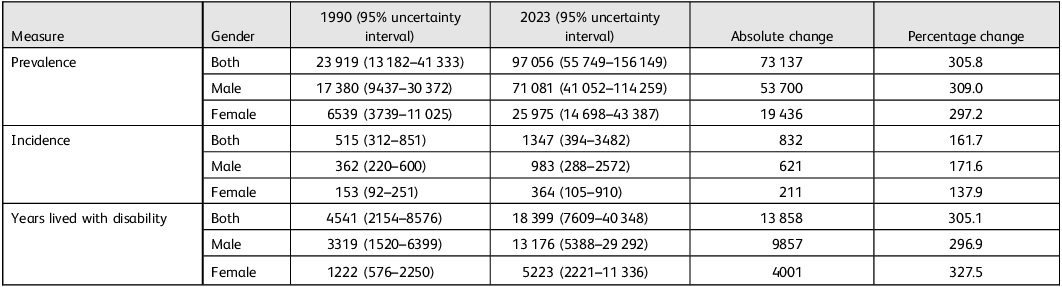
Between 1990 and 2023, modelled estimates from the GBD study 2023 suggest a substantial increase in the burden of ASD in Jordan across all epidemiological indicators. The all-ages number of prevalent ASD cases increased from 23 919 (95% uncertainty interval 13 182–41 333) in 1990 to 97 056 (95% uncertainty interval 55 749–156 149) in 2023, representing a 305.8% increase in modelled estimates over the study period. Similar proportional increases were observed among both males and females, with males consistently accounting for a higher burden throughout the study period. The number of incident cases increased from 515 (95% uncertainty interval 312–851) in 1990 to 1347 (95% uncertainty interval 394–3482) in 2023, corresponding to a 161.7% increase. Consistent with these trends, YLDs increased from 4541 (95% uncertainty interval 2154–8576) in 1990 to 18 399 (95% uncertainty interval 7609–40 348) in 2023, representing an approximate 305.1% increase (Table 1).
All-ages numbers of prevalent cases, incident cases and years lived with disability because of autism spectrum disorders in Jordan, 1990 and 2023, by gender

Table 1 Long description
The table presents data on the prevalence, incidence, and years lived with disability due to autism spectrum disorders in Jordan for the years 1990 and 2023, broken down by gender. It consists of 9 rows and 6 columns. The columns are labeled Measure, Metric, Gender, 1990 (95% UI), 2023 (95% UI), Absolute change, and Percentage change. The rows are labeled with different measures and metrics such as Prevalence Number, Incidence Number, and Years lived e with disability Number. Each row provides data for both genders combined, as well as separately for males and females. The table shows the number of prevalent cases, incident cases, and years lived with disability for each gender and year, along with the absolute and percentage changes over the study period.
Trends in age-standardised rates
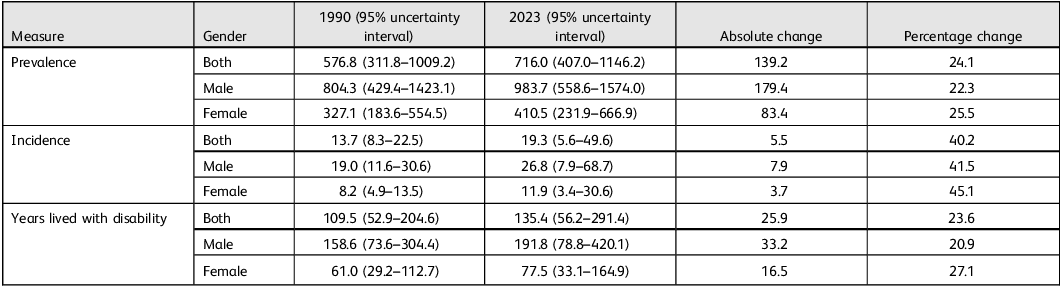
Age-standardised rates demonstrated consistent increasing trends over the study period. The age-standardised prevalence rate increased from 576.8 per 100 000 (95% uncertainty interval 311.8–1009.2) in 1990 to 716.0 per 100 000 (95% uncertainty interval 407.0–1146.2) in 2023, corresponding to an approximate 24.1% increase. Similar increases were observed among both males and females, with male rates remaining approximately twice those of females throughout the study period.
The age-standardised incidence rate increased from 13.7 per 100 000 (95% uncertainty interval 8.3–22.5) in 1990 to 19.3 per 100 000 (95% uncertainty interval 5.6–49.6) in 2023, representing an approximately 40.2% increase. Likewise, the age-standardised YLD rate rose from 109.5 per 100 000 (95% uncertainty interval 52.9–204.6) to 135.4 per 100 000 (95% uncertainty interval 56.2–291.4), reflecting an approximate 23.6% increase (Table 2).
Age-standardised prevalence, incidence and years lived with disability rates (per 100 000) because of autism spectrum disorders in Jordan, 1990 and 2023

Table 2 Long description
A table comparing prevalence, incidence, and years lived with disability rates for autism spectrum disorders in Jordan between 1990 and 2023. The table has 4 rows and 6 columns. Column headers are Measure, Gender, 1990 (95% UI), 2023 (95% UI), Absolute change, and Percentage change. Row labels are Prevalence, Incidence, and Years lived with disability. Row 1: Prevalence, Both, 576.8 (311.8-1009.2), 716.0 (407.0-1146.2), 139.2, 24.1 percent. Row 2: Prevalence, Male, 804.3 (429.4-1423.1), 983.7 (558.6-1574.0), 179.4, 22.3 percent. Row 3: Prevalence, Female, 327.1 (183.6-554.5), 410.5 (231.9-666.9), 83.4, 25.5 percent. Row 4: Incidence, Both, 13.7 (8.3-22.5), 19.3 (5.6-49.6), 5.5, 40.2 percent. Row 5: Incidence, Male, 19.0 (11.6-30.6), 26.8 (7.9-68.7), 7.9, 41.5 percent. Row 6: Incidence, Female, 8.2 (4.9-13.5), 11.9 (3.4-30.6), 3.7, 45.1 percent. Row 7: Years lived with disability, Both, 109.5 (52.9-204.6), 135.4 (56.2-291.4), 25.9, 23.6 percent. Row 8: Years lived with disability, Male, 158.6 (73.6-304.4), 191.8 (78.8-420.1), 33.2, 20.9 percent. Row 9: Years lived with disability, Female, 61.0 (29.2-112.7), 77.5 (33.1-164.9), 16.5, 27.1 percent.
Age-specific prevalence patterns
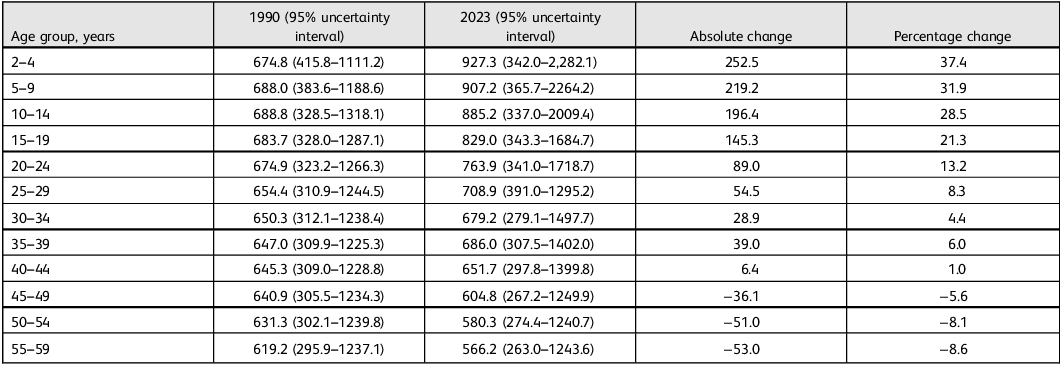
Across all age groups, ASD prevalence rates were highest in early childhood and declined progressively with increasing age. In 1990, prevalence rates peaked in the 5–9 year and 10–14 year age groups, whereas in 2023, the highest rates were observed in the 2–4 year and 5–9 year age groups. Between 1990 and 2023, prevalence rates increased across most age groups, with the largest relative increases observed among children aged 2–4 years (37.4%) and 5–9 years (31.9%) (Table 3).
Age-specific prevalence rates (per 100 000) of autism spectrum disorders in Jordan, for both genders, 1990 and 2023

Table 3 Long description
The table presents age-specific prevalence rates of autism spectrum disorders in Jordan for both genders in 1990 and 2023. It includes six columns: Age group (years), 1990 (95% UI), 2023 (95% UI), Absolute change, and Percentage change. The age groups range from 2-4 years to 55-59 years. Each row lists the prevalence rates for each age group in 1990 and 2023, along with the absolute and percentage changes over this period. Notable trends include an increase in prevalence rates across most age groups, with the largest relative increases observed among children aged 2-4 years (37.4%) and 5-9 years (31.9%).
Age-specific YLD patterns
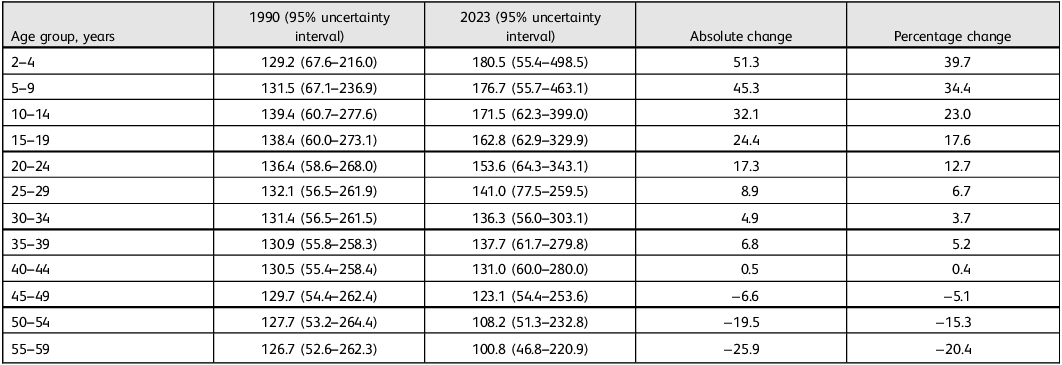
Age-specific YLD rates mirrored the prevalence patterns, with the highest burden observed in younger age groups. Between 1990 and 2023, YLD rates increased substantially among children aged 2–4 years (39.7%) and 5–9 years (34.4%), whereas modest decreases were observed in some older age groups (Table 4).
Age-specific years lived with disability rates (per 100 000) because of autism spectrum disorders in Jordan, for both genders, 1990 and 2023

Table 4 Long description
The table presents data on years lived with disability rates per 100,000 due to autism spectrum disorders in Jordan, for both genders, across different age groups for the years 1990 and 2023. It includes six columns: Age group, 1990 (95% UI), 2023 (95% UI), Absolute change, and Percentage change. The age groups range from 2-4 years to 55-59 years. Each row provides the disability rates for 1990 and 2023, along with the absolute and percentage changes over this period. Notable trends include significant increases in younger age groups, such as a 39.7% increase for ages 2-4 and a 34.4% increase for ages 5-9, while some older age groups show modest decreases.
Discussion
This study provides the first comprehensive assessment of ASD burden in Jordan using standardised GBD methods, addressing a critical national evidence gap in the absence of primary epidemiological data. Our findings demonstrated a substantial increase in modelled ASD prevalence, incidence and YLDs over more than three decades, highlighting a growing non-fatal neurodevelopmental burden in the Jordanian population. Previous regional research has often focused solely on prevalence, relied on heterogeneous diagnostic criteria or been restricted to paediatric populations. Reference Alshaban, Aldosari, Al-Shammari, El-Hag, Ghazal and Tolefat13,Reference Akomolafe, Abdallah, Mahmood, Elshoeibi, Al-Khulaifi and Mahmoud20 Based on the GBD 2023 estimates, the present study provides internally consistent measures of ASD prevalence, incidence and YLDs across time, gender and age groups in Jordan, thereby strengthening the current evidence-based knowledge for ASD epidemiology in low- and middle-income settings.
Gender differences and age patterns
Consistent with global Reference Zhu, Zhang, Wang and Yang21 and regional Reference Akomolafe, Abdallah, Mahmood, Elshoeibi, Al-Khulaifi and Mahmoud20 evidence, our results showed a persistently higher ASD burden among males compared with females across estimates of prevalence, incidence and YLDs. Male age-standardised rates were approximately two to three times higher than female rates throughout the study period. This pattern aligns with well-established gender differences in ASD diagnosis reported internationally, Reference Napolitano, Schiavi, La Rosa, Rossi-Espagnet, Petrillo and Bottino22 and likely reflects a combination of biological susceptibility and potential underrecognition of ASD in females. Reference Dougherty, Marrus, Maloney, Yip, Sandin and Turner23
Age-specific analyses revealed that ASD burden was highest in early childhood and declined progressively with increasing age. The largest relative increases in prevalence and YLD rates between 1990 and 2023 were observed among children aged 2–4 and 5–9 years. This age-specific trend emphasises the importance of early childhood detection and intervention for ASD. These findings align with global burden estimates, indicating that ASD imposes a greater health burden in early life, with disability-adjusted life years peaking in childhood and declining with increasing age, highlighting the critical impact of ASD in younger populations. Reference Santomauro, Erskine, Mantilla Herrera, Miller, Shadid and Hagins24 Such age-specific burden patterns have been reported in prior GBD analyses, where YLDs for ASD were highest among children and decreased across older age groups. Reference Santomauro, Erskine, Mantilla Herrera, Miller, Shadid and Hagins24 In contrast, global and regional studies have suggested that modest declines or plateaus for age-specific ASD burden in older age groups may reflect differences between birth cohorts (i.e. people born in earlier periods who had different life experiences) and diagnostic practices that historically focused less on adults. Reference Akomolafe, Abdallah, Mahmood, Elshoeibi, Al-Khulaifi and Mahmoud20,Reference Santomauro, Erskine, Mantilla Herrera, Miller, Shadid and Hagins24 They may also reflect survival with stable disability rather than progression to more severe health states. Reference Rabba, Lampinen, Meldrum, Dwyer, South and Taylor25 Unfortunately, there are no age-stratified epidemiological studies from Jordan confirming this pattern. However, existing research in Jordan has focused primarily on childhood diagnoses, Reference Zhu, Zhang, Wang and Yang21,Reference Hyassat, Al-Makahleh, Rahahleh and Al-Zyoud26 public knowledge, family experiences Reference Shattnawi, Bani, Al-Natour, Al-Hammouri, Al-Azzam and Joseph27 and service gaps Reference Masri, Al Suluh and Nasir28 rather than age-related prevalence or burden across the lifespan.
Regional context within the MENA
When viewed within the broader MENA context, the increasing burden of ASD observed in Jordan is not unique. Similar upward trends have been reported in recent GBD analyses of mental and neurodevelopmental disorders across the region. Reference Ebrahimi Meimand, Amiri, Shobeiri, Malekpour, Saeedi Moghaddam and Ghanbari29 Many MENA countries have shown comparable patterns of ASD burden over time. Reference Ebrahimi Meimand, Amiri, Shobeiri, Malekpour, Saeedi Moghaddam and Ghanbari29 Age-standardised prevalence and YLD rates were highest in Iran, Qatar and the United Arab Emirates in 2019, whereas lower rates were reported in Libya, Yemen and the Syrian Arab Republic. Reference Ebrahimi Meimand, Amiri, Shobeiri, Malekpour, Saeedi Moghaddam and Ghanbari29 Although regional rates remained relatively stable from 1990 to 2019, the absolute number of ASD cases increased, likely reflecting improved case recognition and demographic growth across the region. Reference Ebrahimi Meimand, Amiri, Shobeiri, Malekpour, Saeedi Moghaddam and Ghanbari29 However, the magnitude and pace of change varied considerably across the region, suggesting potential differences in health system infrastructures, diagnostic capacities, sociocultural perceptions of developmental disorders and data availability. 30
Despite these similarities in regional patterns, detailed country-specific analyses of ASD remain scarce in the MENA region. Most available studies are limited to single time points, subnational samples or specific age groups, and few provided simultaneous estimates of prevalence, incidence and disability burden over extended periods. Reference Shattnawi, Bani, Al-Natour, Al-Hammouri, Al-Azzam and Joseph27,Reference Al Jabery, Arabiat, Al Khamra, Betawi and Abdel Jabbar31 Nevertheless, the present study fills an important gap by offering a nationally focused, retrospective assessment of ASD burden in Jordan that is directly comparable with other GBD-based analyses.
National trends in ASD burden
At the national level, we observed that both all-ages counts and age-standardised rates of ASD prevalence and incidence increased by about threefold between 1990 and 2023. Although this pattern suggests a substantial rise in the recorded burden of ASD in Jordan, the interpretation of these trends requires caution, as multiple confounding factors likely contribute to this increase beyond a true rise in underlying risk.
First, part of the observed increase is likely driven by diagnostic expansion and improved case identification over time. The evolution of diagnostic criteria for ASD and greater clinical recognition, particularly following successive updates in classification systems, have broadened the diagnostic spectrum and facilitated identification of milder or previously unrecognised cases. Reference Hirota and King32 In parallel, increased awareness among healthcare providers, educators and families in Jordan has likely contributed to higher help-seeking behaviour and referral rates, leading to improved detection. Reference Shattnawi, Bani, Al-Natour, Al-Hammouri, Al-Azzam and Joseph27 Second, health system factors and service availability may have played a central role. Over the study period, Jordan has experienced gradual expansion in child developmental services, neurodevelopmental assessment capacity and special education services. These improvements likely enhanced diagnostic opportunities, particularly in urban settings, Reference Shattnawi, Bani, Al-Natour, Al-Hammouri, Al-Azzam and Joseph27 and reduced underdetection that may have been more prominent in earlier decades.
Third, sociocultural changes and shifting perceptions of neurodevelopmental disorders may have influenced both recognition and reporting. Reference AlSamhori, Kakish, Ellayyan, Mohammad, Hijazeen and Kheir33 Reduced stigma, increased parental awareness and greater acceptance of developmental screening in schools and primary care settings may have contributed to earlier identification of ASD cases that would previously have remained undiagnosed or misclassified.
In addition, demographic and epidemiological transitions in Jordan, including population growth and a sustained youthful age structure, could have increased the absolute number of individuals at risk of diagnosis. Reference Tamimi, Al-Abbadi, Tamimi, Juweid, Ahmad and Tamimi34 Although age-standardised rates also increased, suggesting that demographic change alone does not fully explain the trend, population structure likely amplified the overall burden. It is important to mention that the methodological nature of GBD estimates, where ASD is modelled as a lifelong condition. Under this framework, incident cases accumulate over time, contributing to progressively increasing prevalence and YLDs. Therefore, even modest increases in modelled incidence can translate into substantial long-term increases in prevalence, particularly in the absence of recovery or remission assumptions.
Importantly, these findings should also be interpreted in light of the methodological limitations inherent to the GBD framework. GBD estimates are modelled rather than derived solely from nationally representative surveillance systems, and therefore depend heavily on the availability and quality of underlying epidemiological data. In regions such as the Middle East, including Jordan, limited population-based ASD registries, underdiagnosis, variability in access to specialist assessment and sparse longitudinal data may reduce estimate precision and increase uncertainty. In settings with incomplete primary data, the GBD framework incorporates statistical modelling techniques and covariates from comparable countries to generate estimates. Although the GDB approach may improve comparability across regions and years, it may also introduce uncertainty if local epidemiological patterns differ from those assumed by the model. Consequently, part of the observed temporal increase may reflect improvements in data capture and modelling inputs over time, rather than a true epidemiological rise.
Together, these findings suggest that the observed trends likely reflect a combination of true changes in recognised incidence, improved diagnostic capacity, health system development, sociocultural shifts and evolving data availability, rather than a single underlying aetiological driver. Unravelling the relative contribution of these factors remains challenging, but is essential for accurate interpretation of temporal trends in ASD burden in Jordan.
In the absence of country-level data, GBD 2023 estimates for Jordan were generated using standardised Bayesian meta-regression modelling (DisMod-MR 2.1), which synthesises information from available regional and global data sources, alongside relevant covariates such as the sociodemographic index, health system indicators and temporal trends in diagnostic practices. This approach enables internally consistent estimation across locations and time periods, but relies on borrowing data from neighbouring countries and comparable settings. As a result, observed temporal trends in ASD burden for Jordan should be interpreted as changes in modelled estimates rather than directly observed epidemiological trends. These patterns may reflect improvements in diagnostic recognition, service availability and global awareness of ASD, in addition to underlying demographic changes, rather than true increases in disease occurrence.
Implications for the Jordanian health system
The sustained increase in ASD burden has important implications for health, education and social care systems in Jordan. The rising prevalence and YLDs introduces a growing demand for comprehensive diagnostic services, early intervention programmes, special inclusive education and long-term support across the lifespan. Reference Kim35 The concentration of burden in early childhood highlights the need for systematic national screening and early developmental services. In addition, the persistence of disability into adulthood highlights the importance of transition planning and adult support services. At the regional level, our findings emphasise the need for MENA-specific, ASD-related strategies. Reference Smythe, Scherer, Nanyunja, Tann and Olusanya36 These strategies for addressing neurodevelopmental disorders might include workforce training, strengthening data infrastructure, integration of developmental health into primary care systems, and providing evidence-based rehabilitation and community integration services. Reference Smythe, Scherer, Nanyunja, Tann and Olusanya36 GBD-based national analyses such as this study can support evidence-informed planning and facilitate comparisons across countries with similar demographic and health system characteristics.
From a rehabilitative services perspective, the increasing burden suggests a rising demand for multidisciplinary care, including child and adolescent mental health services, developmental paediatrics, psychology, speech and language therapy, occupational therapy and special education support. Reference Alkahtani, Al Awaji, Al Bashir, Alahmari, Alwuraykah and Alotaibi37 However, current service provision in Jordan remains limited and unevenly distributed, with a strong concentration in urban areas and reliance on a small number of specialised centres. This imbalance may contribute to unmet needs, long waiting times and delayed access to intervention. Reference Ronksley, Sanmartin, Quan, Ravani, Tonelli and Manns38
Early detection and intervention remain critical priorities. In Jordan, developmental screening is not yet fully integrated into routine primary care or maternal–child health services, and access to standardised diagnostic pathways remains inconsistent. Strengthening early screening, improving referral systems and embedding ASD detection within primary healthcare could support earlier diagnosis and timely intervention during key neurodevelopmental periods, which are associated with better functional outcomes. Reference Alkahtani, Al Awaji, Al Bashir, Alahmari, Alwuraykah and Alotaibi37
Workforce capacity is a major structural constraint, with expected increases in ASD burden likely to further strain already limited numbers of developmental specialists, psychologists, speech and language therapists, occupational therapists and special education professionals. Reference Alkahtani, Al Awaji, Al Bashir, Alahmari, Alwuraykah and Alotaibi37 Addressing this requires investment in pre-service and in-service training, expansion of multidisciplinary programmes and development of national clinical guidelines to ensure consistent care. Reference Yang and Kim39 At the policy level, ASD should be more explicitly integrated into national health, education and social protection strategies, including strengthened disability-inclusive policies, expanded community-based rehabilitation and improved intersectoral coordination. Reference Bertelli, Bianco, Salerno and Salvador-Carulla40 Establishing national ASD surveillance systems and strengthening routine data collection would support better planning. Although GBD estimates provide useful guidance for long-term planning, they should be interpreted in light of methodological limitations and used primarily to inform strategic resource allocation, rather than precise estimates of service need.
Strengths and limitations
The primary strength of this study lies in its use of standardised GBD 2023 estimates, enabling robust comparisons across time, gender and age groups with a transparent and reproducible methodology. However, a number of limitations should be acknowledged. GBD estimates are based on available data inputs and modelling assumptions, and in settings where primary epidemiological data are limited, uncertainty intervals remain wide. Jordan currently lacks nationally representative epidemiological studies, disease registries and surveillance systems for ASD. As highlighted by recent systematic reviews of ASD prevalence in the MENA region, no population-based studies from Jordan were identified, highlighting a substantial national evidence gap. Reference Akomolafe, Abdallah, Mahmood, Elshoeibi, Al-Khulaifi and Mahmoud20 Consequently, the 2023 GBD study did not incorporate Jordan-specific primary epidemiological data when estimating ASD prevalence, incidence or disability. Country-specific data, however, might be underestimating ASD-related statistics, as national registries are not available. In addition, age-specific incidence estimates were not available for all age groups, restricting detailed age-pattern analyses for the incidence of ASD. Nevertheless, the overall trends observed in this comprehensive analysis are internally consistent and align with regional and global patterns. These estimates do not reflect directly observed case counts, but are derived from GBD modelling frameworks that account for evolving diagnostic definitions, improvements in global ASD recognition, demographic changes and limited diagnostic capacity in earlier decades, particularly in data-scarce settings such as Jordan. Future studies should encourage the establishment of national registries and testing evidence-based ASD interventions specifically applied in the country context. In addition, the integration of artificial intelligence and machine learning approaches is crucial in ASD diagnostic process. These suggested methodological techniques may overcome certain challenges in early detection of ASD, including limited specialist services, inequities in access to healthcare and inconsistencies in clinical evaluations across different clinical contexts.
Conclusion
This study describes changes in the burden of ASD in Jordan between 1990 and 2023, with increases observed in prevalence, incidence and disability-related metrics, as well as differences by age and gender. These findings should be interpreted in light of the descriptive and modelled nature of the data, which reflect underlying assumptions of the GBD framework and the availability of epidemiological inputs over time. Rather than claiming definitive causal or epidemiological changes, the observed trends likely reflect a combination of changes in diagnostic practices, health system capacity, data availability and modelled estimates. Nevertheless, this study provides useful descriptive evidence that may support health policy discussions, service planning and future research on neurodevelopmental disorders in Jordan and similar settings.
Data availability
The data that support the findings of this study are publicly available from the Global Burden of Disease (GBD) Results Tool, provided by the Institute for Health Metrics and Evaluation at https://ghdx.healthdata.org/gbd-results-tool. No new primary data were created in this study. Materials supporting the findings of the study and the analytic code used to generate the results are available from the corresponding author, M.A.-W., upon reasonable request.
Acknowledgements
We would like to thank the Institute for Health Metrics and Evaluation staff and its collaborators, who prepared these publicly available data. The authors are grateful to the Deanship of Research and Graduate Studies, Jordan University of Science and Technology. No artificial intelligence tools have been used in the research or writing process for this manuscript.
Author contributions
M.A.-W. and H.A. contributed to study conceptualisation, methodology, formal analysis, supervision, writing the original draft of the manuscript and reviewing and editing the manuscript. K.A.A. contributed to study conceptualisation, methodology, supervision, validation and reviewing and editing the manuscript. A.F.J. contributed to data curation, formal analysis, visualisation and reviewing and editing the manuscript. N.I. contributed to data curation, investigation, visualisation and reviewing and editing the manuscript. A.O.O. and H.H. contributed to study methodology, validation and reviewing and editing the manuscript. O.A. contributed to study investigation, data curation and reviewing and editing the manuscript. Y.K. contributed to study conceptualisation, supervision, validation and reviewing and editing the manuscript.
Funding
This research received no specific grant from any funding agency, commercial, or not for profit sectors.
Declaration of interest
None.
Ethical standards
This study is based on secondary analysis of publicly available, de-identified data from the GBD study conducted by the Institute for Health Metrics and Evaluation. No individual-level identifiable human participant data were used. Ethical approval was therefore not required in accordance with institutional and national research guidelines. The authors assert that all procedures contributing to this work comply with the ethical standards of relevant national and institutional committees on human experimentation and with the Helsinki Declaration of 1975, as revised in 2013. Patient consent for publication was not required. This study used publicly available, fully anonymised, and de-identified secondary data from the GBD study. No individual-level identifiable human participant data were accessed or included.

 Open access


eLetters
No eLetters have been published for this article.