Introduction
Polychaetous annelids are probably the most frequently encountered and abundant macrobenthic metazoans in marine environments and the establishment of close associations with other invertebrates is a rather common phenomenon for this group (Martin & Britayev Reference Martin and Britayev1998). Most of the known relationships regarding ‘symbiotic’ (sensu De Bary Reference De Bary1878) polychaetes have been generally considered as commensalism. However, these characterizations mostly rely only on an apparent lack of ‘parasitic’ features, rather than on direct evidence (Martin & Britayev Reference Martin and Britayev1998), with the exception of a very few cases where the parasitic relationship has been effectively demonstrated (e.g. Emson et al. Reference Emson, Young and Paterson1993, Freeman et al. Reference Freeman, Richardson and Seed1998, Britayev & Lyskin Reference Britayev and Lyskin2002, Schiaparelli et al. Reference Schiaparelli, Alvaro, Bohn and Albertelli2010).
‘Symbiotic’ polychaetes are usually associated with hosts that provide good shelter (e.g. burrowing animals), have advantageous protective morphological features (e.g. grooves) or have chemical defences, all peculiarities easily found among echinoderms, with examples among all five classes of this phylum (Martin & Britayev Reference Martin and Britayev1998). The numerous species of polychaetes associated with sea stars, sea urchins and brittle stars (mainly polynoids, but also hesionids and syllids) prefer the more protective oral surface of their hosts (Martin & Britayev Reference Martin and Britayev1998). In very few cases only, however, some polychaetes may also be found inside the host's body, either in its coelomic cavity (Monticelli Reference Monticelli1892) or in the intestine (Emson et al. Reference Emson, Young and Paterson1993). To date, the best described association of this kind is that of the polychaete Benthoscolex cubanus Hartman, 1942 (Fam. Amphinomidae), which has been found inside the gut of the irregular sea urchin Archeopneustes hystrix (A. Agassiz, 1880) (Fam. Asterostomatidae) in deep waters off the Bahamas (Emson et al. Reference Emson, Young and Paterson1993). From this position, the polychaete is able to steal forams and other organic material from the host gut content and can move along the entire length of its host's digestive track, exiting through the anus (Emson et al. Reference Emson, Young and Paterson1993).
Although it was clear that the polychaete removed food from the gut of the host, no negative effects on the sea urchin were observed (Emson et al. Reference Emson, Young and Paterson1993). For this reason, Emson et al. (Reference Emson, Young and Paterson1993) defined B. cubanus as either a parasite or a commensal of A. hystrix.
In this paper we describe a similar case in Antarctica, representing the first record, for the Southern Ocean, of an inquilinistic relationships of this kind. Inquilinism is a particular kind of commensalism in which one organism lives within another, usually in some part of the alimentary tract or respiratory chamber, without being parasitic on it or causing it any serious harm (Dales Reference Dales1957). This newly reported Antarctic case seems to fit this definition well. The partners of this Antarctic association are two known species, the irregular sea urchin Abatus nimrodi (Koehler, 1911) (Fam. Schizasteridae) and the polychaete Gorekia crassicirris (Willey, Reference Willey1902) (Fam. Polynoidae). This scaleworm has been reported, so far, only as a free-living species on incoherent substrates of all grain sizes (Hartmann-Schröder & Rosenfeldt Reference Hartmann-Schröder and Rosenfeldt1988) and has a circumpolar distribution, being present around the Antarctic Peninsula, in the South Orkney Islands and in the Ross Sea, from 37–2012 m (Stiller Reference Stiller1996, Knox & Cameron Reference Knox and Cameron1998). Analogously, the deposit feeding sea urchin has a circumpolar distribution occurring in the Ross, Dumont d'Urville and Davis seas, from 13–732 m. (David et al. Reference David, Chone, De Ridder and Festau2003), where it has been observed more or less buried in a silty/sandy sediment (Chenuil et al. Reference Chenuil, Gault and Féral2004).
In the light of the present finding we have reviewed the available literature regarding associations between polychaetes (even families different from Polynoidae) and echinoderms and examined the similarities/differences with the other known examples from outside Antarctic waters.
Material and methods
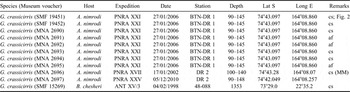
Most of the material examined was collected in the Ross Sea, at Terra Nova Bay, in the course of three different PNRA (Italian National Antarctic Research Program) expeditions (XVII, XXI, and XXV) carried out from 2001 to 2010. The specimens of G. crassicirris associated with A. nimrodi studied here were sampled by means of a naturalist dredge at different coastal stations on detritic bottoms (from 90–148 m) in front of the Mario Zucchelli Station (Table I). In vivo behavioural observations of G. crassicirris on A. nimrodi were performed and recorded (pictures and mini movies) with a digital camera (Nikon Coolpix 4500) before fixation in 80% ethanol.
List of sampling stations and of examined material. Complete specimens, used for size range measurements, are indicated by ‘cs’, while ‘af’ refers to anterior fragments. ‘MM’ refers to the mini movie available as supplementary material at www.journals.cambridge.org/jid_ANS.

Abbreviations: PNRA = Programma Nazionale di Ricerca in Antartide (Italian National Antarctic Research Program), ANT = ANTARKTIS/3 (EASIZ II) of RV Polarstern in 1998, BTN = Baia Terra Nova (Terra Nova Bay), DR = Naturalist dredge.
The diagnostic characters of the polychaetes were studied using a stereomicroscope equipped with a camera lucida apparatus and a Normaski interference contrast compound microscope. Morphometric measures were taken as follows: length (L), taken from the anterior margin of the prostomium to the posterior border of the last segment (pharynx not included, if extended); width (W), taken at approximately the largest segment, including parapodia but excluding chaetae.
An attempt to analyse the stomach content of some specimens of G. crassicirris was made in order to characterize the food spectrum of the polychaete as in Schiaparelli et al. (Reference Schiaparelli, Alvaro, Bohn and Albertelli2010), but no food was found inside the gut of the three examined specimens. In order not to damage all the available material, no further dissections were performed.
Host specimens were identified by using the dichothomous keys from the ‘Antarctic Echinoids interactive database’ (David et al. Reference David, Chone, De Ridder and Festau2003).
According to the available literature, other examples of associations involving polychaetes and echinoderms have been considered, but taking only into account guests and hosts that were identified at least at a genus level. Moreover, we focused only on those partnerships in which the associated polychaete was found along the oral side of the host, more or less close to its mouth, if not directly inside the gut or body cavity (see Supplementary Table I at www.journals.cambridge.org/jid_ANS for further details and bibliographic references). Examples in which the polychaete was generically reported as ‘on the host surface’ or ‘on aboral side’ were not considered, in order to exclude possible occasional epibiotic association. For polyxenous polychaetes, i.e. a single polychaete species associated with several hosts belonging to one/two distinct echinoderm classes (e.g. Arctonoe pulchra Johnson, 1897), each literature record was considered separately for calculations. The same was done for hosts with two (or more) different species of polychaetes (e.g. Ophiodromus flexuosus (Delle Chiaje, 1825) and Acholoe astericola (Delle Chiaje, 1841), both observed on Astropecten irregularis (Pennant, 1777)). Gastrolepidia clavigera Schmarda, 1861 represents another exception, being reported by Britayev & Zamishliak (Reference Britayev and Zamishliak1996) as entering both oral and cloacal cavities of its hosts, but without a specific indication of which species, among the 11 possible different hosts, it is the subject of this behaviour. In this case, we preferred to consider these potentially multiple examples as a single record.
Taxonomic names were checked following WoRMS (World Register of Marine Species, www.marinespecies.org; last search 7 May 2010). Voucher material is deposited at the Italian National Antarctic Museum (MNA) and at the Senckenberg Museum Frankfurt (SMF) (Table I).
Results
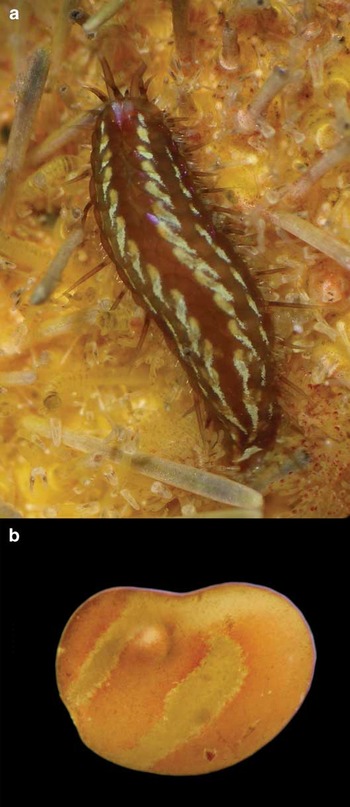
A ‘symbiotic’ relationship involving the Antarctic scaleworm G. crassicirris (Fig. 1) and the irregular sea urchin A. nimrodi is here described.
The scale worm Gorekia crassicirris on its host, the irregular sea urchin Abatus nimrodi. a. Specimen of G. crassicirris, dorsal view. b. Elytron of G. crassicirris showing the typical colour pattern with two lighter bands.

Systematic part
Family Polynoidae Kinberg, 1856
Genus Gorekia Bergström, Reference Bergström1916
Type species. Malmgrenia crassicirris Willey, Reference Willey1902.
Diagnosis. Body flattened dorsoventrally, short, up to 38 segments, more or less covered by elytra. Elytra 15 pairs on segments 2, 4, 5, 7, 9, 11, 13, 15, 17, 19, 21, 23, 26, 29, 32. Prostomium bilobed, without cephalic peaks, with three antennae; lateral antennae with ceratophores inserted terminoventrally to median antenna; two pairs of eyes, anterior pair dorsolateral at widest part of prostomium, posterior pair dorsal near hind margin of prostomium. Parapodia biramous, noto- and neuropodia with elongate acicular lobe; tips of noto- and neuroacicula penetrating epidermis; neuropodia with supra-acicular process. Notochaetae stouter than neurochaetae, with rows of spines and blunt or notched tips; neurochaetae more numerous, with rows of spines only distally and tridentate tips.
Gorekia crassicirris (Willey, Reference Willey1902)
Malmgrenia crassicirris Willey, Reference Willey1902: 269, pl. 42 figs 3 & 4, pl. 44 figs 5 & 6.
Gorekia crassicirris: Bergström (Reference Bergström1916): 295, pl. 3 fig. 9, pl. 5 figs 3–6; Uschakov (Reference Uschakov1962): 170, pl. 8 figs F–J; Hartman (Reference Hartman1964): 23, pl. 6 figs 4 & 5; Hartmann-Schröder & Rosenfeldt (Reference Hartmann-Schröder and Rosenfeldt1988): 29; Stiller (Reference Stiller1996): 35, pl. 15; Knox & Cameron (Reference Knox and Cameron1998): 27 figs 47–50.
Measurements. Specimen figured (SMF 19451: L 10 mm, W 2.5 mm for 37 segments). Size range for seven complete specimens investigated herein: L 6–13 mm, W 2–3.5 mm for 27–38 segments.
Description
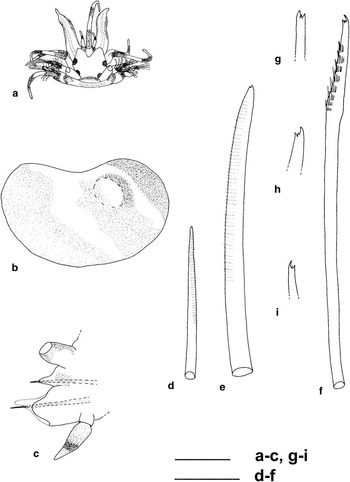
Prostomium bilobed, without cephalic peaks; median antenna with ceratophore in anterior notch, style smooth, tapering, with pigmented bands basally and subdistally; lateral antennae with ceratophores inserted terminoventrally and with short, smooth, tapering styles with pigmented band subdistally; palps smooth, stout, tapering; anterior pair of eyes dorsolaterally at widest part of prostomium, posterior pair dorsally near hind margin, but rather close to anterior pair (Fig. 2a). Tentaculophores inserted laterally to prostomium, without chaetae on inner side, but with a pair of smooth, tapering dorsal and ventral tentacular cirri; styles of tentacular cirri usually distinctly pigmented basally and subdistally (Fig. 2a). Second segment with first pair of elytra, biramous parapodia, and long ventral buccal cirri, similar to tentacular cirri.
Diagnostic characters of G. crassicirris (SMF 19451). a. Anterior end; style of right dorsal cirrus of segment 3 regenerating; elytra removed (Scale bar: 1 mm). b. Right elytron of segment 4 (Scale bar: 500 μm). c. Left cirrigerous parapodium of segment 12, posterior view; style of dorsal cirrus missing (Scale bar: 500 μm). d. Short notochaeta (Scale bar: 100 μm). e. Long notochaeta (Scale bar: 100 μm). f. Middle neurochaeta (Scale bar: 100 μm). g. Tip of upper neurochaeta (Scale bar: 50 μm). h. Tip of middle neurochaeta (Scale bar: 50 μm). i. Tip of lower neurochaeta (Scale bar: 50 μm).

Fifteen pairs of elytra; elytral surface and margin smooth, without papillae or tubercles, surface more or less pigmented (brownish in ethanol, reddish in life), with two unpigmented stripes diagonally (white in life) (Fig. 2b). Styles of dorsal cirri smooth, tapering, with pigmented bands basally and subdistally, extending beyond tips of neurochaetae; styles of ventral cirri smooth, thick, conical, pigmented all over except for tip, shorter than neuropodia, (Fig. 2c).
Parapodia biramous; noto- and neuropodia with elongate acicular lobe; tips of noto- and neuroacicula penetrating epidermis; neuropodia with thick, digitiform supra-acicular process (Fig. 2c). Short and long notochaetae stout with blunt or notched tips and faint rows of spines (Fig. 2d & e). Neurochaetae with rows of spines only in distal part, uppermost rows with very strong spines; tips of neurochaetae tridentate with smaller tertiary tooth between main and secondary tooth; in lower neurochaetae tertiary tooth often minute, less distinct than in upper and middle neurochaetae (Fig. 2 f–i).
Family Schizasteridae Lambert, 1905
Genus Abatus Troschel, 1851
Type species. Spatangus (Tripylus) cavernosus Philippi, 1845, p. 435, by original designation.
Description (from David et al. Reference David, Chone, De Ridder and Festau2003)
Test of variable ambital outline, rounded without any trace of frontal notch in species such as A. nimrodi, or conspicuously but not deeply indented such as in A. cavernosus or A. cordatus. Apical system subcentral with three genital pores. Paired petals deeply sunken into marsupia in females, and flushed with the test in males. The genus Abatus is characterized by the presence of a “peripetalous” fasciole in adults. All types of pedicellarie present, except the ophicephalous form.
Abatus nimrodi (Koehler, 1911)
Pseudabatus nimrodi Koehler, 1911: 60, pl. 7 figs 1–8, pl. 8 figs 7–12
Pseudabatus nimrodi: Bell (1917): 3.
Abatus (Pseudabatus) nimrodi: Mortensen (1951): 263.
Abatus nimrodi, Lockhart et al. (1994): 754, figs 3 & 4.
Measurements. The average length of the test is generally about 30–40 mm, but can be to 60 mm.
Description (from David et al. Reference David, Chone, De Ridder and Festau2003)
The main characteristic of A. nimrodi is that the depressed part of the petals is widely separated from the apical system. This feature is particularly conspicuous in females, in which the brood pouches start as far as 7 or 9 ambulacral plates distant from the apical system. General outline of the ambitus rounded, without frontal notch, slightly attenutated posteriorly. Test flattened aborally. Periproct located on the short vertical posterior end, and scarcely visible in either aboral or oral views. Labrum large, extending to the 2nd or 4th adjacent ambulacral plates, but not distinctly overhanging the peristome. Valves of globiferous pedicellariae terminating in a series of small teeth. Bidentate pedicellariae very abundant all over the test. Colour of preserved specimens dark-brown to almost black.
Description of the association
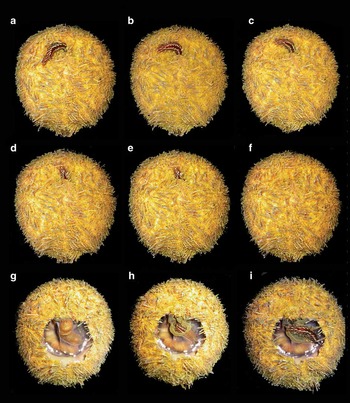
Overall, seven complete specimens of G. crassicirris were measured, resulting in a range of length and width of 6–13 mm and 2–3.5 mm, respectively, for 27 to 38 segments. Of these polychaetes, four were obtained from undamaged sea urchins and the existence of a possible correlation between their length and the tests’ major and minor diameter was verified. No significative correlation was found but, as the number of investigated specimens is so small, this result has to be considered provisional. The infestation rate was evaluated during the XXI PNRA Expedition (2005–06) considering 14 individuals of A. nimrodi collected in a single catch. Eight of these had a polychaete in the gut, accounting for 57% of the total. In the remaining ones no traces of the polychaete could be observed either inside or outside the test. Most polychaetes were found to leave the host gut after few hours of maintenance in small aquaria (T = 0–1°C), possibly due to oxygen depletion in the water. The crawling of the polychaetes on the host body did not provoke any reaction in the hosts, pedicellariae having been never observed to be used against the scaleworms. When sea urchins were placed upside down, in order to document the polychaetes’ movements along the oral side of the host, the scaleworms were repeatedly observed actively searching the mouth opening and entering it (Fig. 1 and movie in supplementary material available at www.journals.cambridge.org/jid_ANS). Dissection of hosts, performed immediately after the polychaete disappearance inside the mouth, revealed that it laid oriented along the gut (Fig. 3g–i). If disturbed by tactile stimuli, the polychaete was able to turn quickly around within the gut, moving away from the stimulus.
Sequence of images showing the behaviour of G. crassicirris on its host. Mini movie available at www.journals.cambridge.org/jid_ANS. a.–f. Disappearing act of the scaleworm inside the host's mouth. g.–i. Final position of the scaleworm, laying in the alimentary canal of A. nimrodi (test and gut opened to show the polychaete).

Since G. crassicirris has been previously considered a free-living polychaete, occurring only in north-western Antarctica (Antarctic Peninsula and the South Orkney Islands) (Stiller Reference Stiller1996) and in several areas of the Ross Sea (Knox & Cameron Reference Knox and Cameron1998), the record herein reported represents the first for Terra Nova Bay, but also for this kind of association for the whole Southern Ocean. However, G. crassicirris is not associated exclusively with A. nimrodi, since it was also found together with Brachysternaster chesheri Larrain, 1985 in the south Vestkapp area (Weddell Sea), at 1353 m (Polarstern cruise ANT XV/3, 1998) (Barnich unpublished data).
Discussion
The establishment of a partnership with an echinoderm host can undoubtedly assure many advantages to a ‘symbiont’ (Davenport Reference Davenport1966). A calcareous test (e.g. sea urchins) or a tough skin sometimes covered with bumps (e.g. holothuroids), as well as pointed spines (e.g. sea urchins, sea stars), do not only reduce potential predation on the host, but also transfer this benefit to the guest as well (Davenport Reference Davenport1966), according to what is known as ‘interspecific facilitation’ (Bruno et al. Reference Bruno, Stachowicz and Bertness2003). Such a combination of surface morphological features and ‘protective devices’ makes echinoderms a particularly attractive niche for numerous organisms (e.g. Davenport Reference Davenport1966, Jangoux Reference Jangoux1987a, Reference Jangoux1987b), including polychaetous annelids.
Among polychaetous annelids, more than half (55%) of all species that are currently defined as commensal belong to Polynoidae (Martin & Britayev Reference Martin and Britayev1998) and many different polynoid-echinoderm associations have been described, from tropical to polar environments (Pettibone Reference Pettibone1993, Freeman et al. Reference Freeman, Richardson and Seed1998, Martin & Britayev Reference Martin and Britayev1998, Britayev & Lyskin Reference Britayev and Lyskin2002, Schiaparelli et al. Reference Schiaparelli, Alvaro, Bohn and Albertelli2010).
To review the available data, we took into account the best documented literature examples of polychaete (all families) and echinoderm (all classes) worldwide-distributed associations, focusing exclusively on those records of polychaetes that were found on the oral side of their echinoderm hosts, if not directly within its gut or body cavity, and attempted to highlight possible similarities with the Antarctic counterpart.
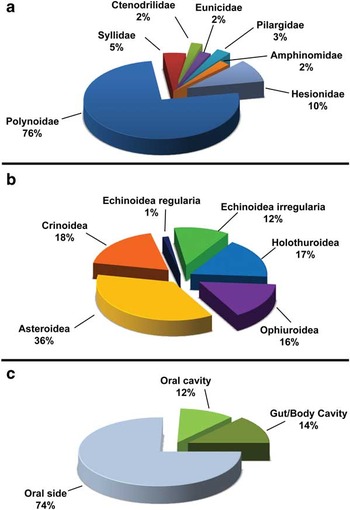
The pie charts in Fig. 4 summarize the information inferred from literature data (as specified in the Material and methods section). It is clear that most of the ‘commensal’ polychaete species (76%) belong to the family Polynoidae (Fig. 4a), while Asteroidea represents the most ‘infested’ class (37%) among Echinodermata (Fig. 4b). Furthermore, regardless of the polychaete family or the echinoderm class, in the majority (74%) of associations the polychaete guest is only found on the oral side of the host (Fig. 4c) although it does not seem to enter the oral cavity/gut with its anterior end.
Review of literature data. a. Taxonomic distribution of polychaete species involved in association with different echinoderm hosts. b. Allocation of polychaetes per host group (i.e. classes of echinoderms). c. Polychaete position on the host body. Information inferred from literature data, as specified in the Material and methods section. For full references and main features of the different polychaete-echinoderm associations considered see Supplemental Table I at www.journals.cambridge.org/jid_ANS.

Up to now, G. crassicirris is the only species, among Polynoidae, found to be able to completely enter the gut of a spatangoid, representing an ‘exception’ within the group. In fact, all other scaleworms just crawl partly into the stomach of their hosts and feed there, as the polynoid Acholoe astericola (Delle Chiaje, 1841) on the host Astropecten irregularis (Pennant, 1777) (Davenport Reference Davenport1953). Moreover, by considering the case of the amphinomid polychaete Benthoscolex cubanus, which is the only other known polychaete (not polynoid) that usually stays in the alimentary canal of an irregular sea urchin, our new Antarctic record represents the second worldwide example of such behaviour. Despite the very limited sample size available in our case, it is possible to highlight two similarities with B. cubanus (Emson et al. Reference Emson, Young and Paterson1993), i.e. the lack of any relationships between the size of the associated worms and that of the hosts, and a similar infestation rate (57% in Abatus and 65% in Archeopneustes).
As already pointed out by Emson et al. (Reference Emson, Young and Paterson1993), irregular sea urchins might be regarded as preferable hosts, due to the fact that access to the gut does not involve ‘negotiating’ an Aristotle's lantern or ascending to the aboral anus. Curiously, in Antarctica, even if spatangoid sea urchins constitute 39% of the Southern Ocean echinoids (RAMS 2010), such a kind of association has never been recorded before but may be much more widespread, involving even other host species.
Unlike B. cubanus, G. crassicirris has been mainly observed in the initial portion of the host's gut and, at least in laboratory conditions, the polychaete has never been seen going through the alimentary canal to exit from the anus as it has been reported for the previous species (Emson et al. Reference Emson, Young and Paterson1993).
The apparently empty stomachs of G. crassicirris prevented us from evaluating if its food spectrum somehow overlaps with that of the host and therefore whether the polychaete depends on the sea urchin for food. In the case of the amphinomid B. cubanus, this association has been defined as either commensal or parasitic (due to the stealing of food) by Emson et al. (Reference Emson, Young and Paterson1993). Further studies will be necessary to characterize better the Antarctic relationship. However, a possible interpretation of the ‘symbiotic relationship’ between G. crassicirris and A. nimrodi as an example of inquilinism can be suggested from previous works on polychaetes associated with holothuroids. Monticelli (Reference Monticelli1892) and Ganapati & Radhakrishna (Reference Ganapati and Radhakrishna1962), in fact, described similar associations in which polychaetes of several families (Syllidae, Ctenodrilidae and Hesionidae) have been found in the body cavity or in the intestine of holothuroid hosts. In both cases, authors defined those ‘symbiotic relationships’ as examples of inquilinism.
In the light of the behaviour observed during experimental conditions and considering the location of G. crassicirris, inside the gut of A. nimrodi, we interpret such an association as a further example of inquilinism, although endoparasitism cannot be excluded since we have not been able to evaluate the possible damage caused by the polychaete to its host. For both B. cubanus and G. crassicirris, there seems to be a strict host-guest specificity: the Caribbean polychaete has been found only on a precise species of irregular sea urchin. The same situation has been recorded for G. crassicirris, which in the Ross Sea is associated only with A. nimrodi, even if two more species of Schizasteridae occur (also sympatrically) at Terra Nova Bay (A. elongatus (Koehler, 1908) and A. shackletoni Koehler, 1911) (Chiantore et al. Reference Chiantore, Guidetti, Cavallero, De Domenico, Albertelli and Cattaneo-Vietti2006). On the other hand, G. crassicirris was also found in the Weddell Sea, on the peristomium of B. chescheri, another irregular sea urchin belonging to the same family (Schizasteridae) as A. nimrodi. Considering that the latter species is absent from that area (David et al. Reference David, Chone, De Ridder and Festau2003), it could be argued that a host-switch phenomenon occurred at some stage, due to the disjoint distribution of the two sea urchin species, as already previously suggested in other cases of Antarctic invertebrates living in close association (e.g. Schiaparelli et al. Reference Schiaparelli, Cattaneo-Vietti and Chiantore2000, Reference Schiaparelli, Ghirardo, Bohn, Chiantore, Albertelli and Cattaneo-Vietti2007).
Acknowledgements
We thank the Italian National Antarctic Program (PNRA) for funding and logistic support. We are indebted to Dr Christian Neumann (Naturkundemuseum, Berlin) for bringing to our attention the record of G. crassicirris from the XV/3 Polarstern Expedition. Two anonymous reviewers are acknowledged for their useful comments on the manuscript. Hanny Rivera (Harvard College) kindly revised the English language. This is CAML contribution 55.
Supplemental material
A supplemental table and a mini movie will be found at www.journals.cambridge.org/jid_ANS.