Introduction
When looking at archaeological objects, the multiple layers of meaning they held and still hold for the peoples who produced them are largely inaccessible to academic researchers. This meaning only becomes known—visible—when the Traditional Owners of that object are sought out for guidance. This paper seeks to demonstrate how much information is not visible if such collaborations are not undertaken through focusing on a set of objects and the stories which attached to them.
This article starts with an oral history telling of a time when sustainability was a lifeway, not a choice, in a time when Aboriginal spirituality created new plants, animals and landscapes. This is the story of Gymea (Krobie), a Dharawal Woman, who through love created a sacred plant which still holds her name, the Gymea lily (Doryanthes excelsa).Footnote 1 This story is essential for understanding the origins and meanings of three key Dharawal objects:
The Gymea fishing spear;
The Gymea fishing scoop; and
The Gymea fishing basket.
These three objects all stem from this one story and are a gift for the support of sustainable life on Dharawal Country by Gymea herself.
Krobie: The Gymea story
The following text is a transcription of the telling of the Gymea story by co-author Julie Freeman, Gorawarl Jerrawongarla woman and Yuin Elder, in August 2019:
This story is our old Grandmother's story from the Gweagal clan of Botany Bay, the land of the Dharawal. A love story of Krobie, a beautiful young girl and her husband Bunda, their love was Mutharng [Everything to them], and filled with great passion, and everyone knew it.
Over the mountains is the land of the Wiradjuri [come by night]. The Wiradjuri men were renowned for coming to the coast to steal away the special Mulgan Katungal [sea-born fisherwomen]. To steal these women broke all our old laws.
The Dharawal warriors would leave the coast to cross the mountains into the land of the Wiradjuri to do battle and bring back the women. The coastal women would wait on the rocky tops of the Escarpment for the warriors to return.
Now, when Bunda and the Warriors come back, he looked up to the escarpment to where the women were waiting wrapped in their possum skin clocks. Bunda said ‘I don't know which one is my beautiful Krobie’, so he decided he would make her a special gift. It was the season when the Black cockatoos came from over the mountains to the coast to drop their red crest feathers. Bunda picked up the feathers and made Krobie the most magnificent red crest feather collar. He says to her, ‘the next time I go away I want for you wear your beautiful collar so I can see you from afar’. When the other women saw the collar, they wanted one for themselves, but the old grandmothers said ‘NO, it's just for Krobie and Bunda, it's the symbol of their great love, they are Mutharng [Everything] to each other.’
So, the next time when Bunda came home, he looked up onto the Rocky escarpment to all the women wrapped in their possum-skin cloaks and saw the red cockatoo crest feather collar he had made and knew it was his Krobie. He said to the other Warriors, ‘there's my Krobie, my beautiful one’ and they said ‘how do you know that's Krobie?’ and he said ‘because she is wearing the feather collar I made for her as a gift, so I could see her no matter which way I came back.’
So, the next time that he went to bring the women back from the Wiradjuri, Bunda did not return, the others warriors said ‘Krobie we are very, very sorry but Bunda was killed in the battle and he won't be coming home. We need you to come back to the coast with us, we will take care of you.’
But she said ‘I will never leave, I told him that I would wait, and I will wait forever here on the rocky top of the escarpment.’
Now the women waited with her for a while, but they couldn't wait any longer because the season was changing, and they needed to get back to the coast. They said ‘Please Krobie, come back to the coast with us, you'll be right’. But she said ‘No, I will never leave.’
So, she stayed alone on the rocky escarpment. And she didn't eat or drink or sleep for a very long time and she became sick and skinny and weak. Until, they say, she stumbled and fell down a big crack in the rocky sandstone, she was there, dead, for many days. Krobie started to worry that her goonge [spirit] would never be found by Bunda and that they may never be together again.
After a while, the old grandmothers say, that a strange plant, never seen to the world before, started to grow, stretching up from the darkness to the light, with big green leaves wide and tall. Out of the middle come a huge stalk and on top burst the most magnificent flower, taller and more beautiful than any flower they had ever seen, in the shape and form of Krobie's black cockatoo, red crest feather collar.
This flower is known today as the Gymea Lily, a symbol to the Dharawal of the great love shared by Krobie and Bunda. This flower only grows in Krobie's Galamban [Country] along the rocky escarpments of the Sydney Sandstone Plateau.
Today the Black cockatoo has no crest feathers in honour of Krobie, the Gymea Lily, and her magnificent Collar.
Gymea and fishing technologies: a Yuin perspective
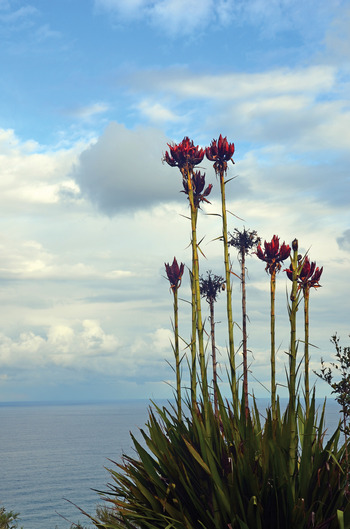
Fishing is a central theme to the Gymea story. Gymea (Krobie) was a fisherwoman herself, and the story just told above outlines how Gymea and the other Dharawal women would take their catch up to the escarpment to await the return of their warriors. Despite the tragic death of Bunda, Gymea refused to break her promise to wait for him, ultimately leading to her death on the rocky escarpment of the Illawarra. Here, she continues to wait for her husband, now in the form of the Gymea lily (Fig. 1).
The Gymea lily in the present day.

This plant, Doryanthes excelsa, is only found on the central coast of New South Wales (NSW) and displays a brilliant red head of flowers around 30 cm across (Fig. 1). The leaves of the plant are woven into scoops (both round and flat) for scooping out fish from nets and traps, as well as baskets for carrying the fish. The flower stem is made into the shafts of the spears, its lightness ideal for the coastal fishing context. The Gymea stem shaft was connected to bone points fixed into a strong gum and kangaroo leg sinew—these points constituted the barbs of the hunting weapon. This part of the spear—the foreshaft—ranges in size from around 25 cm to 60 cm and is fixed to the shaft proper using kangaroo sap or resin. The bone points themselves range in size from 1 cm to 3 cm. This fishing technology—the multi-pronged fishing spear or ‘leister’—was used by men. Women, on the other hand, made much of the fishing lines, as well as the hooks which were made from kurajong (Brachychiton populneus) bark.
Through the use of the objects made from the materials provided by the Gymea Lily, we pay respect to Gymea (Krobie), the woman who gifted this resource to us for making a range of fishing-related objects. Indeed, we have ceremony to dance up the fish and carry on the oral history of Gymea.
Bone fishing technology in the archaeological literature
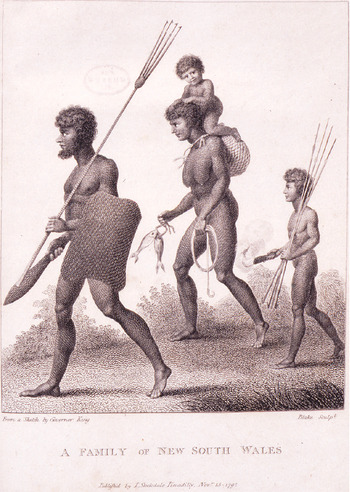
Fishing was such a common sight along the New South Wales coast on British arrival that this activity is one of the most common themes of European illustrations and written accounts of Aboriginal life produced at that time (Attenbrow Reference Attenbrow, Lunney, Hutchings and Hochuli2010). These records describe how men commonly fished using multi-pronged spears primarily from the shore, while women used the hook-and-line primarily from canoes (Bradley Reference Bradley1786; Collins Reference Collins1798; Hunter Reference Hunter1793; Stockdale Reference Stockdale1789; White Reference White1790; Worgan Reference Worgan1788) (Fig. 2). This local gendered organization of fishing duties was disrupted with the coming of the British, whose foreign notions regarding what was ‘men's work’ resulted in the disassociation of women and fishing (Attenbrow Reference Attenbrow, Lunney, Hutchings and Hochuli2010).
‘A Family of New South Wales’ by William Blake, from a sketch by Governor King, as it appears in Hunter (Reference Hunter1793). (Reproduced courtesy of the Australian Museum Research Library.)

Returning to the fishing technology itself, numerous pieces of equipment were observed in use during the late 1700s and early 1800s, including various baskets, nets, tidal traps, spears, fishhooks, fishhook files, lines and canoes. Of these, fishhooks have received the most attention in the archaeological literature, especially aspects surrounding their manufacture and origins (e.g. Attenbrow Reference Attenbrow, Lunney, Hutchings and Hochuli2010; Gerritsen Reference Gerritsen2001; Lampert & Turnbull Reference Lampert and Turnbull1970; Massola Reference Massola1956; Walters Reference Walters1988). In brief, fishhooks recovered from southeastern Australian sites are almost always made from marine shell (Turbo sp.), though European observers also mention the use of hawk talons, wood and bone to create hooks (Hunter Reference Hunter1793; Tench Reference Tench1789). Historically, women are reported to be the makers of these fishhooks (Bradley Reference Bradley1786; Collins Reference Collins1798; Tench Reference Tench1793), which were worked from the nacreous Turbo shell using stone flaking and grinding tools (Attenbrow et al. Reference Attenbrow, Fullagar, Szpak and Fullagar1998; Lampert & Turnbull Reference Lampert and Turnbull1970). Those recovered from archaeological contexts are one-piece, unbarred, C- or J-shaped hooks varying in absolute length between 13 and 50 mm (Attenbrow Reference Attenbrow, Lunney, Hutchings and Hochuli2010). These hooks were attached to a line usually made from various plant fibres, along with small stones to act as sinkers (Attenbrow Reference Attenbrow, Lunney, Hutchings and Hochuli2010).
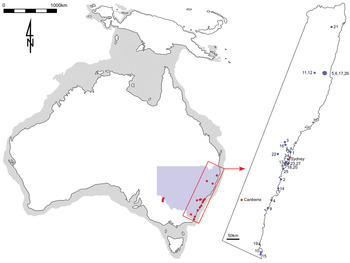
Here we focus on the other projectile technology central to obtaining seafood along the NSW coast—the fishing spear, and in particular the bone points which tipped these weapons. As can be seen in Figure 3, the vast majority of archaeological sites from which bone points thought to be connected to fishing have thus far been recovered (they were found in shell/fishbone middens and appear similar to ethnographically collected fishing spear tips) are located along the coast. The exception to this rule is the Willandra Lakes finds, where freshwater fishing has been demonstrated through the presence of small bi-points similar to the coastal finds, as well as fishbones found in hearths and middens (Johnston Reference Johnston, Smith, Spriggs and Fankhauser1993; Long et al. Reference Long, Stern and Williams2014).
Location of sites within present-day New South Wales (shaded blue) which have produced bone points connected to fishing: (1) Angophora Reserve Rock Shelter; (2) Bass Point; (3) Bird Tracks; (4) Burrill Lake; (5) Clybucca 3; (6) Connection Creek 1; (7) Connell's Point Rockshelter; (8) Curracurrang Shelter; (9) Durras North; (10) Greenglade Rockshelter; (11) Graman Area B, Site 1; (12) Graman Area B, Site 4; (13) Gymea Bay; (14) Lake Wollumboola; (15) Lake Wonboin; (16) MR/1; (17) Maguire's Crossing; (18) North Cronulla; (19) Pambula Lake; (20) Port Hacking; (21) Seelands; (22) Shaws Creek KII; (23) Skeleton Cave; (24) Spring Cove; (25) Stanwell Park; (26) Stuarts Point 1; (27) Watering Place.

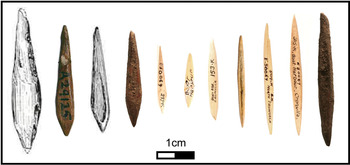
Typically, this type of bone point is small (less than 5 cm in absolute length) and created using a range of approaches, which can combine both flaking and grinding. They are made on both terrestrial and marine bone, though marine bird and macropod long bone currently appears to have been the most favoured over the past few thousand years. For example, the large assemblage of uni- and bi-points recovered from Durras North located just north of Bateman's Bay (no. 9 in Figure 3) was produced exclusively on the long bones of mutton birds (P. tenuirostris), though technique of production and style of the finished point differs across the collection (Lampert Reference Lampert1966) (Fig. 4).
Examples of the small bone points being discussed in this paper, commonly termed ‘muduk’ in early work. (Photographs: Australian Museum, Sydney.)

These small bone points, often pointed at both ends (but not always) were some of the first bone implements to be reported in Australian archaeological texts, and were dubbed ‘muduk’ by Hale and Tindale (Reference Hale and Tindale1930). Muduk were supposed to function as barbs and/or tips for fishing spears, though this interpretation saw heavy debate until the 1970s (Davidson Reference Davidson1934; Reference Davidson1937; Massola Reference Massola1956; McCarthy Reference McCarthy1936; Reference McCarthy1940; Reference McCarthy, Berndt and Berndt1965; Reference McCarthy1976; Megaw & Wright Reference Megaw and Wright1966; Mulvaney Reference Mulvaney1960; Pretty Reference Pretty and Wright1977). The favoured alternative suggestion was that they acted as fishing gorges used in conjunction with a line. While this debate was never fully resolved, the recovery of muduk points in association with large quantities of fish bones, and the likeness of these artefacts to those described by early European observers as well as ethnographically collected fishing spears now held in museums, has led most archaeologists to assume that they are indeed fishing-spear tips. Having said this, bone points have generally gone unrecognized and understudied in Australia, owing to a heavy focus on the better preserving lithic technologies, and consequently we know very little about the Indigenous bone technologies across the continent (Langley Reference Langley2018).
Discussion and conclusion
The purpose of sharing the Yuin story of Gymea/Krobie and outlining what is currently known archaeologically regarding the small bone points frequently recovered from coastal New South Wales sites was to provide a single concrete example of how artefact study divorced from the stories which are intrinsic to its existence results in an exceptionally narrow understanding of that artefact and the people who produced it. To state it plainly, without the insight given by the Yuin community, we would have no reason to think that the bone points which tipped fishing spears had any connection to the Gymea lily and the Gymea story. Indeed, without the preservation of materials made from Gymea lily, how would archaeologists know that this plant was used to make fishing technologies at all, if not for the input of the community? Instead, they would be seen purely in subsistence terms, with discussion only revolving around manufacture technique and use efficiency.
But how deep into the past can we suppose these oral traditions persist? Previously, it was believe that memories of particular events can only survive around 500–800 years, owing to core information being obscured by layers of narrative embellishment (Barber & Barber Reference Barber and Barber2004). However, recent geological research in Australia is suggesting that stories can persist along archaeological time scales, or many thousands of years. For example, Nunn and Reid (Reference Nunn and Reid2016) collected Aboriginal stories of coastline inundation from 21 locations around the Australian coast and concluded that they refer to post-glacial sea-level rise events which occurred more than 7000 years ago. More recently, Matchan et al. (Reference Matchan, Phillips, Jourdan and Oostingh2020) reported new dates for eruptions of Budj Bim and Tower Hill volcanoes located on the Victorian coast: they are dated by 40Ar/39Ar to have erupted c. 37,000 years bp. Gunditjmara people sustain an oral tradition in which, long ago, four giant beings arrived in southeastern Australia. Three of these beings strode out to other parts, but one crouched in place and transformed into the volcano now called Budj Bim, his teeth becoming the lava that the volcano spat out. Consequently, it appears that the twin eruptions of these volcanoes created a significant impression on the community, creating a story powerful enough to continue into the present day. These examples suggest that, in some contexts at least, archaeologists may be able to connect Indigenous stories with archaeological phenomenon dating back many thousands of years.
Museums have made great progress in integrating Indigenous approaches to curatorial practices, through wide recognition that communities have their own ways of perceiving, valuing, handling and preserving their cultural heritage (Golding & Modest Reference Golding and Modest2013; Kreps Reference Kreps, Smith and Akagawa2009). However, it is the observation of the authors that many Aboriginal objects currently held and/or displayed in museums are accompanied only by simple (short, descriptive) text of the item's find location and raw material (which can be more or less detailed). Rarely is information regarding the stories connected to that object provided—and while in some cases this is owing to community wishes, it appears that in most, it is because the information has not been actively sought. Here we should make it clear that while these stories would perhaps be categorized as intangible cultural heritage (‘heritage that is embodied in people rather than in inanimate objects’: Logan Reference Logan, Silverman and Fairchild Ruggles2007), and there has been significant academic attention to this aspect (e.g. Alivizatou Reference Alivizatou2012; Fairchild Ruggles & Silverman Reference Fairchild Ruggles, Silverman, Silverman and Fairchild Ruggles2009), the connection of the intangible with the tangible (stories with artefacts) appears yet to be fully realized. This happening is a historical result of Aboriginal isolation from the management of cultural materials, ultimately resulting in an erasure of the stories the items are connected to and continue to be part of. While it is true that more ephemeral information surrounding some items—usually collected from artists over the past 200 years—has been gathered and recorded, in the majority this has not been the case for archaeological assemblages. Indeed, archaeologists in Australia have only recently begun to recognize the importance of gathering these stories in collaboration with Traditional Owners—and it is a task which has a long way to go. Additionally, communities need to be open to sharing aspects of these stories—only then will the richness and complexity of Indigenous cultures be widely recognized and understood.
Stories are important to all modern peoples, and this behaviour was no doubt the case in the deep past (Langley Reference Langley2013). While we speak from the perspective of Australia, a place where families continue traditions many thousands of years long, the basic premise—that objects are interwoven with stories, and these stories are an important characteristic of their make-up—should also be true for material culture recovered from other Pleistocene-aged contexts around the globe. As such, Indigenous perspectives should not be restricted to spaces where there is an apparent division between an ‘Indigenous’ and ‘non-Indigenous’ population (like Australia), but be sought in a variety of contexts (even far removed) as a valid path for understanding artefacts, assemblages and landscape patterns. While experimental archaeology (and middle-range theory in general) already undertakes such an approach in a way, we are speaking more about regularly seeking out various alternative ideas and interpretations, even for artefacts for which we already understand (at least somewhat) the function. Collecting ideas about the potential place of deep time (Pleistocene) items from a wide variety of cultural backgrounds may allow archaeologists to move closer to truly understanding the meaning of deep time items than has been previously possible. Without the story attribute of artefacts, archaeologists cannot hope to understand present, nor past, cultures.
Acknowledgements
We would like to thank the Yuin community for making this publication possible. We would like to thank Ella Assaf and Francesca Romangoli for the invitation to join this collection of papers and accommodating our last-minute changes to our oral presentation at the NeanderArt 2018 conference in Turin, Italy. This research was supported by an Australian Research Council DECRA grant DE170101076.