Introduction
Unilateral vocal fold paralysis results from recurrent laryngeal nerve dysfunction or the vagus nerve innervating the larynx. This in turn leads to glottal incompetence, which is commonly due to iatrogenic injury to the nerve, such as during thyroidectomy.Reference Singh and Kwartowitz1 Recently, rates of iatrogenic injury have decreased with improvements in surgical techniques, and non-laryngeal primary malignancies have become a more common cause.Reference Singh and Kwartowitz1 Dysphonia is usually the main symptom, accompanied by dysphagia, aspiration and breathlessness.Reference Singh and Kwartowitz1
Patients frequently complain of an inability to project and change the pitch of their voice, which is worse in noisy environments because of the reduced conversational speech intensity.Reference Baki, Yu, Rubin, Chevretton, Sandhu and Birchall2 This affects their quality of life and confidence, and patients have a tendency to develop psychological, social, emotional and employment-related difficulties.Reference Ware, Snow, Kosinski and Gandek3 Unilateral vocal fold paralysis patients suffer greater disability in terms of social performance than other patients with conventional medical problems, such as renal patients undergoing dialysis or bone marrow transplant recipients.Reference Fang, Li, Gliklich, Chen, Wang and Chuang4
Management of unilateral vocal fold paralysis includes voice rehabilitation, and surgical therapies such as injection laryngoplasty, laryngeal framework surgery with or without arytenoid adduction, and laryngeal reinnervation.Reference Moy, Hoe, Hairi, Chu, Bulgiba and Koh5 Evaluation of the effect of treatment on the voice is important in order to determine the effectiveness of the intervention and decide whether the patient will require further intervention. A wide range of voice outcome measures are available to gauge the treatment effect, but there is currently no consensus regarding the primary outcome measure to determine the effectiveness of intervention in unilateral vocal fold paralysis patients.
Given the complexity of the human voice, a multidimensional tool is required to comprehensively assess the vocal change over time, including both subjective and objective evaluations. Subjective impressions of the voice are obtained from either patient self-assessments or perceptual ratings by clinicians.Reference Sataloff6 Perceptual evaluation by clinicians is, however, limited by issues of inter- and intra-rater reliability.Reference Misono and Merati7 Self-assessment of voice perception, such as the 10-item Voice Handicap Index, measures how the voice disorder affects the patient's quality of life and daily activities. The Voice Handicap Index-10 is widely used in voice research. It has been shown to have good validity and reliability, and is recommended as an outcome measure in clinical trials related to unilateral vocal fold paralysis.Reference Ware, Snow, Kosinski and Gandek3,Reference Moy, Hoe, Hairi, Chu, Bulgiba and Koh5 Although patient perception is a well-accepted outcome measure, it is confounded by the patient's lifestyle, voice demand and occupation.Reference Sataloff6
Objective evaluation of voice includes computer or instrument-assisted analysis of voice quality, such as measurements of acoustic parameters (jitter percentage, shimmer percentage, noise-to-harmonic ratio), pitch range, vocal intensity and aerodynamic parameters. The most popular outcome assessments by far are the acoustic and aerodynamic measures. Voice intensity is usually disregarded, despite being easier to measure. It is relevant to vocal dysfunction in cases of vocal fold paralysis.Reference Behrman8
Vocal intensity or loudness is measured in decibels, and is influenced directly by vocal fold vibration amplitude, subglottal air pressure, glottal resistance force and transglottal airflow rate.Reference Dworkin and Meleca9 A perceptual increase in vocal loudness can be obtained by increasing any of these parameters.Reference Dworkin and Meleca9 Vocal intensity is commonly measured using acoustic analysis software. A simpler method is to use a sound pressure level meter or a sound level meter, which is used by audiologists and is readily available in ENT clinics.Reference Behrman8
Baki et al. discovered that the main issue faced by unilateral vocal fold paralysis patients is the inability to project their voice, and that vocal intensity may be a more important measurement which would reflect the handicap level of these patients.Reference Baki, Yu, Rubin, Chevretton, Sandhu and Birchall2 Behrman et al. also suggested that voice intensity is most likely to correlate with the patient's self-assessment and clinical assessment of voice quality.Reference Behrman8
Unpublished data by author MM Baki have suggested vocal intensity as a potential primary outcome measure in future clinical trials related to unilateral vocal fold paralysis, in view of its excellent reliability and ability to differentiate between unilateral vocal fold paralysis and healthy volunteers. Furthermore, it showed a good correlation with Voice Handicap Index-10. The study was, however, limited by the combination of treated and untreated patients with unilateral vocal fold paralysis.
The present study recruited new patients with unilateral vocal fold paralysis and evaluated the suitability of vocal intensity as a measure to quantify improvement in those patients undergoing intervention. It also assessed the correlation of vocal intensity with Voice Handicap Index-10 and other objective outcome measures. This may further enhance the results of previous studies that proposed vocal intensity as a primary outcome measure in unilateral vocal fold paralysis clinical trials in view of its reliability, cost-effectiveness and simplicity in assessing unilateral vocal fold paralysis patients.
Materials and methods
Ethical considerations
Full ethics approval for the study was obtained from Universiti Kebangsaan Malaysia Medical Centre ethics committee.
Participants
A prospective observational study was conducted on uncompensated unilateral vocal fold paralysis patients in the Universiti Kebangsaan Malaysia Medical Centre over 22 months, from February 2018 to November 2019.
The inclusion criteria for this study were: a clinical diagnosis of unilateral vocal fold paralysis; a Voice Handicap Index-10 score of more than 11; participants who were able to give consent, aged 18–65 years; participants who were willing to undergo treatment and attend for follow up; and those who were able to read and converse in Malay and English. Exclusion criteria included: abnormal vocal fold mucosa (such as vocal fold mass, lesion or scar on either side of the vocal fold), co-existing neuromuscular disease (e.g. myasthenia gravis or multiple sclerosis) and severe cardiopulmonary disease. Informed consent was obtained from all eligible participants.
Sixty-four patients were identified, 39 of whom fitted the inclusion criteria and agreed to participate in the study. They subsequently underwent further intervention by either temporary augmentation with injection laryngoplasty or permanent medialisation surgery (Isshiki type 1 thyroplasty) based on the palsy duration, the recurrent laryngeal nerve status, the surgeon's assessment and the patient's preference. A total of 5 participants dropped out from the study; therefore, 34 participants’ results were analysed.
Injection laryngoplasty was conducted either under local anaesthesia via the percutaneous trans-thyrohyoid approach in the clinic setting, or under general anaesthesia in the operating theatre via the transoral approach. The materials used included hyaluronic acid (Juvéderm®), polyacrylamide hydrogel (Aquamid®) or calcium hydroxylapatite (Radiesse®), which were injected into the paraglottic space. Isshiki type 1 thyroplasty (medialisation thyroplasty) was performed using expanded polytetrafluoroethylene under local anaesthesia in the operating theatre.
Methodology
Each participant was required to complete the Voice Handicap Index-10 in either English or Malay. Rosen et al. developed a simplified robust version of the Voice Handicap Index, consisting of 10 items covering the physical, emotional and functional aspects of voice disorders.Reference Rosen, Lee, Osborne, Zullo and Murry10 It has been translated into multiple languages, including Malay, and that version has been validated and proven reliable.Reference Ong, Hassan, Azman, Sani and Baki11 A Voice Handicap Index-10 total score of more than 11 is considered to indicate voice disorder.Reference Arffa, Krishna, Gartner-Schmidt and Rosen12 After completion, the participants were moved to a quiet room for voice analysis. They were asked not to wear any accessories (e.g. jewellery) in order to avoid any background noise being recorded.
Maximum vocal intensity was measured using a sound level meter. Participants were asked to phonate the vowel /a/ at maximum loudness for 5 seconds three times at a 100 cm distance. The loudest measurements were recorded.
Acoustic analysis was performed using OperaVOX™ software installed in a sixth-generation iPod® portable media player. The acoustic parameters measured were jitter percentage, shimmer percentage and noise-to-harmonic ratio. The procedure was standardised to ensure the reliability of the parameters measured.Reference Mat Baki, Wood, Alston, Ratcliffe, Sandhu and Rubin13 The participants were instructed to say the vowel /a/ at conversational loudness for 5 seconds with the iPod placed 30 cm from their lips.
These tests were performed as a baseline assessment (prior to surgical interventions), and at one and three months post-intervention. The maximum vocal intensity measurement was additionally repeated within two weeks of the baseline assessment.
Statistical analysis
All data were computerised and analysed using SPSS® for Windows statistical software, version 25.0. Repeated measures analysis of variance was used to assess changes in maximum vocal intensity and other voice assessments between pre-intervention and different time points post-intervention, and the degree of improvement between the two intervention groups (time–group interaction). Test–retest reliability was conducted to evaluate the intraclass correlation co-efficient of maximum vocal intensity. Intraclass correlation co-efficient values greater than 0.9 indicate excellent reliability. The correlation between Voice Handicap Index-10 and maximum vocal intensity, as well as other acoustic parameters, was evaluated using the Spearman correlation. The correlation was deemed good for an r-value approaching −1 or +1. A p-value of less than 0.05 was considered statistically significant.
Results and analysis
Demography
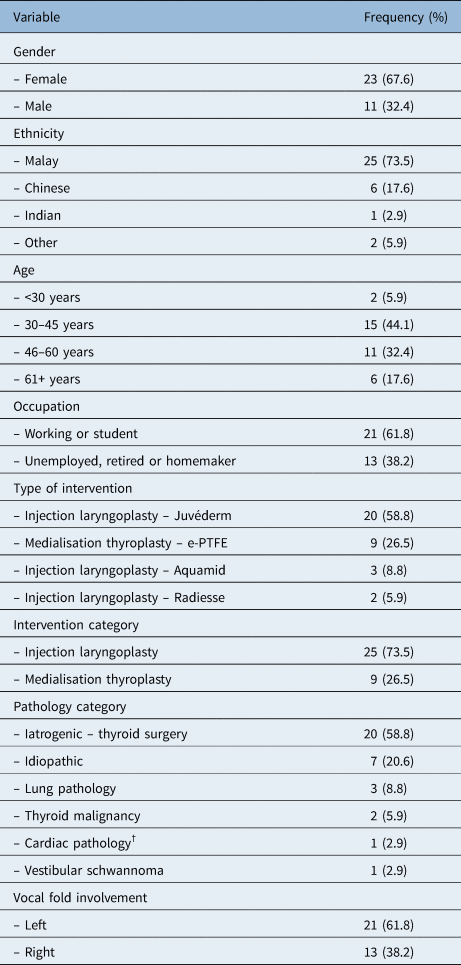
A total of 34 patients were included in the study, consisting of 23 females (67.6 per cent) and 11 males (32.4 per cent) with a mean age of 44.53 ± 12.67 years. The greatest number of patients were Malay (n = 25; 73.5 per cent), followed by Chinese (n = 6; 17.6 per cent), other (n = 2; 5.9 per cent) and Indian (n = 1; 2.9 per cent). Most of the cases were caused by iatrogenic injury, specifically post-thyroidectomy (58.8 per cent), followed by idiopathic unilateral vocal fold paralysis (20.6 per cent). Left unilateral vocal fold paralysis was more common (61.8 per cent) than right unilateral vocal fold paralysis. A total of 21 patients (61.8 per cent) were actively working or students, while 13 patients (38.2 per cent) were homemakers, retirees or unemployed.
A total of 25 patients (73.5 per cent) underwent injection laryngoplasty, while 9 patients (26.5 per cent) underwent Isshiki type 1 thyroplasty using expanded polytetrafluoroethylene. The demographic data are summarised in Table 1.
Demographic data of study participants*

* n = 34. †Ortner syndrome. e-PTFE = expanded polytetrafluoroethylene
Post-intervention changes
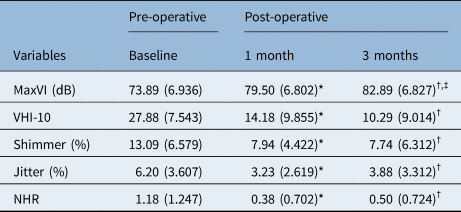
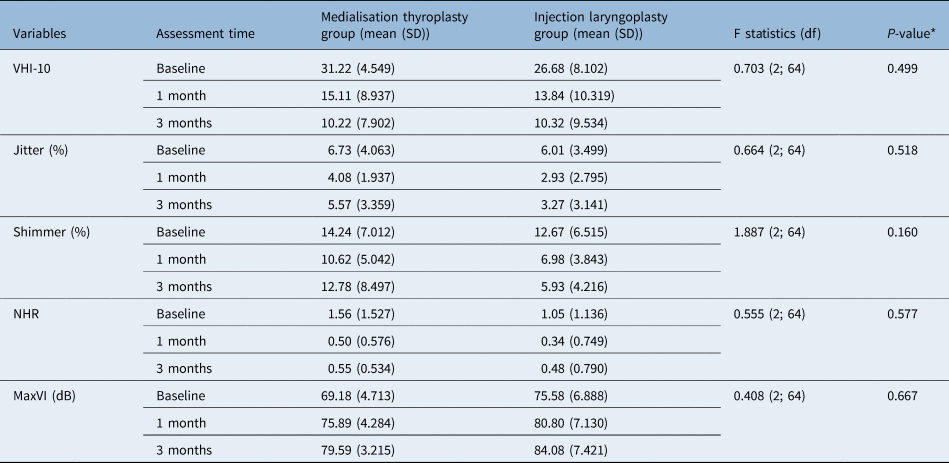
The mean (standard deviation) values for maximum vocal intensity, Voice Handicap Index-10, jitter, shimmer and noise-to-harmonic ratio at baseline and at one and three months post-intervention are summarised in Table 2.
Objective and subjective voice assessments pre- and post-intervention

Data represent mean (standard deviation) values. *p < 0.05, relative to the values measured pre-operatively (baseline); †p < 0.05, relative to the values measured pre-operatively (baseline); ‡p < 0.05, relative to the values measured at one month post-operatively. MaxVI = maximum vocal intensity; VHI-10 = 10-item Voice Handicap Index; NHR = noise-to-harmonic ratio
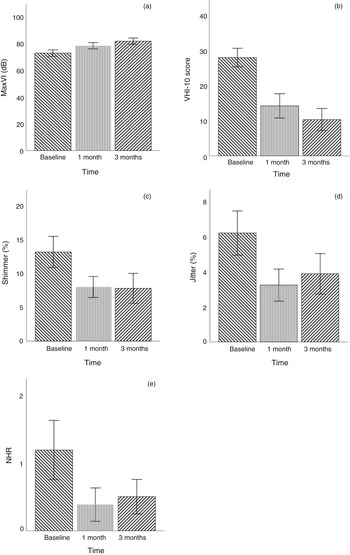
There were significant improvements (p < 0.05) in maximum vocal intensity and other acoustic analyses (jitter, shimmer and noise-to-harmonic ratio) at one and three months post-intervention. Voice Handicap Index-10 also showed significant improvements (p < 0.05) from baseline to one and three months after intervention. Figure 1(a–e) shows the trend of improvement for the respective outcome measures.
Changes in: (a) maximum vocal intensity (MaxVI), (b) Voice Handicap Index-10 (VHI-10), (c) shimmer, (d) jitter and (e) noise-to-harmonic ratio (NHR), at one month and three months post-intervention.

Test–retest reliability of maximum vocal intensity
A high degree of reliability was found between maximum vocal intensity at baseline and within two weeks from baseline prior to surgical intervention. The intraclass co-efficient was 0.953, with a 95 per cent confidence interval of 0.864–0.983 (Table 3).
Test–retest reliability for maximum vocal intensity

ICC = intraclass correlation co-efficient; df = degrees of freedom
Correlation findings for maximum vocal intensity
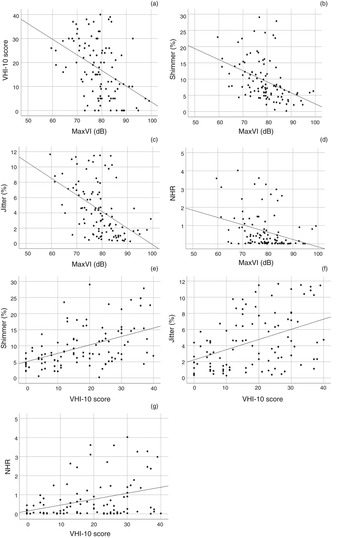
This section focuses on the correlation between maximum vocal intensity and Voice Handicap Index-10 and other objective measurements. Maximum vocal intensity and Voice Handicap Index-10 showed a moderate negative correlation, which was statistically significant (r = −0.452, p < 0.01). There was a statistically significant (p < 0.01) moderate negative correlation between maximum vocal intensity and shimmer (r = −0.523) and jitter (r = −0.537), and a weak negative correlation with noise-to-harmonic ratio (r = −0.388). Figure 2(a–d) shows these correlations.
(a–d) Correlations between maximum vocal intensity (MaxVI) and: (a) Voice Handicap Index-10 (VHI-10) (statistically significant moderate negative correlation; r = −0.452), (b) shimmer (statistically significant moderate negative correlation; r = −0.523), (c) jitter (statistically significant moderate negative correlation; r = −0.537) and (d) noise-to-harmonic ratio (NHR) (statistically significant weak correlation; r = −0.388). (e–g) Correlations between Voice Handicap Index-10 and: (e) shimmer (statistically significant moderate positive correlation; r = 0.492), (f) jitter (statistically significant moderate positive correlation; r = 0.416) and (g) noise-to-harmonic ratio (statistically significant weak positive correlation; r = 0.346).

Correlations for Voice Handicap Index
The subjective Voice Handicap Index-10 showed a statistically significant (p < 0.01) moderate positive correlation with shimmer (r = 0.492) and jitter (r = 0.416), and a weak positive correlation with noise-to-harmonic ratio (r = 0.346). Figure 2(e–g) illustrates these correlations. Table 4 depicts the correlations between objective and subjective measurements.
Correlation between objective and subjective voice measurements*

Data represent correlation co-efficient values.
* Spearman's rho. †Correlation is significant at the 0.01 level (two-tailed). VHI-10 = 10-item Voice Handicap Index; NHR = noise-to-harmonic ratio; MaxVI = maximum vocal intensity
Between-group comparison of maximum vocal intensity
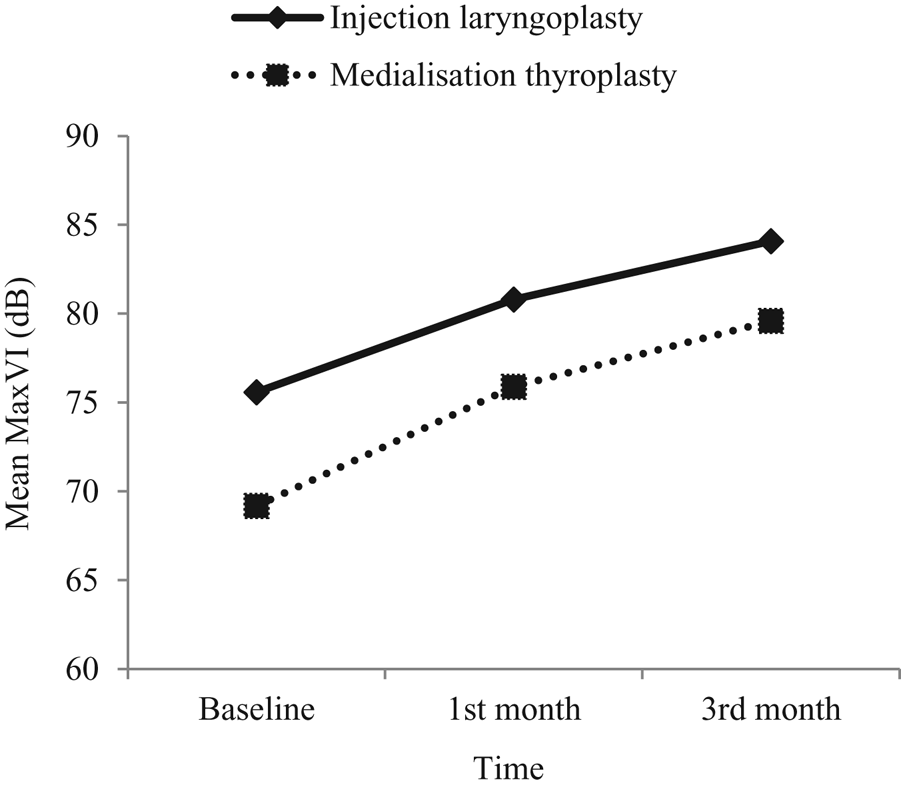
For the injection laryngoplasty group, the mean values for maximum vocal intensity at baseline and at one and three months post-injection were 75.58 dB, 80.80 dB and 84.08 dB, respectively, with significant improvements at one month (p < 0.001) and three months (p < 0.001) compared with baseline. The mean maximum vocal intensity of the medialisation thyroplasty group at the different time points was 69.18 dB, 75.89 dB and 79.59 dB, respectively, with a significant improvement demonstrated at three months post-intervention (p < 0.001). There were no significant differences (p > 0.05) in the degree of improvement for maximum vocal intensity, or the other parameters, when the two groups were compared at other time points. The changes in parameters and comparisons between groups are summarised in Tables 5 and 6 and Figure 3.
Improvement of maximum vocal intensity (MaxVI) post-treatment, for both intervention groups.

Maximum vocal intensity values for each treatment group, pre- and post-intervention

*n = 25; †n = 9. ‡P-value significant, relative to the values measured at baseline. MaxVI = maximum vocal intensity; SD = standard deviation
Comparison of improvement for both study groups

*Repeated measures analysis of variance (time and group interaction effect). SD = standard deviation; df = degrees of freedom; VHI-10 = 10-item Voice Handicap Index; NHR = noise-to-harmonic ratio; MaxVI = maximum vocal intensity
Discussion
Overview
Unilateral vocal fold paralysis can significantly impact a patient's quality of life as a result of noticeable changes in voice quality and performance, and it may be associated with changes in acoustic and aerodynamic voice measures. The main aim of treatment is to achieve optimum glottic closure for phonation and to improve vocal function. Treatment effects can be measured using a broad variety of voice outcome measures.Reference Walton, Carding, Conway, Flanagan and Blackshaw14
According to Walton et al., documenting a statistically significant change (p < 0.05) in responsiveness results and effect size in the outcome measure following intervention is one of the recommendations for the selection of voice outcome measures.Reference Walton, Carding, Conway, Flanagan and Blackshaw14 Previous studies have suggested that voice intensity or loudness is the main issue for unilateral vocal fold paralysis patients, and is likely to correlate with the patient's self-assessment and clinical assessment of voice quality.Reference Ware, Snow, Kosinski and Gandek3,Reference Behrman8 An unpublished study by author MM Baki has shown that maximum vocal intensity has excellent reliability; furthermore, it is a simple measurement that can be easily mastered by any medical staff member in the clinic.
The present study investigated the changes in voice outcome measures, specifically maximum vocal intensity, Voice Handicap Index-10 and several other acoustic parameters, following intervention. Maximum vocal intensity was evaluated as the primary outcome measure for possible future interventional studies of unilateral vocal fold paralysis.
Strength of study
This study rigorously evaluated the reliability of maximum vocal intensity as a potential primary outcome measure in clinical trials related to unilateral vocal fold paralysis by demonstrating: (1) the ability to detect voice quality improvement following surgical interventions; (2) internal consistency; (3) correlation with a self-reported outcome measure (Voice Handicap Index-10); and (4) correlation with other commonly used acoustic parameters (jitter, shimmer and noise-to-harmonic ratio).
Synopsis
Following injection laryngoplasty or medialisation thyroplasty, the voices of the participants with unilateral vocal fold paralysis were significantly louder. The increase in maximum vocal intensity (p < 0.05) and the maximum vocal intensity showed a moderate correlation with the reduction of Voice Handicap Index-10 scores (r = −0.452, p < 0.01). Maximum vocal intensity also showed a significant (p < 0.01) negative correlation with other acoustic parameters (jitter percentage, shimmer percentage and noise-to-harmonic ratio) measured using OperaVOX. Excellent reliability was observed for maximum vocal intensity, with an intraclass correlation co-efficient of 0.953. Significant improvements were also seen for other acoustic parameters, including jitter percentage, shimmer percentage and noise-to-harmonic ratio at one and three months after intervention (p < 0.05). Likewise, these acoustic parameters were moderately correlated with improvements in Voice Handicap Index-10 scores (p < 0.01), except for noise-to-harmonic ratio, which demonstrated a weak correlation with Voice Handicap Index-10 and with maximum vocal intensity.
Following injection laryngoplasty, there was significant improvement in maximum vocal intensity at one and three months from baseline. Following medialisation thyroplasty, significant improvement was only seen at three months from baseline. This may be a result of post-operative vocal fold oedema, which could still be present at one month post-operation for the medialisation thyroplasty group. However, there was no significant difference between the groups in terms of the degree of maximum vocal intensity improvement at one and three months post-intervention. Injection laryngoplasty and medialisation thyroplasty had similar outcomes. There were no significant differences between the two treatment groups for any of the voice parameters.
Comparison with other studies
Limited studies have been conducted to assess the correlation between subjective and objective measurements in unilateral vocal fold paralysis patients. Previous studies showed a lack of correlation between overall quality of life and voice laboratory measures in patients with voice disorders.Reference Hsiung, Pai and Wang15–Reference Gillespie, Gooding, Rosen and Gartner-Schmidt18
A study by Hsiung et al. analysed the correlations of four Voice Handicap Index parameters (emotional, physical and functional domains, and total score) with voice laboratory measures (jitter, shimmer, maximum phonation time and harmonic-to-noise ratio) in dysphonic patients.Reference Hsiung, Pai and Wang15 The results showed that only harmonic-to-noise ratio was significantly correlated with the functional Voice Handicap Index domain (r = −0.270, p < 0.05). That study demonstrated a large discrepancy between Voice Handicap Index score and objective measurements, as patients tend to rate their treatment poorly despite excellent results on voice laboratory measures. The study concluded that objective parameters cannot be viewed as prognostic factors by which to evaluate dysphonic patients’ subjective perceptions.Reference Hsiung, Pai and Wang15
Wheeler et al. examined the relationship between Voice Handicap Index and acoustic measures such as fundamental frequency (F0), jitter, shimmer, signal-to-noise ratio, mean root-mean-square intensity, F0 standard deviation, aphonic periods and breath groups, using TF32 time-frequency analysis software program for 32-bit Windows and Cool Edit digital audio workstation software, in patients with a mildly disordered voice.Reference Wheeler, Collins and Sapienza16 The only acoustic measure that correlated significantly with the overall Voice Handicap Index score was F0 standard deviation (r = 0.593, p < 0.05). The remaining parameters had significant correlations with certain individual Voice Handicap Index subscales, but these were not predictable and did not show a cohesive pattern. This poor correlation may be a result of the non-linear relationship between perceptions of handicap and the individual patient's circumstances, such as occupation, social status, previous experiences with vocal dysfunction, and overall personality.Reference Wheeler, Collins and Sapienza16
A retrospective study by Gillespie et al. used the Voice Handicap Index-10 as a subjective tool, and investigated its correlation with laboratory measures in five common voice disorders, including unilateral vocal fold paralysis.Reference Gillespie, Gooding, Rosen and Gartner-Schmidt18 The objective measurements studied were: acoustic measures (F0 in speech, intensity in speech and most comfortable pitch, and noise-to-harmonic ratio), assessed using the Multidimensional Voice Program (MDVP; KayPentax, Montvale, New Jersey, USA); and aerodynamic measures (subglottal pressure and average airflow at most comfortable pitch, average airflow in speech and laryngeal resistance), calculated using the Phonatory Aerodynamic System (PAS6600; KayPentax). That study demonstrated only a weak significant correlation (r = 0.247, p < 0.01) between change in phonatory airflow in speech and change in Voice Handicap Index-10 score for unilateral vocal fold paralysis patients.Reference Gillespie, Gooding, Rosen and Gartner-Schmidt18 This discrepancy may be a result of the Voice Handicap Index-10 responses, which can be affected by personal circumstances, such as mood, social situation, employment and personality. This is not likely to be the case for acoustic and aerodynamic testing. Voice laboratory measures and Voice Handicap Index-10 scores may change in temporally different ways; for instance, voice handicap may be identified either sooner or later than can be captured by laboratory measurements.Reference Gillespie, Gooding, Rosen and Gartner-Schmidt18
In our study, a moderate significant correlation between acoustic values and quality of life was demonstrated, as shown specifically between Voice Handicap Index-10 and maximum vocal intensity, and between Voice Handicap Index-10 and jitter and shimmer. These favourable findings may result from the standardisation of methodology in measuring the participants’ voices and the recruitment of only those patients with the voice disorder of unilateral vocal fold paralysis.
Injection laryngoplasty and medialisation thyroplasty were comparably effective in improving the maximum vocal intensity and other voice parameters in patients with unilateral vocal fold paralysis. These findings are similar to those of other studies, which have demonstrated that neither treatment was superior to the other.Reference Vinson, Zraick and Ragland19,Reference Morgan, Zraick, Griffin, Bowen and Johnson20 Ultimately, the treatment of choice is based on patients’ preferences and expectations, their general health for undergoing an office-based procedure or general anaesthesia, procedural costs, and the surgeon's preference regarding the optimum treatment. However, generally, temporary injection laryngoplasty has been recommended for early intervention in unilateral vocal fold paralysis cases, as it results in a more favourable medial position of the vocal folds during the time window of synkinetic reinnervation and reduces the need for open neck surgery.Reference Friedman, Burns, Heaton and Zeitels21,Reference Marques, Marronnier, Crampon, Lagier and Marie22
Limitations
The present study involved a small number of patients; therefore, the participants’ acoustic parameters were not analysed according to gender. A bigger study with standardisation of surgical intervention is recommended to confirm the findings, and the normal values for maximum vocal intensity for males and females should be investigated in the future.
Clinical applicability
Maximum vocal intensity is a simple parameter. It can easily be tested using a sound level meter in the clinic setting, and does not require a high degree of skill, and so it can be measured by clinic support staff. The portable instrument itself is widely available in the majority of ENT clinics to monitor ambient noise in soundproof rooms. Together with the subjective assessment of voice perception, using the Voice Handicap Index-10, the parameter of maximum vocal intensity can aid the evaluation of unilateral vocal fold paralysis patients when deciding on treatment, to evaluate outcome, and to monitor the progress of these patients.
• This study demonstrated a significant correlation between acoustic analysis and Voice Handicap Index-10 findings
• Vocal intensity is under-studied as a primary outcome measure despite its potential correlation with patients’ self-reported handicap
• Maximum vocal intensity was a reliable outcome measure, demonstrating significant post-intervention improvements at different time points
• A moderate significant correlation between maximum vocal intensity and Voice Handicap Index-10 was demonstrated
• There was no significant difference in maximum vocal intensity improvement between medialisation thyroplasty and injection laryngoplasty groups
• Maximum vocal intensity may represent an objective measure in future clinical trials
Conclusion
Maximum vocal intensity measured with a sound level meter may be a viable choice for objective measurement and can assist in future clinical trials, as it demonstrates the effectiveness of treatment and moderately correlates with self-reported outcome measures. Maximum vocal intensity, however, may not be an option as a primary outcome measure yet. It is not superior to the other commonly used acoustic parameters. Nevertheless, it can easily be measured with a simple device, which can be used by any health workers in the clinic setting.
Acknowledgements
We would like to thank M Azhan Ubaidah and N Azura Pazil for helping us to conduct the voice assessments, and other members of the Department of Otorhinolaryngology – Head and Neck Surgery Universiti Kebangsaan Malaysia Medical Centre for their continued help and support throughout this study. Thank you to Universiti Kebangsaan Malaysia Medical Centre for providing a platform and supporting this study.
Competing interests
None declared