1 Introduction
In the fields of applied linguistics and English language teaching, an increasing number of scholars and practitioners have become interested in English as an international language (EIL) over the last four decades (e.g. Matsuda, Reference Matsuda2012; McKay, Reference McKay2002; McKay & Brown, Reference McKay and Brown2016; Smith, Reference Smith1976). With EIL becoming increasingly prevalent, research on learners’ perceptions about EIL and implementing EIL ideas in the classroom has mushroomed (e.g. Galloway, Reference Galloway2013; Galloway & Rose, Reference Galloway and Rose2014; Ke & Cahyani, Reference Ke and Cahyani2014). Despite a growing interest in EIL, two gaps in knowledge are particularly noticeable: (1) EIL studies with detailed overviews of how to put EIL pedagogy into practice are sparse (Kubota, Reference Kubota2001) and (2) still fewer empirical studies have been conducted (e.g. students’ EIL perceptions after the EIL intervention) (Galloway, Reference Galloway2013). Tapping into the fields of EIL and computer-assisted language learning (CALL), this study aims to illustrate and implement videoconferencing-embedded classroom (VEC) as an instructional intervention to address these issues.
The primary contribution of this study within the field of EIL and CALL – particularly for practitioners struggling to implement EIL at the instructional level – is the development of a viable pedagogy of VEC that is based on current research, theory, and practice in language education. Another contribution is to add new empirical findings to the field, which may help bridge a discrepancy between theory and practice.
2 Literature review
2.1 English as an international Language (EIL) and learners’ perceptions
Smith (Reference Smith1976: 38) was one of the first scholars who defined EIL as the “[language] used by people of different nations to communicate with one another”. He pointed out that every English user could take ownership of this international language regardless of their status as (non)native. Since then, scholarship has explored a range of issues related to EIL in various contexts: (1) understanding of the present status of English (Crystal, Reference Crystal1997; Graddol, Reference Graddol1999; Kachru, Reference Kachru1986; Kubota, Reference Kubota2012; Matsuda, Reference Matsuda2012), (2) perception of the English user’s identity (Cook, Reference Cook2016; Crystal, Reference Crystal2003; Holliday, Reference Holliday2008; Kubota, Reference Kubota2012; Matsuda & Matsuda, Reference Matsuda and Matsuda2001; Phillipson, Reference Phillipson1992; Widdowson, Reference Widdowson2003), (3) strategy for multilingual/multicultural communication (Byram, Reference Byram1997; Canagarajah, Reference Canagarajah2007; Kubota, Reference Kubota2012; McKay, Reference McKay2002; McKay & Brown, Reference McKay and Brown2016; Yano, Reference Yano2009), and (4) attitude toward different English varieties (Canagarajah, Reference Canagarajah2006; Hino, Reference Hino2012; Jenkins, Reference Jenkins2000; Matsuda, Reference Matsuda2003; McKay, Reference McKay2002; McKay & Brown, Reference McKay and Brown2016; Seidlhofer, Reference Seidlhofer2004; Yano, Reference Yano2001). With EIL becoming increasingly prevalent, Matsuda (Reference Matsuda2015) explains that there are several frameworks of EIL that come with different names such as teaching EIL (e.g. Matsuda, Reference Matsuda2012; McKay, Reference McKay2002), ELF-aware pedagogy (Bayyurt & Sifakis, Reference Bayyurt and Sifakis2015; Sifakis, Reference Sifakis2014), and Global Englishes language teaching (Galloway, Reference Galloway2013; Galloway & Rose, Reference Galloway and Rose2015).
With EIL becoming increasingly more popular, research on learners’ perceptions about EIL has also grown. For instance, some attempts have been made to implement EIL ideas in the classroom and raise students’ perceptions toward EIL: an online forum between Taiwanese and Japanese students and their EIL perceptions (Ke & Suzuki, Reference Ke and Suzuki2011), Global Englishes content-based English course and Japanese students’ perceptions toward EIL (Galloway, Reference Galloway2013; Galloway & Rose, Reference Galloway and Rose2014), pre-service teachers’ perceptions and perspectives toward EIL in the United States (USA) context (Ates, Eslami & Wright, Reference Ates, Eslami and Wright2015), and students’ perceptions toward EIL as a result of online intercultural exchanges between Taiwanese and Indonesian students (Ke & Cahyani, Reference Ke and Cahyani2014). All of these studies have used various interventions such as listening journals, multimedia (e.g. YouTube videos), EIL guest speakers from various countries, and computer-mediated communication (CMC) tools in order to raise learners’ EIL perceptions.
2.2 Videoconference-embedded classroom (VEC)
Despite these increasing attempts to teach EIL, two gaps in our field of research need to be filled. First, our field still needs more studies with detailed overviews of how to integrate EIL pedagogy into the classroom (Kubota, Reference Kubota2001). Second, we need more empirical studies to bridge the discrepancy between theory and practice (Matsuda & Friedrich, Reference Matsuda and Friedrich2011). Combining the strengths of the flipped class and videoconferencing, the authors would like to address these issues by illustrating and implementing VEC as an instructional intervention and raise students’ perceptions toward EIL.
In contrast to a conventional classroom (e.g. students learn new information and knowledge primarily disseminated by a teacher in class while practicing those skills at home as assignment), the flipped classroom allows students to study new information and knowledge at home by watching video lectures or reading assigned materials before practicing those skills in class through interaction with peers and teachers (Bishop & Verleger, Reference Bishop and Verleger2013). This offers “a dynamic, interactive learning environment where the educator guides students as they apply concepts and engage creatively in the subject matter” (Flipped Learning Network, 2014: 1). Several studies have attested to pedagogical benefits of the flipped classroom as it can improve students’ motivation (Hsieh, Wu & Marek, Reference Hsieh, Wu and Marek2017; Strayer, Reference Strayer2012), increase their engagement (Dill, Reference Dill2012), and increase their learning outcomes (Baepler, Walker & Driessen, Reference Baepler, Walker and Driessen2014; Day & Foley, Reference Day and Foley2006; Hung, Reference Hung2015; McLaughlin, Roth, Glatt, Gharkholonarehe, Davidson, Griffin, Esserman & Mumper, Reference McLaughlin, Roth, Glatt, Gharkholonarehe, Davidson, Griffin, Esserman and Mumper2014).
Kinginger (Reference Kinginger1998: 504) described videoconferencing as “a telephone call with the addition of video. Both sites are equipped with video cameras, microphones, and televisions.” Although this is a somewhat rudimentary definition of videoconferencing, Kinginger’s study shows two pedagogically significant implications in relation to teaching EIL. First, videoconferencing helped foreign language learners motivate their language learning as it allowed them to get exposed to authentic spoken language. In particular, it raised students’ awareness of the varieties of spoken French, which helped them understand differences between language presented in formal instruction and how native speakers of French actually talk. Additionally, several “zone of proximal development” (Vygotsky, Reference Vygotsky1978) and “scaffolding” (Wood, Bruner & Ross, Reference Wood, Bruner and Ross1976) incidents took place during the follow-up activity (e.g. getting L2 learners to analyze varieties of French language recorded during the conference), which “help learners become keen and critical observers of language use, aware of the complex relationship between language and context” (Kinginger, Reference Kinginger1998: 511).
More recently, multimodal desktop videoconferencing technology (i.e. FlashMeeting) turned out to be a useful tool for active and interactive learning among L2 learners. For instance, Berglund (Reference Berglund2009) shows that FlashMeeting encourages passive L2 learners (e.g. less talkative students) to more actively participate. Hampel and Stickler (Reference Hampel and Stickler2012) highlighted multimodal aspects of FlashMeeting (e.g. combining text, image, and audio with video modes), which contributed to facilitating more interaction and communication (e.g. social conversations and negotiation of meaning) among L2 learners.
An increasing number of scholars have attempted to integrate free, synchronous CMC software into foreign language lessons. For example, Journell and Dressman (Reference Journell and Dressman2011) used Skype to connect a class of Moroccan undergraduate students with a class of American pre-service teachers. Through this use of Skype, students in each respective group were able to discuss their various opinions about religion, politics, and culture. In this context, Skype served as a pedagogical tool to allow students from both sides to get exposed to diverse perspectives of various academic disciplines (e.g. history, language arts, and multicultural education). Particularly, it was beneficial to the Moroccan EFL learners as they could interact with native speakers of English. In the Taiwanese EFL context, Wu, Marek and Chen (Reference Wu, Marek and Chen2013) incorporated Skype into an English class where Taiwanese EFL learners interacted with American counterparts (e.g. critically analyzing the content knowledge such as holidays, entertainment, and clothing in the USA provided by an American professor, preparing and making presentations on the related topics, and writing reflective papers on the same topics). The study shows that Skype-based English lessons fostered active learning and helped improve learners’ L2 proficiency in areas such as pronunciation, grammar, vocabulary, and fluency. Also, the lessons deepened the students’ content knowledge. Dooly and Sadler (Reference Dooly and Sadler2016) also made use of both Skype and the virtual world Second Life in an exchange between elementary school students studying EFL in schools in Barcelona, Spain, and Vienna, Austria. In this case, the researchers recruited the students to become “little scientists” in a project exploring healthy habits, thus requiring the students in both countries to “[co-construct] knowledge through shared information about the target content between the two classes” (60).
In order to utilize the pedagogical benefits of flipped classrooms and video conferencing, the authors developed and implemented VEC as an instructional intervention in an attempt to raise students’ perceptions toward EIL. This pioneering research project, implemented in the Japanese EFL context, was initiated to answer the following two research questions:
1. How could VEC offer pedagogical benefits in relation to EIL instruction?
2. To what extent does EIL instruction through VEC influence students’ perceptions toward EIL?
3 Methodology
3.1 Participants and context
Undergraduate students majoring in various disciplines (N=20 in 2014; N=21 in 2015) took part in this 14-week study at a major private university in Japan (hereafter referred to as K University), which has one of the largest international student bodies in that country (The Japan Times, 2015). It was an optional course for credit, which was taught in English by the instructor (the second author). The English levels for students in both classes were upper-intermediate and above, and most of them were from expanding circle countries such as Japan, Korea, and China. But none of the students had ever taken an EIL-related class before the beginning of the semester.
Japan – what Kachru’s (Reference Kachru1986) model calls an “expanding circle countryFootnote 1 ” – was chosen because the Japanese perception toward EIL is low (Matsuda, Reference Matsuda2003; Young & Walsh, Reference Young and Walsh2010). That is, they still do not believe in the equal status of the non-native English speaker (NNES) with the native English speaker (NES). For example, NES norms are prevalent across the country as English tests target the NES norms and the majority of Japanese people still perceive NESs as their “ideal” English teachers (Galloway, Reference Galloway2013).
3.2 VEC as an instructional intervention
VEC as an instructional intervention consisting of three stages is detailed below:
1. Pre-videoconference task (11 weeks)
Pre-videoconference task (Pre-VT) was a preparatory stage for the during-videoconference task (During-VT). At the Pre-VT stage, students engaged in both in-class and out-of-class tasks. Prior to each class, all students read one chapter of Seargeant’s (Reference Seargeant2011) book (see Table 1) and supplementary EIL-related articles. Two students were chosen to make a 10-minute presentation on the chapter before leading a follow-up group discussion for approximately 20 minutes. The instructor graded his students based on their preparation and performance while acting as a facilitator (e.g. providing additional examples, giving expert opinions, and eliciting more critical questions).
Overview of Seargeant’s (Reference Seargeant2011) book

2. During-videoconference task (2 weeks)
At the During-VT stage, two consecutive videoconferences took place with seven EIL scholars from all three circle countries (i.e. USA, Hong Kong, Japan, South Korea, and Indonesia). Three EIL scholars from Seoul, Hong Kong, and Tokyo had groups of students in the same room, which dramatically helped construct a far more authentic EIL environment for the K students. In Japan, the instructor set up the videoconferencing using an LCD projector, the Internet, and audiovisual equipment in collaboration with the university staff and his graduate assistant. In terms of seating arrangements, his students faced a projector screen at the front of the classroom.
The topic of the first videoconference was Beyond Borders of the Inner Circle, Outer Circle, and Expanding Circle with five EIL scholars from Hong Kong, USA, South Korea, Indonesia, and Japan. Each scholar spoke in turn on how English language and English education were perceived in each country. Specifically, they discussed topics such as the general perception of English in each country, the status of non-native English-speaking teachers and native English-speaking teachers in each country, age of learning English, and the role of English and local languages/mother tongues. After the completion of the main presentation by each speaker altogether (around 55 minutes), K students could interact with those EIL scholars and students during a Q&A session (around 35 minutes). The guest speakers also discussed and disagreed with one another on some topics.
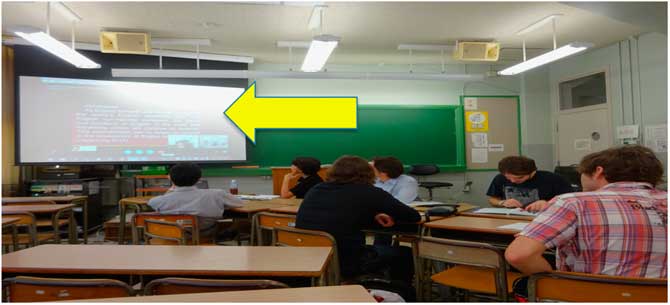
The theme of the second videoconference was Revisiting Principles of Teaching English as an International Language (EIL) with six EIL scholars from the USA (N=2), Japan (N=2), Korea (N=1), and Indonesia (N=1). One of the leading EIL experts was invited to the classroom and delivered the main lecture entitled Revisiting Principles of Teaching EIL for nearly 20 minutes. This time, as illustrated in Figure 1, every speaker’s PowerPoint slides (of written text and images) were combined with audio and video using Skype’s screen-sharing function, which created a much rich multimodal environment and noticeably enhanced the understanding of the EIL content knowledge among students (Berglund, Reference Berglund2009; Dressman, Reference Dressman2016; Hsu, Reference Hsu2015; Hung, 2015). After the completion of the main speaker’s presentation, the other invited speakers discussed EIL topics for a total of half an hour before a Q&A session, similar to the first videoconference. According to the end-of-semester class evaluation, the students felt as if they had been physically present at an international conference, a process that would not have been possible without videoconferencing technology.
Creating a rich multimodal environment using Skype’s screen sharing

3. Post-videoconference task (1 week)
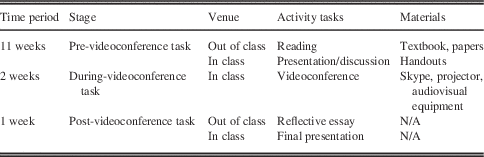
Based on Pre-VT and During-VT, the students wrote reflective essays. For this activity, similar to Kinginger’s (Reference Kinginger1998) study, they watched the video clips of the videoconferences again that were archived on the website (http://eslweb.wix.com/esol-roundtable) and critically analyzed the content as well as the different varieties of Englishes, which would “help [them] become keen and critical observers of language use” (Kinginger, Reference Kinginger1998: 511). After essay submission, each student made a final presentation regarding his or her essay during the last week of the 2015 spring semester. As the students went through a thorough process of Pre-VT, During-VT, and Post-VT, as exhibited in Table 2, they could engage in critical thinking by reviewing diverse opinions on an EIL theme on book chapters and papers during Pre-VT, comparing/contrasting a particular issue from various perspectives discussed by the EIL experts during During-VT, and coming up with their own original opinions (in the form of a reflective essay and final presentation) during Post-VT.
Three stages of VEC

3.3 Data collection
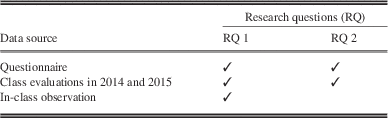
Data were collected through a questionnaire, post-course class evaluations having been collected in spring 2014 (without VEC) and spring 2015 (with VEC), and in-class observation. A matrix is constructed in Table 3 in which the research questions are listed along the vertical axis and data sources along the horizontal axis. The open-ended questionnaire (see Appendix A), which had been developed based on the second author’s observation and informal interview prior to the main study, was distributed at the end of the During-VT stage to examine the students’ overall perception of the VEC. Students were asked to respond to question items about the structure of the VEC, the influence of the VEC on their EIL awareness, and the pedagogical benefits of the VEC on their learning in comparison to the conventional instruction. At the end of the questionnaire, there was also a prompt that encouraged them to make suggestions about improving VEC.
A matrix of data source and research questions

Two post-course class evaluations using the same instrument (see Appendix B) were administered at the conclusion of the spring 2014 and 2015 semestersFootnote 2 . The students were asked about the interaction between the professor and students, material/content quality of an EIL class (without VEC) in 2014 and an EIL class (with VEC) in 2015, and overall satisfaction of an EIL class (without VEC) in 2014 and an EIL class (with VEC) in 2015. Eight 5-point Likert-scale statements ranging from 1 (“strongly agree”) to 5 (“strongly disagree”) were used to obtain specific responses. The results of the two post-course class evaluations were compared to examine the pedagogical effectiveness of VEC in terms of interaction and the understanding of students’ EIL content. Qualitative data were also generated via open-ended questions, which provided examples and illustrative quotes, thereby adding more depth and color to the data than would be the case with answers provided for closed response items (Brown, Reference Brown2009).
The instructor and his research assistant collected in-class observation data to gain greater depth of understanding of the learners’ experience in the following procedure: (1) Prior to the in-class observation, they discussed the particular goals of the observation (i.e. research questions); (2) During the observation, all observation data relevant to the research questions were recorded in the field notes; (3) After the observation, they arranged a debriefing meeting for the data analysis. In particular, the discussion focused on how the students interacted with EIL scholars and other students at the During-VT stage.
3.4 Data analysis
A grounded theory was adopted to analyze the recursive data and recognize the themed findings (Strauss & Corbin, Reference Strauss and Corbin1998). The authors read through the questionnaire reiteratively, and bits of data that were relevant to “the pedagogical benefits of VEC” (for RQ 1) and “the influence of VEC on students’ perceptions toward EIL” (for RQ 2) of the study were coded. Similar codes were aggregated into three major analytic categories, respectively: for RQ 1, linking between Pre-VT and During-VT, promoting critical thinking, and no pedagogical benefits, and for RQ 2, understanding the EIL content more deeply, experiencing diverse English accents and EIL concept, and no influence. The results of the post-course class evaluations in spring 2014 (without VEC) and spring 2015 (with VEC) were also compared in order to investigate the effectiveness of the EIL instruction through VEC. Finally, the field notes from the in-class observations were used to produce concrete categorizations under the themes such as “link between Pre-VT and During-VT” and “promote critical thinking”. For instance, the authors read the field notes line by line, and they coded the meaningful segments of text that were relevant to the first research question.
4 Results
1 Pedagogical benefits of VEC
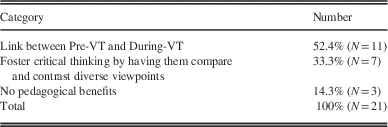
A questionnaire, post-course class evaluations, and in-class observation data were used to answer the first research question. First, according to the questionnaire, 85.7% of the participants (N=18) held positive views of VEC in terms of its pedagogical benefits. They responded that VEC helped them link between Pre-VT and During-VT and foster critical thinking by having them compare and contrast diverse viewpoints, as shown in Table 4.
Pedagogical benefits of VEC (questionnaire)

Specifically, 52.4% of the participants (N=11) mentioned that they could connect newly learned EIL-related knowledge from the Pre-VT stage to During-VT stage, as described in the following:
∙ “The recognition of English as a tool for globalization, and the way to choose native teacher or not was related to the articles.” (Hino)
∙ “Yes the main point that was emphasized most to me was the importance of having appropriate teaching style and type of English to best suit the purpose of learning. This relates with some examples in the articles where this is mismatched, leading to unmotivated teachers and students.” (Suzuki)
∙ “A lot of the issues addressed a lot of good points and ideas like we had done in class, but similarly, solutions are not so easily defined.” (Honda)
As for fostering critical thinking, 33.3% of the participants (N=7) responded that VEC helped them compare and contrast diverse viewpoints on EIL issues, as demonstrated in the following:
∙ “A lot of the information presented was very similar. But … it was interesting that [unlike the other Outer Circle countries] in Indonesia, non-native English teachers of Indonesians are preferred to native English speakers.” (Yoshiko)
∙ “I learned that there are differences in how English is taken depending on how much English is common in that country.” (Yuri)
∙ “[The invited speaker’s] intervention was really interesting. The content of the class is really interesting … I wished that I could hear more professor’s points of view.” (Chika)
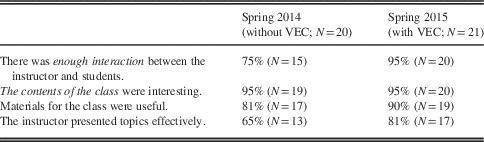
The post-course class evaluations between spring 2014 (without VEC) and spring 2015 (with VEC) were also analyzed quantitatively and qualitatively. The findings were then compared to examine any pedagogical benefits of VEC, particularly in relation to interactions. Quantitatively, the participants from spring 2015 (with VEC) reported that there was a greater interaction between the instructor and students than those from spring 2014 (without VEC) by 20% (see Table 6).
The qualitative information of the post-course class evaluations about interactions also corroborated the quantitative data. In spring 2014 (without VEC), several participants reported that more interaction would be necessary between instructor (or a more knowledgeable individual) and students: “More interaction with teacher …” and “There were too much emphasis on students’ presentations, but a little more insight from the professor might have been interested”. In spring 2015 (with VEC), the students reported on the strengths of the class as, “A professor did a good job allowing students to learn from another [through interaction]” and “… interaction was high and discussion was ample.”
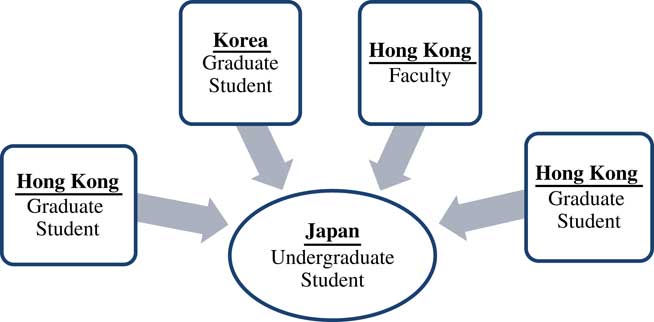
The field notes from the in-class observation from the first videoconference reveal that VEC allowed students to explore EIL issues more deeply through active interactions. For instance, during the first videoconference, one student from K University asked a question regarding the motivation of learning English in each country during a Q&A discussion. Then, one of the audience members from Hong Kong (a graduate student) with a somewhat British accent responded that people in Hong Kong had little motivation to learn English for communicative purposes. But the EIL environment (where Hong Kong people could hear diverse English accents such as American English or Japanese English) became more common a decade ago due to the influence of the media and globalization. After the response from the audience member from Hong Kong, a Korean graduate from Seoul with a somewhat American accent shared his personal anecdote of how the college entrance examination played a strong role in learning English in Korea. Then a K student from Tokyo directed a follow-up question to the Hong Kong participants. His question was why he could hardly communicate with local Hong Kong people in English even though, according to Kachru’s (Reference Kachru1986) model, Hong Kong, as a former British colony, is an outer circle country. In response to this question, an EIL expert from Hong Kong explained the importance of understanding a particular socio-political context in relation to English use. To complement his comment and give us contextual information, a graduate student from Hong Kong described the English education system in Hong Kong and explained why a majority of people in Hong Kong had few opportunities to talk with English users from inner circle countries, which was actually a conflicting viewpoint against what K students had learned from EIL-related materials during the Pre-VT stage. Therefore, this indicates that when a K student asked one EIL-related question, he received four different viewpoints from four different people with diverse English accents and usages, which explicitly manifested an authentic EIL environment. It was interesting that this discussion was primarily initiated and led by the participating students, rather than the instructor or the EIL scholars. And it was a great opportunity for K students to know what was really going on in an outer circle country such as Hong Kong, which was very different from what they had learned from reading materials and the in-class discussion.
The field notes from the in-class observations from the second videoconference also revealed that VEC allowed students to explore EIL issues more deeply through active interactions. For example, we could observe that one of the K students asked an invited EIL expert whether teaching a concept in EIL would also be feasible across the board – from the K–12 level as well as in a higher educational setting. In this interaction, he was referring to his notebook that he had taken from the Pre-VT stage. Therefore, these data vividly demonstrate how students attempted to link what they had learned during Pre-VT stage to During-VT and took advantage of the scaffolding supplied by an EIL expert.
2 Perceptions toward EIL
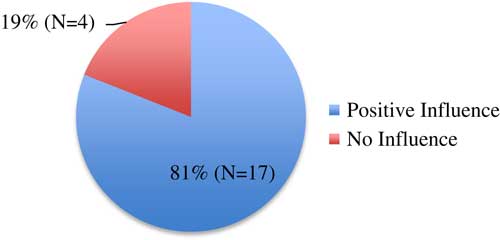
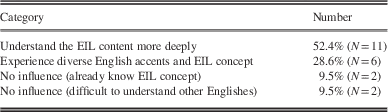
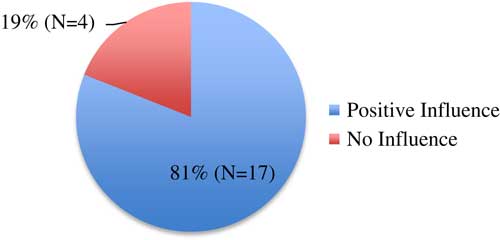
Data from the questionnaire reveal several interesting insights, many of which show how VEC positively influenced students’ perceptions toward EIL, as shown in Table 5. Overall, 81% of the participants (N=17) responded that there was a positive influence on their perceptions toward EIL, as shown in Figure 2.
Influence of VEC on students’ perceptions toward EIL
Detailed responses of the questionnaire (N=21)

Specifically, 52.4% of the students (N=11) held more positive attitudes toward EIL as VEC helped them understand the EIL content more deeply:
∙ “I had only a small idea of the depth and educational ideas that are currently being debated on the subject [EIL] prior to the discussion.” (Yoshiko)
∙ “Whilst I did have a notion about different Englishes around the world, the discussion gave me a deeper understanding about the state of English teaching in other countries and the problems associated with it.” (Masami)
∙ “The panelists from each different place give me different insights into views about English education and how problems and solutions vary across situations.” (Tomomi)
Additionally, 28.6% of the students (N=6) appreciated that they could experience diverse English accents and EIL concept, which led to them holding positive views of EIL:
∙ “I feel I did well in understanding each professor in their varying Englishes.” (Chika)
∙ “I was able to pick up the different accents used by each speaker.” (Yasuo)
∙ “I had not heard of this concept before, therefore yes, it did raise my awareness.” (Akira)
Lastly, 19% of the students (N=4) responded that VEC had no influence on their perception toward EIL. When analyzing the responses more deeply, one of the students was already aware of the EIL concept, and another found it difficult to understand other Englishes:
∙ “It didn’t really help raise my awareness. My awareness is already raised!” (Kiyoko)
∙ “Actually, it’s hard for me to listen to their English, so it’s much harder for me to understand what they talked about.” (Aya)
The post-course class evaluations between spring 2014 (without VEC) and spring 2015 (with VEC) were also used to address the second research question. As indicated in Table 6, both groups demonstrated a significantly high interest in the EIL class (95% and 95%, respectively) regardless of the kind of instructional intervention they had received in the post-surveys. As we did not conduct pre- and post-surveys to measure participants’ perceptions of EIL, we were not able to identify which of the instructional interventions would work better in their view. However, overall, the findings showed that both the EIL flipped classroom and the VEC did make a positive difference in participants’ perceptions of EIL.
Post-course class evaluations between spring 2014 (without VEC) and spring 2015 (with VEC)

5 Discussion
This study found that VEC enhanced an EIL pedagogical instruction in that an EIL instruction in spring 2015 (with VEC) led to an increase in more frequent interaction between students and an instructor than an EIL instruction in spring 2014 (without VEC). Some may argue that this technology-enhanced, new VEC pedagogy simply met the learning needs and preferences of young, tech-savvy digital learners (Gallardo-Echenique, Marqués-Molías, Bullen & Strijbos, Reference Gallardo-Echenique, Marqués-Molías, Bullen and Strijbos2015; Oblinger & Hawkins, Reference Oblinger and Hawkins2005; Tapscott, Reference Tapscott2009). But we think this explanation takes an oversimplified view of VEC. It is true that multimodal aspects of videoconferencing, such as text, image, audio, and video, may contribute to facilitating more interaction and communication among the participants (Berglund, Reference Berglund2009; Hampel & Stickler, Reference Hampel and Stickler2012). From our data as well as our professional experience, however, it was not technology per se that would affect students’ interest and motivation to learn. Rather, we recognize the importance of the pedagogy, the professor, and the professor’s efforts in coordinating learners’ activities to achieve their learning goals. The professor’s carefully designed EIL pedagogy was combined with the pedagogical benefits of technology (i.e. videoconferencing) to create synergy effects, which improved students’ motivation and interaction as well as created an authentic EIL environment (Bishop & Verleger, Reference Bishop and Verleger2013; Hsieh et al., Reference Hsieh, Wu and Marek2017; Journell & Dressman, Reference Journell and Dressman2011; Kinginger, Reference Kinginger1998; Strayer, Reference Strayer2012; Wu et al., Reference Wu, Marek and Chen2013). As the students interacted with diverse users of English and EIL experts from all three circle countries, they were exposed to a variety of Englishes and heard diverse opinions on EIL-related issues (Crystal, Reference Crystal2010; Friedrich & Matsuda, Reference Friedrich and Matsuda2010; Journell & Dressman, Reference Journell and Dressman2011; Kinginger, Reference Kinginger1998).
This study also identified that VEC helped students deepen and strengthen the understanding of the EIL contents. Specifically, students attempted to link newly learned EIL-related knowledge by reading articles or engaging in class discussion from the Pre-VT stage to During-VT stage. It was observed during the second videoconference that students made efforts to interact with EIL experts based on the EIL-related knowledge from the Pre-VT stage. As a result, VEC helped students compare and contrast diverse perspectives on EIL issues, which led to promoting their critical thinking. For instance, Yoshiko thought that people in outer circle countries generally preferred native English-speaking teachers to non-native English-speaking teachers. But after hearing about the Indonesian situation from an EIL expert from Indonesia, she could learn new EIL-related information that “in Indonesia, non-native English teachers of Indonesians are preferred to native English speakers”. Here, all EIL experts including an instructor at K University served as more knowledgeable individuals to scaffold a deeper comprehension of EIL issues (Vygotsky, Reference Vygotsky1978; Wood et al., Reference Wood, Bruner and Ross1976; Wu et al., Reference Wu, Marek and Chen2013). Interestingly, it was observed that students took the initiative in leading the almost entire Q&A session through active interactions. Students from K University were able to acquire authentic, EIL-related information on an outer circle country (e.g. Hong Kong people seldom use English in everyday life) from graduate students from Hong Kong, which was a different knowledge from the existing EIL contents. In this circumstance, students from Hong Kong helped K students explore other aspects of EIL issues and strengthen their EIL content knowledge (see Figure 3; Wu et al., Reference Wu, Marek and Chen2013). Through interactions with diverse interlocutors, students became more critical observers of EIL (Kinginger, Reference Kinginger1998).
One example of interaction between a K student and videoconferencing participants

This study also found that VEC helped improve students’ perceptions toward EIL. Specifically, 81% of the participants responded that VEC helped them experience diverse English accents and EIL concepts as well as understand the EIL content more deeply, which led to enhancing their perceptions toward EIL. Significantly, the participants in this study did not hold any negative perceptions toward non-native English-speaking partners, although a majority of the students in Ke and Suzuki’s (Reference Ke and Suzuki2011) study held beliefs that English belongs to Anglo-Americans’ native speaking standards and resist the interaction between non-English-speaking users from expanding circle countries (e.g. Japanese-Indonesian). So, we can add VEC to one of the viable instructional interventions along with listening journals, multimedia (e.g. YouTube videos), EIL guest speakers from various countries, and CMC tools (Galloway, Reference Galloway2013; Galloway & Rose, Reference Galloway and Rose2014; Ke & Cahyani, Reference Ke and Cahyani2014).
6 Conclusion
This study found that VEC was a useful EIL pedagogical instruction as it helped increase greater interaction between students and an instructor and helped students deepen the understanding of the EIL contents. It also found that students linked new EIL-related knowledge from the Pre-VT stage to the During-VT stage. Particularly, at the During-VT stage, students could foster their critical thinking as they could compare and contrast diverse perspectives on EIL issues from EIL experts and other online participants. As a result, VEC helped enhance students’ perceptions toward EIL.
As the authors could not obtain any in-class, multiple-way videoconferencing resources and guidelines, they underwent a series of trial and error during the Pre-VT stage. Here, some major challenges are highlighted when implementing VEC:
∙ Identifying the tech environment and logistics of each speaker (e.g. Wi-Fi connection, microphone, webcam, etc.). The coordinator should constantly communicate with each participant to understand and troubleshoot a range of unanticipated technological issues. For instance, the instructor of this study purchased new digital devices and set up the videoconferencing environment in collaboration with K University staff. Additionally, communication using various digital technologies (e.g. Facebook, e-mail, text messages, etc.) helps obtain more accurate contextual information of each participant.
∙ Arranging an online meeting and videoconferencing for all the participants. For instance, as the participants were residing in four different time zones, the coordinator had to consider those different time zones in addition to academic schedules in each institution and individual schedules. Additionally, the summer time that usually applies every March and October in the USA also needs to be taken into consideration.
∙ Making sure every participant feels comfortable with this videoconferencing technology and a new form of collaboration. To enhance the confidence of each scholar in these areas, a “tech-savvy” member should offer the participants a brief “on-the-job” training and constantly troubleshoot technical issues along the way.
∙ It is of paramount importance to minimize background noises to create a more real-life conversational context.
∙ Providing supplementary materials or additional instruction for those with low English listening skills, as they experience difficulties understanding the conversation during the videoconferencing.
Nevertheless, the primary contribution of this study is to add new empirical findings to the field, which help bridge theory and practice. Another contribution within the field of EIL and CALL – particularly for practitioners struggling to implement EIL at the instructional level – is the development of a viable pedagogy of VEC that is based on current research, theory, and practice in language education.
Appendix A
Open-Ended Questionnaire
For those who participated in the Skype panel discussions, please answer the following questions. Thank you very much in advance.
1. Was the panel discussion informative?
2. Were the contents of the panel discussion well organized?
3. Compared with the traditional panel discussion where the panelists give each individual talk 20 minutes respectively followed by the discussion, the present one using Skype was quite untraditional. How did you find it?
4. Were you able to link what you have learned from the reading articles in class and what you have heard through the panelists’ talk? Did you find something in common?
5. How did you find your language skills (speaking, listening) all through the panel discussion?
6. Did the discussion help raise your awareness about the idea of globalization or Englishes?
7. Do you have any suggestions about a Skype panel discussion in general?
8. Any comments are welcome about this panel discussion class.
Appendix B
Post-Course Class Evaluation Form
For each of the items below, please indicate your response, ranging from “strongly agree” to “strongly disagree”.

About the authors
Ju Seong (John) Lee is a PhD candidate at the University of Illinois at Urbana-Champaign. His research interests include computer-assisted language learning (CALL), particularly videoconferencing and informal digital learning of English, English as an international language (EIL), and teacher preparation/development.
Yuji Nakamura is a Professor of English at Keio University where he teaches language testing and English teaching methodology. He is a Past President of the Japan Language Testing Association (JLTA). His research interests include the connection between technology and EFL teaching and learning in terms of assessment.
Randall Sadler is an Associate Professor of Linguistics at the University of Illinois at Urbana-Champaign, where he teaches courses on computer-mediated communication and language learning (CMCLL), virtual worlds and language learning (VWLL), and the teaching of L2 reading and writing. His main research area is on the role of technology in language learning, with a particular focus on how virtual worlds may be used to enhance that process. He has published in these areas in journals including the Journal of English for Academic Purposes, CALICO Journal, and Computers & Education, and has authored chapters and books in these areas.