INTRODUCTION
Enteric protozoan parasites are ubiquitous in domestic mammal populations (Taylor, 2000). Many species have intracellular life-cycle phases in the intestinal epithelia and have the potential to cause disease. Their widespread occurrence, economic importance coupled with limited options for treatment (Haberkorn, 1996) and sometimes zoonotic potential have meant most investigations of protozoan infections in ruminants have come from outbreaks on farms or from experiments involving production animals (e.g. Catchpole et al. 1976; Berriatua et al. 1994; Xiao, 1994; De Graaf et al. 1999).
Few parallel epidemiological studies have monitored intracellular protozoan infections in wild ungulate populations, where they often present as chronic infections which intensify or abate in response to environmental conditions and host susceptibility (Duszynski and Upton, 2001) and more commonly co-occur with extracellular helminth parasites in the absence of widespread anthelmintic treatment. Studying co-infections in the wild is of interest for two main reasons. First, there is evidence for interactions between parasite species in mammals (Christensen et al. 1987; Cox, 2001; Poulin, 2001), highlighting the importance of understanding these relationships before devising control strategies against specific species in livestock systems (Lello et al. 2004). Secondly, from an evolutionary perspective, there is the possibility of balancing selection for host resistance to co-infecting protozoa and helminths in natural populations since intracellular and extracellular parasite infections are controlled via a compromise between the mutually inhibitory Th1 and Th2 immune responses (Graham, 2002).
The feral Soay sheep population of Hirta, St Kilda, provides a unique opportunity to investigate the ecological and evolutionary consequences of co-infection. Monitored intensively since 1985, it is host to a diverse array of metazoan and protozoan parasites (Wilson et al. 2004). Every few years a high proportion of the population dies due to food shortage. Previous research has shown that in these high-density years, although the proximate cause of death is malnutrition, high helminth burdens also contribute to host mortality (Gulland, 1992; Illius et al. 1995; Coltman et al. 1999). Furthermore, nematode resistance is a heritable trait in the population (Smith, 1999; Coltman et al. 2001) with evidence of advantageous alleles at specific loci such as the MHC (Paterson et al. 1998) and γ-interferon (Coltman et al. 2001). Considering the apparently strong selection that helminth parasites exert on the Soay sheep it is unclear why beneficial alleles do not rise to fixation in the population and why genetic variation is maintained. One possibility is that parasite diversity both within parasite groups such as helminths and protozoa, and between groups such as parasites with extracellular versus intracellular life-stages, may explain why host genetic diversity is maintained.
As a step towards testing this hypothesis we report the first epidemiological survey of gastrointestinal protozoan species in the population. Thirteen species of protozoa, also known from domestic sheep (M.A.F.F., 1986), were identified. In this paper, we present point prevalence and/or intensity and diversity of infections in sheep caught in summer, document epidemiology in relation to host age, host sex and year of sample, where years varied in host density, and report an investigation of associations between species.
MATERIALS AND METHODS
Population dynamics and sample collection
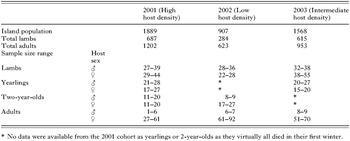
The feral Soay sheep population of Hirta, St Kilda experiences persistent fluctuations in density regulated primarily by food availability. The population dynamics and study area are described in detail elsewhere (Clutton-Brock and Pemberton, 2004; Craig et al. 2006). Parasitological sampling reported in this paper took place in 3 consecutive years of varying host population density. Between the Augusts of 2001 and 2002, the Hirta population of sheep decreased by 52%. Between the Augusts of 2002 and 2003 the population increased by 74% (Table 1). The population crash early in 2002 demonstrated that the August 2001 population was above carrying capacity for the following winter. Despite the dramatic increase in population size that took place in 2003, sheep numbers did not exceed the carrying capacity as the population did not decrease early in 2004. Therefore, the 3 years can be consecutively termed high, low and intermediate population density years.

Results derived for this paper originate from representative and random subsets of sheep caught for sampling in the Augusts of 2001–2003. At the time of sampling, lambs, yearlings, 2-year-olds and adults were 4, 16, 28 and [ges ]40 months old respectively. The 2001 cohort suffered 95% mortality in the population crash of 2002 and so no yearling or 2-year-old sheep were available for sampling in August 2002 and 2003 respectively. Sample sizes of hosts examined for each protozoan genus varied slightly due to the different diagnostic tests used and are given in Table 1.
Parasitology
Diagnosis of parasite species infection was by coprological examination. Helminth eggs and Eimeria oocysts were quantified per gram of faeces using a modification of the McMaster technique (M.A.F.F., 1971). A further 3 g wet weight of faecal sample was homogenized in 42 ml of distilled water and filtered though a tea-strainer. The filtrate was then used to fill two 15 ml test tubes that were centrifuged at around 800 g for 10 min. The resulting pellets were retained; one was used to make a smear slide which was stained using a modification of the Ziehl-Neelsen technique (J. McGoldrick, personal communication) to test for the presence or absence of Cryptosporidium parvum. The other pellet was incubated in 2·5% potassium dichromate solution at room temperature for 2 weeks for sporulation of Eimeria oocysts (Duszynski and Wilber, 1997) and then stored at 4 °C until analysed. Following removal of the potassium dichromate solution the pellet was mixed with 33% zinc sulphate solution (specific gravity=1·25), subjected to centrifugal flotation onto a coverslip and examined under oil at 1000× magnification to identify Eimeria species and check for the presence or absence of Giardia duodenalis cysts. Up to 100 Eimeria oocysts on each coverslip were identified to species level based on morphological traits (Levine, 1973; M.A.F.F., 1986; Soulsby, 1986). An estimate of intensity of each Eimeria species was achieved by relating their proportions to the McMaster counts. No intensity data were collected for C. parvum or G. duodenalis as the tests were only qualitative.
Statistical analysis
The epidemiology of each protozoan species, and of total mixed Eimeria species, in terms of associations between their prevalence and/or intensity and host age, sex and year was investigated. Prevalence of each species was analysed using a generalized linear model (GLM) with binomial error structure and logit link function on binary data (zero versus non-zero counts) testing for associations between presence/absence of infection and the possible explanatory variables of age, sex and year. The Eimeria species counts were analysed first by considering the total count of all species, and secondly by considering individual species separately. The abundance of total mixed Eimeria species was aggregated in the host population (k=0·12) in all years, and was best described by a negative binomial distribution and analysed using a GLM with negative binomial error structure and log link function. However, some of the individual Eimeria species showed distributions that were more awkwardly distributed and hence failed to conform to a negative binomial distribution.
In these cases, the highest count of zero was not followed by a second highest count of 1, and so on, as the negative binomial distribution assumes. By way of example, Fig. 1 shows the distribution of E. crandallis; similar distributions were observed for all the other Eimeria species. Therefore, intensity of these species was modelled using a linear model (LM) on log-transformed count data, excluding the zero counts. All models specified sex (D.F.=1) and year (D.F.=2) as categorical variables and age as a continuous variable (D.F.=1) and these main effects were tested along with all possible interactions. Where year was found to explain significant variation in prevalence or intensity, model coefficients were used to interpret patterns.

Fig. 1. Frequency distribution of log transformed Eimeria crandallis count (+1) 2001–2003.
Two analyses were used to investigate different aspects of protozoan diversity. First, diversity of Eimeria species was measured across all years using the Shannon-Weiner index, a heterogeneity measure that combines species richness and evenness components (Magurran, 2004). Indices were tested for associations with age, sex and year using a linear model with normal error structure. Second, we investigated whether there were systematic relationships between protozoan species that might indicate competition or mutualism between species. Associations between prevalence of protozoan species were tested for using a GLM with a binomial error structure and logit link function with the presence/absence of each species (in turn) as the response variable and the possible explanatory variables of age, sex, year and presence/absence of all other species.
Statistical significance in the GLMs was assessed by the change in deviance associated with a term, distributed as χ2 on the respective degrees of freedom, and using F-statistics for models with normal errors. Non-significant terms were dropped from a full model containing all possible main effects and interactions to give a final model containing only significant terms. In order to limit the chances of making type 2 errors in the analyses presented in this paper, a sequential Bonferroni correction (Rice, 1989) was applied to the 39 statistical tests yielding a threshold value of P[les ]0·001. All statistical analyses were conducted in S-Plus® professional edition version 6.2.1 for Microsoft windows (Insightful Corp.). In the figures, for illustration purposes, age is presented as up to 4 categories: lambs (4 months), yearlings (16 months), 2-year-olds (28 months) and adults ([ges ]40 months).
RESULTS
Prevalence of Cryptosporidium parvum
The prevalence of C. parvum in lambs and adults and in both sexes by year is illustrated in Fig. 2 with overall herd prevalence given in Table 4. In the GLM of C. parvum prevalence there was no main association with host age or sex, but there was significant variation among years (χ22=28·94, P<0·001) and an interaction between host age and year (χ22=14·27, P<0·001; final model explained 7·27% of the deviance). The year of highest host density, 2001, was also the year of highest prevalence (Table 4) and lambs that year had higher prevalence than any other age class in any of the 3 years (Fig. 2A).

Fig. 2. Prevalence of Cryptosporidium parvum by (A) host age and (B) host sex in each year of study. Only prevalence in lambs and adults are shown here but statistical analyses were done on the full range of ages (see text).
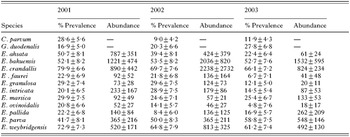
Table 4. Overall prevalence (%) of species and mean Eimeria oocyst count per gram of faeces ±95 % C.I. for all sheep sampled in each year (See Table 1 for the composition of host ages and sex in each sample set. Dashes denote no quantitative data was obtained.)

Prevalence of Giardia duodenalis
The prevalence of G. duodenalis in lambs and adults and in each sex by year is illustrated in Fig. 3 with overall herd prevalence given in Table 4. In a GLM of G. duodenalis prevalence there was a significant association with host age, with young animals, especially lambs, having higher prevalence than older age classes (χ21=94·67, P<0·001; final model explained 17·55% of the deviance) but there was no association with host sex, year or any interactions.

Fig. 3. Prevalence of Giardia duodenalis spp. by (A) host age and (B) host sex in each year of study. Only prevalence in lambs and adults are shown here but statistical analyses were done on the full range of ages (see text).
Prevalence, intensity and diversity of Eimeria spp.
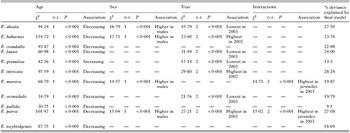
Eimeria was the most speciose genus of protozoan in the Soay sheep, with 11 species identified. Overall herd prevalence and abundance values are given in Table 4. The prevalence of each species by year in lambs and adults is shown in Fig. 4 and significant associations are shown in Table 2. There was a strong negative association between host age and prevalence of all the Eimeria species, except E. granulosa for which prevalence increased with host age. Four species, namely E. ahsata, E. bakuensis, E. marsica and E. parva were significantly more prevalent in males than females; other species showed no difference between host sexes.

Fig. 4. Prevalence of each species of Eimeria by host age in each year of study. Only prevalence in lambs and adults are shown here but statistical analyses were done on the full range of ages (see text).
Table 2. Summary of significant results of GLM analyses, with binomial error structure, testing for associations between age, sex and year and prevalence of individual Eimeria species (Dashes denote associations were not significant.)

All except 3 species (E. crandallis, E. pallida and E. weybridgensis) showed significant prevalence variation among years, but different species showed different patterns (Fig. 4). One group, comprising E. ahsata, E. bakuensis, E. faurei and E. intricata, increased in prevalence from 2001 to 2002 before decreasing in 2003. E. marsica varied positively with host population density (declining from 2001 to 2002 then increasing from 2002 to 2003). E. parva prevalence increased with each successive year of sample while E. ovinoidalis and E. granulosa decreased with each sample year. Finally, the prevalence of 2 species, E. marsica and E. parva, was associated with interaction terms, in both cases indicating an interaction between host age and year in which lambs had highest prevalence in 2003 (Table 2).
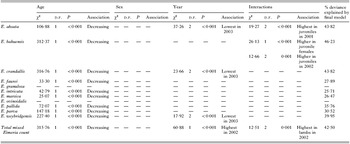
The overall intensity of total mixed Eimeria species decreased with age and reached a maximum in 2002. There was also an age-year interaction so that the highest counts were in lambs sampled in 2002 (Fig. 5 and Table 3), Intensities of the individual Eimeria species (Fig. 6) showed similarities with the associations found for prevalence, although for individual species there were fewer significant associations and some differences were also found.

Fig. 5. Box and whisker plots of mixed Eimeria species intensity, plotted by (A) host age, (B) host sex and (C) year. The white line in the middle of each box shows the median of the distribution, the middle 50% of intensity values fall within the range defined by the box and the dotted lines bounded by brackets show 1·5 times the interquartile range of the data. Horizontal lines outwith the brackets are outliers. One extreme outlier (a female lamb from 2002 with 250800 oocysts) was removed for illustration purposes. Age is shown as 4 categories: lambs (0), yearlings (1), 2-year-olds (2) and adults (3).

Fig. 6. Intensity (and S.E.) of each species of Eimeria by host age in each year of study. The standard error bar for E. crandallis (±6942) has been truncated for illustrative purposes. Note that these data include all individuals including those that were negative for the species in question. Only intensity in lambs and adults are shown here but statistical analyses were done on the full range of ages (see text).
Table 3. Summary of significant results of LM analyses, testing for associations between age, sex and year and log transformed counts (excluding zero counts) of individual Eimeria species (A GLM with negative binomial error structure and log function was applied to the analysis of total mixed Eimeria species count. Dashes denote associations were not significant.)

In individual species intensity tests, all except 2 (E. granulosa and E. ovinoidalis) showed a significant association with host age, in which intensity declined with host age. There were no main order associations between intensity and host sex. Three species showed associations between intensity and year of sample of which E. ahsata decreased in each year of sample, while E. crandallis and E. weybridgensis increased from 2001 to 2002 before decreasing from 2002 to 2003. Interaction terms explained further variation in the intensity of two species: in E. ahsata there was a host age-year of sample interaction in which juveniles in 2001 had the highest intensity; in E. bakuensis there was a host age-host sex interaction in which juvenile females had the highest intensity and a host age-year of sample interaction in which juveniles in 2002 had the highest intensity.
Diversity of Eimeria species was measured for each host using the Shannon-Weiner diversity index and illustrated in Fig. 7. Diversity significantly decreased with age (F1,384=153·99, P<0·001) was higher in males than females (F1,384=40·26, P<0·001) and showed significant differences between years (F2,384=7·77, P<0·001; final model explained 35·33% of the variance).

Fig. 7. Box and whisker plots of Shannon-Weiner diversity index, calculated for all species of Eimeria for all hosts sampled in all years and plotted by (A) host age, (B) host sex and (C) year. See Fig. 5 for notation.
Associations between protozoan species prevalence 2001–2003
Some Eimeria species consistently co-occurred. Taking into account the effects of host age, sex, year, and the multiple tests performed (i.e. a threshold of P[les ]0·001), 5 positive associations were found across the 3 years. These were between (i) G. duodenalis and E. crandallis; (ii) E. ahsata and E. crandallis; (iii) E. ahsata and E. bakuensis; (iv) E. crandallis and E. weybridgensis and (v) E. granulosa and E. weybridgensis. No negative associations were found.
DISCUSSION
Elucidating the diversity of parasite species in a host population is a prerequisite to understanding how parasites and their hosts co-exist and how the relationship can ultimately steer the direction of natural selection. Prior to this research, the greatest gap in our knowledge of the St Kilda Soay sheep parasites was among the protozoa. The discovery of 13 species, most of which have intracellular phases in their life-cycles and which co-exist with a diverse array of helminth parasites in the intestines of the sheep (Wilson et al. 2004; Craig et al. 2006), highlights the potential for them to be exerting additional and conflicting demands on the host immune system. Examining their epidemiology across 3 years of varying host population density has revealed several points for discussion.
Associations with host age and sex
In Soay sheep, the prevalence as well as intensity and diversity (where measured) of C. parvum, G. duodenalis and mixed Eimeria spp. declined with host age. Prevalence of C. parvum infection decreased with host age in 2001 and this has been found in other unmanaged mammal populations such as feral pigs in Western California (Atwill et al. 1997) and rodents in Poland (Bajer et al. 2002) and also in numerous livestock systems (Olson et al. 1997; Majewska et al. 2000; Huetink et al. 2001). Due to the highly immunogenic nature of C. parvum, acute primary infection results in a good level of resistance to any subsequent challenge (Okhuysen et al. 1998; Chappell et al. 1999). Although acquired resistance is likely to contribute to the negative association of infection with host age, Ortega-Mora and Wright (1994) demonstrated an independent age-related resistance to infection in which a significant extension of the pre-patent period and decrease in intensity occurred in lambs experiencing their first infection of C. parvum with increasing time since birth.
G. duodenalis is the only protozoan species studied here with an entirely extra-cellular life-cycle in the small intestine. Prevalence decreased with host age and this association has also been found in wild (Olson and Buret, 2001) and domestic animals (Olson et al. 1997; Wade et al. 2000). The decrease in infection levels was probably due to the effect of acquired immunity to the protozoan (Faubert, 2000).
Virtually all measures of Eimeria species declined markedly with host age. All species except, E. granulosa, were more prevalent in juveniles and all species except E. granulosa and E. ovinoidalis were more intense in juveniles. Both mixed Eimeria species intensity and species diversity showed the same pattern. This general juvenile bias in infection of Eimeria spp. has also been observed in badger populations in England (Anwar et al. 2000; Newman et al. 2001) and is well documented in domestic sheep throughout the world (O'Callaghan et al. 1987; Maingi and Munyua, 1994; Arslan et al. 1999). Acquired immunity has been shown to cause a decrease in infection of various Eimeria species with host age (Chapman, 1974a,b; Gregory and Catchpole, 1989; Yun et al. 2000). It is not clear why E. granulosa prevalence increased significantly with host age although this tendency for the parasite to have an apparently longer pre-patent period in lambs was also observed by Jorg Reeg et al. (2005).
Where host sex differences occurred, males usually had higher rates of infection. C. parvum showed no difference in prevalence between the host sexes which is similar to a study on wild rodents in Spain (Torres et al. 2000). Similarly, there was no significant difference in the prevalence of G. duodenalis between the host sexes despite a tendency for higher levels in male hosts. Diversity of Eimeria species was higher in males and in terms of prevalence, 4 Eimeria species were commoner in males than females, but this was not reflected in the intensity data (where the only effect of sex appeared as an interaction suggesting juvenile females had the highest intensity of E. bakuensis). This apparent male bias in infection with parasitic protozoa is consistent with the findings for helminth parasites in the population where males have significantly higher burdens (Craig et al. 2006) causing greater parasite-induced mortality and higher reproductive fitness costs in males than females (Wilson et al. 2004). It is therefore possible that parasitic protozoa have comparable detrimental effects in male Soay sheep.
Associations with year
Host density is an important factor in dictating host nutritional status and rate of transmission of infection (Anderson, 1998), and the Soay sheep population displays extreme variation in density from year to year. In the Soay sheep, prevalence and intensity of the protozoan parasites generally decrease with host age but low levels of infection still persist in the older age classes. Therefore, when population density increases, a persisting reservoir allows recrudescence of infection within the population to occur.
C. parvum prevalence appeared to vary positively with population density. This finding is similar to that of Atwill et al. (1997) who found that above a certain threshold density of feral pigs, infection rates of C. parvum increased dramatically. In the high-density year of 2001, lambs had significantly higher prevalence than any other age class across the years. In August 2002, following a population crash, intensity levels in all cohorts had dropped and prevalence in lambs was 1·6% compared with 34·9% the previous year. One explanation for the observed results is that in the high density year lambs were less well nourished and with high levels of C. parvum oocysts in the environment, more susceptible to acquiring a chronic infection which was still patent around 4 months after initial exposure. In 2002, neonates born in the wake of the population crash would have been in poor condition (Clutton-Brock, 2004) and would have quickly acquired infection. Despite initial infection, this cohort would have experienced a marked improvement in nutrition in the following months so that infection acquired soon after birth had probably dissipated by August. This implies that hosts experiencing malnutrition, especially lambs, in the high-density year were more prone to infection. Similarly, studies involving human populations have also shown that malnutrition contributes significantly to the predisposition of infection of the parasite in children (Macfarlane and Horner-Bryce, 1987; Allam et al. 2002; Kirkpatrick et al. 2002; Gendrel et al. 2003).
In contrast, of the Eimeria species only 1, E. marsica, seemed to vary positively with host population density in terms of prevalence. Four species were at highest prevalence in 2002 and 6 at lowest prevalence in 2003. This was also the pattern shown by mixed Eimeria intensity and species diversity. It seemed, therefore, that there was a lag in infection rate following the host population crash, in which levels of most Eimeria species peaked and then decreased. This is strikingly different to the infection pattern with C. parvum. The different infection patterns of the two intracellular parasites may reflect the response of the host immune system to co-infection. As C. parvum tends to be highly immunogenic and prolific (2 auto-infective stages), high levels of infection in lambs in 2001 may have suppressed levels of Eimeria species oocyst shedding either due to immuno-cross-reactivity (Lorenzo et al. 1998) or as a result of the so called ‘crowding effect’ as demonstrated in Eimeria infection in chickens where very high levels of infection result in a decrease in oocyst output due to a combination of competition between and within species and sloughing off of epithelial cells (Brackett and Bliznick, 1952; Williams, 1973).
After the epidemic of C. parvum had allayed in 2002, Eimeria species may have taken advantage, fulfilling their reproductive potential in the intestines at a time of poor host condition and high environmental contamination of oocysts. Also it is possible that increased availability of herbage in the months following the population crash may have promoted Eimeria species proliferation. Abo-Shehada and Muwalla (1989) found that in naturally infected sheep fed 3 different nutritional planes, prevalence of some species such as E. bakuensis was significantly higher in higher plane fed animals. Also, a pilot study by Pout and Catchpole (1974) indicated that sheep on a low plane of nutrition may suffer less clinical coccidiosis than those on a higher nutritional plane.
Regardless of population density, prevalence of G. duodenalis remained at comparable levels across the years. Similarly, Atwill et al. (1997) found that population density was not significantly associated with the prevalence of Giardia spp. infection in feral pigs.
Associations between protozoan species
There are 2 types of explanation for the 5 positive pair-wise correlations between protozoan species. In natural populations, parasites are usually over-dispersed, that is most individuals harbour few parasites and a few harbour many. The cause of aggregation may be variation in the exposure or susceptibility to infection within the host population. On St Kilda various factors influence susceptibility in the sheep such as host age, sex, previous exposure to infection and nutritional status. Variation in any of these factors, causing aggregation both within and across parasite taxa, could therefore explain the positive associations observed between protozoan species. In addition, or alternatively, to this main effect, it is possible that concurrent parasite infection exerts a synergistic effect. Although not easy to detect (Behnke et al. 2005) such interactions have recently been documented for protozoa (Bajer et al. 2002) and helminths (Lello et al. 2004) in wild mammal populations. That is, infection with one species enhances proliferation of another species. For instance, Catchpole et al. (1976) found that pure inoculations of 4 species of Eimeria in lambs produced shorter patent infections than when all 4 species were administered at once. The immunogenicity of the different parasite species and the extent to which hosts develop cross-immunity will play a role in this phenomenon.
Implications for the study of evolution of parasite resistance in wild populations
In nature, infections with multiple and taxonomically diverse parasite species are usual, but few studies of wild animal populations have attempted to examine the epidemiology of all the metazoan and protozoan species present. In order to understand how resistance to certain parasite species evolves in a population it is crucial to consider the potential effect of other co-infecting species. In the St Kilda Soay sheep, despite evidence that strongyle nematode parasites have the potential to promote nematode resistance in the population, heritable variation in resistance to this group is maintained. There is a possibility that the maintenance of host genetic variation in the Soay sheep is an optimal response to co-infection with diverse parasites and balancing selection could be in operation for resistance to helminths and protozoa due to the Th1/Th2 trade-off response against these groups. This study highlights the importance of considering the potential influence of microparasites as well as macroparasites in long-term evolutionary studies of host-parasite relationships.
We thank The National Trust for Scotland and Scottish Natural Heritage for permission to work on St Kilda. Logistical support was kindly given by the MOD, QinetiQ and Eurest staff on St Kilda and Benbecula. We thank Professors T. H. Clutton-Brock, B. T. Grenfell, M. J. Crawley and the Natural Environment Research Council for long-term management and funding of the Soay sheep project and many assistants and volunteers for collection of the field data. Professor M. A. Taylor, Dr J. Catchpole and Mr J. McGoldrick gave advice on the identification of the protozoan species. Comments from Dr A. L. Graham improved the manuscript considerably. L.K. is funded by the Royal Society. The project was funded by a Wellcome Trust Biodiversity Studentship.